Mt. Carmel Fall Clean Up Begins Friday With No Curbside Collection

Mt. Carmel’s Fall Clean Up begins this Friday, but residents need to be aware of a major change this year — there will be no curbside collection.

Fire and Garbage Commissioner Susan Zimmerman recently announced that Fall Clean Up will run from October 2nd through October 17th. Instead of placing unwanted items along the curb, residents will be responsible for taking eligible items to the Brush Arbor Recycling Center.

The recycling center will be open Monday through Saturday from 9 a.m. until 5 p.m. during the clean-up period. Extended hours until 7 p.m. are planned for October 6th and October 16th.

Residents should not place large trash items along the curb, as they will not be picked up.

During this month’s Ask The Mayor program on WSJD, Mayor Joe Judge explained that Republic Services has moved away from curbside collection for similar clean-up programs in a number of communities because of the expense involved.

Judge said Mt. Carmel’s contract with Republic Services requires two big-trash events each year but does not specify that those events must include curbside collection.

Under the new system, Mt. Carmel residents can make as many trips to the recycling center as necessary during the Fall Clean Up period. Residents will need to present a copy of their city water bill to participate. Those who do not receive a physical water bill can obtain a copy at City Hall.

Judge acknowledged concerns about elderly residents and others who may not have a way to haul large items. He said the city has been looking at possible options to assist elderly residents, while encouraging residents to help neighbors who may not have access to a pickup or other suitable vehicle.

The mayor said another factor behind the change has been problems with residents not following curbside collection rules in previous years. That included items being placed at the curb after Republic Services had already completed collection in an area.

Mt. Carmel’s Community-Wide Yard Sales are also scheduled for this Friday and Saturday, October 2nd and 3rd. Residents can use the weekend to sell unwanted items before taking remaining eligible material to the recycling center during Fall Clean Up.

WGH Board Approves New Joint Replacement Protocol, Dermatology Privileges

Wabash General Hospital is implementing a new infection-prevention protocol for patients undergoing joint replacement surgery.

Executive Vice President of Clinical Services and Chief Nursing Officer Kim Pearson outlined several medical staff recommendations during a recent Board of Directors meeting.

Pearson said patients preparing for total joint replacements will begin a decolonization protocol five days before surgery. The protocol includes mupirocin ointment applied inside the nostrils along with CHG bathing in an effort to reduce the risk of infection.

The board also approved a change involving tube feeding, increasing water flushes from every six hours to every four hours.

In addition, Wabash General is preparing to offer dermatology as a new service. Pearson said the hospital did not previously have a delineation of privileges for dermatologists, so new privileges were developed and approved by the medical staff.

The board also approved updated emergency room privileges and the annual review of the hospital’s blood bank service agreement. Pearson said there were no changes to the blood bank agreement, but an annual review was required.

All of the recommendations had previously received medical staff approval and were approved by the hospital board.

MCPD Works Over 600 August Incidents

The Mt. Carmel Police Department handled more than 600 incidents during August.

According to the department’s monthly activity summary, officers responded to a total of 612 incidents and investigated 22 traffic accidents.

Police issued 80 warnings during the month. Traffic arrests included 10 for uninsured motor vehicles, five registration violations, four speeding offenses, four involving suspended or revoked licenses and six other moving violations.

Drug-related arrests included four for possession of drug paraphernalia. Officers also made two arrests for weapons offenses, three for resisting or obstructing an officer, one for criminal trespass and one for retail theft or theft. Eight ordinance violations were reported.

Alcohol-related arrests included two for driving under the influence and one for illegal transportation or possession of alcohol.

Officers conducted 134 residential security checks, 77 hospital security checks and nine business security checks. The department also responded to 17 animal complaints and completed 11 mental health incident forms.

Other activity included the issuance of 10 new golf cart stickers and two renewals, four new bicycle registrations, one community-relations event and one school resource officer incident.

The department reported no warrants served, search warrants, missing-person cases or sex-assault transfers during August.

Wabash County Highway Department Continues Hot-Mix Patching

The Wabash County Highway Department has continued road patching work as crews take advantage of the availability of hot-mix asphalt.

County Highway Engineer Dustin Bunting updated the Wabash County Board last week, saying the department recently obtained additional surface mix from Ambraw Asphalt while the company's plant was operating.

Bunting said crews have been trying the surface mix for patching and have been pleased with the results.

He said the department anticipates using more of the hot-mix material for future patching projects whenever it is available.

Bunting also reported that the county's loader is currently out of service due to leaking seals. The equipment is in the shop for repairs, but Bunting said he does not expect it to be down for an extended period.

Other than the loader repairs, Bunting said operations at the Highway Department are going well.

District 348 Adopts $20.3 Million Budget for 2026-27 School Year

The Wabash Community Unit School District 348 Board of Education adopted its budget for the 2026-27 school year last Monday evening, following a public hearing held before the regular monthly meeting.

Superintendent Dr. Chuck Bleyer said the district is budgeting for approximately $21.3 million in receipts, compared with about $20.3 million in disbursements.

Local sources are expected to provide just over $10.9 million, or 51 percent of district revenue. Bleyer said real estate taxes alone are projected at about $7 million. State funding is budgeted at approximately $8.5 million, accounting for nearly 40 percent of revenue, while federal sources are expected to provide about $1.86 million, or just under nine percent.

Evidence-Based Funding from the state is projected at nearly $7.4 million.

On the expense side, salaries remain the district's largest cost at approximately $11.4 million, or 56 percent of total spending. Employee benefits are budgeted at $3.23 million, purchased services at $2.32 million and supplies at nearly $1.59 million.

Bleyer cautioned that some expenses could exceed the budgeted figures, particularly purchased services, supplies and transportation.

He said the cost of parts, tires, fuel and other transportation expenses continues to climb, while the district also faces increasing costs in its building fund.

Bleyer said the district is fortunate to have reserves and working cash available to help shore up funds facing additional expenses.

Overall, the budget projects receipts exceeding disbursements by approximately $998,000 for the fiscal year ending June 30th, 2027.

I-64 Head On Crash Leaves One Dead, Multiple Injured

On September 26, 2026, at 4:10 a.m. Gibson County Central Dispatch was notified of a fatal accident on Interstate 64 at the 29-mile marker. Multiple law enforcement officers as well as the Haubstadt Fire Department, and Gibson County Ambulance Service were dispatched to the scene.   Upon arriving, first responders began extracting injured persons from the accident scene and preparing them for transport via Gibson County Ambulances and medical helicopters.  Once all patients were transported from the scene the Gibson County Major Accident Investigation Team (MAIT) conducted a thorough investigation into the incident.

Witness statements indicate that a White 2007 Jeep Liberty was Westbound on Interstate 64 and crossed the grass median striking a Black 2005 GMC pickup that was traveling Eastbound head on. 
One person died on scene before emergency service personnel arrived on scene.  One other person from the Jeep Liberty as well as two occupants from the GMC truck were transported to an Evansville area hospital for treatment of severe injuries.

The Gibson County Coroner will release any further information in regard to the deceased person.

The Gibson County MAIT is a joint team comprised of officers with the Princeton Police Department and Gibson County Sheriff’s Office who respond to and investigate accidents that require accident reconstruction and documentation

25 years ablaze: SIU’s ‘Fire Dawgs’ inspires land management careers

More than 1,000 students have completed the program over the past quarter century


Article Summary

  • The Fire Dawgs is a campus club at Southern Illinois University Carbondale that provides both hands-on experience in controlled burns and a community service for students interested in land management careers. 

  • Now in its 25th year, just over 1,000 students have been trained through Fire Dawgs, many going on to work for the Illinois Department of Natural Resources, U.S. Forest Service and in other government agencies and nonprofits focused on land management. 

  • SIU forestry professor Charles Ruffner, the group’s adviser, said the club is a testament to the power of “experiential learning.”  

This summary was written by the reporters and editors who worked on this story. 

By JOURNEY SHORT

Saluki Local Reporting Lab 

Photos by Lylee Gibbs, Cooper Wackerlin & Carly Gist

On a clear spring morning in southern Illinois, a group of students stands at the edge of the woods near Lake Murphysboro in rural Jackson County. They wear bright yellow fire-resistant shirts, green pants, heavy boots and helmets. Each person carries a tool — a hoe, shovel or drip torch. 

Everything is calm for now. But that’s about to change.

The group walks nearly a mile into the woods before reaching a burn site. Once there, they start clearing sticks and debris from the ground. They listen carefully to the directions called out by their experienced leader, Charles Ruffner, a professor with the Southern Illinois University Carbondale School of Forestry and Horticulture. 

Ruffner also oversees the Fire Dawgs, a campus club that provides both hands-on experience and a community service for students interested in land management careers.

Soon, students light their drip torches, tools that lay down a strip of fire along the ground.

“I’m glad I’m on a small fire today,” one forestry student quips about the 91-acre burn.

Smoke starts to rise — slowly at first, then thicker. For the rest of the day — one aptly named a “burn day” — Ruffner and the Fire Dawgs manage the blaze. The purpose of the prescribed burn, as it is known in industry parlance, is to clear underbrush from the forest floor so that the region’s native hardwood can flourish. It also helps prevent wildfires by removing dead leaves and other debris.

Now in its 25th year, Fire Dawgs at SIU Carbondale has become an important part of both student learning and land management in the region. Just over 1,000 students have gone through the program, many going on to land jobs with the U.S. Forest Service, Illinois Department of Natural Resources and in other government agencies and nonprofit organizations focused on land management. 

The program started in 2001, when Ruffner and a graduate student, Beth Davis, wanted students to get more than just classroom experience. They wanted them to actually work with fire in real situations. Over time, it has grown into one of the few programs like it in the Midwest.

Ruffner said the program is a testament to the power of “experiential learning,” moving students beyond the classroom to practice what they’ve read about or heard in a lecture hall. Those lessons, he said, tend to stick.

Some of the most meaningful notes Ruffner has received over the years have come from parents who weren’t sure how their son or daughter would fare in college, or even whether they would make it through. Then, they joined the Fire Dawgs and thrived.

“I’ve received notes saying you literally lit a fire under this kid and gave him a reason for living,” Ruffner said. “Thank you so much for opening up my child’s life."

For SIU alum and former Fire Dawg Ray Bieri, the experience made a huge difference in landing him a job upon graduation. 

“You get actual hands-on training. It’s a really great way to get experience with wildland fire,” Bieri said.

Bieri graduated from SIU in 2020 with a bachelor’s degree in forestry and in 2024, a master’s in forestry, and now works as the executive director of the Shawnee Resource Conservation and Development, a nonprofit that works with landowners on conservation practices. He said the Fire Dawgs helped prepare him for the kind of work he does today.

“There’s really no replacement for the Fire Dawgs,” he said. “Otherwise, you’re trying to get a seasonal job to get that experience.”

Zach Stawicki, who earned his bachelor’s in forestry in 2023, echoed Bieri’s sentiments. Stawicki said he participated in all kinds of hands-on activities with Ruffner at SIU, including invasive species removal days and several seasons with Fire Dawgs — experiences he found invaluable in landing him the job he holds today as burn coordinator for the Southern Illinois Prescribed Burn Association, a nonprofit that assists private landowners in prescribed burning on their properties. 

“His mentorship definitely helped me get that position,” Stawicki said. “That hands-on experience and professional development really put me a step ahead of people in my grade. It really played a huge part in creating my career path.”

Before each burn, students gather for instructions. They stand with professionals, including people from the Illinois Department of Natural Resources, and go over safety rules and job roles. At the end, the message is simple: stay safe.

Even though it’s serious, the mood isn’t tense. Some students talk quietly or joke a little. There are different experience levels. Some are new, others have done this before, but either way, once the fire starts, everyone focuses. Fire, after all, isn’t something to mess around with — even an intentional one. 

Flames spread across the ground, and smoke moves through the trees.

For students who are new, the experience is memorable, sometimes even overwhelming. But Ruffer’s command of the situation keeps them calm.

Bieri said that kind of environment is intentional.

“He made sure that we were all comfortable,” he said. “You have to respect fire, but he created an environment where you could enjoy the experience rather than be fearful.”

Students take on different roles during the burns. Some watch the fire line, some use tools to control flames, and others help light the fire. Bieri said rotating through these roles is an important part of learning.

“He would cycle all of us through the different roles,” he said. “Whether that’s suppression, being a lookout, or actually being an igniter.”

When it came time to apply for jobs, the diverse skill set he obtained here gave him a boost.

“I can’t imagine that being in Fire Dawgs didn’t have an impact on hiring decisions,” Bieri said. “You’re gaining real, hands-on experience.”

Now, Bieri helps organize prescribed burns across southern Illinois. His work includes partnering with groups like the U.S. Forest Service and the U.S. Fish and Wildlife Service.

“It is a lot,” he said. “But it’s great work. I really like doing it.”

The burns also serve an environmental purpose. Controlled fire helps remove invasive species, return nutrients to the soil and reduce the risk of larger wildfires.

Taryn Bieri, Ray Bieri’s wife, is a district forester with the Illinois Department of Natural Resources who earned her bachelor’s in forestry from SIUC in 2020, and a master’s in 2024. Her job encompasses forest management in the southern Illinois counties of Williamson, Johnson, Alexander, Pulaski and Perry counties. 

“I took several classes with him that were focused on fire and learned a lot of the background on why we burn,” Taryn Bieri said of Ruffner. She and her husband, now of Vienna, are both from Prairie du Rocher and attended SIU undergraduate and graduate school together, both spending time in Fire Dawgs. 

“You can learn a lot in the classroom,” she said, “but it wasn’t really until I got in the field with the Fire Dawgs that things really clicked.”

Looking back, Ray Bieri said Ruffner’s impact goes well beyond just one class or program. Bieri said that Ruffner has been an invaluable part of training a significant part of the state, federal and nonprofit land management sector in the region. 

“He has impacted probably thousands of students in a meaningful way,” Bieri said.

Ruffner has recently begun transitioning out of the SIU Forestry Department and, eventually, out of Fire Dawgs. In July 2025, he became director of the SIU Honors Program, which gives undergraduates the chance to take specialized courses, engage in volunteer and leadership opportunities, and earn an honors certificate alongside their degrees.

His replacement in forestry recently arrived at SIU, but Ruffner said he plans to stay involved with Fire Dawgs until that person is ready to fully take over.

Still, there are already moments when the significance of stepping away hits him.

In early September, Ruffner helped put on the Illinois Prescribed Fire Symposium, a biennial gathering that brought nearly 90 land managers from across the state to Giant City Lodge in Makanda. During the event, Scott Crist, fire management officer for the Shawnee National Forest, told Ruffner how much he had shaped the fire community in Illinois and across the Midwest.

Crist told him to look around the room. Many of the people there were Ruffner’s former students, people who had first picked up a drip torch because of him and who had gone on to build careers in fire and land management.

For Ruffner, it was a chance to see the reach of Fire Dawgs gathered in one room.

“He just said the nicest things,” Ruffner said. “I went home and just cried in my wife’s arms. It’s so nice to go out on a high note. It’s been wonderful. I’ve watched so many kids come out of their shells.” 

Then, many of them go on to work together in the field. Ruffner described the local fire community as tight-knit, joking that Midwestern fire people aren’t as uptight as their counterparts in the East or as convinced they know better than everyone else as those out West.

The Midwest fire community, he said, hits a sweet spot.

“We help each other out,” Ruffner said. “We work on each other’s fires.”

“Maybe it’s because half of them are my former students and know each other,” he added with a laugh. “That could be part of it.”

Molly Parker for Capitol News Illinois and Carly Gist for the Saluki Local Reporting Lab contributed reporting to this story.

The Saluki Local Reporting Lab is a special project of the SIU School of Journalism and Advertising and is designed to give students from diverse backgrounds practical reporting experience while providing news coverage to underserved communities.

Capitol News Illinois is a nonprofit, nonpartisan news service that distributes state government coverage to hundreds of news outlets statewide. It is funded primarily by the Illinois Press Foundation and the Robert R. McCormick Foundation.
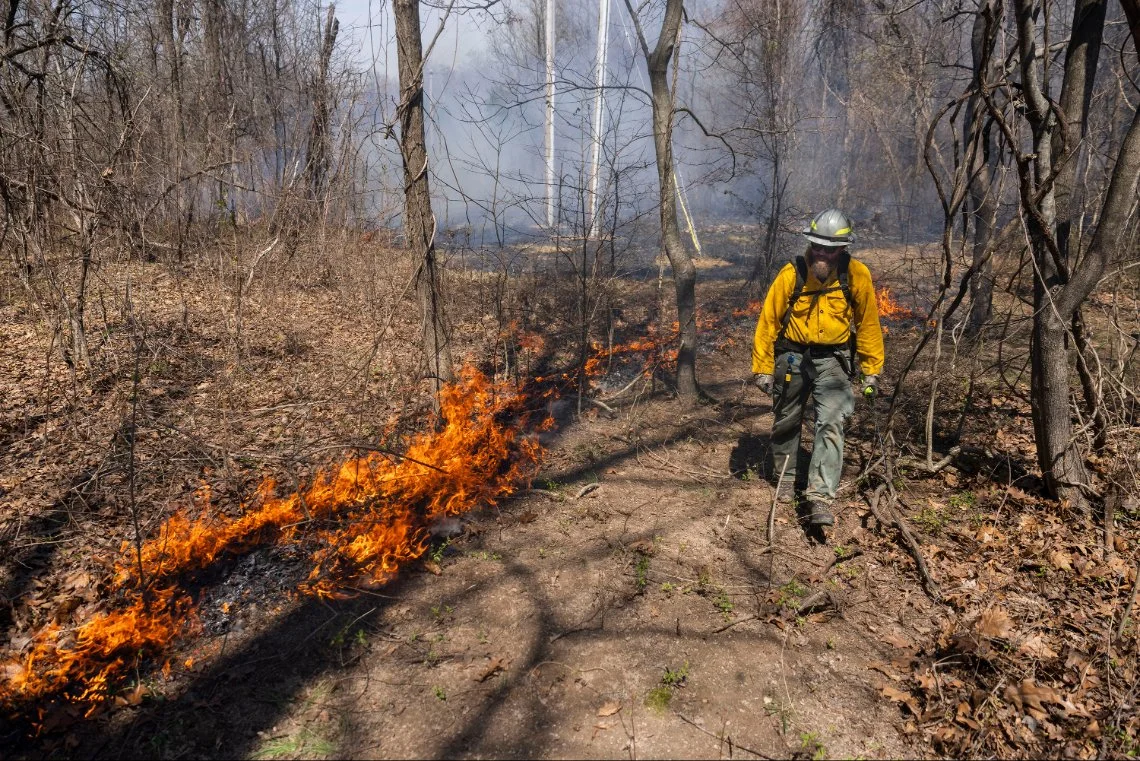

 Nathan Speagle walks along the edge of a burn unit as he and other members of The Nature Conservancy’s Illinois Chapter control burn portions of the Shawnee March 25, 2026, in Makanda, Illinois. (Lylee Gibbs for the Saluki Local Reporting Lab)

As early voting begins, officials seek to reassure public about election security, integrity

Mail balloting goes forward as normal after Trump’s failed attempt to federalize the process

By PETER HANCOCK
Capitol News Illinois
phancock@capitolnewsillinois.com

Article Summary

  • At a local forum, Sangamon County Clerk Don Gray and State Board of Elections spokesman Matt Dietrich explained how safeguards in the voting process ensure a fair and accurate outcome.

  • Voting by mail has been growing steadily in popularity in recent years and could account for as much as a third of the total vote in this year’s elections.

  • Illinois and other states have been involved in multiple lawsuits with the Trump administration over access to the state’s voter registration data and control over mail-in voting. So far, the states have prevailed in those lawsuits.

This summary was prepared by the reporters and editors who worked on the story.

SPRINGFIELD — With early in-person and mail-in voting now underway in Illinois, state and local election officials insisted Friday that the state’s voting system is being run fairly and accurately.

Sangamon County Clerk Don Gray and Illinois State Board of Elections spokesman Matt Dietrich told a Springfield audience not to buy into false reports that the system is vulnerable to widespread fraud or that voter rolls can be hacked or manipulated.

“We can't allow that disinformation to permeate our systems here, or that form of terrorism to erode our greatest beacon of what we do — electing our leaders,” Gray said. “I encourage all of you to get involved. Become an election judge. See what it is that we do. See how we operate.”

Gray and Dietrich were the featured speakers at a forum sponsored by the Citizens Club of Springfield. It was billed as an effort to address concerns that have been raised in recent years about the integrity and security of elections in the United States.

Much of the recent criticism of the electoral process has come directly from the White House where President Donald Trump has tried to exert more federal control over elections, particularly mail-in voting.

Federal lawsuits

For more than a year, Illinois and at least 29 other states have been embroiled in litigation over the Trump administration’s efforts to gain access to the states’ complete, unredacted voter registration databases that include sensitive personal information such as dates of birth, driver’s license numbers and partial Social Security numbers.

The Trump administration has said it needs the data to determine whether states are properly maintaining their voter rolls, including purging the rolls of non-U.S. citizens and other people ineligible to vote. But Illinois has argued the administration has no statutory authority to demand the data while state law prohibits election officials from releasing it.

“We've won at the trial court level,” Dietrich said, referring to a July 31 federal court ruling. “But those cases are going on. There are still five more that are out there. So far, the states have prevailed in 25 of those cases. That's going to go on for a while. I foresee that that will end up at some point before the Supreme Court.”

Illinois was also part of a successful multistate lawsuit to block the administration’s attempt to put the U.S. Postal Service in charge of regulating the pickup and delivery of mail ballots.

Because the U.S. Supreme Court ruled in the states’ favor in that case, Gray said local election authorities throughout Illinois were able to mail out ballots to people who had requested them on Thursday, the official start of early voting in Illinois.

“If the guidelines were upheld, we'd have to reprint all our envelopes,” he said. “It would take weeks for us to do that. They'd have to restuff all of the materials to get them in. So the timing was terrible for us to do this.”

Election safeguards

Despite Trump’s attempts to cast doubt over vote-by-mail systems, Gray said mail balloting has been growing “by leaps and bounds” in recent years and predicted that mail-in votes could account for as much as one-third of all votes cast in the Nov. 3 election.

Gray and Dietrich also tried to put to rest concerns that the state does not properly check the identity of people registering to vote.

Gray said Illinois provides multiple ways for people to register. Many people do it when applying for or renewing their driver’s license or state identification card, but they can also do it through an online portal on the State Board of Elections’ website or by filling out a paper form that can be delivered to their local election office.

Illinois requires applicants to show two forms of identification, at least one of which must show their current home address. That can include a driver’s license, state ID card, bank statement, a residence contract or lease, or a utility bill. The application also asks for the last four digits of the person’s Social Security number and their date of birth.

No matter how a person submits their application, Gray said, it eventually gets sent to the local election authority where officials verify all the information provided.

“When it comes back to the election authority, we look up those driver's licenses into a portal of secretary of state to ensure it's active, it's legitimate, it's the person that's presenting themselves and at the address that they request,” he said. “We also do the same with the last four digits of your Social Security number with the Social Security Administration. So we're doing a lot of upfront vetting all the time through those means to ensure that you are who you are.”

And while Illinois does not require voters to show identification at the polls to cast a ballot, Gray and Dietrich said it would be extremely difficult for anyone to vote under someone else’s name.

“You would have to know the voter's name and address for one,” Dietrich said. “You'd also have to have a pretty good idea of what their signature is. But if impersonation was happening at any volume, even if it was just a few dozen, eventually the real voter is going to show up in their polling place and try to get their ballot. The election judge will say, ‘Well, you already voted. We have this here,’ and the legitimate voter is going to say, ‘Well, I didn't vote.’ That's going to start an investigation.”

Dietrich also discussed cybersecurity measures that have been put in place since a highly-publicized attempt in 2016 by Russian agents to hack into the state’s voter registration database as part of a broader attempt to interfere in that year’s U.S. elections.

In response, he said, Illinois used a $13 million federal grant and state matching funds to hire “cyber navigators” who were deployed across the state to train local election authorities on cyber security.

“Probably the biggest thing that they did in that first year was they put all 108 local election authorities onto the Illinois Century Network, which is the state of Illinois' private internet that state government uses to send data within an intra-agency communication,” Dietrich said. “So your voter data is never being put onto the public internet to come to us.”

More information about how to vote by mail or cast an early in-person ballot is available from the State Board of Elections or local election authorities.

Capitol News Illinois is a nonprofit, nonpartisan news service that distributes state government coverage to hundreds of news outlets statewide. It is funded primarily by the Illinois Press Foundation and the Robert R. McCormick Foundation.  

Kent Redfield, left, a political science professor at the University of Illinois Springfield, moderates a discussion about election security and integrity Friday, Sept. 25, with Illinois State Board of Elections spokesman Matt Dietrich, center, and Sangamon County Clerk Don Gray. (Capitol News Illinois photo by Peter Hancock)

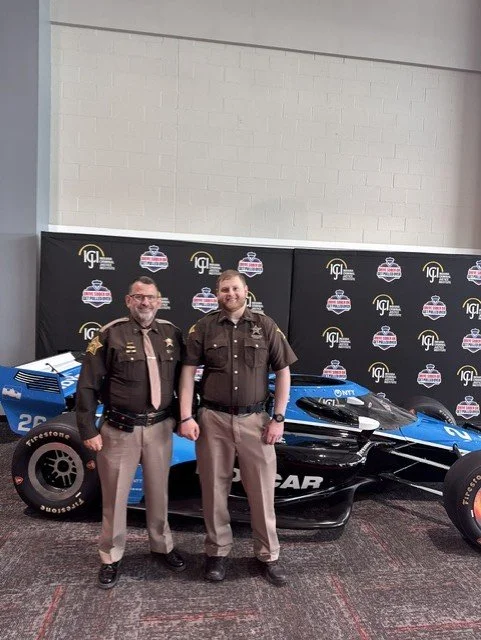
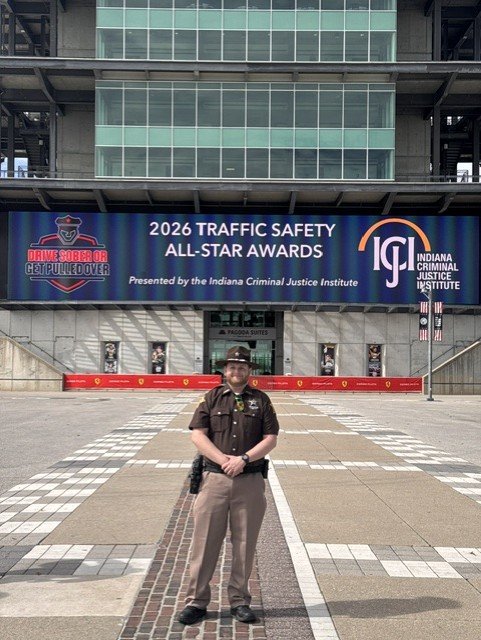
Bates awarded ICJI 2026 Traffic All-Stars award

On September 25, 2026, The Indiana Criminal Justice Institute hosted the 2026-Traffic Safety All-Stars Awards Ceremony at the Gallagher Pavilion at the Indianapolis Motor Speedway. This event was held for officers across the state who have excelled in removing impaired drivers from Hoosier roadways. Gibson County Deputy Michael Bates was recognized at the presentation and catered lunch for having over 25 DUI arrests in 2025.

Deputy Bates, a Gibson County native, was hired as a Corrections Officer in 2021 and was later hired as a Merit Deputy in 2023. Deputy Bates is a certified Standard Field Sobriety Test Instructor, and a certified Drug Recognition Expert. These certifications have enabled him to remove not only 25 impaired drivers last year, but 20 more this year!

If you combine all the all star award recipients OWI arrests together for last year 4,300 impaired drivers were taken off Indiana roadways!

Arkansas man arrested on drug charges

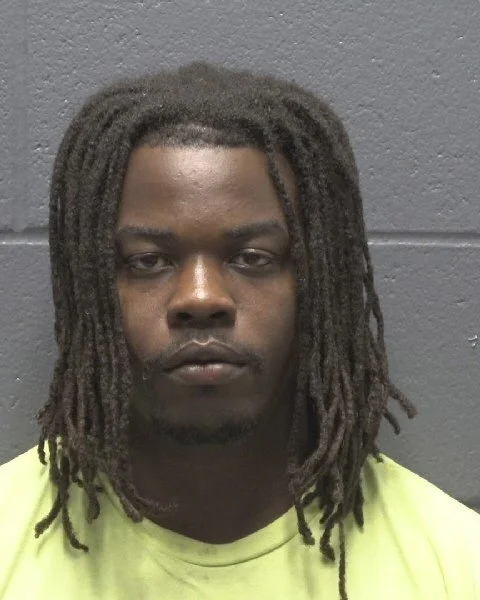
On September 24, 2026, at 12:31 p.m. Gibson County Deputy U.B. Smith conducted a traffic stop on a White 2000 International Truck at Walmart after observing the vehicle disregard a stop light on US 41 and County Road 100 North.  Upon stopping the vehicle Deputy Smith identified the driver as 24-year-old Kentarian Williams of Ashtown, Arkansas.  During the interaction Deputy Smith detected the odor of raw Marijuana coming from inside the vehicle and began a roadside drug investigation.  At the conclusion of the investigation Mr. Williams was taken into custody and transported to the Gibson County Detention Center where he was charged with Possession of Cocaine and Possession of Marijuana.  Mr. Williams was also issued citations for Disregarding a Traffic Control Device, Operating a Commercial Vehicle without a CDL, and Driving While Suspended. 
 
Deputies Jennifer Loesch, Bryan Small, and Aubrey McNeely assisted Deputy Smith in his investigation. 
 
All criminal defendants are to be presumed innocent until and unless proven guilty beyond a reasonable doubt in a court of law.