Illinois’ 8 interstate visitor information centers to close at month’s end

The state says the centers’ role has evolved over time as travelers’ needs change

By MAGGIE DOUGHERTY
Capitol News Illinois
mdougherty@capitolnewsillinois.com 

Article Summary 

  • The eight state-run visitor information centers located along interstates throughout Illinois are set to close by the end of September, as the state says the way visitors travel has changed.

  • The rest stops where the centers are located will remain open and other services will not be affected.

  • The centers offered valuable information, and former employees consider it a loss. 

This summary was written by the reporters and editors who worked on this story. 

(This story was updated to add details about job losses provided by the state after publication.)

CHICAGO — Illinois’ eight state-run visitor information centers, located within rest areas at interstates around the state, will be closing by the end of the month.

“The role of the State’s visitor information centers has evolved significantly over the past couple of decades as the ways visitors plan and access travel information have changed,” the Illinois Department of Commerce and Economic Opportunity told Capitol News Illinois in a statement. “For example, the centers used to provided services such as booking hotel rooms for tourists, while that is no longer a need of many travelers.”

The closures were independent of financial pressures, according to the agency. Operating the centers cost the state approximately $1.6 million per year.

The rest areas where the centers are located will continue operating, and other services will be uninterrupted, the department added. The closures do not extend to independently operated visitor information centers by local governments or tourism organizations.

The state did not publicly announce the news but confirmed the closures to Capitol News Illinois when asked for comment.


FLOURISH MAP HERE

The 20 employees who staffed the centers were all employed through third parties, not directly by the state. Those roles included a mix of full-time and part-time positions.

Nancy Bauer used to work at the Homestead visitor information center in Hamel, where she and her colleagues would greet visitors as they came through the doors, offering them brochures and magazines. But more importantly, she said they could give advice about where to stop.

She considers the closures a loss, especially for older adults.

“They’re alienating the older adults because they want everyone to go towards looking everything up online, and that’s fine to a point,” Bauer said. They had a computerized touch screen map with information available, too, she said.

“That helped, but it wouldn't tell you why should you go to this restaurant and why should you go see this, and that’s when you needed someone there,” Bauer said.

260922 WELCOME CENTERS DESK MD.jpg

Her colleagues could point visitors to the best restaurant two hours away, Bauer added. They would also educate travelers about historic events, like the state’s celebration of the 100th anniversary of Route 66.

Read more: ‘More than just a road’: Illinois communities celebrate Route 66’s centennial

Bauer, 62, majored in tourism. She worked at the Homestead center on Interstate 55 for around a year and a half before she had to stop working because of worsening symptoms of Parkinson’s disease.

She said she didn’t understand why the state was closing the centers, which she felt  helped many travelers — especially after the state has recently broken its own records for visitor tourism.

Tourism generated over $88 billion in economic impact for Illinois last year, with 115 million visitors spending over $50 billion.

“Why get rid of something that's not only helping the consumer, but helping to bring money into your state?”

Capitol News Illinois is a nonprofit, nonpartisan news service that distributes state government coverage to hundreds of news outlets statewide. It is funded primarily by the Illinois Press Foundation and the Robert R. McCormick Foundation. 


Proposed Changes To MCHS Valedictorian and Salutatorian Requirements Explained

Mt. Carmel High School could change how its valedictorian and salutatorian are selected beginning with the Class of 2031.

Principal Amy Duckworth presented a proposed policy during Monday evening’s Wabash Community Unit School District 348 Board meeting.

The proposal follows the Class of 2026 graduating with eight valedictorians under the current policy. The honor is presently awarded to every student who completes the required curriculum and maintains straight A’s throughout high school.

Duckworth said a committee of parents, staff members, a board member and Superintendent Dr. Steve Bleier developed the proposed revisions.

Students would continue to meet the existing academic requirements, including specified coursework in English, mathematics, laboratory sciences and either foreign language, music, art or vocational studies.

Under the proposal, students beginning with the Class of 2031 would also be required to start their high school mathematics sequence with geometry. Students beginning below geometry would not be eligible for valedictorian or salutatorian consideration.

Eligible students would then be ranked according to the cumulative grade percentage earned in every course appearing on their official transcripts from freshman through senior year.

Percentages would initially be calculated to the hundredth of a percentage point. If a tie occurs, calculations would be extended to the thousandth. Co-valedictorians would be recognized only if an exact tie remained.

The student with the next-highest cumulative percentage would be named salutatorian.

The proposal would also require the selected valedictorian and salutatorian to deliver speeches during the MCHS commencement ceremony.

The board did not take final action on the proposed policy Monday night.

MCHS Principal Amy Duckworth makes presentation to District #348 school board Monday night.,

MCHS Homecoming Weekend Is Here!

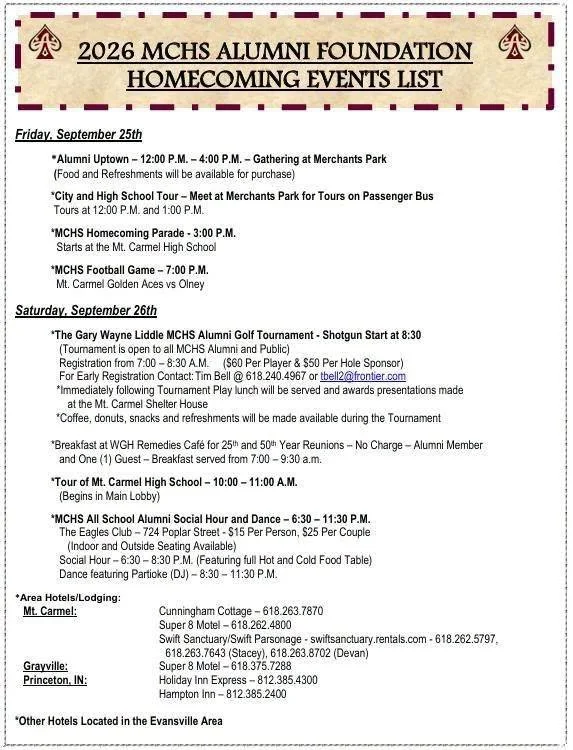
Mt. Carmel High School’s 2026 Homecoming festivities begin today, with a full weekend of activities planned for alumni, students and the community.

MCHS Alumni Foundation members Amy Pettyjohn and Nathan Brines recently joined the WSJD Morning Show to discuss the schedule.

The Alumni Uptown Gathering will run from noon until 4 p.m. today at Merchants Park. Food trucks will be available, and Mayor Joe Judge will lead city bus tours at noon and 1 p.m. The tours will highlight recent improvements around Mt. Carmel and discuss future projects.

The Homecoming Parade leaves Mt. Carmel High School at 3 p.m.

Tonight, the undefeated Golden Aces host Olney at Riverview Stadium. Kickoff is scheduled for 7 p.m., with the 2026 Homecoming Queen crowned during halftime.

Saturday begins with the 15th annual Gary Wayne Liddle MCHS Alumni Foundation Four-Man Golf Scramble. Registration starts at 7 a.m., followed by an 8:30 shotgun start. The entry fee is $60 per player.

A free breakfast will be held at Wabash General Hospital for this year’s 25th- and 50th-anniversary classes. A tour of Mt. Carmel High School begins at 10 a.m. in the main lobby.

The weekend concludes with the all-school alumni social hour and dance Saturday night at the Mt. Carmel Eagles. The social hour, featuring food and a cash bar, runs from 6:30 until 8:30. A DJ will play from 8:30 until 11:30.

Admission is $15 per person or $25 per couple. The event is open to alumni, spouses and other community members who would like to reconnect with friends.

A free concert will bring the sounds of Southern rock to uptown Mt. Carmel Saturday night as part of Homecoming Weekend.

Market Street MTC’s Summer Concert Series continues with LynSkynyrd, a Chicago-area Lynyrd Skynyrd tribute band.

The concert will run from 7 until 9 p.m. at Merchants Park and is free to attend.

Market Street MTC organizer Mike Harris recently joined the WSJD Morning Show and said Homecoming Weekend concerts traditionally attract strong crowds, including many former residents returning to Mt. Carmel.

Food and refreshments will be available from several vendors. Kolb’s Culinary Cuisine will provide food, while Liberty Noble will offer Freedom Cookies and other baked goods. The Snow Shack will also be set up during the concert.

Those attending are encouraged to bring lawn chairs. Golf carts may also park around the perimeter of the concert area.

Saturday’s performance will be the next-to-last concert of the 2026 series. The season concludes October 10th with a Doobie Brothers tribute band, also performing from 7 until 9 p.m.

Again, LynSkynyrd performs Saturday night from 7 until 9 at Merchants Park in downtown Mt. Carmel. Admission is free.

Hunters Feeding Illinois Returns for Second Year

ALBION, Ill. – University of Illinois Extension serving Edwards, Lawrence, Richland, Wabash, and Wayne counties is kicking off the return of the local Hunters Feeding Illinois program with the start of archery deer season on Oct. 1.

 Hunters Feeding Illinois provides local food pantries with ground venison from hunters who've donated their legally harvested deer. Locally, the program is facilitated by Illinois Extension in partnership with Feeding Illinois to support food security in Illinois communities. In its inaugural year, the five-county unit’s program received 83 deer donations, yielding 2,698 pounds of venison for five food pantries within the Feeding Illinois food bank network in Lawrence, Richland, and Wabash counties.

 The capacity to accept deer donations for the 2026-2027 program depends on financial contributions to cover deer processing costs. Since every donation is matched by Feeding Illinois, a $50 donation will process one deer. Donations are now being accepted via check at local Extension offices or online at donorbox.org/hunters-feeding-illinois. Donors are encouraged to include Edwards, Lawrence, Richland, Wabash, or Wayne County on the memo line of a check, or in the comment box online, to ensure funds are applied to the local program.

 Deer hunters interested in donating a deer are asked to field-dress their whole, legally harvested deer, then contact one of the program’s participating processors to confirm donations are still being accepted. This season, Charlie’s Deer Processing and Smokehouse in Bridgeport (618-945-3100) and Legacy Meats in Sumner (618-936-4072) have partnered with Illinois Extension to process deer donations locally.

 To learn more about Hunters Feeding Illinois, visit go.illinois.edu/HuntersFeedingIllinois. For questions about the local program, contact the Edwards County Extension Office at 618-445-2934.

Wabash County Clerk's Office Preparing for Early Voting and 2027 Consolidated Election

The Wabash County Clerk’s Office is preparing for the start of early voting while also looking ahead to next spring’s Consolidated Election.

County Clerk Janet Will told the Wabash County Board Monday afternoon that today (Thursday, September 24th), is the first day for early voting for the November General Election.

Will said the office is waiting for ballots to arrive. In addition to in-person early voting, ballots will be mailed to voters who have requested a regular vote-by-mail ballot or are enrolled in permanent vote-by-mail.

The Clerk’s Office is also preparing for the April 6th, 2027 Consolidated Election. Will said petitions are currently being circulated for positions with cities, villages, school districts, college trustees and regional boards of school trustees. The filing period is November 16th through November 23rd.

Will also discussed the state-required notices concerning permanent vote-by-mail. She said the county is preparing to mail more than 6,000 letters to registered voters who have not responded to the notices during the previous two mailings.

Will said voters who do not want to receive a permanent vote-by-mail ballot can indicate that on the letter and return it to the Clerk’s Office. Once they opt out, they will no longer receive the notice in future election cycles.

Will encouraged residents who don't want to participate in permanent vote-by-mail to return the form, noting the county spends a significant amount of money every two years mailing thousands of notices while receiving relatively few responses.

Jones and Wrosch File Federal Civil Rights Lawsuits Following Mt. Carmel Arrests

Two Michigan men whose criminal charges were dismissed last month have now filed separate federal civil rights lawsuits stemming from their 2024 arrests in downtown Mt. Carmel.

Steven Jones and Matthew Wrosch filed their lawsuits Tuesday in U.S. District Court for the Southern District of Illinois, Benton Division. Both suits name former Mt. Carmel Police Sergeant Jared Price and former Officer Ashton Walker individually, Former Police Chief Michael McWilliams in his official capacity, and the City of Mt. Carmel as defendants.

Jones’ complaint says the case arises from his detention and arrest while he and Wrosch were recording from public sidewalks in downtown Mt. Carmel on September 25th, 2024. Jones alleges violations of his First and Fourth Amendment rights and brings claims involving unreasonable detention and false arrest, First Amendment retaliation, failure to intervene and municipal liability.

According to Jones’ lawsuit, officers had reviewed information before the encounter concerning people who record public officials, but had determined Jones and Wrosch were not the people depicted in a safety-email video. Jones alleges officers nevertheless detained and arrested him without individualized reasonable suspicion or probable cause.

Jones also alleges his recording from public sidewalks was constitutionally protected activity and that his detention, handcuffing and arrest were retaliation for that activity. His lawsuit further claims the City of Mt. Carmel failed to provide adequate training and supervision concerning public recording and First Amendment activity.

Wrosch’s separate lawsuit makes similar allegations involving his detention and arrest during the same incident and also claims violations of his First and Fourth Amendment rights.

Both men are seeking compensatory and punitive damages, costs and other relief. They are also asking for eligible records associated with their arrests to be expunged, destroyed or sealed and for the city to review and update police department First Amendment policies and training. Both have demanded jury trials.

The allegations are contained in civil complaints and have not been proven in court.

The lawsuits come about a month after the criminal cases against Jones and Wrosch were dismissed in Wabash County Circuit Court.

Both men had faced a Class 4 felony charge of making a false alarm or complaint to 911, along with misdemeanor charges of filing a false report to a public safety agency and disorderly conduct. They had pleaded not guilty and were scheduled for jury trials in September.

In August, prosecutors filed motions to nolle prosequi the cases, and Judge Denton Aud granted those motions, ending the prosecutions before trial.

Jones and Wrosch operate YouTube channels with thousands of followers and describe themselves as First Amendment or constitutional auditors.

Public Hearing Set for Revised RWE Solar Farm Application

A public hearing has been scheduled for a revised solar farm application from RWE in Wabash County.

Wabash County Commissioners received an update on the project during their meeting Monday afternoon. County officials said Bellwether reviewed RWE’s amended application and determined it meets state guidelines and the requirements of the county’s solar ordinance.

Commissioners said the primary change involves relocating some of the acreage included in the project. The change became necessary because property originally leased for the development had been associated with coal mining operations and had not yet received the necessary reclamation bond release.

Officials said RWE has now completed the revised application requirements.

The county will hold a public hearing and special meeting on the application Wednesday, October 7th. That will follow the commissioners’ regular meeting earlier that week on Monday.

Commissioners indicated that because the revised application has met the applicable requirements, the project can now move forward to the public hearing stage.

Republican-turned-independent Collin Corbett hopes to provide voters an alternative for governor

He differs from his former party on support for service tax, criticism of Trump 

By BEN SZALINSKI
& BRENDEN MOORE
Capitol News Illinois
news@capitolnewsillinois.com

Article Summary

  • Former Republican strategist Collin Corbett is running as an independent for governor, hoping enough people will be dissatisfied with the two-party system.

  • Corbett supports social issues that align with many Democrats while describing himself as fiscally conservative but also supporting a service tax. 

  • Facing minimal funding and concentrating more on private fundraisers than large gatherings, he says he’d be happy to get 15% of the vote. 

This summary was written by the reporters and editors who worked on this story.

SPRINGFIELD — Collin Corbett has spent enough time in politics to know he’s a longshot to pull off a victory as an independent candidate for governor.

“I'm going to push as hard as I can before Nov. 3,” Corbett said in an interview with Capitol News Illinois. “But I'm a political strategist. I can do math. I'm aware of how this will likely turn out at the end of this election.”

But the former Republican strategist said it’s more of a long game.  

“I'm 40 years old. I got a long runway ahead, and there's a ton of people who've been coming up to me saying, 'I don't know if I can vote for you in this election, but I'm all in for your larger goal of building an independent majority,’” he said. “’So Nov. 4, I'm in, let's go.’”

Corbett said his campaign is about proving there is an appetite for independent, centrist candidates in Illinois as voters weigh their options between staunch Democratic Gov. JB Pritzker and Trump-endorsed Republican Darren Bailey. 

Corbett last worked for Republicans in the March primary season, including for Don Tracy, the party’s former chair and current nominee for U.S. Senate. But he is taking a hiatus from advising campaigns to mount his own bid for governor. 

Independent candidates face a greater challenge to make it on the ballot and often get just a few percentage points of the vote. Corbett said 15% would be enough to make a point and position himself or another candidate to try again in 2030. 

Though he’s long been an insider in the nation’s two-party system, he’s now changing his tune.

“We've got to start changing things now because the path we're on — with these two parties that only seem to offer extremes, and they just want to snipe at each other and attack each other instead of actually getting things done — it's not working for me,” Corbett said.

Independent traits

Corbett said he’s skipped the presidential question on the ballot in the last three general elections and supported John Kasich and Nikki Haley in the 2016 and 2024 primaries respectively — two Republicans who are more often identified as traditional members of the party, separate from Trump’s wing. 

Among Illinois political role models, Corbett views himself as “a blending” of late former Gov. Jim Edgar and former Sen. Mark Kirk, who were among the socially moderate, fiscally conservative Republicans who once dominated the state party. 

“There are really good people on both sides,” Corbett said. “It’s just this tribalism where my side is good and your side is evil. That’s the thing that’s ruined our politics.”

Corbett, an experienced pollster, said he believes the average Illinois voter is center-right on fiscal policy, but center-left on social issues, “which is exactly where I’ve always been.”

He said he supports marriage equality, abortion rights and more gun control measures. Corbett said Democratic voters “could feel pretty comfortable with where I’m at” on all social issues. 

He said he believes in a more conservative fiscal approach but differed from Republicans by supporting a tax on services.

He called the state’s reliance on sales taxes — citing items such as diapers, formula and groceries — “regressive.” 


“If we can shift that to services, especially higher-end services, and get it out of the basics, you can not only raise more revenue for the state, which then can use it to lower property taxes, but you can also help those working families in Illinois who are struggling right now,” he said.  

Corbett, the father of a two-year old son with another child on the way, praised Pritzker’s focus on early childhood education. 

But he said overall that this year’s candidates have spent more time focusing on things happening outside Illinois.

“It seems like both of the major-party candidates are obsessed with Trump and with federal policies,” Corbett said, adding he thinks Pritzker’s constant fights with Trump are causing Illinois to lose federal funding. 

Plans for office

Corbett contrasts his positions to those of Bailey, who has called for abolishing the Illinois Tollway, instituting a 1% property tax cap and using a DOGE-style method to root out wasteful spending in state government.

“I wish I had whatever magic beans Darren Bailey is growing on his farm, but unfortunately, I have to live in reality, and in reality, we’ve got to fund our roads, we’ve got to fund our schools, we’ve got to fund our police and fire,” Corbett said. 

Corbett also called for diversifying funding for road construction and said the motor fuel tax won’t be sustainable as more electric vehicles join the roads. He said the state should levy a mileage-based tax instead.

On ethics reform, he said the legislative inspector general should be empowered to subpoena and to release its own reports. But more broadly, Corbett said there should be an independent ethics oversight commission that covers all state government, from state workers to elected officials. 

One of the biggest issues in state government also hits close to home for the Palatine resident: incentivizing the Bears to build a stadium in Arlington Heights. Corbett got married at the former Arlington Park horse racing track and said he wants the land to be used for something that benefits the public and doesn’t just become another complex of condos that are already prolific throughout northwest Cook County. 

Corbett said if he was governor, he would commission a study to determine how the Arlington Heights site would compare to the Hammond site in terms of economic benefit. He said a study like that would be key to convincing skeptical Chicago lawmakers to get on board. 

“That study’s never been done because we don’t have a governor who’s actually leading on finding consensus on this issue,” he said. 

Inside the campaign

Corbett is running with Carolyn Schofield, a former Republican McHenry County Board member who is president of the county’s mental health board and is also a member of the Chicago Metropolitan Agency for Planning. Until April this year, she was a legislative director for the Illinois Senate Republicans. Schofield also ran for lieutenant governor in 2022 alongside former Republican Sen. Paul Schimpf. 

When Corbett filed to run in May, he said he expected strong support from donors and some noteworthy endorsements. 

“You’re going to start to see a lot of positive developments on our fundraising,” he said then. “It’s not going to be too long before we pass the Republican candidate on fundraising.”

That hasn’t happened. 

He loaned his campaign $500,000 and had more cash on hand than Bailey on July 1. But Bailey has spent more money and reports a steady stream of donors, indicating some level of grassroots support for his campaign. 

Corbett has reported just four contributions over $1,000 since July, while Pritzker has dumped more than $90 million into his campaign. Corbett acknowledged that shortcoming and said he hears from many people who would support him, but not in this year’s election. He said some donors also don’t want to be the first to contribute and that’s holding up others. 

He also said he didn’t intend to be the candidate.

“We went out actively recruiting somebody who could lead this independent movement in Illinois and we had really good people lined up who had way, way bigger names,” Corbett said. “And unfortunately, for financial reasons and personal reasons, they couldn't do it towards the end.”

His campaign’s public presence has also been limited. Corbett said he’s holding private meetings with voters and will hold town halls soon. But much of his public campaigning to this point has been limited to news releases and social media posts. 

He said that’s by design, as his campaign is “actively targeting” disaffected voters and people who are frustrated by politics.

While his campaign likely poses a greater threat to Bailey’s than to Pritzker’s, his opponents aren’t acknowledging him. Corbett said that makes sense because any criticism would only raise his profile. 

Asked last month at the State Fair if Corbett’s campaign poses a threat, Bailey replied, “Who?”

“I think it's actually just a business model to prove that you know, ‘Hey, you pay me enough money, I can get you on a ballot in the future,’” Illinois Republican Party Chair Bob Grogan told reporters in August.

Independent history

While independent candidates have found electoral viability in states like Maine and Nebraska, history is not on Corbett’s side in Illinois. For one, the state’s two established political parties have long wielded what’s effectively a duopoly in the political arena.

This has its roots in the state’s "We don't want nobody nobody sent" political culture in which party machines — Democratic in Cook County and Republican much of downstate — dominated state and local government.  

Vestiges remain, such as the state law that requires Democratic and Republican candidates for statewide office to collect only 5,000 signatures to obtain ballot access. Independents and third-party candidates, on the other hand, must obtain 25,000. 

Third parties can become established political parties if their candidate wins at least 5% in the preceding election. In the past century, this has only happened twice.

First in 1986, when Democrat Adlai Stevenson III won 40% running on the Solidarity Party line — a move to avoid running on a ticket with Democratic lieutenant gubernatorial nominee Mark Fairchild, a follower of conspiracy theorist Lyndon LaRouche. And then in 2006, when Green Party nominee Rich Whitney secured 10%. Neither candidate won, and the parties were unable to maintain their established status following the next election.

The last true independent on the ballot for governor was Scott Lee Cohen in 2010. He won 135,705 votes, about 3.64% of the statewide share, despite having withdrawn as the Democratic Party’s lieutenant governor nominee earlier that year amid domestic violence allegations. In 2002, independent Marisellis Brown received 23,089 votes, or 0.65%. And in 1932, independent W.W. O'Brien got 1,182 votes, or 0.03%.

Despite this history, Corbett believes he has a lane that’s reliant on convincing independents and moderates that an independent candidate is viable. 

He said he expects his election night margins to “surprise people what kind of strength is out there for a centrist mainstream type of movement.”   

“I know on election night the number is going to be higher than frankly anybody expects it to be,” Corbett said. “Does that mean it's going to be enough to win the race? We'll find out.” 

Capitol News Illinois is a nonprofit, nonpartisan news service that distributes state government coverage to hundreds of news outlets statewide. It is funded primarily by the Illinois Press Foundation and the Robert R. McCormick Foundation.

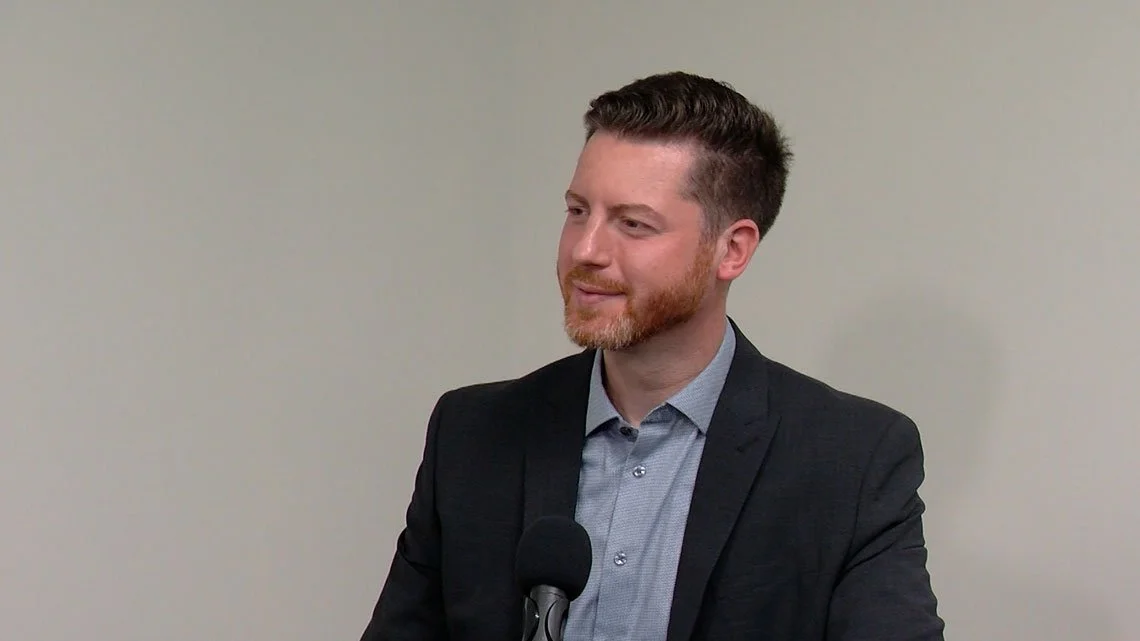
Collin Corbett, independent candidate for governor, sits for an interview in the Capitol News Illinois recording studio. (Capitol News Illinois photo by Andrew Campbell)


Francisco man arrested for pointing firearm at Deputy

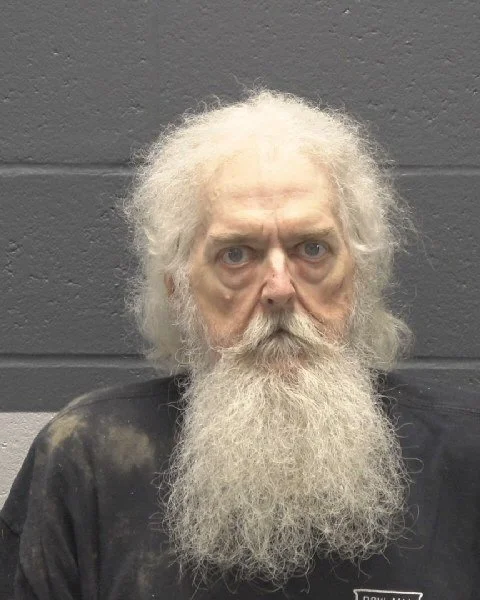
On September 18, 2026, at 2:31 p.m. Gibson County Deputy Quinten Might was dispatched to a residence in the 7000 block of East 500 South near Francisco to speak with an individual who was upset because his dog had been run over by a passing vehicle.  Upon arriving Deputy Might spoke with the caller, 69-year-old Timothy Peavler.  During the conversation Mr. Peavler made a threat to shoot vehicles speeding down his roadway.  At that point for his safety, Deputy Might asked Mr. Peavler if he had a firearm on him at the time.  Mr. Peavler pulled a pistol out of his waistline and pointed it at the officer.  Deputy Might quickly disarmed the man and attempted to place him in investigative custody.  While placing handcuffs on Mr. Peavler he began to resist and was taken to the ground.  After refusing treatment on scene by a Gibson County Medic Mr. Peavler was transported to Deaconess Gibson for medical clearance.  Ultimately, he was transported to the Gibson County Detention Center where he was charged with Pointing a Firearm at another person and Resisting Law Enforcement.
 
Sgt. Roger Ballard, Detective Jennifer Loesch, Deputy Bart Wagner, Deputy Aubrey McNeely, and Deputy Michael Owens assisted in this investigation. 
 
All criminal defendants are to be presumed innocent until and unless proven guilty beyond a reasonable doubt in a court of law.

Importance Of Building Permits Stressed

Mt. Carmel Code Enforcement Officer Heath Reed is reminding residents about the importance of obtaining a building permit before beginning construction.

Reed addressed the issue during last Monday’s City Council meeting after commissioners approved a property subdivision and setback variance involving two homes in the 1100 block of North Mulberry Street.

A garage built by a previous owner crossed the boundary between the two properties, requiring the current owner to seek city approval to adjust the property line and reduce the setback.

Reed said the city issued two building permits during the past two weeks, with both permits involving the construction of garages. He noted that neither garage will be built on a property line.

Reed said the permitting process is designed to identify potential zoning and boundary problems before construction begins.

He said obtaining a permit is an easy process that can prevent property owners from facing the additional time, expense and legal complications required to correct a problem later.