Meeting is Monday at 4pm.
Lions Club Reveal Upgrades To Froman Park
The Mt. Carmel Lions Club has received approval from the Wabash County Board to move forward with a multi-phase improvement project at Froman Park.
Lions Club representatives appeared before the board requesting permission to begin a re-beautification effort, starting with addressing long-standing drainage and roadway issues near the ballpark. The group said funding is already in place to complete the initial drainage work, which has made portions of the park road difficult to travel.
The Lions Club said the drainage improvements are the first step in a larger vision for the park that could eventually include a disc golf course. The goal, they said, is to bring more positive activity to the park, increase community use, and reduce ongoing maintenance problems.
Plans also discussed include landscaping and beautification efforts, potential use of mulch around trees and the lake to reduce mowing, and future conservation projects such as native plantings and wildflowers. Club members said these improvements could create new spaces for community gatherings, photos, and events.
The County Board thanked the Lions Club for taking the initiative and unanimously approved a motion allowing the group to proceed with the first phase of the project. The Lions Club will provide the county with project details before work begins, with additional phases to be reviewed as plans develop.
Photo Credit: Wabash County Chamber of Commerce
Sean Grayson receives maximum sentence for murder of Sonya Massey
Former Sangamon County deputy was convicted of second-degree murder
Editor’s note: This story was originally published by the Illinois Times and republished with permission.
By DEAN OLSEN
Illinois Times
A Sangamon County judge on Thursday gave former Sangamon County Sheriff’s Deputy Sean Grayson the maximum sentence — 20 years in prison — for the July 2024 murder of Sonya Massey, culminating a nationally publicized case that led to ongoing discussions and action locally to bridge racial divides.
A cheer went up in the courtroom and Donna Massey, Sonya’s mother, said, “Thank you God, thank you God,” as the hearing concluded.
But after the decision by Circuit Judge Ryan Cadagin, Sean Grayson could end up serving less than half of that time in prison. That’s because a Peoria County jury on Oct. 29 found the 31-year-old Riverton resident, originally charged with first-degree murder after the shooting death of Massey, 36, in her Woodside Township home, guilty of the lesser offense of second-degree murder.
Grayson, who is white, killed Massey, a Black, unarmed single mother of two teenagers, in a rapidly progressing confrontation over Grayson’s fear that Massey would harm him with a pot of hot water from the stove of her kitchen.
Grayson’s profanity-laced comments toward Massey, her soft-spoken yet firm comment, “I rebuke you in the name of Jesus,” and Grayson’s fatal shot to Massey’s head were all captured on police-worn body camera video footage of the exchange. The footage went viral on the internet and was played to the jury at trial.
Grayson would have been ensured a prison sentence of 45 years to life if convicted of first-degree murder because of enhancements related to the use of a gun and state law requiring that defendants serve 100% of a sentence for certain crimes.
The jury decided that Grayson’s actions met the legal standard for first-degree murder but that his belief he was acting in self-defense — even though that belief was unreasonable — was a mitigating factor justifying a finding of second-degree murder.
With time already served behind bars and because the second-degree charge allows the sentence to be reduced by half for good behavior, Grayson could be released in about 8½ years.
The jury decided that Grayson, who was dispatched to Massey’s home after she called 911 when she suspected a prowler in the neighborhood, shot Massey, who had been dealing with chronic mental illnesses, under the misguided belief that he needed to act in self-defense.
Cadagin denied Grayson’s request for a new trial after Grayson’s lawyers, Dan Fultz and Mark Wykoff, argued, among other things, that the judge erred in allowing the jury of nine women and three men to hear Grayson’s disparaging remarks about Massey after the shooting.
Massey’s death, and the ensuing protests in Springfield and in other cities, led to the formation locally of the Massey Commission.
The citizen group recently finalized a range of recommendations for improving relations with the public and the police, boosting services for people with mental illnesses, and reducing economic disparities between Blacks and whites.
This is a developing story and will be updated.
Supporters of the Massey family gather outside the Sangamon County courthouse the morning of Jan. 29 as the sentencing hearing for Sean Grayson begins. Credit: photo by Zach Adams, Illinois Times)
Providers say feds’ new rural health care grants to Illinois won’t cover Medicaid cuts
State received second-smallest grant among neighboring states.
Article Summary
Providers say the $193 million Illinois will receive in federal rural health care grants will cover important updates for rural hospitals, but it won’t make up for cuts to Medicaid.
Though every state got roughly $200 million, states with smaller rural populations are getting more per person than those with more people in rural areas.
Illinois health systems will use the funds to improve technology and increase the number of rural health care workers with more incentives
This summary was written by the reporters and editors who worked on this story.
By NIKOEL HYTREK
Capitol News Illinois
nhytrek@capitolnewsillinois.com
Illinois will receive $193 million for each of the next five years to expand health care access for the approximately 1.9 million people in rural areas — or about $101 annually for every rural Illinoisan.
The money comes from the $50 billion federal Rural Healthcare Transformation Program fund, which Congress created to offset federal Medicaid spending cuts included in the One Big Beautiful Bill Act, or H.R. 1, that passed last summer.
But health care organizations said the money will not be enough to compensate for Medicaid cuts.
“These funds are good, and we're going to put them to good use, but it's not a solution,” said Jordan Powell, senior vice president of health policy and finance for the Illinois Health and Hospital Association. “It's not going to mitigate the impact of the significant Medicaid cuts that are coming our way.”
The Illinois Department of Healthcare and Family Services said between 190,000 to 360,000 Medicaid recipients are at risk of losing coverage in Illinois because of new work requirements.
H.R. 1 also imposes a tighter cap on how much money states can raise for their Medicaid programs through provider taxes. The new limits will be phased in, starting in fiscal year 2028, and could reduce total Medicaid funding in Illinois by $4.5 billion a year by fiscal year 2031.
“Long term, we know a number of HR 1 provisions will have a devastating impact on healthcare in our state and present significant challenges with respect to maintaining equitable access to high-quality healthcare coverage for all Illinois residents,” the department said in a statement.
Illinois has 85 small and rural hospitals that serve as hubs for access to care for people who can’t travel long distances. Nearly 30% operate at a deficit, though, and most of the patients they serve are on Medicare or Medicaid, according to the Health and Hospital Association.
Powell described the new federal money as a bandage, not a permanent solution for the cuts Illinois hospitals will face. As Medicaid reimbursement decreases, he said, hospitals could be forced to reduce services like obstetrics, cut staff, or close entirely.
Rural population is only a small part of grant consideration
The amount each state received ranged from $147 million for New Jersey to $281 million for Texas, and rural population appeared to be only a small factor in the equation.
That means states like Texas, with the largest rural population in the country, got far less per rural resident than states like Rhode Island, which has the smallest. Texas received $66 per rural resident and Rhode Island, with a total award of $156 million, received $6,305 per rural resident.
Half of the total $50 billion was awarded to states equally, but the other half was awarded based on specific factors such as a state’s current or planned policies for rural health care and proposed ideas that align with federal Make America Healthy Again priorities.
Among its neighbors, Illinois has the second-lowest award amount. Michigan, with its $173 million award, is the only state with less.
In the Midwest, Michigan’s rural population is slightly larger than Illinois’, but it received only $83 per person compared to Illinois’ $101. Iowa, with fewer rural residents than Illinois, got $139 per rural person.
Illinois’ Priorities
When filling out the application to the federal government, Illinois’ HFS consulted provider associations, rural hospitals, community health centers, community mental health centers, universities and community colleges, legislators and vendors.
According to the department, the state’s application focused on:
Increasing the number of health care workers in rural areas with education, scholarships, training and incentive programs.
Removing the barriers that rural residents face to getting health care by investing in mobile and telehealth services.
Changing the way rural health care systems run by creating regional partnerships.
The federal government indicated a preference for “transforming systems,” not just supporting ongoing operating expenses.
HFS said the hospital transformation grants will be a good tool for expanding its existing Healthcare Transformation Collaboratives to rural areas. The state launched the collaborative effort in 2021 to improve health care outcomes and reduce disparities across the state. It involves providers sharing resources to meet the health needs of multiple communities and expand access to services like preventative and specialty care.
“Team-based care, in partnership with hospitals and primary care practices, looks to improve access to care for rural residents by building out infrastructure and technology in order to increase access to specialty services, transform healthcare delivery, and overcome known geographic barriers for these communities,” the agency said in an emailed statement.
Powell said increasing the workforce and cybersecurity at hospitals are some of the top priorities. After that, he said, expanding rural broadband internet and upgrading electronic health records are important.
“Workforce and technology were two of the main things that we heard from our members,” he said. “I think the state wants to emphasize better partnerships and collaboration between providers.”
‘Not a long-term fix’
Despite allowing rural hospitals and health systems to make needed improvements, Powell said he still doesn’t think the money will be enough to make up for losing Medicaid payments.
“It’s kind of like supplemental funding that’s going to help them survive just a little bit longer,” he said. “I would actually say a significant portion of them are facing slim to negative margins, as is. And so this is funding that, again, will maintain some stability and viability for these organizations. But it's not a long-term fix.”
Capitol News Illinois is a nonprofit, nonpartisan news service that distributes state government coverage to hundreds of news outlets statewide. It is funded primarily by the Illinois Press Foundation and the Robert R. McCormick Foundation.

Illinois’ Democratic U.S. Senate primary heats up over ICE
Lt. Gov. Juliana Stratton goes on offense as immigration dominates debate
By BRENDEN MOORE
Capitol News Illinois
bmoore@capitolnewsillinois.com
Article Summary
Rep. Robin Kelly of Lynwood, Rep. Raja Krishnamoorthi of Schaumburg, and Lt. Gov. Juliana Stratton all to varying degrees called for U.S. Immigration and Custom Enforcement to be dismantled but differed on the extent in their first live debate.
Trailing in the polls, Stratton went on the attack against Krishnamoorthi over donations from an executive at a business with a $30 million ICE contract.
Stratton also criticized Krishnamoorthi and Kelly for accepting donations from corporate political action committees. They pushed back, accusing Stratton — who has pledged not to accept corporate PAC money — of hypocrisy, noting that a super PAC supporting her candidacy has yet to disclose its donors despite running ads
This summary was written by the reporters and editors who worked on this story.
Editor’s note: This story was corrected to reflect that the 2025 terrorist attack in Colorado killed one, injuring at least a dozen.
SPRINGFIELD — Illinois' once-sleepy Democratic primary for retiring Sen. Dick Durbin’s seat heated up Monday night as the three leading contenders used their first live debate to cast themselves as the strongest bulwark against President Donald Trump and his administration’s aggressive immigration enforcement tactics.
The hourlong debate, hosted by the Chicago Sun-Times, WBEZ and the University of Chicago, came in wake of two deadly shootings involving federal immigration agents in Minneapolis this month that have sparked national outcry – and echoed the enforcement campaign that targeted and disrupted the Chicago region last fall.
Abolish ICE?
The three candidates — Rep. Robin Kelly of Lynwood, Rep. Raja Krishnamoorthi of Schaumburg, and Lt. Gov. Juliana Stratton — all to varying degrees called for U.S. Immigration and Custom Enforcement to be dismantled but differed on the extent.
“I want to abolish ICE because this agency cannot be reformed,” Stratton said, adding that “it doesn't matter whose ICE it is.”
Stratton sought to create a wedge against her opponents, going even further than Gov. JB Pritzker, who came out in favor of abolishing “Trump’s ICE.” The agency has ratcheted up in aggressiveness since it received a massive funding boost under the One Big Beautiful Bill Act Trump signed last year. Pritzker has endorsed his No. 2’s campaign.
Some Democrats view the phrasing as an attempt to qualify a slogan that, in its absolute form, could politically backfire, much as “defund the police” did for the party in 2020.
Krishnamoorthi said he supports abolishing “Trump’s ICE” while backing reforms such as banning agents from wearing face coverings, requiring visible identification and installing an inspector general within the agency to ensure compliances with laws and regulations.
Kelly said they needed to “dismantle ICE” and “build an agency that people can trust” as part of a larger overhaul of the nation’s immigration system.
“The Department of Homeland Security is too big, too unwieldy and not accountable, and we need to do all this in the guise of immigration reform,” Kelly said. “It can't be one thing or another.”
Race heats up
Pressure on ICE and U.S. Customs and Border Patrol has intensified in recent weeks as the agencies carry out an aggressive enforcement campaign in the Minnesota, which has led to violent confrontations between agents and protestors.
Earlier this month, it turned deadly after an ICE agent shot 37-year-old American citizen Renee Good at close range while she apparently attempted to flee a traffic stop. Over the weekend, a Border Patrol agent fatally shot 37-year-old American citizen Alex Pretti.
Senior Trump administration officials later labeled both as “domestic terrorists,” despite them having no criminal records. Video footage and witness accounts contradicted the government’s initial versions of events, prompting questions about the use of deadly force.
The uproar has spilled over into Illinois’ Democratic primary for Senate.
Days after Good’s killing, Kelly introduced articles of impeachment against Department of Homeland Security Secretary Kristi Noem. The measure has 140 cosponsors, including Krishnamoorthi and most of Illinois’ Democratic congressional delegation.
Immigration dominated the debate even before it began, with Krishnamoorthi’s campaign and allies of Stratton releasing ads hours before highlighting their candidates’ positions on ICE.
“Donald Trump has weaponized ICE against our cities and our people,” Krishnamoorthi said in a 30-second television ad. “Torn apart families, terrorized neighborhoods. We should abolish Trump’s ICE. We can’t have a government or ICE running out of control. It’s morally wrong, and it’s unlawful.”
Illinois Future PAC, a group supporting Stratton, launched a targeted digital ad focusing on the immigration issue.
“Juliana Stratton has made clear ICE must be abolished – not reformed, not retrained, abolished,” a narration reads. “Every candidate on the debate stage knows what ICE is doing to our state and our country. Juliana Stratton will do what it takes to stop it. And that’s the difference.”
Stratton attacks
Trailing in fundraising and polling, Stratton further attempted to use immigration as a wedge against her opponents, particularly Krishnamoorthi, accusing the Schaumburg Democrat voting to “thank ICE” and for accepting “funding from ICE contractors.”
She pointed to nearly $30,000 in campaign contributions Krishnamoorthi received from Shyam Sankar, the chief technology officer of Palantir, which holds a $30 million contract with ICE to provide tools to track self-deportation, the Sun-Times reported last month.
The contributions, made over several years, represent a miniscule fraction of the millions Krishnamoorthi’s raised over the past decade. And after the news report came out, his campaign said it donated the sum of Sankar’s contributions to unnamed immigrant rights groups.
Stratton also criticized Krishnamoorthi for joining Republicans and 74 Democrats last year in voting for a resolution that, in part, expressed “gratitude” to ICE officers, arguing that it is “not the example of somebody who is going to stand up to Donald Trump.”
The language was attached to a larger resolution condemning anti-Semitism following a 2025 terrorist attack that injured at least a dozen people at a rally for Israeli hostages in Colorado, killing one. Krishnamoorthi defended the vote, saying that he’s “going to condemn anti-Semitism eight days out of the week” and that it was important to signal support to the Jewish community.
Recognizing himself as “the only immigrant on this stage,” Krishnamoorthi — born in India — defended his oversight record, arguing that he was “the only candidate on the stage that actually inspected an ICE facility itself.”
“We can either roll over or we can fight,” Krishnamoorthi said. “And I say we have to fight.”
“We have to fight in the courts. We have to fight in the press. We have to fight in the court of public opinion, in the halls of Congress and, yes, the United States Senate,” he said. “But we should never, ever, ever surrender our values.”
Stratton also criticized Krishnamoorthi and Kelly for accepting donations from corporate political action committees. They pushed back, accusing Stratton — who has pledged not to accept corporate PAC money — of hypocrisy, noting that Illinois Future PAC has yet to disclose its donors despite running ads in support of her candidacy.
Kelly acknowledged accepting contributions from corporate PACs, but said she votes “like the people who put me in office want me to vote.”
“And the corporate PAC money I take? You see who I take corporate PAC money from, unlike the commercial that the lieutenant governor has that is paid for by dark money, and we don't know who's behind those commercials,” Kelly said.
Party leadership
Stratton said she would not support keeping Senate Minority Leader Chuck Schumer in charge of the upper chamber’s Democrats. Kelly and Krishnamoorthi said they would hear him — and any other possible candidates — out.
Kelly, Krishnamoorthi and Stratton will debate again on Thursday on ABC 7 Chicago.
Early voting begins Feb. 5. And the primary election is March 17.
The seven other Democratic candidates running for Senate include Steve Botsford, Sean Brown, Awisi Bustos, Jonathan Dean, Bryan Maxwell, Kevin Ryan and Christopher Swann.
There are six Republicans running for the office: Cary Capparelli, Casey Chlebek, Jeannie Evans, Pamela Denise Long, Jimmy Lee Tillman II and Don Tracy.
Capitol News Illinois is a nonprofit, nonpartisan news service that distributes state government coverage to hundreds of news outlets statewide. It is funded primarily by the Illinois Press Foundation and the Robert R. McCormick Foundation.
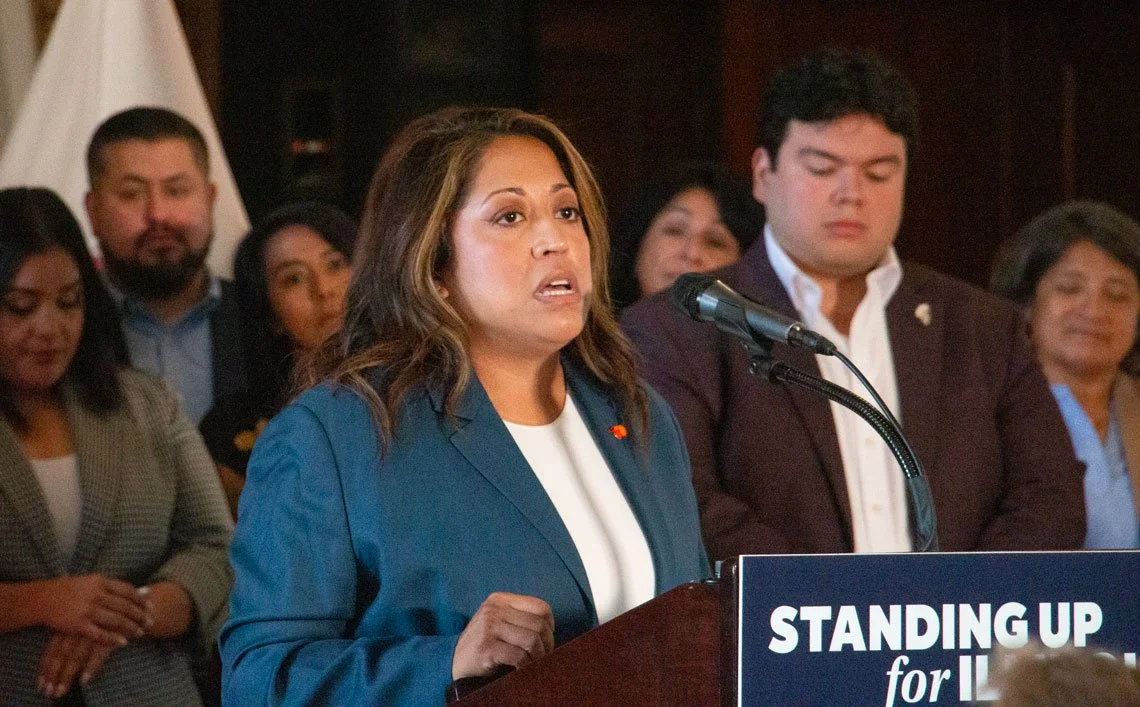
Lt. Gov. Juliana Stratton and U.S. Reps. Robin Kelly and Raja Krishnamoorthi were the fundraising leaders in the Democratic Senate primary, according to quarterly finance reports. (Capitol News Illinois photos by Jerry Nowicki)
New SNAP work requirements go into effect Feb. 1, threatening recipient eligibility
The requirements change which recipients must work or volunteer and how often
Article Summary
H.R. 1, or the One Big Beautiful Bill Act, signed into law last July, changes the work requirements for the federal food assistance program known as SNAP.
Starting Feb. 1, adults aged 18 to 64 without dependents under age 14 must work, participate in employment and training programs or volunteer at least 80 hours each month to receive benefits.
Officials from the Illinois Department of Human Services say over 300,000 Illinoisians who receive SNAP benefits could be affected.
This summary was written by the reporters and editors who worked on this story.
By JENNA SCHWEIKERT
Capitol News Illinois
jschweikert@capitolnewsillinois.com
New work requirements for the Supplemental Nutrition Assistance Program go into effect Feb. 1, threatening benefits for hundreds of thousands of Illinoisians.
Adults aged 18 to 64 without dependents under age 14 will be required to work, participate in SNAP Employment and Training programs or volunteer for at least 80 hours per month to receive benefits. Previously, only adults aged 18 to 54 without dependents under age 18 had to meet those requirements.
H.R. 1, known as the “One Big Beautiful Bill Act,” set these new SNAP requirements and made changes to many other federal programs when it was signed into law in July 2025.
Up to 340,000 Illinoisians are at risk of losing their benefits with the new requirements, according to the Illinois Department of Human Services. Adults who do not meet the requirements can only receive SNAP benefits for up to three months in a three-year period.
As of September 2025, nearly two million Illinois residents were using SNAP benefits, according to the U.S. Department of Agriculture.
Two major changes to SNAP
Most SNAP recipients must meet general work requirements by applying for and accepting available work, participating in SNAP Employment and Training and not voluntarily quitting or reducing work hours below 30 a week without good reason.
Some recipients are automatically exempt from this requirement based on factors like age, while others must submit exemption forms if they meet other criteria like homelessness or certain health conditions.
A smaller group of SNAP recipients known as ABAWDs, or able-bodied adults without dependents, must meet further requirements if they are not exempt.
H.R. 1 made two major changes by modifying the definition of ABAWDS and implementing more work requirements for the newly defined population, ending Illinois’ long-term work requirement waiver for existing ABAWDs, according to IDHS.
“Trump’s budget bill is designed to deliberately prevent Americans and Illinoisans from receiving assistance through the SNAP program by implementing new requirements that burden states and individuals who rely on this 100 percent federally funded benefits resource,” Summer Griffith, a spokesperson for IDHS said in a statement.
SNAP recipients must also continue to update their income and household information to ensure they are receiving the correct benefits and meeting the applicable requirements.
“The Illinois Department of Human Services is communicating with SNAP participants regarding upcoming changes to SNAP and continues to provide support as people navigate new processes and changes imposed by the Trump Administration,” Griffiths said.
Capitol News Illinois is a nonprofit, nonpartisan news service that distributes state government coverage to hundreds of news outlets statewide. It is funded primarily by the Illinois Press Foundation and the Robert R. McCormick Foundation.
Illinois sees its worst flu season in recent years as vaccine skepticism grows
The IDPH classified the state as having “very high” levels of flu, the most since 2009-10
By OLIVIA ARDITO
Medill Illinois News Bureau
Article Summary
Illinois is experiencing a severe flu season with outbreak zones popping up across the state.
Peak flu season comes in February as January fatalities increase at a rapid rate to at least 100.
One cause for the high rate of cases, experts believe, is people distrusting vaccines and avoiding the flu vaccine altogether due to political pressure.
Illinois lawmakers recently passed a bill revising standards for residents, defying new lower federal vaccine recommendations.
CHICAGO — Flu cases are increasing rapidly in Illinois as the state sees its worst flu season in more than 15 years.
At least 100 people have died from the flu this season in Illinois, with 77 of those deaths occurring this month alone, according to the Illinois Department of Public Health. Children and the elderly have been the most-affected age groups. So far, there have been three pediatric fatalities in Illinois this flu season, IDPH reports.
IDPH reported this month that flu activity in the state has climbed to “very high,” the most severe of five categories of respiratory illness, as defined by the U.S.Centers for Disease Control and Prevention. The 2009-10 season was the last time the state reached such high numbers of cases.
The public health department reported that for the week of Jan. 11-17, on average, 3% of all emergency department visits and 2.1% of hospital admissions were for the flu. The IDPH does not report a total number of cases. Additionally, 16.9% of flu tests, or 2,963 tests, done in a lab were positive for the flu. There were also 414 ICU admissions across the state for the flu.
The height of flu season is typically from early to mid-February. According to the IDPH, flu outbreaks are specifically growing in West Chicago, Bellwood, Rockford, Metro East, Peoria and Champaign. Additionally, the CDC reports that at least 230,000 people have been hospitalized for the flu nationwide, and the numbers continue to rise.
Dr. Taylor Heald-Sargent, an associate professor at Northwestern University who specializes in the cold and flu, vaccines, and pediatric illnesses, said one reason Illinois is having such a severe flu season is because fewer people are getting vaccinated against the flu.
“We've definitely seen just overall vaccination rates decreasing for years,” Heald-Sargent said. “We just keep trying to remind people that vaccines are safe and effective, and they’ve been well-studied. And if you look back over the past century and a half, some of the biggest gains in modern medicine have been because of vaccines.”
Two significant reasons people distrust the flu vaccine are that they may experience flu symptoms after receiving it, and sometimes people still get the flu after receiving the shot, according to Heald-Sargent. Another explanation for these feelings of distrust could be that people often forget that the goal of the flu vaccine is to prevent hospitalization, not to build complete and total immunity from the disease.
Vaccines have become a political target instead of being solely a medical issue. Political conversations about vaccines became popularized by a study published by Andrew Wakefield in 1998 that connected the MMR vaccine to autism in children. This study has been proven to be false and has since been retracted from publication. Recently, vaccines have reentered the political zeitgeist due to U.S. Secretary of Health and Human Services Robert F. Kennedy Jr.’s policies.
A significant portion of Kennedy’s agenda has involved a large-scale overhaul and change to vaccine schedules and standards. Kennedy considers himself a long-time vaccine skeptic and hopes to restore public trust in vaccines through his changes. The most notable change so far has been the overhaul of the recommended vaccine schedule for children. Previously, federal standards recommended 18 vaccines for children, including the COVID-19 vaccine. The new standard cuts the recommended number of vaccines to 11.
However, Illinois state legislators recently responded to these changes by passing House Bill 767 in early December. The bill allows Illinois to issue state-specific standards. State Sen. Dave Koehler, D-Peoria, a sponsor of the bill, said the changes look very similar to the standards Illinois had before Kennedy took office and initiated his new protocol.
“Robert F. Kennedy Jr. has made a mockery of all that DHS should stand for,” Koehler said. “When the federal government fails, we as a state have to fill in the gaps and make sure that people have the right kind of information. We show that government actually cares and wants to provide them scientifically sound information.”
Koehler advised Illinoisans not to turn to the internet or to the federal government, but to listen to one’s own trusted doctor for medical advice.
“(House Bill 767) was the governor and the legislature’s attempt to say, ‘Look, we need to have the professionals, the doctors, the people who actually understand this stuff provide the public with information that is sound and that people want,’” Koehler said.
To handle such rapidly spreading diseases like the flu, physicians like Heald-Sargent suggest taking as many precautions as possible: Avoid large crowds, stay home when sick, wash your hands well, and talk to your doctor if you get a virus.
“Once you get a virus, while there are antiviral medications … they’re not as great as boosting up your immune system ahead of time through giving your immune system practice, and that is what a vaccine is — your immune system getting some training on how to respond,” Heald-Sargent said.
Olivia Ardito is a graduate student in journalism with Northwestern University’s Medill School of Journalism, Media and Integrated Marketing Communications, and is a fellow in its Medill Illinois News Bureau working in partnership with Capitol News Illinois.
Capitol News Illinois is a nonprofit, nonpartisan news service that distributes state government coverage to hundreds of news outlets statewide. It is funded primarily by the Illinois Press Foundation and the Robert R. McCormick Foundation.
Superintendent Delivers Report To School Board
At last week’s Wabash District #348 school board meeting, Superintendent Dr. Chuck Bleyer offered this report to the board…
Commissioners Hear Update On County's 911 System
Wabash County 911 Director Kyle Smith has updated the County Board on an issue involving the county’s phone system and power outages.
Smith explained that when the police department upgraded its phone system, it made financial sense to tie into the county’s existing system at the courthouse. However, he noted a major concern — the courthouse is not connected to a generator. During power outages lasting more than an hour, the phone system relies on backup batteries, and staff have had to run an extension cord from the jail to the courthouse basement to keep the system operating.
Smith told board members that situation is not ideal, especially for emergency communications. He asked for permission to explore moving the phone system to the police department, which is supported by a generator, and to gather cost estimates for the change.
According to Smith, Midwest Communications estimated their portion of the work at around one thousand dollars, while Clearwave indicated there may be no cost involved. He added that relocating the system would benefit the county by providing more reliable backup power and eliminating the need for temporary fixes during outages.
The County Board approved a motion allowing Smith to continue exploring the project and obtaining quotes. No funding request was made at this time.
WGH Board Moves Forward With $75 Million Expansion Project
As Wabash General Hospital starts to celebrate serving the community for 75 years this year, the Wabash General Hospital Board of Directors has approved moving forward with planning for a major campus expansion. During a special meeting Monday, the board voted to advance a proposed $75 million building plan, marking the largest construction project in the hospital’s history. This planning approval does not authorize construction. A project of this complexity has several design and permitting steps, including a Certificate of Need permit from the Illinois Health Facilities Services and Review Board, before it can officially proceed.
Hospital President and CEO Karissa Turner noted the timing is especially meaningful, as 2025 marks Wabash General Hospital’s 75th anniversary. Turner said planning for campus improvements began several years ago, dating back to 2018 and 2019, when hospital leadership identified growing needs in several departments. She pointed out that parts of the facility — including the medical-surgical unit and emergency department — have not seen major renovations in decades, despite continued growth.
The hospital now employs more than 650 people, and Turner said the project represents an investment in both staff and the community’s future.
Vice President of Project Management and Infrastructure Nate Stevenson, who has led the project for the past year, outlined a phased construction approach designed to limit disruptions to patient care. Stevenson explained that early concepts approached $100 million, but revisions and phased planning reduced the recommended project cost to approximately $75 million, with construction expected to take several years.
Hospital officials emphasized that detailed floor plans are still being developed and that the current designs reflect a high-level framework rather than final layouts.
Until the project is further along in design and permitting, including the Certificate of Need permit, no formal timeline will be set. The next phase of design is expected to take 12 months. Routine progress updates will be presented to the Hospital Board of Directors. Construction would be staged to keep hospital services operating throughout the project. Planning for this investment into our community reflects Wabash General Hospital’s long-standing commitment to providing high-quality care close to home.