Proposed closing of 4 low-level prison facilities draws sharp rebuke in Du Quoin 

Questions surround plan to close Du Quoin Impact Program, three other facilities

 Article Summary 

  • Numerous community members spoke out against planned IDOC closures in southern and central Illinois at a forum in Du Quoin on Wednesday evening hosted by a state commission required to review proposed state facility closures and issue recommendations.

  • Roughly 40 community members attended the forum, many of them expressing concerns about what will become of the shuttered facilities, and diminishing opportunities for incarcerated young and low-level offenders.

  • The commission planned two additional meetings this week in Greene County and Clayton, and will hold a final hearing during the Illinois General Assembly’s veto session next month. 

This summary was written by the reporters and editors who worked on this story. 

By GEOFF RITTER
For Southern Illinois Source 

DU QUOIN — A plan to close four downstate correctional facilities drew strong opposition at a public hearing Wednesday in Du Quoin, where critics cited concerns about future upkeep of the facilities and Illinois’ approach to the incarceration of young and low-level offenders.

"We have watered down this program that we built in the late '80s," said Ty Petersen, staff representative for the American Federation of State, County and Municipal Employees Council 31. "We have given up on the opportunity to change people's lives in the Illinois Department of Corrections."

Petersen was one of several to offer testimony at Wednesday's public hearing, held by members of the Illinois Commission on Government Forecasting and Accountability. About 40 members of the public attended the forum at the Du Quoin State Fairgrounds.

The meeting was held in response to a plan announced in August by the Illinois Department of Corrections to phase out impact program facilities in Du Quoin and Dixon Springs in southern Illinois and work camps in Clayton and Greene County in east-central Illinois. IDOC says the four closures will save a combined $35.9 million in capital costs and $6.5 million in annual operating expenses.

The commission, which planned two additional meetings this week regarding the closures in Greene County and Clayton, will hold a final hearing during the Illinois General Assembly's veto session next month. Its members then will vote on a final, non-binding recommendation.

IDOC Director Latoya Hughes said at Wednesday's public meeting the planned facility closure in Du Quoin will make permanent a temporary action that moved all of the offenders housed there to the Murphysboro Life Skills Re-Entry Center. The Du Quoin facility has not housed offenders since 2024.

Hughes said IDOC decided to permanently close the facilities to address aging infrastructure and financial efficiency, among other reasons. She stressed that current employees will be reassigned and that IDOC intends to honor current collective bargaining agreements.

"This closure is a consolidation of services, not a reduction," Hughes told the commission. "There are no layoffs that will occur as a part of this process. The decision to close this facility was not made lightly. It reflects careful, data-driven evaluation of our operational needs, long-term population needs, aging infrastructure and our responsibility to use our state resources wisely."

Some, however, questioned IDOC's stated commitment to its impact incarceration program, which offers qualifying young and low-level offenders an alternative to stricter prison sentences by providing training, education and work opportunities in exchange for shorter terms of incarceration.

Chuck Stout, staff representative for AFSCME Council 31, suggested IDOC intended to permanently close the facilities years ago, when the facilities in Du Quoin, Dixon Springs and Greene County were temporarily shuttered as a result of a memorandum of understanding between IDOC and AFSCME.

"Every time we talked about it, they said at worst we would repurpose them," Stout said. "There was not a discussion of closure at any time during those, except when the union raised it and asked. We believed then, we still believe, that their intention was to close them all along, but they wanted to avoid this process for as long as possible."

State Sen. Terri Bryant, R-Murphysboro, similarly said IDOC seemed not to communicate its real intentions at the time the memorandum was signed, adding "it looks very much like the intention was to get rid of it rather than trying to make the program work."

She also questioned whether IDOC was properly promoting the program to judges who possess sentencing discretion. Jennifer Parrack, IDOC's chief of programs and support services, said she regularly speaks about the program at conferences and to judges, although Bryant subsequently asked Parrack to submit documentation corroborating those efforts. 

"I would like to see more people sentenced to the impact incarceration program," Parrack told the commission. "Someone that is looking at a six-, seven-, eight-year prison sentence, this is an excellent opportunity for them, and the success we've had in the impact incarceration program from a programmatic standpoint, I absolutely support the program."

The Du Quoin Impact Program first opened in 1994, and its facility near the Du Quoin State Fairgrounds was cited by many Wednesday as being among the more modern in the IDOC system. Despite that, Du Quoin Mayor Josh Downs said he has serious concerns about what will happen to the facility once IDOC abandons operations there.

"There are options there," Downs said. "My concern is that, as a mayor and also as a taxpayer, don't let the facility sit, go to waste, cave in on itself."

Michael Crum, chief compliance officer at IDOC, said the department would work with the Illinois Department of Central Management Services to manage the facility following the anticipated closure.

Rep. C.D. Davidsmeyer, R-Murrayville, whose district covers the Greene County Work Camp, said the condition of other facilities demonstrates that IDOC didn't properly invest in upkeep.

Davidsmeyer added that the promises offered by the impact program aren't ones the state should quickly abandon.

"This is an opportunity for a better future," Davidsmeyer said. "It's not, you're going to be put in prison, you're going to serve your sentence, we're going to shove you out on your way, good luck. We're not just here to punish people. We don't want them coming back.”

Geoff Ritter is a longtime journalist and editor based in southern Illinois.

Capitol News Illinois is a nonprofit, nonpartisan news service that distributes state government coverage to hundreds of news outlets statewide. It is funded primarily by the Illinois Press Foundation and the Robert R. McCormick Foundation.
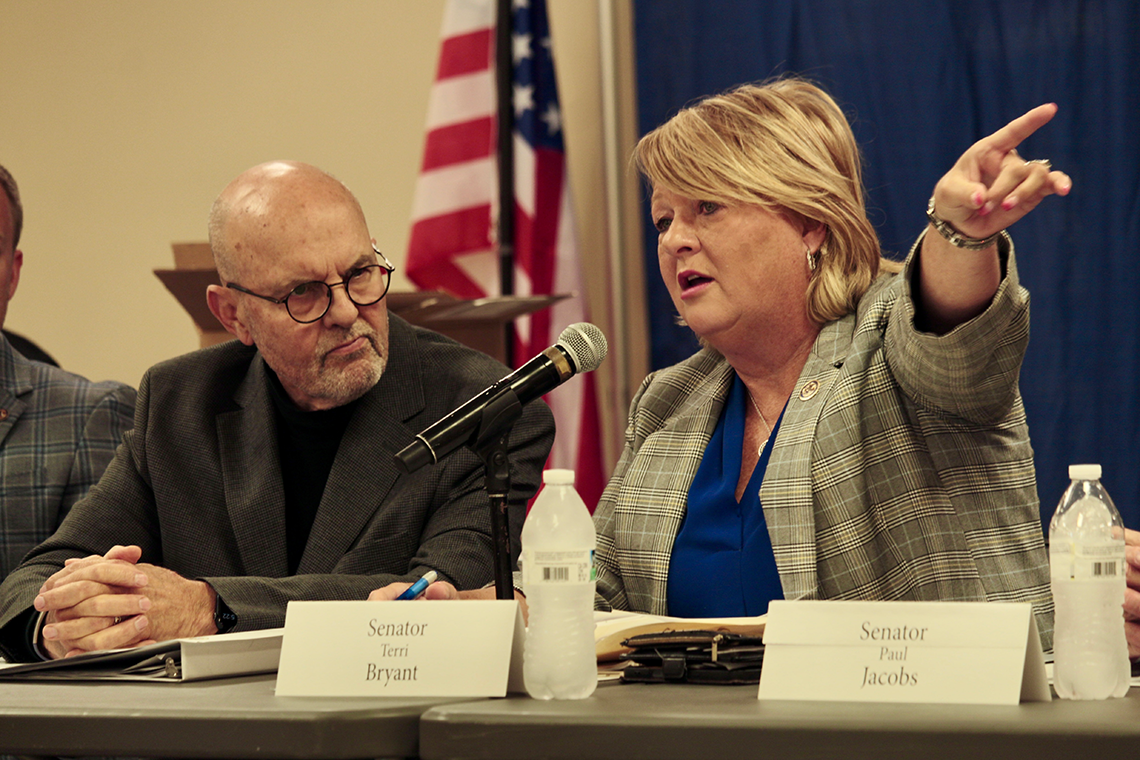

State Sen. Terri Bryant speaks Wednesday during a hearing in Du Quoin held by the Illinois Commission on Government Forecasting and Accountability regarding the proposed closure of the Du Quoin Impact Program. (Southern Illinois Source photo by Geoff Ritter)
Illinois regulators move to bring video gambling under self-exclusion program

The state’s extensive network of video gambling terminals is one of the largest gaps in the program 

By MAGGIE DOUGHERTY
Capitol News Illinois
mdougherty@capitolnewsillinois.com 

Article Summary 

  • The Illinois Gaming Board proposed new rules Thursday that would bring the state’s network of nearly 50,000 video gambling machines into the program that allows problem gamblers to ban themselves from casinos, sportsbooks and other forms of legalized gambling. 

  • The new rules would require identity verification for players to purchase vouchers to gamble on the machines and would create new options for cashless wagering.  

  • The rules now face a roughly year-long journey through the state’s rulemaking process, allowing public discussion before implementation.

This summary was written by the reporters and editors who worked on this story. 

CHICAGO — Problem gamblers seeking to avoid the temptation to gamble can ban themselves from most of the state’s gambling offerings, from casinos to online sportsbooks to the Lottery. 

But the state’s voluntary self-exclusion program does not extend to Illinois’ extensive network of video gambling terminals — the largest in the world — that can be found in gas stations, bars, hair salons and hotel lobbies across the state.

Regulators are looking to change that.

The Illinois Gaming Board proposed new rules Thursday to bring the state’s video gambling terminals under the program that allows problem gamblers to self-ban by requiring identity verification before players can purchase vouchers at video gambling locations.

The new rules would also create new options for cashless wagering and player rewards programs.

Gaming Board Administrator Marcus Fruchter said the move was “another critical step forward” in the agency’s goal to bring video gambling under the program’s umbrella.

“We are decidedly on the right path and will continue driving forward, but we will do so in a focused, collaborative, intentional, and efficient manner as we advance this critical initiative,” Fruchter said.

Read more: Illinois regulators propose expansion to self-exclusion program for compulsive gamblers

The Gaming Board identified closing the coverage gap for video gambling as a “public health priority,” and passed a resolution expressing its commitment to doing so during its September meeting.  

The board unanimously approved the proposed rules, sending them to the General Assembly’s rulemaking committee for review, a process that usually takes between six months to a year and gives opportunities for public comment.

ID verification

The new rules would shift the way gamblers pay to play on video gambling machines, which would no longer accept cash directly.

Instead, players would purchase vouchers from a payout device, either with cash or with digital payments through a video gaming account. Both options would require identity verification to confirm players are at least 21 years old and not on the self-exclusion list. 

Using a video gaming account would be voluntary, and players could still use cash to purchase vouchers from the redemption terminal after identity verification. 

Video gambling operators that offer accounts would be required to give players tools to set responsible gambling limits, actively keep self-excluded gamblers from opening accounts and refrain from sending promotional materials to those on the list. They would also be allowed to run player reward programs for non-excluded players.

One consequence of having so many cash-filled video gambling machines sitting in businesses across Illinois has been a rise in burglaries at those locations.

But while decreasing the burglary risk may be a byproduct of the new rules, Fruchter said it’s more about bringing video gambling in line with the rest of the industry, where cashless wagering and player accounts are standard. 

Allowing digital payments also allows more options for customer controls and money laundering prevention, Fruchter added.

However, cashless wagering can also reduce the friction for bettors, allowing them to spend — and lose — more cash.

Acres Manufacturing, a Las Vegas-based company that released a new cashless betting technology last year, conducted a six-month case study on its impact.

Cashless gamblers purchased 92% more gambling credits per session and were more likely to re-up than players paying with cash, Acres found.

"Our study makes clear that players spend significantly more when using a cashless funding option," Acres told the Nevada Independent.

Read more: Illinois tax revenue from gambling increased 19% last year

If true more broadly, that could have major ramifications for betting behavior in what is already Illinois’ highest-grossing source of wagering revenue; the machines brought in more than $1 billion in state and local tax revenue last fiscal year, with gamblers losing more than $3.3 billion.

Fruchter said it’s one of the issues the Gaming Board wants to discuss further in the public comment period of the rulemaking process.

Timeline

The biggest hurdle to bringing video gambling terminals under the state’s self-exclusion program has been the technology needed to upgrade the state’s roughly 50,000 video gaming machines to connect with the list maintained by the state while maintaining data privacy protections.

The Gaming Board has contracted with LNW Gaming, which builds slot machines and table games, to upgrade the state’s machines for that purpose. 

Read more: Addicted to gambling in Illinois: ‘Someone has decided they can make money off you’ 

Fruchter said he was confident that the work would be ready to deploy next year, giving the state the technological capacity to bring video gambling terminals under the self-exclusion program. 

Capitol News Illinois is a nonprofit, nonpartisan news service that distributes state government coverage to hundreds of news outlets statewide. It is funded primarily by the Illinois Press Foundation and the Robert R. McCormick Foundation. 


WABASH COUNTY TREASURER REOPENS PROPERTY TAX PREPAYMENT PROGRAM THROUGH OCTOBER 30TH

Wabash County Treasurer Angela Broster has announced that the county's real estate tax prepayment program has reopened through Friday, October 30th.

Broster provided the update to the Wabash County Board of Commissioners during Monday afternoon's meeting.

She explained that the prepayment program was originally closed on September 30th because her office anticipated receiving the 2025 property taxes, payable in 2026, before the end of October.

However, Broster says she has since been informed that the tax information will not arrive until sometime in November, allowing her office to temporarily reopen the prepayment program.

Broster says she will reevaluate the situation at the end of October to determine whether the prepayment deadline can be extended again.

She explained that a cutoff date is necessary to allow her office time to balance payments and enter them into the system before tax bills are printed.

Property owners interested in making a prepayment toward their 2025 real estate taxes, payable in 2026, should contact the Wabash County Treasurer's Office.

For additional information, call 618-262-5262 or stop by the Treasurer's Office.

DISTRICT #348 BOARD FORMALLY APPROVES NEW VALEDICTORIAN POLICY AT MCHS

The Wabash Community Unit School District #348 Board of Education has approved a change in how Mount Carmel High School selects its valedictorian and salutatorian.

The revised policy was approved during Monday evening's school board meeting and will first apply to students currently in eighth grade, who are scheduled to graduate from high school in 2031. Current high school students will not be affected.

The change follows the graduation of eight valedictorians in the Class of 2026 under the existing policy, which awards the honor to students who complete required coursework and maintain straight A's throughout high school.

High School Principal Amy Duckworth first presented the proposal to board members in July.

Under the new policy, the valedictorian will be determined by the highest cumulative grade percentage earned over four years of high school, rather than simply maintaining straight A's.

The change will not affect the school's grading scale or reinstate weighted grades. Students must still complete the rigorous college-preparatory coursework required under the current policy.

Duckworth previously explained that using cumulative percentages will better distinguish between students earning grades in the low 90s and those consistently earning grades closer to 100 percent.

The revised policy is designed to recognize one valedictorian and one salutatorian, although co-valedictorians could still be named if students remain tied after calculating grade percentages to additional decimal places.

The selection process will continue to be based strictly on academics, without consideration of attendance, discipline or extracurricular activities.

With Monday's approval, the new selection process will begin with the Mount Carmel High School Class of 2031.

Click the links for our previous stories on the new policy…

https://wsjd.fm/new-blog-1/2026/7/22/mchs-may-change-how-valedictorians-are-chosen?rq=VAL

https://wsjd.fm/new-blog-1/2026/9/25/proposed-changes-to-mchs-valedictorian-and-salutatorian-requirements-explained?rq=VAL

Wabash County Commissioners Table Three-Year Funding Request from Area Economic Alliance

Wabash County Commissioners have tabled a request from the Area Economic Alliance seeking a three-year commitment of financial support from the county.

Board Chairman Tim Hocking brought the request before commissioners during Monday afternoon's meeting.

Hocking said the organization is asking the county to commit to supporting its efforts for another three years.

During discussion, commissioners noted the county has previously contributed $3,000 annually to the organization.

One commissioner suggested contacting Mayor Joe Judge to learn more about the proposed agreement before making a decision.

Commissioners then approved a motion to table the request until additional information can be obtained.

No new financial commitment was approved during Monday's meeting.

MCHS TEACHERS PRAISE NEW GYM AIR CONDITIONING

The new air conditioning system at Mount Carmel High School's gymnasium is receiving high marks from students and teachers.

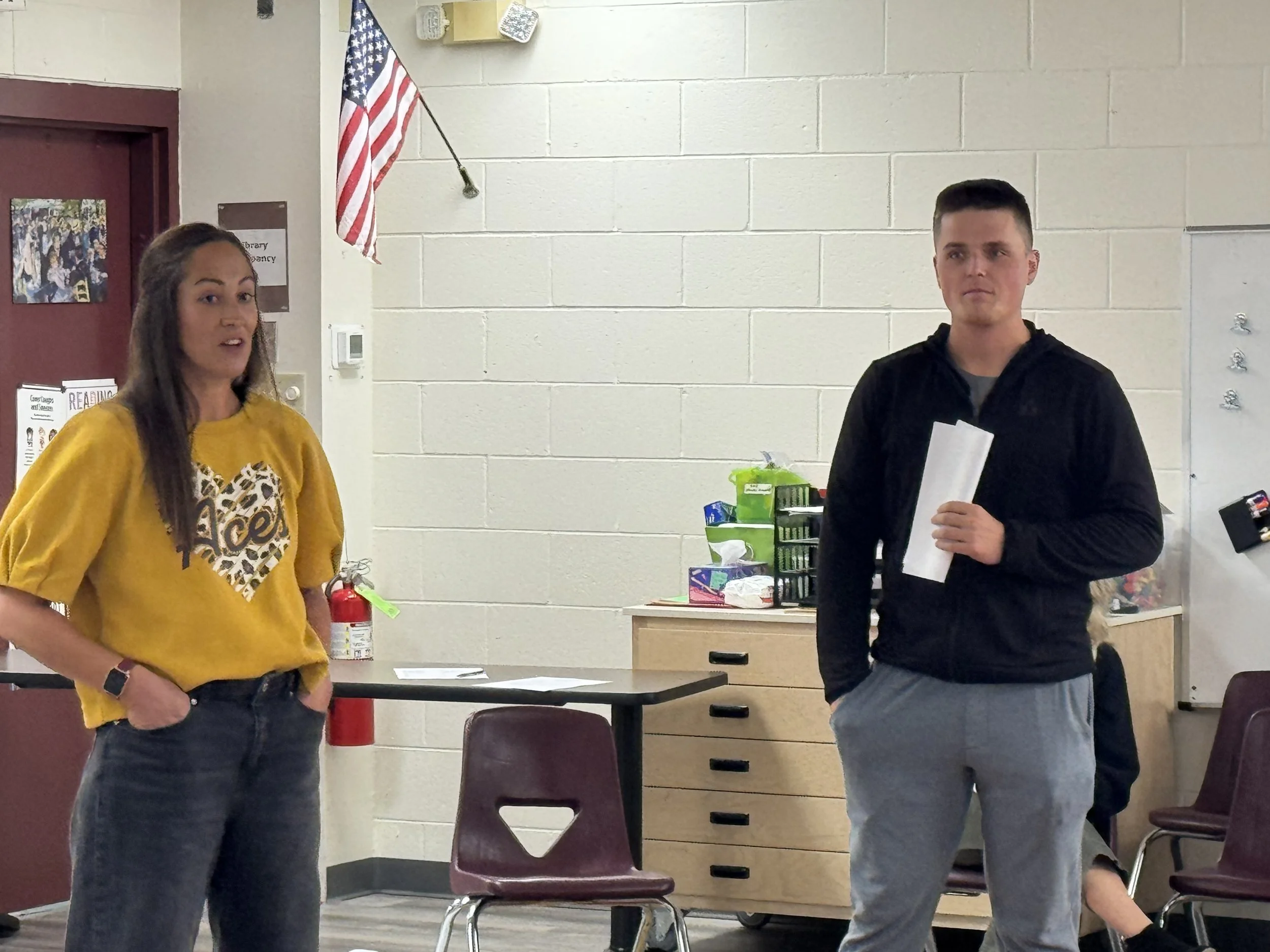
During Monday evening's Wabash Community Unit School District 348 Board of Education meeting, MCHS physical education teachers Jen Schilb and Jaden Merritt discussed the positive impact the new cooling system has had on their classes.

Schilb, who joined the district in 2023, told board members the air conditioning has been a game changer for the physical education department.

She explained that motivating approximately 50 high school students to participate in physical activities was especially challenging when temperatures inside the gym approached 100 degrees.

With the new air conditioning system, Schilb said students are more willing to get up and participate in activities rather than complaining about the heat.

She added that the improved temperatures have also made conditions much more pleasant from a hygiene standpoint.

Merritt, a Mount Carmel High School graduate who returned to the district as a teacher this school year, said several upperclassmen have expressed their appreciation for the improvement.

Board members also discussed the benefits for athletic events held in the gymnasium.

Board chairman Jamie McCorkle recently attended a volleyball game and commented on how comfortable the facility was compared to previous years.

Schilb thanked the school board for making the investment, saying the new air conditioning has made a significant difference in the learning environment for students and working conditions for teachers.

Both teachers agreed the improvement has been especially noticeable during the hot weather experienced earlier this school year.

RISING GAS PRICES COULD IMPACT SCHOOL FIELD TRIPS AND ATHLETIC TRAVEL IN DISTRICT #348

Rising gasoline prices could eventually force Wabash Community Unit School District 348 to reconsider how far students travel for field trips and non-conference athletic events.

During Monday evening's school board meeting, Superintendent Dr. Chuck Bleyer expressed concern about the increasing cost of fuel and its impact on the district's transportation budget.

Bleyer told board members he has been discussing the issue with district administrators as higher gasoline prices begin showing up in transportation expenses.

While no changes have been made, Bleyer said the district may eventually need to establish guidelines on how far school buses should travel for certain activities if fuel prices continue climbing.

The superintendent emphasized that conference athletic contests would remain a priority, but questioned whether lengthy trips across the state for non-conference events are financially justified.

Bleyer pointed out that traveling to Paris for a conference game is already a significant expense, and suggested the district may need to reconsider even longer trips for non-conference competitions held during the school week.

He said the same concerns apply to educational field trips.

Bleyer noted that District #348 is fortunate its buses do not rely on diesel fuel, which could make the financial situation even more challenging.

The superintendent said he has spoken with officials from other school districts who are also closely monitoring fuel costs.

Bleyer acknowledged that parents understandably want their children to have opportunities to participate in athletic events and educational trips.

However, he stressed that school officials also have a responsibility to manage taxpayer dollars carefully.

The superintendent indicated he may ask the district's finance committee to meet and help determine what transportation limits or guidelines might be appropriate if gasoline prices continue rising.

For now, Bleyer said the district is simply beginning those discussions and wants board members to be aware of the potential financial challenges ahead.

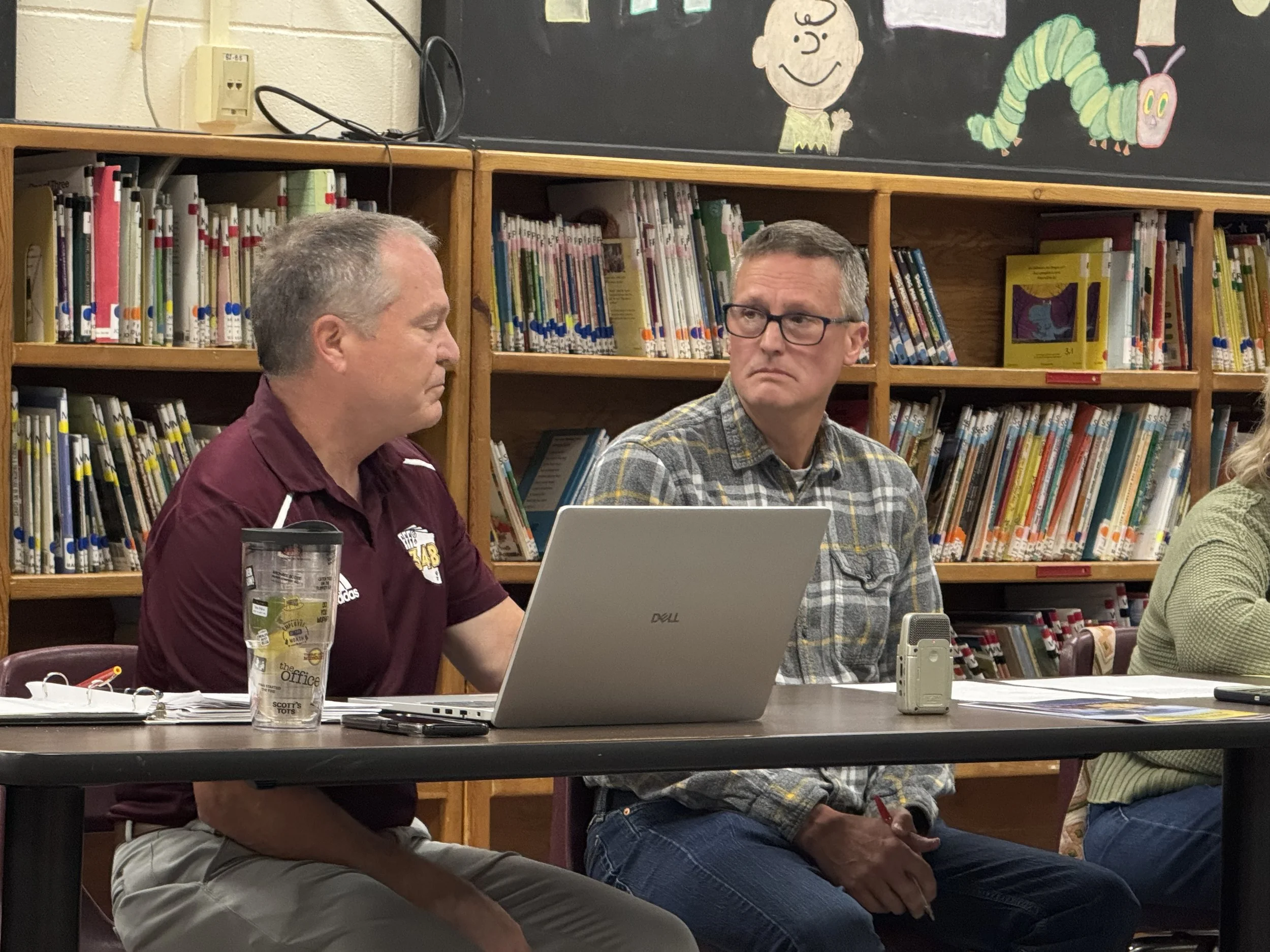
School board president Jamie McCorkle (R) looks on as Superintendent Dr. Chuck Bleyer discusses the impact of high gas prices on district travel.

MT. CARMEL MAN CHARGED IN ALLEGED INCIDENT WITH WOMAN

MT. CARMEL MAN CHARGED WITH CRIMINAL SEXUAL ABUSE AND AGGRAVATED BATTERY, ORDERED HELD WITHOUT PRETRIAL RELEASE

A 56-year-old man is being held in the Wabash County Jail after being charged with two felonies in connection with an alleged incident involving a 20-year-old woman.

Jeremy Jay Drew was arrested earlier this month by local authorities and charged by Wabash County State's Attorney Kelli Storckman with Class 2 felony criminal sexual abuse and Class 3 felony aggravated battery.

According to court records, the charges stem from an alleged incident on October 5th in which Drew is accused of using his hand to slap the woman's buttocks and touch her pubic area.

The criminal sexual abuse charge is classified as a Class 2 felony due to Drew's previous conviction for aggravated criminal sexual abuse in 1999.

Drew appeared in Wabash County Circuit Court on October 7th, where Public Defender William Easton was appointed to represent him.

During the hearing, prosecutors requested that Drew remain in custody pending trial.

The court granted the state's petition to deny pretrial release, finding that the evidence supported the detention request, that Drew posed a real and present threat to public safety, and that no conditions of release could adequately address that threat.

Drew is scheduled for a preliminary hearing on October 26th at 11 a.m. A final pretrial hearing is listed for November 16th, with a jury trial scheduled to begin December 7th.

Drew remains in custody. The charges are allegations, and he is presumed innocent unless proven guilty in court.

MT. CARMEL POLICE RESPOND TO 734 INCIDENTS DURING SEPTEMBER

The Mount Carmel Police Department handled 734 incidents during the month of September, according to the department's monthly activity report.

Officers reported 17 traffic accidents and issued 108 warnings during the month.

Traffic-related arrests and violations included seven involving uninsured motor vehicles, four for driving with a suspended or revoked license, three for speeding, and five for other moving violations.

In criminal activity, police reported four battery or aggravated battery arrests, two burglaries, two thefts, two criminal trespassing offenses, and one arrest for resisting or obstructing an officer. There were also five ordinance violations and four arrests classified as other criminal offenses.

Drug-related activity included one arrest for possession of drug paraphernalia. The department reported no arrests for possession of methamphetamine or other controlled substances and no DUI arrests during September.

Officers also served two warrants and handled 17 animal complaints. The department recorded 16 mental health incident forms and three sexual assault transfers.

Police continued their community safety efforts, conducting 262 residential security checks, 87 hospital security checks, and 11 business security checks.

The department also participated in four community relations events, while the school resource officer reported four incidents.

Additionally, police issued 10 new golf cart stickers and one renewal, along with five new bicycle registrations.

The figures are included in the Mount Carmel Police Department's September 2026 activity summary.