Meeting is 4:30pm at the Wabash County Courthouse.
MT. CARMEL COMMISSIONERS REPORT ON CITY FINANCES, WATER DEPARTMENT WORK AND FIRE DEPARTMENT ACTIVITY
Mount Carmel city commissioners provided updates on city finances, water and sewer operations, and fire department activity during Tuesday afternoon's City Council meeting.
Finance Commissioner Eric Ikemire reported the city collected $338,752 in revenue over the past two weeks.
The largest portion came from sales tax collections totaling $236,806, while replacement tax revenue accounted for another $64,681.
Ikemire said the city has now collected 59 percent of its budgeted revenue for the fiscal year.
Expenses during the two-week reporting period totaled $195,441.92.
Meanwhile, Water and Sewer Commissioner Tom Meeks reported a busy couple of weeks for the city's water department.
Crews completed 60 JULIE utility locate requests, including 30 in just two days.
Workers also repaired a four-inch water line supplying the Waller Subdivision and bored three new water service lines.
At the wastewater treatment plant, crews replaced a front roller bearing on a skid steer and began pumping out primary tank number two so it could be taken offline because of unusually low wastewater flow.
Meeks said both the water and wastewater treatment facilities continue their regular day-to-day operations and maintenance.
Fire Commissioner Susan Zimmerman also reported a busy period for the Mount Carmel Fire Department.
Zimmerman said firefighters spent much of last week participating in Fire Prevention Week activities, including giving station tours to area schoolchildren, visiting local schools, and conducting fire drills.
She said those activities provide an opportunity for children to become familiar with firefighters and fire trucks before encountering them during an actual emergency.
In addition to those educational activities, the Mount Carmel Fire Department responded to 13 incidents over the past two weeks, including structure fires, vehicle fires, and grass fires.
Zimmerman thanked the schools for allowing firefighters to participate in Fire Prevention Week activities and said the department appreciated the opportunity to work with local students.
CONSTRUCTION MOVING QUICKLY ON MT. CARMEL AQUATIC CENTER WITH UP TO 40 WORKERS ON SITE
Construction continues to move forward at Mount Carmel's new aquatic center, with as many as 40 workers now on site as the project enters another busy phase.
During Tuesday afternoon's Mount Carmel City Council meeting, Mayor Joe Judge reported that crews have begun leveling the area surrounding the pool in preparation for the concrete decking.
Judge said workers will be forming the pool deck and concession area this week, while also completing additional drainage work around the facility.
Work is also progressing on the bathhouse roof, with ventilation and HVAC installation taking place this week.
The mayor said between 30 and 40 workers are currently involved in the project, representing several different trades, including plumbing, electrical, building construction, and concrete work.
Judge said Landmark representatives and city officials are also regularly on site overseeing the progress.
Another visible addition is expected later this week or early next week, when crews begin installing the posts for the aquatic center's shade structures.
Judge said contractors expect to have much of the current construction work completed by the first week of November, allowing residents to get a much clearer picture of what the finished facility will look like.
The mayor said it's been impressive to watch the different construction crews working together and how quickly the project is taking shape.
Judge added that with so many aspects of construction happening simultaneously, the new aquatic center is beginning to come together very quickly.
Pritzker reports more than $9M in income on 2025 tax returns, not including blind trust
Governor’s wealth topped $4B within the last year
By BEN SZALINSKI
Capitol News Illinois
bszalinski@capitolnewsillinois.com
Article Summary
Gov. JB Pritzker and his wife reported making $9.4 million on their 2025 tax returns.
Pritzker’s wealth largely came from capital gains as he does not take a salary from the state.
Pritzker’s assets were put in a blind trust when he became governor, and his campaign said the trust paid $50.4 million in federal taxes in 2025, implying an income in the hundreds of millions of dollars.
The governor’s wealth is now more than $4 billion, according to Forbes.
This summary was written by the reporters and editors who worked on this story.
SPRINGFIELD — Gov. JB Pritzker and First Lady MK Pritzker made more than $9 million in adjusted gross income in 2025, according to tax summaries released by his campaign Thursday.
Pritzker and his wife paid $2.1 million in federal taxes and paid in $5.1 million, meaning they received a refund of $2.8 million on $9.4 million in income. The couple applied that amount to their taxes for 2026.
The returns show Pritzker’s income mostly came from capital gains, earned interest and dividends as he does not take a salary from the state. But they’re not fully inclusive of the governor’s vast wealth, which is boosted by income from family trusts.
Pritzker placed his assets in a blind trust when he was elected, which his campaign spokesperson said paid $8.8 million in state taxes and $50.4 million in federal taxes last year, implying an additional income in the hundreds of millions of dollars. Pritzker’s required annual statement of economic interest outlines six pages of assets he or someone in his household has ownership interest in.
Pritzker has released his tax returns each year since becoming a candidate in 2017.
The 2025 summary prepared by Deloitte Tax LLP shows Pritzker and his wife made $9.4 million, including $4 million from capital gains.
Pritzker claimed a $1.9 million standard deduction on his state filing, meaning he paid taxes on $7.6 million in income. Another $1.8 million was from interest and $3.6 million from dividends.
Unlike on his 2024 returns, Pritzker did not record any gambling winnings this year. He also reported $28,090 in farm income and $33,812 from real estate, royalties, partnerships, S corporations and trusts.
The Pritzkers also made $1.9 million in charitable contributions last year, the campaign said.
<div class="flourish-embed flourish-chart" data-src="visualisation/30569740"><script src="https://public.flourish.studio/resources/embed.js"></script><noscript><img src="https://public.flourish.studio/visualisation/30569740/thumbnail" width="100%" alt="chart visualization" /></noscript></div>
Pritzker’s 2025 income was below the $10.7 million reported last year, which was bolstered by $1.4 million in gambling winnings. His highest-earning year as governor was in 2021, at $18.5 million. Prior to leaving his private equity investment firm to run for governor, Pritzker made $55 million in 2017.
Growing wealth
The governor is one of the wealthiest politicians in U.S. history and an heir to the Hyatt Hotel fortune. His net worth has continued to grow since he took office and is now $4.2 billion, according to Forbes, up from $3.7 billion last October. He ranks around Forbes’ 1,000th richest person in the world
Pritzker has self-funded all three of his campaigns for governor, putting in more than $430 million combined, including $90.5 million for this year’s campaign. The governor has also been spending his money on national races through political action committees, including this year’s launch of the Ready for the Fight PAC.
Pritzker’s Republican challenger, Darren Bailey, has so far not released his tax returns. A spokesperson for Bailey did not immediately say whether he planned to do so.
The downstate farmer released several years of tax returns during his 2022 campaign that showed wild fluctuations not unusual for a farmer. In some years, the Baileys topped $200,000 in income while in others they reported less than $2,000, the Chicago Sun-Times reported at the time.
Christian Mitchell’s taxes
Pritzker’s running mate, Christian Mitchell, also released his 2025 tax returns. He reported $481,548 in income, $379,290 of which came from wages. Another $90,000 is listed as business income.
Mitchell left his job as vice president of civic engagement at the University of Chicago last July when Pritzker selected him to be his running mate.
Mitchell claimed an $82,843 standard deduction and owed $10,932 on his federal returns and $5,144 on his state returns.
Mitchell served as one of Pritzker’s deputy governors during his first term. He is also an active member of the Illinois National Guard.
Capitol News Illinois is a nonprofit, nonpartisan news service that distributes state government coverage to hundreds of news outlets statewide. It is funded primarily by the Illinois Press Foundation and the Robert R. McCormick Foundation.
Illinois medical debt relief program surpasses $1B goal in two years
Over $1.4B in medical debt has been erased for nearly 700K Illinoisans across all counties
By BERNARDA MALEVSKA
Capitol News Illinois
bmalevska@capitolnewsillinois.com
Article Summary
Two years after its launch, a state medical debt relief program has erased more than $1.4 billion in debt, exceeding the original goal by $400 million.
Almost 700,000 Illinoisans across all counties had medical debt relieved.
The state spent less than $10 million to relieve these debts through a partnership with a nonprofit that focuses on buying and relieving medical debt.
This summary was written by the reporters and editors who worked on this story.
The state has erased over $1.4 billion in medical debt for almost 700,000 Illinoisans for pennies on the dollar, two years after launching a new relief program.
At its launch, the Illinois Medical Debt Relief Program aimed to eliminate $1 billion in debt. The state has surpassed that goal by $400 million, spending less than $10 million in state dollars to achieve these results. That means that every state dollar invested in the program wiped out over $100 in debt.
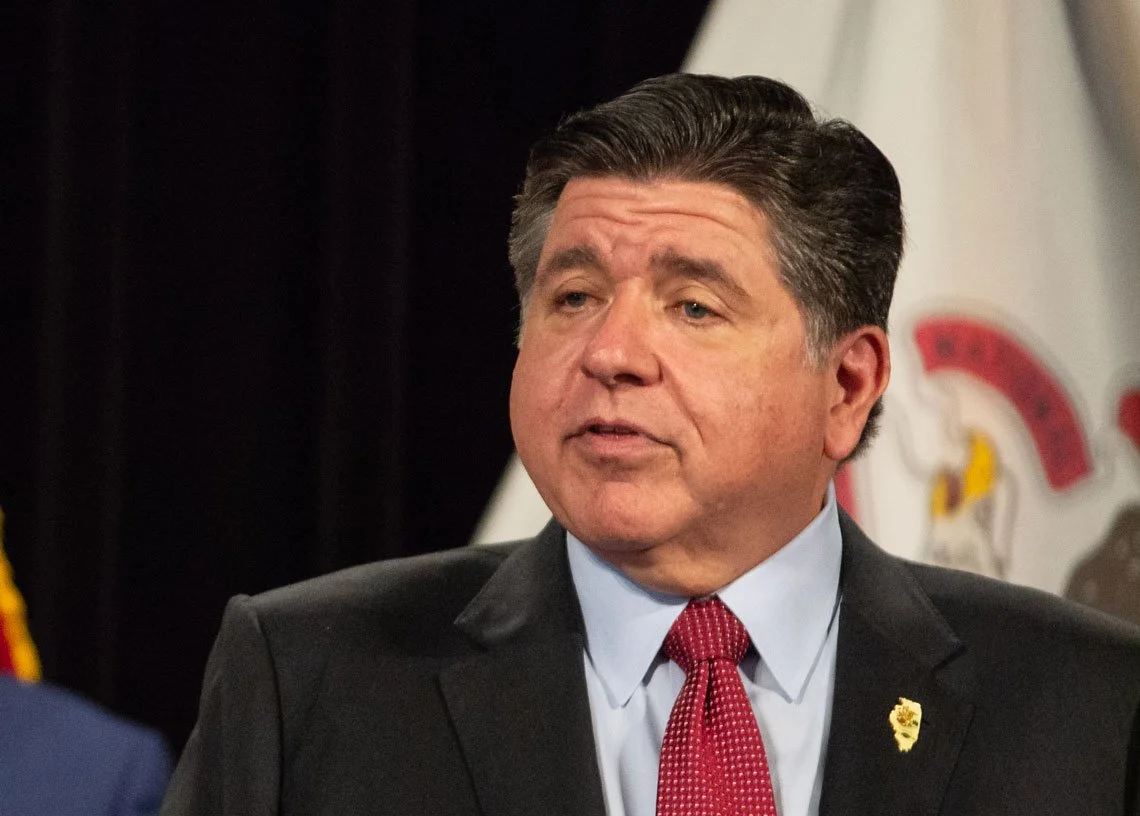
That was possible due to the state’s partnership with Undue Medical Debt — a nonprofit that works with local governments and healthcare providers to purchase and eliminate qualifying medical debt owed by low-income residents.
“Medical debt is a leading cause of bankruptcy,” Gov. JB Pritzker said in a news conference Thursday in Chicago. “It can ruin credit, limit financial opportunities, and cause years of uncertainty long after they leave the hospital. That is a symptom of a truly broken system.”
Illinois residents whose household income is at or below 400% of the federal poverty level, or who have medical debt equal to 5% or more of their household income, are eligible.
Residents do not apply to this program — impacted households receive letters after their debts have been erased.
“Healthcare should be about getting people back on their feet, not just keeping them, well, down with years of financial struggle,” Pritzker said.
The statewide initiative was modeled after Cook County’s program that launched in 2022. Since then, the Cook County Medical Debt Relief Initiative has eliminated an additional $1 billion in medical debt, covering 22% of eligible adults.
The American Rescue Plan Act funded the Cook County initiative to support recovery from the COVID-19 pandemic. These funds end this year, Toni Preckwinkle, president of the Cook County Board of Commissioners, said.
“At a time when the Trump administration is stepping back from its federal responsibility to working families, Cook County and the state of Illinois are standing firm in our belief that access to quality healthcare should not depend on your income or your ability to pay,” Preckwinkle said.
Recently, President Donald Trump and the federal government have rolled out cuts to Medicaid, a program that provides free or low-cost coverage to people with limited income and resources.
The Illinois Department of Healthcare and Family Services warned that two policy changes are expected by the beginning of 2027 and may reduce Illinoisans' eligibility: redeterminations every six months for Medicare eligibility instead of every year and a federal work requirement.
For Steph Willding, CEO of Community Health, a center offering free services for low-income, uninsured and underinsured patients, access to healthcare should never be connected to their ability to pay.
“We know the value of taking away the barrier of cost for our patients, and as federal policy changes continue to threaten healthcare coverage for more and more Illinoisans, this program has never been more important,” said Willding at a news conference.
The average debt relieved of the medical debt relief program per resident was over $1,200, while the highest amount eliminated was over $900,000.
The program relieved debt for residents in all 102 Illinois counties. In 40 counties, more than 5% of residents received debt relief. In 11 counties with populations over 100,000, the percentage was even higher, with Kankakee County at over 21.5%.
Although Cook County will fund this initiative from its own budget, Preckwinkle said they aren’t willing to walk away from the program.
"The next phase of this work will put data from this initiative to use to understand who is being pushed into medical debt and why, and to design policies that address its root causes,” Preckwinkle said.
Capitol News Illinois is a nonprofit, nonpartisan news service that distributes state government coverage to hundreds of news outlets statewide. It is funded primarily by the Illinois Press Foundation and the Robert R. McCormick Foundation.
Drinks and interruptions: Pritzker, Bailey meet in only governor debate of election cycle
Federal issues key focus as candidates lob attacks
By BEN SZALINSKI
Capitol News Illinois
bszalinski@capitolnewsillinois.com
Article Summary
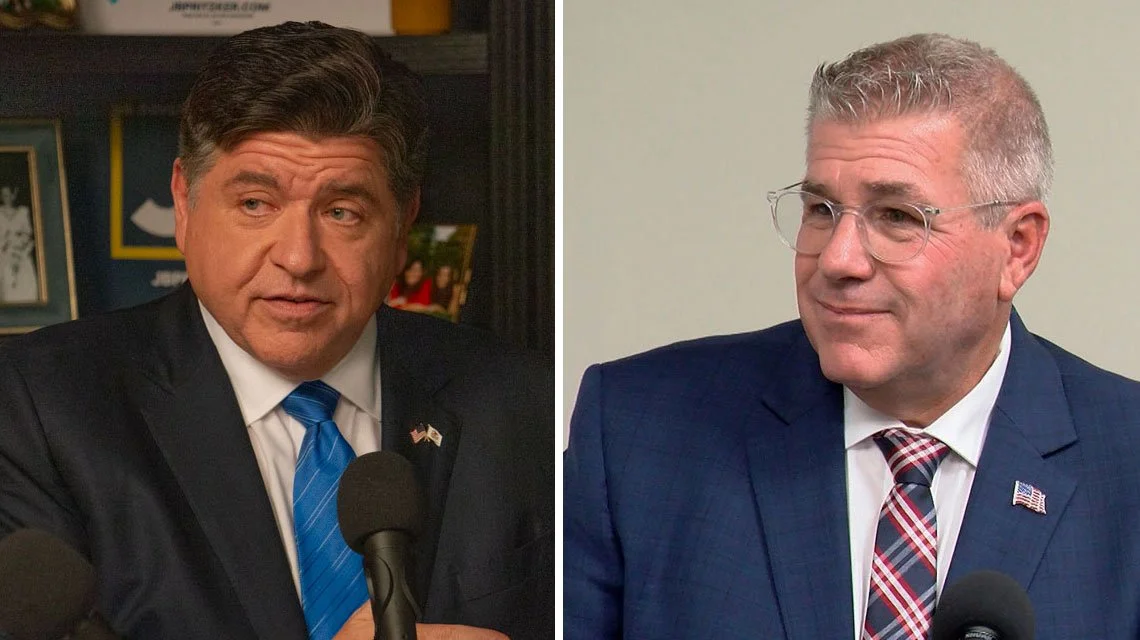
Gov. JB Pritzker and Darren Bailey met for the only scheduled forum of the election cycle on WTTW.
The event was dominated by interruptions and accusations by the candidates about each other’s records.
Federal issues received a lot of attention, leading Bailey to say he was focused on issues in Illinois while Pritzker mounts a presidential campaign.
This summary was written by the reporters and editors who worked on this story.
Democratic Gov. JB Pritzker and Republican Darren Bailey spent an hour talking over and accusing each other of stretching the truth in their only planned meeting of the campaign Tuesday night.
The WTTW forum was supposed to be a question-and-answer session, but Bailey quickly revealed his strategy to interrupt Pritzker on nearly every question, launching the event into a full-blown debate. The candidates were asked about their plans on a variety of policy issues and Pritzker often listed his previous accomplishments while Bailey used his time to slam Pritzker’s leadership.
“I wish you’d stop interrupting,” Pritzker said midway through the debate. “I do think people ought to hear what we have to say.”
The pair met for two debates in 2022 ahead of Pritzker’s 12-point victory. Four years later, many of the positions for the two candidates remained the same, and the relationship remained heated.
The candidates sparred on state spending, education funding, safety net hospitals, the SAFE-T Act, the Chicago Bears, Choate Mental Health and Developmental Center and more.
But much of the debate centered on the relationship between the federal government and the state. Bailey urged the audience to “fill up your glass of water or your iced tea or your lemonade” and “take a drink” every time the governor mentioned President Donald Trump. He reminded them to do so each time the governor invoked the president.
Bailey, who has spent the campaign trying to appeal to moderate voters in the Chicago area, tired of several federally focused questions.
“I think we’re all ready for the tariffs to end. I think we’re ready for the war in Iran to end,” Bailey said when asked how he’d respond to Trump’s tariffs. “But these questions, this sounds like this is a debate about the presidency of the United States with President Trump. That’s something the president deals with. We need to be focused on what we can do here in Illinois.”
Bailey, a farmer, also punted on a question about what he’d like to see in the next federal farm bill, saying “I’m not running for president like JB Pritzker is.”
“I’m flattered that you think I could get elected president of the United States,” Pritzker retorted at one point.
Instead, Bailey said Illinois lawmakers should lower the estate tax. When challenged by Pritzker to endorse the Family Farm Preservation Act that would cap that tax, Bailey said “I need to read it,” pointing out that Democrats haven’t passed it despite controlling all levers of state government.
Budget issues
The candidates spent considerable time debating education funding. Pritzker listed Illinois’ improvement in various rankings of test scores and public school funding. But he said more money is still needed, despite the fact Illinois has increased funding education funding by about $3 billion in his tenure under the Evidence-Based Funding model.
“The very question from Jackson County schools suggests that we’re not up to par like JB just said that we were,” Bailey said in reference to a southern Illinois reporter’s question. “The point’s made clear: Evidence-Based Funding is not working because Evidence-Based Funding suggests that more money is the answer.”
“More money is not always the problem,” he said, instead suggesting the state should reduce unfunded mandates. He also pledged to replace the entire State Board of Education if he’s elected.
Pritzker wouldn’t commit to meeting Chicago Public Schools’ demand more funding during this fall’s veto session.
“We can’t just magically come up with $150 million when one school district or another asks for it,” he said.
More broadly on the budget, Bailey has pledged to institute a DOGE-style (Department on Government Efficiency) review process if he’s elected.
“At two in the morning, you’re given this budget, 5,000 pages, and you’re told to pass it,” Bailey said. “Even the Democrats themselves don’t know what’s in there. It’s time for a forensic audit.”
Pritzker sidestepped a question about putting a millionaire’s tax on the ballot and instead criticized Bailey for voting against the budget when he was in the legislature.
“If we continue to tax the rich, that’s a socialist mentality and we can’t afford to do that,” Bailey said.
Public safety
The candidates also dove into public safety issues. Bailey said Pritzker’s decision to significantly reduce available care at Choate Mental Health and Developmental Center in Anna will limit mental health services in southern Illinois and put pressure on law enforcement.
Pritzker defended the decision for the abuse-plagued facility.
“I said at the very beginning-that if we could not fix it because the personnel weren't fixing themselves, or being fired, or laid off, then we needed to close that facility,” Pritzker said. “And I followed through on my promise.”
The SAFE-T Act, the 2021 law that included the elimination of cash bail in Illinois, also got another vetting four years after it was a dominant issue in the governor’s race.
Pritzker said he is “always open” to amending the law, which puts the onus on state’s attorneys and judges to determine whether a defendant is jailed while awaiting trial. but the governor didn’t elaborate when asked to assess how the law is working and instead brought up Bailey’s support for lessening gun restrictions.
Bailey pointed to recent crimes in Chicago involving people on electronic monitoring. The law allows people on monitoring to have two free roaming periods each week, which Bailey said needs to change. Democratic Cook County State’s Attorney Eileen O’Neill Burke has also called on lawmakers to amend electronic monitoring laws.
But Bailey also said the whole SAFE-T Act should be repealed, prompting Pritzker to retort that Bailey’s solution was returning to a cash bail system “where the most violent criminals can buy their way out of jail.”
Bailey also criticized Pritzker for having an Illinois State Police security detail.
Bears and other issues
There was only brief discussion about the Chicago Bears’ stadium plans. Pritzker reiterated how the Bears are a private business and the state isn’t in the business of subsidizing them, though it could fund related infrastructure projects.
“I’m just glad I’m not going to be known as the governor that lost the Bears,” Bailey said when asked to explain his plan to facilitate their move to Arlington Heights. He accused Pritzker of delaying engagement with the team until Indiana stepped in with a massive subsidy package.
On housing, Bailey suggested Illinois needs to lower property taxes before he ripped Pritzker about the state’s lackluster population growth.
On lowering utility prices, Pritzker repeated he will push lawmakers to pass the POWER Act in November — a bill many advocates believe will help reduce energy costs by requiring data centers to supply their own power.
Bailey criticized the state’s two major climate and energy bills passed under Pritzker, which aim to take fossil fuels offline by 2045. Critics say that deadline disincentivizes coal and gas plants from investing in the state, driving up prices and reducing available production.
“We're phasing out reliable energy far too soon,” he said. “I have no problem with bringing on what we suppose is clean energy, but we all know the wind doesn't always blow, and the sun doesn't always shine.”
Pritzker’s latest energy plan has focused on battery storage as a means of increasing reliability.
On Medicaid funding and struggles many Illinois hospitals are facing because of federal funding cuts, Bailey suggested lawmakers “reprioritize spending” while Pritzker called for universal health care and faulted cuts at the federal level — prompting Bailey to call for a “drink.”
Independent candidate Collin Corbett was not on the stage Tuesday night, garnering only a brief mention.
“The good news is there is an alternative to the two party circus you saw on display tonight,” he said in a statement. “My running mate, Carolyn (Schofield), and I have developed common sense plans to get our state moving in the right direction. Send a message to the broken two party system by voting for a mainstream Independent for Governor."
Capitol News Illinois is a nonprofit, nonpartisan news service that distributes state government coverage to hundreds of news outlets statewide. It is funded primarily by the Illinois Press Foundation and the Robert R. McCormick Foundation.
MT. CARMEL MAN SENTENCED TO 17 YEARS IN PRISON IN ARMED ROBBERY CASE
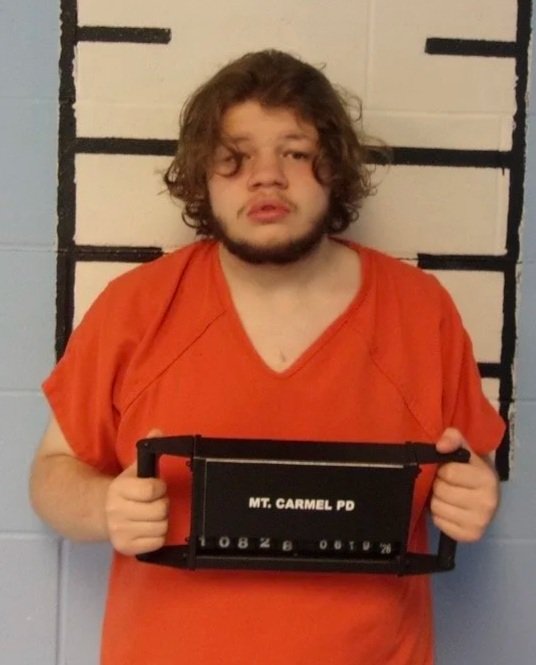
An 18-year-old Mount Carmel man has been sentenced to 17 years in the Illinois Department of Corrections after pleading guilty to armed robbery in Wabash County Circuit Court Tuesday.
Joshua Parrish appeared in court Tuesday with Public Defender William Easton and entered a guilty plea to one count of armed robbery, a Class X felony.
Court records show the judge accepted the plea and, after considering Parrish's criminal history and the negotiated agreement, sentenced him to 17 years in prison, with the sentence to be served at 50 percent. Parrish will also be subject to up to 18 months of mandatory supervised release.
As part of the plea agreement, prosecutors dismissed the remaining seven felony charges, including robbery of a victim age 60 or older, aggravated robbery, two counts of attempted aggravated criminal sexual assault, attempted aggravated kidnapping, aggravated battery, and unlawful restraint.
The charges stemmed from an incident on June 19th involving an elderly woman in Mount Carmel.
Prosecutors had alleged Parrish used a knife to rob the woman, threatened to sexually assault her, and attempted to force her into a wooded area.
Parrish had remained in custody while awaiting trial after the court previously determined his release would pose a threat to public safety.
The guilty plea and sentencing bring the criminal case to a close at the trial court level. Parrish was advised of his appeal rights during Tuesday's hearing.
MT. CARMEL FALL BIG TRASH CLEANUP ENDS SATURDAY
Mount Carmel residents have just a few days remaining to take advantage of the city's annual Fall Big Trash Cleanup.
During Tuesday afternoon's Mount Carmel City Council meeting, Garbage Commissioner Susan Zimmerman reminded residents that this is the final week of the program, which allows city residents to dispose of unwanted household items and oversized trash.
Zimmerman thanked everyone who has already participated and encouraged those who still have items to dispose of to take advantage of the remaining collection days.
The city's disposal site on Golden Aces Way will be open Thursday from 9 a.m. until 5 p.m.
On Friday, the hours will be extended from 9 a.m. until 7 p.m.
Saturday is the final day of the cleanup, with the site open from 9 a.m. until 3 p.m.
Mount Carmel residents can dispose of eligible items free of charge by presenting their Mount Carmel water bill.
Zimmerman said the program has given residents an opportunity to get rid of unwanted and unused items around their homes.
Again, Mount Carmel's Fall Big Trash Cleanup wraps up this Saturday, October 17th, at 3 p.m.
Lincoln Memorial Bridge closure planned for State Road 441 in Knox County
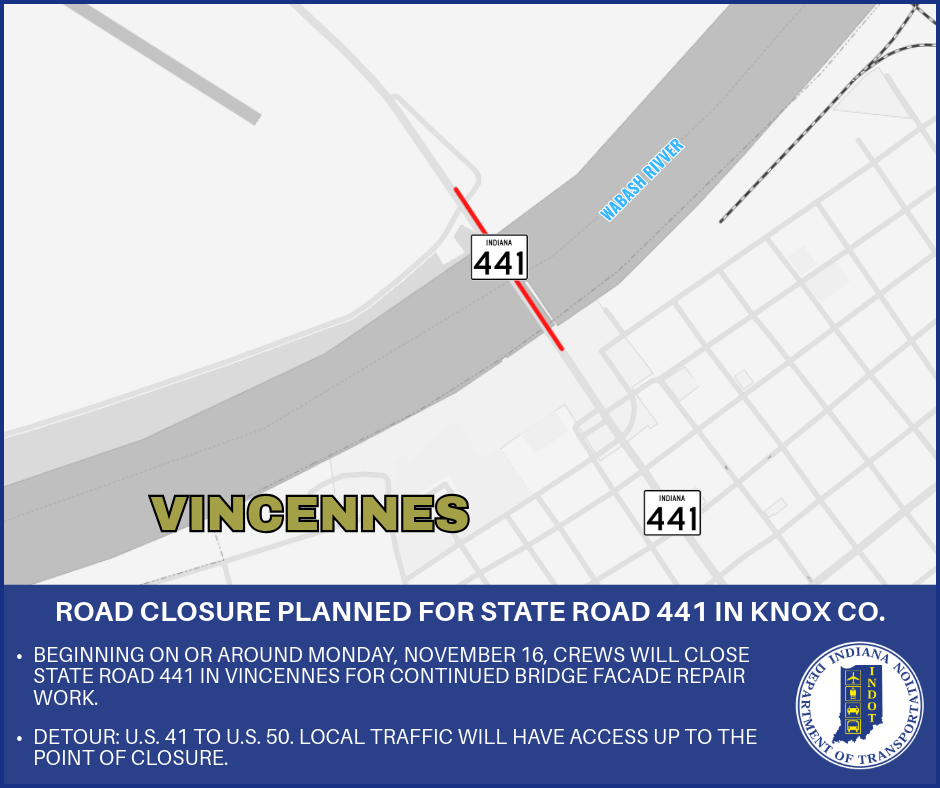
KNOX COUNTY Ind. – The Indiana Department of Transportation announces a road closure for State Road 441 in Knox County.
Beginning on or around Monday, November 16, crews will close State Road 441 in Vincennes. This closure will occur at the Lincoln Memorial Bridge over the Wabash River.
This closure will allow for continued repair work to the façade of the Lincoln Memorial Bridge. This work is expected to last through mid-March of 2027, depending on the weather.
The official detour for this project is U.S. 41 to U.S. 50. Local traffic will have access up to the point of closure. INDOT reminds drivers to slow down, use extra caution, and avoid distractions when traveling in and near work zones.
JUDGE ADDRESSES ODOR COMPLAINTS AT MT. CARMEL WASTEWATER TREATMENT PLANT
Mount Carmel Mayor Joe Judge says the ongoing drought is responsible for unpleasant odors coming from the city's wastewater treatment plant on South Division Street, and city crews are taking steps to address the problem.
The issue was first raised during Friday's Ask the Mayor program on WSJD, when a listener complained that strong odors from the sewer plant have made it difficult to enjoy evenings outdoors.
Judge explained that the city's aging sewer system normally receives additional water from rainfall and groundwater infiltration. However, the extended dry conditions have dramatically reduced the amount of water flowing through the treatment plant.
The mayor said the plant typically processes between 1.2 and 1.5 million gallons of wastewater daily. Currently, that figure has dropped to just 200,000 to 300,000 gallons.
Judge says the unusually low flow has contributed to a buildup in the plant's primary sludge tanks, resulting in the strong odors residents have been noticing.
During Tuesday's Mount Carmel City Council meeting, Judge provided another update, saying the plant's flow had barely reached 200,000 gallons that morning.
The mayor said crews began making adjustments Monday in an effort to reduce the odors, but warned that it could take several days before residents notice an improvement.
Judge also addressed suggestions from residents that the city simply add more water to the treatment system.
He explained that the plant uses non-potable water from its treatment process, and that supply is limited. Adding chlorinated water from the city's drinking water system could disrupt the biological processes inside the plant's clarifiers, potentially causing expensive problems.
Judge emphasized that the city must carefully manage any adjustments to avoid damaging the treatment system.
The mayor also assured residents that the wastewater treatment plant remains in full compliance with Illinois Environmental Protection Agency regulations and that state officials are aware of the unusually low flow conditions.
Judge said city employees are doing what they can to minimize the odors while protecting the plant's operations.
He added that some much-needed rainfall would help improve conditions at the facility.