WGH Board Approves New Digital Sign For Carmi Facility

Wabash General Hospital is moving forward with plans for a new digital sign at its Carmi Medical Clinic.

During Monday evening’s Board of Directors meeting, President and CEO Karissa Turner requested authorization to spend up to $75,000 on the project.

Turner said the proposal from Signarama falls within her normal spending authority, but the project was not included in the previously approved $400,000 budget for the Carmi clinic. Because of that, she brought the expenditure before the board for approval.

The proposed digital sign would utilize the framework of an existing sign at the clinic, which Turner described as being located in a high-traffic area.

Turner said one concern was investing in a permanent sign at a building the hospital leases rather than owns. Hospital officials confirmed the digital sign could be relocated in the future if necessary, although the hospital would be responsible for moving costs.

The new sign would be similar to the digital sign used at Wabash General’s Grayville location. Officials are also determining whether changing the existing sign to digital will require additional permits.

Turner requested authorization not to exceed $75,000, allowing some flexibility for possible landscaping or other work around the sign.

The Board of Directors unanimously approved the request.

Mt. Carmel Jr. High Athletic Officials Pay Increasing

The Wabash Community Unit School District #348 Board of Education has approved an increase in pay for officials working junior high athletic events.

The board met in special session Tuesday morning at the district office, with junior high athletic officials’ pay among the items on the agenda.

Superintendent Dr. Chuck Bleyer said the request came from the junior high athletic director following the board’s previous meeting. The goal is to bring Mount Carmel’s pay rates more in line with other schools in the area and help the district attract officials.

Under the new rates, pay will increase by about five dollars for baseball and softball officials and by ten dollars for volleyball officials. Track officials will also receive an increase of about ten dollars, with the highest rate reaching 125 dollars for certain meets. Junior high basketball officials’ pay will remain unchanged.

Bleyer said the increases are relatively small but keeping rates competitive with surrounding districts is important when scheduling officials.

Board members agreed, noting the ongoing shortage of officials in high school and junior high athletics. Members pointed out that officials often work for relatively modest pay while dealing with criticism from spectators and the physical demands of games.

The shortage has also affected scheduling. Board members noted that football games have previously been moved to Thursday nights because of difficulty finding enough officials for traditional Friday and Saturday schedules.

Following discussion, the board unanimously approved the new junior high officials’ pay rates.

District #348 School Board Approves Chromebook Purchase

The Wabash Community Unit School District #348 Board of Education has approved the purchase of 115 new Chromebooks at a cost of just over 53-thousand dollars.

The board met in special session Tuesday morning at the district office.

Superintendent Dr. Chuck Bleyer said the district needs to replenish a full grade-level set of Chromebooks. The Building and Grounds Committee reviewed the proposal in detail, with Lenovo selected as the preferred device.

Bleyer said the new Chromebooks will initially be assigned to third-grade students and will remain with those same students as they progress through junior high, creating roughly a five-year replacement cycle.

The district is purchasing 115 devices, slightly more than the number of students currently in the class, to allow for attrition and other needs. The Chromebooks will also include five-year warranties.

Bleyer said assigning a specific Chromebook to each student will allow the district to better track wear and tear and how individual devices are being cared for.

While the Chromebooks will follow students from grade to grade, Bleyer stressed that the devices will not leave school. At the end of each day, they will be placed on carts for storage and charging.

As students get older and begin moving between classrooms, they will take their assigned Chromebook with them from class to class.

Following discussion, the board unanimously approved the purchase of 115 Lenovo Chromebooks at a cost of just over 53-thousand dollars.

WGH Board Hears Updates on Ambulance Building, Carmi Rehab Space

Wabash General Hospital board members received updates on several projects during committee reports at Monday evening’s Board of Directors meeting.

Planning Committee Chairman John Evans said work continues on plans for a new ambulance building. Hospital officials have been working with ACRA to reduce the projected cost and are still determining exactly what will be included in the project. Evans said the committee hopes to have a final cost estimate available at its next meeting.

The Planning Committee also discussed a possible solar panel installation. No action was taken, and the proposal remains under study.

Construction and Building Committee Chairman Rob Coleman reported that the hospital currently has little construction underway. He did announce that Wabash General’s space in Carmi has been refreshed, reopened to patients and is doing well.

Meanwhile, Contract Compliance Committee Chairman Bill Easton reported the committee approved an agreement with a medical provider who will serve the hospital as an independent contractor. No additional details about the provider were announced during the meeting.

The hospital board approved the minutes and reports from all three committees.

Major Upgrades To District #348 Bus Garage Considered

The Wabash Community Unit School District #348 Board of Education is considering a major upgrade to the district’s bus garage, with an initial estimate putting the project at approximately 2.1 million dollars.

The board met in special session Tuesday morning at the district office, where Board President Jamie McCorkle said several long-discussed district projects were being brought before the full board for review.

Superintendent Dr. Chuck Bleyer presented preliminary plans for replacing the existing bus garage. Bleyer said the district owns enough property at the current site to construct a new facility behind the existing building, which would eventually be demolished.

The preliminary design calls for a three-bay garage, including a center bay with a maintenance pit that would allow the district mechanic to work underneath buses. Plans also include new plumbing and drainage, restrooms, an office, conference room, storage, mechanical and break rooms.

The estimated base cost is approximately 2.1 million dollars. Additional options, including bus shelters and other site improvements, could increase the price. Bleyer said construction costs appear to have leveled off, although there is no guarantee the final cost would remain at the current estimate.

Funding could include revenue from the district’s one-percent sales tax. Bleyer said about half of that revenue is currently committed to bonds used for previous athletic facility improvements, with approximately five years remaining on those bonds.

Board members expressed support for continuing to explore the project, noting the age and limitations of the existing bus garage. Bleyer cautioned that spending more than two million dollars on the facility would leave the district less financially flexible and could cause some future projects or purchases to be delayed.

No vote was taken Tuesday. Bleyer said the next step will be additional discussion by the Building and Grounds Committee, including input from bus garage employees about what the new facility actually needs. The district could also consider reducing or modifying the preliminary three-bay design.

Bleyer said any formal vote would likely come at a regular board meeting, and the project would not begin until sometime next year at the earliest.

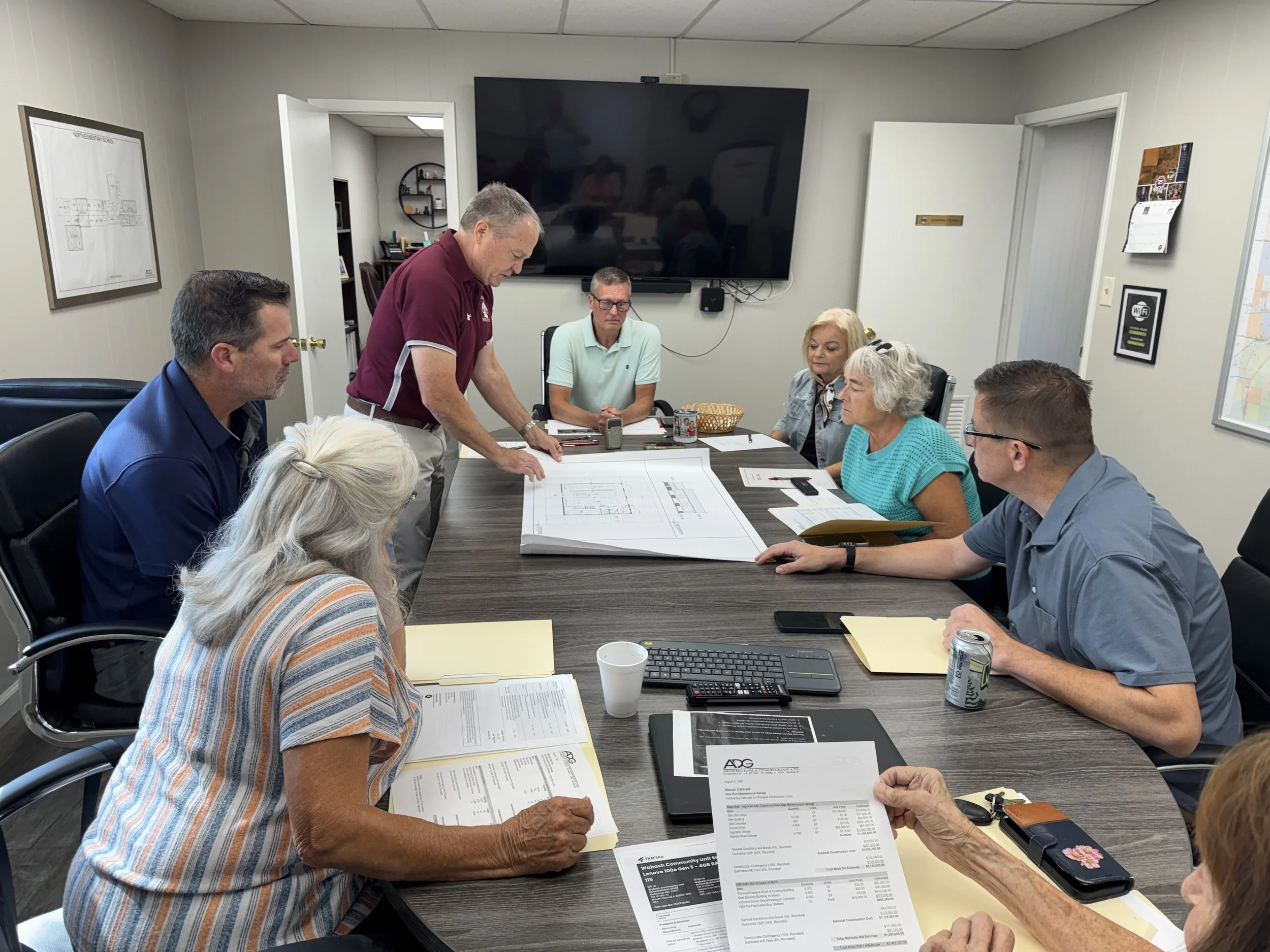
Members of the Wabash District #348 school board look on as Superintendent Dr. Chuck Bleyer shows them preliminary designs for a new bus garage on West 3rd Street.

Mayor, Commissioners, & Staff Offer City Updates

Mt. Carmel city officials offered updates on the new aquatic center, city finances and several ongoing projects during a brief City Council meeting last week..

Mayor Joe Judge said construction of the new aquatic center continues to move along quickly, with the project now in its 11th week. Crews are installing the stainless-steel gutter system, while walls in the aquatic area have been completed and plumbing for the main pool's recirculation system is being installed.

Judge said work on the decking outside the pool is expected to begin this week. Garmong Construction also recently poured the pump room floor, with pumps scheduled to be installed last week.

Judge also called Chamber Days a success, praising the Chamber and amusement company for this year's event.

Street Commissioner Tyson Meador reported continued work on the Park Road sidewalk project, repairs to a storm sewer at 7th and Chestnut, and fresh paint on Poplar Street crosswalks ahead of the start of school. Crews also trimmed trees and brush and filled potholes.

Finance Commissioner Eric Ikemire reported nearly $342,000 in revenue over the past two weeks, including more than $216,000 in sales tax revenue and $77,000 in state income tax. He said the city is about three-and-a-half months into its fiscal year but has already used approximately 42 percent of its budget, putting spending slightly ahead of schedule.

Water and Sewer Commissioner Tom Meeks reported crews repaired three water leaks and bored three new water lines. The city is also repairing the number-one well motor at the water treatment plant following what officials believe was a lightning strike. At the wastewater treatment plant, crews were also working on repairs to a floating aerator.

Commissioner Susan Zimmerman reported the Mt. Carmel Fire Department responded to 11 incidents over the past two weeks, ranging from a kitchen fire to lift assistance calls with Wabash General Hospital Ambulance Service.

During staff reports, Mt. Carmel Municipal Airport Manager Luis Garcia said work on the airport's taxiway lights is nearly complete. Garcia also replaced a runway light Monday and said only a couple of additional transformers are needed to finish the lighting work.

Mt. Carmel Police Chief Erin Peach reminded motorists to use additional caution around local schools now that classes are back in session. Peach urged drivers to watch for increased traffic, pedestrians and children riding bicycles.

City employee Mike Hannah also reported that crews completed a significant road repair on Westover. Hannah said that section of roadway had been deteriorating for some time before crews dug out the damaged area and made repairs.

WCHC Reports Early Success With Medication-Assisted Treatment Clinic

A new treatment program at Wabash Community Health Center is already making a difference for area residents struggling with substance dependence.

During Monday evening’s Wabash General Hospital Board of Directors meeting, Wabash Community Health Center’s Cathy Ruth reported that six patients have been treated through the Medication-Assisted Treatment Clinic.

Ruth said the program uses Suboxone as part of treatment for patients attempting to stop using substances, including kratom. Patients must be experiencing withdrawal when they arrive for their initial treatment so providers can determine an appropriate dose.

After that initial visit, patients return weekly for counseling, monitoring and adjustments to their medication when necessary.

Ruth said the difference she has seen in patients following treatment has been remarkable, with patients returning more engaged, smiling and reporting improvements in their lives.

Some participants were already Wabash Community Health Center patients receiving counseling before medication-assisted treatment became available. Others are traveling from outside the immediate area, including one patient from Mt. Vernon.

Ruth said Wabash Community Health Center is currently the closest provider offering the treatment in the surrounding area and expects participation to grow as more people learn the service is available.

Patients are tested during visits and must sign an agreement stating they will not use prohibited substances while receiving treatment through the program.

Carbondale educator accused of exploiting young girl in violent online ‘cult’

The former high school teacher’s aide faces 2 felony counts, denied bail until trial

Article Summary

  • Austin Knoob, 32, of Carbondale, faces two counts of sexual exploitation of a child.

  • An underage girl told the FBI she’d been communicating with Knoob for roughly four years, since she was 12, and he had encouraged her to send sexually explicit videos of herself, as well as videos of her cutting herself. 

  • Knoob, who until recently also owned the Levels nightclub in Carbondale, was a teacher’s aide at Carbondale Community High School during most of the time covered by the federal criminal complaint and supporting FBI affidavit. He resigned on April 10.

  • The case originated in Boston. After the girl was interviewed in late July, Boston FBI agents reached out to the FBI’s field office in Marion for assistance in investigating Knoob, who the girl knew online as “Frank.”

This summary was prepared by the reporters and editors who worked on the story.

By MOLLY PARKER

Capitol News Illinois

& MARIAH FLETCHER

Saluki Local Reporting Lab 

A Carbondale Community High School teacher’s aide allegedly cultivated an online relationship with an underage girl, sending her money and gifts while repeatedly encouraging her to make sexually explicit videos of herself, according to a federal criminal complaint and an FBI affidavit. 

Austin Knoob, 32, of Carbondale, who is also the former owner of Levels nightclub, faces two counts of sexual exploitation of a child. He pleaded not guilty last week in federal court in Benton. Judge Reona Daly on Monday denied Knoob’s pretrial release; he will remain in custody while his case is pending.

The case originated in Boston and quickly led to Knoob’s arrest after he admitted to the FBI that he had been talking to the girl, who said she was 12 when they first met online, according to a sworn affidavit filed last week by FBI Special Agent Samuel J. Sukovich, who investigates violent crimes against children from the FBI’s Marion office.

Later, Knoob allegedly recruited the girl into an online group whose members encouraged her to share videos of her harming herself. She was then added to an even more extreme group she described as a “cult” that included members sharing videos of people committing suicide and other bizarre acts, the affidavit alleged.

Assistant U.S. Attorney Casey Bloodworth asked the court to keep Knoob in custody, saying the allegations against Knoob suggest a “deep-seated, heavily rooted sexual deviancy.” While the government’s charges involve one minor victim, Bloodworth said there may be additional victims identified as the investigation unfolds. 

Knoob’s attorney said Knoob did not have a prior record, noting he would use an ankle monitor and said his dad had offered to ensure he had no internet access. But Judge Daly sided with the government in keeping him in custody, saying that despite hearing numerous child pornography cases, “I have never seen anything like this.” 

The girl was interviewed July 28, and the FBI’s Boston office referred the investigation to agents in Marion on Aug. 6. Six days later, agents interviewed Knoob at his home. Knoob, who the girl knew as “Frank” online, was taken into custody two days later.

One count stems from an Aug. 12-13, 2025, exchange in which “Frank” asked the girl whether she had any new material. After she said she did, he wrote, “I definitely wanna see lol.” She then sent him a link to a video of herself masturbating, according to the affidavit.

The second stems from an April 9 exchange in which “Frank” asked her to “spoil me with any new things she has taken.” After she said she had “a lot,” he told her, “My last day of work is tomorrow,” then wrote, “I need a lot.” The girl sent six images and nine videos of herself, most of which the FBI identified as child pornography under federal law.

“I love you,” he wrote after receiving them. He then suggested he might visit her soon and the two could “Make our own videos.”

FBI: Girl reported Knoob said he bragged about other victims

Carbondale Community High School Superintendent Daniel Booth said Knoob was hired as an aide in August 2025 and resigned effective April 10, one day after the text exchange underlying the second federal charge. The period documented in the affidavit largely overlaps with his employment at the high school. The girl told investigators that Knoob sometimes solicited sexual content from her while he was bored at work.

Booth said he was unaware of the allegations against Knoob or his arrest last week until contacted by Capitol News Illinois on Sunday. He said Knoob submitted his two week’s notice in a letter dated March 30 and told co-workers that he was leaving to pursue a different job. Booth stressed that no one from the FBI or any other federal authorities have contacted him, and that he has no information to believe any Carbondale High students are involved. But he encouraged anyone with information to reach out to the district or federal authorities. 

The girl told the FBI that before Knoob became a teacher’s aide at Carbondale High, he had told her he previously worked as a teacher in another district but was fired. The resume he provided Carbondale High listed substitute teaching in the neighboring Murphysboro school district as his only prior educational experience, according to records obtained by CNI. The Murphysboro superintendent told CNI that Knoob worked only a handful of days in that district three years ago. 

She said he claimed to have had sex with multiple students, as well as his girlfriend’s 15- or 16-year-old cousin, according to the affidavit. It does not say whether investigators independently verified those claims.

The affidavit cites Carbondale Community High School Board minutes showed Knoob was employed as a teacher’s aide for the 2025-26 school year but provides no other information about his employment history.

Illinois State Board of Education records show Knoob was licensed as a substitute teacher in November 2023. In July 2025, he obtained a license to teach social science and history in grades 9-12. His licenses were registered in two regional offices of education spanning nine Southern Illinois counties: Alexander, Franklin, Jackson, Johnson, Massac, Perry, Pulaski, Union and Williamson.

In a statement to CNI, a spokesperson for the FBI’s Springfield Field Office described the case as an “active investigation” and “per Department of Justice policy, we are unable to comment on active investigations.”

However, the FBI said it will alert any relevant public or private entities if suspected abuse in those locations occurred; these notifications would also include the Illinois Department of Children and Family Services, if warranted.

The girl told investigators she began talking with Knoob on Snapchat roughly four years ago, when she was about 12.

Knoob told investigators he believed the girl was about 15 when they met online and acknowledged knowing she was underage. He said he had never met the girl in person. 

Knoob acknowledged asking her for sexually explicit images and videos and said he “might have” coached her in making them.

Knoob also told investigators they would find child sexual abuse material on his computer and admitted searching for it online and participating in groups where it was shared, according to the affidavit.

He also told investigators he was sexually attracted to underage children though would not want to “go below 15,” according to the affidavit.

The girl told investigators that Knoob’s Snapchat accounts were repeatedly banned and that he sent her child sexual abuse material involving other children, some she estimated were as young as 4. She said he wanted her to recreate what she saw, according to the affidavit.

She also told investigators he wanted to get her a dog because he wanted her to do “things” with it.

Girl pushed into violent, online extremist groups

She said Knoob later added her to a group on the social media channel Telegram, where child sexual abuse material was shared. She also told investigators Knoob knew she was harming herself and added her to another Telegram group whose members wanted photos and videos of her hurting herself.

After she sent the self-harm group a video, members asked her to recruit female friends to make similar videos. 

When she refused, she said, members threatened to show her family images and videos that Knoob had sent to the group. Members posted her home address and the full names of her mother, father and grandmother and threatened to hurt her family unless she continued sending content, she told the FBI, according to the affidavit.

She said she was later added to another, more extreme online group she described as a “cult.” She said members posted images and videos showing writing in blood on walls, people killing animals and live viewings of people committing suicide. She also described content showing people selling their skin and drinking acid.

The affidavit does not say whether Knoob allegedly added her to this second group.

'764' a growing online concern

The girl told the FBI that members pressured her to cut herself and wanted her to carve the group’s identifying numbers into her stomach. She remembered those numbers as “Seven something Four.” When she refused, she said, members threatened her, and she eventually sent the group videos of herself cutting her thigh.

The affidavit does not identify the group. But in recent months, the FBI has warned parents, guardians and caregivers about a group known as 764, which it has described as a loose network of violent online groups that exploit children and other vulnerable people.

In February, the FBI’s Boston office issued a warning to parents about what it described as a “sharp increase” in activity involving 764 and similar violent online networks. The bureau said members connect with children online by first establishing a trusting or romantic relationship. 

Then, they coerce them into producing child sexual abuse content or engaging in animal cruelty, self-harm and other violence.

At the time, the FBI said it was investigating more than 350 people nationwide tied to 764 and similar networks. All 56 FBI field offices were involved, and federal prosecutors have already brought several major 764 cases. Last week, Kyle Spitze, of Tennessee, received 77 years in prison, the longest federal prison sentence ever imposed on a nihilistic violent extremist, according to the Justice Department.

Neither the criminal complaint nor the supporting affidavit alleges that Knoob was part of 764.

But months after the Boston office issued that warning, the same field office became involved in the investigation that led agents to Knoob.

During her July 28 interview, the girl gave investigators a phone number she said “Frank” used to communicate with her. Agents found an iMessage thread with that number on her laptop containing about 720 messages exchanged between July 30, 2025, and May 21, 2026.

Verizon records obtained Aug. 7 identified the subscriber as Knoob. An FBI agent drove by Knoob’s Carbondale home that day and saw two vehicles registered to him. Agents interviewed Knoob there five days later.

Knoob previously owned Levels, along with his father, Greg Knoob, who originally operated it as Carboz. Greg Knoob also ran other popular college bars, including Callahan’s Irish Pub and Stix Bar & Billiards. The family was entangled in years of disputes with the city over underage drinking and fights at their establishments, especially at Levels, which Austin Knoob assumed ownership of in 2015. He ran it until 2020, when the city revoked his liquor license. Levels and Stix was sold to new owners this year.

The FBI encouraged anyone with information to report concerning Knoob to contact the bureau at 1-800-CALL-FBI and make a report, referring to this specific incident.  

 Capitol News Illinois is a nonprofit, nonpartisan news service that distributes state government coverage to hundreds of news outlets statewide. It is funded primarily by the Illinois Press Foundation and the Robert R. McCormick Foundation.

The Saluki Local Reporting Lab is a special project of the SIU School of Journalism and Advertising and is designed to give students from diverse backgrounds practical reporting experience while providing news coverage to underserved communities.
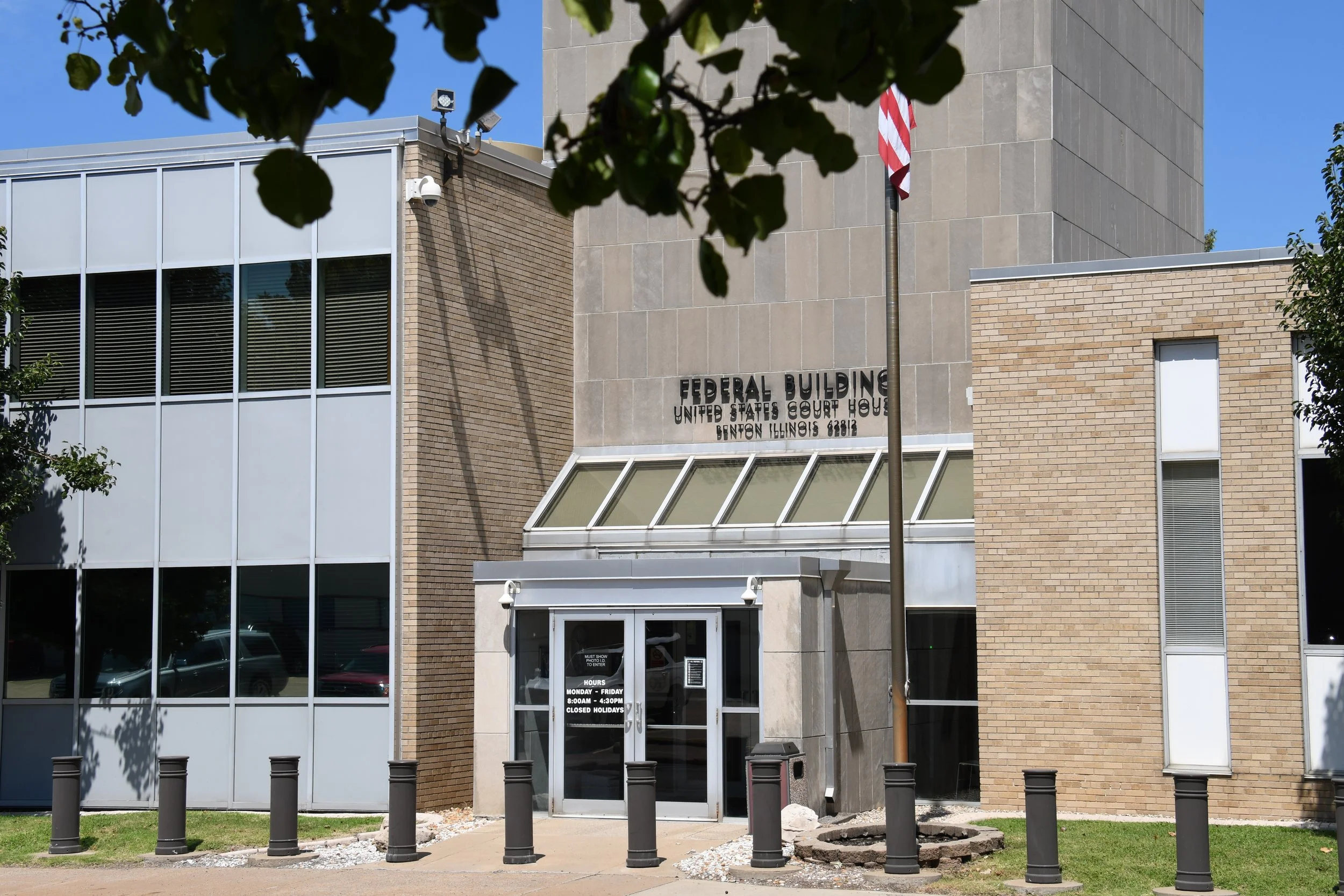
A view of the federal courthouse in Benton, Illinois. (Photo by Jackson Brandhorst, Saluki Local Reporting Lab)

WGH Announces New Breast Cancer Support Group

Wabash General Hospital is launching a new monthly support group for women affected by breast cancer. The group is open to women who have been diagnosed with breast cancer, are currently undergoing treatment, or are breast cancer survivors.

The Breast Cancer Support Group will provide a welcoming setting where participants can connect with others who understand the breast cancer experience, share encouragement, and build a supportive community.

The first meeting will be held Tuesday, October 20, 2026, at 6 p.m. in the classroom at Wabash General Hospital. The group will continue to meet at 6 p.m. on the third Tuesday of every month.

Women from Mount Carmel and surrounding communities who are living with or have survived breast cancer are invited to participate.

For more information about the Breast Cancer Support Group, contact Wabash General Hospital's Oncology Department at 618-263-3700.

Pritzker, Bailey offer different visions for Illinois education

Candidates respond to questions on school funding, education policy, in State Fair appearances

By PETER HANCOCK
Capitol News Illinois
phancock@capitolnewsillinois.com

Article Summary

  • In appearances during the Illinois State Fair, Gov. JB Pritzker and his Republican challenger Darren Bailey offered different visions for how to improve public education in Illinois.

  • Pritzker acknowledged more funding is needed but maintained his administration has provided significant new funding that has led to improved student performance.

  • Bailey said test scores show too many students are not performing at grade level in reading and math and argued that schools need less government oversight, not more funding.

  • The Pritzker campaign also criticized Bailey over the curriculum at a private religious school he founded in 2016. Bailey now reports that school has received threatening messages and blamed Pritzker for creating a potentially dangerous situation with his rhetoric.

This summary was written by the reporters and editors who worked on this story.

SPRINGFIELD – Gov. JB Pritzker said during Illinois State Fair festivities this month that he agrees public schools need more funding. 

But he also boasted about the additional funding his administration has already provided, and he said that has led to improved performance in reading and math, even though by the state’s own measure, most schools in Illinois remain underfunded.

“We lifted eighth grade reading and math scores to a new high,” Pritzker told a cheering crowd at the Illinois Democratic County Chairs’ Association brunch on Wednesday, Aug. 19. “We got a fifth-in-the-nation ranking for Illinois' K-12 education. We expanded preschool and we notched the highest high school graduation rate in Illinois history.”

His Republican challenger Darren Bailey, meanwhile, said he believes the way to improve education in Illinois is through less government interference, not more funding.

“Let local communities, let parents decide how they want their children educated,” he told reporters outside a Republican State Central Committee meeting Thursday. “Get the government out.”

Those were just some of the comments the two candidates for governor made during political events surrounding the State Fair, an event that traditionally marks the unofficial start of the general election campaign.

The issue of school funding

The state fiscal year that began July 1 marks the 10th year of funding public schools under the Evidence-Based Funding model. Lawmakers enacted that system in 2017 to improve adequacy and equity in Illinois school finance, and it was signed into law by then-Gov. Bruce Rauner, a Republican.

That law established a goal of bringing all districts up to adequate levels of funding by this fiscal year. And in the years since it passed, annual state funding for K-12 education has increased more than $3 billion, with the bulk of that money being directed to the most underfunded districts in the state.

Still, the most recent figures from the Illinois State Board of Education show that more than two-thirds of the state’s elementary, high school and unit school districts will be underfunded this year. And the overall “adequacy gap” — the difference between the funding districts and their adequacy target under the law — now stands at $6.8 billion and growing.

In addition, Capitol News Illinois reported in July that while the state has made progress in narrowing the wealth-based disparities in the distribution of school funding, significant disparities still exist in the property tax rates people pay to fund the local share of education costs. Research showed homeowners in the poorest districts paid tax rates that were twice as high as those in the wealthiest districts.

Pritzker responds

Asked about those trends while speaking with reporters at the fairgrounds, Pritzker said he agreed the state needs to continue increasing education funding, saying “adequacy is always a challenge.”

But then he quickly pivoted to certain performance measurements showing Illinois students improving on several metrics.

“We have a higher graduation rate than we've ever had in the history of record keeping in the state of Illinois,” he said. “We have a higher graduation rate overall. We also have a higher graduation rate for Latino students in high school. We have a higher graduation rate for Black students in high school, and the fact that we have a better student-teacher ratio now is another reason why we're getting better results.”

That’s a message Pritzker has been pushing both from the governor’s office and on the campaign trail. On Aug. 17, his office issued a news release touting the state’s rankings according to various surveys of educational quality. 

That same day, his campaign issued a statement highlighting his administration’s record in education while announcing he had received the endorsement of the Illinois Education Association, the state’s largest teacher’s union.

Bailey responds

Bailey, meanwhile, has been delivering an entirely different message about education, pointing — sometimes inaccurately — to the number of students who score below proficiency on standardized state assessments.

“When 70% of our children across the state cannot read and write and do math at grade level, that's a problem and everyone knows it,” Bailey told reporters. “And Chicago Public Schools system, my heart breaks for them, 90% of the children up there. —Go to Illinois State Board of Education's website. Read it. That's not my numbers. That's the state's numbers.”

In fact, according to the state’s 2025 Report Card, only 47.6% of Illinois students scored below proficiency in English Language Arts while 61.6% scored below proficiency in math.

At Chicago Public Schools, the 2025 Report Card showed 58% of students scored below proficiency in English language arts while 73% did so in math.

Those, however, were the first tests administered under a new scoring system in which the cut scores for determining proficiency were lowered. ISBE officials said that was done to reflect student performance more accurately.

Bailey also brushed aside the suggestion that low scores could be the result of inadequate funding and that most of the students in Illinois attend schools that are underfunded.

“Funding is not the issue,” he said. “Why is money always the always the answer to every problem that we have? Money is not the answer to every problem that we have.”

When asked to explain how he proposes to improve education in the state, Bailey said: “Get the government out of it. Less government, and let the people, let the school districts control themselves.”

“Government doesn't need to mandate and regulate it,” Bailey said. “Let local communities, let parents decide what how they want their children educated.”

Aaron Del Mar, Bailey’s running mate, echoed Bailey’s call for less direct state involvement in school funding and suggested instead that Illinois should opt in to a new federal program backed by the Trump administration that provides tax credits for contribution to private school scholarship funds.

That is similar to Illinois’ former tax credit program called Invest in Kids, which lawmakers allowed to expire in 2023.

“Why don't you ask JB Pritzker why he doesn't opt into the federal program that would bring federal dollars and resources to Illinois,” Del Mar said. “Thirty-two states have already opted in … but JB Pritzker wants to put his political ambitions for the 2028 Democratic (presidential) primary in front of educating Illinois students. When JB Pritzker opts into the federal program, we can start talking more about education.”

Evolution controversy

Also during the fair, the Pritzker campaign tried to revive criticism of Bailey’s involvement in founding a private religious school in southern Illinois in 2016, Full Armor Christian Academy, that teaches a biblically based curriculum that includes the teaching of creationism in science classes.

Bailey stepped down from his role in running the church shortly before launching his 2022 gubernatorial campaign. The Pritzker campaign ran ads at that time criticizing the school for using textbooks published by Bob Jones University Press that suggested humans and dinosaurs once roamed the earth at the same time.

This year, Pritzker’s campaign placed inflatable dinosaurs outside a Republican Day gathering on the fairgrounds to mock Bailey.

The stunt infuriated Bailey, especially when asked by reporters to comment on it. Bailey did not directly respond to the criticism or state a position on evolution, telling a Chicago reporter he “wasn’t there.” He also accused Pritzker of using the issue to deflect attention away from the state’s problems while focusing on running for president in 2028.

Then Monday, Bailey issued a statement saying the school had received a “threatening message” and he accused Pritzker of putting children in danger with by using “reckless” campaign rhetoric.

“Pritzker is free to attack Darren Bailey,” the statement said. “He can spend his billions slinging all the political mud he wants at another candidate. But a governor who not only drags students, teachers, and families into the political gutter but also endangers them with his reckless rhetoric has lost any claim to moral leadership.”

A spokesperson for Illinois State Police said in an email Monday that it is assisting the Clay County Sheriff’s Office in investigating a threat made to the school but offered no additional comment.

Capitol News Illinois is a nonprofit, nonpartisan news service that distributes state government coverage to hundreds of news outlets statewide. It is funded primarily by the Illinois Press Foundation and the Robert R. McCormick Foundation.  


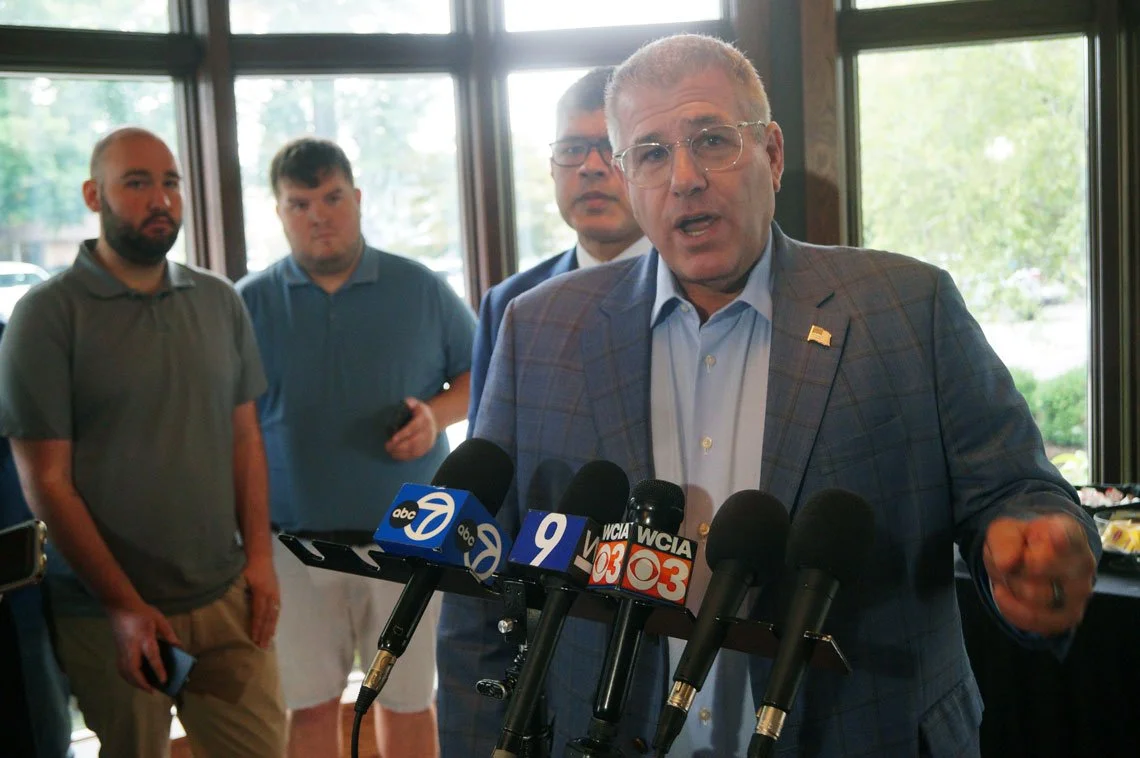
Republican gubernatorial candidate Darren Bailey speaks with reporters following a meeting of the Illinois Republican State Central Committee on Thursday, Aug. 20, 2026. (Capitol News Illinois photo by Peter Hancock)