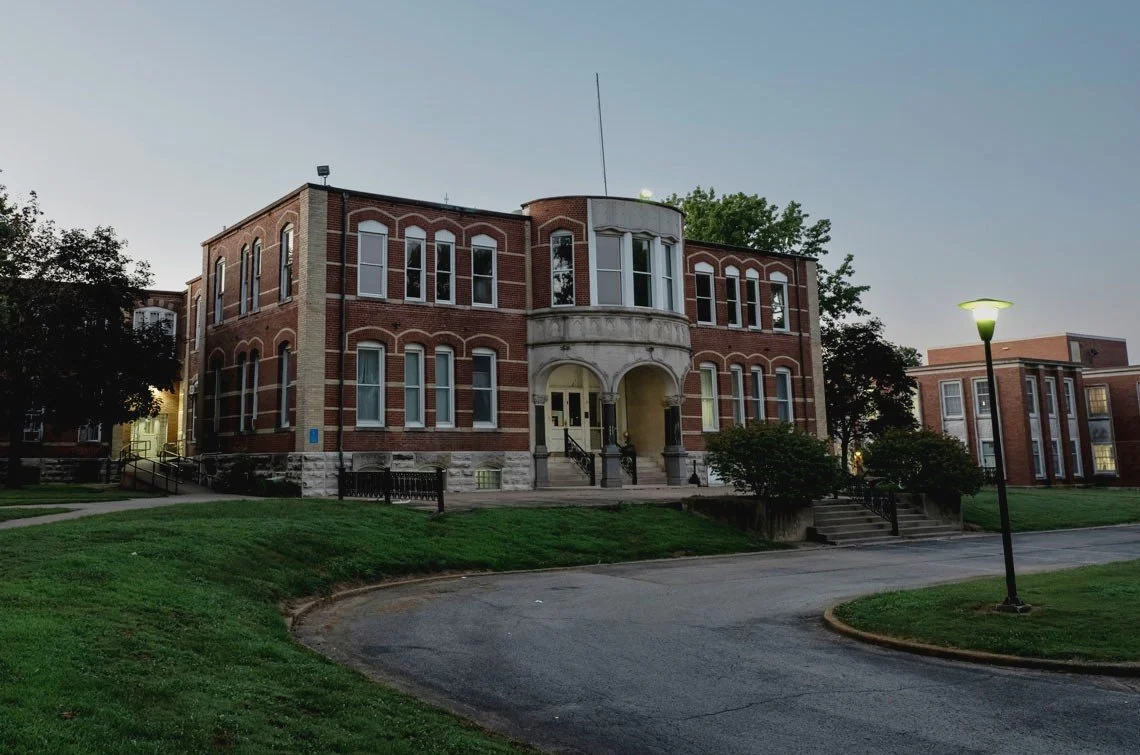
State to lay off hundreds at troubled southern Illinois mental health facility 

Choate Mental Health and Developmental Center to reduce patient population, staff amid operational changes

Article Summary

  • About half of the staff of 524 employees will be laid off at the Choate Mental Health and Development Center in southern Illinois amid operational changes.

  • The Illinois Department of Human Services stated the changes are part of a three-year plan aimed at repurposing the facility.

  • There is now a greater need for mental health beds in northern Illinois, according to IDHS.

This summary was written by the reporters and editors who worked on this story.

By JACKSON BRANDHORST 
Saluki Local Reporting Lab
jbrandhorst@dailyegyptian.com

ANNA — The Illinois Department of Human Services announced Thursday that the Choate Mental Health and Developmental Center in Anna will lay off staff and undergo several operational changes in the coming months, including the elimination of the state-run facility’s entire general residential program for people with intellectual and developmental disabilities.

According to the American Federation of State, County and Municipal Employees — the union that represents the majority of Choate staff — IDHS said it intends to lay off about 250 of the facility’s more than 500 employees over the coming months.

In a letter to Choate staff, IDHS said that the changes are a result of the “success” of the state's three-year plan, which aimed to repurpose the facility over three years in partnership with the Southern Illinois University School of Medicine. 

According to the letter, IDHS plans to cease operations for the intellectual and developmental disabilities general units by Sept. 30. The department will also “phase down” 75 civil mental health beds at Choate while adding beds to the Madden Mental Health Center in Chicago.

This phase-down, says IDHS, which is planned to be completed by March 2027, is because the “need for mental health beds is greater in northern Illinois.”

In its letter, IDHS did not specify how many employees would face layoffs as a result of these reductions, but acknowledged that layoffs will occur.

“We will work with our labor partners to support employees,” the IDHS letter states. “This includes working closely with directly impacted staff who may be subject to the contractual layoff process.”

Choate currently serves 58 total general and forensic I/DD patients and an additional 75 mental health patients while employing roughly 524 people across its campus. Of those employees, 468 are represented by AFSCME Council 31.  

AFSCME responded to the announcement in a news release with comments from Council 31 Executive Director Roberta Lynch, who said that IDHS should have consulted with the union to develop a more rational plan that would be more fair to Choate’s employees and the individuals in their care.

“Unfortunately, the department chose to forge ahead with a plan which will weaken services for the most vulnerable mentally ill individuals and upend the lives of hundreds of Choate employees and their families,” Lynch said. 

Choate’s 40-bed forensic developmental disabilities unit will continue operations, as will the other IDHS administrative offices on the Choate campus. 

Culture of cruelty

The IDHS decision to reduce operations at Choate comes after decades of documented issues at the southern Illinois facility, including resident abuse, neglect, criminal investigations and repeated failures by employees and administrators to report or stop misconduct. 

A 2022 investigation by Capitol News Illinois and ProPublica found that residents had been beaten, sexually assaulted, humiliated and dangerously neglected at Choate for roughly a decade. At least 26 employees have been arrested on felony charges connected to their work at the facility while they were entrenched in a “code of silence” in which workers withheld information, coordinated their accounts or protected colleagues accused of abuse. 

In March 2023, Gov. JB Pritzker announced a three-year “transformation” plan that would move about 123 residents — roughly half of Choate’s population at the time — into community placements, family homes or other state-operated facilities. The state also promised stronger oversight, additional training, cameras in common areas and a partnership with the SIU School of Medicine to help determine how Choate’s remaining programs should operate. 

Officials said at the time that the plan was not a closure and did not include layoffs. 

In February 2024, a newly installed security camera recorded an employee throwing a resident to the floor and punching him. The incident went unreported for 11 days and was discovered only after an anonymous letter prompted investigators to review the footage. 

Choate’s general developmental disabilities population has since fallen from 199 residents at the beginning of the transformation to 16. IDHS now characterizes the elimination of those units and the phaseout of Choate’s civil mental health beds as the completion of that plan — though the layoffs mark a departure from the state’s original assurance that the restructuring would not cost employees their jobs. 

AFSCME said the administration assured the union during the recent legislative session that its proposed fiscal year 2027 budget would not include layoffs.

“Had we been aware of the planned layoffs, we certainly would have opposed the budget as introduced,” Lynch said. “The AFSCME collective bargaining agreement with the State of Illinois includes well-defined rights for employees slated for layoff and AFSCME intends to ensure that all such requirements are fully met if the department continues down this irresponsible path.”

Legislators respond

State Sen. Terri Bryant, R-Murphysboro, called the IDHS decision a devastating blow to southern Illinois, saying in a news release that it will cost the region hundreds of jobs, uproot vulnerable patients and create chaos for families and employees. 

“I have consistently advocated for Choate to continue serving our most vulnerable residents here in Southern Illinois,” Bryant said. “I am disappointed to see those calls ignored through this announcement. The people who depend on Choate deserve to be treated as individuals, not numbers on a spreadsheet.”

Republican state Sen. Paul Jacobs of Pomona also called the decision devastating, saying in a news release that he is disappointed that southern Illinoisans are being left to deal with the consequences of a state decision.

 Newly appointed Republican state Rep. Scott Doody, an Anna resident who represents Illinois’ 118th District, condemned the IDHS decision in a press release Friday, calling on Pritzker and IDHS to immediately halt the implementation of these reductions. 

 "Taxpayers invested tens of millions of dollars to improve Choate's facilities, and they have decided to walk away from that investment and the employees, residents, and families who depend on Choate,” Doody said in the release. 

  "After years of promises to transform Choate, the administration's answer is now to eliminate services, relocate residents, and lay off hardworking employees. Southern Illinois deserves better.” 

 Jackson Brandhorst is a student at Southern Illinois University Carbondale, and a senior member of the Daily Egyptian, SIU’s student newspaper. Brandhorst can be reached at jbrandhorst@dailyegyptian.com.

Capitol News Illinois is a nonprofit, nonpartisan news service that distributes state government coverage to hundreds of news outlets statewide. It is funded primarily by the Illinois Press Foundation and the Robert R. McCormick Foundation. 


Pritzker signs bills designating Emmett Till Day, requiring boater's liability insurance 

The governor signed 78 bills last week, including two affecting teachers 

By BRENDEN MOORE &

PETER HANCOCK
Capitol News Illinois 
news@capitolnewsillinois.com  

Article Summary  

  • Gov. JB Pritzker signed the legislation designating July 25 as Emmett Till Day in Illinois. The governor signed the bill at Roberts Temple Church of God in Christ in Bronzeville, the site of Till's funeral, on what would have been his 85th birthday.

  • A new law will require companies such as cable, plumbing and other home service providers to provide at least one hour notice via phone call of their arrival at a residence if the service appointment window they provide is more than two hours.   

  • The governor also signed a bill that creates a legal pathway for separated couples or roommates to go to court to fight for custody of a pet.  

This summary was written by the reporters and editors who worked on this story.  

SPRINGFIELD — July 25 is now officially Emmett Till Day in Illinois. 

Gov. JB Pritzker signed legislation codifying the designation ahead of what would have been Till's 85th birthday. It was one of 78 bills the governor signed last week. 

Till, a 14-year-old from Chicago, was kidnapped, beaten and brutally lynched by two white men while he was visiting family in Mississippi in 1955. It came after he allegedly whistled at a white female store clerk. The men accused of murdering Till were acquitted by an all-white, all-male jury, though they later confessed to a journalist the details of their crime.

Till's mother, Mamie Till-Mobley, held a public, open-casket funeral for her son, exposing his severely mutilated body in an event that served as a catalyst for the American Civil Rights Movement. 

“In Illinois, we understand that we cannot build a more just future if we are unwilling to confront the injustices of our past,” Pritzker said. “This legislation ensures that Emmett Till and his mother Mamie Till-Mobley will never be forgotten, their legacy will continue to challenge us to be better, and their example will continue to inspire us to build a state and a nation that lives up to its highest ideals.”

Pritzker signed the legislation, House Bill 4323, at Roberts Temple Church of God in Christ in Bronzeville, the site of Till's funeral that was designated a national landmark by President Joe Biden in 2023.

Boater's insurance

Pritzker also signed Senate Bill 2972, which would require the owners of boats with at least a 50-horsepower engine or that are at least 21 feet long to obtain liability insurance. 

Violations carry a fine of at least $500 but no more than $1,000. First-time offenders who obtain the required coverage by their court date will have their punishment reduced to a $100 fine and court supervision. 

It takes effect Jan. 1, 2027.

Pet custody

The governor signed House Bill 4540, which creates a legal pathway for separated couples or roommates to go to court to fight for custody of an animal.

The bill's sponsor, Rep. Barbara Hernandez, D-Aurora, said pet custody is already a subject for divorce cases, but there was no existing legal mechanism for nonmarried cohabitants to determine custody of a pet that may be jointly owned. 

The bill will allow courts to consider who has been responsible for caring for the pet, paying for vet visits, emotional bonds between a pet and human, the living environment and documentation on who bought the animal.

It takes effect Jan. 1, 2027. 

Early high school credit

Seventh- and eighth-grade students soon will be able to take high school-level coursework and receive high school credit.

House Bill 4239, sponsored by Sen. Laura Ellman, D-Naperville, provides that middle school students may enroll in high school courses offered by the high school they would attend, provided the course is taught by a properly licensed teacher and can be taken at the student’s current school.

“Students learn at different paces, and our policies should reflect that,” Ellman said in a statement. “This law will ensure that motivated middle school students have clear, equitable access to high school coursework, without unnecessary barriers, while maintaining the high standards families expect.”

The law takes effect Jan. 1, 2027.

 Teacher evaluations

Senate Bill 2913 clarifies that student growth can only be used as a factor in teacher evaluations if the district and the teachers — or their teachers union — agree to do so in advance. 

Student growth factors were a required element in teacher evaluations until 2025 when the law was changed to say districts “may” incorporate those factors, subject to negotiation between the district and the teachers.

Under the new law, starting July 1, 2026, if the district and the teachers, or their collective bargaining unit, cannot agree on whether to use student growth data as a factor in evaluations, then the default policy will be not to use such data.

Teacher discipline

Teachers now have greater ability to challenge written warnings about alleged misconduct.

Under Senate Bill 2914, before a school board can vote to issue a written warning to a teacher for alleged misconduct, the teacher has a right to challenge the findings in the proposed warning, either in person or in writing. And if the board votes to issue the warning anyway, it allows the teacher to take the issue to binding arbitration.

The new law takes effect immediately.

Service windows

Illinois consumers will soon have new protections against lengthy service appointment windows. 

Senate Bill 3066 will require companies such as cable, plumbing and other home service providers to provide at least one hour notice via phone call of their arrival at a residence if the service appointment window they provide is more than two hours. 

If a company fails to provide the required notice and the customer isn't home when they arrive, they will be prohibited from charging fees associated with the missed appointment.

“I don’t think that people should be left holding the bag if a company failed to communicate with them,” said Sen. Christopher Belt, D-Swansea, the bill's sponsor. “If a service provider fails to follow the rules and shows up without proper notice, we shouldn’t be stuck paying extra fees.”

The bill takes effect Jan. 1, 2027. 

Cash refunds

House Bill 4044 will prohibit retailers from limiting refunds on returns of unopened or unused merchandise to store credit. Instead, they must offer another form of refund, such as cash or the original payment method. 

“This is about fairness and protecting the hard-earned dollars of working people by ensuring their right to a return is not arbitrarily restricted,” said Rep. Marcus Evans, D-Chicago, the bill's sponsor. 

The bill does not cover medicine, medical equipment or food or beverage items.

Violations of the act will carry fines of up to $25. Businesses will be notified by a county state's attorney and if the violation is remedied within 30 days, no fine will be imposed.

Businesses cannot be fined more than $500 per year for violations.

The law takes effect July 1, 2027.

Capitol News Illinois is a nonprofit, nonpartisan news service that distributes state government coverage to hundreds of news outlets statewide. It is funded primarily by the Illinois Press Foundation and the Robert R. McCormick Foundation.
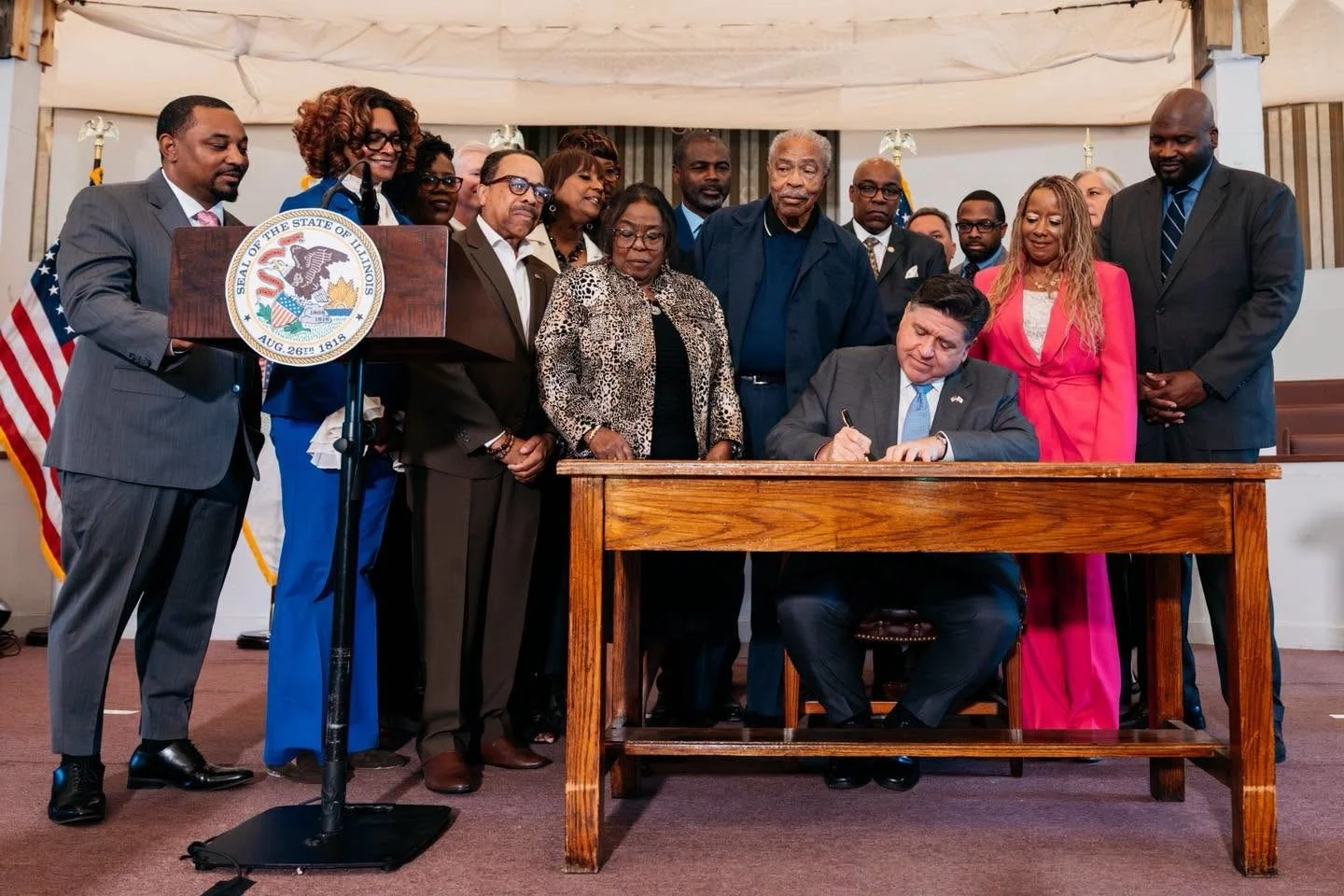
 Gov. JB Pritzker signs a bill designating July 25 as Emmett Till Day in Illinois. (Photo courtesy state of Illinois)


Illinois recognizes gambling addiction, allowing new treatment options

The new law classifies compulsive gambling under the same umbrella as alcohol and drug disorders

By MAGGIE DOUGHERTY
Capitol News Illinois
mdougherty@capitolnewsillinois.com 

Article Summary 

  • Gov. JB Pritzker signed a bill last week that officially recognizes gambling addiction under the state’s Substance Use Disorder Act, expanding options for treatment.

  • Advocates of the bill call it a “massive step” forward in terms of normalization and recognizing the issue but say it needs to be supported by funding. 

  • The bill does not address the issue of Medicaid reimbursement, but future legislation could build on the law to secure reimbursement certainty. 

This summary was written by the reporters and editors who worked on this story. 

CHICAGO — Gov. JB Pritzker signed a bill Friday that officially recognizes gambling disorder as an addiction in Illinois.

The legislation, Senate Bill 2749, updates the state’s existing Substance Use Disorder Act to codify gambling addiction under the same framework as alcohol and drug use disorders, allowing the Illinois Department of Human Services’ behavioral health division to offer programs and support to compulsive gamblers and affected families.

The bill’s sponsor, Sen. Julie Morrison, D-Lake Forest, said recognizing the disorder under the law would make it easier for the state to provide resources for those struggling with gambling addiction.

“We see people who have alcohol dependencies, people who have drug addictions. I think we recognize those as disorders, and it’s in statute, and we are providing different granting mechanisms, different ways to help those people across the state,” Morrison said. “We haven’t done that with gambling, and that’s what this bill is about. It’s just recognizing the fact this is also another addiction disorder, and those people also need the help.” 

The bill passed with broad bipartisan support this spring, receiving dissenting votes from only 11 Republican representatives in the House and passing unanimously in the Senate.

Gambling disorder is often considered a hidden disease, as the symptoms can be less physically evident than alcohol or drug abuse. But according to experts, the dopamine release that compulsive gamblers receive when placing a bet creates a compulsion just as strong.

Gambling also has one of the highest rates of suicide of any addictive disorder; the National Council on Problem Gambling estimates one in five compulsive gamblers have tried to take their own life. 

In Illinois, more than a million people, over one in 10 adults, are estimated to have a gambling addiction or to be at risk of developing one. 

A recent investigation by Capitol News Illinois and Illinois Answers project found that people in Illinois lost over $7.7 billion gambling last year. That spending is fueled by compulsive gamblers, who drain inheritances, work bonuses and nest eggs to fund their addiction.

Read more: Addicted to gambling in Illinois: ‘Someone has decided they can make money off you’ | What compulsive gamblers know

The ability to hide the disease — and the lack of public awareness about it — means people don’t often seek treatment, according to providers who specialize in gambling addiction treatment.

When they do, the resources available to help them remain “a leap year behind” treatment options for alcohol and drug addiction, according to Ryan Aten, a policy analyst with the Illinois Association for Behavioral Health, or IABH, which advocates for the prevention and treatment of addiction and mental illness.

Still, Aten cheered the bill becoming law as a “massive step” forward.

“SUD (substance use disorder) has treatment facilities. There’s not gambling facilities in the same way,” Aten said. “This is a big step because we’re really bringing the attention first. Attention is the thing that gambling needs, because it is something so normalized as a whole.”

According to IDHS, recognizing gambling as an addiction under the law is intended to provide a level of legitimization for the disorder, helping to address public stigma.

The bill took immediate effect after receiving Pritzker’s signature. 

What’s covered, and what’s not

Before the passage of the bill, compulsive gamblers in Illinois could only receive state-funded inpatient services if they also had a substance use disorder that required in-patient treatment. The law now allows the state to offer treatment for compulsive gambling on its own, according to IDHS.

It also allows the state to provide additional training to addiction counselors and expands options for prevention services, such as offering early awareness and intervention programs in high schools and colleges.

“The Pritzker Administration has made clear that gambling must be responsibly regulated, with strong consumer protections and meaningful investments in treatment and prevention,” a spokesperson for Pritzker told Capitol News Illinois in an email. “SB 2749 builds on that commitment by strengthening Illinois’ approach to gambling disorder prevention, education and treatment.”

However, advocates like IABH worry about the lack of guaranteed funding or specific timeline for implementation in the legislation. The bill did not allocate any new funding for treatment, though lawmakers set aside $15 million in the fiscal year 2026 budget to the treatment and prevention of compulsive gambling, up $5 million from the year before.

But the amount the state actually spends to treat gambling addiction remains small: Only $0.06 for every $100 collected in state gambling taxes was devoted to treatment and prevention last year. 

People familiar with the bill say it does not make gambling addiction treatment eligible for Medicaid payments, a major barrier to treatment for low-income people, though IABH analyst Aten said he hoped to see a bill introduced next session that could build on the groundwork laid by this law.

Now that the addiction has been recognized, Aten added, the actual prevention and treatment resources can follow.

“This bill has been probably one of the biggest gambling bills we’ve seen in many, many years, because it does bring that awareness and does bring the attention to an emerging problem,” Aten said.

Capitol News Illinois is a nonprofit, nonpartisan news service that distributes state government coverage to hundreds of news outlets statewide. It is funded primarily by the Illinois Press Foundation and the Robert R. McCormick Foundation.


Commissioners Deliver Reports At City Council Meeting

Mount Carmel city commissioners provided updates on city finances, utility operations and public safety during last Monday afternoon's City Council meeting.

Finance Commissioner Eric Ikemire reported the city received $328,738 in revenue over the past two weeks, with the largest sources coming from sales tax totaling $220,736 and replacement tax of $46,314, along with miscellaneous receipts. During the same period, city expenses totaled $165,181.

Water and Sewer Commissioner Tom Meeks said crews are repairing the grit collector at the wastewater treatment plant after disassembling the equipment to replace worn components. Mayor Joe Judge added the city plans to order additional replacement parts while they are still available because the grit collector has been discontinued, noting the equipment has gone about ten years since its last major rebuild.

Meeks also reported routine mowing and equipment maintenance continue at the wastewater treatment plant, while the water treatment plant remains in normal day-to-day operation. Water and sewer crews responded to 50 JULIE utility locate requests, cleaned several sewer lines and completed maintenance on the city's E-Grip equipment.

Fire and Garbage Commissioner Susan Zimmerman reported the Mount Carmel Fire Department responded to 11 calls over the past two weeks, including malfunctioning fire alarms, lift assists and a vehicle fire. Zimmerman also said residential garbage collection continues to run on schedule.

Low Bid Accepted For Market Street Parking Improvements

The Mount Carmel City Council has awarded the contract for new public parking improvements along Market Street.

During last Monday afternoon's meeting, council members approved a bid from Dean Colyer Construction to furnish the labor and materials needed to construct new parking stalls, an ADA-accessible parking aisle and an ADA ramp along the east side of Market Street between Sixth and Seventh Streets.

City Engineer Dave Dallas said the city received two bids before the deadline. Dean Colyer Construction submitted the low bid of $29,185, while Kieffer Brothers Construction bid was $46,077.52. Dallas said a third bid was received after the deadline and could not be considered.

Based on the bids received, Dallas recommended awarding the project to Dean Colyer Construction as the lowest responsible bidder.

The city council unanimously approved the recommendation, and work on the new parking improvements is expected to begin at a later date.

Commissioners Prepare for Amended RWE Solar Farm Application

The Wabash County Commissioners are preparing for an amended solar farm application from RWE later this summer.

During last Monday afternoon's meeting, Board Chairman Tim Hocking said RWE is expected to submit an amended application in August reflecting changes to its proposed solar project.

Hocking said the revisions involve adjustments to the size of the solar farm and changes to some of the acreage included in the project. He emphasized the amendment is part of the normal review process and not an entirely new application.

Hocking recommended the county continue using Bellwether to review the amended application, noting the consulting firm has guided the county through the project and is already assisting with questions related to the county's solar ordinance.

Commissioner Rob Dean agreed, saying Bellwether has done a good job advising the county throughout the process. He added the expected filing is simply a modification to the existing proposal rather than starting the approval process from the beginning.

Hocking said some of the changes are being driven by delays in reclaimed mine ground receiving bond release, while other revisions involve additional landowners who have expressed interest in participating in the project.

Commissioners unanimously approved continuing their agreement with Bellwether and authorized Chairman Hocking to sign any documents necessary to review the amended application once it is submitted.

Sheriff Updates Commissioners on Jail, Vehicles and Contract Negotiations

Wabash County Sheriff Derek Morgan updated county commissioners Monday afternoon on several issues affecting the sheriff's office, including storm damage, staffing, vehicle replacement and upcoming labor negotiations.

Morgan reported that heavy rainfall earlier this month caused water to back up into the basement of the courthouse. He said the water caused a mess, and the county is awaiting a damage estimate from Servpro. Morgan added that, based on preliminary discussions, the damage may not meet the insurance deductible for a claim.

Morgan also reported that correctional officer Noah Bell is scheduled to graduate from the police academy on August 7 and is expected to return to duty at the Wabash County Jail shortly afterward.

Looking ahead, Morgan asked commissioners to consider dedicating a portion of the county's cannabis sales tax revenue to a vehicle replacement fund. He said the sheriff's office fleet is aging, with patrol vehicles ranging from 2019 to 2021 models. Rather than borrowing money for replacements every few years, Morgan said setting aside tax revenue annually would allow the county to build a fund for future vehicle purchases.

Morgan also reminded commissioners that the county has received formal notice from the Fraternal Order of Police Labor Council to begin collective bargaining negotiations. He noted that law enforcement agencies across Illinois continue to compete for officers, making wages a key issue in retaining and recruiting personnel.

Commissioners acknowledged the county will likely need to remain competitive as negotiations move forward. The board later approved appointing Commissioner Rob Dean to represent the county during the bargaining process and report back to the full board on negotiations.

Progress Continues On New City Pool Complex

Construction continues to make steady progress on Mount Carmel's new aquatic center.

During Monday afternoon's City Council meeting, Mayor Joe Judge said work is moving along well, with the bathhouse beginning to take shape.

Judge told council members the bathhouse walls are now going up, while crews continue making progress on the pool shell. He said residents can expect to see even more visible changes over the next two weeks as concrete walls begin to be poured.

The mayor said the project will soon start looking much more like a completed aquatic center as construction advances.

Judge also announced the project has received another $20,000 in donations over the past two weeks. He thanked the individuals and organizations that have contributed to the fundraising effort, saying their continued support is helping make the new aquatic center a reality.

The new pool is scheduled to open for the 2027 swimming season.

Suspects in City Park Vandalism Turn Themselves In Following Mayor's Appeal

The individuals responsible for vandalism at Mount Carmel's City Park have turned themselves in.

Mayor Joe Judge provided an update on Facebook at 9 a.m. Friday, thanking the community for helping spread the word after he had offered those involved until noon to come forward and accept responsibility.

Judge said the responsible parties have now identified themselves and will be taking responsibility for their actions.

Earlier Friday morning, the mayor reported that several individuals had vandalized City Park overnight. He said the city had clear security camera footage showing those involved and warned that criminal charges would be filed if they failed to contact City Hall and assist with cleaning up the damage.

The city had also offered a reward for information leading to the identification of those responsible.

In his update, Judge thanked the individuals for coming forward and accepting responsibility for their actions, while also thanking residents for their assistance in helping resolve the incident quickly.

City Accepts Top Bid for City-Owned Mobile Home, Delays Decision on Lots

The Mount Carmel City Council accepted the highest bid Monday afternoon for a city-owned mobile home while delaying action on the sale of two city-owned lots in the Wolfe Addition.

Mayor Joe Judge opened sealed bids for a 2001 Fleetwood mobile home located on city property across from Big R Farm and Home on Route 15 West. The city received two bids, with Kenneth Hornby submitting the highest offer at $17,776. A second bid from Cherry Street Estates, LLC totaled $10,510. Following discussion, the council unanimously accepted Hornby's bid. The successful bidder will be required to coordinate with City Hall on a timeline to remove the mobile home from the property.

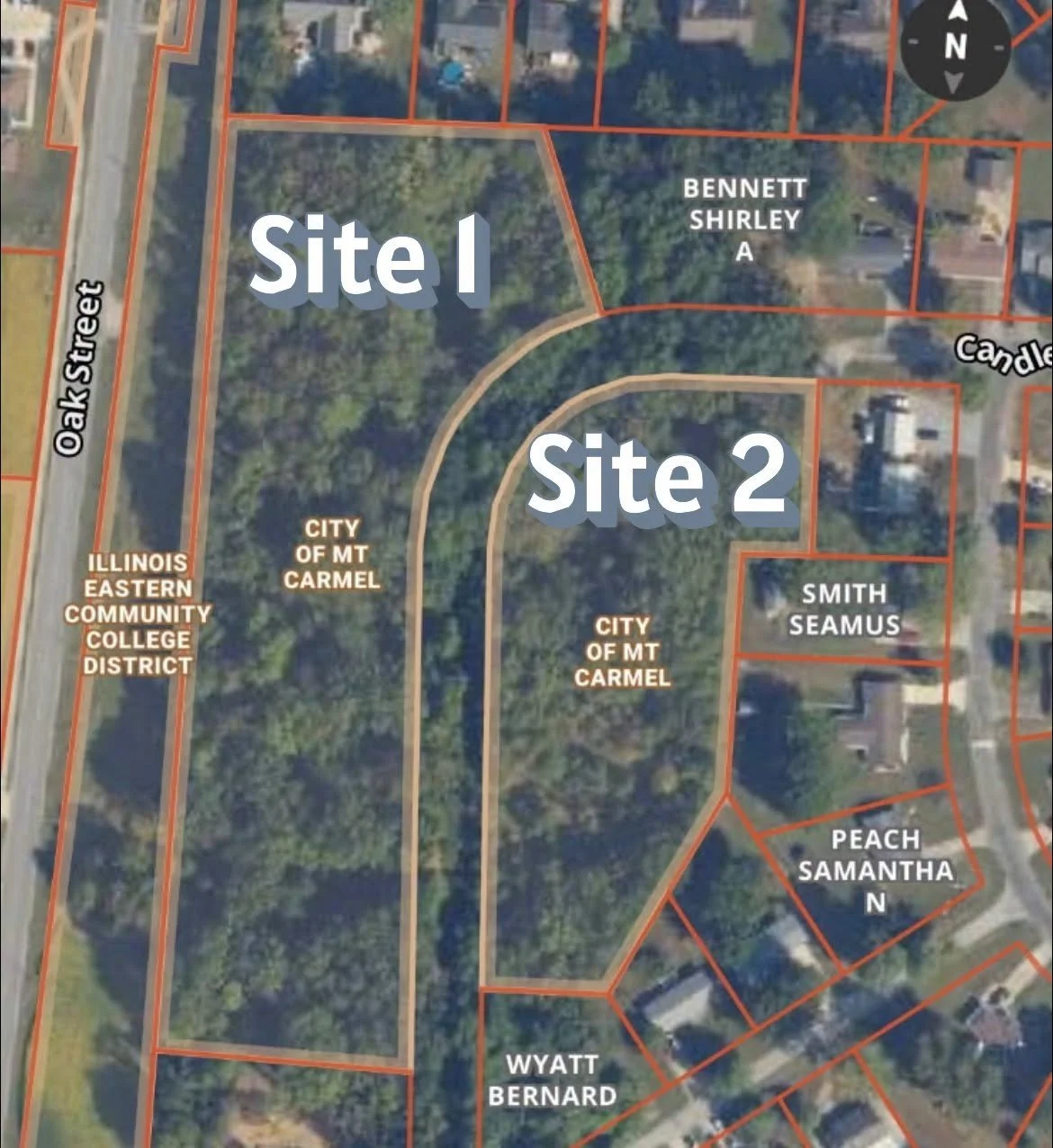
The council also opened bids on two city-owned parcels in the Wolfe Addition near Oak Street.

For Site One, bids of $26,500 from Mark Neikirk and $30,000 from Greg Neikirk were received.

For Site Two, bids included $2,000 from Shea Smith, $15,025 from Doug Kieffer, $20,000 from Greg Neikirk, and $46,331 from Lynn Burgess, whose proposal included several conditions that require further review.

The city also received combined bids for both lots, including $50,000 from Greg Neikirk and $60,000 from the Wabash Valley College Foundation.

Because of the multiple bidding options and the potential savings in legal costs if both properties are sold together, the council voted to take all land bids under advisement. City Clerk Ryan Turner will prepare a comparison of the proposals before the council considers awarding the bids at its next meeting.