‘A real farm crisis’: Illinois farm bankruptcies rise for 3rd straight year

Rising land rent, an unstable export market and record farm debt are blamed 

By TARA SUN
Medill Illinois News Bureau
news@capitolnewsillinois.com

Article Summary

  • Family farm bankruptcies surged 46% nationwide in 2025. In the Midwest, filings jumped 70%. In Illinois, they rose 55%.

  • Total farm debt is forecast to hit a record $624.7 billion in 2026, as overhead costs like land rent and interest keep climbing.

  • Farmers bought a record 2.54 million crop insurance policies in 2025. But when the guaranteed revenue floor falls below production costs, farmers lose money on every bushel.

This summary was written by the reporters and editors who worked on this story.

SPRINGFIELD — With the growing season well underway in Illinois, farmers once again are struggling to turn an abundant harvest into survival.

In 2025, family farm bankruptcies surged 46% nationwide — reaching 315 filings and marking the third consecutive year of increases. The Midwest recorded 121 filings in 2025 — up 70% from the prior year.

The trend has only accelerated. In April alone this year, 62 Chapter 12 farm bankruptcies were filed nationwide – a 130% jump from the prior year and the highest monthly total since February 2020. The USDA projects total farm debt will rise 5.2% to a record $624.7 billion in 2026, with 330 bankruptcy cases filed.

“I’m scared about there being a real farm crisis,” said Eliot Clay, executive director of the Association of Illinois Soil and Water Conservation Districts. “This could come down to people being able to save their farms – just knowing that they could put it into some conservation easement or something. Like, they need anything that they can get.”

For Illinois, the crisis is playing out as lawmakers just finished a budget session that delivered few meaningful results for an industry under siege. Gary Asay, who has farmed in Illinois since 1976 and sold crop insurance for more than 20 years, sees clear reasons to worry.

“The increase in the number of bankruptcies and the increased buying of higher-level crop insurance are both signs of the stress that’s in the industry,” Asay said. “Farmers are under stress. They may be having to borrow more money. Therefore, they want more protection.”

Crop insurance, he pointed out, can’t fully protect farmers from losses. The most common policy, Revenue Protection, covers only up to 85% of projected revenue.

“Even with the best crop insurance coverage you can buy, if that coverage is below your cost of production, you can still lose money without even collecting,” Asay said.

In 2025, U.S. soybean production totaled 4.26 billion bushels, with the average yield per acre estimated at a record high 53.0 bushels per acre. Illinois alone harvested more than 639 million bushels in 2025.

Then, in February 2025, the U.S. imposed a 10% tariff on Chinese products. And China – once the world’s largest buyer of U.S. soybeans – stopped purchasing U.S. crops. Last September marked the first month since 2018 that imports from the U.S. fell to zero, according to China’s General Administration of Customs.

Farmers had entered the 2025 season with a smaller safety net after the projected price for the crop insurance guarantees fell by 8.7% that year. The drop meant less protection heading into the spring planting. But because yields were high, most farms still generated revenue above their guaranteed floor. Although farmers grew plenty, they sold every bushel for less than it cost to produce.

“A lot of farmers cannot sell their corn or soybeans at a profit right now, just because the price is so low,” Asay said.

Bankruptcies in agriculture rarely follow a single bad year. For U.S. farmers, the financial squeeze began well before 2025.

Real estate debt – tied to the land farmers rent or own – is expected to reach $404.3 billion in 2026, a reflection of the high cost of farmland that has squeezed so many operators.

“Overhead costs represent the largest cost component on the U.S. farm, accounting for nearly one-half of total costs during the 2020-24 period,” said Joana Colussi, a research assistant professor of agricultural economics at Purdue University, citing Purdue data. “Eighty percent of the farmers in the Midwest, they rent the land.”

Colussi has tracked the financial squeeze on farmers across the Midwest. When land prices rise, so does the rent – a fixed cost that farmers pay regardless of crop prices or yields. That leaves farmers searching for ways to keep operations going. “The way to continue being competitive is to try to reduce the costs,” she said.

Diversification into niche markets — non-GMO (genetically modified organism), organic or specialty crops — offers one path forward, though Colussi mentioned it’s not a quick fix

Farm crisis reminiscent of the 1980s.

Rep. Charlie Meier, R-Okawville, who is a farmer himself, described the current moment as reminiscent of the 1980s farm crisis. “There were massive bankruptcies in the ‘80s,” Meier said. “A lot, a lot of farms went under.”

The trigger now and then is the unstable export market. But the financial strain was already visible. In 2025, the Federal Reserve Bank of Chicago reported that 5.6% of farm loans were classified as having “major” or “severe” repayment problems — the highest since 2020. That means borrowers were falling behind on payments or reworking their loans. It’s an indicator that many farmers were struggling to repay old debt while borrowing more to plant the next crop.

Ahead of the 2026 legislative session, farm groups pushed for estate tax relief, one of the Illinois Farm Bureau’s top priorities, along with payouts for farmers to protect their land and programs that help them find new buyers for their crops. But in a tight budget year, those priorities stalled.

The Illinois Farm Bureau did not secure passage of the Family Farm Preservation Act, which would have raised the state’s estate tax exemption from $4 million to $6 million, reducing the tax burden on inherited farms and making it easier for young farmers to keep the land and operations intact.

State Rep. Sharon Chung, D-Bloomington, who serves on the House Agriculture Committee, was also unable to get a relatively small boost for farmers through this session. 

She pushed for a $10 million increase in funding for Soil and Water Conservation Districts through House Bill 4755. But the final Fiscal Year 2027 budget held funding at $4.5 million for the third straight year, far short of what advocates say districts need. These districts are trusted by local farmers because they work alongside them, offering advice on how to farm more efficiently at a lower cost.

Clay, the district’s executive director, said the biggest need is giving districts “the financial certainty that they can hire and keep people hired.” 

Without that, districts see constant turnover. That means farmers lose access to experienced local advisors who understand their land and can help them navigate conservation practices that might save money and keep them afloat.

“Agriculture is the No. 1 producer for our economy in Illinois,” Chung said. “Anything we can do to help prop that up is so important.”

Despite those unpassed bills, farmers did secure a few victories. The final budget included changes to the Farmland Assessment Law — extending a tax break for conservation practices through 2031 — and avoided cuts to key programs, including the Illinois Department of Agriculture, agricultural education and cover-crop incentives that enrich the soil.

While farmers had hoped Springfield could do more, they also recognized that forces shaping the industry go far beyond the influence of legislators: falling crop prices, an unstable export market and rising costs.

As farmers face mounting distress, the history of the 1980s hangs over the heartland.

“There’s just not enough room for error right now. Something that happened in the past can take down a farmer today,” Asay said.

Tara Sun is a graduate student in journalism with Northwestern University’s Medill School of Journalism, Media and Integrated Marketing Communications, and is a fellow in its Medill Illinois News Bureau working in partnership with Capitol News Illinois.

Capitol News Illinois is a nonprofit, nonpartisan news service that distributes state government coverage to hundreds of news outlets statewide. It is funded primarily by the Illinois Press Foundation and the Robert R. McCormick Foundation.
4th of July Firework Safety Tips From Indiana State Police

It’s that time of the year again! As we celebrate Independence Day, we’re also proudly honoring 250 years of the United States of America.  Whether you’re enjoying the summer weather, having a backyard BBQ, spending time with family and friends, and using fireworks are all some of the best ways to celebrate.  ISP Putnamville wants everyone to remain safe this July 4th, and safely handling fireworks is a priority.


Listed below are some safety tips that the Indiana State Police would like to provide when using fireworks to celebrate this July 4th:


  • Never let children handle, play with, or light any fireworks.

  • Never aim, point, or throw fireworks at another person.

  • Use extreme caution when lighting fireworks in the wind. Keep spectators where the wind is blowing smoke and debris away from them.

  • Never smoke or consume alcohol when lighting fireworks.

  • Store fireworks in a cool, dry place away from the reach of children.

  • Steer clear of others setting off fireworks. They can backfire or shoot off in the wrong direction.

  • Do not attempt to make or alter any fireworks or firework devices.

  • Always have a fire extinguisher or water supply, such as a hose or bucket of water, nearby.

  • Only light one firework at a time and never attempt to re-light or fix a "dud" firework.

  • After a firework has finished burning, douse it with plenty of water before throwing it away to prevent starting a trash fire.

  • Be considerate of individuals with PTSD and other types of medical conditions. The noise can cause severe stress and reaction in neighbors.

  • Think about pets. Animals have sensitive ears and can be very frightened or stressed by fireworks sounds.

  • Use fireworks outdoors, never indoors. 

Become more familiar with the state fireworks laws in Indiana. Throughout the year it is legal to set off fireworks from 9 a.m. to 11 p.m., but this may be limited further by local ordinances. 

  • On state holidays it is legal to set off fireworks from 9 a.m. to midnight, but this may be limited further by local ordinances.

  • The times on the following dates are protected in Indiana for consumer use of fireworks and may not be prohibited by local ordinance:

    • June 29 to July 3: from 5 p.m. until two hours after sunset;

    • July 4: from 10 a.m. to midnight;

    • July 5 to July 9: from 5 p.m. until two hours after sunset; and

    • December 31: from 10 a.m. to 1 a.m.

  • Fireworks can only be purchased by persons 18 years of age or older.

  • Fireworks use is limited to personal property, the property of someone who has approved the use of fireworks or a location designated specifically for the use of consumer fireworks. 

Please be sure to check local ordinances for any fireworks limitations that might exist in your area.

The Indiana State Police Post hopes that these few safety tips help you enjoy your 4th of July by safely celebrating with fireworks.  

Zero tolerance for impaired drivers during Independence Day travel

SPRINGFIELD – The Illinois Department of Transportation, the Illinois State Police and local law enforcement throughout the state are reminding the public: Whether you’re drinking alcohol, using cannabis or under the influence of other drugs, if you get behind the wheel, you’ll face the consequences. During the Fourth of July “Drive Sober or Get Pulled Over” campaign, zero tolerance will be shown for those driving impaired.

 “Driving impaired is not a game – it’s a decision with potentially deadly consequences,” said Stephane B. Seck-Birhame, IDOT’s bureau chief of Safety Programs and Engineering. “Plan ahead. If you’re drinking alcohol, using cannabis or any other drug, don’t drive. Designate a sober driver, call a ride service or stay put.”

 According to provisional IDOT data, last year in Illinois during the Independence Day holiday from 6 p.m. July 3 to 11:59 p.m. July 6, there were 17 fatal crashes resulting in 18 fatalities, an average of more than five people killed each day. Four of the 17 fatal crashes involved drivers who had been drinking, resulting in four of the 18 fatalities.

 In addition to removing impaired drivers from the roads, police will strongly enforce seat belt, speeding and other traffic laws through July 6. Wearing a seat belt is the law in Illinois and your best defense against impaired drivers. Always buckle up and make sure your passengers do, too.

 “If you’re driving to watch fireworks, attend a picnic or celebrate the 250th anniversary of the birth of our nation some other way, remember to drive safely,” said ISP Division of Patrol Col. Christopher Owen. “Wear your seat belt, watch your speed, and don’t drive distracted or impaired.”

 Remember these important safety tips:


If you’re planning to use drugs or alcohol, give your keys to a sober driver who can safely drive you home – or call a taxi, rideshare service or, if available, your community’s sober ride program. ​

  • If you see an impaired driver on the road, contact law enforcement.

  • Remind your friends to never get in a vehicle with an impaired driver. If you have a friend who is about to drive impaired, take their keys away and help them get home safely. Don’t worry about offending someone – you might be saving their life or someone else’s.

 The Independence Day “Drive Sober or Get Pulled Over” campaign is funded with federal highway safety tax dollars administered by IDOT and runs through the early morning hours of July 6. The effort is administered by IDOT with federal funds and coincides with the comprehensive multimedia campaign “It's Not a Game.”

Illinois State Police Announces Results of Alcohol Countermeasure Enforcement Patrols

Illinois State Police (ISP) Troop 9 Commander, Lieutenant Bruce Waggoner, announces the results of Alcohol Countermeasure Enforcement (ACE) patrols in Marion, Wabash, Hamilton, Effingham, and Wayne counties during June. These ACE patrols allowed the ISP to focus on preventing, detecting, and taking enforcement action in response to violations associated with impaired driving and illegal transportation or consumption of alcohol or drugs.

Violations Enforcement Activity

Driving Under the Influence (DUI) Citations 4

Other Alcohol/Drug Citations 11

Occupant Restraint Offenses 1

Registration Offenses 17

Driver’s License Offenses 12

Insurance Violations 2

Speed Violations 40

Total Citations/Arrests 40

Total Written Warnings 111

Alcohol and drug impairment are estimated to be a factor in more than 47% of all fatal motor vehicle crashes in Illinois. There is one alcohol-related traffic fatality every 39 minutes in the United States. The ACE program allows officers to work even harder at removing dangerous DUI offenders from the road. This project is funded through the Illinois Department of Transportation.

Stay alert for crews, heavy equipment as peak roadside mowing period begins

SPRINGFIELD – With peak roadside mowing season underway, the Illinois Department of Transportation is reminding the public to slow down, proceed with caution and pay extra attention when encountering equipment and personnel. In keeping with the recent practice of timing operations to preserve and promote pollinator habitat, the heaviest mowing period will continue until Aug. 15.

 “You’ll see our mowing crews throughout the entire state so please remember to give them room to do their jobs safely,” said Illinois Transportation Secretary Gia Biagi. “Our top priorities are protecting our workers, the public and the environment.” ​

 During the summer, IDOT conducts two primary types of mowing. Safety mowing occurs directly adjacent to the road as needed. Maintenance mowing, which lasts for approximately six weeks and starts around July 1, includes areas next to culverts, ditches, traffic control devices and other structures, while following the Illinois Monarch Project Mowing Guidelines for Pollinators, protecting as much habitat and nectar resources as possible. ​

 The mowing schedule helps to minimize the impact on the traveling public and encourage pollinator activity, which assists in the reproduction of flowers, fruits and vegetables that are essential to the state’s ecosystem and agricultural economy. Reducing the amount of land maintained and growing pollinator habitat also protects the endangered rusty patched bumble bee and the monarch butterfly, the official state insect of Illinois. ​

 To view a short video about IDOT’s mowing schedules and its work with pollinators, click here or visit IDOT’s YouTube channel. ​

 In 2020, IDOT joined in the launch of the Illinois Monarch Action Plan as part of the Illinois Monarch Project, a collaborative effort with local and state partners to help ensure the survival and successful migration of monarchs by increasing and protecting habitat.

Road closure planned for State Road 68 in Posey County

POSEY COUNTY Ind. – The Indiana Department of Transportation announces a road closure for State Road 68 in Posey County.

Beginning on or around Wednesday, July 1, crews will close State Road 68 near Poseyville. This closure will occur near Byes Road.

This daily road closure will allow for a pipe replacement project. Work to remove the pipe is expected to take a day to complete. Once the pipe has been remove and replaced, the road will reopen to traffic.

Beginning on or around Monday, July 6, crews will close the S.R. 68 in the same location to complete the pipe replacement project with new pavement. This portion of the project is expected to take a few hours and will reopen when complete.

The official detour for this closure is State Road 165 to State Rod 66 to State Road 69. Local traffic will have access up to the point of closure. INDOT reminds drivers to slow down, use extra caution, and avoid distractions when traveling in and near work zones.

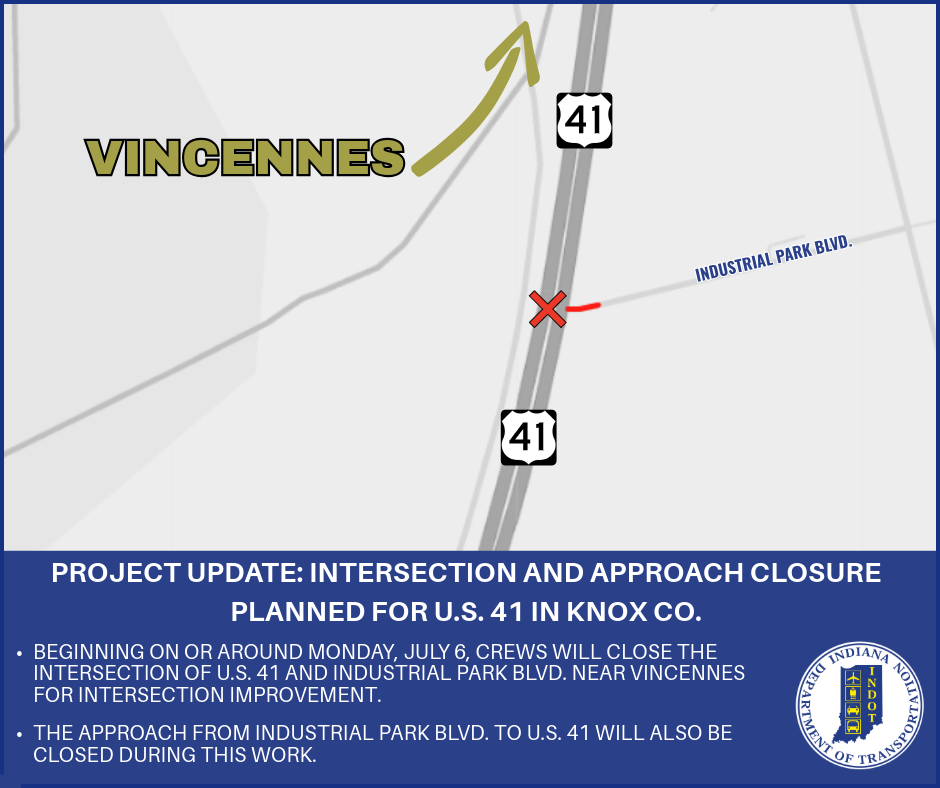
PROJECT UPDATE: Intersection and approach closure planned on U.S. 41 for in Knox County

KNOX COUNTY Ind. – The Indiana Department of Transportation announces an intersection and approach closure for U.S. 41 in Knox County.

Beginning on or around Monday, July 6, crews will close the intersection of U.S. 41 and Industrial Park Boulevard near Vincennes. This closure will also include the closure of the Industrial Park Blvd. approach to U.S. 41.

These closures are part of an intersection improvement project. When complete, this intersection will be converted into a Reduced Conflict Intersection. These closures are expected to last through the end of July, depending on the weather. INDOT reminds drivers to slow down, use extra caution, and avoid distractions when traveling in and near work zones.

Indiana State Trooper is being credited with helping save the life of a man who suffered a serious chainsaw injury Sunday afternoon in Crawford County

Eckerty, IN - On June 28, 2026, at approximately 4:33 p.m., Trooper Blake Leary responded to a medical emergency at Wildridge Resort near Birdseye. Crawford County Dispatch had received a report of a 35-year-old man who had sustained a severe chainsaw laceration to his leg. The caller was attempting to control the bleeding until emergency responders arrived.

Trooper Leary arrived on scene within approximately five minutes and immediately applied a tourniquet to the man’s right thigh, successfully controlling the severe bleeding. Emergency Medical Services arrived shortly afterward, assumed patient care, and transported the man to a medical helicopter for transfer to a trauma center.

The man is currently reported to be in stable condition.

All Indiana State Troopers are equipped with tourniquets and receive training in emergency medical response, allowing them to provide lifesaving care while awaiting the arrival of EMS personnel.
 

Illinois State Police Seeks the Public’s Assistance Identifying the Remains of a Man Discovered in Lake Mattoon

LAKE MATTOON – Illinois State Police (ISP) Division of Criminal Investigations Zone 8 is seeking the public’s assistance identifying the remains of a man discovered in Lake Mattoon.

 On the evening of June 28, 2026, boaters observed part of a human arm in Lake Mattoon. The Cumberland County Sheriff’s Department requested ISP adopt the investigation. ​ The arm has distinct tattoos and ISP is hoping this will help in identifying the man.

 If anyone has any information regarding a man with tattoos matching the pictures below, or has any other information which may be helpful, we ask that they contact ISP Zone 8 Investigations at 618-542-2400 or email ISP.Zone8commander@illinois.gov.


Gidcumb Recognized at Final Mt. Carmel City Council Meeting Before Retirement

Last week’s Mt. Carmel City Council meeting marked the final meeting for Public Works Director Mike Gidcumb before his retirement next month after nearly 21 years of service to the city.

Addressing the council, Gidcumb thanked city officials for the opportunity to serve.

"It has been an honor serving the city for these years," Gidcumb said, adding that while he looks forward to retirement, he knows part of him will miss the job.

Mayor Joe Judge thanked Gidcumb for his years of dedication and praised the impact he has made on the city's Public Works Department.

Judge called Gidcumb a valuable member of the city's team and said his contributions have helped keep Mt. Carmel moving forward.

"I know we have stressed you at times, but you did an outstanding job, Mike," Judge said. "I'm very much appreciative of your contributions, and you will be missed."

Judge ended his remarks with a laugh, telling Gidcumb the city still has his cell phone number and knows where he lives if they need him.

Gidcumb officially retires next month after beginning his career with the City of Mt. Carmel in 2006.