County Board Holds Brief Meeting

Monday afternoon's meeting of the Wabash County Commissioners was a brief affair, with little business on the agenda and few county officials in attendance.

County Clerk Janet Will was the only elected county office holder present for the meeting. Treasurer Angela Broster, who was absent, was the only other office holder to submit a report.

Commission Chairman Tim Hocking reported that last week's Board of Review sessions were completed successfully, with commissioners noting the process went smoothly and most issues were resolved without difficulty.

Broster's report noted that mobile home tax bills were mailed this past Wednesday and will be due August 7th. Residents may make payments at the Treasurer's Office or use the drop box outside the courthouse. Broster also reported that excess fees totaling $38,866.40 from the 2024-25 tax cycle were transferred to the county's general fund.

Commissioners also completed their required six-month review of closed session minutes and voted to keep those records sealed.

The board heard a brief presentation from Kevin Kern regarding the Hope Trust conference scheduled for July. Kern encouraged county officials to attend sessions focused on employee health insurance and benefit costs.

In correspondence, Will reported that Animal Control handled 14 dogs, 12 skunks, nine raccoons, one snake, and one bat during May while logging 1,650 miles. She also informed commissioners that the Circuit Clerk's audit had been completed and filed with the County Clerk's Office.

With no old business and no executive session needed, the commissioners adjourned after a relatively short meeting.

MCFD Receives FEMA Funding For Turnout Equipment

The Mount Carmel Fire Department has been awarded federal funding to help replace critical firefighter safety equipment.

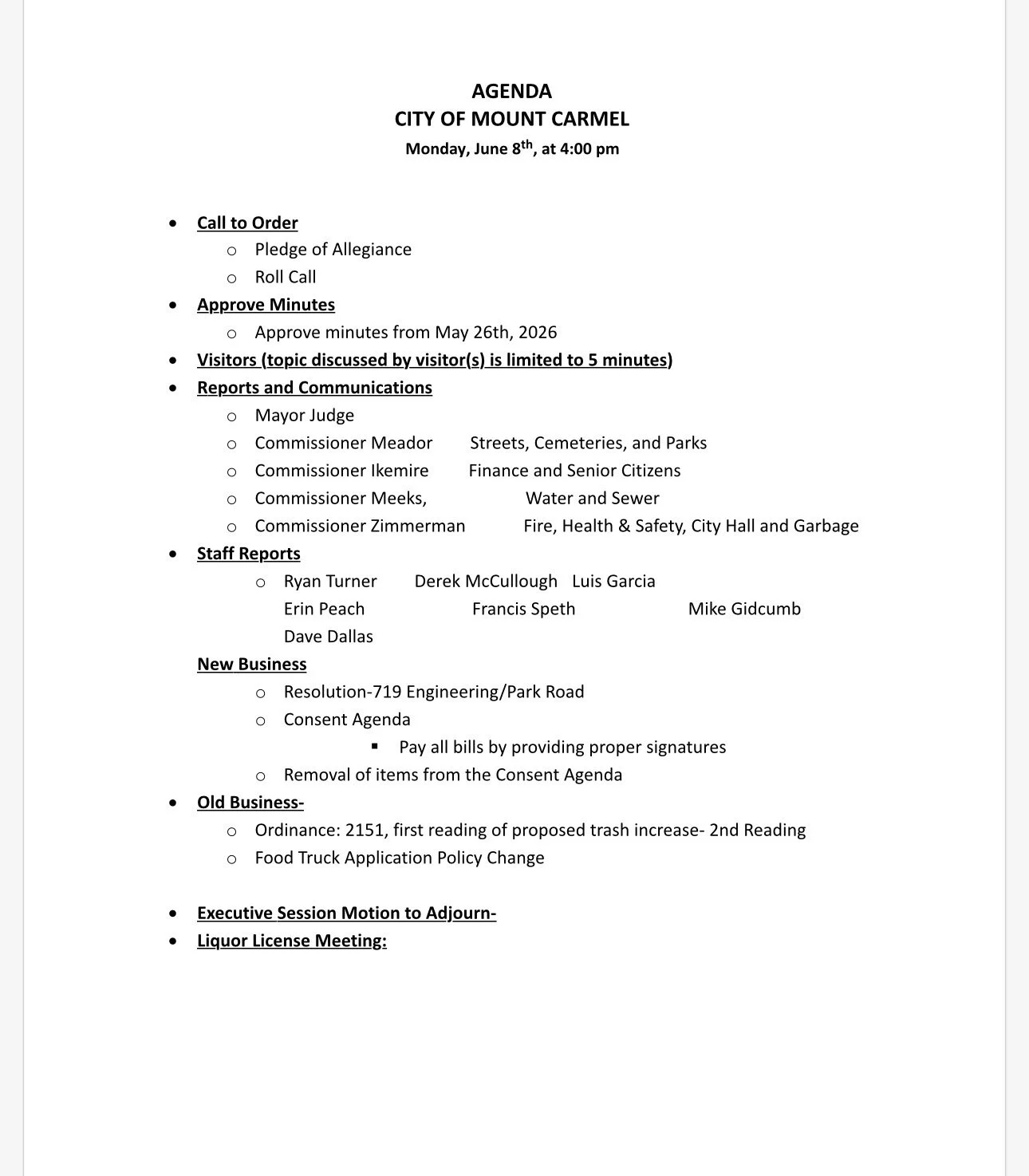
During the most recent City Council meeting, Fire Chief Francis Speth announced the department recently received a FEMA grant that will fund the purchase of five complete sets of turnout gear.

Speth said the grant is valued at approximately $25,700 and will provide firefighters with new protective equipment used when responding to fires and other emergency incidents.

The chief noted that receiving the gear will take some time. Firefighters must first be measured for proper sizing, and the manufacturing process is expected to take four to five months. Speth estimated it could be around six months before the new gear is delivered and placed into service.

Turnout gear includes the specialized coats, pants, boots, helmets, and other protective equipment firefighters wear while operating in hazardous conditions.

Speth said the FEMA funding will help ensure Mount Carmel firefighters have access to modern, properly fitting safety equipment without placing additional costs on local taxpayers.

The chief made the announcement as part of his report to the council and said there were no other major updates from the fire department.

Champ Closing Continues To Impact Local Jobless Rates

The latest unemployment figures from the Illinois Department of Employment Security show the continued impact of the Champion Laboratories closure in Albion, although Edwards County's jobless rate improved significantly from the previous month.

Edwards County posted the highest unemployment rate in the region at 11 percent in April, down from 14.9 percent in March but well above the 3.2 percent rate recorded a year ago. The county's unemployment rate has increased 7.8 percentage points over the past year.

Wabash County's unemployment rate stood at 4.6 percent in April, an improvement from 5.7 percent in March but up from 3 percent one year ago. Lawrence County recorded a 4.6 percent unemployment rate, while Richland County came in at 3.9 percent. Wayne County posted a rate of 5.2 percent.

Across the Olney-Mount Carmel labor market area, total nonfarm payroll employment declined by 950 jobs compared to April of last year.

The largest losses occurred in the manufacturing sector, which shed 650 jobs, reflecting the impact of the Champion Laboratories closure in Edwards County. Additional declines were reported in private education and health services, trade, transportation and utilities, government, financial activities, leisure and hospitality, and professional and business services.

The only sector posting year-over-year job growth was natural resources and mining, which added 25 jobs. Employment levels remained unchanged in construction, information services, and other services.

Despite recent improvements from March levels, unemployment rates throughout the area remain above where they were a year ago, with Edwards County continuing to experience the most significant effects from the loss of manufacturing jobs.

Cell-phone ban, loosening foreign language requirements among education bills to pass

Lawmakers expand in-state tuition, amend child care licensing

By PETER HANCOCK
Capitol News Illinois
phancock@capitolnewsillinois.com

Article Summary 

  • Several educations measures were among the hundreds of bills that cleared the General Assembly before it adjourned on June 1. 

  • Schools will have to adopt policies next year banning cell phones in the classroom under a bill Gov. JB Pritzker says he will sign. 

  • Another measure allows students to fulfill foreign language requirements by taking career and technical education courses. 

  • Lawmakers also expanded in-state tuition and amended child care licensing laws. 

This summary was written by the reporters and editors who worked on this story.

Gov. JB Pritzker says he intends to sign legislation imposing a statewide ban on cell phones and other wireless communication devices during instructional time in public schools and charter schools.

Although many districts in Illinois have already adopted more stringent bans of their own, Senate Bill 2427 would require all school boards to adopt policies that at least meet a minimum standard, beginning in the upcoming 2026-2027 school year.

That includes prohibiting students from using wireless devices during the regular school day, including instructional time, recess, lunch and time passing between classes. But it does not include before- and after-school activities or off-campus learning activities.

The bill provides a variety of exceptions to the ban such as when their use is needed for the student’s health management, for special education purposes or because the student is also a caregiver for a family member.

Wireless communication devices are defined as any portable wireless device that can provide voice, messaging or other data communication between two or more parties. That includes cell phones, tablet computers, laptop computers, gaming devices and wearable devices such as smart watches.

“Every parent and educator knows the damage that unchecked screen time and social media can do to our children and how disruptive they can be in school,” Pritzker said in a statement. “The bipartisan support for this effort reflects the urgency educators and families across Illinois feel.”

The bill prohibits schools from using fines, fees or law enforcement officers to enforce the ban. 

The bill passed the House in April, 102-3. The Senate concurred in the House version of the bill Sunday, 55-2.


Foreign language requirement

Students entering high school in 2028 will not necessarily have to complete two years of foreign language as a condition of graduating, under another bill headed to Pritzker’s desk. Instead, they’ll have the option of taking a foreign language or an approved career and technical education course.

Senate Bill 3070 was one of at least two bills lawmakers considered in the final days of the legislative session that would amend the foreign language requirement that lawmakers approved in 2021. It is scheduled to take effect for students entering ninth grade in the 2028-2029 school year.

Another proposal, a Senate amendment to House Bill 4795, would have canceled the foreign language requirement entirely. It passed the Senate unanimously on Saturday but was not taken up in the House.

In debate over both bills, supporters said they supported the concept of emphasizing foreign languages as part of the high school curriculum. But they conceded there simply aren’t enough foreign language teachers available in Illinois to make the classes available to every student in every high school.

“What we’re finding is that teacher shortage is still a big challenge in our state and we do not have enough foreign language teachers, and we want to put more effort in workforce development while we’re building that pool,” Senate Majority Leader Kimberly Lightford, D-Westchester, said on the Senate floor. 

SB 3070 passed the Senate Tuesday, May 28, by a vote of 58-0. It passed the House Sunday, May 31, on a vote of 117-0 with four members voting “present.”


Childcare licensing 

A bill that paves the way for the new Department of Early Childhood to take over the licensing and regulation of childcare facilities cleared the Senate Saturday and will soon be considered by the House.

The bill has been the subject of intense debate and negotiation since the session began. It’s considered must-pass legislation because the authority already scheduled under current law to transfer to the new agency on July 1. The new bill spells out many of the rules for how the agency is to carry out that authority.

For example, under the bill, the term “day care,” as it relates to the care of children, will be changed in all statutes to “early care and education.” It also changes the word “facility” to “provider.”

House Bill 3595 sets out standards for the types of providers that have to be licensed in order to operate. It also defines the types of smaller providers that are exempt from licensing requirement but which still must register with the state as “recognized alternative providers” whose employees still must undergo background checks.

It also spells out the types of programs that are exempt from any licensing or registration requirements, such as in-home providers who serve three or fewer children, school-based extracurricular programs, activities sponsored by park districts and providers that are attached to retail shopping facilities, health spas or churches that provide care for only a few hours a day while the parent remains on the premises.

The bill passed the Senate on Saturday 50-7, and the House 80-33 on Sunday.


In-state tuition expansion

More students could qualify for in-state tuition at Illinois colleges and universities under a bill that will soon be sent to Gov. JB Pritzker.

House Bill 5093 would loosen one of the requirements for paying in-state tuition by making it available to students who attended Illinois high schools for at least three years, even if they established residency outside the state before enrolling.

If approved by Pritzker, the bill would take effect immediately.

The bill marks the latest in a series of measures Illinois has enacted in recent years aimed at making higher education more affordable for Illinois residents and more attractive to nonresidents.

Nationwide, many states, including Illinois, have allowed their institutions to enter reciprocal agreements with neighboring states to offer either in-state or discounted out-of-state tuition. Illinois is also one of several states that offers in-state tuition to noncitizens who are residents of the state and graduate from local high schools, regardless of their legal status as immigrants.

In recent months, however, the Trump administration has begun suing states over such policies as part of its immigration enforcement crackdown.

During debate on the bill, Republicans in both chambers tried to renew arguments against offering in-state tuition to noncitizens. But supporters of the bill noted that none of the public colleges or universities in Illinois had expressed opposition.

“It isn’t just one group who would benefit from this measure,” Sen. Celina Viallanueva, D-Chicago, the bill’s chief Senate sponsor, said in a statement. “DACA, low-income, first generation, minority and transgender students would no longer have to worry about facing higher tuition costs just for moving away before enrolling in college — a choice that youth rarely get a say in.” 

The bill passed the Senate on Saturday, 38-19. It passed the House Sunday, 70-40.

Capitol News Illinois is a nonprofit, nonpartisan news service that distributes state government coverage to hundreds of news outlets statewide. It is funded primarily by the Illinois Press Foundation and the Robert R. McCormick Foundation.
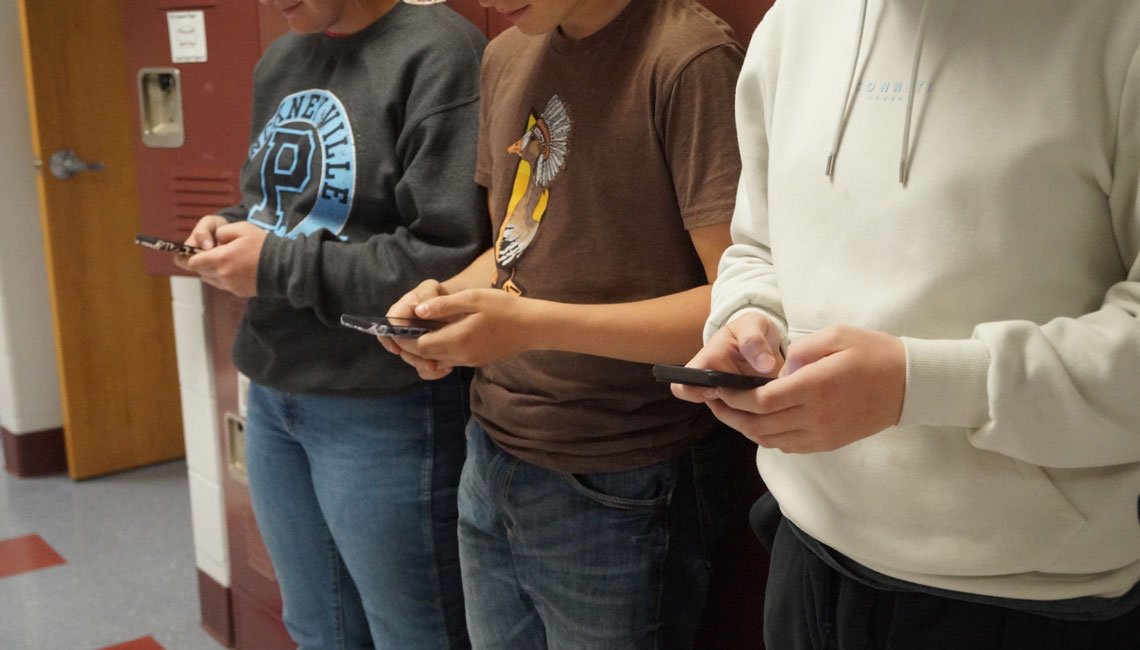
Most public school students in Illinois will no longer be allowed to use their cell phones in school next year under legislation that Gov. JB Pritzker says he intends to sign. (Capitol News Illinois photo by Peter Hancock)

Illinois’ ‘swipe fee’ law on the brink after another delay, adverse court ruling

Banks get upper hand in yearslong fight after federal rule changes, court interpretation

By JERRY NOWICKI
Capitol News Illinois
jnowicki@capitolnewsillinois.com

Article Summary 

  • The legislative and judicial branches dealt a pair of blows to a state law banning “swipe fees” being applied to the tax and tip portion of a debit or credit card transaction. 

  • Lawmakers delayed the ban for another year, until July 1, 2027. 

  • But a federal judge also issued a permanent injunction against it, citing federal rules that were recently rewritten by the Office of the Comptroller of the Currency. 

  • The injunction only applies to national banks, federal savings associations, payment networks and out-of-state banks. It doesn’t apply to state-chartered institutions, causing further uncertainty. 

  • The latest moves leave Illinois’ first-in-the-nation law in both legislative and judicial limbo.

This summary was written by the reporters and editors who worked on this story.

SPRINGFIELD — An Illinois law banning “swipe fees” on taxes and tips — already delayed twice by lawmakers — appears to be on life support after a federal judge that once permitted it issued a permanent injunction against it this week. 

U.S. District Judge Virginia Kendall issued the injunction just hours after the General Assembly approved a further one-year delay to the Interchange Fee Prohibition Act — subject of the ongoing “Credit Card Chaos” advertising campaign — before adjourning its spring session. 

It’s the latest development in a yearslong fight between retailers and financial institutions about a fee that’s levied on every credit and debit card transaction. 

Each time a shopper swipes their credit or debit card, it sets off a complicated string of payments between banks. The retailer’s bank pays an “interchange fee,” typically around 1-2% of the transaction cost, to the consumer’s bank. The fees include both a set amount and a percentage of the transaction, but the credit card companies, namely Visa and Mastercard, control how they’re calculated.

The Illinois law would have prohibited financial institutions from applying the fee to the tax and tip portion of bills. Banks and retailers have estimated it would affect $120 million to $200 million in revenue or more each year — to the benefit of retailers and chagrin of banks. Illinois would be the only place where such a law was implemented. 

The law was slated to take effect July 1 after already being postponed from its 2025 effective date. If Gov. JB Pritzker signs the latest delay, its effective date would be July 1, 2027.

But it’s Kendall’s Monday ruling that casts the measure into further doubt.

Judicial history

Kendall in February ruled that the law could take effect, based largely on her interpretation of administrative rules written by the federal Office of the Comptroller of the Currency, an independent subsection of the U.S. Treasury. 

Kendall had ruled that because the fees are set by third parties — the card companies — they’re not preempted by the federal laws and regulations that give banks wide latitude to determine their own fees. 

But the OCC, in a pair of April filings, rewrote the language at question and issued an order specifically preempting Illinois’ law. 

“Although the OCC believes that (Section) 7.4002 (the section discussed in the lawsuit) already allows national banks to impose fees that are set by a third party, the OCC is revising (Section) 7.4002 to make that explicit and resolve any uncertainty about the scope of the regulation,” the agency wrote in the filing in direct response to Kendall’s ruling. 

Read the filings: Preemption of Illinois law | Restatement of National Banking Act

At the time, the case was before the 7th Circuit Court of Appeals. But the court sent it back to Kendall for a reinterpretation of the new OCC filings. Addressing that change, Kendall wrote this week: “It is obvious from the face of the new rule that the modified language tees up an express conflict with the IFPA.”

Ultimately, Kendall decided Illinois’ law is now preempted by the federal rules, at least as it pertains to national banks, federal savings associations, payment networks and out-of-state banks. 

The Electronic Payments Coalition — the bank-backed entity that’s been running the “Credit Card Chaos” ads — welcomed the ruling. But they warned it further creates an unlevel playing field. 

“Even with this decision, credit unions and Illinois-chartered banks remain subject to IFPA, creating ongoing uncertainty and the risk of inconsistent treatment for parties in the same transaction,” the group said in a statement. 

Kendall had previously issued a similar injunction on a portion of the law regarding data collection, applying it to only some financial entities. 

What happens next isn’t immediately clear, but further judicial review is almost guaranteed, with both sides weighing their legal options. 

Legislative history, debate

The law was enacted two years ago at the behest of the Illinois Retail Merchants Association. 

Pritzker and lawmakers in 2024 agreed to raise about $101 million in revenue to plug a budget hole by putting a $1,000 monthly cap on the “retailer’s exemption,” a tax break retailers claim for being the state’s de facto sales tax collectors.

Late in the legislative process, IRMA successfully lobbied for the long-sought tax and tip exemption to alleviate the financial impact of the exemption cap for retailers.  

The financial institutions argue the electronic payment system as it exists today can’t segregate the tax and tip portion of a transaction, which could result in “credit card chaos” in Illinois if the law was to become effective.

Instead of complying, according to the coalition’s literature, the card companies could just stop processing cards altogether in Illinois. They could also stop processing tax and tip portions or require two separate swipes for the subtotal and the tax and tip portion of bills.

“Electronic payments rely on a highly interconnected network that requires a uniform national standard,” the Electronic Payments Coalition said in a statement. “We will continue working through the courts and with policymakers to ensure that all participants in the payments system are treated consistently, so the customers they serve will also be protected from the harm IFPA will cause.”

But Rob Karr, president and CEO of IRMA, has forcefully disputed the “chaos” claim. 

“This industry had had two years to figure this out. Instead of using their vast resources to solve problems, they're doing all they can to distract, distort, delay and demonize,” Karr testified in a House committee over the weekend. 

The Merchant Payments Coalition, a group of retailers and similar businesses that advocates on credit and debit card issues, argued the new rule gives financial institutions dangerously broad fee-setting authority.

“The revised language could apply broadly to numerous categories of consumer financial charges, including late fees, overdraft or over-limit fees, annual card fees, ATM fees and similar charges,” the MPC said in a statement. “By eliminating the expectation of independent competitive pricing, the rule risks encouraging industry-wide fee standardization at the expense of consumers and merchants alike.”

While Kendall said Illinois’ law is indeed preempted for certain institutions, she also faulted the OCC for using emergency authority to implement new rules. And she criticized the order specifically preempting Illinois’ law, writing that much of the logic contained in it “perches atop the catch-all justification of this is how things are done around here.”

“What the Order’s argument overlooks, however, is that the IFPA does not impede national banks’ ability to participate in card networks, nor does it require them to engage in “costly negotiations” to maintain that participation,” Kendall wrote. “Instead, it reduces the portion of a transaction upon which a fee could be calculated.” 

Capitol News Illinois is a nonprofit, nonpartisan news service that distributes state government coverage to hundreds of news outlets statewide. It is funded primarily by the Illinois Press Foundation and the Robert R. McCormick Foundation.
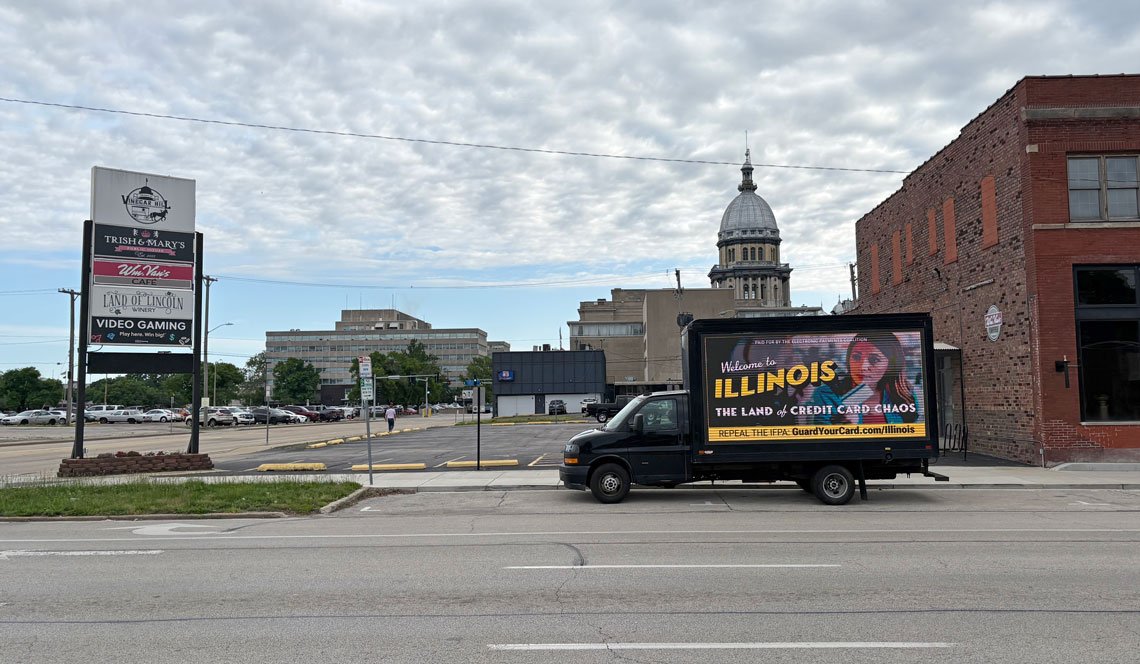
A “Credit Card Chaos” ad appears on a drivable billboard a few blocks from the Illinois Capitol during the legislature’s final stretch. The Illinois law that it targets suffered a pair of setbacks this week. (Capitol News Illinois photo by Jerry Nowicki)

Illinois bill limits how social media companies can target feeds to children

Article Summary

  • A bill to protect children online and limit their access to addictive social media features passed both chambers on Monday and will soon head to the governor’s desk.

  • The bill is an initiative from Gov. JB Pritzker, and he has indicated he’ll sign it. Pritzker first raised the idea in his February budget address, saying it was a top concern he’s heard from Illinoisans.

  • The bill would require social media companies to verify a child’s age on the device’s operating system and use stricter features for minors like limiting location-sharing and nighttime notifications.

This summary was written by the reporters and editors who worked on this story.

SPRINGFIELD — Lawmakers on the final day of the General Assembly passed a bill to regulate how minors interact with social media and other online platforms to make them less addictive.

The goal of House Bill 5511, the Children’s Online Social Media Safety Act, is to prevent children under the age of 18 from being exposed to harmful content and addictive features by requiring social media companies to confirm a user’s age through the device’s operating system.

The bill doesn’t prevent children from downloading or using social media apps. During device set-up, parents would set the child’s age, which would adjust certain design features in apps such as algorithmic feeds, the visibility of the child’s profile and what media can be shown to them.

The bill passed the Senate unanimously on Monday with a vote of 57-0. It passed the House a second time on Monday with a 113-0 vote.

Gov. JB Pritzker proposed the bill during his February budget address, and he celebrated its passage on Monday and said he would sign it.

“I am proud the Illinois General Assembly passed the Children’s Online Social Media Safety Act, marking an important milestone in our efforts to improve kids’ safety and privacy online, mitigate the harmful effects of social media on mental and physical health, and prevent financial scamming,” Pritzker said in a statement.

Efforts to pass some kind of measure in Illinois have been ongoing for a few years.

“This legislation is about recognizing a simple reality: children are not miniature adults,” Sen. Willie Preston, D-Chicago, the bill’s sponsor, said at a Saturday committee meeting. “These platforms invest billions of dollars into capturing attention, maximizing engagement, keeping users online for as long as possible. When that system is directed at developing minds, the consequences will be and have proven to be devastating and sadly irreversible.”

The bill previously passed the House in April with a bipartisan vote of 82-27. The Senate version mainly increased privacy protections for minors and altered definitions to target the most harmful platforms.

“While this legislation is not perfect, lawmakers cannot continue waiting for the perfect solution while technology continues to evolve around us,” Sen. Sue Rezin, R-Morris, said in an emailed statement.

She helped work on some of the bill’s language and has advocated for youth social media protections for years.

What’s in the bill

The bill prohibits social media companies from using a minor’s viewing history or data stored on the device to determine what shows up in their feeds.

Instead, feeds for minors will only be allowed to show information the user requested or searched for, or was posted by a creator the user follows. Youths will also be able to see media that is a direct, private message to them.

Under the bill, platforms would be required to establish some default privacy settings for minors, shield a minor’s precise location and limit digital currency transactions. Social sites and apps would also be prohibited from sending notifications between 10 p.m. and 7 a.m.

The Illinois Attorney General’s office would enforce the law, which takes effect in 2028, if signed. Violators would be liable for fines up to $2,500 for each child for unintentional violations and up to $7,500 per child for intentional violations.

Lobbyists for tech companies raised concerns that the bill may violate the First Amendment and warned that it will likely face lawsuits. But the governor’s office said in a Saturday committee that the bill’s language is modeled after legislation in other states that have survived court challenges.

Rep. Jennifer Gong-Gershowitz, the House sponsor, said she doubted social media companies would ever be completely on board.

“I’m not sure we’re ever going to get complete neutrality from social media companies that are going to be asked to comply with this act in order to keep our kids safe from addictive algorithms that are frankly designed to keep them glued to these devices,” she said on the House floor. “But this is an incredibly important measure to address the most dangerous features of these devices, which is that they’re designed to be addictive to children.”

Nationwide effort

As of April, at least 19 states have laws regulating social media for children on the books, though many have been blocked or tied up in court because tech companies claim they violate the First Amendment and privacy rights.

In March, a New Mexico jury determined that Meta, the parent company of Facebook and Instagram, had knowledge the platform harmed children’s mental health and concealed information about child sexual exploitation on its platforms. The company was fined $375 million for violating New Mexico’s  youth social media law.

Capitol News Illinois is a nonprofit, nonpartisan news service that distributes state government coverage to hundreds of news outlets statewide. It is funded primarily by the Illinois Press Foundation and the Robert R. McCormick Foundation.
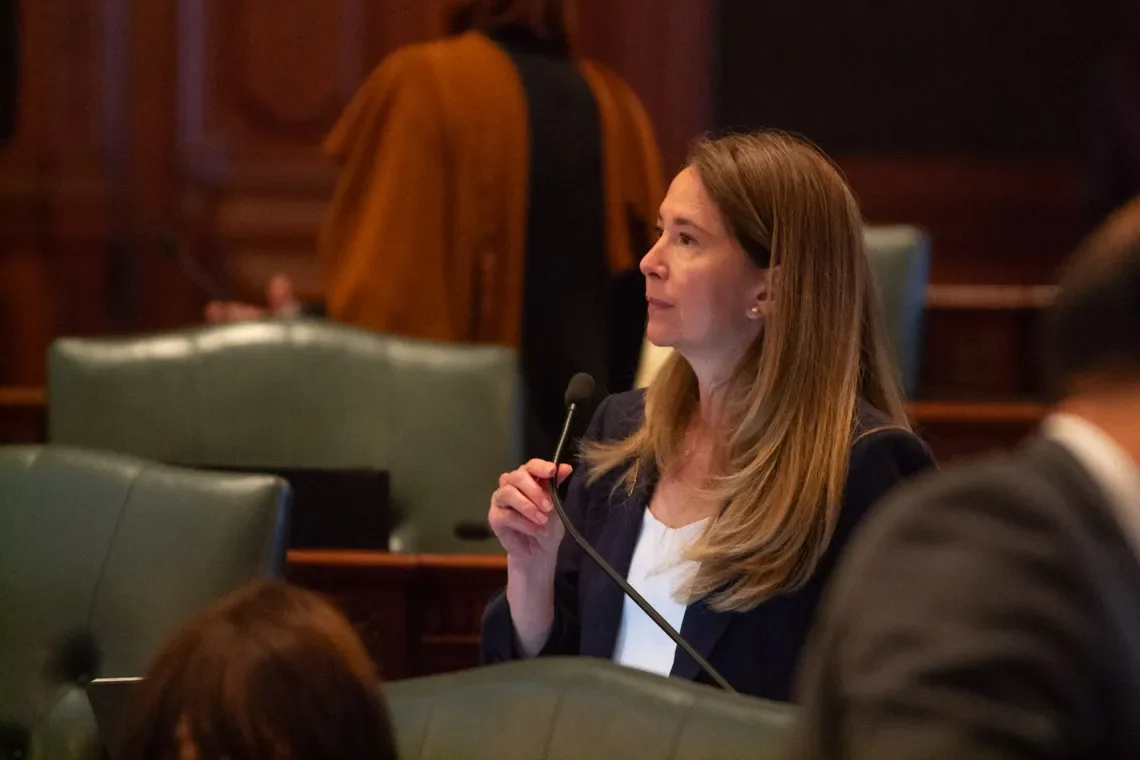
Rep. Jennifer Gong-Gershowitz speaks on the House floor on May 21, 2026. (Capitol News Illinois photo by Jerry Nowicki)

Detention centers, exoneree restitution, foster care protections among final bills to pass 

Dozens of bills passed on the final session days — here are some of the most significant

By NIKOEL HYTREK & JENNA SCHWEIKERT
Capitol News Illinois
news@capitolnewsillinois.com 

Article Summary

  • As lawmakers put their final touches on the budget, they passed dozens of other bills in a late-night session that are now heading to the governor.

  • Among those bills are protections for kids in foster case, limitations on new detention centers and higher restitution for exonerees.

  • Also included is a bill aimed at giving high schoolers the chance to register to vote in school, named for voting rights activist Rev. Jesse Jackson Sr.

This summary was written by the reporters and editors who worked on this story. 

SPRINGFIELD — Nearly 400 bills cleared both chambers of the General Assembly this session, with more than 150 of them moving in the session’s final week. 

Aside from the $56 billion budget package, the wide range of bills would limit where the federal government can build immigrant detention centers, regulate plastic pellets and increase exoneree restitution, among others. 

The measures all await a signature from Gov. JB Pritzker before they can become law. 

Exoneree restitution

House Bill 3663 would increase the amount of money paid to people who have been wrongfully imprisoned in Illinois and bring the state in line with federally recommended minimum standard set in 2004. 

The Court of Claims would now be able to award an exoneree up to $50,000 for each year wrongfully spent in prison and $25,000 for each year wrongfully on parole, probation or a sex offender registry with no upward cap. The court could also pay out associated attorney fees and costs.

The previous system set specific payouts based on the range of years served, with a maximum total payout of $199,150 that’s hit once a person has served at least 14 years wrongfully. 

It unanimously passed both chambers of the General Assembly on Sunday and Monday. 

The bill is the product of years of work by the Illinois Innocence Project. 

Detention center limitations 

House Bill 5024 would ban the construction or operation of new immigration detention centers within 1,500 feet of any home, school, day care center, park, forest preserve, cemetery or place of worship.

Sponsored by House Speaker Emanuel “Chris” Welch, D-Hillside, the bill passed along party lines in both chambers. Welch’s district includes the neighborhood of Broadview, the location of a detention center that was the focal point of some protests during Operation Midway Blitz last summer. 

The bill is not retroactive, so it won’t apply to Broadview or any existing detention centers. 

It received heavy criticism from Republicans who called it a political stunt. The federal government is generally exempt from state and local zoning restrictions, so the bill is likely to face legal challenges.

Plastic pellet protections

House Bill 4418 creates the Plastic Pellets Pollution Control Act, which takes a step toward controlling the amount of plastic that ends up in Illinois waterways. 

The bill makes Illinois the first Great Lakes state to classify plastic pellets as pollutants. 

It instructs the Illinois Environmental Protection Agency to implement a program to control plastic pellets, which are a byproduct of plastic production that frequently end up in Illinois waterways through spills. The pellets are a major source of microplastics as they break down. 

The measure doesn’t specifically spell out what the plan would entail but gives the IEPA one year to implement the requirements to be included in National Pollutant Discharge Elimination System permits.

Republicans generally criticized the broad authority the measure gives to the IEPA.

The bill passed the Senate with a 44-13 vote. It passed the House in April with a vote of 69-33.

Foster placement

Lawmakers passed a bill to protect the personal information of children in foster care, especially if they’re placed out of state.

House Bill 4966, known as the Safeguards to Ensure Continuity and Uphold Rights and Equity, or SECURE, Act, would strengthen nondiscrimination protections for youth in the care of the Department of Child and Family Services and establish that Illinois children placed in out-of-state homes are under the jurisdiction of Illinois and should receive the same services and care they would have in Illinois. 

The bill would require DCFS to protect a child from unnecessary and unapproved disclosure of any personal information that could be linked to the child's sexual orientation or other protected characteristics like gender. It also establishes guidelines for the department to share that information if needed. 

The bill would also give children age 8 years and above some input into their placement if that child expects they might be mistreated or wouldn’t be able to access certain healthcare like gender-affirming care or reproductive services.

“Beyond the fact that this federal administration is hell-bent on rolling back civil rights protections, the SECURE Act is necessary because youth in care deserve to have their rights protected and their voices heard,” Rep. Kelly Cassidy, D- Chicago, the House sponsor of the bill, said.

Republicans in floor debate mainly argued the bill might make placements more difficult and strain DCFS resources if the department has to find homes that will affirm a child’s sexual orientation or gender identity.  

The measure passed the Senate with a 35-19 vote on Friday, and it passed the House Sunday 75-40. 

Mandated reporters 

House Bill 4911 would expand the list of mandated reporters to include investment advisers, certain dealers, salespersons and branch managers of financial institutions. It is intended to expand reporting of financial exploitation and other forms of abuse or neglect of older adults.

Those individuals could also place a 15-day hold on a transaction if they suspect financial exploitation. The bill passed unanimously in both chambers.

Reports would be provided to the Department of Human Services and the Department of Healthcare and Family Services. The state’s Department on Aging and Department of Financial and Professional Regulation would set minimum training standards for financial institution employees. 

Construction site sanitary facilities 

Senate Bill 3465 would require construction sites with 10 or more employees and at least one woman to provide sanitary facilities for people “who are menstruating, lactating, or both” and defines the minimum hygienic standards for those facilities. Sites must also provide lactation stations for employees upon request.

The bill was inspired by a similar one in Washington and is meant to help women access appropriate sanitary facilities without having to leave the work site and be docked pay, Rep. Theresa Mah, D-Chicago, said.

The bill passed both chambers along party lines, as Republicans criticized the bill for capturing a wider population of people — anyone who menstruates and any woman despite age — than they thought was necessary.

Nonprofit investment fund 

Senate Bill 2968, an initiative of state treasurer Michael Frerichs, would establish a state-run investment fund for nonprofits to receive grants from. 

Pritzker vetoed a version of the legislation last summer out of concern that extremist groups could access the fund.

Eligible nonprofits must be based in Illinois, have a certain tax status and provide recent audited financial statements or charitable filings. They must also have a purpose or mission meeting specified nonprofit categories and not be on state suspension lists, which should exclude any extremist groups.

“Nonprofits are on the front lines every day, helping families, strengthening neighborhoods, and meeting critical needs in communities across Illinois,” Frerichs said in a statement. “At a time when federal funding cuts are creating uncertainty for many organizations, Illinois is stepping up.”

It passed the House 75-36 and the Senate 41-16. 

High school voter registration

House Bill 4339 would require high schools to offer eligible students the opportunity to register to vote. The bill, however, creates no consequences if a school does not offer that opportunity.

The bill is named for the Rev. Jesse Jackson Sr., a voting and civil rights activist who died earlier this year. The bill passed with bipartisan support in both chambers.

It passed the Senate 41-12 and the House 77-24. 

Capitol News Illinois is a nonprofit, nonpartisan news service that distributes state government coverage to hundreds of news outlets statewide. It is funded primarily by the Illinois Press Foundation and the Robert R. McCormick Foundation.
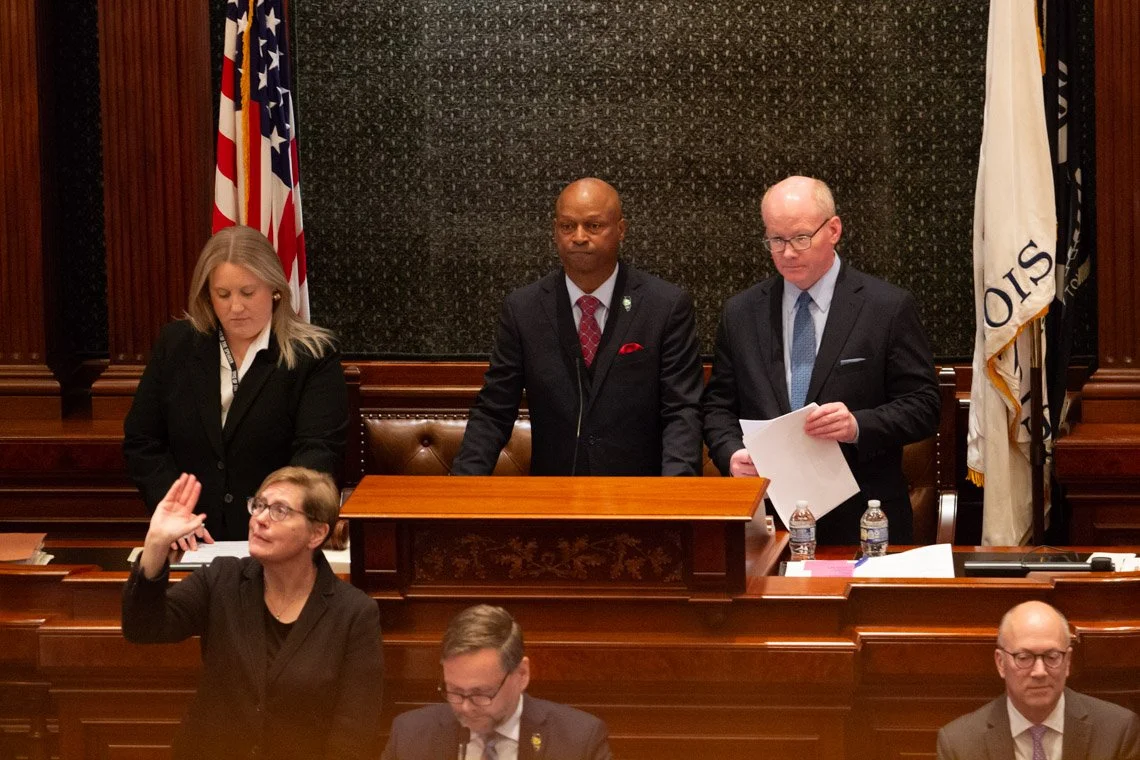
Speaker Emanuel “Chris” Welch, D-Hillside, and Senate President Don Harmon, D-Oak Park, preside over a joint session of the House and Senate on May 27, 2026. (Capitol News Illinois photo by Jerry Nowicki)

Community Turns Out In Force To Help WGH Celebrate #75

A large crowd turned out Wednesday as Wabash General Hospital celebrated its 75th anniversary with a community lunch and open-house style gathering on the hospital campus.

Visitors enjoyed smoked pork chop sandwiches prepared by Mike Wilson, along with cupcakes, cookies, and refreshments as hospital employees, community members, and local leaders came together to mark the milestone.

Wabash General Hospital President and CEO Karissa Turner said the anniversary is a special moment for both the hospital and its staff.

Turner said she feels blessed to serve as the hospital's CEO during the milestone year and reminded employees that their responsibility is to ensure the hospital remains successful for generations to come.

She said the strong turnout reflects the community's appreciation for the hospital and its employees.

Turner praised the hospital staff for their dedication and compassion, noting that many residents frequently tell her the care they receive at Wabash General Hospital is different from what they experience elsewhere.

She added that healthcare can be challenging work, making it especially meaningful to see so many community members come out to show their support.

Turner also thanked residents for continuing to utilize hospital services and support hospital events. She noted that ticket sales for Friday night's WGH Soirée have been strong, with only about 20 tickets remaining as of Wednesday afternoon.

Wabash General Hospital first opened its doors in 1951 and today employs hundreds of people while providing a wide range of healthcare services throughout the region. The anniversary celebration honored both the hospital's history and its commitment to serving the community for years to come.

Sellers Found Guilty On Both Counts By Wabash County Jury

A former Mt. Carmel man has been found guilty in Wabash County Circuit Court of sexually abusing a child more than two decades ago.

After approximately 90 minutes of deliberations, a jury returned guilty verdicts at 6:10 Wednesday evening against 45-year-old Joseph Sellers of Janesville, Wisconsin. Jurors found Sellers guilty on two Class 2 felony counts of criminal sexual abuse.

The convictions stem from incidents that occurred between 1997 and 2000 when the victim was under the age of 9 and Sellers was 17 and 18 years old.

Sentencing has been scheduled for August 11th at 10:45 a.m. Sellers faces a prison term of three to seven years on each conviction.

Sellers took the stand in his own defense Wednesday afternoon, denying the allegations. He told jurors it was "impossible to remember something that never happened." Sellers testified he was close to the victim's father, whom he described as a spiritual mentor, and became emotional while stating he would never do anything to harm him or his family.

Sellers said he attended church with the victim's family in Mount Carmel and served as a youth minister intern. He testified he was an influential member of the church before leaving to attend Southern Illinois University Edwardsville following a stint in the Illinois Army National Guard.

During closing arguments, Wabash County State's Attorney Kelli Storckman argued the case was more than a "he said, she said" situation because testimony indicated Sellers admitted to touching the victim. Storckman questioned what motive the victim would have to pursue charges after all these years and said jurors would have to believe multiple witnesses conspired against Sellers in order to find him not guilty.

Defense attorney Monroe McWard argued that while child sexual abuse is a serious crime, convicting an innocent person would be even worse. McWard pointed to what he described as inconsistencies in the victim's testimony and statements to police and criticized investigators for failing to pursue information he said could have cleared Sellers.

Following the verdict, McWard said the defense was disappointed with the outcome.

"I think the evidence was against the verdict and in favor of him being acquitted," McWard told WSJD. "We certainly are looking forward to doing an appeal for him."

McWard acknowledged the challenges of defending a case involving allegations that are nearly 30 years old and were not reported until years later.

"Very difficult. Yeah. Very, very difficult," he said.

Asked whether there was one piece of evidence that may have swayed the jury, McWard said it was impossible to know.

"It is difficult to imagine with the jury looking at a case over 20 years. It's hard to identify exactly which part the jurors held their hat on," he said.

Storckman declined to comment on the verdict when contacted by WSJD, citing the fact that a second criminal case remains pending against Sellers.

Sellers also faces separate charges in another Wabash County case. He is charged with two counts of predatory criminal sexual assault of a child, Class X felonies that carry substantially greater penalties upon conviction.

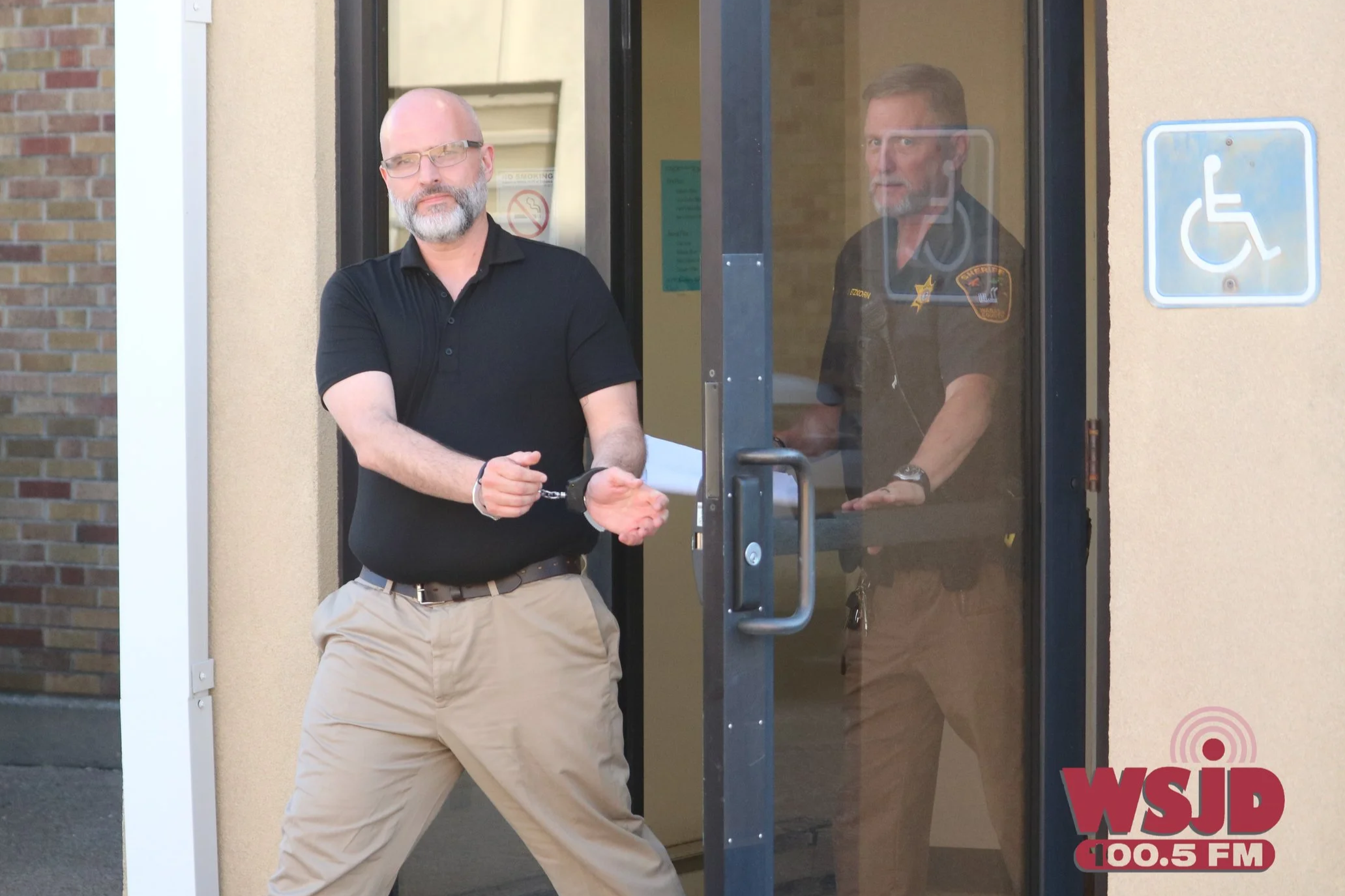
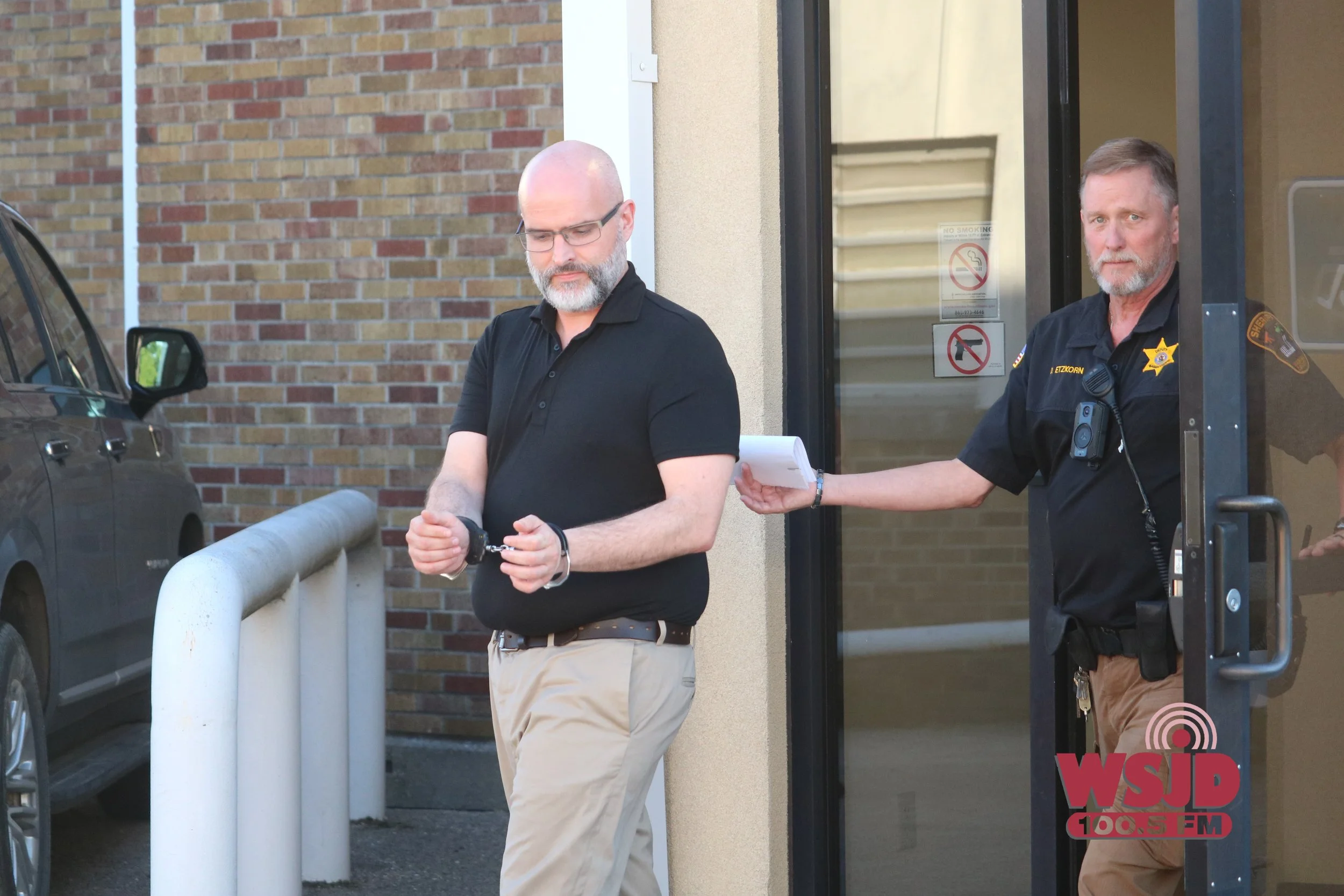
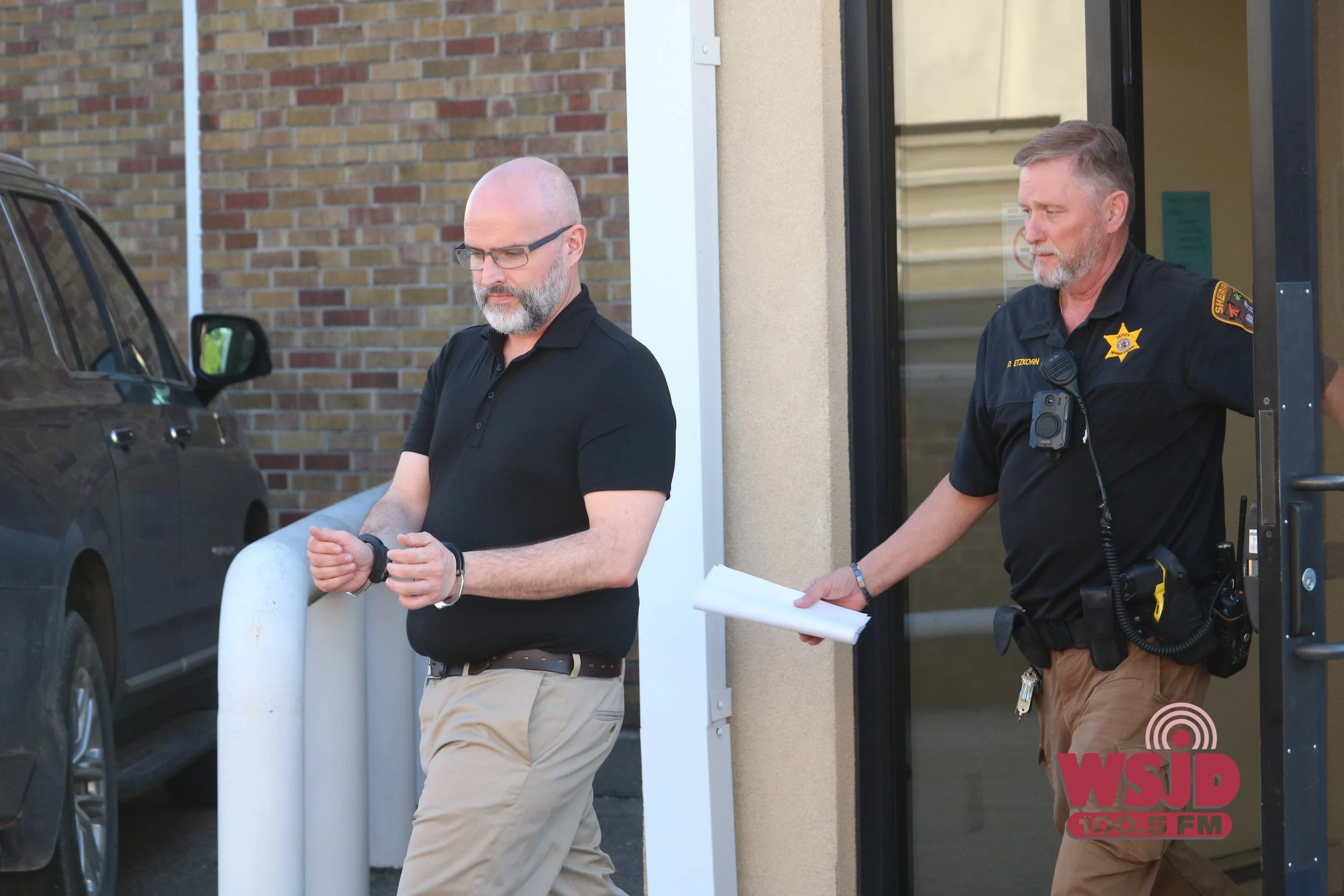
Joseph Sellers is led from the Wabash County Courthouse to the Wabash County Jail following his Wednesday night conviction. Judge William C. Hudson revoked Sellers’ $12,500 cash bond and ordered taken to jail pending his August sentencing.