The Great American Smoke Out is Thursday, November 20th and the Wabash County Health Department will be participating by sharing information about how to stop smoking and offering stop smoking kits to anyone that wants a little extra help.
County Holding Public Hearing Today On Energy Grant
Wabash County Commissioners have scheduled a pair of public hearings in the coming weeks. The first will be November 17th at 4pm seeking public input on the energy transition community grant on how local residents want the money from the grant spent. In June, Jeff Vaughan of the Greater Wabash Regional Planning Commission explained the grant to commissioners saying the state had set up the program to assist communities who face losing a coal mine or power plant. In Wabash County’s case, the loss of the Friendsville Mine look to generate at least $50,000 in grant monies but could be much more. Vaughan said the state has a pool of $40 million to pull from during this grant cycle.
The second public hearing is December 8th at 4pm on the proposed solar ordinance in Wabash County. After the public hearing, commissioners are expected to adopt the ordinance necessitated by RWE Clean Energy’s plan to site a solar farm in rural Wabash County.
Blessing Boxes A Blessing To Those In Need
The Wabash County Health Department is working to help meet local food needs through a community food drive supporting the county’s Blessing Boxes.
At Wednesday’s Wabash County Board of Health meeting, Health Educator Tristan Barbre said students across local schools are currently collecting nonperishable food items to fill the blessing boxes ahead of the holidays. Barbre said each school has a collection box, and the department’s prevention division will distribute the donations to several blessing box locations in Mt. Carmel.
Barbre explained that the blessing boxes are available 24 hours a day for anyone in need, and the effort comes in response to a noticeable increase in food insecurity following SNAP benefit reductions earlier this year.
She added that the Health Department has also updated information on local food pantry schedules and is partnering with community organizations to make that information more accessible to residents.
Barbre said the goal is simple — to keep the blessing boxes full and ensure families in need have access to food throughout the winter season.
Judge Offers Report To City Council
Mt. Carmel Mayor Joe Judge says work is officially underway on the city’s new aquatic center.
Speaking to the City Council last Monday, Judge announced that Guisewite Excavating began dirt work earlier in the day. The company expects to complete that phase within the next ten days, weather permitting.
A groundbreaking ceremony for the new Mt. Carmel City Aquatic Center is scheduled for Tuesday, November 19th at 1 p.m. During that event, the city will also launch its naming rights campaign, offering sponsorship opportunities ranging from naming the facility itself to purchasing commemorative bricks along the sidewalks.
Judge also noted the city recently received a $30,000 donation toward the pool project from a community partner, whose name will be announced later.
In addition, Mt. Carmel has received $95,820.80 from the Energy Transition Grant through the Illinois Department of Commerce and Economic Opportunity. A public hearing on that grant will take place November 24th at 3 p.m. in City Hall.
The mayor also thanked local sponsors for helping put up new downtown banners, including Wabash General Hospital, First National Bank, and the City of Mt. Carmel, with design assistance from Terry Beckerman and Corwin Printing.
School Board Hears Test Scores Report
There was some positive academic news at last Monday night’s Wabash District 348 School Board meeting
Superintendent Dr. Chuck Bleyer says the district has received its official state test results and the news is good.
“The embargo was lifted on those scores and we did have all of our schools come in commendable. So that means we’re three out of four, which is great for right now. It shows improvement from the previous year, which is great.”
Bleyer said the strong results reflect steady progress across the district, and now the focus shifts to moving all schools to the state’s highest rating.
“Now we’re working with Michael Brewer and the principals on how we get to the next level. So we’re happy with that development.”
Dr. Bleyer said the district’s goal is to continue building on this year’s gains and reach the top performance category in the coming years.
One Market Street Intersection To Be Without Christmas Lights
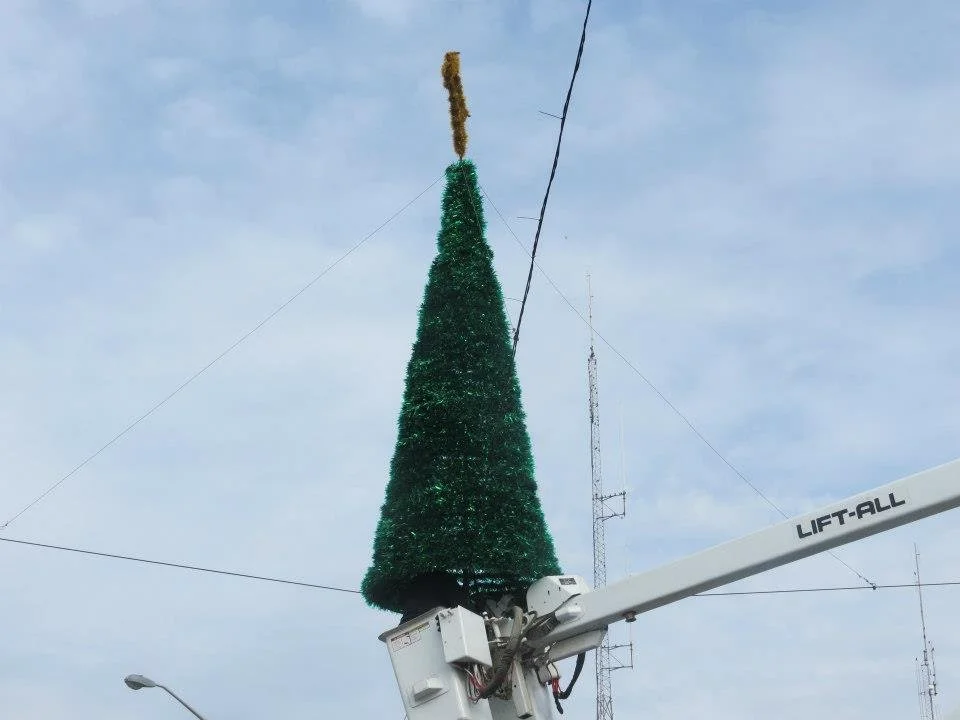
The Wabash County Chamber of Commerce says one of Mt. Carmel’s most visible Christmas decorations won’t be going up this year. At last week’s City Council meeting, Chamber Executive Director Lesley Hipsher told council members that the traditional lighted Christmas tree display at the 7th and Market Street intersection will not be installed this holiday season. Hipsher said a structural engineer determined that the poles used to support the tree are not structurally safe. The Chamber has looked into replacing them, but the cost is described as tens of thousands of dollars. She said the Chamber is working with city and utility officials to explore a contingency plan, but there won’t be a replacement display at that location this year. Other downtown decorations are expected to go up in the next few weeks, but the familiar 7th Street tree will be missing for the 2025 Christmas season.
WSJD File Photo
Bus Drivers Bring Concerns To District #348 Board
Two Wabash District 348 bus drivers spoke at last Monday evening’s school board meeting raising concerns about safety and facilities.
Veteran bus driver Chris Cunningham told the board the district’s bus garage is outdated and in need of major improvements.
“Our current garage is about 1948, somewhere in there. It has three bays, but really only one is usable for mechanic work. The sewer system is old, the restrooms aren’t up to code, and we just want to ask the board to look at upgrading or maybe relocating the facility.”
Cunningham thanked the district for adding two new buses this year but said the condition of the garage makes it difficult to maintain the fleet — especially during the colder months.
Driver Paul Tarpley also spoke, echoing Cunningham’s concerns about the garage but focusing on student safety on bus routes.
“I’ve had several cars go right by my bus when the stop sign’s out and kids are getting ready to cross the road. It’s scary. We need cameras that can catch license plates — right now it’s my word against theirs.”
Tarpley said the addition of stop-arm cameras and on-board communication systems would make a big difference in keeping students safe.
School board members thanked both drivers for sharing their concerns. The district is expected to review the issues as part of ongoing transportation and safety discussions.
State agency spending cut plans remain unclear following Pritzker’s order
Governor signed order requiring agencies to identify cuts by late October in response to budget pressures
By BEN SZALINSKI
Capitol News Illinois
bszalinski@capitolnewsillinois.com
Article Summary
The governor’s office won’t release details about how state agencies plan to cut spending and reserve funds weeks after their plans for doing so were due to be submitted.
A spokesperson for Gov. JB Pritzker said the governor’s budget office is still reviewing the agencies’ recommendations.
Republican lawmakers said Pritzker needs to be transparent about how state agencies propose reducing spending in the current fiscal year.
Pritzker issued an executive order for the cuts over fears that the state will not have as much revenue as anticipated.
This summary was written by the reporters and editors who worked on this story.
SPRINGFIELD — Most state agencies were required to submit spending cut plans to Gov. JB Pritzker by Oct. 23, but the governor’s office has declined to release details about those plans.
A spokesperson for Pritzker said the governor’s budget office is still reviewing the proposed cuts.
“Gov. Pritzker is taking proactive steps to protect Illinois’ fiscal stability,” spokesperson Andres Correa said in a statement. “These reviews are part of ensuring the state remains on solid financial footing and can continue delivering the core services Illinoisans depend on.”
But this lack of transparency is not sitting well with Republicans, who said Pritzker needs to be open about the cuts agencies have proposed.
“I was very much looking forward to seeing where Gov. Pritzker’s agencies identified inefficiencies and excessive spending and hoped that maybe this executive order would create a slightly more efficient government,” Rep. Amy Elik, R-Godfrey, the House Republicans’ budget leader, said at a news conference Thursday.
Pritzker signed the executive order on Sept. 23 that requires most state agencies to “identify immediate spending reductions, including efficiencies that will result in reduced spending.” It also directed the agencies to reserve 4% of fiscal year 2026 General Fund appropriations.
Pritzker issued the order in response to fears that federal policies passed in the summer will reduce state revenue and require the state to spend more as economic instability grows.
Read more: Pritzker directs agencies to limit spending in response to Trump’s economic policies
A Freedom of Information request submitted by Capitol News Illinois to review what agencies submitted to Pritzker was denied, with the governor’s office saying the agencies’ responses were draft recommendations and therefore exempt from public disclosure.
State revenue is up
The General Assembly’s bipartisan Commission on Government Forecasting and Accountability’s November report shows state revenue continues to remain up so far in FY26 compared to this time in FY25. But Pritzker’s budget office released a report in October that the state is on track to run a more than $200 million deficit in FY26 – though recent legislative action could erase some of that projected deficit.
Read more: Illinois’ budget on track for deficit as new federal policies create challenges
Republicans said now is the time for the state to formulate a plan to ensure budget stability if the federal government cuts funding to the state or revenues dip.
“We're seeing federal dollars that are no longer going to flow to Illinois based on some of our policy choices, and so as a state, we're going to need to build up those rainy day funds, those backup plans for when we are going to have to fill in some of those gaps,” Rep. Regan Deering, R-Decatur, said.
The FY26 budget included only a 1% increase above FY25 spending, but Republicans warned back in May when it passed that Democrats were being too aggressive with spending and seeking out $700 million in new taxes to fund a spending increase.
Read more: Pritzker signs $55.1B state budget reliant on $700M of new taxes
“Now, just a few short months later, Gov. Pritzker is claiming that the very same budget he signed is not feasible and is pointing fingers at the Trump administration through politically motivated executive orders rather than solving Illinois’ problems,” Elik said.
Early mitigations
Democratic lawmakers took action during the October veto session that they hope will address the projected deficit.
Read more: Illinois bill ‘decouples’ state, federal taxes, raising revenue and angering businesses
Lawmakers voted to “decouple” state taxes from the federal tax code in certain areas to avoid revenue shortfalls because of tax changes at the federal level. The changes are still waiting for Pritzker’s approval but are expected to plug most of the FY26 shortfall.
Businesses are expected to be hit hardest by the changes, and Elik said the decision will make Illinois less competitive in retaining or attracting new employers.
Capitol News Illinois is a nonprofit, nonpartisan news service that distributes state government coverage to hundreds of news outlets statewide. It is funded primarily by the Illinois Press Foundation and the Robert R. McCormick Foundation.
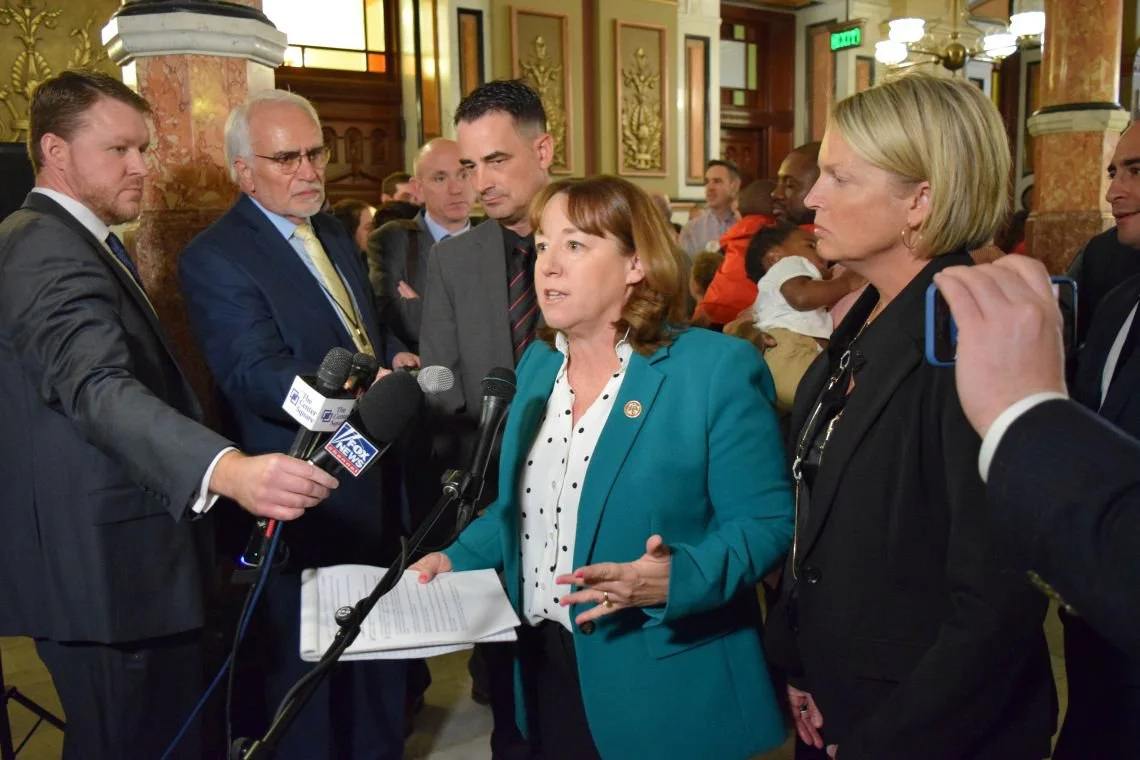
State Rep. Amy Elik, R-Godfrey, speaks to reporters following a committee hearing on March 19, 2025. (Capitol News Illinois photo by Jade Aubrey)
Education union, students call on governor to release higher education funding
Money was included in budget with condition that Pritzker must approve all expenditures
Article Summary
Education union members, students and faculty at state universities called on the Illinois Board of Higher Education to pressure the governor to release higher education funding that is being held in reserve.
Lawmakers approved the funding with the caveat that its release required written permission from the governor.
Gov. JB Pritzker’s office says the money will remain in reserve until there is “stability” from the federal government in higher education funding.
This summary was written by the reporters and editors who worked on this story.
By PETER HANCOCK
Capitol News Illinois
phancock@capitolnewsillinois.com
SPRINGFIELD — University students and faculty urged the Illinois Board of Higher Education to press Gov. JB Pritzker to release more than $29 million in funding for state colleges and universities that state lawmakers approved this year but the Pritzker administration is holding back.
But the governor’s office said in an email to Capitol News Illinois that it does not intend to release the state-approved funding until it sees “stability” on federal education policy coming from Washington.
“(President) Trump’s budget bill and reckless tariffs have wreaked havoc on state revenues nationwide, making it essential to double down on fiscal discipline,” a spokesman in the governor’s office said.
Advocates for releasing the funds spoke Wednesday during the public comment portion of an IBHE business meeting, held on the campus of Elgin Community College, in Kane County. They included faculty members from nearby universities who are members of University Professionals of Illinois, a collective bargaining unit within the Illinois Federation of Teachers that represents about 3,000 employees across eight public university campuses in the state.
In addition to calling for release of the $29 million, advocates also called on the IBHE board to endorse legislation that would overhaul funding of the state’s higher education system, putting it on a needs-based formula similar to the Evidence-Based Funding formula used for grades K-12 education.
“Years of underfunding by the state have forced most Illinois public universities to increase tuition, cut programs and reduce staff,” said UPI vice president Keith Nyquist, a business instructor at Northern Illinois University. “We have to look no further and what's been going on at Western (Illinois University) and most recently at Eastern Illinois (University), where dozens and dozens of staff and faculty have had their positions terminated. And they're on their way out because of the lack of funding.”
Money held back
In his budget proposal to the General Assembly in February, Pritzker proposed a 3% increase in higher education funding. But the $55.3 billion budget bill that lawmakers approved in May contained only a 1% increase, with an additional 2% — or $29.5 million — that could be distributed only “after the purpose and amounts have been approved in writing by the Governor.”
Democratic leaders in the General Assembly said at the time the money was intended to be used if there were significant cuts in federal higher education spending.
But in its statement this week, the governor’s office said it was always Pritzker’s intent to hold the money back as a cushion against uncertainties caused by the Trump administration.
“When the budget was approved by the legislature and signed, the Governor was clear that a 2% reserve would remain in place until we saw stability on education from Washington, which has yet to materialize,” the statement read.
In addition to holding back the higher education funding, Pritzker issued an executive order in September directing executive branch agencies to make plans to hold back as much as 4% of their budgets this year. The IBHE and Illinois Community College Board were not subject to that order.
Read more: Pritzker directs agencies to limit spending in response to Trump’s economic policies
Kimberly Britt, a junior psychology major at Chicago State University, said that for her as well as many students and teachers at campuses across the state, the issue was not about national politics.
“The 2% being withheld might seem small on paper, but its impact is immense,” she said. “It determines whether a student can stay enrolled, whether a professor can continue teaching full time, and whether Chicago State can continue being the beacon of opportunity it has been for generations.”
New funding formula
In addition to calling for release of the funds, several of the advocates who spoke Wednesday called for IBHE to openly support overhauling the way higher education funding is allocated among the state’s public universities.
Of the $29.5 million that Pritzker is holding in reserve, the largest portion, $12.9 million, is earmarked for the University of Illinois system, which includes campuses in Urbana-Champaign, Chicago and Springfield.
The rest would be divided among the state’s eight other public university systems, the Illinois Community College Board and City Colleges of Chicago.
That distribution formula would change dramatically under legislation that was introduced earlier this year but which did not pass out of a key legislative committee, largely due to opposition from U of I.
That legislation, Senate Bill 13 and House Bill 1581, known as the Adequate and Equitable Public University Funding Act, would establish a new formula that would set an adequacy target for each university and then direct the bulk of any new funding approved by the General Assembly — the proposal calls for $1.7 billion over 10-15 years — to those institutions furthest away from their targets.
Under that formula, Western Illinois University would be first in line for any new funds because it is currently funded at only 46% of adequacy. U of I’s Urbana-Champaign campus, which is currently funded at 89% of adequacy, would be last in line.
“The board’s silence on the legislation aimed at addressing higher ed's desperate and immediate need for adequate and equitable funding is deafening,” said Christopher Merchant, an associate psychology professor at Northeastern Illinois University and a UPI member.
“As more and more political leaders abandon colleges and universities out of political convenience or malice or both, this board's absence of support gets thrown into more and more stark relief,” Merchant said. “How do we secure a pathway to the future for our students if nobody is willing to fight the fights that matter on their behalf?”
The advocacy group Advance Illinois, which was a strong proponent of the proposed new funding formula, has said it intends to continue pushing for the legislation in the 2026 session.
Capitol News Illinois is a nonprofit, nonpartisan news service that distributes state government coverage to hundreds of news outlets statewide. It is funded primarily by the Illinois Press Foundation and the Robert R. McCormick Foundation.
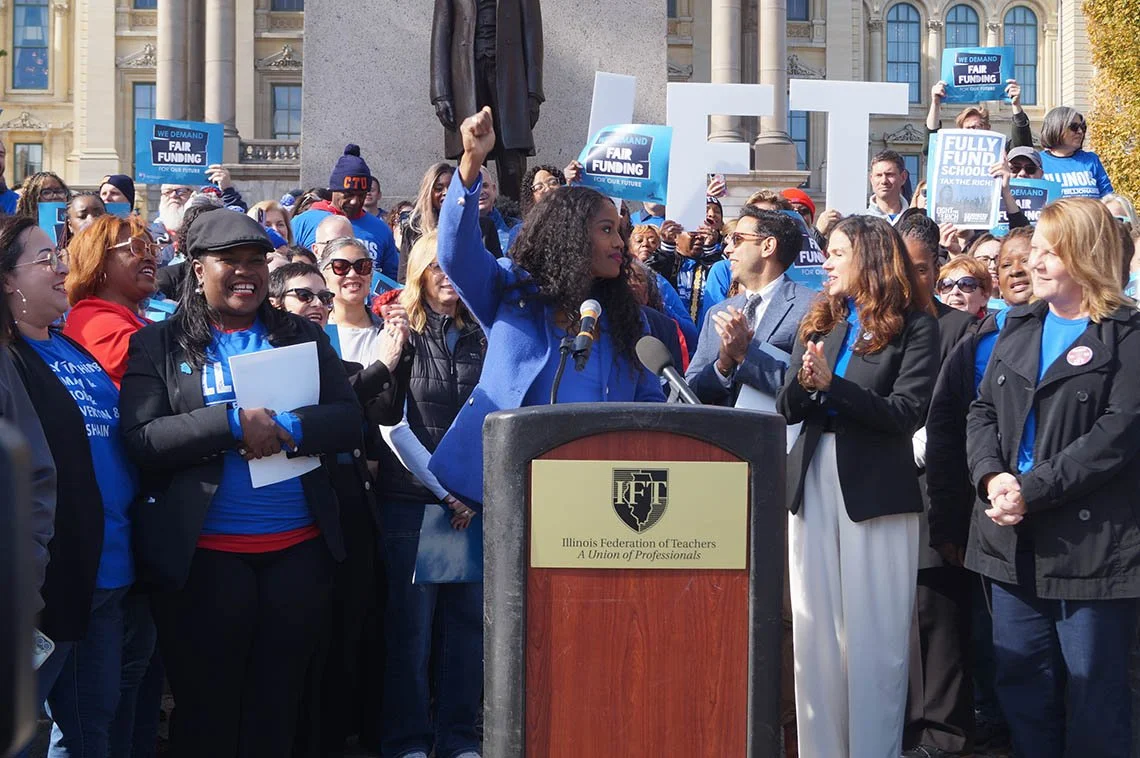
Members of the Illinois Federation of Teachers, led by union president Stacy Davis Gates, rally in front of the Statehouse in Springfield during the 2025 fall veto session calling for increased funding for K-12 and higher education. (Capitol News Illinois photo by Peter Hancock)
Bailey to stay in governor’s race following family tragedy
The decision came after ‘a lot of prayer and reflection,’ Bailey told his supporters
By BRENDEN MOORE
Capitol News Illinois
bmoore@capitolnewsillinois.com
Article Summary
Darren bailey is staying in the governor’s race after his son, daughter-in-law and two grandchildren were killed in a helicopter crash in Montana on October 22.
The downstate Republican said he received encouragement from President Donald Trump to “keep fighting” and stay in the race and “that’s exactly what we’re going to do.”
He faces six candidates, including former conservative thinktank executive Ted Dabrowski, video gambling tycoon Rick Heidner and DuPage County Sheriff James Mendrick in the 2026 GOP gubernatorial primary.
This summary was written by the reporters and editors who worked on this story.
SPRINGFIELD — Less than three weeks after a helicopter crash claimed the lives of his son, daughter-in-law and two grandchildren, Darren Bailey said late Monday that he will move forward with his campaign for governor.
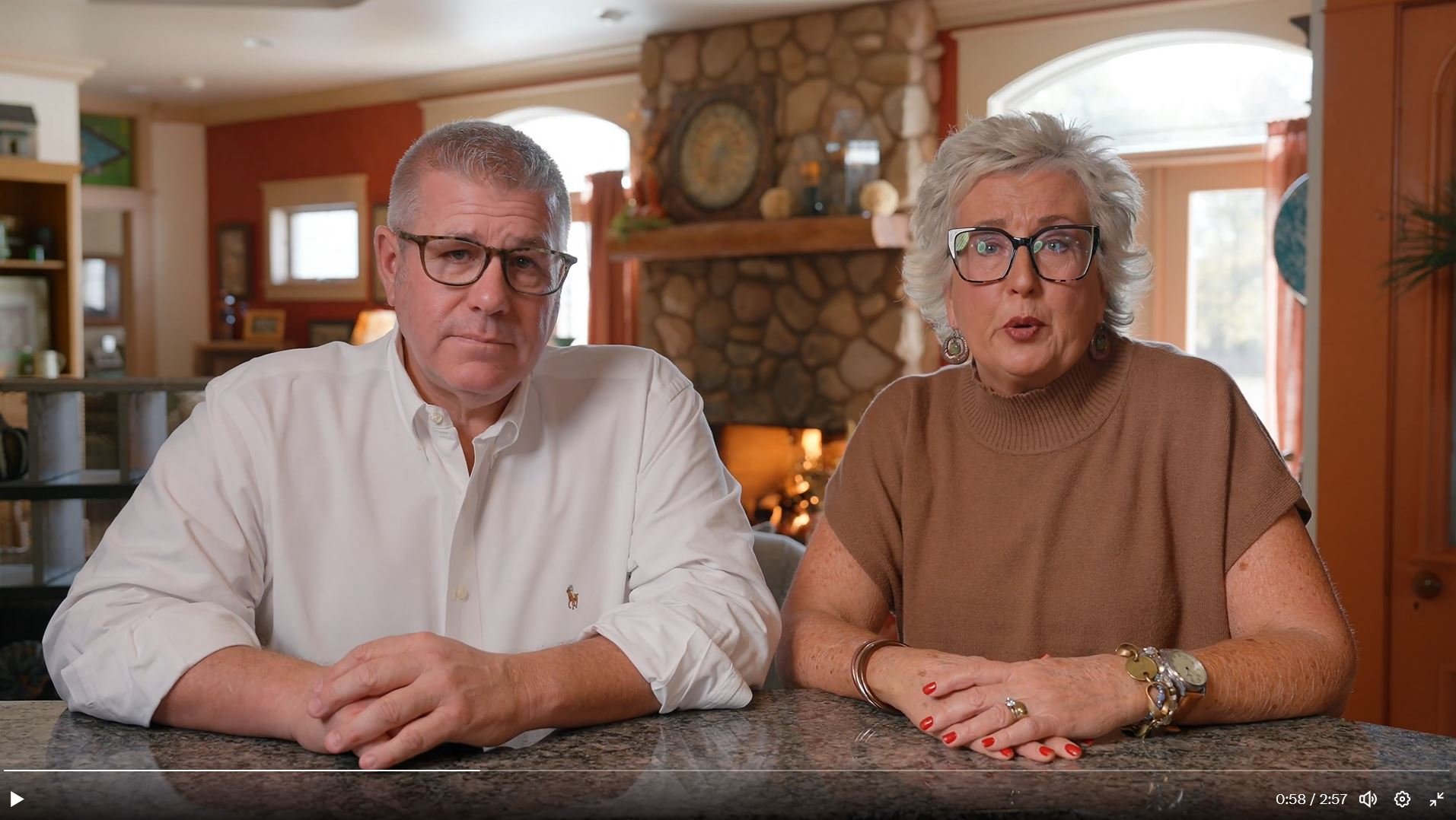
“After a lot of prayer and reflection, Cindy and I have decided we're staying in this race for governor — not for politics, but for every family trying to make it in a state that's lost its way, for every parent who dreams of a better future for their children and for every Illinoisan who knows that we can do better,” Bailey said in a nearly three-minute video recorded with his wife and posted to his social media accounts.
Bailey said he received encouragement from President Donald Trump to “keep fighting” and stay in the race. “That’s exactly what we’re going to do,” he said.
“So I'm asking you: stand with us, pray with us, fight with us,” Bailey said, grasping his wife Cindy’s hand. “Together, we can bring back common sense, honesty and leadership that serves real people again. Together, we will save Illinois' future.”
Bailey’s second campaign for governor had been in doubt after his son Zachary, daughter-in-law Kelsey and two grandchildren, 12-year-old Vada Rose and 7-year-old Samuel, died when the helicopter Zachary was piloting crashed in Montana on Oct. 22. The couple’s 10-year-old son, Finn, was not on board at the time.
The crash is being investigated by the National Transportation Safety Board.
‘Hardest days of our lives’
The campaign filed petitions in late October to secure a spot on the March 17 primary ballot, but running mate Aaron Del Mar told reporters at the time that Bailey was “taking time to think” about whether to proceed with the campaign.
Read more: Crowded Dem primaries, GOP field for governor take shape as candidates file for office
Bailey, a farmer and former state legislator, won the 2022 GOP gubernatorial nomination but lost the general election to Democratic Gov. JB Pritzker by nearly 13 percentage points. He later unsuccessfully challenged U.S. Rep. Mike Bost, R-Murphysboro, in 2024, losing that primary election by under 3,000 votes.
With high name recognition among Republican voters, Bailey starts as the favorite in the 2026 primary against six lesser-known candidates. They include former conservative thinktank executive Ted Dabrowski, video gambling tycoon Rick Heidner and DuPage County Sheriff James Mendrick. Pritzker is seeking a third term as the state’s chief executive.
Bailey acknowledged that the past few weeks “have been the hardest days of our lives,” but that he and his wife had been lifted by the many well-wishes and their evangelical faith.
He said the tragedy changed their lives forever, “but it also reminded us why we fight.” His late son and daughter-in-law, he said, “believed in an Illinois where families could build a future without being crushed by bad government and broken promises.”
“We've all been through tough times,” Bailey said. “But what makes Illinois special are the people who don't quit, the ones who work hard, help their neighbors and believe tomorrow can be better. That's who I'm fighting for.”
Capitol News Illinois is a nonprofit, nonpartisan news service that distributes state government coverage to hundreds of news outlets statewide. It is funded primarily by the Illinois Press Foundation and the Robert R. McCormick Foundation.