Funding formula earmarks Road Fund money for public transportation
By BEN SZALINSKI
Capitol News Illinois
bszalinski@capitolnewsillinois.com
Article Summary
A sweeping bill overhauling public transportation in Illinois included more than just operations funding and governance reforms.
Peoria and the Quad Cities could see new train service as part of the plan that includes several provisions affecting transit outside Chicagoland.
Lawmakers are hoping to incentivize new developments around transit stops by allowing transit agencies to be involved in construction projects and limiting municipalities from requiring parking spaces near public transportation.
The bill requires some transit agencies to complete several specific infrastructure projects, such as two new CTA “L” stations in Chicago.
The new funding formula for public transportation was controversial for state lawmakers, however, as more money will go toward public transit rather than road projects.
This summary was written by the reporters and editors who worked on this story.
SPRINGFIELD – With money for new rail lines, regulations for residential development projects and a list of infrastructure priorities in the Chicago area, a public transportation bill recently approved in Springfield does more than just fill a transit funding gap.
While Senate bill 2111 was widely covered for the $1.5 billion it drives to transit throughout Illinois and its governance reforms in the Chicago region, the more than 1,000-page bill outlines a new approach to public transportation. And it includes new regulations designed to spark development near transit stops and bring passenger rail service to new cities.
Read more: Lawmakers approved $1.5B transit funding package without statewide tax increase
Two regions — Peoria and the Quad Cities — could be the largest downstate communities to benefit from the bill. It allows the Illinois Department of Transportation to use up to $476.7 million from a pair of downstate public transportation funds to build new passenger rail routes from Chicago.
Bill supporter Sen. Mike Halpin, D-Rock Island, said in an Oct. 31 news conference that would cover the remaining cost of a long-planned project to establish a train route from Chicago to the Quad Cities.
The project still has a long way to go and there is no timeframe for when people might be able to ride a train from the Moline to Chicago, Halpin said. The biggest hurdle remains reaching an agreement with the Iowa Interstate Railroad, which operates the tracks that a passenger train would have to use to make the route a reality.
Funding for the project has been elusive, and Halpin said stakeholders have become frustrated that freight rail companies have not committed to funding part of the project.
“We decided this was an opportunity that if we needed to, the state and local governments could go it alone to fund this project,” Halpin said.
But House Minority Leader Tony McCombie, R-Savanna, said during debate over the bill in the House on Oct. 31 that there is still no assurance the project will become reality because of the dispute with the private Iowa Interstate Railroad.
“To say you're going to vote for this because there's going to be a rail to Moline is false until that deal is made,” she said.
Peoria could also be in line for its own train route. Beyond funding, the bill directs the IDOT to study what improvements are needed at the Joliet station for it to become a hub that facilitates passenger train traffic specifically to Peoria and other locations outside the Chicago area. That station sits in a busy corridor of Amtrak, Metra and freight lines.
Metra, Chicago’s suburban rail agency, could be key to expanding the reach of passenger rail from Chicago. The bill specifies that Metra is allowed to reach agreements to provide service outside the Chicago area “when it is deemed beneficial to the state.” It also directs Metra to study expanding the Metra Electric Line, which currently ends in University Park, to Kankakee.
It also codifies that Metra must allow South Shore Line trains, which are operated by the Northern Indiana Commuter Transportation District between South Bend and Millenium Park, to stop at Metra stations along the route.
Developing transit corridors
A key priority for lawmakers in the bill was supporting development near public transportation corridors and stops. The bill would allow transit agencies to buy, build, own, operate or maintain sites for residential or commercial development.
Areas for development would be within a half mile of a train station or one-eighth of a mile of a bus stop. The goal is to allow more people to live, work or engage in economic activity with easy access to public transportation.
Sen. Ram Villivalam, D-Chicago, the Senate sponsor of the bill, told Capitol News Illinois he envisions more communities will adopt transit-friendly developments like Morton Grove in his district. The near north suburb has built apartment buildings near its Metra station on the Milwaukee District North line, which makes it easy for residents to access public transportation into the city.
“Morton Grove is investing in a Metra station to make it even more appealing and accessible and they’re doing it in collaboration, in conjunction with, developing residential property that is next to the Metra station,” Villivalam said. “So if you are someone that works in the city of Chicago, wants to have access to the entertainment district, you can live in Morton Grove next to the Metra station.”
The bill also directs the new Northern Illinois Transit Authority to identify parcels of land owned by it or other transit agencies that can be used for transit-supportive development.
A grant established in the bill aims to incentivize projects that allow people to use public transportation to access outdoor recreation. The annual grant program, which is subject to appropriation by state lawmakers, would go toward projects that expand operations of existing transit services, or construct or improve infrastructure.
Transit agencies, owners of public lands and units of local government that facilitate outdoor recreation would be eligible for the grants.
Parking regulations
As lawmakers try to incentivize living near transit stops, they’re also hoping to decrease people’s dependence on cars. The bill would establish the People Over Parking Act that bans municipalities from establishing minimum parking requirements for a development that is within a half mile of a public transportation hub or one-eighth of a mile of a public transportation corridor.
MTD BUS
The bill defines a hub as a train station or the intersection of two or more bus routes that provide service every 15 minutes or less during peak commute hours. Corridors are a street with one or more bus routes with service every 15 minutes or less during peak commute times.
The bill still allows developers to build private parking voluntarily, but municipalities cannot require them to provide a minimum number of spaces.
Targeted funding and projects
Some communities will be early beneficiaries of projects under the bill.
In Chicago, the bill appears to require NITA to rebuild a long-shuttered stop on the Blue Line at Central Ave. in the Austin neighborhood along the Eisenhower Expressway that has been closed since 1973. It also requires NITA to renovate or build a new Green Line stop in Englewood.
One suburban project would also receive more funding from NITA under the bill. It calls for allowing NITA to share the cost of bridge repairs along the Green Line outside of Chicago, which would only apply to Oak Park.
Oak Park, River Forest, Forest Park and Rosemont would also receive annual reimbursements from NITA for providing first responders that cover CTA “L” stations in those communities. Cicero, Evanston and Skokie, which also have “L” stations, were not included in the bill.
A spokesperson for Senate President Don Harmon, a Democrat who lives in Oak Park and represents parts of River Forest and Forest Park, said Harmon did not request those cost-sharing agreements.
On Metra, riders on the Rock Island Line that ends in Joliet would be part of a “regional rail scheduling” program beginning in 2027 that is designed to “improve transit access for residents” in Will County and southwestern Cook County.
Outside the Chicago area, the bill allows state lawmakers next year to appropriate money from a downstate transit fund for IDOT to use as a grant for the Springfield airport to help sustain daily commercial flights to and from O’Hare.
Controversial funding formula
The most controversial part of the bill deals with funding. Republican lawmakers argued the funds used to close a major budget gap would have otherwise gone to road projects, particularly downstate.
Lawmakers estimate $860 million in new funding for public transit will come from redirecting sales tax revenue on motor fuel to public transportation operations, marking a substantial change in how the proceeds are used. Under current law, 64% of the sales taxes go into the Road Fund and most of the rest goes into the state’s General Fund.
Beginning next July, after the bill becomes law, 80% of the sales tax revenue will go toward public transportation — marking a dramatic shift away from road projects. Of the sales tax revenue going toward public transportation, 85% will be dedicated to the Chicago region.
“That was a conversation that evolved over time and, you know, that fund is for transportation and public transit is an issue that falls within transportation in our state,” Villivalam said, pushing back against Republican criticism that the money should be reserved for road work.
Motor fuel tax revenue, which is separate from sales tax revenue on motor fuel sales, will continue going into the Road Fund.
The bill also calls for directing 90% of the expected $200 million in interest generated in the Road Fund to NITA, leaving 10% for the rest of the state.
Transit agencies outside the Chicago area will be getting more funding through a formula that takes sales tax revenue collected in areas served by transit agencies and deposits it into the Downstate Public Transportation Fund. Agencies will be able to receive up to 80% of funding for operating expenses from the fund; an increase from the 65% mark that has been in place since 2008.
The bill and the shift in funding away from downstate has left a rift between some labor organizations, particularly at the Laborers' International Union of North America, or LiUNA.
Dustin Ramage, a representative at the downstate union, told Capitol News Illinois the union is ending its affiliation with the Illinois AFL-CIO. LiUNA officials were unhappy about the way AFL-CIO officials handled negotiations on the transit bill at the end of October. The AFL-CIO declined to comment.
Capitol News Illinois is a nonprofit, nonpartisan news service that distributes state government coverage to hundreds of news outlets statewide. It is funded primarily by the Illinois Press Foundation and the Robert R. McCormick Foundation.
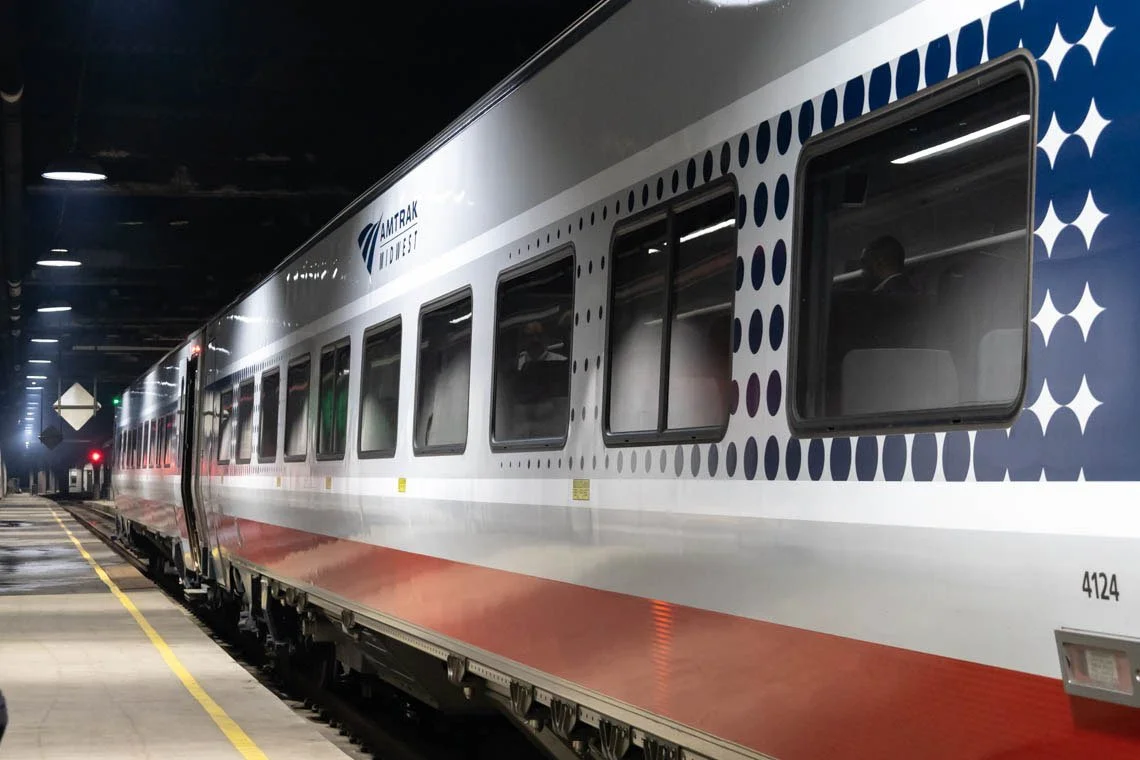
An Amtrak train is pictured in Chicago’s Union Station on June 25, 2023. The transit funding bill passed by the General Assembly could expand train service to Peoria and Moline. (Capitol News Illinois photo by Andrew Adams)