Tax Sale for 2023 Pay 2024 is Friday, May 23, 2025 at 10am in the Courtroom, if you still need to pay your taxes the last day to pay is Thursday, May 22 with cash or cashier's check only.
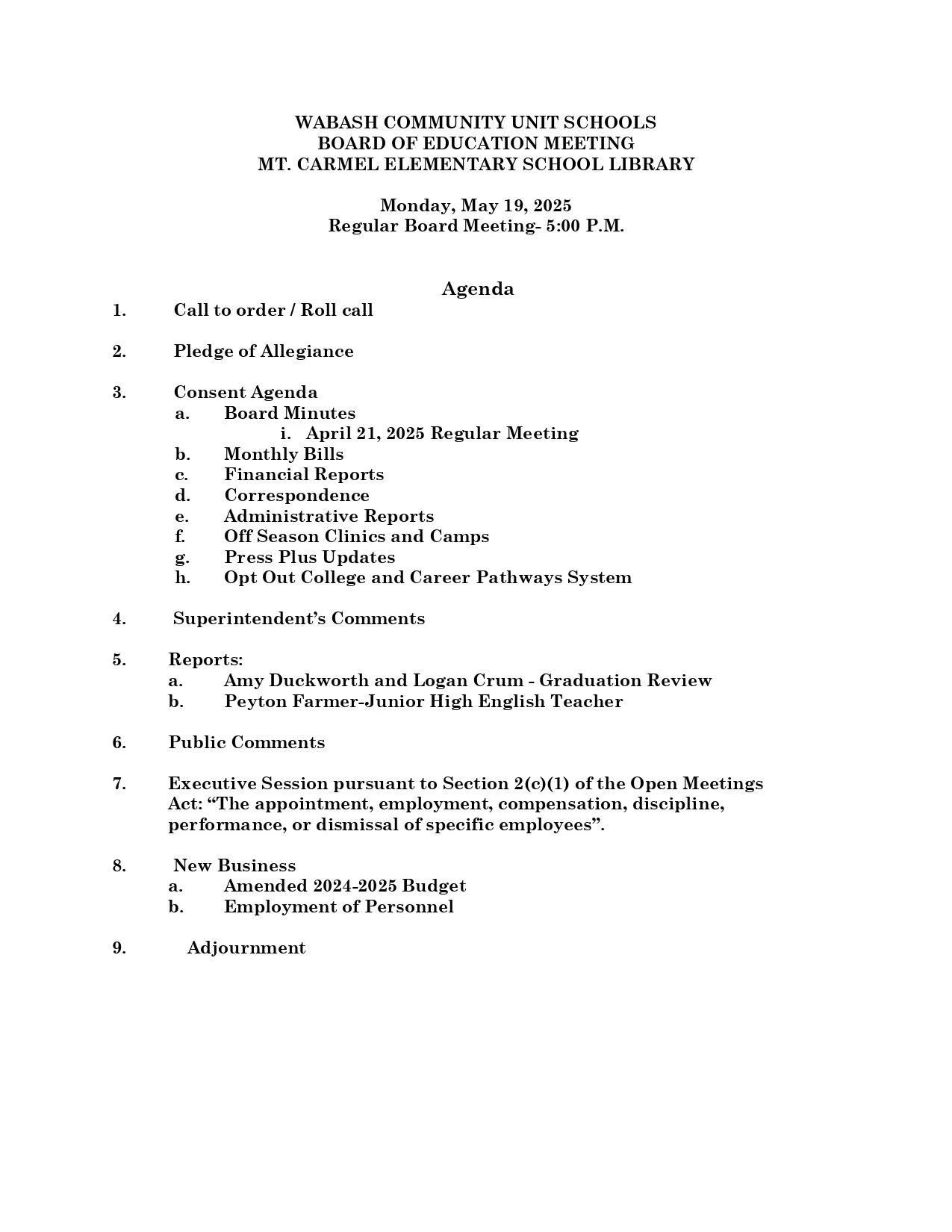
District #348 School Board Agenda
Meeting at 5pm Monday at MCES.
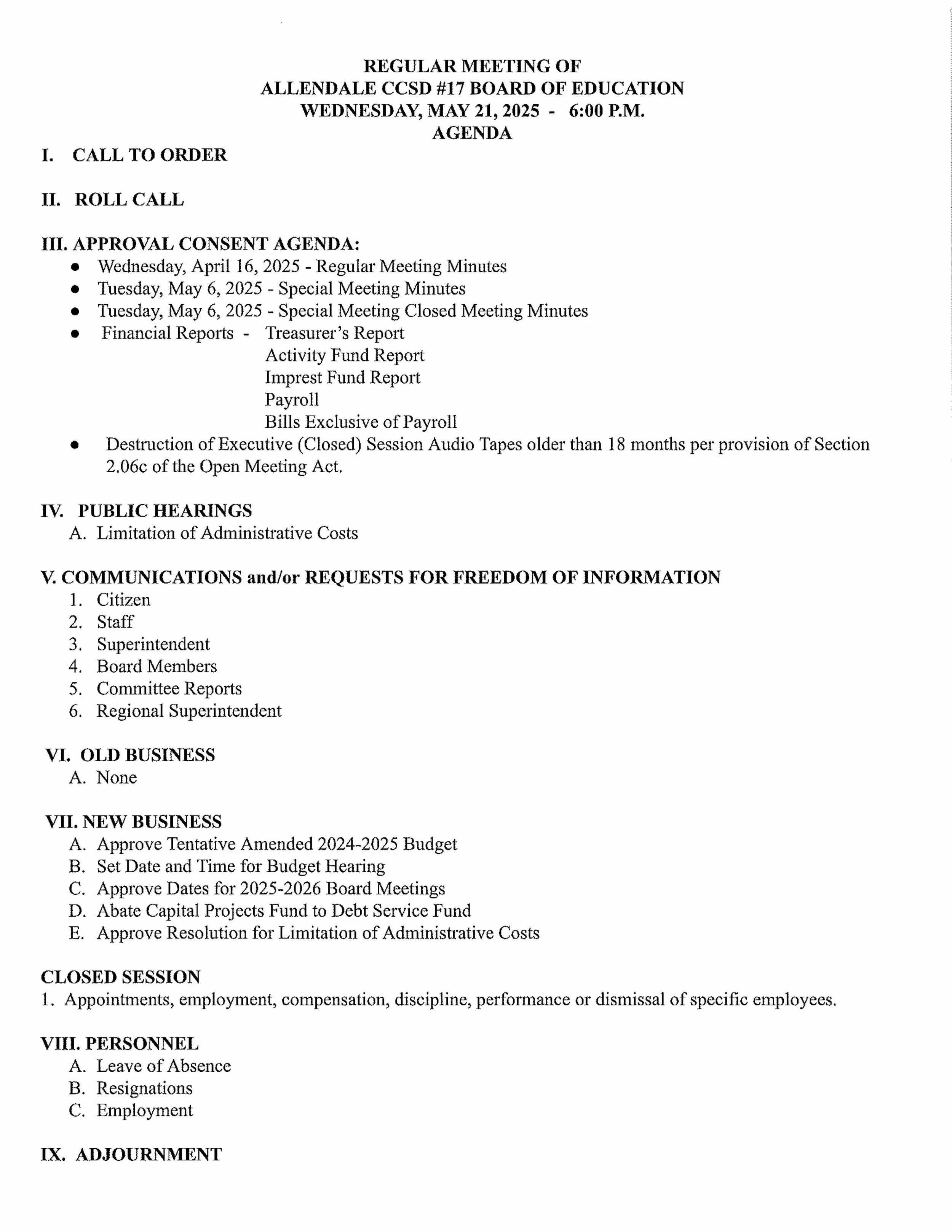
Allendale School Board Agenda
Meeting at 6pm Wednesday.
Traffic Stop Leads To DUI Arrest
On May 11, 2025, at approximately 1:10 a.m., Gibson County Deputy Eric Powell observed a vehicle traveling northbound at 95 mph in a 60 mph zone on US 41 near County Road 1025 South. Upon catching up with the vehicle near Deadmans Curve, Deputies Powell and Michael Bates initiated a traffic stop.
While speaking with the driver, 35-year-old Casey Denbo, Deputy Bates detected signs that the driver might be intoxicated. At that point, Deputy Bates began a roadside DUI investigation. Upon concluding the investigation, Mr. Denbo was taken into custody and transported to the Gibson County Jail, where he was charged with Operating a Vehicle While Intoxicated and Reckless Driving.
Sgt. John Fischer assisted Deputies Bates and Powell in their investigation.
All criminal defendants are presumed innocent until proven guilty beyond a reasonable doubt in a court of law.
Hangar Project Greenlit By City Council
The City Council has approved plans to construct a new hangar at the Mt. Carmel Airport. The $1.5 million project which will house between 8 and 9 planes is funded mostly by a federal grant. The city’s cost is estimated to be at $90,000 which the council will look to formally approve at their next meeting.
City Ends Fiscal Year In Positive Position
City Finance Commissioner Eric Ikemire says the city’s financial outlook continues to be bright. Ikemire noted that most of the city’s various revenue streams came in higher that forecast at the close of the last budget year – leaving most city accounts in better shape than expected.
Mayor Offers 9th Street Construction Update
The 9th Street construction project in Mt. Carmel continues to progress. At Monday’s City Council Meeting, Mayor Joe Judge says crews continue to work on the new sidewalk approaches, noting a lot of time will be spent at 9th and Market as new stoplight poles will be added there along with the sidewalk work. Judge says he did talk with IDOT officials who do plan to come and fill potholes along 9th Street until the road can be resurfaced. Judge says residents should continue to focus on the end result through the next few months.
St. Louis man sentenced to prison for unarmed bank robberies
EAST ST. LOUIS, Ill. – A district court judge sentenced a St. Louis man to 87 months in federal prison after he admitted to robbing four banks in less than three weeks in 2023.
Tyrone Leslie, 40, pleaded guilty in January to four counts of bank robbery. One count was charged in the Southern District of Illinois, and the other three were charged in the Eastern District of Missouri. The Missouri cases were transferred to southern Illinois to be prosecuted simultaneously.
“Bank robbers like Tyrone Leslie threaten the safety of the community, even when they are not carrying guns,” said U.S. Attorney Steven D. Weinhoeft. “It is no defense that Leslie used threatening notes instead of more violent means.”
According to court documents, Leslie robbed the U.S. Bank on Tesson Ferry Road in St. Louis of $2,740 on Nov. 14, 2023. On Nov. 17, he robbed the People’s National Bank on Hampton Avenue in St. Louis of $964. Leslie robbed the PNC Bank in St. Louis on Manchester Road of $5,050 on Dec. 2. He tried to take $4,125 from the FCB Bank in Caseyville, Illinois, on Dec. 4.
Following the FCB Bank robbery in Caseyville, Leslie led police on a high-speed chase.
The Caseyville Police Department led the investigation, and Assistant U.S. Attorneys Ali Burns and Laura Reppert prosecuted the case.
Governor’s office cuts revenue projection by $500M in latest downward estimate
Move comes as lawmakers enter final two-week stretch of budget negotiations
By BEN SZALINSKI
Capitol News Illinois
bszalinski@capitolnewsillinois.com
SPRINGFIELD — Gov. JB Pritzker’s office is now projecting state revenues to come in about a half-billion dollars below the baseline projections assumed during his February budget address.
The latest downward revision comes as lawmakers are entering the final two-week stretch to approve a budget before their May 31 deadline amid increasing economic uncertainty.
While Pritzker’s office blamed changes made by the Trump administration for revenue shortfalls, the new fiscal reality is almost certain to make passing a budget more difficult as lawmakers are forced to consider approving new revenue streams or cutting state programs to make up the difference.
The Governor’s Office of Management and Budget lowered revenue projections for fiscal year 2026, which begins July 1, by $536 million from its February estimate. It’s a 1% decrease that puts the state on track to finish FY26 with $54.9 billion in revenue.
The change “is largely driven by the economic uncertainty and anxiety fueled by the Trump Administration and Republicans in Congress,” Deputy Gov. Andy Manar said in a statement.
“Their reckless economic policies have already triggered the first quarterly decline in the nation’s Gross Domestic Product (GDP) in three years and are driving up costs for working families,” Manar added. “This growing national instability poses a serious risk to Illinois’ continued economic progress and outlook.”
Income tax, federal funding changes
Projections for income and sales tax revenue in FY26 were lowered by 1% since February while corporate income tax expectations decreased by nearly 7%.
GOMB’s projection more closely aligns with a revision issued earlier this month by the Commission on Government Forecasting and Accountability, the General Assembly’s bipartisan forecasting commission. COGFA’s May 2 forecast projects FY26 will see $54.5 billion in revenue, compared to the $54.9 billion forecast by GOMB.
The roughly $400 million difference between COGFA’s and GOMB’s is driven by the fact that GOMB’s latest estimate includes tax code changes sought by the governor that will raise revenue beyond what’s in current law. Pritzker proposed a tax increase on electronic gambling and table games at casinos, pausing a transfer of sales tax revenue from motor fuel sales to the road fund, and providing temporary amnesty for individuals making delinquent tax payments.
Read more: State revenue projections improve as economic uncertainty grows
Pritzker’s office decreased federal revenue expectations for FY26 by about 2%, but COGFA lowered expectations by more than 6%.
Pritzker in February proposed a $55.2 billion spending plan that would be fueled by $55.5 billion in revenue, including the proposed revenue changes. But now lawmakers must work to fit their spending priorities into a smaller window that was already tight. Pritzker’s introduced budget called for 1% spending growth in most areas of the budget outside education, pensions and health care costs.
Senate Democrats’ budget leader, Sen. Elgie Sims, D-Chicago, said he believes the governor’s office’s adjustment keeps with its recent tradition of “responsible and conservative revenue estimating” and that Pritzker was not too aggressive when he introduced his budget in February.
“It was looking at the information available at the time,” Sims said in an interview. “He made an adjustment call. After having more real data, he changed the estimate to reflect that.”
House Republicans’ budget leader, Rep. Amy Elik, R-Godfrey, said Pritzker’s adjustment was “sensible,” but he should have been aware of President Donald Trump’s plans and accounted for their effects when he introduced his budget. She added the state budget has also relied too much on federal funds to pay for state programs.
“We are now in a situation where we have so much reliance on the federal government that any little cut feels like a very big deal to Illinois,” Elik said in an interview.
Special session needed?
The Trump administration has made the budgeting process “much more difficult,” Sims said, and it is possible lawmakers will need to come back later this year to make changes to any budget passed this month.
“We have no idea what the federal government is going to do,” Sims said. “This is the most uncertainty we’ve had in a very long time. So it’s possible. Is it the preferred outcome? Absolutely not, but is it a possibility? Sure.”
Both Sims and Elik said lawmakers need to look closely at what the state is spending to make decisions about how to balance the budget with minimal revenue growth and without hurting key services.
"We’re looking at every line,” Sims said. “This is that point of the session where we gather information.”
Some Republicans are seeking to slash significant portions of the state budget. Rep. Jed Davis, R-Newark, a member of the far-right Freedom Caucus, suggested the budget could be reduced by $10 billion, but many of his recommendations eliminate capital projects that are not part of the $55 billion general fund budget. He also suggested reducing pension contributions that are required by law.
Elik was more measured when discussing potential cuts.
“You can’t just do an across-the-board reduction of state spending,” she said. “I wouldn’t recommend that in any way. So I think you go department by department and line by line.”
Projections for the current FY25 budget that ends June 30 remain largely in line with expectations on the revenue end, although spending has outpaced revenues.
Both COGFA and GOMB expect the state will close the year with $53.9 billion in revenue, though corporate and sales tax income will end slightly lower than expected.
Spending for the year is so far trending 4% higher than what lawmakers budgeted for, according to GOMB, but nearly all of this comes from higher-than-expected pension payments. Recently enacted state law allows the comptroller to “pre-pay” pensions, meaning the comptroller can make pension payments earlier in the fiscal year. Generally speaking, that means spending could fall more in line with revenues as the fiscal year progresses.
Further cuts from Congress?
Congressional budget talks taking place this month could mean further cuts to federal funding for the state.
Congress is considering a plan that includes some substantial cuts to Medicaid and federal health care programs, including a 10% cut to the federal matching rate for states that provide health care coverage for undocumented immigrants.
Read more: State on track to end health coverage program for immigrant adults
Pritzker proposed eliminating a health care program for noncitizens ages 42-64 to save the state $330 million in FY26, but a $132 million program covering seniors remained in his proposal.
Pritzker has long warned the state will not be able to make up for any significant Medicaid cuts approved by Congress.
“The Governor has made it clear: he will only sign a balanced budget,” Manar said. “At the same time, he has warned of the devastating impact on working families if Trump and Congressional Republicans succeed in their cruel cuts (to) Medicaid, SNAP, and other critical safety net programs.”
Capitol News Illinois is a nonprofit, nonpartisan news service that distributes state government coverage to hundreds of news outlets statewide. It is funded primarily by the Illinois Press Foundation and the Robert R. McCormick Foundation.
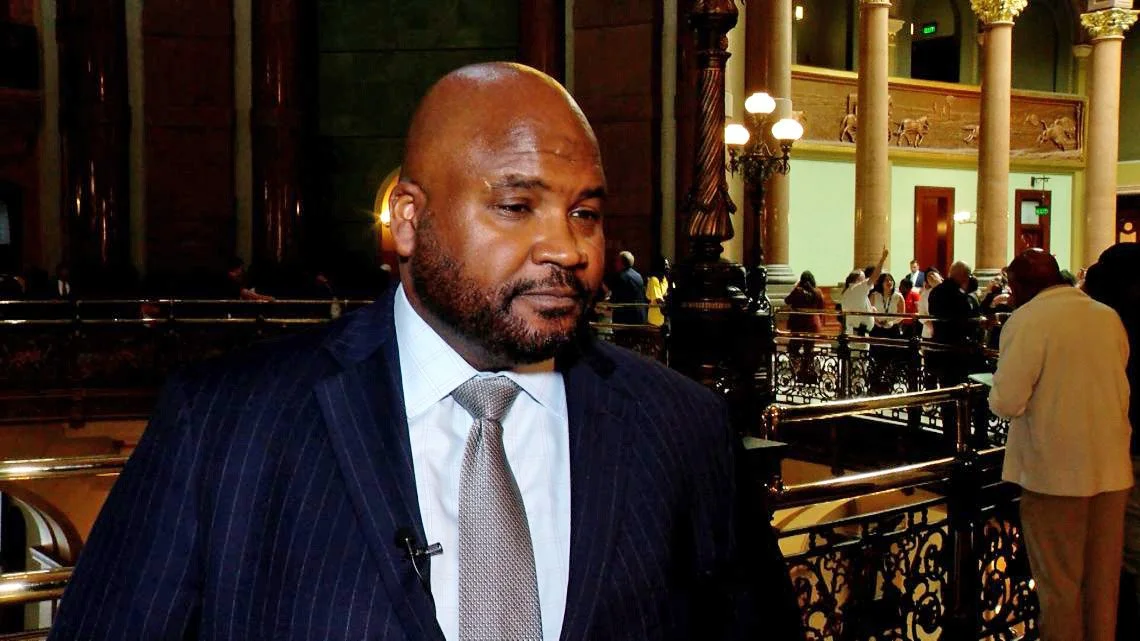
Sen. Elgie Sims, D-Chicago, speaks to Capitol News Illinois about the status of state budget negotiations. (Capitol News Illinois photo by Andrew Campbell)
Safety reforms could be coming for Chicagoland transit, but funding still up in the air
Officials quiet on other reform plan details, funding options for transit agencies
By ANDREW ADAMS
Capitol News Illinois
aadams@capitolnewsillinois.com
With just over two weeks to go before their spring adjournment, lawmakers in Springfield are facing a tight deadline to pass major reforms to Chicagoland’s transit system — but officials have released few concrete details of the plan they say is taking shape.
Influential lawmakers said one major element will be addressed: safety.
“We need to make sure that there are safety mechanisms that are implemented by transit security, that there are transit ambassadors for customer service and nonviolent situations, and there are social services for those that are in need of mental and behavioral health services,” Senate Transportation Committee Chair Ram Villivalam, D-Chicago, said at a Thursday news conference.
Villivalam said transit safety reform should be rooted in data and “law enforcement expertise.” He cited the Los Angeles transit system, which he said has a similar number of riders as Chicago-area transit.
“We can look at their system and say these are how many officers they have, these are how many transit ambassadors they have and so forth,” Villivalam said.
Villivalam made the announcement alongside Rep. Marcus Evans, D-Chicago, a high-ranking House Democrat. Earlier this year, the two sponsored a transit reform proposal backed by more than 30 labor organizations. That bill outlined the creation of a new police force overseen by the Regional Transportation Authority.
“There’s no police presence. It makes no sense,” Evans said of the current Chicago transit landscape. “Across the world, not just this country: New York City? Dedicated police. Washington, D.C.? Dedicated police. Boston? Dedicated police presence. London? Dedicated police presence. Germany? Dedicated police presence.”
No final agreement has been reached for the expected reform bill. A spokesperson from the Illinois Clean Jobs Coalition, one of the advocacy groups involved in the transit negotiations, said that discussions dealing with public safety were scheduled for Thursday.
Late last month, two other lawmakers involved in the transit reform negotiations said Springfield insiders were nearing a deal that would resemble the labor-backed bill.
Read more: With 1 month left in session, lawmakers near deal on public transit reform
But that proposal doesn’t include a plan for funding the beleaguered Chicago-area agencies. While lawmakers have repeatedly stressed they are going to pass reforms before providing transit agencies new funding, agency heads and activists have consistently asked for financial support.
House Speaker Emanuel “Chris” Welch, D-Hillside, speaking to Capitol News Illinois on Thursday, didn’t commit to any details of the reform package, but did echo the need for safety reforms
“We have to have reforms before we even talk about revenue. We have to improve the ridership experience,” Welch said. “We have to improve rider safety. We have to improve safety for the employees on these trains and on these buses.”
Welch also pointed to a group of House lawmakers he convened who are “getting close on agreements.”
Chicagoland transit agencies — Chicago Transit Authority, Pace Suburban Bus, Metra commuter rail service and the RTA oversight agency — face a collective $770 million budget shortfall beginning this summer.
The RTA says that unless the state steps in with funding help, that budget gap will grow even as the transit agencies will have to make massive cuts to service in the region.
But that funding might not come from the state.
Villivalam said Thursday that conversations are continuing around how to handle the issue and declined to provide specifics. Instead, he pointed to past proposals from the Chicago Metropolitan Agency for Planning and RTA without indicating what options, if any, lawmakers will adopt.
Capitol News Illinois is a nonprofit, nonpartisan news service that distributes state government coverage to hundreds of news outlets statewide. It is funded primarily by the Illinois Press Foundation and the Robert R. McCormick Foundation.
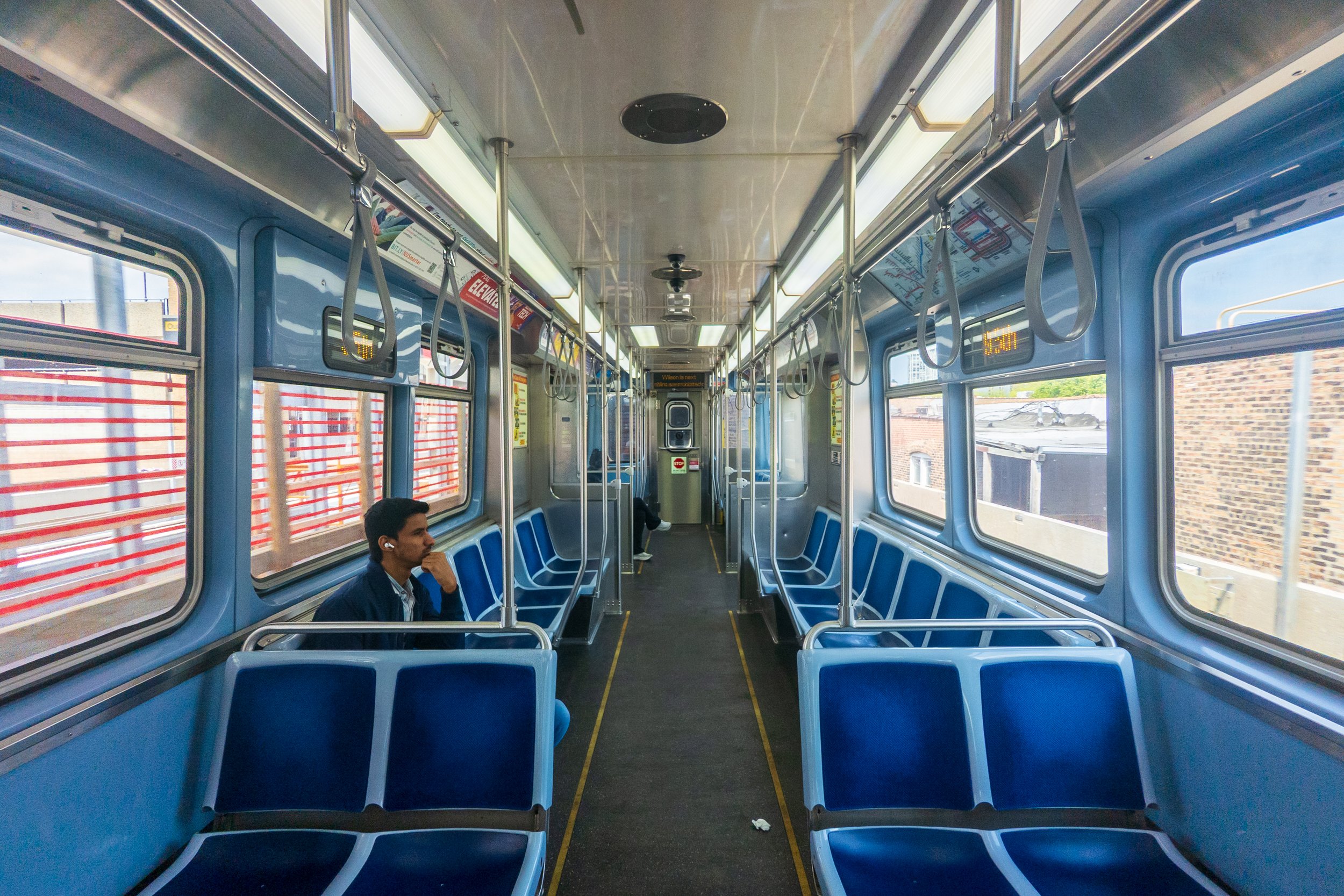
A couple of passengers ride a southbound Red Line “L” train in Chicago. (Capitol News Illinois photo by Andrew Adams)