Plan to limit scope of ‘crime-free housing’ ordinances clears Illinois Senate committee

Advocates say measures have been overused in some municipalities

By JADE AUBREY
Capitol News Illinois
jaubrey@capitolnewsillinois.com

SPRINGFIELD — A Senate committee on Wednesday advanced a measure aiming to limit the circumstances under which tenants can be evicted due to local “crime-free housing” ordinances. 

The measure was backed by housing advocates who argued the crime-free ordinances have been used to evict people in instances where the actual residents of the homes in question committed petty offenses or no crimes at all. But law enforcement and municipal groups countered that limiting local authority to enforce crime-free or nuisance ordinances would take away policies that can be used to revitalize neighborhoods.

The Senate Executive Committee approved Senate Bill 2264 on Wednesday, which cracks down on crime-free housing policies after a recent investigation by the Illinois Answers Project and The New York Times. It found that there were more than 2,000 cases in 25 Illinois cities where crime-free housing ordinances were enforced from 2019 to 2024, with about 500 of those cases involving evictions.

The investigation found that only a third of those 2,000 violations were for serious crimes like drug charges or felony convictions. The other approximately 1,300 violations were due to misdemeanors or noncriminal offenses, “many of which were never pursued by prosecutors,” according to the reporting.

Crime-free housing ordinances in Illinois municipalities began cropping up in the early 1990s in attempts to remove violent criminals, drug dealers and nuisance tenants who frequently disturb their neighbors at rental properties. While the local ordinances have been used to achieve those goals, advocates say they are sometimes abused to apply to people who aren’t even accused of crimes, much less convicted of them. 

In recent years, many cities have enforced the laws so aggressively that virtually any contact tenants have with law enforcement has been used as a reason to bring violations against tenants, according to the news reporting. That includes evictions of tenants who called the police to request assistance, which led housing advocates to push for the new bill.

In 2015, Illinois lawmakers passed a law prohibiting the ordinances from being used to evict victims of domestic violence. At the time, some cities were counting calls to police made by victims of domestic violence as nuisance calls, resulting in the eviction of the victims, the Chicago Tribune reported

If enacted, SB 2264 would bar municipalities from penalizing tenants for calling the police to request assistance from law enforcement officers. It would also prohibit nuisance and crime-free ordinances from being applied to tenants who are not themselves accused of crimes and would block ordinances from being applied to tenants based on who they associate with, unless the association itself is a crime. 

Any municipality enforcing crime-free housing policies would have to hire a crime-free housing coordinator, who would handle cases where law enforcement informs a landlord that a tenant should be evicted. The coordinator would review cases and decide whether the tenant’s action warrants eviction.

Tenants would be given the right to challenge enforcement action in circuit court, and municipalities would be required to create a hearing process for those facing enforcement actions. 

Illinois Association of Chiefs of Police Executive Director Kenny Winslow, who previously served as Springfield police chief, called the city’s crime-free housing laws a “usual crime prevention crime reduction tool.” His organization opposed the measure, which passed with only Democratic support. 

“When utilized right, it can be a revitalization tool for a neighborhood,” he said.

Michael Banske, director of the Illinois Crime Free Association, disputed claims that the ordinances are overused. 

“We do not displace families for domestic violence situations, for excessive calls for the police to come there,” he said in committee. “Nuisance abatement is completely separate. Oftentimes in a municipality, both of those are handled by the same officer or the same division, but they are, in fact, separate.”

The measure still needs approval from the full House and Senate before it would head to the governor for consideration. 


Capitol News Illinois is a nonprofit, nonpartisan news service that distributes state government coverage to hundreds of news outlets statewide. It is funded primarily by the Illinois Press Foundation and the Robert R. McCormick Foundation.

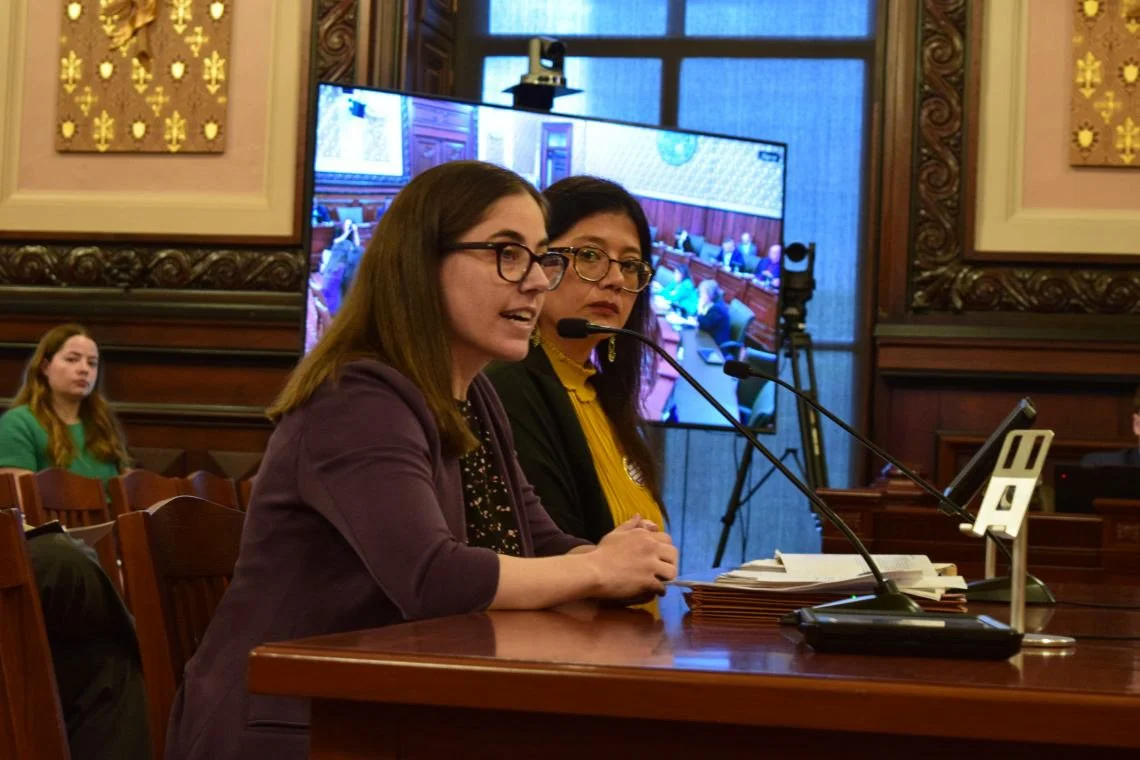
Emily Coffey, senior counsel of the Chicago Lawyers' Committee for Civil Rights, speaks beside Sen. Karina Villa, D-Chicago, during a Senate Executive Committee in the Statehouse on Wednesday. (Capitol News Illinois photo by Jade Aubrey)

Lawmakers seek to reverse Illinois law penalizing companies that boycott Israel

Uphill battle for legislation this session comes as Israel faces protests for its war in Gaza


By SIMON CARR

& SONYA DYMOVA

Medill Illinois News Bureau

news@capitolnewsillinois.com

SPRINGFIELD — A growing number of state lawmakers are moving to repeal a 2015 Illinois law penalizing companies that boycott Israel to protest its policies toward Palestinians.

Amid concerns about Israel’s ongoing war in Gaza, lawmakers in Springfield supporting human rights for Palestinians have increasingly signed on to legislation opposing the decade-old anti-boycott law. But so far, these bills have stalled.

Illinois’ 2015 law prohibits state pension funds from investing in companies engaging in the Boycott, Divest, Sanction, or BDS, movement against Israel, making Illinois the first U.S. state to enact such legislation, with dozens of other states following suit. The measure, signed into law by Gov. Bruce Rauner, a Republican, was modeled after similar post-9/11 measures restricting Illinois’ pension funds from investment in companies that engage in business with the governments of Iran and Sudan

When boycotting Israel became grounds for blacklisting, Illinois lawmakers established the Illinois Investment Policy Board, tasked with investigating companies' investment choices. Opponents of the laws have warned they curtail free speech. Israel is the only country for which boycotting is penalized in Illinois by the board. 

To repeal this policy, Rep. Abdelnasser Rashid, D-Bridgeview, introduced House Bill 2723, and Sen. Mike Porfirio, D-Bridgeview, introduced Senate Bill 2462 earlier this year. Since then, some 22 co-sponsors were added in the House and Senate, while two of those later had their names removed.

“This is about the right for people to advocate for what they believe — in this particular case, for human rights advocacy — without the state telling you what you have to believe and how you have to act,” said Rashid, the first Palestinian-American to serve in the Illinois House of Representatives. “It is a matter of making sure that Illinois is on the right side of history — not participating in the oppression of the Palestinian people – but it is also about making sure the Illinoisans and companies that do business in Illinois are not being forced and bullied and retaliated against because they chose to stand for human rights.”

Thirty companies are currently on the Illinois Investment Policy Board’s prohibited entity list for boycotting Israel. 

In 2021, Unilever, for example, was added to that list after its subsidiary — ice cream company Ben & Jerry’s — announced it would stop selling its products in the Occupied Palestinian Territory, as defined by the United Nations. While remaining a supporter of Israel, the company said it did not support “an internationally recognised illegal occupation.”

Chicago-based investment firm Morningstar narrowly avoided state divestment in 2022, when the Illinois Investment Policy Board accused the firm’s subsidiary, Sustainalytics, of having an anti-Israel bias. The company then commissioned an independent report that found evidence of anti-Israel bias in Morningstar’s standalone product, Human Rights Radar. Morningstar agreed to accept a series of recommendations, including discontinuing the Human Rights Radar and no longer taking input from the United Nations Human Rights Council, in order to avoid state divestment.

Wavering support 

While President Trump-supporting Republicans and right-wing activists rail against a bipartisan national bill that would toughen penalties for boycotting Israel’s government, Illinois’ Democratic supermajority legislature appears hesitant to put an end to its 2015 anti-boycott law, which passed unanimously in both houses.

Rashid’s and Porfirio’s bills have stalled in committee despite the initial support from about one-fifth of the Democratic caucus, including the leaders of the Latino, Black and Progressive caucuses.

Thousands of bills, the vast majority of those proposed, get stuck in the Rules Committee every year for various reasons. In HB 2723’s case, the holdup can be attributed in part to the political costs of supporting the bill, advocates said.

Sen. Napoleon Harris, D-Harvey, was listed as a cosponsor on March 20, and Sen. Adriane Johnson, D-Buffalo Grove, signed onto the bill on April 2, but both had their names removed on April 8. Neither senator responded to a request for comment on their reasoning. 

Porfirio, the Senate bill’s chief sponsor, and its chief cosponsors — Karina Villa, D-West Chicago; Graciela Guzmán, D-Chicago, and Rachel Ventura, D-Joliet — all declined or failed to respond to requests for comment.

“Even though it had quite an impressive list of sponsors and cosponsors, it's a controversial piece of legislation that is likely to engender a lot of debate that most legislators don't want to vote on, because they either have Jewish or Palestinian constituents, or both,” said Dick Simpson, a professor emeritus at the University of Illinois at Chicago and former Chicago alderman. “Why should they vote on something that isn't going to pass and then cause some constituents to be mad at them?”

But Deanna Othman, member of the Chicago chapter of American Muslims for Palestine, said HB 2723 is urgent, citing both a humanitarian crisis and a crisis of free speech.

“Unfortunately, it's more relevant now than ever, because we've seen all of the crackdown on student protesters and people who engage in boycott and people who are just voicing their First Amendment rights,” Othman said. “If I cannot stand up for the rights of my fellow Palestinians, whose rights can I stand up for?”

‘It’s impossible to tell if this bill will ever pass’

Activists say they are hopeful a repeal of the anti-BDS law will pass in 2026 if it continues to stall this year. But it remains an uphill battle, even as they point to a steady decrease in American popular support for Israel.

About 53% of Americans express an unfavorable opinion of Israel, according to a Pew Research Center study conducted last month. This is an increase from March 2022, when that figure was 42%. 

The survey found the share of Americans with little or no trust in Israeli Prime Minister Benjamin Netanyahu to “do the right thing for global affairs” increased significantly from 2023 to 2024. Since Oct.  7, over 52,000 people in Gaza have been killed in Israeli attacks, according to the Hamas-run Ministry of Health in Gaza. An estimated 1,200 people were killed in Israel during the Hamas’s attacks on Oct.  7, 2023, and around 250 Israelis were taken hostage.

The pro-Israel, pro-peace advocacy group J Street does not oppose boycott initiatives “that explicitly support a two-state solution and recognize Israel’s right to exist,” according to a statement of its policies. “It is critical to maintain the distinction between boycott efforts that work against the interests of Israel, and initiatives which are limited to opposing the occupation. We neither oppose nor call for these initiatives,” the group said in a statement.

But J Street does oppose the broader Global BDS Movement, which advocates for three tenets: That Israel should stop policing the border on and occupying legally Palestinian land, that Arab-Palestinian citizens of Israel should have full equality with Jewish citizens and that Palestinians be allowed to return to their homes, as stipulated in UN Resolution 194.

Lesley Williams, an activist with Evanston Ceasefire who has been lobbying to repeal Illinois’ anti-BDS law, said the three tenets don’t mean “Israel needs to stop existing.” 

“That doesn't mean that non-Palestinians should be forced to leave Israel,” she said. “It just says the Palestinians should have equal rights in that territory and that Israel should be following United Nations resolutions.”

The original sponsor of the 2015 anti-BDS law in the House, then Rep. (now Sen.) Sara Feigenholtz, D-Chicago, declined several requests for comment. However, when a 2022 Crain’s Chicago Business op-ed criticized Feigenholtz’s legislation, arguing it was “raising the specter of McCarthy-like scrutiny.” Feigenholtz issued a statement defending her law.

“Israel is the singular democracy in the Middle East that has historically been a consistent ally to the United States,” Feigenholtz said at the time. “Boycotts of Israel, like Ben & Jerry’s/Unilever, are intended to harm and weaken Israel.” She added, “No one’s free speech is curtailed.”

Ben and Jerry’s co-founders Bennett Cohen and Jerry Greenfield, who no longer run the company, denied the boycott was anti-Israel or antisemitic in a 2021 op-ed. They said it was merely a rejection of Israeli policy, and that Ben and Jerry’s was in fact advancing justice and human rights, both “core tenets of Judaism.”

Given the controversy surrounding the Israeli-Palestinian divide, many political obstacles to these current bills passing will probably remain next year. Politicians are less likely to discuss controversial issues like the BDS movement when there’s a supermajority of one party — in Illinois’ case, Democrats — for fear of factionalizing, said Ryan Burge, a political science professor at Eastern Illinois University.

Even if a repeal of the anti-BDS law makes it through the legislature, Gov. JB Pritzker may still be an obstacle, Burge added. 

“Pritzker is going to try to run for president in 2028, and he doesn't want anything to happen in the GA that could be used as an albatross on his neck when he runs for the primary in a couple years,” Burge said. Should anti-BDS legislation reach Pritzker’s desk, “The Governor will carefully review this piece of legislation,” the governor’s press secretary, Alex Gough, said in an email.

“It’s impossible to tell if this bill will ever pass, and the reason for that is it's impossible to predict where the Israeli and Palestinian war will be next year,” Simpson said. “I don't know, if Israel does carry through on its threats to move all the Palestinians out of Gaza and to permanently take control, that might provide enough anger to cause it to pass. But it is just predicting.”

Simon Carr and Sonya Dymova are students in journalism with Northwestern University’s Medill School of Journalism, Media, Integrated Marketing Communications, and are fellows in its Medill Illinois News Bureau working in partnership with Capitol News Illinois.

Capitol News Illinois is a nonprofit, nonpartisan news service that distributes state government coverage to hundreds of news outlets statewide. It is funded primarily by the Illinois Press Foundation and the Robert R. McCormick Foundation.


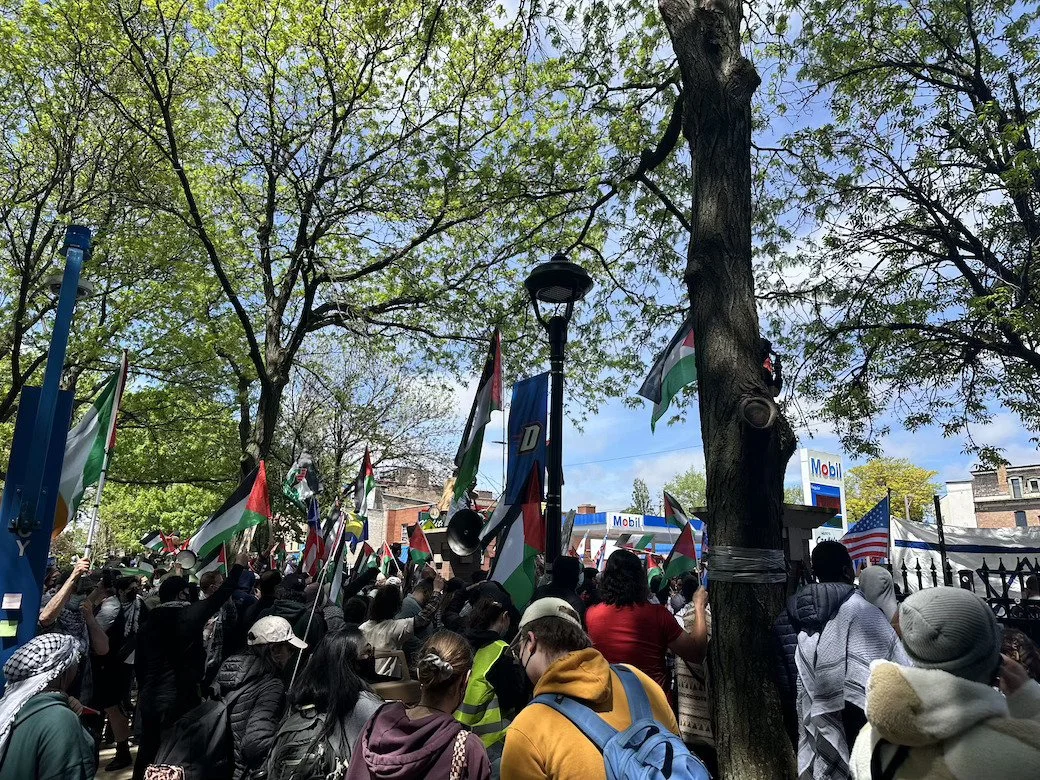
Students at DePaul University’s Gaza Solidarity Encampment face counter protesters in May 2024. This encampment was one of at least 130 similar campus protests last year, which highlighted concerns that Israel was engaging in human rights violations. (Medill Illinois News Bureau photo/ Simon Carr)

After 150 years, Mary Lincoln’s ‘madness’ still haunts American psyche

In new book, Mrs. Lincoln’s own words offer insight into her sometimes tortured mind

By PETER HANCOCK
Capitol News Illinois
phancock@capitolnewsillinois.com

SPRINGFIELD — On May 19, 1875, a Cook County jury handed down a verdict in a case concerning the health and welfare of Mary Lincoln, widow of the former president who had been assassinated a decade earlier.

After listening to only a single day of testimony, the 12 men on the jury signed the standard verdict form stating simply that they “are satisfied that said Mary Lincoln is insane, and is a fit person to be sent to a State Hospital for the Insane …”

The case had been brought to court by her surviving son, Robert Todd Lincoln, then just 31 years old and a successful practicing attorney in Chicago. At his request, the court ordered her committed to the Bellevue Place Sanitarium in Batavia, west of Chicago, and named him conservator of her estate for a period of one year, based on the finding that she was at the time incapable of managing her own affairs.

But Mrs. Lincoln would not spend a full year in the facility. With the help of two of her closest and only remaining friends, James and Myra Bradwell, of Chicago – and against the strong protests of Robert Lincoln – Mary Lincoln would be released after only four months to the custody of her sister in Springfield, Elizabeth Edwards.

The subject of Mary Lincoln’s mental health has long been the subject of public debate. Was she, in fact, a danger to herself and others, and was her son truly acting in her best interests? Or was Robert Lincoln, as his mother would sometimes allege, scheming to shove her aside in order to take over her money and property?

Now, 150 years after her commitment, a newly rediscovered collection of correspondence between Mrs. Lincoln and her friends and family – letters long assumed to have been lost or destroyed – shed new light on the nature of her illness as well as the nature of her relationships with the few friends and family she had left by that time.

“The Dark Days of Abraham Lincoln’s Widow, As Revealed by Her Own Letters,” was compiled by historian Jason Emerson and was recently released by Southern Illinois University Press.

“People have always wondered if these missing letters, if they showed that, in fact, she was perfectly sane, that her son Robert did actually railroad her, bribe the judge and jury because he wanted to steal her money,” Emerson said in a podcast interview with Capitol News Illinois. “And they do not show that at all. They show that Mary thought that's what was happening – which, in my opinion, and the opinions of psychiatrists I've consulted – that was one of her delusions, that everyone was trying to steal her money, not just Robert.”

The book was actually first compiled a century ago by Myra Helmer Pritchard, granddaughter of James and Myra Bradwell, and they were scheduled for publication in 1927, first in installments in the magazine “Liberty,” and then as a book.

Before the publication, however, Pritchard, as a courtesy, offered to show them to Mary Harlan Lincoln, widow of Robert Lincoln, who had just died the year before. Although she was initially agreeable to the project and even offered to add additional information, after reading the manuscript, Mary Harlan Lincoln withdrew her consent and launched a series of legal efforts to suppress their publication.

Pritchard eventually agreed to hand over the material and never publish them in any form, in exchange for a payment of $22,500.

Emerson’s book recompiles that material and presents it as it was intended to be published in 1927, including Pritchard’s comments on the letters. But it also includes Emerson’s own annotations and footnotes that provide context, as well as clarifications and corrections to some of Pritchard’s commentaries.

The letters reveal her to be lonely, occasionally depressed and at times desperate for companionship. But on their surface, do not necessarily portray someone of an unsound mind, especially considering the traumas she had endured through much of her life.

“Pray for me that I may be able to leave such a place as this,” she wrote to Myra Bradwell on Aug. 3, 1875. “Let me see Judge Bradwell. I beg you to come on Friday morning. I should like to see Dr. Evarts. I feel I must have some further conversation with him. Write me, your heartbroken friend, frequently, daily. But come to me. Will you kindly bring out some samples of black alpaca a best quality without luster and without cotton. Also some samples of heavier black woolen goods.”

The book is Emerson’s second work on the subject of the lost letters, which he uncovered in 2005. He found them locked away in a trunk that had once belonged to one of Robert Lincoln’s personal attorneys, Frederick Towers. 

Using those letters and a wealth of other material, Emerson wrote his first book on the subject, “The Madness of Mary Lincoln,” in 2007. 

In that book, Emerson cites a modern psychiatric expert who theorized that Mary Lincoln suffered from what would likely be diagnosed today as bipolar disorder.

“And he told me that today, Mary would be committed involuntarily for probably about seven days,” he said. “Doctors would look at her. They'd give her medication, and she'd be fine today, as long as she took the medication.”

“But back then, they didn't have that,” Emerson said. “But if you look at her whole life, it's very clear the incidence of bipolar disorder, or what used to be called manic depressive illness, where she's high and she's low, and she's wonderfully loving and horribly mean. Her spending could be considered a manic action. She was depressed a lot. So it's clear throughout her whole life.”

After her release, Mary Todd Lincoln lived a relatively quiet life, although she remained plagued by both psychiatric and physical ailments. She died in 1882 at the age of 63. She is buried next to her husband at the Lincoln Tomb in Springfield, along with three of their sons: Edward, William and Thomas.

Robert Lincoln went on to lead a distinguished career of his own. In addition to his legal career, he served as secretary of war under President James Garfield and continued in that post under President Chester A. Arthur after Garfield’s assassination. He also served as minister to Great Britain in the Benjamin Harrison administration. He died in 1926 at age 82.

Capitol News Illinois is a nonprofit, nonpartisan news service that distributes state government coverage to hundreds of news outlets statewide. It is funded primarily by the Illinois Press Foundation and the Robert R. McCormick Foundation. 
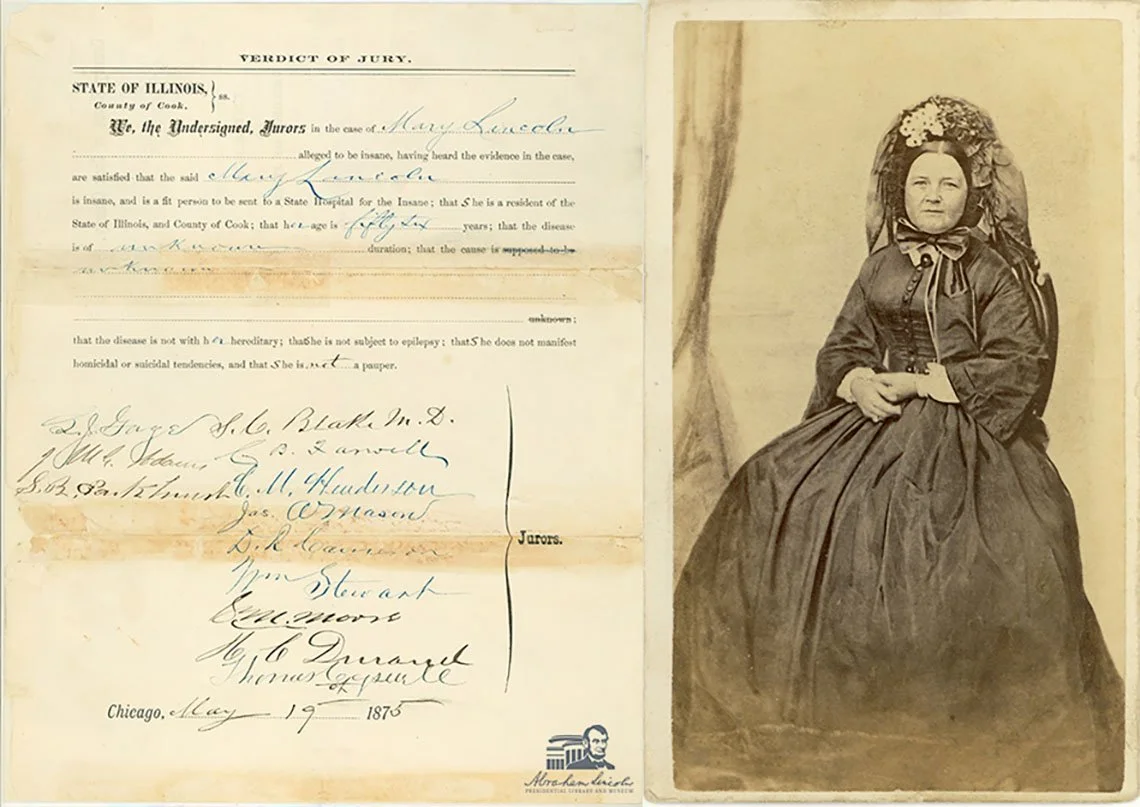

A verdict form, left, from a Cook County jury dated May 19, 1875, officially declared Mary Todd Lincoln “insane” and ordered her commitment to a sanitarium. At right, is a portrait of Mary Todd Lincoln, circa 1869. (Images courtesy of the Abraham Lincoln Presidential Library and Museum)

Princeton man arrested for OWI

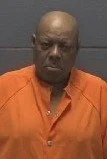
On May 15, 2025, at 8:43 p.m., 66 year old Kelvin Webster of Princeton approached Deputies in front of the Gibson County Sheriff’s Office and began speaking with them.  While Deputies were speaking with Mr. Webster they observed obvious signs of intoxication.  At that point Deputy Shawn Holmes began a roadside DUI investigation.  At the conclusion of his investigation Deputy Holmes placed Mr. Webster into custody and transported him to the new Gibson County Sheriff’s Office and Detention Center where he was charged with Operating a Vehicle While Intoxicated Endangerment.
 
Deputies Eric Powell and Wes Baumgart assisted Deputy Holmes in his investigation. 
 
All criminal defendants are to be presumed innocent until and unless proven guilty beyond a reasonable doubt in a court of law.

Liquor License Approved By City

Acting as Mt. Carmel Liquor Control Commissioner – Mt. Carmel Mayor Joe Judge has approved a liquor license for Jackpot 777, LLC which will be opening inside the former Comeaux's Daiquiri Depot at 319 West 9th Street – some may remember the location as the former Long Branch Bar. Judge says the license isn’t an additional one – as Comeaux’s has turned in their license which is the license being granted to the new establishment.

Three sentenced to DOC In Wabash County

Kelli Storckman, Wabash County State’s Attorney, reports that on May 12, 2025, the following individuals were sentenced to the Department of Corrections by the Honorable Circuit Judge William C. Hudson in Wabash County Circuit Court:

Donald Scott Baird, a 54-year-old Mt. Carmel, IL man, was sentenced to 5 years in the Department of Corrections to be followed by 6 months of mandatory supervised release after failing to comply with the terms of a prior probation order for the offense of Possession of Methamphetamine, a Class 3 Felony.

Daniel Robbins, a 46-year-old Princeton, IN man, was sentenced to 2 years in the Department of Corrections to be followed by 6 months of mandatory supervised release for the offense of Theft, a Class 3 Felony.


Kristina Randall, a 32-year-old Fort Branch, IN woman, was sentenced to 3 years in the Department of Corrections to be followed by 6 months of mandatory supervised release for the offense of Possession of Methamphetamine, a Class 3 Felony.

Threat of Violence at Carmi Schools has been investigated and no issues at this time

At approximately 2:56 am on 05/13/25 Carmi Police were notified by CWCHS Administrators of an online report of a possible perceived threat made via Safe 2 Help IL. The threat was not specific in which school but only referenced a threat toward a school at Carmi. Carmi Police and School Administrators spoke at length throughout the early morning hours and a decision was made to cancel school while a further thorough investigation by law enforcement continued to ensure the safety of the students and staff.
        

    Carmi Police began issuing multiple search warrants to providers for information regarding the possible threat of violence at a Carmi School and cited exigent circumstances. A response was received which led to the address of the reporter. Upon further investigation Carmi Police revealed the report was submitted to Safe 2 Help IL by a 16-year-old male. It was revealed the male did not have any knowledge of an actual threat toward the school but was intoxicated at the time and sent the report to Safe 2 Help IL as a joke. It was discovered that the male does not have access to weapons in the residence and the parents were fully cooperative in the investigation. A full report will be submitted to the White County States Attorney for his review.

            Carmi White County Administration was informed of the outcome of the investigation and the information of no perceived threat at this time pertaining to this report. As always Carmi Police and CWC Administrators encourage students and parents to report any knowledge of possible concerns to law enforcement and teachers as they are learned.

            CWCHS Graduation Ceremonies will resume as scheduled this evening and there will be an increased presence of law enforcement and additional security measures during graduation and normal school activities to allow for enhanced safety and peace of mind to the public.

City Council Hears Update On Pool Project

Demolition work continues on the old pool house at the Mt. Carmel City Pool. Major Joe Judge told the city council Monday that city public works crews have removed all of the windows from the building with demolition set to begin early next month. Judge says he and City Administrator Ryan Turner have met with engineers for the project recently to review alternative design plans which could be presented to the city for consideration soon.

City Maps Out Mosquito Route

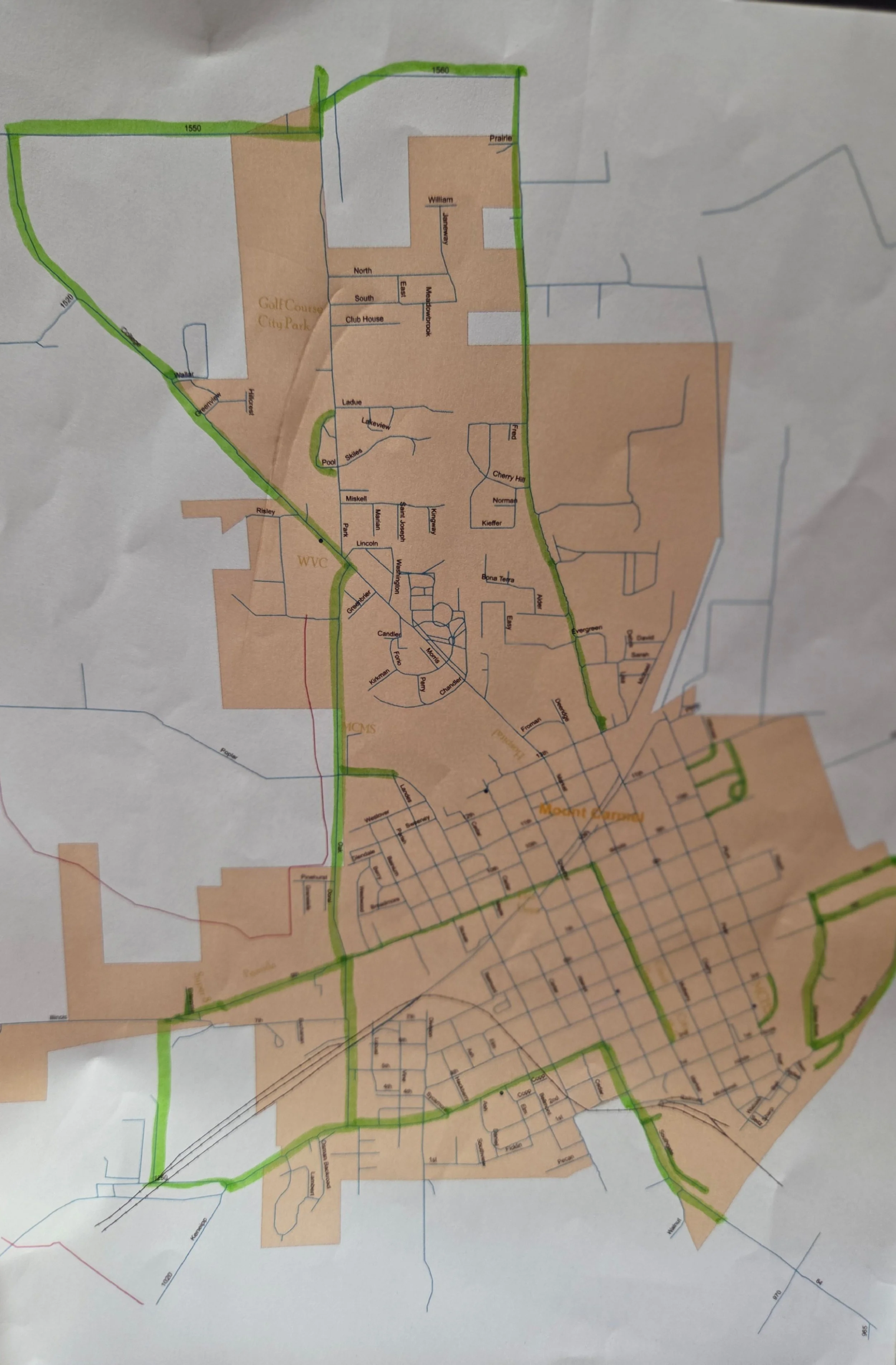
Changes are coming to the City of Mt. Carmel’s mosquito spraying route. Commissioner Susan Zimmerman reported at Monday’s City Council meeting that the city has received several call regarding when they spray and where they spray, so the city will be making some changes. Administrator Ryan Turner explains the plan to hit mainly public areas, while making a permitter pass around the city… saying homeowners may need to become more involved in helping to eradicate the pests.

Turner says it’s hoped the new route, which you can see on WSJD.fm and on our Facebook page will appease as many people as possible.


“Click It Or Ticket” Indiana State Police Ramping Up Patrols Ahead Of Memorial Day Weekend

With Memorial Day marking the unofficial start of summer travel, the Indiana State Police is preparing to step up patrols to crack down on seatbelt usage. From May 17 through May 31, Troopers will join police officers across the state to participate in a national campaign to promote safe driving habits, including seat belt usage

“To kick off the summer travel season, it’s critical to remind all motorists that wearing a seatbelt is not just the law; it’s something that can save your life,” said Douglas Huntsinger, Executive Director for the Indiana Criminal Justice Institute. “Our goal is simple – we want everyone to make it home safely. Buckling up is the first step in achieving that goal.”

This high-visibility enforcement campaign is part of a nationwide effort funded by the National Highway Traffic Safety Administration through grants administered by ICJI. During the campaign, the Indiana State Police will take a no-excuses approach to enforcement, issuing citations to anyone not properly restrained.

“If the enforcement effort alerts people to the dangers of unrestrained driving, we’// consider our mission to be a success,” said Lieutenant Brock Werne. “We are asking friends and family to remind each other to buckle up when they drive, and to consider changing their habits if they don’t.”

Indiana continues to see strong compliance with its seat belt laws. ICJI’s latest observational survey found that 93.6% of Indiana drivers wear their seatbelts. While this is encouraging, there is still work to be done to reach the remaining 6.4% of drivers who put themselves at risk.
 
State traffic safety leaders reinforce the message by reminding people why the laws exist.

“Seat belts are one of the simplest, most effective ways to protect yourself on the road,” said Jim Bryan, Traffic Safety Director for ICJI. “Putting on a seat belt takes just a few seconds but can make all the difference in the event of a crash. You are taking a dangerous risk if you’re not buckled up.”

Research consistently shows that seat belts can reduce the risk of injury or death in a crash by up to 65%. Without one, people are at a higher risk of being ejected from a vehicle, which can lead to fatal outcomes.

For additional information about seat belt safety, visit on.in.gov/seatbelt