City Council Considers 1% Sales Tax Instead Of Property Tax Hike To Pay For Pool

It looks like Mt. Carmel property owners won’t be paying higher real estate taxes for the new city pool after all. Last year, Illinois Governor JB Pritzker eliminated the state’s 1% grocery tax that had been returned to municipalities. The Governor gave cities the right to not only reinstitute the tax on groceries but all other goods as well.

At their regular meeting yesterday, the city council heard the first reading of an ordinance that would place a 1% sales tax on everything sold in the corporate limits of Mt. Carmel with the exception of gas and vehicles. Mayor Joe Judge said the trade off for the new tax is one property owners will like…

The additional 1% will bring Mt. Carmel’s sales tax to 8.25%, which Judge said is still lower than many in southern Illinois including Olney and Harrisburg where the rate is 8.75%; Carbondale’s is 11.75%; Marion and Benton are at 9.5%; and Grayville is also at 8.25%.

The mayor said the city will soon benefit from increased sales tax receipts with the opening of the new cannabis outlet this Spring in Mt. Carmel.

The council is expected to hear the second reading of the ordinance and adopt it at their next meeting in two weeks.

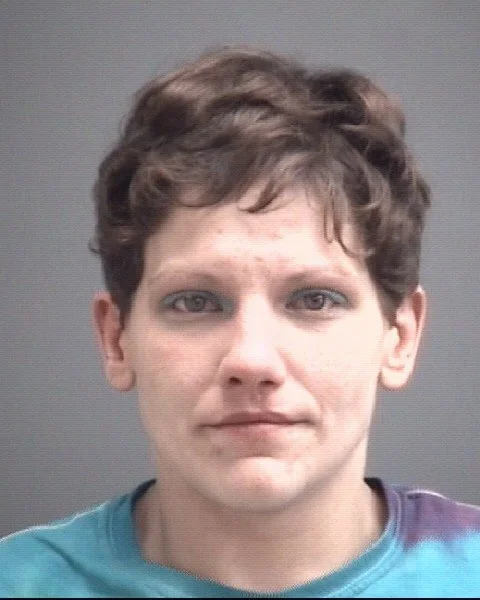
Oakland City woman arrested on drug charges

On March 16, 2025 at 4:48 p.m. Gibson County Central Dispatch received a report of a suspicious person in the area of the 10000 block of East 450 South who was attempting to go through other person’s property and possessions.  The reporting party gave a detailed description of the female to Communications Officer Amber Lowery.  Officer Lowery in turn dispatched law enforcement in the area, and upon arriving in the area Deputies located a female matching the description given to dispatch.  After a brief investigation 30 year old Megan Mitchell Oakland City was placed into custody and transported to the Gibson County Jail where she was charged with Driving While Suspended Prior and Possession of Methamphetamines. 
 
Arresting Officer:  Deputy Eric Powell
Assisting Deputies were Deputies Wes Baumgart, Shawn Holmes, and Bart Wagner.
 
All criminal defendants are to be presumed innocent until, and unless proven guilty beyond a reasonable doubt in a court of law.

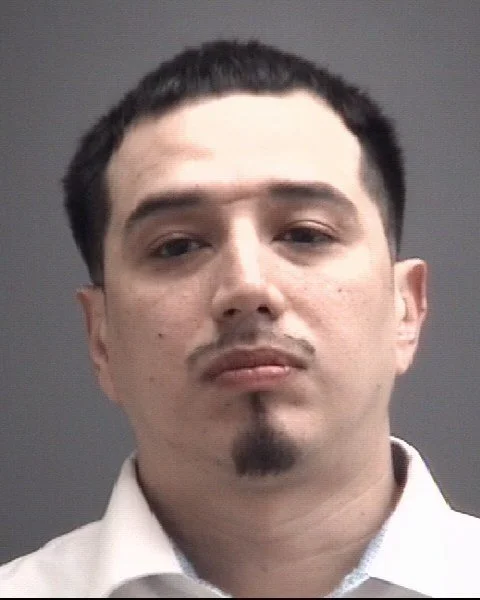
Princeton man arrested on multiple charges

On March 17, 2025, at 12:04 a.m. Gibson County Deputy Michael Bates conducted a traffic stop on a Black 2010 Mercedes for speeding on US 41 near State Road 64.  Upon catching up to the vehicle a traffic stop was conducted on Vail Street just east of US 41.  Deputy Bates identified the driver as 36 year old Isae Buenrostro of Princeton.  While speaking with Mr. Buenrostro Deputy Bates detected clues that the driver may be under the influence of an unknown intoxicant.  At that point Deputy Bates began a roadside OWI investigation.  Once that investigation was completed Deputy Bates placed Mr. Buenrostro into custody and transported him to the Gibson County Jail where he was charged with Driving While Intoxicated-Prior, Driving While Suspended-Prior, Possession of Marijuana above 30 Grams with a Prior, Speeding, and Expired Vehicle Registration.
  
All criminal defendants are to be presumed innocent until, and unless proven guilty beyond a reasonable doubt in a court of law.

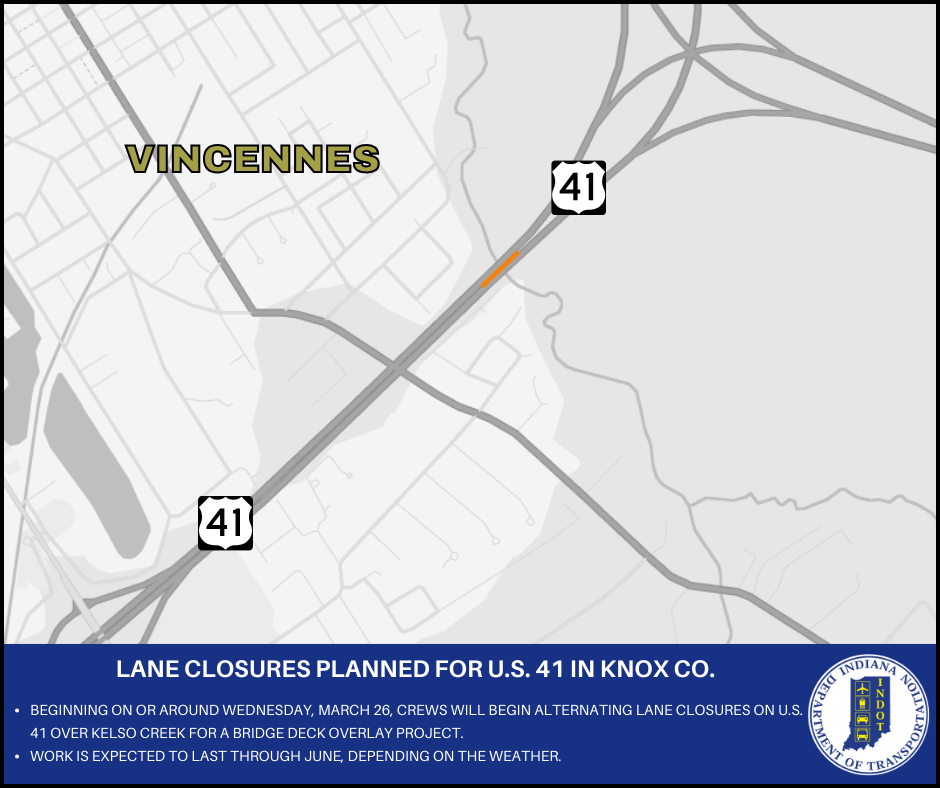
Lane closures planned for U.S. 41 in Knox County

KNOX COUNTY, Ind. – The Indiana Department of Transportation announces alternating lane closures for U.S. 41 in Knox County.

Beginning on or around Wednesday, March 26, crews will begin alternating lane closures on both north and south bound lanes of U.S. 41 in Knox County. These lane closures will occur over Kelso Creek, near Vincennes.

Alternating lane restrictions will allow for a bridge deck overlay project to be completed on both north and southbound bridges. Work is expected to last through the end of June, depending on the weather.

Illinois department streamlines online licensing system

Improvements eliminate ‘historic wait times’

By JADE AUBREY
Capitol News Illinois
jaubrey@capitolnewsillinois.com 

SPRINGFIELD — The Illinois Department of Financial and Professional Regulation updated lawmakers Wednesday on its new online licensing system to streamline the process and eliminate backlogs. 

Rep. Bob Morgan, D-Deerfield, called for the subject matter hearing in the House Health Care Licensing Committee to discuss the progress IDFPR has made on the system so far, as well as their timeline to implement all license applications online.

“I've been around state government for over 15 years now, and I really am hard pressed to think of a turnaround like this,” Morgan said.

One of IDFPR’s main roles as a state agency is to regulate and handle all business licenses in Illinois.

However, the department has struggled to keep up with the influx in both initial licensing and renewals since 2019, as applications were almost entirely submitted on paper via mail. In 2020, the problem was compounded as the COVID-19 pandemic affected the country’s mailing systems. 

By late 2023, IDFPR Director Mario Treto, Jr. said applicants were experiencing “historic wait times” and officially called the situation a “crisis.”

Read more: Lawmakers pass bill aimed at modernizing professional licensing in Illinois | Capitol News Illinois

In December 2023, Illinois lawmakers passed legislation that enabled the department to create an online licensing application process. And in October 2024, IDFPR officially launched its online licensing system — the Comprehensive Online Regulatory Environment, or CORE.

Read more: Illinois rolls out first phase of plan to modernize professional licensing | Capitol News Illinois

The initial system rollout in October only included three licensing types: clinical psychologists, music therapists and nail technicians. 

During his testimony in the committee meeting Wednesday, Treto said the department has outlined six specific phases in order to fully implement a complete, comprehensive online licensing system. The CORE startup in October completed Phase 1.

Phases 2 and 3 include the continuous rollout of the rest of the license types, which Treto said will come in rollouts of small numbers of license types until all types have been launched online.

In January, the department kicked off both phases when it launched online applications for four more license types: professional midwifes, behavioral analysts, assistant behavior analysts, and behavior analysts continuing education sponsors. 

“Rather than waiting to roll out 15 applications all together in one big batch, the department, understanding that our licensed professionals are eager to begin using CORE, has added applications to the system as soon as they are available,” Treto said. 

Camile Lindsay, director of IDFPR’s division of professional regulation, said the department hopes to rollout all license types by the end of this summer. This would complete both Phases 2 and 3.

However, Lindsay said the current phases aren’t simply about getting new license types online. After new license types are rolled out, her team will be analyzing the efficiency of those application process. What they learn from those analysis will be applied to the wave of license types they roll out, and the same process will be applied until all the license types are online.

“I expect not only will your constituents be happy because they are able to use this new and improved system, but they will see differences in even the way that we are requesting information,” Lindsay said. “The way that they are able to keep track of what the status is of their applications, how they submit money, etc. I just think that your constituents will be very pleased.”

Although she said the system has more to implement and processes to improve, Lindsay praised the actions taken to get the system where it currently stands.

“Our customer surveys satisfaction results are in the 98% and the record breaking 120,933 licenses were issued in 2024,” Lindsay said. “That is an almost 14% increase from the previous record set in 2023.”

The majority of applications the department is currently processing were submitted this year, which is what Lindsay called “a far cry from two years ago.”

She boasted that her team’s process of constantly improving the implementation of license types is contributing to the decline of inquiries from applicants needing assistance. From September 2024 to February 2025, IDFPR experienced a 33% decrease in inquiries, and their call center volume decreased almost 40%.

“It is clear that IDFPR is issuing more licenses to qualified applicants, improving customer service, and implementing a variety of thoughtful improvements to our processes and procedures to ensure licensing is convenient for applicants and efficient for the department,” Lindsay said,

Treto said that IDFPR’s goal is to implement the last phase of CORE’s online integration, or Phase 6, by August 2026.

Morgan admitted that when Illinois lawmakers passed the legislation for IDFPR to create CORE 2023, he wasn’t “totally sure” that the agency would be able to implement the online system and fix their growing application backup.  He praised not only Treto and Lindsay’s work, but the work of all IDFPR staff on the issue.

“It's a little surreal, because to me, this is exactly the kind of progress that we would want to see,” he said. “You both said that we have more work to do. There are more licenses by the month that you will be having, but I think it's safe to say you are absolutely moving in the right direction, and I want to thank you for that.”


Capitol News Illinois is a nonprofit, nonpartisan news service that distributes state government coverage to hundreds of news outlets statewide. It is funded primarily by the Illinois Press Foundation and the Robert R. McCormick Foundation.
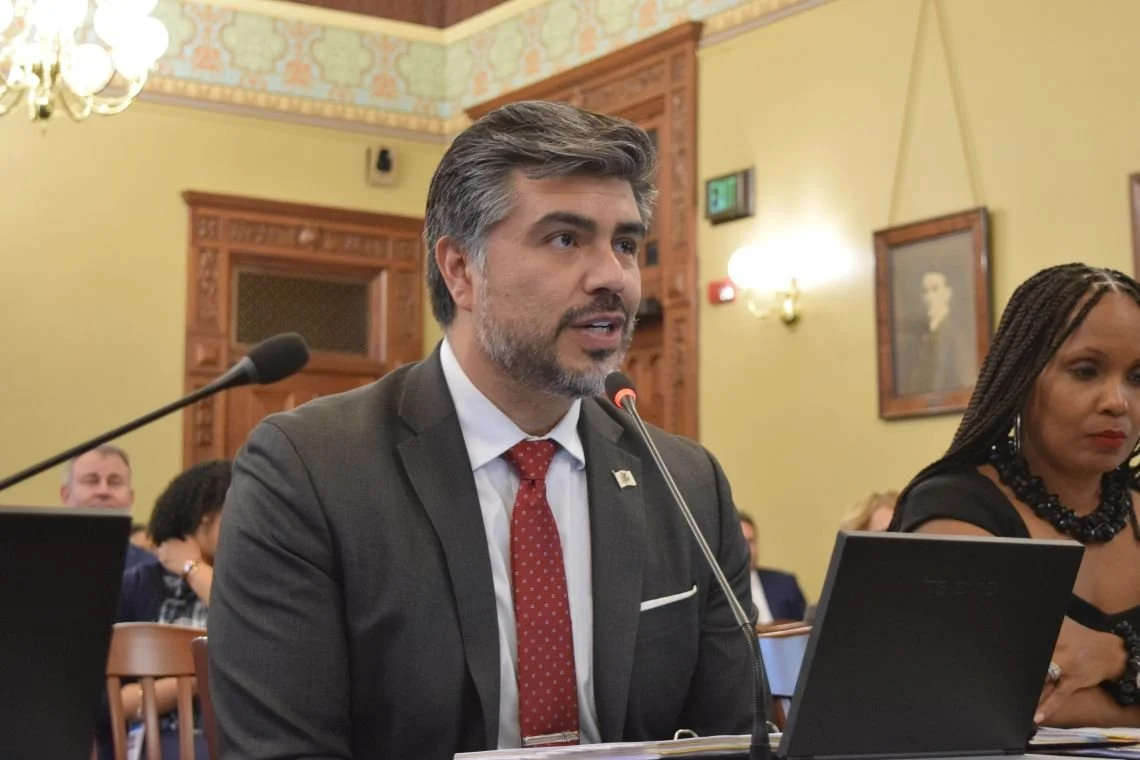
Illinois Department of Financial and Professional Regulation Secretary Mario Treto Jr. testifies during a committee in the Statehouse on Wednesday. (Capitol News Illinois photo by Jade Aubrey)


Feds pull grant funding from Illinois fair housing orgs that investigate discrimination

Groups warn cuts will drastically reduce capacity to represent tenants, homebuyers

By LILY CAREY
Medill Illinois News Bureau
news@capitolnewsillinois.com

CHICAGO — John Petruszak opened his email Feb. 27 to find a message he called “shocking”: the federal Department of Housing and Urban Development had rescinded two grants it had awarded to his advocacy organization, the South Suburban Housing Center.

The grants, which represent 37% of the center’s budget, hadn’t been rescinded through any misstep by the organization. Rather, at the order of the Trump administration’s newly established Department of Government Efficiency, or DOGE, the grant was being terminated because it “no longer effectuates the program goals or agency priorities,” the letter read.

The message came as a surprise to Petruszak, the center’s executive director. Fair housing organizations like his offer legal services and support to anyone facing discrimination in the housing market on the basis of race, color, religion, sex, familial status or disability, receiving hundreds of complaints each year. In 2023, private fair housing nonprofits across the country handled over 75% of all housing discrimination complaints

“Fair housing is really a fundamental right,” Petruszak said. “It’s a check and balance on the housing market, just like democracy is a check and balance on our governing systems.” 

But a drastic reduction in these organizations’ capacity or a mass shuttering of fair housing nonprofits could leave renters and prospective homebuyers with fewer avenues for justice if they face discrimination from landlords, real estate agents or neighbors. 

Petruszak said the South Suburban Housing Center will have to cut its housing enforcement team down from five full-time staffers to one or fewer. The Homewood-based organization typically investigates up to 250 complaints each year but won’t be able to keep up with this demand after these cuts are made, he said.

Since 1987, the federal government has helped fund private organizations that investigate cases of housing discrimination through its Fair Housing Initiatives Program, or FHIP. 

The South Suburban Housing Center is one of at least 60 fair housing groups nationwide, including at least four in Illinois, that saw their FHIP grant funding suddenly pulled last month. The organizations represent about half of all of the fair housing grant recipients. Advocates said they heard from the National Fair Housing Association that some organizations saw all of their grants terminated, while others saw only partial cancellations.

The groups all received the exact same message, which consisted of about three sentences and provided little detail other than attributing the grant rollback to President Donald Trump’s executive order establishing the Department of Government Efficiency. 

In response, four fair housing groups, backed by the National Fair Housing Alliance and law firm Relman Colmax, sued HUD and DOGE in Massachusetts’ federal court on Thursday. The lawsuit, filed on behalf of all of the groups that had their grants terminated, alleged the government’s decision to rescind the grants was unlawful, and noted the funding had already been authorized by Congress.

In a statement provided to Capitol News Illinois, a HUD spokesperson said that “the Department is responsible for ensuring our grantees and contractors are in compliance with the President’s Executive Orders,” citing only the Trump order that established DOGE. 

“If we determine they are not in compliance, then we are required to take action,” the spokesperson said in an email. “The Department will continue to serve the American people, including those [who] are facing housing discrimination or eviction.”

Dominic Voz, director of fair housing for the Evanston-based fair housing nonprofit Open Communities, said the cancellations “felt like an attack on civil rights in housing.”

“All of our work is about justice, and it’s not about one group, it’s for everybody,” Voz said. “We're on the side of the law, so we are not a political group.”

The 1968 Fair Housing Act outlawed discrimination in any housing-related transactions. According to HUD, the law also requires that “all federal programs relating to housing and urban development be administered in a manner that affirmatively furthers fair housing.”

“This is something that has continued for decades upon decades, including under the last Trump administration,” said Emily Coffey, director of equitable development and housing for the Chicago Lawyers’ Committee for Civil Rights. “It's shocking, at this stage, that the administration would sidestep the longstanding bipartisan appropriation of this funding.”

The lack of federal grant funding, which many fair housing groups have depended on for over 30 years, could be an “existential threat” for advocates and renters alike, Voz said. The Chicago area has a well-documented history of redlining, the practice of withholding financial services or loans from people who live in neighborhoods with higher numbers of racial minorities. 

While the south suburbs, where Petruszak’s work is based, were once heavily redlined, shifts to affordable housing policies in Chicago led many Black residents to move to the area from the city in the late 20th century. That history continues to impact the area’s housing market today, making fair housing work “essential,” Petruszak said.

“There’s a great deal of historical documentation of discriminatory practices in the housing market that led to the south suburbs changing from a predominantly white area in the 1970s and 80s, to a predominantly Black area by 2000,” he said. “It’s an area where monitoring for discrimination in housing is most crucial, because of the historical nature of this discrimination.”

Though the federal grants to the South Suburban Housing Center represent more than a third of its overall budget, they funded 92% of its housing enforcement and education programs annually. The two grants that were terminated amounted to $550,000 combined. 

Open Communities’ canceled grants amounted to 25% of its annual budget, according to Voz. The group, based in the northern suburbs of Cook County, dedicates these resources to investigating landlords accused of discrimination and filing human rights complaints. One of its lawsuits, filed in the U.S. District Court of Northern Illinois in 2023 helped prevent landlords from using artificial intelligence to reject rental applications.

The Chicago Lawyers’ Committee for Civil Rights saw a three-year grant rescinded two years into its implementation, Coffey said. The grant comprised approximately 15% of the group’s annual budget. The group focuses primarily on filing lawsuits in federal courts, pursuing “high impact” cases related to large housing providers or local governments, Coffey said.

In Illinois, the Human Rights Act, passed in 1979, prohibits discrimination in housing and real estate against the same seven federally protected classes. The Illinois Department of Human Rights also helps intervene in instances of housing discrimination. However, IDHR has struggled to keep up with the number of discrimination cases it has received over the past two years. 

A 2022 expansion to the Illinois Human Rights Act added source of income as a class protected against housing discrimination. When this expansion took effect in 2023, IDHR began to see a “steady increase” in complaints, according to agency spokesperson Addie Shrodes. 

It can sometimes take a few months for IDHR to address complaints when they’re filed, Shrodes said. But she said the department is also adding new staff to its fair housing division next week and is hoping to support private fair housing organizations in any way possible.

Petruszak said it’s the responsibility of the state government to step up and assist fair housing groups impacted by funding losses. 

“We’re not talking about a great deal of money — to the government, the FHIP grant is like a grain of sand in the Saharan desert,” he said. 

For Coffey, though, it seems unlikely that the state would be able to fill the gap created by the federal government’s decision to rescind these grants. 

“The state budgetary landscape is just as decimated by what's happening at the federal level,” Coffey said. “But without having access to lawyers to be able to push forward claims of housing discrimination, this discrimination is allowed to go unchallenged.”


Lily Carey is a graduate student in journalism with Northwestern University’s Medill School of Journalism, Media, Integrated Marketing Communications, and a fellow in its Medill Illinois News Bureau working in partnership with Capitol News Illinois.

Capitol News Illinois is a nonprofit, nonpartisan news service that distributes state government coverage to hundreds of news outlets statewide. It is funded primarily by the Illinois Press Foundation and the Robert R. McCormick Foundation.
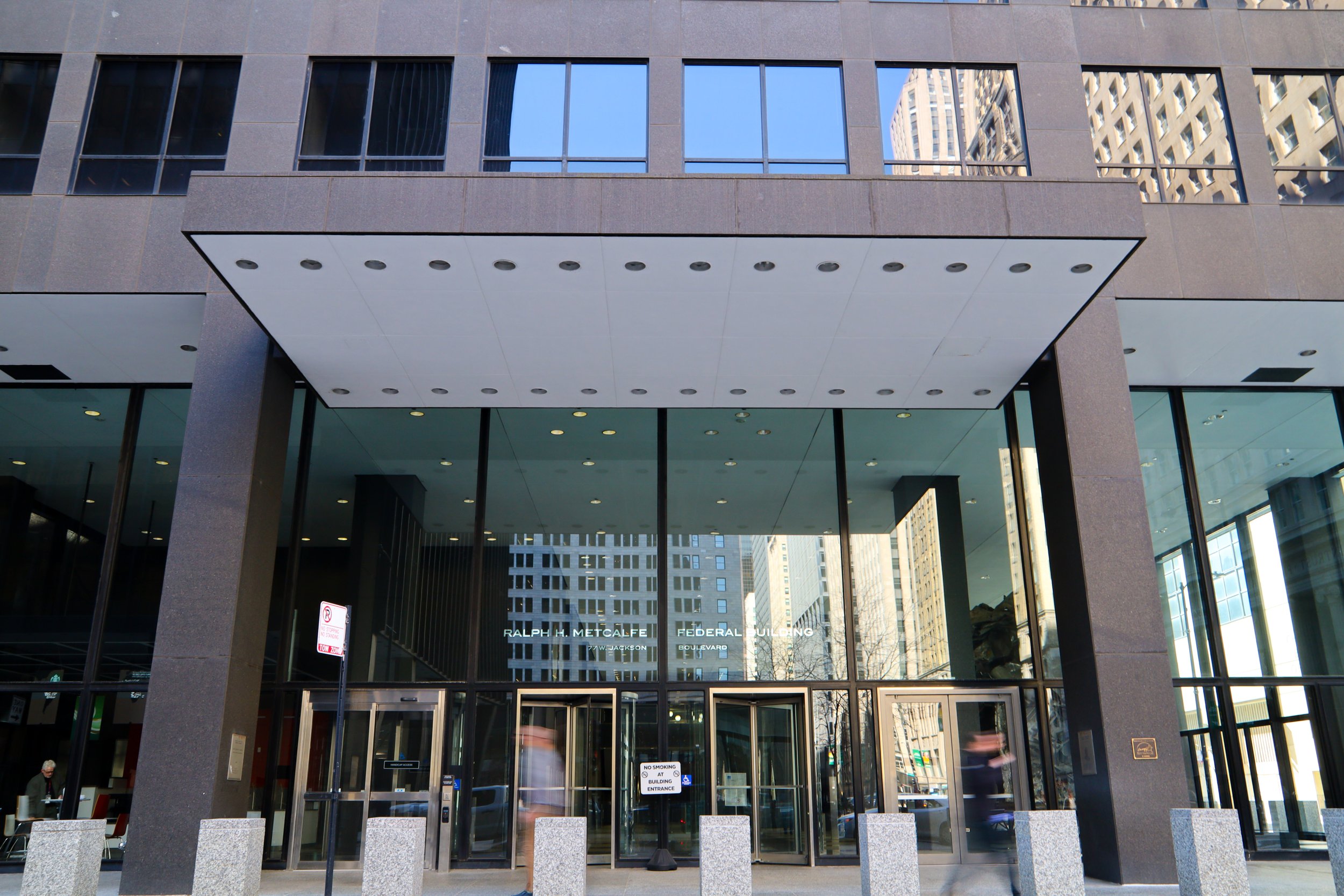
The Ralph H. Metcalfe Federal Building in Chicago's Loop houses the Midwest Regional Office of the U.S. Department of Housing and Urban Development. HUD last month notified fair housing nonprofits across the country, including several in Illinois, that their Fair Housing Initiatives Program grant funding would be cut off. (Capitol News Illinois photo by Andrew Adams)