Pritzker positions himself at forefront of Trump opposition by invoking Nazis’ rise to power

Governor quest to project pragmatic progressivism present in budget, other policy proposals 

By HANNAH MEISEL
Capitol News Illinois
news@capitolnewsillinois.com 

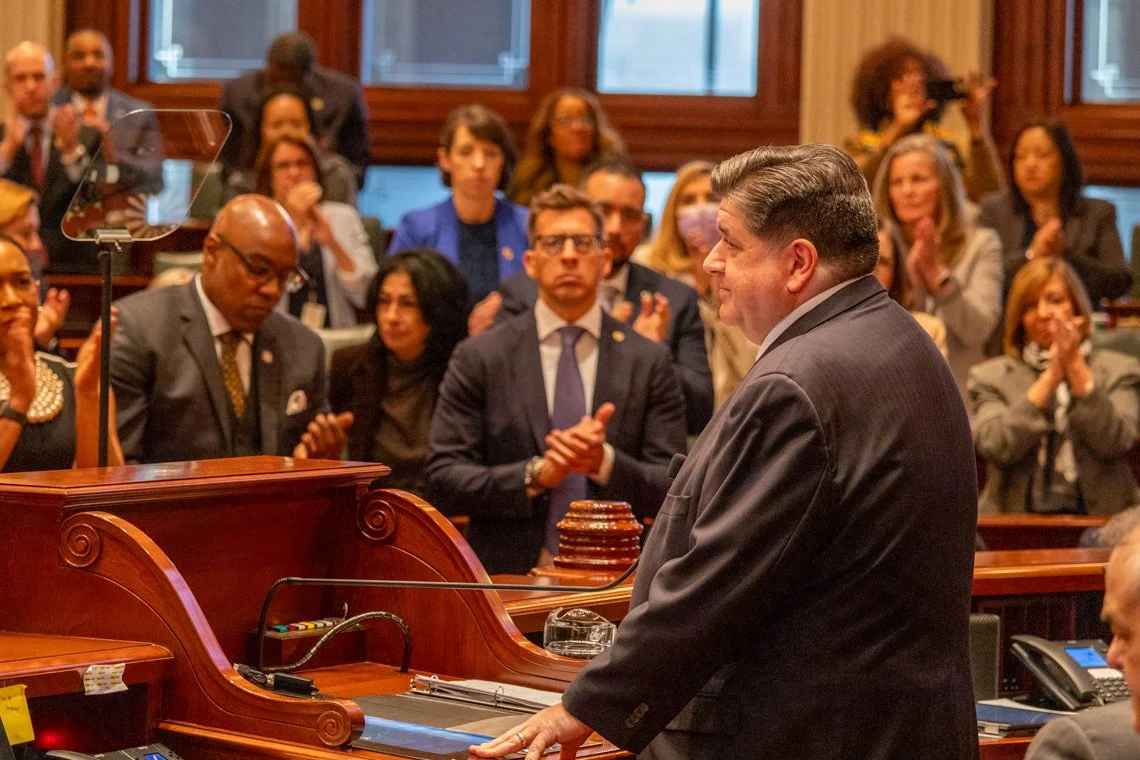
SPRINGFIELD – A month into President Donald Trump’s second term in the White House, Gov. JB Pritzker last week warned that the breakneck pace at which the Trump administration has been remaking federal policy could be a harbinger of something darker.

“It took the Nazis one month, three weeks, two days, eight hours and 40 minutes to dismantle a constitutional republic,” the governor said near the end of his annual combined State of the State and Budget Address on Wednesday.

Pritzker’s speech to a packed Illinois House chamber marked the start of the usual monthslong process of crafting a new state budget for the coming fiscal year. More than any budget or policy proposal, though, the governor used his annual public address to take aim at Trump in a way other high-profile Democrats have largely shied away from: discussing the rise of Adolf Hitler.

“The seed that grew into a dictatorship in Europe a lifetime ago didn’t arrive overnight,” he said. “It started with everyday Germans mad about inflation and looking for someone to blame.” 

Pritzker, Illinois’ third Jewish governor whose ancestors fled religious persecution in Ukraine in the late 1800s, said he didn’t “invoke the specter of Nazis lightly” but cited his experience working with survivors to help found the Illinois Holocaust Museum in suburban Skokie as basis for his warning message.

“I’m watching with a foreboding dread what is happening in our country right now,” he said. “The authoritarian playbook is laid bare here: They point to a group of people who don’t look like you and tell you to blame them for your problems. I just have one question: What comes next?” 

Read more: Pritzker emerging as one of Trump’s most vocal Democratic critics

As the governor presented his seventh budget proposal last week, he nodded to the very real possibility that it could all be blown up by the Trump administration and a Republican-controlled Congress. 

Read more: Pritzker calls $55.2B budget ‘responsible and balanced’ – but warns Trump policies could upend it 

“For all the Illinoisans watching at home, let me be clear: this is going to affect your daily lives,” Pritzker said. “Our state budget can’t make up for the damage that is done to people across our state if they succeed.” 

Instead of his usual post-Budget Address whistle-stop tour of Illinois promoting his agenda, the governor spent Tuesday in the U.S. Capitol with Illinois’ congressional delegation “to press the Trump admin on the more than $1.8 billion they are withholding from Illinoisans,” according to a social media post from a spokesman.

It’s unclear whether Pritzker’s fiery rhetoric will help him pass the budget blueprint and legislative agenda he laid out last week in Springfield. But it did garner him national attention, including on The Rachel Maddow Show and earning millions of ‘likes’ on TikTok

The governor insisted he wasn’t “speaking up in service to my ambitions – but in deference to my obligations.”

But the spotlight moment comes as years of speculation over the governor’s political future as a presidential candidate may come to a head later this year as Pritzker decides whether to run for a third term as governor in 2026. 


‘On the federal chopping block’

The second-term governor went on to urge political leaders to “be strong enough to learn from” history in order to prevent repeating it.

But Pritzker also cited more recent history, drawing parallels between Trump’s move to slash federal spending and a budget fight that crippled much of Illinois government under his predecessor, Republican Gov. Bruce Rauner.

This year marks a decade since Rauner’s political fight with Democratic majorities in the General Assembly launched the state into a two-year budget impasse that decimated social services in Illinois. It also ballooned Illinois’ unpaid bill backlog to $17 billion and earned the state multiple credit downgrades.

“Here in Illinois,10 years ago we saw the consequences of a rampant ideological gutting of government,” Pritzker said. “It genuinely harmed people. Our citizens hated it. Trust me: I won an entire election based in part on just how much they hated it.” 

Pritzker, who is now the nation’s second-wealthiest elected official after Trump, said in his speech Wednesday that tech billionaire Elon Musk – the richest person on earth – plans to “steal Illinois’ tax dollars and deny our citizens the protection and services they need.” 

“They say they’re doing it to eliminate inefficiencies,” Pritzker said of Musk’s so-called “Department of Government Efficiency.” “But only an idiot would think we should eliminate emergency response in a natural disaster, education and healthcare for disabled children, gang crime investigations, clean air and water programs, monitoring of nursing home abuse, nuclear reactor regulation, and cancer research.” 

Despite campaign promises to not touch entitlement programs, Trump has endorsed congressional Republicans’ plans to shrink federal spending to pay for an extension the president’s 2017 tax cuts over the next decade at a cost of $4.5 trillion. Advocates worry the GOP framework would leave Congress little choice but to gut Medicaid, a joint program between states and the federal government that supports 3.3 million Illinoisans who are either low-income, have disabilities or meet other qualifications for benefits.

Illinois is one of 40 states plus the District of Columbia that have adopted Medicaid expansion programs authorized under the Affordable Care Act that extend Medicaid coverage to low-income childless adults who don’t otherwise qualify for the program.

But like other states, Illinois has a trigger law in place that would effectively cancel its Medicaid expansion program if federal reimbursement falls below 90%, making it likely more than 700,000 Illinoisans would lose health coverage if congressional Republicans target ACA expansion first.

Pritzker warned Medicaid cuts would mean rural hospitals in Illinois would be shuttered.

Meanwhile the governor said popular programs like Meals on Wheels “are on the federal chopping block” as the Trump administration briefly blocked routine federal payments for many services last month.

Read more: ‘Blatantly unlawful’ federal spending freeze sends state scrambling

Even so, Pritzker last week presented no contingency plans for federal funds potentially disappearing. Instead, he proposed a $55.2 billion budget that would see discretionary spending – including state programs targeted at everything from economic development to violence prevention – grow at about 1% from the current fiscal year, which ends June 30. 

Fixed costs, including pension payments, K-12 education spending and state employee health care costs – drive the rest of the $2 billion in spending growth from this year’s enacted budget

Read more: Pritzker’s budget office projects $3.2B deficit in early look at upcoming fiscal year | Pritzker must address multi-billion-dollar deficit amid federal funding uncertainty

Reaction to invoking Nazi history

While some members of the General Assembly’s influential Latino and Black caucuses were less than thrilled with Pritzker’s budget proposal, some in his own party praised the framework – including moderate members who held up last year’s late night budget vote in protest. 

Read more: Black, Latino lawmakers criticize Pritzker’s proposed budget 

But reactions were mixed when it came to the governor invoking the rise of the Nazis in 1930s Germany. Many Democrats clapped when Pritzker urged learning from history to avoid repeating it.

Rep. Bob Morgan, D-Deerfield, who co-chairs the General Assembly’s Jewish Caucus, and whose great-grandparents perished in the Holocaust, was among them.

“I think we are seeing some ignoring of those rising elements of extremism and hate,” he said. “The confidence that white supremacists feel to march in state capitals around the country is relatively recent, and it's absolutely happening, and I think we have to call it out … That was the lesson I've always taken from the Holocaust – it’s that people didn't speak up.”

To critics’ ears, however, Pritzker’s speech signaled he has his eye on the White House in 2028.  

The governor was vetted as a possible running mate for former Vice President Kamala Harris’ presidential run last summer. He’s also expanded his political influence in recent years, spending big for Democrats in other states and even launching a nationwide “dark money” 501(c) organization focused on progressive policies, starting with abortion protections. 

Read more: With budget proposal and fiery address, Pritzker paints himself as progressive pragmatist | In primetime DNC speech, Pritzker leans into role of benevolent billionaire 

Rep. Ryan Spain, R-Peoria, warned that the governor’s rhetoric may put Illinois squarely in the Trump administration’s crosshairs. 

“He is not going to be running against Donald Trump in 2028 and he needs to understand that as soon as possible, because there's a lot at risk for the state of Illinois by continuing to play the part of antagonizer to the president of the United States,” he said. 

Even Democrats who had previously been more outspoken in their opposition to Trump have been more muted since the president’s inauguration last month. 

California Gov. Gavin Newsom, who just last summer made references to the spread of fascism in 1930s Europe in his 2024 State of the State speech, needs federal disaster funding to help the state recover from January’s devastating wildfires. Earlier this month Newsom met with Trump about disaster relief, thanking the president and his administration for their assistance.

Trump has directly threatened funding to blue states in the last month, including directly to Maine Gov. Janet Mills last week over her state’s laws aimed at protecting transgender people from discrimination.

Federal funding to Illinois has also been threatened in Trump’s second term. Though courts blocked the president’s 2017 attempt to withhold funding from “sanctuary cities,” an executive order the president issued on his first day back in office calls for the same halt to funding on any local government that has enacted policies restricting local law enforcement agencies from cooperating with federal immigration enforcement actions.

And earlier this month, Trump’s Department of Justice sued Chicago, Cook County and Illinois over their “sanctuary” laws.

Read more: Illinois locked in legal battles with Trump administration over immigration policy

Illinois’ senior U.S. Sen. Dick Durbin, with whom Pritzker has publicly disagreed with over politics in the past, last month was roundly criticized for saying he didn’t know who would be leading Democrats’ charge against Trump. 

“I can’t answer that. Give us a little time,” he told Semafor. “This is brand new.” 

Pritzker on Wednesday used his bully pulpit to challenge his fellow Democrats, who are facing intraparty criticism for failing to do much to stop or slow the Trump administration’s consolidation of power.

Read more: Pritzker emerging as one of Trump’s most vocal Democratic critics

“There are people – some in my own party – who think that if you just give Donald Trump everything he wants, he’ll make an exception and spare you some of the harm,” Pritzker said, launching into an abbreviated version of a story he’s told publicly several times about the early weeks of the COVID-19 pandemic in March 2020. 

In the governor’s telling, he offered to praise Trump on Sunday news shows in exchange for N95 masks and ventilators. But when the supplies arrived, the crates were instead filled with surgical masks and broken BiPAP machines, which are most commonly used to treat sleep apnea and other breathing disorders. 

“Going along to get along does not work,” he said. “Just ask the Trump-fearing red state governors ... Those Trump state – red state governors are dealing with the same cuts that we are, and I won't be fooled twice.” 

Aside from accusations that Pritzker used inflammatory comparisons to grow his national platform, some Republicans said they were offended Wednesday. Six GOP House members left their desks on the House floor, walking toward the back exit when the governor began talking about the 1978 Nazi march on Skokie. 

Though most of them were members of the ultraconservative “Illinois Freedom Caucus,” Rep. Jeff Keicher, R-Sycamore, one of the more moderate Republicans in the General Assembly, said his walkout was spurred by “emotional frustration” borne of what he felt was a sort of cognitive dissonance in Pritzker’s speech.

“We still have all this money to spread all over the place,” Keicher said of Pritzker’s spending plan, even as social services in Illinois face persistent funding challenges. Keicher cited ongoing state funding challenges to services including domestic violence shelters, nursing homes and “a seven-year backlog” for adults seeking ” for developmental disabilities services.developmental disabilities services in Illinois – though the state’s official estimate has fallen to roughly five years.

"And then I hear the governor lay into what he's calling Illinois Nazis, and the way that we slip into Nazism is by having high inflation,” he continued. “As a man who has stood up repeatedly in his public role and defended the plight of Israel and Jews in this country – to be called a Nazi is beyond the pale.” 

David Shyovitz, the director of Northwestern University’s Crown Family Center for Jewish and Israel Studies and an associate professor of history, said careful study of how Hitler consolidated power through “constitutional means” – “basically uprooting and eventually eliminating any legal impediments that stood in their way” – can be instructive.  

But he said Nazi Germany is not the only example of strongmen leaders seizing power, and pointed to Hungarian Prime Minister Viktor Orbán, whom Trump has said he personally admires. 

While Shyovitz said invoking Hitler has a “certain rhetorical thrust,” he said there is a risk to “devaluing what made that historical period so horrible” and warned that overuse, particularly in online discourse, could zap it of its power. 

“As a historian, I think it's appropriate for us to try and learn from the historical past and apply it in the present,” Shyovitz said. “As a voter, I would be worried that using that example is going to end up alienating the very people that you need to convince.” 


‘It’s not a scare tactic’

Rep. Terra Costa Howard, D-Glen Ellyn, the chair of the New Democrats caucus, a group of more than 20 more moderate Democrats in the Illinois House, agreed. She said she understood why Pritzker would choose to invoke Nazism because “it is the only reference in modern times that people can connect to.” 

But she said Democrats will see more success messaging against Trump if they put the focus on the ways in which decisions from the White House affect Americans. 

Read more: Trump tariffs could impact hundreds of billions of dollars of trade in Illinois 

“If we lose Medicaid dollars, everybody knows somebody in a nursing home,” Costa Howard said. “That is going to have a direct impact to people we know and love in our community. People are not making that connection. We need to explain what that is. It's not a scare tactic. It is a reality. And that is what people need to hear.” 

In an op-ed for MSNBC and a longer podcast interview with one of its hosts published Monday, Pritzker agreed with Costa Howard’s assertion, saying Democrats should focus on “affordability” instead of expending the party’s rhetorical power on “threats to democracy.” 

To that end, the governor also backed an array of legislative proposals in his speech last week, including cracking down on pharmaceutical benefit managers in an attempt to hold down prescription drug costs. Pritzker’s campaign last week also put out a poll showing that of Trump’s recent moves, Illinoisans are most concerned about rolling back former President Joe Biden’s initiative to lower drug costs. 

Another Pritzker-backed idea would build on last year’s Healthcare Protection Act, requiring insurers to reimburse travel costs to get to medical appointments at certain distances and barring insurance companies from spending less than 87% of premiums on health care services. 

Read more: Pritzker signs health insurance reform measures 

Another affordability-focused proposal would have Illinois follow 24 other states that already allow community colleges to offer baccalaureate degrees. As proposed, the program would authorize community colleges in Illinois to offer four-year degrees specifically tailored to meet the employment needs of their communities, including in fields like health care, early childhood education or advanced manufacturing. 

Read more: Pritzker to call for expansion of 4-year degree offerings at some community colleges 

Rep. Fred Crespo, D-Hoffman Estates, said he’s “excited” about that proposal after having twice passed legislation in the House to allow Harper College in Palatine to offer nursing degrees, only to see the bills die in the Senate. 

“So getting the governor's backing on this – I'm hoping really moves the needle because I think really that that's where the future of education is,” he said, noting that enrollment in Illinois’ community colleges has increased more than the national average in recent years. 

Pritzker’s other proposals range from progressive priorities like further expanding abortion care availability and protections to ideas that could appeal to voters in both parties, including banning cell phones during instructional time in Illinois schools. At least 11 other state legislatures have passed legislation on school cell phone use in the last two years. 

Improving and then selling off unused state property, lowering the petition signature threshold for a township consolidation ballot question and regulating cryptocurrency ATMs are also on the governor's list. 

Bridgette Fox and Jade Aubrey contributed. 


Capitol News Illinois is a nonprofit, nonpartisan news service that distributes state government coverage to hundreds of news outlets statewide. It is funded primarily by the Illinois Press Foundation and the Robert R. McCormick Foundation.
Republic Garbage Truck Rollover- 1 injured

On 02.24.25 at approximately 1:40 p.m. The Wabash County Sheriff's Office responded to the area of 2306 E 1200 RD. , Allendale. (The portion of Bridgeport Blacktop north of Highway 11) The 911 call was reported to be an overturned garbage truck on the east side of the roadway down the embankment with the driver unaccounted for. 

While emergency units were in route the caller advised the driver had been located in the wooded area just north of the crash site. (30 yards)  During the crash investigation it was found the garbage truck was north bound on E 1200 Rd, proceeding through the "S" curves when the truck ran off the shoulder of the roadway to the right. The truck overturned and the driver was ejected from the vehicle. 

Emergency crews worked to stabilize the driver, 40-year-old Jason A. Miller of Olney, then moved him up the embankment to the Wabash General Ambulance. WGAS relocated to the parking lot of Weber Seed Service where a landing zone was set up for StatFlight. StatFlight transported Miller to an Evansville area hospital with major injuries.

The Sheriff's Office was assisted by the Lawrence Co. Sheriff's Office, Wabash General Ambulance Service , Allendale Rural Fire Protection District and Sully's Towing. The roadway was closed until about 8 p.m. The north bound lane was also closed for some time today as crews completed clean up. No citations were issued. 

'25-'26 District #348 School Calendar Adopted

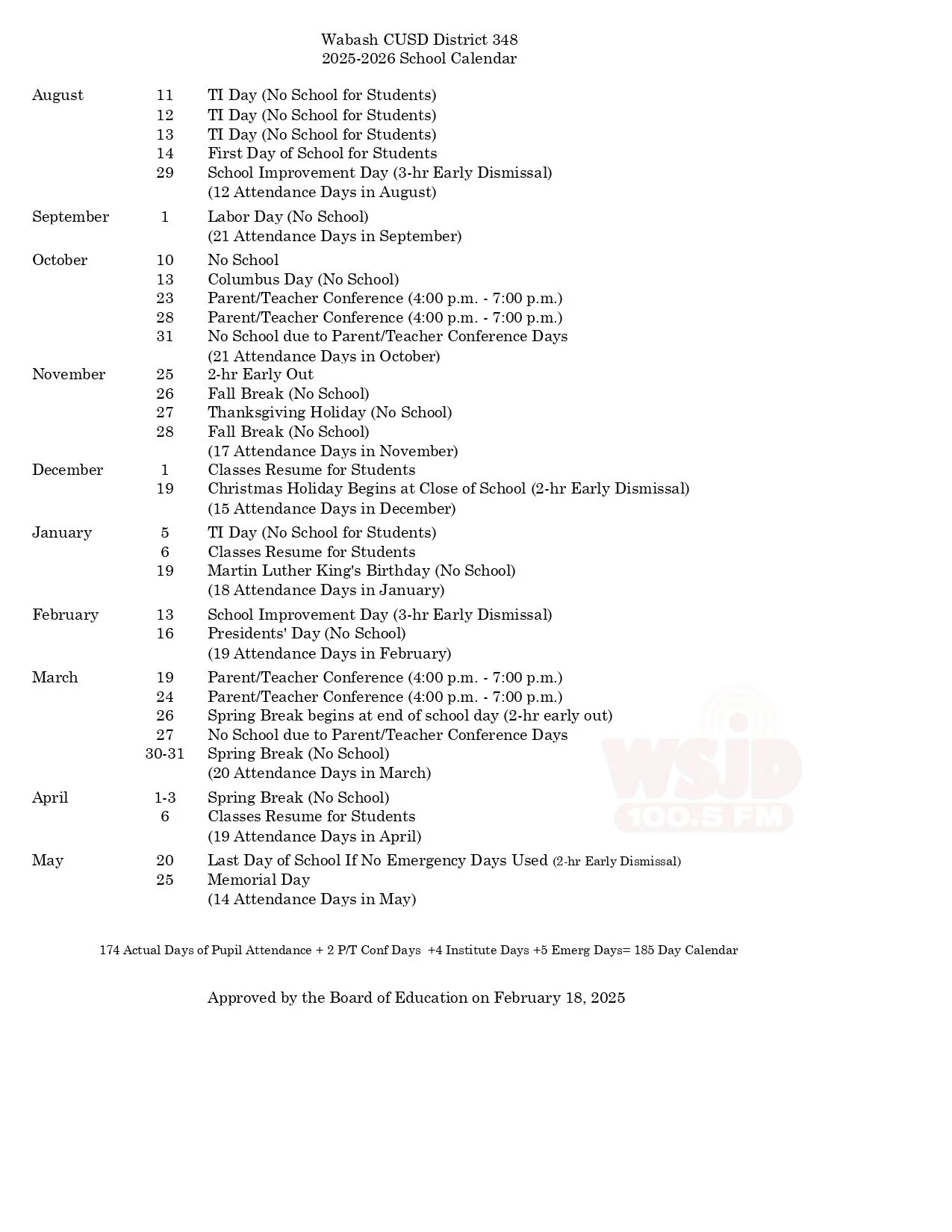
The 2025-26 Wabash District #348 school calendar will look different in a few ways than the current school year. Superintendent Dr. Chuck Bleyer said input into crafting the calendar came from a variety of viewpoints and that resulted in some noticeable changes….

DR. CHUCK BLEYER SCHOOL CALENDAR 2 18 25

The first day of classes next year for students will be Thursday, August 14th and the last day slated for May 20th if no snow days are needed and May 28th if all snow days are used. Christmas break will be December 22nd through January 5th. Spring break next year will be the week of March 30th. As Bleyer pointed out, there will be school on Monday and Tuesday of Thanksgiving Week.


As federal deadline approaches, Illinois Secretary of State urges residents to “Get Real”

Deadline for federally compliant ID May 7

By JADE AUBREY
Capitol News Illinois
jaubrey@capitolnewsillinois.com 


With a deadline approaching for U.S. citizens to obtain Real IDs, Illinois Secretary of State Alexi Giannoulias is urging Illinois residents to “Get Real.”

Real ID is a federally-standardized identification card that requires stricter proof of identity to obtain than the regular state driver’s licenses or ID cards. All Drivers Services facilities in Illinois are issuing Real IDs, except for mobile units and express facilities.

Last May, Giannoulias’ office launched the “Get Real Illinois” campaign to raise awareness about the requirements and deadline of the Real ID implementation. During a news conference Tuesday, he continued to urge Illinoisans to obtain the new ID soon, as a federal deadline approaches.

On May 7, state-issued driver’s licenses will no longer be accepted as a valid form of identification for domestic flights or at certain federal facilities such as military bases or federal courthouses. Although U.S. citizens will need a Real ID to visit those facilities, they will not need a Real ID to fly domestically if they have a valid passport.

A Real ID is signified by a gold star on the upper right corner of the ID card. 

“We know for sure that as May 7 approaches, demand for Real ID drivers’ licenses and state IDs will inevitably increase,” Giannoulias said. “What we don't want are crazy, unmanageable lines at our facilities and major issues for individuals and their families at our airports.”

He said the news conference aimed to “clear up confusion” over the technicalities of the Real ID.

“Since the new administration has taken over in D.C., we've seen an influx of people who are confused about what real ID means and think they need it as a form of identification,” Giannoulias said. “And our point that we're trying to hammer home today is that that's not the case. You do not need a Real ID to drive a vehicle.”

Other qualms about the new identification have arisen, including issues around gender identity and the likelihood of the May 7 deadline holding firm. Although Giannoulias didn’t directly address the first issue, he said multiple times that Illinoisans should use their own discretion to decide if the Real ID is right for them.

“I don't want to discourage anyone from getting a Real ID, but the fact is that not everyone needs a Real ID on May 7, and in some cases, might not ever need one,” Giannoulias said.

However, he did address growing skepticism that the deadline won’t hold firm.

“I know many of you are asking yourselves, after years of blown deadlines, delays and extensions, why should we trust the Department of Homeland Security,” he said. “The reasons for the delays have run the gamut, ranging from partisan politics to a lack of coordination among the federal government and various states.”

In direct response to the terrorist attacks of 9/11, Congress passed the REAL ID Act in 2005, which established “minimum security standards for state-issued driver's licenses and identification cards.” The effective date of the law has been extended multiple times, most recently to 2025 due to the COVID-19 pandemic.

“Now I get asked on a regular basis, is this real ID deadline for real this time,” Giannoulias said. “The one thing that's different this time around is that TSA just recently published a ‘final rule,’ rejecting the option for another extension and requiring the regulation to finally take effect.”.

TSA’s final rule, which they published on Jan. 13, 2025, stated the agency will begin enforcing the law on May 7, taking what they call a “phased enforcement approach” to implement enforcement until May 2027.

The Secretary of State’s website has an interactive checklist where Illinoisans can find out what documents they need to obtain a Real ID. The required documents include proof of identity, proof of full Social Security number, and two documents providing proof of current address.


Capitol News Illinois is a nonprofit, nonpartisan news service that distributes state government coverage to hundreds of news outlets statewide. It is funded primarily by the Illinois Press Foundation and the Robert R. McCormick Foundation.
Illinois Secretary of State Alexi Giannoulias exits the House chambers in the Illinois Capitol. (Capitol News Illinois photo by Jade Aubrey)

Lawmakers weigh whether to legalize ‘medical aid in dying’

Doctors, disability activists split on support for the controversial procedure 

By ANDREW ADAMS
Capitol News Illinois
aadams@capitolnewsillinois.com

CHICAGO — Lawmakers are considering legalizing a controversial medical practice that proponents say could ease suffering for the terminally ill. 

It’s sometimes called “assisted suicide,” although physicians and advocates for the practice prefer the term “medical aid in dying,” or MAID. 

While Compassion & Choices — a group that advocates for medical aid in dying policies — found a majority of Illinois voters supported legalizing MAID in a 2023 poll, some critics call the process “barbaric.” 

The measure, contained in Senate Bill 9, is being backed by Sen. Linda Holmes, D-Aurora, who told her Senate colleagues at a hearing Friday that she supports the proposal because of her parents’ deaths. Both her mother and father died after extended battles with cancer. 

“You think the toughest thing you go through is watching somebody die, and you know what? It’s not,” Holmes said. “It’s not as tough as watching somebody you love suffer and there’s nothing you can do to ease that suffering. That is the hardest thing I’ve ever gone through.”

Holmes’ proposal would legalize MAID — a process where a doctor prescribes but does not administer a lethal combination of drugs — for patients whose doctors determine have less than six months to live due to a terminal illness. The patient then administers the drugs on their own at a time of their choosing. 

The bill contains several safeguards to prevent abuse, according to its proponents, including a waiting period to receive a prescription, a requirement that the patient receive a terminal diagnosis from two doctors, a requirement that patients prescribed lethal medication have sufficient “mental capacity.” 

Friday’s meeting of the powerful Senate Executive Committee was a “subject matter” hearing, meaning no vote was taken. The bill will need more committee hearings, a vote in both legislative chambers and approval by the governor before becoming law. 

Ten other states and Washington, D.C., have all legalized some form of medical aid in dying. Oregon was the first state to legalize MAID in 1994. 

Advocates for the proposal include patients with terminal illnesses, people whose loved ones used the procedure in other states and doctors who specialize in end-of-life care. 

In 2022, Deb Robertson of Lombard was diagnosed with neuroendocrine carcinoma — a rare and aggressive form of liver cancer. She asked lawmakers to give her “permission” to take her own life. 

“It would give me the option to die peacefully and on my own terms,” Robertson said. “There’s a level of comfort in that.” 

Diana Barnard, a doctor in Vermont who offers MAID prescriptions, said most patients have “a very clear understanding” of what’s an acceptable quality of life as they approach death. 

“We have now 27 years of national experience with the practice that really shows these laws are working well,” Barnard said. 

But the medical practice is controversial among doctors and disability activists. 

Benjamin German, a doctor on the West Side of Chicago, said the "problem” with the bill was its safeguards. 

“For some of my patients, these safeguards will be just tight enough for lawmakers to assume things will be okay and amply generous to allow abuse to happen,” German said. “People and organizations looking for ways to exploit this law, I fear, will find a way.” 

Disability advocates, meanwhile, say they worry about medical professionals mischaracterizing illnesses as terminal, misdiagnosing people or pushing vulnerable or marginalized people to consider ending their own life. 

“As someone with a disability myself – I use a wheelchair – I can say firsthand that my life is often viewed as something to pity and not something to cherish,” Riley Spreadbury, an independent living advocate from Joliet, said. “It’s sentiments like these that make me incredibly concerned regarding Senate Bill 9.”

MAID is also opposed by groups that express a “consistent life ethic,” meaning they object to abortion, capital punishment, assisted suicide, and euthanasia. Those groups include the Catholic Church and non-religious groups such as Illinois Right to Life.   


Capitol News Illinois is a nonprofit, nonpartisan news service that distributes state government coverage to hundreds of news outlets statewide. It is funded primarily by the Illinois Press Foundation and the Robert R. McCormick Foundation.

Deb Robertson, a Lombard woman facing a terminal cancer diagnosis, speaks in favor of legislation that would allow doctors to prescribe lethal medication to dying patients. (Capitol News Illinois photo by Andrew Adams)


Financial impacts of federal action stir anxiety for Illinois farmers 

Farmers face uncertainty as Congress delays long-term spending legislation 

By Ashley N. Soriano and Medill Illinois News Bureau


CHICAGO — The effects of President Donald Trump’s planned tariffs on allies and rivals are yet to be seen, but farmers in Illinois are bracing for their impact – even as they wait years for Congress to pass long-term federal spending legislation.

Fourth-generation Illinois farmer Rick Nelson feels that uncertainty keenly. He learned how to drive a tractor at 6 years old. By age 8, he was preparing the ground for planting.

“I became a ‘tractor jack’ at an early age,” said Nelson, 72, who still operates his 2,500-acre family farm in Paxton, Illinois.

Now in his final farming years before passing the farm to his son,the Nelson family is anxious about the road ahead this year.

The Nelsons’ farm is one of nearly 71,000 registered farm operations in Illinois, the third-ranked state in the nation for agricultural exports, according to the U.S. Department of Agriculture.

But the number of family-run farms is declining because the profit margins are slim and the industry is unpredictable, according to the Illinois Farm Bureau.

Farmers are biting their nails as they await a new Farm Bill – a piece of federal legislation that Congress passes every five years to set comprehensive agricultural programs and policies.

The bill expired in September 2023 and was extended through last year. Congress extended the 2018 version for a second time in December. That legislation, the American Relief Act, 2025, extended the Agriculture Improvement Act of 2018 for one year through Sept. 30, 2025.

First enacted under President Franklin Roosevelt’s New Deal in 1933 to support struggling farmers and address Depression-era hunger, the Farm Bill allocates funding for crop insurance, disaster assistance and conservation programs for farmers. It also funds nutrition programs like the Supplemental Nutrition Assistance Program (SNAP), also known as food stamps, and school lunch programs.

The Farm Bill didn’t exist when Nelson’s great-grandfather started their family farm in 1910, but it’s become an essential part of farmers’ financial planning process.


“When we do any kind of planning, we have to be looking out one, two, three, even five years ahead in terms of purchases or cash flow needs,” Nelson said.

Another immediate concern is the impact already of the Trump administration’s halting of USAID purchase of crops for foreign aid, which could hit Illinois farmers hard.

China could impose retaliatory tariffs like it did in 2018, which led to a significant decrease in soybean exports at the time.

This go-around could increase the cost of producing farm machinery and equipment.

“Farmers are working in the 2024 economy with a piece of legislation that was passed in 2018,” Ryan Whitehouse, the Illinois Farm Bureau’s director of national legislation,said in December. “And with everything that's happened to inflation … It just needs modernized bills.”

“Congress, you know, they kicked the can down the road two times,” Whitehouse said. 

Lawmakers in Springfield have also expressed frustration at Congress’ lack of an update to the Farm Bill. 

“I think it’s really unfortunate that the federal government is not doing their part right now,” state Rep. Sonya Harper, D-Chicago, said. “That lends itself to hurting our farmer families, which we know the majority of them are in rural communities.”

Harper, who chairs the House Agriculture and Conservation Committee, said the delays are “disrespectful to farm families.” 

The delay has caused budgeting pressure for Nelson, who is considering upgrading an aging tractor to a newer, $334,000 model. 

“If I were trying to project ahead, am I going to try and replace that in 2025? Am I going to try and replace that 2026? I don't know where the safety net will be from the Farm Bill,” Nelson said. “It's a politically driven decision in D.C., and there's lots of parts to it.”


A new year looming: ‘There are repercussions’

Across more than 26 million acres covering 75% of the state’s land, farmers produced $10.8 billion in corn and $8.2 billion in soybeans in 2023, according to the USDA.


Each year, the state’s 274 million bushels of corn produce more ethanol than any other state, according to the Illinois Department of Agriculture.

Jim Niewold, a corn and soybean farmer in Loda, said he’s frustrated with the Farm Bill’s delay.

“Several years, or if not decades, most of it ends up getting delayed and put into these omnibus bills, and I wish they'd do it right,” Niewold, 69, said. “They call it the Farm Bill, but it's really much bigger than that ‘cause it's really like for food security for the country.”

Without solidified legislation, funding is in limbo. Farmers rely on crop insurance funding from the farm bill, which protects farmers from losses in crop yields and revenue due to disasters like drought and severe weather events.

“They want their dollars from the market, not from a government handout, but they want that crop insurance there in case there is a crisis or if there's a disaster or national disaster,” the Farm Bureau’s Whitehouse said.

Although Nelson, also a corn and soybean farmer, said he isn’t a fan of disaster payments, he would like the government to invest more consistent dollars into existing programs.

“Some folks get caught on the wrong side of the decisions that were made out of D.C., or in our case, Springfield, and consistency is to me a really important thing to have,” Nelson said.

Delays to a new Farm Bill also impact consumers, particularly those who rely on benefit programs like SNAP or have students who eat a school lunch. These food system impacts could also increase the cost of many grocery items. 

GRAPHIC

But a one-year extension doesn’t help much, according to farmers.

“I think we're always concerned because even with a five-year Farm Bill, people look at and say, well, that's a long-term farm bill, but it's really not when you're trying to set up things on the farm,” said Ron Bork, a corn and soybean farmer in Piper City, Illinois.

The 73-year-old grew up on his family farm and has had a hand in operations since he was 8 years old. He’s preparing to sell his farm and enter retirement, but he is still navigating the uncertainty that comes with farming.

“It's just like trying to steer a big ship in an ocean. You can't turn that ship around in a very short time. It takes a long period of time to get that turned around,” Bork said. “It's the same way with farming.”

Nelson and Niewold also plan to retire in the next couple of years, passing the reigns to their sons.

This could be the last Farm Bill any of them see as active farmers.

“Nothing these folks in D.C. do can change the rules. They can change the size and the speed of the waves up and down I think, but they can't completely change them, so (my son), like all of us, will have to go through some tougher times and then hopefully enjoy good times,” Niewold said.


Capitol News Illinois is a nonprofit, nonpartisan news service that distributes state government coverage to hundreds of news outlets statewide. It is funded primarily by the Illinois Press Foundation and the Robert R. McCormick Foundation. 

Rick Nelson, a fourth-generation farmer, operates this 2,500-acre family farm in Paxton, Illinois, shown in a 2023 photograph, (Photo provided by Rick Nelson)

Severin: Pritzker Insults President Trump and Fails to Take Responsibility for Illinois' Budget Deficit

SPRINGFIELD, IL – State Representative Dave Severin (R-Benton) says Illinois Governor JB Pritzker’s combined State of the State and Budget Address failed to acknowledge that Illinois’ Sanctuary State policies have caused havoc for the state’s finances.

“Governor Pritzker has been the head honcho of illegal immigration since taking office, supporting sanctuary state policies, and spending billions of taxpayer dollars on illegal migrant services. Instead of acknowledging that these policies have significantly contributed to our state’s financial decline, the governor used his Budget Address to blame President Trump for Illinois’ financial woes. That is not how an executive demonstrates ownership over significant financial problems facing our state. What happened to, “The Buck Stops Here?”

Governor Pritzker’s proposed budget would once again spend a record amount of money, totaling $55.235 billion. That number is over $15 billion higher (a 38% increase) compared to Pritzker’s first budget year (FY20). Severin says it is time for Pritzker and General Assembly Democrats to face the reality that they have over-promised, overspent, and under-delivered for Illinois taxpayers.

“It’s been record spending budgets and tax hikes year after year,” Severin said. “Socialism doesn’t work. It’s been tried. No matter who is trying it, you eventually run out of other people’s money. We are seeing citizens and businesses leaving the state, taking their families and jobs with them. There is a direct relationship between our high-tax, high-spending government policies, and the outmigration of our citizens. Today’s proposed budget fails to take into account that our citizens are tapped out, and tired of the same failed policies.”

Severin says he and his fellow House Republicans have three main priorities to get Illinois’ finances back in order.

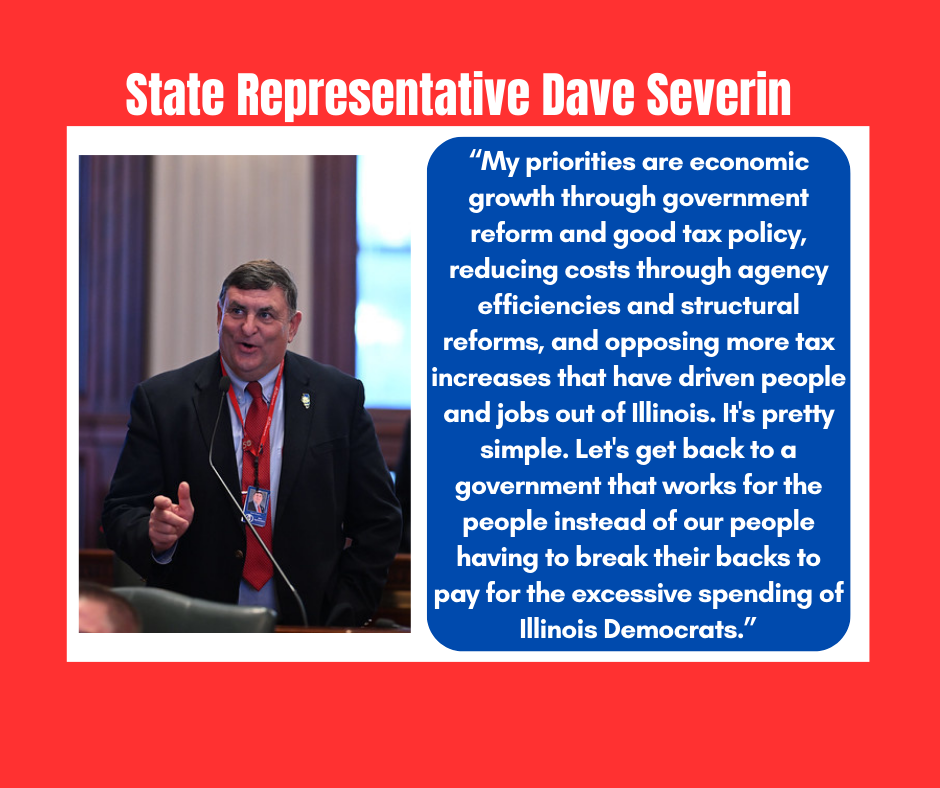
“Our priorities are economic growth through government reform and good tax policy, reducing costs through agency efficiencies and structural reforms, and opposing more tax increases that have driven people and jobs out of Illinois,” Severin said. “It’s pretty simple. Let’s get back to a government that works for the people instead of our people having to break their backs to pay for the excessive spending of Illinois Democrats.”

Traffic accident leads to seizure of pounds of Marijuana

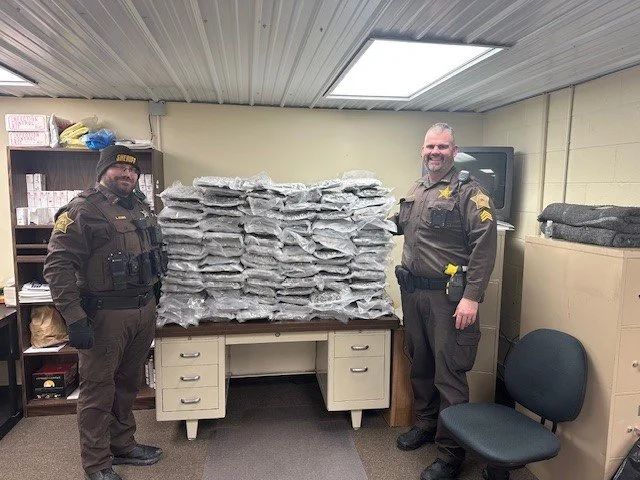
On February 20, 2025, at 1:16 a.m. Gibson County Central Dispatch received a report of a single vehicle accident on US 41 near the White River Bridge. Deputy Levi Sims was dispatched to the accident and found a Black 2017 Lincoln Sedan that left the roadway due to roadway surface conditions.  Upon speaking with the driver it was discovered that the vehicle was being used as a taxi service.  During the course of the investigation Deputy Sims detected the odor of raw Marijuana coming from inside the vehicle.  After a brief investigation Deputy Sims and Sgt. John Fischer found 100 vacuum sealed baggies containing Marijuana.  At the end of the investigation a passenger in the vehicle, 19 year old Haking Weeks of Newark, New Jersey was taken into custody and transported to the Gibson County Jail. Mr. Weeks was charged with Felony Possession of Marijuana.
 
Each bag weighed approximately 530 grams equating to approximately 116 pounds. 
 
All criminal defendants are to be presumed innocent until, and unless proven guilty beyond a reasonable doubt in a court of law.
 

Highland woman pleads guilty to selling counterfeit designer cosmetics, purses and accessories

EAST ST. LOUIS, Ill. – A Highland woman admitted in federal court to trafficking counterfeit designer goods and infringing on registered trademarks by selling items she imported from overseas through her business. The counterfeit items included cosmetics, purses, clothing, and accessories with well-known trademarks from high-end brands.

Emily Montegna, 38, pleaded guilty to one count of trafficking in counterfeit goods.

“Fake cosmetics pose significant health risks for consumers and selling counterfeit goods harm unsuspecting shoppers who believe they are getting the real product,” said Acting U.S. Attorney Ali M. Summers. “Counterfeit goods threaten a fair, legitimate marketplace, and the U.S. Attorney’s Office will continue to prioritize consumer safety.”

According to court documents, Montegna operated a business known by several names such as “Emily’s Creative Creations”, “Hickory Flat Farm Vinyl & Deals”, “Emily’s She Shed” or “Hickory Hill Vinyl & Deals,” and utilized a Facebook group and her home to sell the counterfeit products from October 2019 through January 2022.

Montegna imported fake designer makeup products, socks, purses, sunglasses and other accessories from overseas to sell for a profit through her business. The items were meant to deceive consumers by including trademarks owned by Estee Lauder, L’Oreal, Parfumes Christian Dior, Tarte, Too Faced, Deckers Outdoor, Victoria’s Secret, Kate Spade, Under Armour, Nike and Michael Kors.

Montegna’s sentencing hearing is scheduled for 10:30 a.m. on July 1 at the federal courthouse in East St. Louis. Trafficking in counterfeit goods is punishable by up to 10 years’ imprisonment and fines up to $2 million.

Homeland Security Investigations led the investigation, and Assistant U.S. Attorney Zoe Gross is prosecuting the case.

"Disgusting" Situation Closes District #348 Administrative Offices

Cleanup continues at the Wabash District #348 office on West 13th Street where sewage backup caused the building to be evacuated….

DR. CHUCK BLEYER OFFICE CLOSED 2 19 25

That’s District #348 Superintendent Dr. Chuck Bleyer who told the school board Tuesday night that it’s hoped the clean up will be finished tomorrow. In the meantime, workers in the district office are working offsite.