Financial impacts of federal action stir anxiety for Illinois farmers 

Farmers face uncertainty as Congress delays long-term spending legislation 

By Ashley N. Soriano and Medill Illinois News Bureau


CHICAGO — The effects of President Donald Trump’s planned tariffs on allies and rivals are yet to be seen, but farmers in Illinois are bracing for their impact – even as they wait years for Congress to pass long-term federal spending legislation.

Fourth-generation Illinois farmer Rick Nelson feels that uncertainty keenly. He learned how to drive a tractor at 6 years old. By age 8, he was preparing the ground for planting.

“I became a ‘tractor jack’ at an early age,” said Nelson, 72, who still operates his 2,500-acre family farm in Paxton, Illinois.

Now in his final farming years before passing the farm to his son,the Nelson family is anxious about the road ahead this year.

The Nelsons’ farm is one of nearly 71,000 registered farm operations in Illinois, the third-ranked state in the nation for agricultural exports, according to the U.S. Department of Agriculture.

But the number of family-run farms is declining because the profit margins are slim and the industry is unpredictable, according to the Illinois Farm Bureau.

Farmers are biting their nails as they await a new Farm Bill – a piece of federal legislation that Congress passes every five years to set comprehensive agricultural programs and policies.

The bill expired in September 2023 and was extended through last year. Congress extended the 2018 version for a second time in December. That legislation, the American Relief Act, 2025, extended the Agriculture Improvement Act of 2018 for one year through Sept. 30, 2025.

First enacted under President Franklin Roosevelt’s New Deal in 1933 to support struggling farmers and address Depression-era hunger, the Farm Bill allocates funding for crop insurance, disaster assistance and conservation programs for farmers. It also funds nutrition programs like the Supplemental Nutrition Assistance Program (SNAP), also known as food stamps, and school lunch programs.

The Farm Bill didn’t exist when Nelson’s great-grandfather started their family farm in 1910, but it’s become an essential part of farmers’ financial planning process.


“When we do any kind of planning, we have to be looking out one, two, three, even five years ahead in terms of purchases or cash flow needs,” Nelson said.

Another immediate concern is the impact already of the Trump administration’s halting of USAID purchase of crops for foreign aid, which could hit Illinois farmers hard.

China could impose retaliatory tariffs like it did in 2018, which led to a significant decrease in soybean exports at the time.

This go-around could increase the cost of producing farm machinery and equipment.

“Farmers are working in the 2024 economy with a piece of legislation that was passed in 2018,” Ryan Whitehouse, the Illinois Farm Bureau’s director of national legislation,said in December. “And with everything that's happened to inflation … It just needs modernized bills.”

“Congress, you know, they kicked the can down the road two times,” Whitehouse said. 

Lawmakers in Springfield have also expressed frustration at Congress’ lack of an update to the Farm Bill. 

“I think it’s really unfortunate that the federal government is not doing their part right now,” state Rep. Sonya Harper, D-Chicago, said. “That lends itself to hurting our farmer families, which we know the majority of them are in rural communities.”

Harper, who chairs the House Agriculture and Conservation Committee, said the delays are “disrespectful to farm families.” 

The delay has caused budgeting pressure for Nelson, who is considering upgrading an aging tractor to a newer, $334,000 model. 

“If I were trying to project ahead, am I going to try and replace that in 2025? Am I going to try and replace that 2026? I don't know where the safety net will be from the Farm Bill,” Nelson said. “It's a politically driven decision in D.C., and there's lots of parts to it.”


A new year looming: ‘There are repercussions’

Across more than 26 million acres covering 75% of the state’s land, farmers produced $10.8 billion in corn and $8.2 billion in soybeans in 2023, according to the USDA.


Each year, the state’s 274 million bushels of corn produce more ethanol than any other state, according to the Illinois Department of Agriculture.

Jim Niewold, a corn and soybean farmer in Loda, said he’s frustrated with the Farm Bill’s delay.

“Several years, or if not decades, most of it ends up getting delayed and put into these omnibus bills, and I wish they'd do it right,” Niewold, 69, said. “They call it the Farm Bill, but it's really much bigger than that ‘cause it's really like for food security for the country.”

Without solidified legislation, funding is in limbo. Farmers rely on crop insurance funding from the farm bill, which protects farmers from losses in crop yields and revenue due to disasters like drought and severe weather events.

“They want their dollars from the market, not from a government handout, but they want that crop insurance there in case there is a crisis or if there's a disaster or national disaster,” the Farm Bureau’s Whitehouse said.

Although Nelson, also a corn and soybean farmer, said he isn’t a fan of disaster payments, he would like the government to invest more consistent dollars into existing programs.

“Some folks get caught on the wrong side of the decisions that were made out of D.C., or in our case, Springfield, and consistency is to me a really important thing to have,” Nelson said.

Delays to a new Farm Bill also impact consumers, particularly those who rely on benefit programs like SNAP or have students who eat a school lunch. These food system impacts could also increase the cost of many grocery items. 

GRAPHIC

But a one-year extension doesn’t help much, according to farmers.

“I think we're always concerned because even with a five-year Farm Bill, people look at and say, well, that's a long-term farm bill, but it's really not when you're trying to set up things on the farm,” said Ron Bork, a corn and soybean farmer in Piper City, Illinois.

The 73-year-old grew up on his family farm and has had a hand in operations since he was 8 years old. He’s preparing to sell his farm and enter retirement, but he is still navigating the uncertainty that comes with farming.

“It's just like trying to steer a big ship in an ocean. You can't turn that ship around in a very short time. It takes a long period of time to get that turned around,” Bork said. “It's the same way with farming.”

Nelson and Niewold also plan to retire in the next couple of years, passing the reigns to their sons.

This could be the last Farm Bill any of them see as active farmers.

“Nothing these folks in D.C. do can change the rules. They can change the size and the speed of the waves up and down I think, but they can't completely change them, so (my son), like all of us, will have to go through some tougher times and then hopefully enjoy good times,” Niewold said.


Capitol News Illinois is a nonprofit, nonpartisan news service that distributes state government coverage to hundreds of news outlets statewide. It is funded primarily by the Illinois Press Foundation and the Robert R. McCormick Foundation. 


Rick Nelson, a fourth-generation farmer, operates this 2,500-acre family farm in Paxton, Illinois, shown in a 2023 photograph, (Photo provided by Rick Nelson)

Severin: Pritzker Insults President Trump and Fails to Take Responsibility for Illinois' Budget Deficit

SPRINGFIELD, IL – State Representative Dave Severin (R-Benton) says Illinois Governor JB Pritzker’s combined State of the State and Budget Address failed to acknowledge that Illinois’ Sanctuary State policies have caused havoc for the state’s finances.

“Governor Pritzker has been the head honcho of illegal immigration since taking office, supporting sanctuary state policies, and spending billions of taxpayer dollars on illegal migrant services. Instead of acknowledging that these policies have significantly contributed to our state’s financial decline, the governor used his Budget Address to blame President Trump for Illinois’ financial woes. That is not how an executive demonstrates ownership over significant financial problems facing our state. What happened to, “The Buck Stops Here?”

Governor Pritzker’s proposed budget would once again spend a record amount of money, totaling $55.235 billion. That number is over $15 billion higher (a 38% increase) compared to Pritzker’s first budget year (FY20). Severin says it is time for Pritzker and General Assembly Democrats to face the reality that they have over-promised, overspent, and under-delivered for Illinois taxpayers.

“It’s been record spending budgets and tax hikes year after year,” Severin said. “Socialism doesn’t work. It’s been tried. No matter who is trying it, you eventually run out of other people’s money. We are seeing citizens and businesses leaving the state, taking their families and jobs with them. There is a direct relationship between our high-tax, high-spending government policies, and the outmigration of our citizens. Today’s proposed budget fails to take into account that our citizens are tapped out, and tired of the same failed policies.”

Severin says he and his fellow House Republicans have three main priorities to get Illinois’ finances back in order.

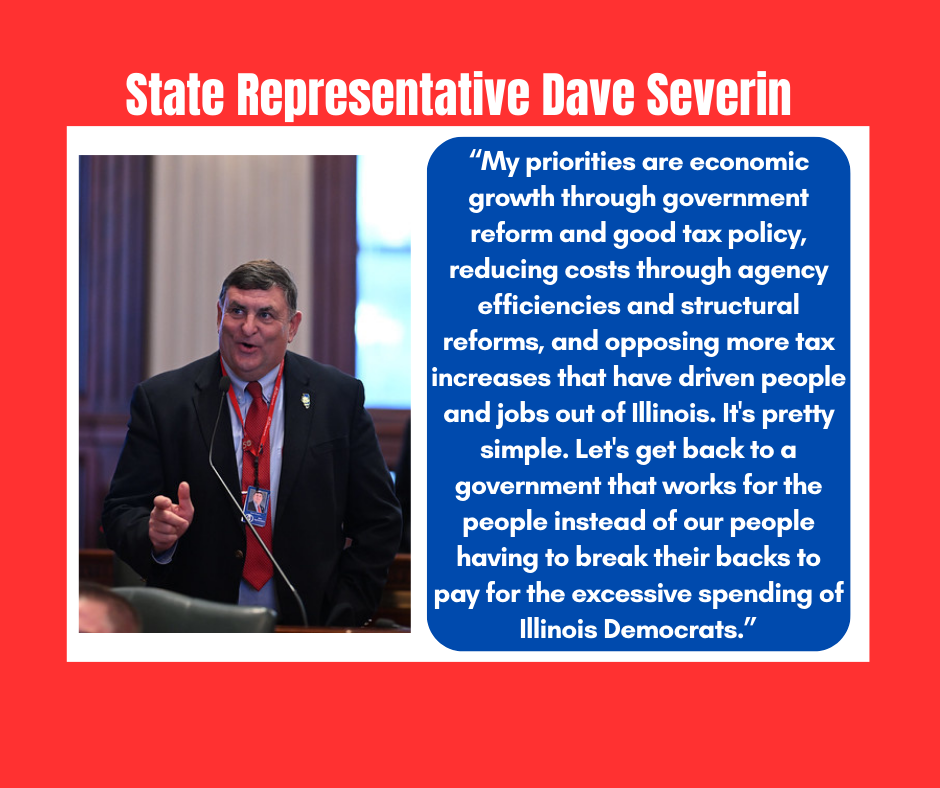
“Our priorities are economic growth through government reform and good tax policy, reducing costs through agency efficiencies and structural reforms, and opposing more tax increases that have driven people and jobs out of Illinois,” Severin said. “It’s pretty simple. Let’s get back to a government that works for the people instead of our people having to break their backs to pay for the excessive spending of Illinois Democrats.”

Traffic accident leads to seizure of pounds of Marijuana

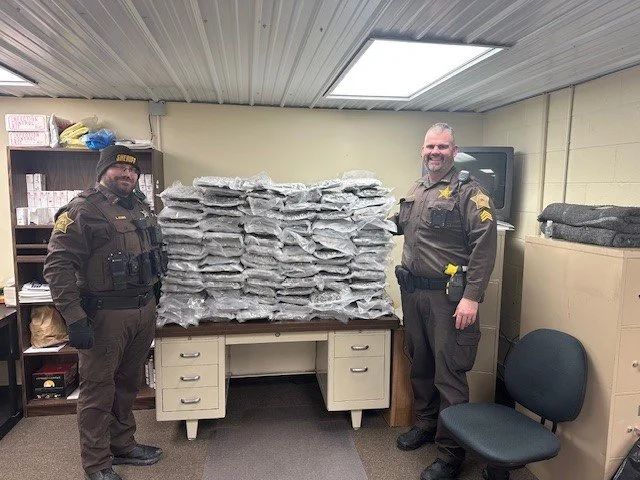
On February 20, 2025, at 1:16 a.m. Gibson County Central Dispatch received a report of a single vehicle accident on US 41 near the White River Bridge. Deputy Levi Sims was dispatched to the accident and found a Black 2017 Lincoln Sedan that left the roadway due to roadway surface conditions.  Upon speaking with the driver it was discovered that the vehicle was being used as a taxi service.  During the course of the investigation Deputy Sims detected the odor of raw Marijuana coming from inside the vehicle.  After a brief investigation Deputy Sims and Sgt. John Fischer found 100 vacuum sealed baggies containing Marijuana.  At the end of the investigation a passenger in the vehicle, 19 year old Haking Weeks of Newark, New Jersey was taken into custody and transported to the Gibson County Jail. Mr. Weeks was charged with Felony Possession of Marijuana.
 
Each bag weighed approximately 530 grams equating to approximately 116 pounds. 
 
All criminal defendants are to be presumed innocent until, and unless proven guilty beyond a reasonable doubt in a court of law.
 

Highland woman pleads guilty to selling counterfeit designer cosmetics, purses and accessories

EAST ST. LOUIS, Ill. – A Highland woman admitted in federal court to trafficking counterfeit designer goods and infringing on registered trademarks by selling items she imported from overseas through her business. The counterfeit items included cosmetics, purses, clothing, and accessories with well-known trademarks from high-end brands.

Emily Montegna, 38, pleaded guilty to one count of trafficking in counterfeit goods.

“Fake cosmetics pose significant health risks for consumers and selling counterfeit goods harm unsuspecting shoppers who believe they are getting the real product,” said Acting U.S. Attorney Ali M. Summers. “Counterfeit goods threaten a fair, legitimate marketplace, and the U.S. Attorney’s Office will continue to prioritize consumer safety.”

According to court documents, Montegna operated a business known by several names such as “Emily’s Creative Creations”, “Hickory Flat Farm Vinyl & Deals”, “Emily’s She Shed” or “Hickory Hill Vinyl & Deals,” and utilized a Facebook group and her home to sell the counterfeit products from October 2019 through January 2022.

Montegna imported fake designer makeup products, socks, purses, sunglasses and other accessories from overseas to sell for a profit through her business. The items were meant to deceive consumers by including trademarks owned by Estee Lauder, L’Oreal, Parfumes Christian Dior, Tarte, Too Faced, Deckers Outdoor, Victoria’s Secret, Kate Spade, Under Armour, Nike and Michael Kors.

Montegna’s sentencing hearing is scheduled for 10:30 a.m. on July 1 at the federal courthouse in East St. Louis. Trafficking in counterfeit goods is punishable by up to 10 years’ imprisonment and fines up to $2 million.

Homeland Security Investigations led the investigation, and Assistant U.S. Attorney Zoe Gross is prosecuting the case.

"Disgusting" Situation Closes District #348 Administrative Offices

Cleanup continues at the Wabash District #348 office on West 13th Street where sewage backup caused the building to be evacuated….

That’s District #348 Superintendent Dr. Chuck Bleyer who told the school board Tuesday night that it’s hoped the clean up will be finished tomorrow. In the meantime, workers in the district office are working offsite.

Black, Latino lawmakers criticize Pritzker’s proposed budget


Republicans take issue with governor’s rhetoric, spending growth 

By ANDREW ADAMS
JADE AUBREY
PETER HANCOCK
& BRIDGETTE FOX
Capitol News Illinois
news@capitolnewsillinois.com 

SPRINGFIELD – Majority Party Democrats had mixed reactions to Gov. JB Pritzker’s budget address Wednesday, with leadership in the General Assembly offering praise amid criticisms from members of the legislature’s Black and Latino caucuses. 

The governor’s budget speech – which outlined a $2 billion spending increase without new taxes on everyday Illinoisans – also drew immediate criticism from Republicans, some of whom left the House floor as he drew parallels between the Trump administration and Nazi Germany in the 1930s. 

The Illinois Legislative Black Caucus and Illinois Legislative Latino Caucus together include about a quarter of all lawmakers in the General Assembly. Several of them pushed back on the governor’s proposal, which he called “responsible and balanced.”  

“This is not a time for celebration,” Sen. Willie Preston, D-Chicago, said at a news conference. “Budgets reveal the morals and the values of our state. In Illinois, Black communities contribute significantly to the economy, yet when the budget is finalized, those contributions are not flowing back into our community.”

At least two Black Caucus members said they wouldn’t vote for Pritzker’s proposal as it stands today – though the February budget proposal only kicks off negotiations each year, with a budget vote coming generally in May after lawmakers make changes.  

Sen. Javier Cervantes, D-Chicago, said the Latino Caucus was “profoundly disappointed” in Pritzker’s proposal to eliminate a health care program for many immigrants. 

But other Democrats, like moderate veteran House member Fred Crespo, D-Hoffman Estates, praised Pritzker’s address as the best he’s heard in his near-two decades in the General Assembly, saying he was heartened to hear the governor vow to ask for legislators to suggest budget cuts commensurate to spending increases they might propose.

Republicans, meanwhile, took exception to the governor’s tone during his address, accusing him of using the opportunity to further his rumored ambitions for higher office. Still, several Republicans suggested there is room for collaboration on some of Pritzker’s policy proposals relating to economic development and prescription drug affordability. 


Black Caucus reaction

Black Caucus members said the governor’s proposed budget does not adequately address “historical disparities” within the state’s Black communities and does not reflect the priorities of Black Illinoisans. 

Preston said Black taxpayers are not getting their “fair cuts” of state aid.

Rep. Carol Ammons, D-Urbana, said she will not vote for the budget until the Black community receives more resources.

As hundreds gathered around the podium on the Capitol rotunda where the caucus gave its response, Rep. Will Davis, D-Homewood, asked for the crowd’s opinion on the proposal. 

“Did you hear something that applies directly to you?” he asked. “Did you hear something in that budget speech that talks about you? And your priorities? And your family? And your employment? And your community? Did you hear it? I didn't.” 

Davis later said he would vote ‘present’ on the budget as of now. 

Other Black Caucus members were more supportive. Sen. Elgie Sims, who has led budget negotiations for the Senate Democratic caucus for the last several years, said Pritzker’s proposal is a “great first step.” The Chicago Democrat said he doesn’t have any major issues with the proposal but wants additional details on a few items.

“I often say – and I've said this to our caucus on a number of different occasions – there are infinite needs with finite resources,” Sims said. “From our perspective, that's why these next couple of months, as we go through negotiations, we're going to have to match those infinite needs to the finite resource we have.”

Sims said members need to be responsible and prudent on this year’s budget due to “so much unpredictability coming out of D.C.”


Latino Caucus reaction

Pritzker’s proposed budget would eliminate the Health Benefits for Immigrant Adults program that provides coverage to low-income people between ages 42 and 64 who would qualify for Medicaid if they were citizens. Pritzker’s office projected the cut would save $330 million in general fund spending. Its sister program, Health Benefits for Immigrant Seniors, was not cut from the proposed budget.

Pritzker said he’d work with lawmakers on his proposal but urged them not to come to negotiations empty handed.

“If you come to the table looking to spend more, I’m going to ask you where you want to cut,” Pritzker said.

Members of the Latino Caucus said they were going to go through the budget “line-by-line” to try and keep HBIA on the table.

“We will be talking about other options, revenue options, and other options that could be on the table to make sure that all of our programs are preserved,” Rep. Lilian Jiménez, D-Chicago, said.

Caucus members said Pritzker did not inform them before the budget address that HBIA was on the chopping block.

“All of us have been hearing that it was going to be a tough budget year. I think that we expected there to be some things in the budget that we weren't going to be happy with,” Sen. Karina Villa, D-West Chicago, said. “But I think completely removing a program is not anything that we were expecting.”


Republicans criticize message

Republicans reacted angrily to the speech, especially Pritzker’s criticisms of the Trump administration and frequent references to Nazi Germany.

Near the end of his speech, Pritzker used the recent conviction of former Illinois House Speaker Michael Madigan on federal corruption charges to call out Republicans who have remained largely silent about actions of the Trump administration that have been challenged or even reversed in federal courts.

“If you applauded that (Madigan) decision like I did, then I expect you to defend and applaud those same federal courts as they check this president in his quest for unrestrained power,” Pritzker said.

He wrapped up his speech with a warning about the dangers of neo-Nazis, comparing the rise of Trump’s Make America Great Again movement with the rise of fascism in Germany in the 1930s.

“The seed that grew into a dictatorship in Europe a lifetime ago didn't arrive overnight. It started with everyday Germans mad about inflation and looking for someone to blame,” Pritzker said. “I’m watching with a foreboding dread what is happening in our country right now.”

Some Republicans walked out.

“That was appalling to sit there,” House Minority Leader Tony McCombie, R-Savanna, said during a news conference after the speech. “It was, it was hard to sit there through that.”

Deputy Minority Leader Ryan Spain, R-Peoria, accused Pritzker of delivering a campaign speech by “playing to what he believes is a national message and feeding his presidential ambitions.”

On the substance of the governor’s budget plan, however, House Republicans said there appears to be some areas for potential for bipartisan agreement, such as calls for lowering the cost of prescription drugs and investing in economic development initiatives.

“There were things that are opportunities for collaboration in government, which is what we'd like to see more of,” Spain said. “But we're going to have to put aside the insulting national rhetoric in order to do so.”


Democrats have questions

Democrats applauded Pritzker’s invocation of Nazi Germany. 

“I thought it was a speech for our moment,” Senate President Don Harmon, D-Oak Park, said in a statement. “The governor recognizes that our budget doesn’t exist in a vacuum and is subject to the economic winds in Washington and our place on the greater world stage.”

Other Democrats said they wanted to know what the governor’s contingency plans are if there are major cuts to federal funding.

And while members of the Latino Caucus are looking for ways to save HBIA, other Democrats said the governor made the right call in cutting it. 

Speaking as the chair of the “New Democrats” caucus, a recently rebranded caucus of roughly two dozen moderate Illinois House members, Rep. Terra Costa Howard, D-Glen Ellyn, said HBIA’s elimination should tell Democrats to think differently about funding requests.

“It's a positive step toward acknowledging that the accountability of programs and the programs needs to be better before we pass the law,” she said.

Crespo continued his criticism of Democrats for passing bills that are “subject to appropriation” yet not funded in the budget – creating future-year spending pressures and giving “folks a false sense of hope.”

“When we pass legislation or appropriation bills, we need to do a better job on the front end to make sure that we understand potentially how much it's going to cost,” Crespo said.

Both Costa Howard and Crespo were among a group of Democrats who opposed elements of the FY25 budget last spring, in a rare dissent from Pritzker and their caucus’ leadership.

They both agreed that they’d like to see a return to empowering appropriations committees to better police funding requests. House Speaker Emanuel “Chris” Welch, D-Hillside, has increasingly relied on internal working groups composed of House Democrats to craft major legislation on key subjects, rather than allowing them to come together through the committee process. 

“If we don’t go back and start using our aprops (appropriations) committees, then what is the point?” Costa Howard said. “It’s a waste of everyone’s time.” 

Welch didn’t issue a statement himself, though his spokesperson sent one on behalf of his four-person budgeting team.

“Governor Pritzker shared his vision of ways to continue strengthening our state and uplifting working people,” Reps. Robyn Gabel, Kam Buckner, Will Guzzardi and Eva-Dina Delgado said in a statement. “Now the work of creating a budget that invests in Illinois families begins. We know the most important goal is to continue our work of helping people make ends meet, but we also know the biggest challenge in that work will be the chaos and uncertainty in Washington.”


Comptroller Mendoza

Comptroller Susana Mendoza said lawmakers need to assume “a worst-case scenario” if they’ve been planning on receiving funding from the federal government.

“There’s going to be a lot of ‘no’s’ going around,” she said. “If you really want to fight for your project, then you have to figure out where are you going to cut in order to make that revenue a possibility in this year's budget.”

 Mendoza called the $55.4 billion in projected revenue a “conservative” estimate, though she said she worried it does not take future federal funding cuts into account. 

“Every day there's some new level of instability or unpredictability injected into the system, not just here in Illinois, but across the country, and it doesn't help anyone,” she said. “It doesn't help Democrats, Republicans or anyone in between. And I do believe that we should be working really hard to find efficiencies everywhere we can, but we also need to be doing it in a responsible and methodical way.”


Interest groups 

One focus of Pritzker’s speech was criticizing “pharmacy benefit managers” – organizations which set the price of prescription drugs on behalf of health insurance plans.

The Pharmaceutical Care Management Association, which represent PBMs, said the speech “missed the mark” and wasn’t focusing enough on the manufacturers of drugs. 

Education unions offered a mixed response. The governor proposed increasing funding for the K-12 school Evidence-Based Funding formula by $350 million – the minimum called for in law. 

Illinois Federation of Teachers President Dan Montgomery said the budget exposed “deep, systemic flaws in Illinois’ revenue system” by only chipping in the minimum amount. Montgomery and Illinois Education Association President Al Llorens also criticized the governor for not proposing any large reforms to the state’s two-tier pension system.

Groups representing community colleges as well as teachers and administrators all praised his proposal that would allow the publicly funded schools to offer four-year degrees.

Hannah Meisel and Jerry Nowicki contributed.


Capitol News Illinois is a nonprofit, nonpartisan news service that distributes state government coverage to hundreds of news outlets statewide. It is funded primarily by the Illinois Press Foundation and the Robert R. McCormick Foundation.


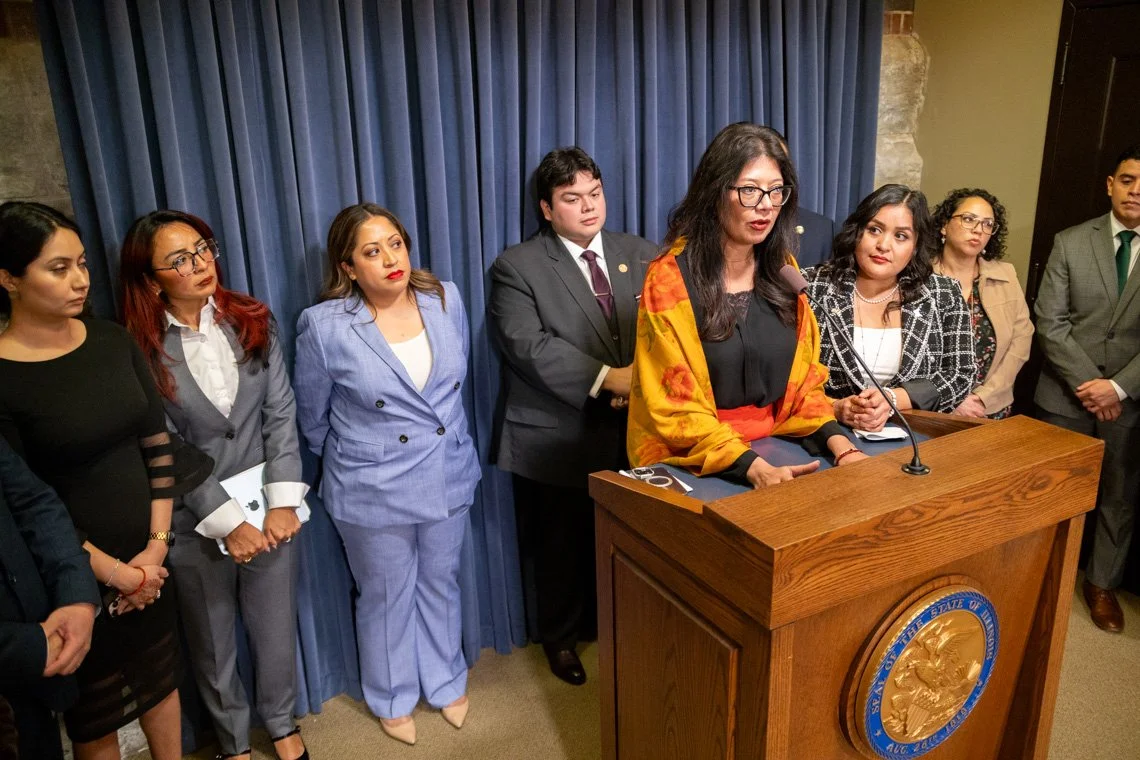
Sen. Karina Villa, D-West Chicago, reacts to Gov. JB Pritzker’s budget address. Villa is the Senate chair of the Illinois Latino Legislative Caucus. (Capitol News Illinois photo by Andrew Adams)


Allendale School Board Notes

At the February 2025 Allendale School Board meeting held in the Library of Allendale School, the board:

1. Discussed a tentative school calendar for the 2025-2026 school year. Will approve a calendar for next year at the March meeting.

2. Approved a change in the June meeting date. The regular board meeting will now be held on June 24, 2025 instead of June 25, 2025.

3. Approved the resignation of Part-time Custodian, Kent Deisher.

4. Approved the resignation of Part-time Kitchen, Shelly Deisher.

5. Jessica Deisher, 4th grade teacher, and Emily Wilson, 3rd grade teacher, made an outstanding presentation to the board this evening

U.S. Attorney Rachelle Aud Crowe for the Southern District of Illinois departs from post

FAIRVIEW HEIGHTS, Ill. – Rachelle Aud Crowe, the United States Attorney for the Southern District of Illinois, who has served as the chief federal law enforcement officer in the district, has departed from the position, effective Feb. 18. She releases the following statement:

“It has been my honor to serve the Southern District of Illinois as the United States Attorney. Announcing my departure accompanies many emotions, but my heart is full of gratitude.

Working for the Department of Justice and leading an office of talented attorneys, dedicated legal staff and supportive administrative employees has been a lifelong dream. It was my privilege to guide the Department on matters of policy, procedure and management as a member of the Attorney General’s Advisory Committee and the Domestic Terrorism Executive Committee.

I have been fortunate to partner with the local, state and federal law enforcement officers to seek justice for victims and improve public safety. In addition to prosecuting hundreds of criminal cases, the office represented the government effectively in civil lawsuits and recovered millions of taxpayer dollars.

I will cherish the time I spent at the federal courthouses. I’m thankful to the district judges for their judicial oversight, it’s been my honor to work with and learn from them. The future for the office is bright, and I’m confident the employees will continue to exceed their high standard of excellence, integrity and functionality. 

Thank you for the encouragement during my service.”

“From the beginning, USA Crowe has been a champion of the FBI mission,” said FBI Springfield Special Agent in Charge Christopher Johnson. “The combination of the FBI’s investigative efforts and the Southern District of Illinois’ commitment to uphold the law has brought justice for victims and made our communities a safer place to live.”

“It’s been a pleasure working alongside U.S. Attorney Crowe,” Drug Enforcement Administration St. Louis Division Special Agent in Charge Michael Davis said. “She’s been a tremendous partner and we’re grateful for her service. Her commitment to helping remove the threat of drugs and those who distribute them across Southern Illinois has been invaluable.”

"U.S. Attorney Crowe has been a tremendous partner for the Illinois State Police," said ISP Director Brendan F. Kelly. "U.S. Attorney Crowe supported our Public Safety Enforcement Group and its work, bringing charges and winning convictions in numerous criminal cases, and was instrumental in holding people accountable and bringing them to justice."

Ali M. Summers is the Acting U.S. Attorney for the Southern District of Illinois. She joined the office as an Assistant U.S. Attorney in 2012.

BREAKING: Pritzker proposes $2B in spending growth without new income or service taxes

Budgeting office says global outlook has changed since previous $3.2B deficit estimate

By JERRY NOWICKI
Capitol News Illinois
jnowicki@capitolnewsillinois.com 

Editor’s note: This is a breaking news story. Check back to capitolnewsillinois.com for fuller coverage of the budget proposal later today. 

Gov. JB Pritzker has proposed growing spending by about $2 billion without new income or service taxes in the upcoming fiscal year – though his administration acknowledged policy changes by the Trump administration could drastically alter the fiscal landscape. 

Spending and revenues would each grow by about 3% under the proposal laid out Wednesday during the governor’s annual budget address, with total general revenue fund spending growing to $55.2 billion. 

View the budget book here | View the budget in brief here

The proposal is balanced, in part, because the governor’s budgeting office expects to collect about $1.5 billion more in base tax revenue than it did when it issued its first fiscal year 2026 forecast in November. 

That November forecast from the Governor’s Office of Management and Budget had projected revenues to remain flat, driving a deficit of $3.2 billion. But it relied on a September economic forecast from the financial services company S&P Global. The governor’s office says S&P has since revised its forecasts – but the numbers released Wednesday are ultimately likely to fluctuate amid the rapid pace of policy changes happening in Washington, D.C.

The governor’s proposal would increase K-12 funding by $350 million and boost higher education funding by 3%. He’d keep funding flat for the Early Childhood Block Grant, however, which is a major driver of his effort to increase access to publicly supported preschool in Illinois.

Ultimately, lawmakers and the governor will have to come to an agreement on a spending plan by the end of May. But the governor’s opening salvo could meet opposition from Democratic lawmakers in the General Assembly – especially members of the Illinois Legislative Latino Caucus – due what it doesn’t fund. 

The proposal would eliminate a health care program for low-income noncitizens aged 42-64 who are in the U.S. without legal permission. The Health Benefits for Immigrant Adults program, which was implemented in 2022, provided Medicaid-like and costs the state general revenue fund roughly $330 million, or less than 1 percent of the overall budget. 

“As always, I stand ready to work with members of the General Assembly to deliberate and negotiate the final budget, but let's be clear, I will only sign a balance budget. If you come to the table, looking to spend more, I'm going to ask you where you want to cut,” Pritzker said in his address. 

Advocates say that program is a key public health measure that drives down emergency room care costs and ultimately saves money. The governor’s office says its decision not to propose funding reflects the state’s fiscal reality. 

The budget proposal maintains funding for a similar program serving immigrants aged 65 and older, passed by the legislature during the early months of the pandemic in 2020. 

The governor’s plan would raise another $469 million in revenue through other changes to law, including adjusting tax rates on electronic gambling and table games at casinos to generate $100 million in revenue. The plan also calls for pausing the transfer of $171 million in sales tax collected on motor fuel to the road fund, and raising $198 million by providing temporary amnesty for individuals making delinquent tax payments. 


Capitol News Illinois is a nonprofit, nonpartisan news service that distributes state government coverage to hundreds of news outlets statewide. It is funded primarily by the Illinois Press Foundation and the Robert R. McCormick Foundation.