Drivers say they want better wages, an ability to set rules and to address punishments
Article Summary
The General Assembly passed a bill early Monday that would give rideshare drivers the right to form a union.
Drivers for companies like Uber and Lyft could elect union representatives and perform union activities, like collective bargaining.
Drivers say a union is necessary because of low wages, and limited opportunities to appeal deactivations, or to have a say in setting rules.
This summary was written by the reporters and editors who worked on this story.
By JENNA SCHWEIKERT
Capitol News Illinois
jschweikert@capitolnewsillinois.com
Over the past five months, a sea of rideshare drivers in yellow T-shirts flooded the Illinois state Capitol almost weekly, lobbying for the right to form a union. They may be able to do so soon, after Illinois lawmakers passed a bill giving them that ability in the final hours of the spring session.
House Bill 5090 would regulate how rideshare drivers can form a union, elect union representatives and engage in union activities such as collective bargaining.
The bill passed the House 83-28 early Monday morning and now heads to the governor. It passed the Senate 42-12-1 earlier on Sunday afternoon.
Rideshare drivers say a union is necessary because under federal law, they’re defined as independent contractors, despite having little control over work practices while working for companies like Uber and Lyft. That makes a statewide union their only option to collectively bargain and form a labor agreement, they say.
“This goes back to a fundamental belief that when workers are able to organize and have a collective voice, that does lead to better wages, benefits and working conditions,” bill sponsor Sen. Ram Villivalam, D-Chicago, said. Rep. Yolonda Morris, D-Chicago, carried the bill in the House.
“This legislation is urgently needed as drivers face declining wages, rising vehicle costs and unsafe working conditions without basic protection or a real voice on the job,” Morris said.
Forming a union
Drivers who are interested in forming a union would need to follow specific guidelines to do so: They would have to obtain signatures in support from 10% of active drivers to show interest, then 30% to become a certified union. From there, the union can petition the Illinois Labor Relations Board to conduct an election for individual union representatives.
Those thresholds are lower than in other labor sectors, but they were chosen because this industry is so new, Villivalam said. Union membership would be voluntary.
Every four months, transportation network companies — defined as entities providing rides through a digital platform, not including taxi associations — that provide the top 95% of rides would need to give the ILRB contact information for all drivers who, in the past six months, completed 10 or more rides in Illinois.
The board would determine the median number of rides completed by that population, and any driver who completed that number or more would be considered an active driver and would be eligible to join the union.
Like any other organization with unionized employees, these companies would be required to adhere to fair work practices, negotiate in good faith, provide timely and accurate information to the union and follow other standard labor regulations. They could be fined by the ILRB for violations.
This bill also includes a 4-cent-per-ride charge to the companies, to cover the implementation costs under the bill and for a grant program, a charge that companies are prohibited from passing on to the consumer. The grant program, Rideshare Workers Support Fund, would be managed by the secretary of state and paid to the union representative.
The bill also regulates how the ILRB and the Department of Labor would handle bargaining mediation, arbitration, labor agreements and unfair work practices.
The path to unionization
Rideshare drivers in Illinois have pushed for unionization rights since early 2019, initially beginning in the city of Chicago. In rallies and committees, drivers have told stories of dwindling wages and a lack of access to appeals for deactivations.
“Let’s be honest, we don’t operate independently at all. We don’t set our own wages. We don’t control the rules. We don’t decide who is deactivated and how they’re punished. The algorithm, the corporations do,” Brett Currin, a rideshare driver, said at a January rally at the state Capitol.
The bill does not address those issues specifically, but through a union, drivers would be able to negotiate with their company on those issues.
“Hearing these (constituent) stories and then working with organized labor to craft a product that they had already been working on to move forward, really is what this is stemming from,” Villivalam said.
Villivalam, who represents parts of the northwest side of Chicago and its suburbs, said his district has the largest number of rideshare drivers in Illinois.
The Illinois Drivers Alliance led the effort throughout this spring, backed by the local International Association of Machinists and Aerospace Workers, and the Service Employees International Union Local 1, two unions representing thousands of workers across the Midwest.
California and Massachusetts have also passed similar measures, with Massachusetts certifying their statewide union just last week, on May 26.
Capitol News Illinois is a nonprofit, nonpartisan news service that distributes state government coverage to hundreds of news outlets statewide. It is funded primarily by the Illinois Press Foundation and the Robert R. McCormick Foundation.
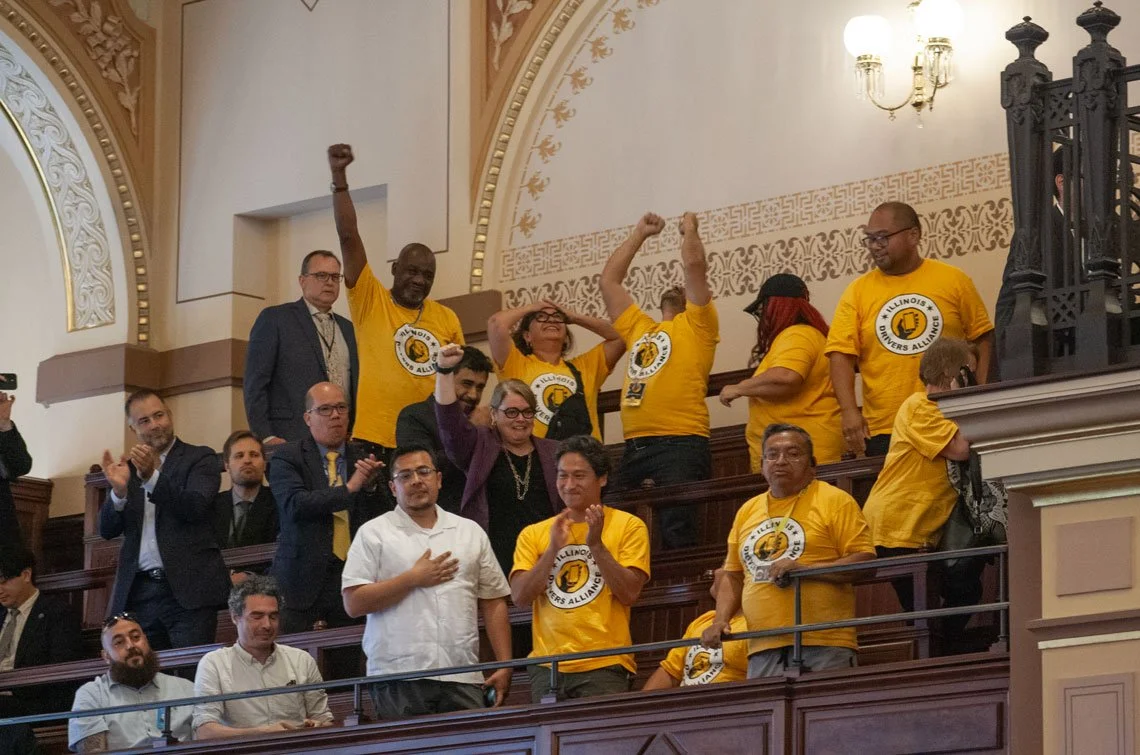
Supporters of the rideshare union bill celebrate in the Senate gallery after the bill passed on the floor. (Capitol News Illinois photo by Jenna Schweikert.)