
Cook County state’s attorney’s office to review evidence with local law enforcement
By MAGGIE DOUGHERTY
Capitol News Illinois
mdougherty@capitolnewsillinois.com
Article Summary
The Illinois Accountability Commission voted to approve its final report on Thursday, creating a record of misconduct by federal immigration agents amid Operation Midway Blitz.
The 204-page report provides recommendations for accountability and policies to prevent harm in the future.
The commission is also sending letters to relevant local law enforcement agencies where they believe there is reason to believe agents may have violated policy or broken the law.
The Cook County state’s attorney's office says it will review the evidence compiled by the commission with local law enforcement.
This summary was written by the reporters and editors who worked on this story.
(Editor’s note: This story has been updated.)
CHICAGO — A state board unanimously voted Thursday to approve a 204-page report detailing its investigations into misconduct by on-duty federal immigration agents amid Operation Midway Blitz.
It is also sending letters to local law enforcement agencies for potential prosecution of the agents. The letters are not determinations of guilt, but requests for further investigation by the relevant agencies.
“Where that record establishes reasonable cause to believe that misconduct may have occurred, we implore those responsible to ensure that this information is reviewed and that it is handled in an appropriate fashion,” said Patricia Brown Holmes, vice chair of the body.
The Illinois Accountability Commission, created by Gov. JB Pritzker through executive order last October, was tasked with forming a public record to document the impact of the federal immigration campaign on Chicago communities, but also to produce recommendations for harm reduction and prevention of future abuses.
To inform its report, the commission conducted 16 investigations for which it interviewed over 60 people, reviewed nearly 100 hours of body camera footage from 250 videos, and reviewed hundreds of hours more of footage from security cameras, personal devices and social media, according to commission officials.
It also held seven private neighborhood listening sessions and five public hearings, featuring testimony from law enforcement experts, community advocates and everyday Chicagoans.
“Documenting this was easy,” Commission Chair Rubén Castillo said. “The record is overwhelming; the video tapes are overwhelming. They’re devastating. They’re shameful. They’re brutal.”
Prosecution referrals
One of the referrals letters names Border Patrol agents Benito Nuñez, Carlos Chavira and Jesus Guillen, who the commission said used an intentional, high-speed car-ramming maneuver in Chicago’s East Side neighborhood after being repeatedly instructed to stop by supervisors.
Body camera footage released by the commission shows the agents proceeded to use teargas on a street of onlookers in the Far Southeast Side neighborhood, including more than a dozen Chicago police officers who had explicitly asked agents not to deploy the gas.
Others name Border Patrol agent Charles Exum, who shot Chicago teacher’s aide Marimar Martinez five times last October and then bragged about it over text, and Border Patrol agent Timothy Donahue, who made headlines for aggressive conduct in Evanston last Halloween.
Donahue and his partner, agent Thomas Parsons, are accused of denying medical care to a man they violently arrested that day in Evanston. The pair also showed up in the commission’s report on a Little Village raid where they are accused of conducting “roving raids” based on race rather than targeted evidence of wrongdoing.
In some cases, the commission was unable to identify specific agents involved. For example, a military-style raid on a South Shore apartment building references approximately 300 agents who may have broken agency policy or criminal law.
In total, the incidents reviewed by the commission identify 16 agents by name but refer to hundreds more in the abstract.
The commission says that’s due to its limited powers, which do not include the authority to issue subpoenas. That’s why it says law enforcement agencies should carry forward the cases, including the Cook County state’s attorney’s office.
The commission’s materials were transmitted to the Cook and Kane County state’s attorneys offices, as well as the Chicago, Evanston, Franklin Park and Elgin police departments.
Disputed path forward
Cook County State’s Attorney Eileen O’Neill Burke has drawn fire for her inaction investigating crimes of federal agents, and a Cook County judge is currently reviewing arguments on a petition to appoint a special prosecutor to lead these investigations in her place.
Under Illinois law, special prosecutors can be appointed to oversee a particular case when a state’s attorney has a conflict of interest. Petitioners in the case have argued that O’Neill Burke has a conflict of interest due to a “political alliance” with federal law enforcement. A ruling on the special prosecutor case is expected May 11.
Castillo, in his personal capacity, is a member of that coalition seeking a special prosecutor.
“We need courage, and we need a state’s attorney with courage, or if not, she should step out of the way,” Castillo said. “I say that plainly, and I say that on the basis of 25 years of being a judge.”
The state’s attorney’s office, though, has said that its authority is limited and that O’Neill Burke has avoided prosecutions or making “political statements” about ICE enforcement to mitigate the risk of those prosecutions being overturned on appeal.
According to O’Neill Burke’s office, statute prevents the office from prosecuting cases before it receives a completed investigation from a law enforcement agency. To date, it says no local agencies have brought cases against any on-duty immigration officials.
However, the office now says it looks forward to receiving the report and will review it with local law enforcement partners.
“There is no doubt that Operation Midway Blitz has traumatized and harmed our communities,” the office said in a statement, adding that it commended the bravery of witnesses who shared testimony with the commission.
The commission was asked Thursday whether it has considered referring cases directly to Illinois Attorney General Kwame Raoul as an alternative.
However, for cases to reach Roaul’s desk, it would require that the AG’s office be invited onto the case by the relevant state’s attorney. The practice is not common and generally only occurs when there is a conflict of interest or when the case is complex enough to require additional resources.
In Springfield, Republican lawmakers have called for amending state law to increase coordination between local law enforcement and federal immigration officials, arguing that greater cooperation could have lessened the impact of Midway Blitz.
Sen. Chapin Rose, R-Mahomet, on Thursday called for repealing much of the state’s TRUST Act, which prohibits law enforcement from working with federal immigration agents in civil immigration cases. He appeared alongside Joe Abraham, the father of 20-year-old Katie Abraham, who was killed last year in a drunken driving accident in Urbana by a Guatemalan man residing in the U.S. without legal status.
“No family should ever have to experience this kind of loss,” Abraham said. “If speaking out can help prevent even one family from going through this pain, then it’s worth it. Public safety should come first, and law enforcement agencies should be able to work together to stop dangerous criminals before more innocent lives are lost.”
‘It could have been her’
Members of the commission shared personal reflections on the body’s work after voting to approve the report, with many saying they were especially moved by the testimony shared by Marimar Martinez.
“This young woman looks just like my daughter. Like that could have been my daughter. Another American citizen. ... Same color hair, same complexion,” Commissioner Ric Estrada said, appearing emotional. “And it was just on my mind. I’m like, ‘that could have been her.’ It should be no one.”
It was a sentiment shared by other commissioners, with Commissioner Cindy Sam calling Martinez’s testimony “overwhelming” and “hard to listen to.”
The work also struck close to home, literally, for Commissioner Jimmy Arce, who said his parents live only two blocks from the location where Border Patrol agents shot Silverio Villegas Gonzalez, the only fatality at the hands of on-duty federal agents that occurred in Chicago during the immigration enforcement campaign.
Commissioner Aurora Austriaco, an immigrant and naturalized U.S. citizen herself, became tearful when speaking, saying she related personally to the accounts shared by witnesses.
Commissioners said they hoped other states would follow Illinois’ lead, calling it an example for the nation.
“The issuance of this report is not the end, it is the beginning,” Castillo said. “We need a reckoning to occur.”
Capitol News Illinois is a nonprofit, nonpartisan news service that distributes state government coverage to hundreds of news outlets statewide. It is funded primarily by the Illinois Press Foundation and the Robert R. McCormick Foundation.
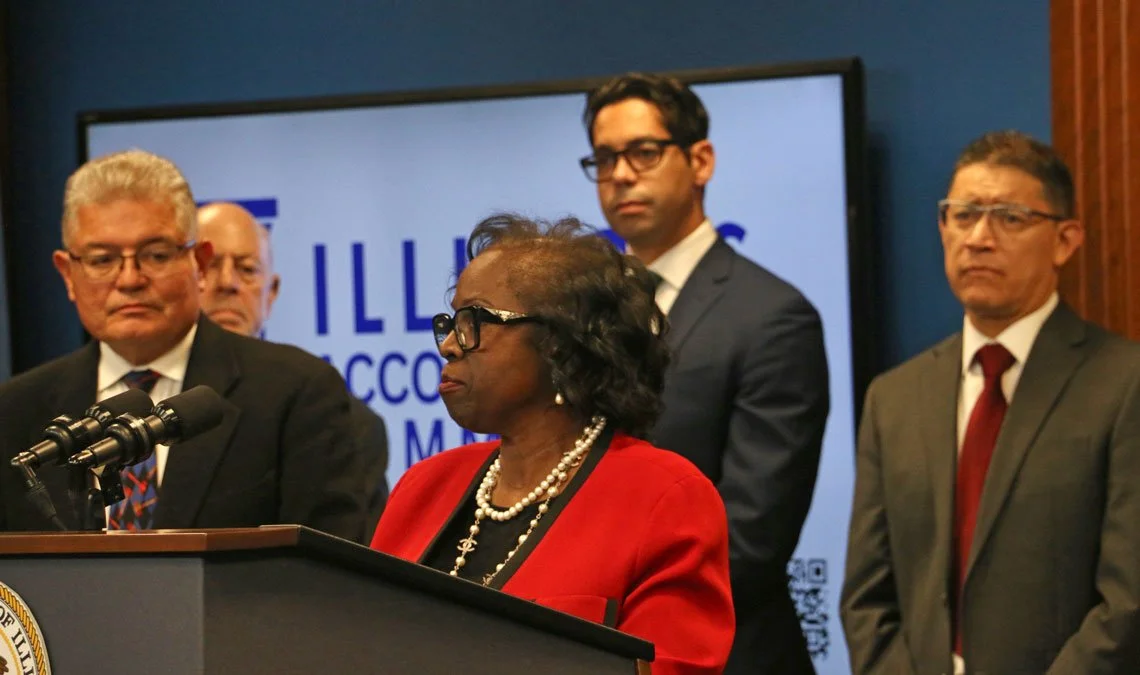
The Illinois Accountability Commission Vice Chair Patricia Brown Holmes announced on April 30, 2026, that the commission is sending referral letters to appropriate law enforcement agencies for investigations of federal agents where the commission has determined reasonable cause to believe those agents violated agency policy, state or federal criminal law, or individual human rights. (Capitol News Illinois photo by Maggie Dougherty)