
Republicans seeking unity as party seeks to reverse decade of statewide losses
By BEN SZALINSKI
Capitol News Illinois
bszalinski@capitolnewsillinois.com
Article Summary
Republican gubernatorial nominee Darren Bailey said his campaign will focus heavily on the Chicago area.
Bailey heavily lost suburban counties in Tuesday’s primary that he won four years ago but said he intentionally focused on downstate in recent months.
Bailey said he will also be trying to win over more moderate voters who don’t share views as conservative as his — two years after trying to primary a conservative downstate congressman from the right.
The state Republican Party overall is also trying to present a more united front for the general election after the party has been bruised by internal divisions.
This summary was written by the reporters and editors who worked on this story.
NAPERVILLE — Tuesday night’s primary results show downstate farmer and former state lawmaker Darren Bailey will have his work cut out for him in the Chicago area as he tries for a second time to unseat Gov. JB Pritzker.
He and other members began that work in earnest at a unity breakfast in Naperville on Wednesday morning – an area of the state that will be a focus for the statewide candidates as the primary results once again demonstrated the fault lines of Illinois’ electorate.
Bailey was trounced by conservative researcher Ted Dabrowski in Cook, Lake and DuPage counties, and is so far trailing him among the 290 GOP primary voters in Alexander County on the state’s southern tip. In the 2022 primary, Bailey won all but one county in the state against his well-funded competitor, Richard Irvin.
Dabrowski, a resident of north suburban Wilmette, has received 48% of the vote in Cook County to Bailey’s 31%. Four years ago, Bailey was the one who received 48% of the vote in the state’s most populous county.
“As far as the primary was concerned, nothing went wrong,” Bailey told reporters. “We came up here, we spent time, but we knew the primary is won in the other counties, so we focused on that as part of the strategy. For the next eight months, get used to me because you're going to be seeing me up here almost every day.”
But the geographic divide was also evident in the race for the GOP’s secretary of state nomination, which pitted Joliet Junior College Trustee Diane Harris against Walter Adamczyk, a GOP committeeman for Chicago’s 29th Ward.
Harris appeared poised to carry virtually all of the state’s counties outside 11 counties in the state’s northwest corner, which were carried by Adamczyk.
Bailey performed well with the base of Republican voters in the state. He received more than three-quarters of the vote in many of the state’s most rural counties and took home more than 90% of the vote in his home county of Clay. But statewide, Bailey has also underperformed the benchmarks he set four years ago when he received 57% of the vote, so far coming in at 53.5% this year with 95% of votes counted.
Turnout in the Republican primary also appears to be down overall from 2022, according to initial unofficial results, although ballots are still being counted.
New campaign strategy
Another big question is whether Bailey can convince voters that this year will be different from 2022, when he lost to Pritzker by 12 points. Bailey’s opponents urged voters to reject him in the primary, arguing that a rematch will yield the same result.
“We understand where we failed the last time and we're fixing those and we're getting into every ward and every area and every district of Chicago, and we're going to earn their respect and support,” Bailey said.
Pritzker’s campaign is already taking swings at Bailey, launching a video saying “Darren Bailey is back and he's still too extreme for Illinois.” Bailey’s team hit back with their own digital ad highlighting questions that have been raised about Pritzker’s wealth.
Asked about how his conservative views will play on the campaign trail this year, Bailey acknowledged he needs to broaden his appeal.
“I served as a state senator from very conservative districts, and we come up here up north and we find out that, you know, not everybody thinks the same,” Bailey said. “We're focusing on what people do agree on.”
A Republican has not won a race for a statewide office since 2014.
Party unity
The other major challenge Bailey faces is competing with Pritzker’s vast personal wealth. The governor spent $300 million on his first two campaigns and he’s already dumped $25.5 million in his campaign coffers this year.
“We don't have to match JB Pritzker dollar for dollar,” Bailey said. “What we need is people to get registered to vote, to show up to vote.”
Bailey said one of his wealthy primary opponents, Rick Heidner, has “stepped up to the plate” for an unspecified contribution. Heidner, who carried less than 9% of the vote, did not immediately return a request for comment.
Bailey chose running mate Aaron Del Mar, the Cook County Republican Party chair, largely in an effort to woo Chicago-area voters. Bailey also appears to have work to do convincing some of his opponents to support him in November.
“Right now, it's a time for healing, and there's been so much work, so much effort put not just by the candidates, but by all of their staff and by all their volunteers,” Del Mar, told reporters when asked if the other Republican opponents have committed to supporting Bailey’s ticket. “So, there's going to take a little bit of time to heal, and I want to offer grace to each and every one.”
Dabrowski issued a statement late Wednesday congratulating Bailey and wishing him well in the general election although he didn't attend the breakfast.
"The goal of defeating Pritzker and restoring the quality to life in Illinois has not changed," he said in the emailed statement. "I will not be the standard-bearer for this effort, but I will commit to the task that remains at hand."
Illinois Republican Party Chair Kathy Salvi did not speak to reporters following Wednesday’s breakfast. The state party has been plagued by internal divisions for several years over how much it should embrace President Donald Trump and conservative candidates.
Trump has performed poorly every time he’s been on Illinois’ ballot, and Bailey seemed to acknowledge that fact in his Tuesday night election speech. But the candidates who align themselves with the present often perform best in state primaries.
“You’re going to hear JB Pritzker and his Democrat allies try to compare me to Donald Trump and use some pretty mean words while doing it,” he said. “Well, there are things that I agree with Donald Trump about, and there are things that I disagree with him about. I am my own man. But when Trump is right, we’re going to try to do those things in Illinois.”
The Republican Party’s divisions were further exposed in a downstate House race on Tuesday. In the 94th House District in western Illinois, Henderson County Republican Josh Higgins defeated Rep. Norine Hammond, R-Macomb, with 58% of the vote. Higgins was backed by the far-right Freedom Caucus.
Hammond was a member of House Minority Leader Tony McCombie’s leadership team, which the Freedom Caucus opposes.
“Josh Higgins' victory is a loud and clear statement that the grassroots will no longer tolerate frauds in the Republican party, much less as a ‘leader’ of the Republican caucus,” the Freedom Caucus said in a statement.
Capitol News Illinois is a nonprofit, nonpartisan news service that distributes state government coverage to hundreds of news outlets statewide. It is funded primarily by the Illinois Press Foundation and the Robert R. McCormick Foundation.
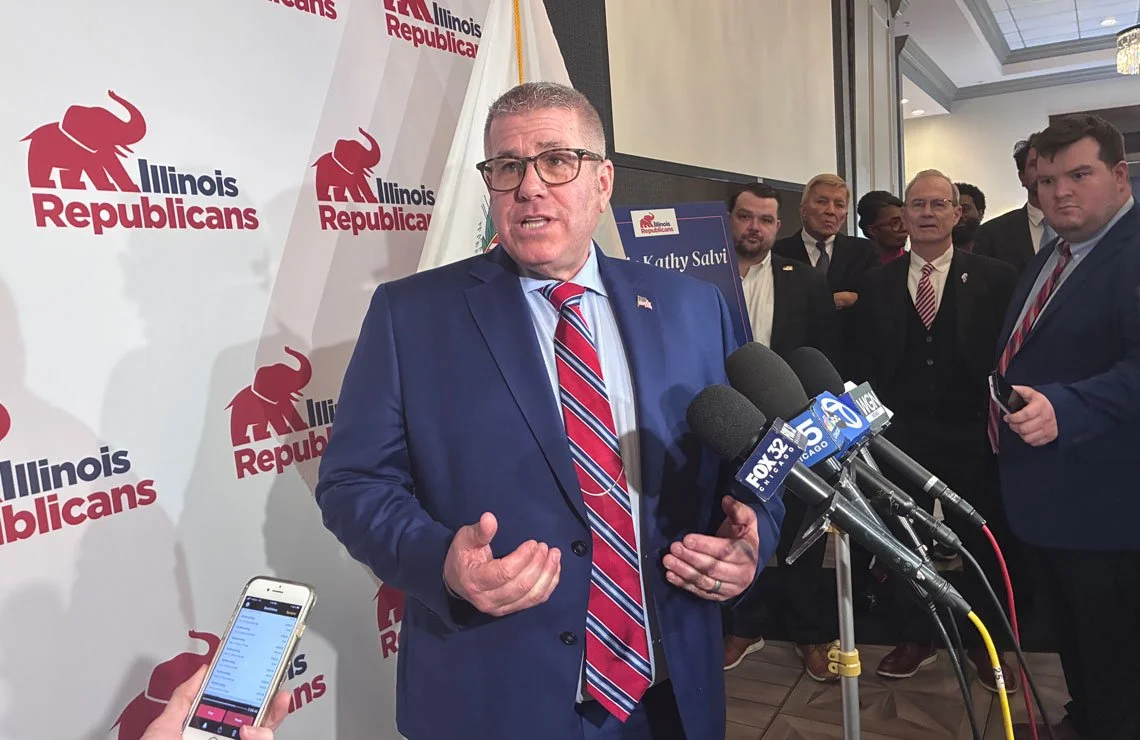
Republican nominee for governor Darren Bailey speaks to reporters following a Republican Party breakfast in Naperville on March 18, 2026. (Capitol News Illinois photo by Ben Szalinski)
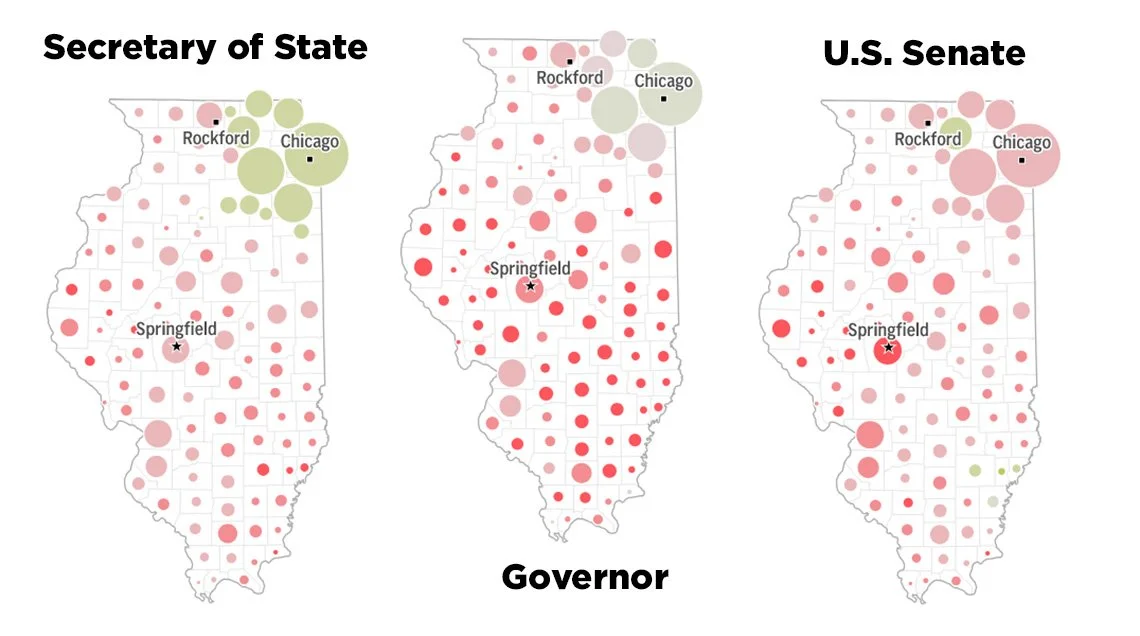
Election results from the 2026 March primary reported by the Associated Press show differences in voters’ preferences between the Chicago area and downstate counties. (Capitol News Illinois illustration)