
Former Illinois GOP Chair Don Tracy set to face Stratton in November
By BEN SZALINSKI, BRENDEN MOORE & JENNA SCHWEIKERT
Capitol News Illinois
news@capitolnewsillinois.com
Article Summary
Lt. Gov. Juliana Stratton won the hotly contested Democratic primary for U.S. Senate, defeating U.S. Reps. Raja Krishnamoorthi and Robin Kelly.
Stratton performed better than expected in many downstate counties and the city of Chicago.
Former Illinois Republican Party Chair Don Tracy won the Republican nomination for Senate and will face Stratton in November.
Several primaries were decided on Tuesday night in Illinois’ five open congressional districts.
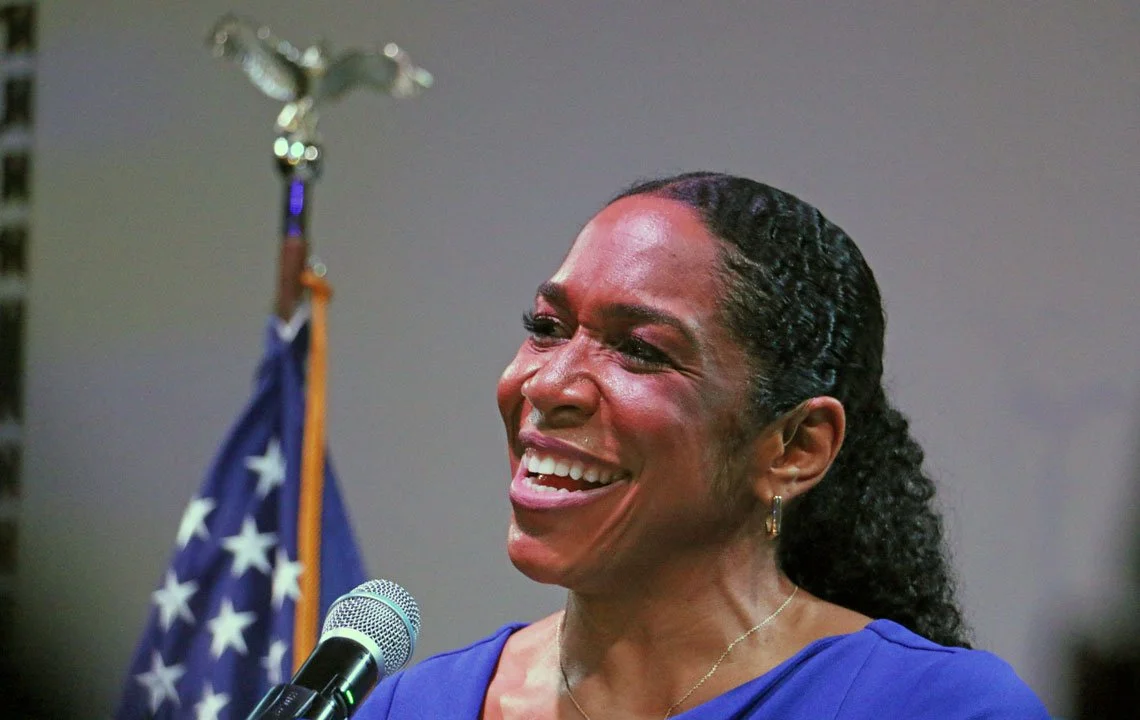
Lt. Gov. Juliana Stratton delivers a victory speech Tuesday night, shortly after 10 p.m., after securing the Democratic nomination for U.S. Senate in 2026. (Capitol News Illinois photo by Maggie Dougherty)
This summary was written by the reporters and editors who worked on this story.
CHICAGO — Lt. Gov. Juliana Stratton rode a late wave of momentum to win the Democratic nomination for Illinois’ open U.S. Senate seat, toppling longtime frontrunner Rep. Raja Krishnamoorthi with the financial aid and political muscle of Gov. JB Pritzker and an outsider message that set her apart from her rivals with Washington experience.
With 82% of precincts reporting, Stratton had a 39.6% to 33.6% lead over Krishnamoorthi, a margin of about 50,000 votes out of more than 900,000 cast. Rep. Robin Kelly, D-Lynwood, was in third place with 18.5%. The Associated Press called the race for Stratton at 9:40 p.m. Tuesday evening.
“Eleven months ago, I made a promise to Illinois to be the fighter you deserve, to go to the mat fighting for you, and bring your voices with me to Washington,” Stratton told supporters on Chicago’s West Side. “I haven't forgotten that promise.”
Stratton received about 44% of the vote in Chicago to Kelly’s 25% and Krishnamoorthi’s 23%. She essentially fought suburban Cook County to a draw with Krishnamoorthi while he came out ahead in the suburban collar counties besides Will County, where Stratton led.
Stratton also led in many downstate counties, especially population centers in the Metro East, Springfield, Bloomington-Normal and Champaign-Urbana.
“We never lost sight of what's most important, and that is courage, courage, inspired me to run,” Stratton said. “Courage powered this campaign, and courage will bring this fight straight to Donald Trump's door.”
Stratton pledged to continue calling for abolishing U.S. Immigration and Customs Enforcement Agency, raising the minimum wage and instituting Medicaid for All.
“It's time for bold ideas, big dreams and real courage in Washington, and we won't wait a second longer,” Stratton said.
Across town at Krishnamoorthi’s event, the energy in the room was flat the entire night as results streaming on a large projector continually showed Stratton ahead. Eventually, the feed was cut off and replaced with a large “Raja” campaign logo.
While the Associated Press had yet to call the race, Krishnamoorthi took the stage shortly after 9:30 p.m. to announce that he’d called Stratton to concede the race.
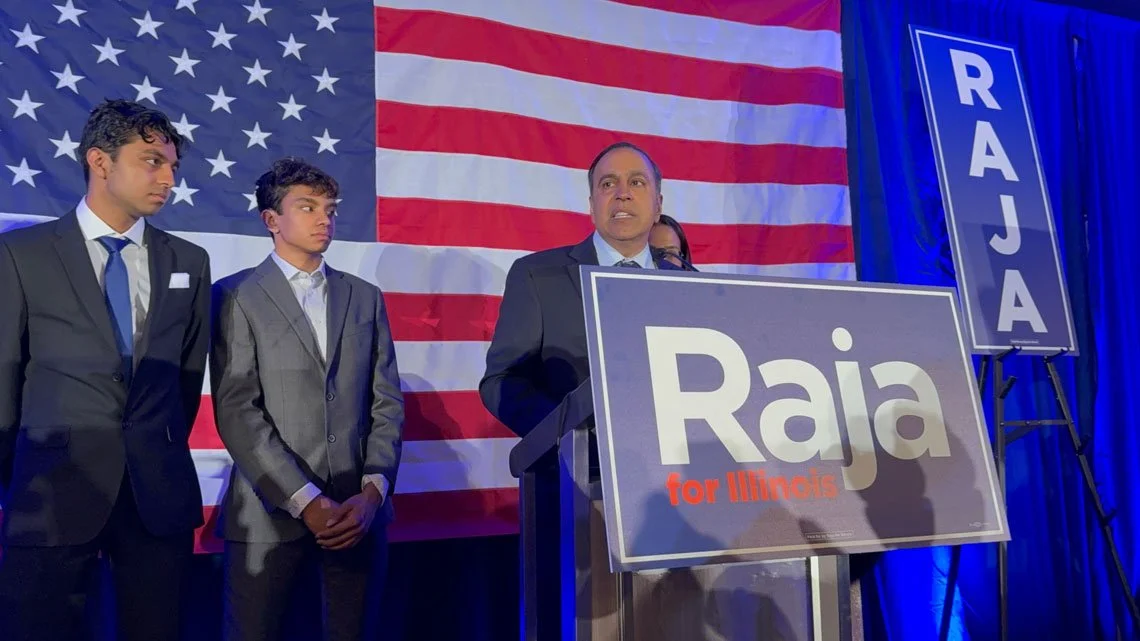
U.S. Rep. Raja Krishnamoorthi concedes defeat in the U.S. Senate Democratic primary to Juliana Stratton just after 9:30 p.m. (Capitol News Illinois photo by Brenden Moore)
“Obviously, this is not the result we sought,” a somber-looking Krishnamoorthi, flanked by his wife and two of his children, told supporters. “But unlike Donald Trump, I'm not going to question the outcome. I'm proud of the race we ran. And I'm honored at the support we received from every corner of the state, from Rockford to Cairo and from the Quad Cities to Decatur.”
Referencing an old Chicago machine phrase about excluding outsiders from party politics, Krishnamoorthi cast himself as the guy “nobody sent.”
He thanked supporters “who had the courage to defy the party establishment and endorse the candidate with 29 letters in his name.” He also thanked his donors, whom he credited with enabling him to “compete against very wealthy interests,” a not-so-veiled reference to Gov. JB Pritzker, who largely bankrolled a super PAC that backed Stratton.
End of long primary season
Tuesday night marked the conclusion of a lengthy and expensive primary campaign to replace Sen. Dick Durbin, who has held the seat since 1997, and did not make an endorsement in the race.
Krishnamoorthi spent years laying the groundwork for a Senate run. He made frequent stops across the state, from fundraisers for various county Democratic parties to official congressional events well outside the boundaries of his suburban congressional district.
He was also the most aggressive fundraiser in the Illinois congressional delegation, banking more than $19 million before he launched his Senate run in May 2025.
He continued fundraising at a breakneck pace, allowing him to run television advertisements nonstop since last July — more than six months before any other campaign or outside political action committee got on the air. Krishnamoorthi’s campaign spent more than $27 million on ads.
The name recognition attained through his paid media blitz allowed Krishnamoorthi to build an early polling lead on his main rivals, Stratton and Kelly. However, Krishnamoorthi’s numbers eventually hit a ceiling, remaining stubbornly stuck in the mid-to-high 30s even as he continued to lead his opponents.
Stratton entered the race with Pritzker’s endorsement. But after seven years as the self-funding billionaire’s No. 2, she struggled to fundraise on her own — a problem exacerbated by strict federal contribution limits to campaign committees.
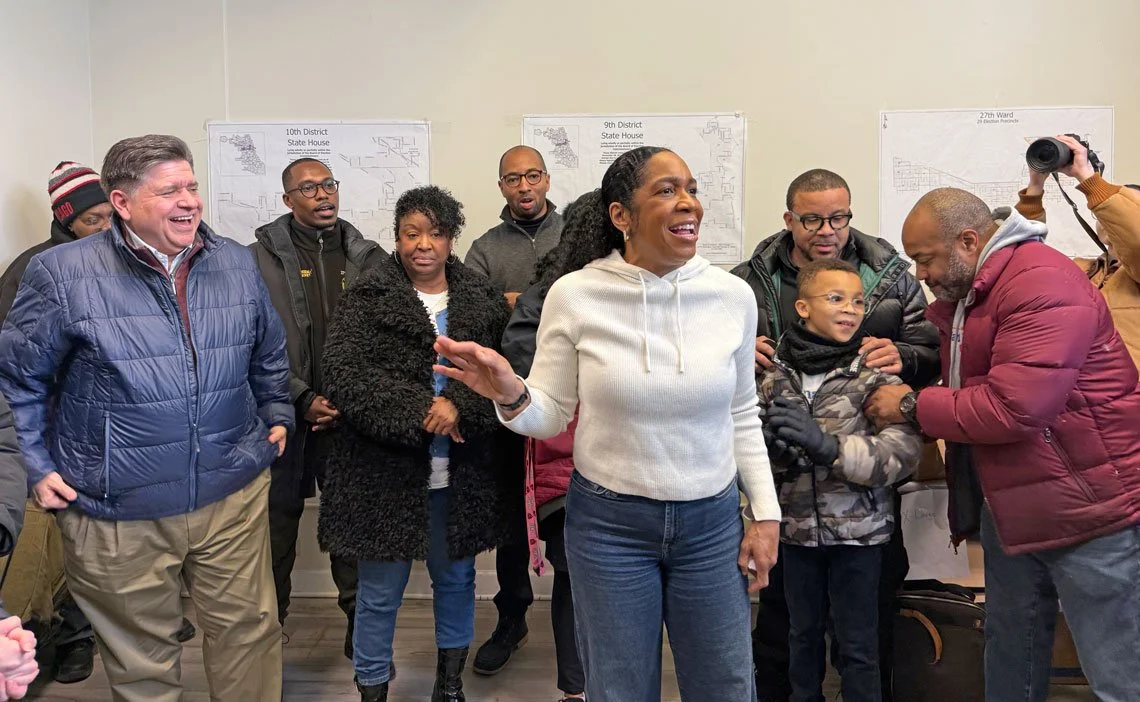
Gov. JB Pritzker and Lt. Gov. Juliana Stratton were in good spirits at Manny’s Deli in Chicago Tuesday afternoon — and for the remainder of the evening. Stratton became the Democrats’ nominee for U.S. Senate in 2026. (Capitol News Illinois photo by Brenden Moore)
She attempted to turn this weakness into a strength by pledging not to accept donations from corporate political action committees. She also made bold policy proposals like an hourly $25 minimum wage.
But she really started gaining ground on Krishnamoorthi in January, when the Pritzker-funded Illinois Future PAC finally launched a long-expected ad campaign on her behalf.
Unlike candidate committees, which are subject to strict contribution limits, PACs can raise unlimited sums, making it an attractive option for Pritzker to exert outsized influence on the race.
Krishnamoorthi simultaneously faced tough headlines over more than $90,000 in contributions from donors with ties to President Donald Trump, including nearly $30,000 from Shyam Sankar, the chief technology officer of Palantir, a company that holds a $30 million contract with ICE to help track individuals for deportation. Krishnamoorthi donated a sum equaling Sankar’s contributions to immigrant rights organizations.
This was around the same time Operation Midway Blitz dominated the headlines, drawing negative attention to federal immigration officers.
Kelly has served in Congress since 2013 and previously served a stint as chair of the Democratic Party of Illinois before being ousted by Pritzker-backed Lisa Hernandez. She cast herself as a progressive in the race who could work across the aisle to get things accomplished.
But Kelly also struggled to break out due to a lack of resources, always remaining a distant third place behind Krishnamoorthi and Stratton.
As Stratton gained in the polls, dark money PACs with ties to the cryptocurrency industry poured more than $10 million into ads against her. They also sought to boost Kelly, leading to accusations that the effort was meant to split the Black vote between Stratton and Kelly, who are both Black women.
Stratton begins the general election as a heavy favorite to succeed Durbin, facing off against former Republican Party Chair Don Tracy.
Seven other candidates were also on the ballot and received about 9% of the vote.
Republican results
In the Republican primary for Durbin’s open Senate seat, Tracy received 40% of the vote as of 10 p.m. Tuesday evening. Tracy faced five other candidates in the primary race, which lacked the same attention as the Democratic primary with a field of lesser-known candidates with little political experience.
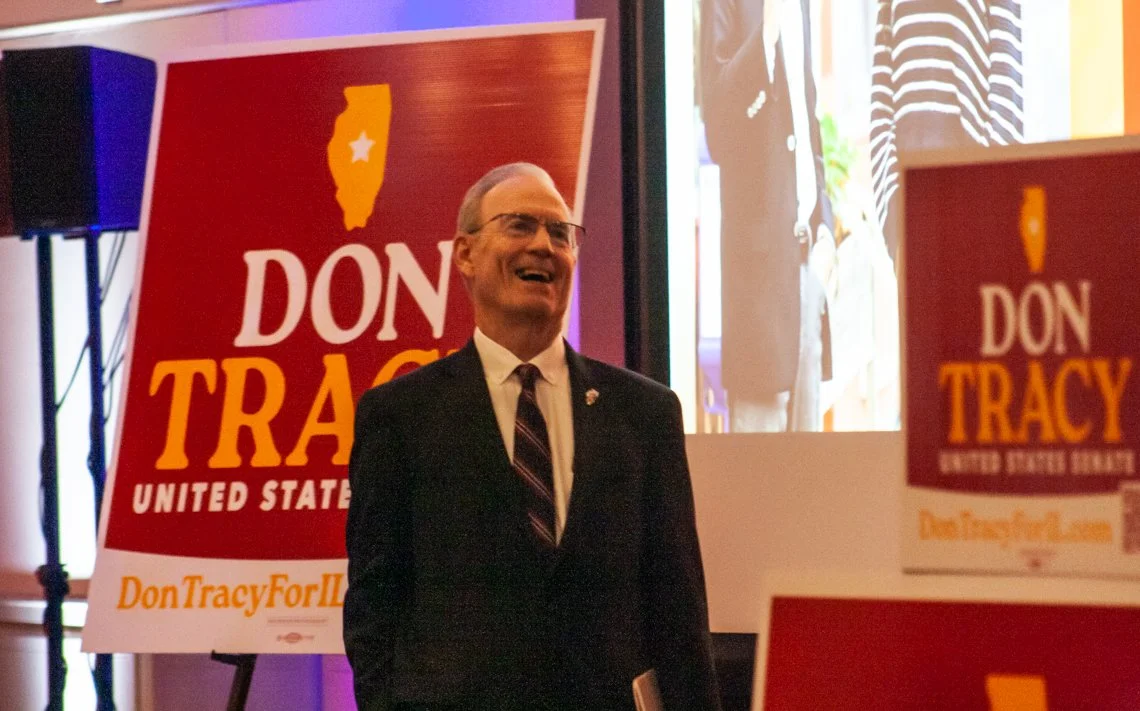
Don Tracy, the former chair of the state Republican Party, celebrates his nomination as the GOP’s candidate for U.S. Senate in 2026. (Capitol News Illinois photo by Jenna Schweikert)
“We stand before you tonight as the Illinois Republican nominee for the United States Senate. Thank you again for entrusting me with this important nomination,” Tracy said at his watch party in Springfield. “With your help, we'll deliver that underdog victory in November that will shock the nation and make Illinois better, more balanced and a stronger state.”
Tracy said his top priority will be reducing cost of living in key areas like energy and health care. The mood at the watch party was quiet initially, picking up as supporters watched results roll in. Kathy Salvi, the current Illinois Republican Party chair and the party’s failed Senate candidate in 2022, spoke to the growing crowd around 8 p.m.
“I am absolutely delighted to be here for you, Don,” Salvi said. “Everything that you stand for will elevate and bring hope and promise to Illinois.”
Of the five other candidates, Chicago attorney Jeannie Evans received about 22% of the vote, real estate manager Casey Chlebek received 11%, and the final three candidates received about 25% collectively.
Congressional results
Four of the five open congressional seats saw intense competition in their primary races this cycle, with dozens of candidates seeking rare open seats in Congress and an unprecedented $62 million contributed in direct campaign contributions and outside funding.
In the 9th Congressional District, Evanston mayor Daniel Biss won with about 30% of the vote as of 10 p.m. The contentious primary in one of the state’s most liberal districts gained national attention after candidates sparred over whether they aligned with the views of American Israel Public Affairs Committee and one candidate was charged by the federal government with conspiring to impede immigration agents. Biss, a former state senator who lost the 2018 gubernatorial primary to Gov. JB Pritzker, will face Republican John Elleson in the November general election.
In the 2nd Congressional District, Cook County commissioner Donna Miller beat nine candidates including state senator Robert Peters and former U.S. Rep. Jesse Jackson Jr. with 40% of the vote as of 10 p.m. Miller will face Republican Michael Scott Noack, who won his primary uncontested, in the general election.
In the 7th Congressional District, state Rep. La Shawn Ford won the Democratic primary against 12 other candidates, with just under 25% of the vote as of 10 p.m. Ford will face the GOP primary winner Chad Koppie in November.
In the 8th Congressional District, former U.S. Rep. Melissa Bean won her primary with about 32% of the vote as of 10 p.m. and will face Republican nominee Jennifer Davis in November.
The 4th Congressional District is also open this fall but did not have a contested primary. The November election is expected to be a tense battle between Democratic nominee Patty Garcia and candidates who filed as independents.
Capitol News Illinois is a nonprofit, nonpartisan news service that distributes state government coverage to hundreds of news outlets statewide. It is funded primarily by the Illinois Press Foundation and the Robert R. McCormick Foundation.