The agreement will see Google power data centers with natural gas by capturing carbon, but critics call the tech unproven
By MAGGIE DOUGHERTY
Capitol News Illinois
mdougherty@capitolnewsillinois.com
Article Summary
Decatur residents rallied to protest Google’s plan to power its data centers with energy from a natural gas-fired facility.
The project plans to use carbon capture and sequestration technology, which would store carbon dioxide emissions from the facility underground.
But the advocates want the tech giant to invest in renewable energy storage solutions and called upon Illinois lawmakers to pass the POWER Act.
This summary was written by the reporters and editors who worked on this story.
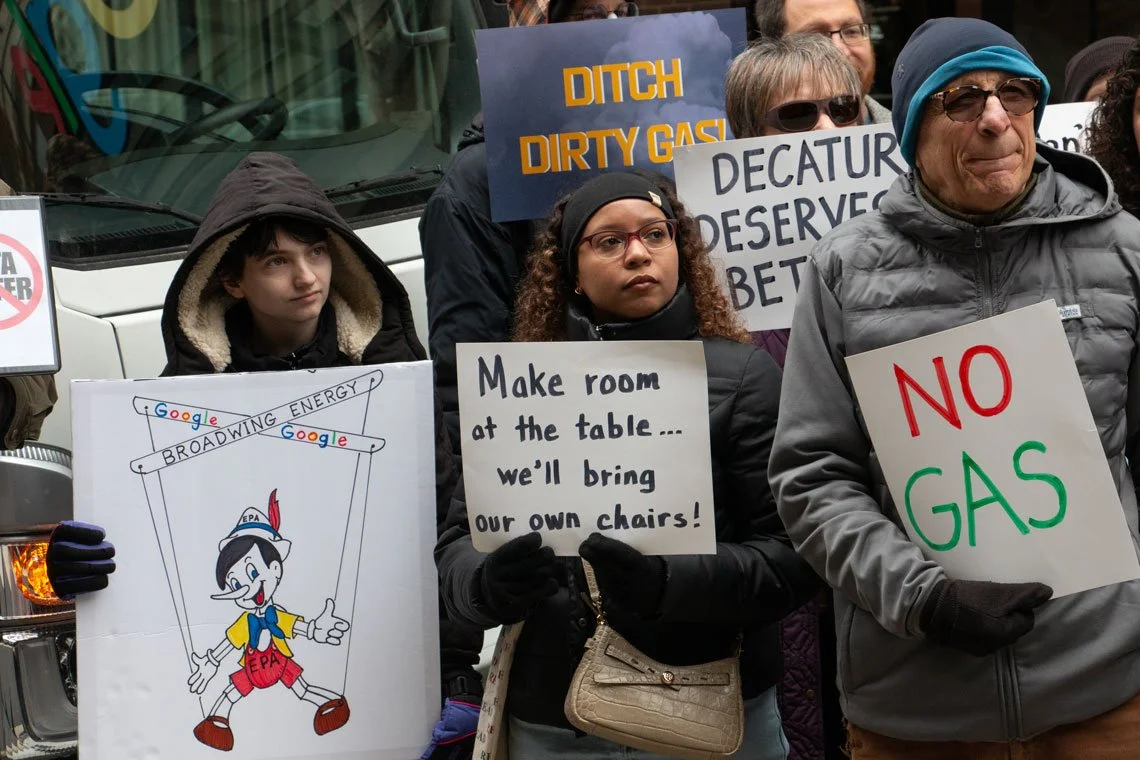
CHICAGO — Decatur residents joined environmental advocates in front of Google’s Chicago headquarters on Thursday to protest the tech giant’s deal to power its data centers with energy purchased from a natural gas-fired facility.
Through the deal, Google is making a major investment in carbon capture and sequestration technology, known as CCS, that would trap carbon dioxide emissions from power plants and bury it thousands of feet underground.
The project announced last October between Google and Broadwing Energy is currently under development in Decatur with the expectation of bringing CCS technology to commercial operation by 2030, to potentially store over 2 million tons of carbon dioxide waste per year in an injection well operated by Archer-Daniels-Midland, Co., known better as ADM.
But ADM already has a poor reputation with residents of Decatur, some of whom say the company has lost their trust after a series of leaks at the company’s CO2 monitoring wells went unreported and violated the Safe Drinking Water Act.
Instead of investing in the Broadwing project, the coalition of residents and activists called on Google to make a comparable investment in renewable energy and battery solutions, and to invite Decatur residents to the table for future discussions.
Kavi Chintam, Illinois campaign manager for the solar energy advocacy nonprofit Vote Solar, said the state is at a crossroads. She urged lawmakers to pass the POWER Act, a bill that would regulate data centers’ energy and water usage, require greater transparency and set environmental reporting standards.
“How we require data centers to power their operations today will define this state's climate legacy,” Chintam said. “Illinois can choose to cede its climate leadership to further the interests of the data center industry, or we can establish the strongest clean energy requirements in the nation.”
Whether tech companies can use natural gas to power data centers is a contentious question in ongoing negotiations around the POWER Act. It’s likely that any legislation passed will require data centers to pay to bring new energy to the grid to offset what they use, but the type of energy will be crucial.
Advocates delivered a letter to Google’s Chicago headquarters during the rally, seeking a response by Dec. 3.
Promise, doubts for CCS
This May, a Google executive confirmed the company remained committed to its ambitious goal of running on 100% carbon-free power by 2030, a goal it first set in 2020, despite the challenges it now faces to power its major buildout of artificial intelligence infrastructure.
Advancing CCS technology has been a key part of Google’s strategy toward achieving that goal, and success of the Decatur site would be a major milestone — not just for Google, but globally.
But while CCS has been heralded as a solution to keep natural gas plants on the grid without harmful carbon emissions, critics say the technology is unproven — it has not been successfully deployed by electric utilities in the U.S. yet — and environmental advocates consider it a distraction used to prolong fossil fuel generation.
The new project’s storage goal would roughly quadruple the volume of carbon waste ADM sequesters at its existing site, according to the most recently available U.S. Environmental Protection Agency data.
Read more: Lawmakers move to pause – then further regulate – carbon dioxide pipeline development | After years of controversy, state pauses CO2 pipeline construction, for now
Illinois’ landmark climate bill, the 2021 Climate and Equitable Jobs Act, or CEJA, requires power plants in the state to reduce carbon emissions to zero by 2045. But the state’s transition away from fossil fuel generation has coincided with the data center boom, resulting in high energy prices for everyday users and deep concerns for grid reliability amid projected shortfalls.
When asked in October whether the state would need to delay its phaseout of fossil fuels to prioritize energy supply, Gov. JB Pritzker told Capitol News Illinois that developing technologies — like CCS — might allow gas plants to reduce emissions enough to continue operating without punting on the carbon mitigation timeline.
“Keeping those plants going is actually in the bill that was passed, CEJA,” Pritzker said. “That is, it can keep going if it meets certain requirements, and we believe the technology is advancing quite fast, and so will allow those folks to apply the technology to bring down emissions and make it possible for gas plants to keep going.”
But in lieu of successful CCS implementation, allowing technology giants like Google to power their data centers with gas-fired plants would be a major step back for the environmental coalition — and likely a red line in negotiations.
Water, pollution
Residents are also concerned about the impacts of the Google-Broadwing project on Lake Decatur, the city’s primary source of drinking water, and one that has been strained by recent drought conditions.
Verlyn Rosenberger is a retired teacher and now an organizer with the progressive grassroots organization Illinois People’s Action. She has lived in Decatur for 64 years, her entire adult life, she said.
“Lake Decatur is where 70,000 Decatur residents, myself included, get our drinking water,” Rosenberger said. “In 2025, during the drought, the city asked us to ration water. We were told that every gallon mattered. There is no backup.”
261112-GOOGLE-BROADWING-SIGNS-3-MD.jpg
Most traditional methods of generating electricity are heavy water users, mostly employing water for cooling. Natural gas plants drew an average of 2,803 gallons per megawatt hour in 2021, according to the U.S. Energy Information Administration.
That’s far more water-efficient than coal plants, which used an average 19,185 gallons per megawatt hour, but less water-efficient than most renewables, which do not rely on water.
Read more: ADM carbon sequestration project violated Safe Drinking Water Act, per EPA
Beyond using water for cooling, residents worry about environmental contamination if the pipes transporting carbon dioxide from the plant to the sequestration wells leak.
Advocates say an investment by Google in renewable energy resources instead would be well-suited to the area and create new workforce opportunities. They suggest a partnership with Richland Community College, which hosts a Clean Energy Job Hub — another product of the CEJA legislation.
“Building a methane gas plant next to ADM will bring more fossil fuel pollution to Decatur instead of new clean energy investments that can put our CEJA workforce graduates to work,” said Manley Mallard, who also lives near the Broadwing project. “That’s the wrong direction.”
Neither Google, ADM, nor Broadwing Energy’s parent company responded to a request for comment.
Capitol News Illinois is a nonprofit, nonpartisan news service that distributes state government coverage to hundreds of news outlets statewide. It is funded primarily by the Illinois Press Foundation and the Robert R. McCormick Foundation.