Data centers emerging as key issue in Illinois governor’s race

State lawmakers could tackle new regulations in fall veto session after the election 

By MAGGIE DOUGHERTY
& BEN SZALINSKI
Capitol News Illinois
news@capitolnewsillinois.com

Article Summary

  • The emergence of a new class of data centers has garnered bipartisan opposition in communities across the state. What was once seen as an avenue for economic growth has become a political issue in Illinois, and one on which candidates from both sides of the aisle are hoping to distinguish themselves.

  • Democratic Gov. JB Pritzker once championed data centers as a driver of new jobs, signing a tax incentive program to bring more of them to the state. 

  • But as data centers have scaled up, he’s paused state incentives and his position has evolved to one of “responsible growth.”

  • Republican candidate Darren Bailey has both criticized Pritzker’s pause of the tax incentive program and claimed credit for inspiring it. 

  • He now says he would go further than Pritzker and pause all existing data center tax agreements. 

This summary was written by the reporters and editors who worked on this story. 

When Gov. JB Pritzker signed tax incentives for data centers into law in his first year as governor in 2019, Republicans and Democrats celebrated the plan as an economic driver. 

“In today’s world, data centers are as critical a part of our infrastructure as our roads, trains and schools,” Pritzker said in October 2019. “With the legislation I signed into law, we are welcoming a surge of economic development, labor income, and good union jobs to Illinois.”

Now, eight years and nearly two full terms later, the governor has paused those incentives as the onset of data centers has stressed energy and water resources and public opinion has swiftly turned against the tech behemoths. 

At the crux of the changing debate on data centers is the advent of artificial intelligence. The technology requires a new class of data center: hyperscale, always-on facilities that require massive amounts of energy.

“We weren’t talking about AI hyperscalers back in 2019,” Pritzker said at an unrelated news conference earlier this month. “I've already taken action. We've taken away the data center tax credits that existed, but it’s with the goal of getting legislation that will ensure that the people of Illinois, the businesses of Illinois, are not having burdened upon them higher electric rates, higher water rates, or having environmentally unsound practices by these data centers."

Polling conducted this spring on behalf of the Illinois Clean Jobs Coalition, which has led the push for data center regulations, showed Illinoisans from across the political spectrum favoring legislation that would require hyperscale data centers to bring their own energy and establish new reporting requirements on water use and environmental impacts.

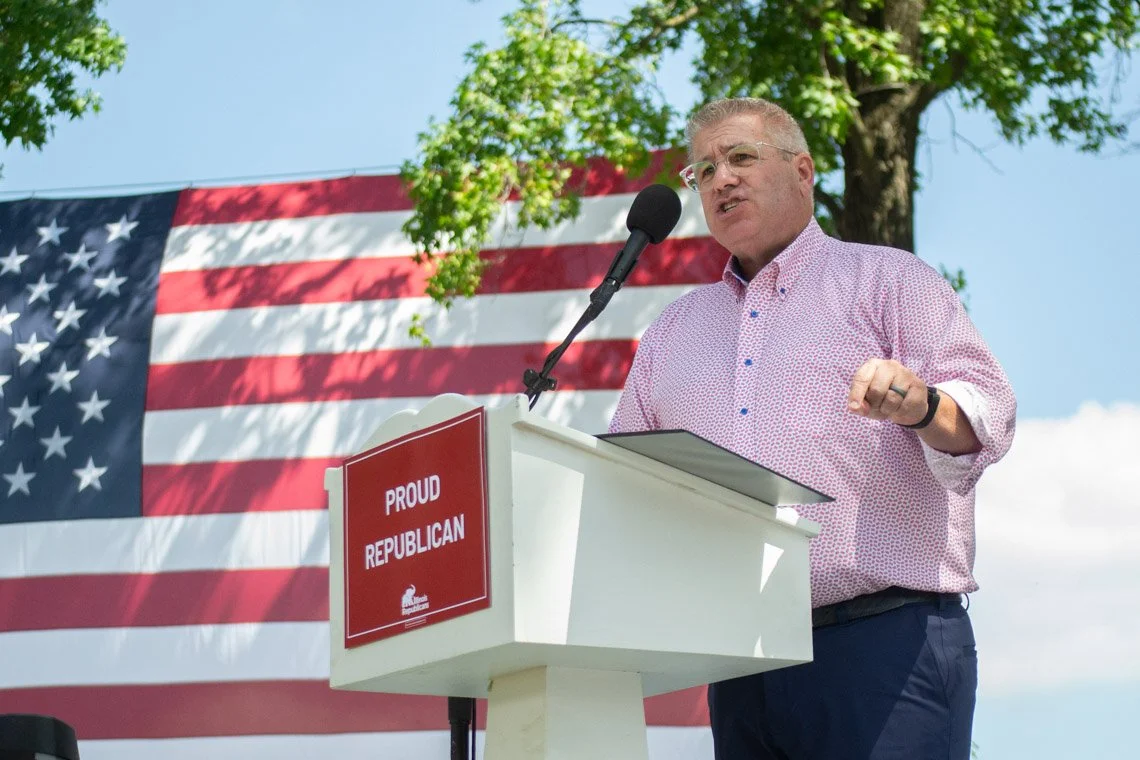
Pritzker’s Republican opponent Darren Bailey has also evolved in his support of data centers. While seeking to seize on their unpopularity by blaming the governor for the incentives package, he’s making AI a major piece of his campaign strategy. 

"To be anti-AI, anti-data center, that’s not what this is about at all,” Bailey said in an interview. “This is about protecting the people.”  

Evolving tech landscape

The changing public perception of data centers tracks with the evolution of the industry — and that’s led political candidates to take notice.  

“I think political candidates have sort of realized more within the last year or so just how important this issue is to voters because it goes so far beyond just energy bill impacts,” Illinois Environmental Council spokesperson Hannah Flath said. “Regardless of your political affiliation, regardless of where you live in the state of Illinois or across the country, you have a reason, at least one reason, to be concerned about data centers.”

Per the Clean Jobs Coalition survey, when respondents were asked whether they would support regulations on data centers “to minimize their impact on our utility bills, climate and water while still allowing them to be built,” 68% of respondents said they would somewhat or strongly support such legislation. Support was slightly stronger at 71% among Democrats and Independents, though 62% of Republicans also supported the idea.

Bailey told Capitol News Illinois that finding ways to regulate data centers falls back to one of the themes of his campaign: affordability. He said new utility regulations for the facilities will help lower Illinoisians’ utility bills while ending tax credits will lower property tax burdens as data centers cover a greater share. 

He pointed to Pritzker’s signature on the 2019 law establishing a tax incentive program designed to attract data centers to Illinois. Bailey voted against it when he was a state representative. Though he opposed the original bill, he — and every other member of the Senate at the time — supported a law in 2021 that expanded it.

That program committed more than an estimated $650 million in tax exemptions to 34 data center projects before Pritzker put it on pause in June, according to the Department of Commerce and Economic Opportunity, after lawmakers failed to act on his request for new data center regulations in the spring session.

Pritzker celebrated the groundbreaking of several new data centers in Illinois before AI significantly burst onto the scene, including the opening of Meta’s data center in DeKalb in November 2023. 

"It isn't an accident, though, that Meta and many other tech giants are seeing massive potential in our great state for data center growth,” Pritzker said that year. “Their decision to locate here is a reflection of the hard work that our General Assembly members and our administration have done to position our state to win this business."

A year later, he was present at the groundbreaking for CyrusOne in Aurora, where he said electricity in Illinois is “readily available and reliable.” 

But by the beginning of this year, Pritzker’s focus shifted to new regulations as the industry evolved. The governor asked lawmakers in his February State of the State address to impose a two-year moratorium on new data center tax credits and further demanded data centers now supply their own electricity.

"We need to think critically about our future energy usage with the needs of Illinois households at the forefront,” Pritzker said at the time. “So, in the face of rising demand and surging prices, I’m proposing a two-year pause on authorization of new data center tax credits. With the shifting energy landscape, it is imperative that our growth does not undermine affordability and stability for our families.”

‘An essential service’

Advocates — including the same organizations that criticized the governor this spring for a “lack of engagement” on passing data center regulations — said no one, not even Pritzker, could have foreseen the challenges data centers would bring.

Andrew Rehn, policy director of the Prairie Rivers Network, said 2019 was “a different world” in terms of data centers.

While traditional data centers have existed for decades in Illinois, the new hyperscale data centers needed for AI require significantly more energy, water and space. Some of the largest proposals, Rehn said, would consume half the energy of the entire city of Chicago, and take up a space as big as Central Park.

“It feels like, well, why is this conversation new? And of course, the answer is generative AI,” Rehn said. “It’s not just that we’re aware of something that wasn’t there. It is that what they’re doing has changed, or the scale of what is happening has changed in a meaningful way.”

Advocates for the data center industry say they know public opinion views them unfavorably. Brad Tietz, director of Midwest government affairs for the Data Center Coalition, said in an interview much of that comes down to misconceptions, and that the industry should listen to communities and address their concerns.

“You can't discount the fact that the data center industry is providing an essential service that we all rely on as residents and businesses,” Tietz said. “And data centers bring significant economic benefits to the communities in which they locate.”

One such misconception that members of the data center industry point to is that all of Illinois’ new hyperscale data center proposals would support AI. Rather, most are still used for traditional cloud computing and digital business infrastructure. Specific concerns of running afoul of the state’s strong biometric privacy law have also preemptively kept some AI developers at bay, according to industry insiders. 

Complicating the regulatory picture, a growing swath of the population would prefer full moratoriums on new hyperscale data centers to aggressive regulation. 

Of the 21% polled who opposed the proposed regulations, more than half said they did so because they opposed hyperscale data centers being built at all.

“People want, at the very least, to see these regulations in place if they are going to welcome data centers — and the benefits that do come with them — to their local community,” Flath said.

Positions shift 

Even nearly six months into the general election for governor, the data center debate continues to evolve.

Bailey seemed to initially balk at Pritzker’s incentives pause during a news conference responding to the State of the State address, as he listed the proposal among others from Pritzker that he disapproved. 

“We heard about new fees on social media companies, new regulations on insurers, new spending initiatives and even a pause on data center tax incentives at a time when other states are competing aggressively for investment,” Bailey said. 

But, speaking to Capitol News Illinois this month, Bailey argued his campaigning forced Pritzker to support more rigorous regulations. When asked to provide evidence of that, a spokesperson for Bailey pointed to social media posts he made in April — two months after Pritzker announced his proposal. 

Alex Gough, spokesperson for Pritzker’s campaign, said the decision to pause the tax incentives program was not inspired by Bailey.

Bailey also claims Pritzker is personally benefiting from data center construction in Illinois, specifically Meta’s site in DeKalb. 

“He owns 25% of Facebook. God bless him for that,” Bailey claimed of Pritzker while campaigning in Chicago last month. 

Financial disclosure records show Pritzker does own stock in Meta, managed through his blind trust, and though it’s not clear how much, it’s nowhere near Bailey’s claim — A 25% stake in the company would be worth approximately $375 billion, over 87 times Pritzker’s estimated $4.3 billion net worth. 

Meta CEO and founder Mark Zuckerberg owns roughly 13% of economic interest in the $1.5 trillion company and 61% voting power, according to its 2026 proxy statement. Other major investors include BlackRock and Vanguard, which each own around 6-7%.

State law also requires the governor to disclose every asset for which he, his wife or his children have direct beneficial ownership interest exceeding $10,000.

While Bailey voices concerns about data centers, his campaign often posts artificial intelligence-generated images on social media, including an image of a campaign button that said “say no to data centers,” which Facebook labeled as an AI image. He argued that doesn’t make his position on data centers inconsistent.

At a forum last month in Lake Zurich, Bailey said data centers are necessary, though he’s wary of tax incentives for them.

“We've got to have the data centers, in time. We had the race for space; we had the arms race,” Bailey said. “This new race is technology, and we cannot let China beat us in the race.”

Current policy positions

Pritzker also hasn’t adopted an anti-data center position, despite his support for more regulations. 

“Illinois has an opportunity to continue leading in technological innovation and economic growth, but we also have a responsibility to protect working families and local communities as the data center industry rapidly expands,” Pritzker said in his June announcement directing the state to pause processing new data center tax incentives. 

Pritzker said he wants data centers coming to Illinois to bring their own resources rather than depending on the same utilities and water residents and other businesses use. 

“We’re not going to incentivize you. We’re going to tell you that you’ve got to bring energy with you if you’re going to come, and you’ve got to have closed-loop systems that make sure that you’re not contaminating our water or taking too much of our water,” Pritzker said at a forum on quantum last month, addressing data center developers.

The pause was designed to give lawmakers more time to pass new regulations when they return to session in November after the midterm election. But it also upset labor leaders who see the projects as a benefit to their unions.

 “This pause does nothing to lower utility bills, protect the grid, or advance clean energy,” labor leaders said in a statement in June. “Instead, it will send billions of dollars in investment and thousands of union jobs to Indiana, Kentucky, and Ohio — states that sit on the same electrical grid, where those data centers will be built anyway, just without Illinois workers protected by nationally leading labor standards and without the clean energy requirements we’ve collaboratively fought to establish here.”

Upcoming legislation?

More recently, prominent labor leaders have circulated a proposal for a legislative framework that would restart the tax incentive program and reshape the state’s biometric privacy law to be more favorable to AI developers, while setting baseline transparency standards around the use of nondisclosure agreements. 

The proposal calls for requiring binding community benefit agreements, closed-loop water cooling systems with incentives for use of treated wastewater, use of union labor agreements, and a bring-your-own-energy model, prioritizing grid interconnection for projects that support renewable energy development.

Pritzker said last week the idea is “not a bill” and declined to take a position on it. He said in June the state needs to focus on “responsible growth” for the industry that also protects the state’s resources.

Bailey wants to go a step further and pause tax incentives for all data center projects, even ones currently getting a break from the state, until there’s a greater understanding of their effects on water and electricity. 

“I think we need to have an immediate halt because ultimately, if we continue on this path that we’re going on, energy prices are going to continue to skyrocket,” Bailey said.

He said “it’s a matter of making a better deal” that also addresses energy problems. And though he noted in February other states are also competing for data centers, he doesn’t think pausing tax exemptions will harm growth in Illinois.

“Everybody wants tax breaks, but these data centers are coming, and I really personally believe they’re going to ... build regardless,” Bailey said. 

To solve the energy problems from data centers, Bailey agreed they should provide their own energy, but also advocated a rollback of the state’s landmark climate legislation to allow fossil fuel operators to continue generating energy. He added that data centers should also pay into a fund that would be given back to consumers as relief of their utility bills.

While the candidates battle over data centers on the campaign trail, Pritzker said last week that passing new regulations should be a priority when lawmakers return for their fall veto session.  

“This has been going on for quite some time, but they need to come to a conclusion, and I believe that something should be voted on in the November veto session,” Pritzker said.

Capitol News Illinois is a nonprofit, nonpartisan news service that distributes state government coverage to hundreds of news outlets statewide. It is funded primarily by the Illinois Press Foundation and the Robert R. McCormick Foundation.
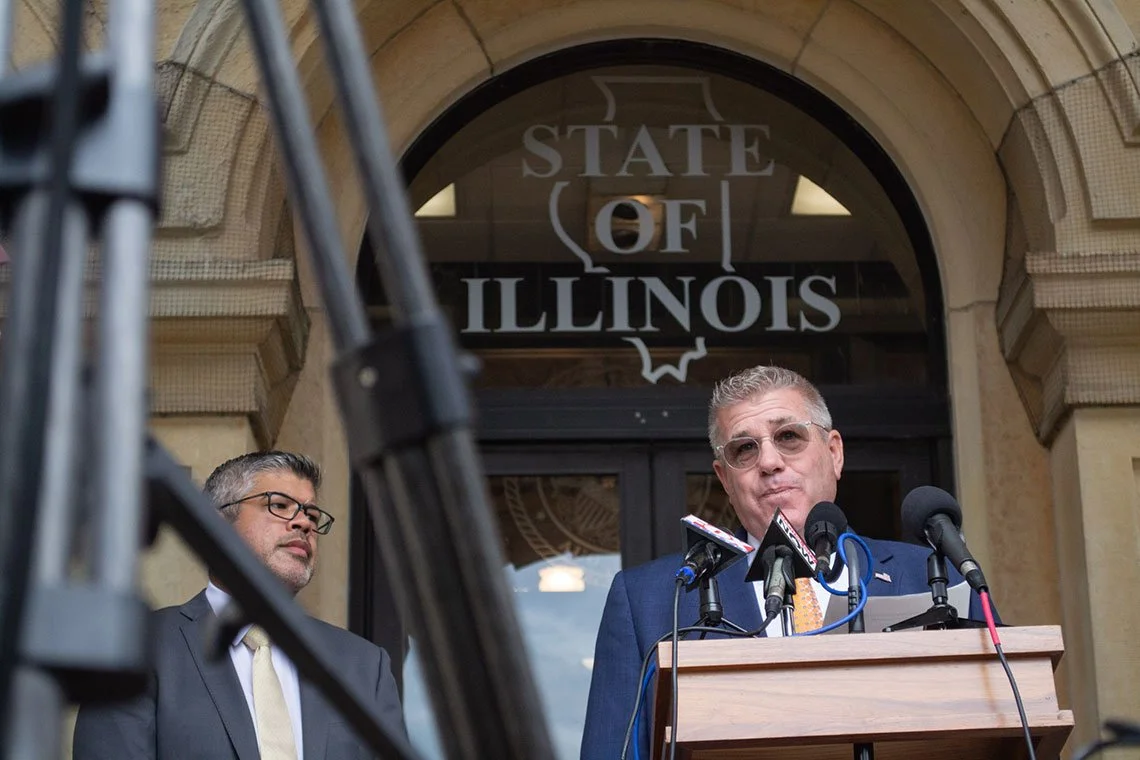

 Republican candidate for governor Darren Bailey speaks at a news conference on the steps of the Capitol in August. (Capitol News Illinois photo by Jerry Nowicki)
Illinois Democrats focused on Trump as they seek third sweep of statewide races 

Cloud of ethics issues forces Democrats to answer questions about trust in the party

By BEN SZALINSKI
& BRENDEN MOORE
Capitol News Illinois
news@capitolnewsillinois.com 

Article Summary

  • Democrats slammed President Donald Trump as their common enemy during State Fair festivities in Springfield on Wednesday. 

  • The state’s top leaders lined up to highlight ways they’ve fought Trump’s agenda, arguing voters should give them another term to continue executing their anti-Trump platform.

  • Party leaders also had to answer questions about ethics issues in the Illinois House, and many acknowledged they are issues that must be addressed.

This summary was written by the reporters and editors who worked on this story.

SPRINGFIELD — Though hundreds of Republican candidates will appear on the ballot in Illinois in November, the state’s Democrats are focused on a common opponent: President Donald Trump. 

The party’s leaders gathered in Springfield on Wednesday for their annual Democrat Day at the Illinois State Fair and at a brunch with county party leaders where they attempted to draw contrasts between themselves and Republicans. Amid their various names for the country’s leader — such as the “Cheeto president” whose agenda is a “river of sewage” — Democrats patted themselves on the back as a model of governing success. 

While the sense of urgency in confronting Trump and national Republicans was unmistakable, there was little evidence Democrats fear being dislodged as the state's dominant party. After a March primary election that featured several high-profile contests, the statewide general election campaign has largely been a sleepy affair. This was reflected in the focus of the speeches Democrats delivered to party faithful.

“We are only 19 months into Donald Trump’s term and what he and his MAGA Republicans are doing to this nation is disgraceful,” Gov. JB Pritzker said.

Pritzker and running mate Christian Mitchell invoked the names of their Republican opponents, Darren Bailey and Aaron Del Mar, respectively, only a handful of times. Lt. Gov. Juliana Stratton, the Democratic nominee for U.S. Senate, didn't utter her GOP opponent Don Tracy's name once. And none of the other statewide Democratic elected officials mentioned the names of the little-known Republicans running against them. 

It's a reflection of the sheer dominance Democrats have built in Illinois, which Sen. Tammy Duckworth referred to as the "rebar" in the Midwestern blue wall. The party holds all statewide offices, supermajorities in the state legislature and 14 of 17 congressional seats. 

And if anyone needed a reminder of the advantage Democrats have, Pritzker last week cut a $65 million check to his campaign fund, which will support his bid for a third term and help Democrats up and down the ticket. Bailey, who will rally with Republicans at the fairgrounds on Thursday, had just $127,990 in the bank at the end of June and has reported just $115,000 in contributions since. 

Though Pritzker, speaking to reporters after the rally at the fairgrounds, suggested state Democrats wouldn’t be complacent despite the party having swept statewide offices in both 2018 and 2022.

“We’re fighting it out in every district, so it's not a one-party state,” Pritzker said. “We got battles going on toward the general election, and we'll see who wins. But I'm very proud of the fact that Democrats actually represent the working people of the state and are standing up for their rights and making sure that we're putting money in their pockets and lowering costs for them.”

‘Don’t toy with Illinois’

Democrats running for statewide office couldn’t wait to share with supporters what they’ve done to fight Trump during their tenure. 

Attorney General Kwame Raoul touted his office's legal tussles with the Trump administration, including its successful efforts to beat back the president's attempt to deploy the National Guard to the streets of Chicago. 

"Some may say 'Don't mess with Texas,' but we went all the way to the Supreme Court to tell Donald Trump, 'Don't toy with Illinois,'" Raoul said.

Minutes later, Duckworth told Raoul that "if you want to put that on a T-shirt and say ‘Don’t f---ing toy with Illinois,’ I’ll buy a dozen of them.” It was one of two expletives Illinois' soon-to-be senior senator deployed. 

Though he’s unpopular in the state, Trump had his best performance in Illinois of his three campaigns in 2024. While he didn’t substantially receive more votes, many Democratic voters appeared to skip over Kamala Harris on the ballot. Democratic Party Chair Lisa Hernandez said her party isn’t taking the state’s dark blue leanings for granted.

“We're doing all we can to bring back the trust of the vote, based on what we saw in the last election,” Hernandez told Capitol News Illinois. 

With Trump the focal point of Democratic campaigns, Pritzker argued there’s no daylight between the president and Bailey, who Trump endorsed four years ago but hasn’t so far this year. 

"This is the government that Darren Bailey rooted for,” Pritzker said. “This is the vision that he and his Illinois Republicans want to impose on working families across Illinois. I think it’s instructive for us to put side-by-side two visions of Illinois.” 

Pritzker got high praise from one prominent national politician on Wednesday: Massachusetts Democratic Sen. Elizabeth Warren, who keynoted the breakfast.

"JB Pritzker stood up and delivered a message directly to Donald Trump,” Warren said. “He said, ‘You come for my people, you come through me.’ And I thought that is leadership. JB Pritzker was showing some old school loyalty to the people of Illinois and showing that Democrats, or at least some Democrats, don’t back down from bullies.”

Fight over affordability 

Democrats argued Trump’s Republican Party has only made life worse for Americans through “wars of choice” that have driven up gas and grocery prices.

“At a time when Donald Trump and MAGA Republicans and his entire freak show are demonstrating how the government can be distorted to satisfy the greed of the wealthy and the greed of Donald Trump’s own pockets, while robbing working families blind, Illinois Democrats are showing what it means to truly fight for the people,” Pritzker told supporters at the fair. 

But as Democrats bashed Trump for rising prices, the Illinois Tollway on Wednesday morning approved a 57% increase on cars and 30% on trucks beginning next year. It will increase by inflation every two years after that without further public hearings or board votes. The rate increase will fund a capital program for the Tollway and was permitted by the transit reform bill lawmakers approved last year. 

“We want to make sure that our roads are pothole-free, that we're making sure to build more so that we can build our economy across the state of Illinois,” Pritzker told reporters. 

Bailey has suggested eliminating tolls, but Pritzker said that would only cause more downstate communities to foot the bill for Chicago area expressways. More broadly, Bailey has tried to say Pritzker’s criticism of Trump on cost-of-living issues rings hollow as Illinois has implemented dozens of new taxes during his governorship. 

“We feel great about our record and that shows that we are deeply focused on the people of Illinois and will continue to be through Nov. 3,” Mitchell told Capitol News Illinois. 

Ethics issues

Republicans are hoping to derail Democrats' electoral hopes by focusing on a series of alleged ethical lapses unearthed this summer. 

Rep. Carol Ammons, D-Urbana, has pleaded not guilty to federal charges that she orchestrated a scheme to receive illegal cash kickbacks from her own campaign account and from local nonprofits for which she helped secure state grant funding. 

House Speaker Emanuel "Chris" Welch, D-Hillside, didn’t attend any of the Democrat Day festivities on Wednesday. 

He is under scrutiny for his handling of sexual harassment allegations against disgraced ex-Rep. Harry Benton, D-Plainfield, who resigned in July after a Legislative Inspector General report found he engaged in "a pattern and practice of inappropriate sexual conduct” that began soon after he took office in 2023.

Welch's office knew about an allegation against Benton but did not address it for several months. Welch then subsequently spent $1.4 million in support of Benton's reelection in 2024.

A Chicago Tribune report also highlighted Welch's behavior on social media, which included reacting to a former staffer’s Instagram photos with heart eyes and inviting her to a bar through an encrypted messaging app.

As Welch made the rounds to a series of fundraisers and receptions in downtown Springfield on Tuesday, mobile billboards circled the block airing an Illinois House Republican message highlighting posts Welch has liked on social media. Other billboards tied newly appointed Rep. Jessica Dixon Heitman, D-Plainfield, and Rep. Katie Stuart, D-Edwardsville, both in relatively competitive districts, to Welch. 

Hernandez acknowledged the incidents could undermine trust with voters. 

“I believe that the speaker is doing all he can and I think he is putting himself out there and doing what he (can) to put in place what we have learned based on the current incidents that we have to do better,” she said.

But other Democrats dismissed the notion that they will be punished at the ballot box for the ethical lapses. 

"I mean, Republicans are always going to find something to run on where they are going after individual candidates for, you know, reasons that are outside of their control," said Rep. Margaret Croke, D-Chicago, the party's nominee for comptroller, referring to the Heitman and Stuart billboards. "But no, I think that we just have to continue to run on the things that people are hearing about right now: affordability, healthcare, education. And if we continue that message, we'll be successful in November."

Mitchell echoed those sentiments. 

“Obviously those ethics issues should be dealt with,” Mitchell, a former representative, said. “Sounds like the House is trying to do that. We want to focus on the issues facing the voters in November, and when we do that, I think we'll win.”

Looking ahead 

With Democrats heavily favored in all statewide contests, many are already looking ahead to the Chicago mayoral election next February. 

Secretary of State Alexi Giannoulias and Comptroller Susana Mendoza are among several declared candidates challenging incumbent Mayor Brandon Johnson. 

Mendoza ran unsuccessfully for mayor in 2019. She received criticism that year for seemingly having her eye on the Chicago City Hall while running for reelection as comptroller in 2018. This time, Mendoza opted against seeking reelection to her statewide office to focus on the mayor's race. 

Giannoulias, on the other hand, is running for reelection and mayor simultaneously, for which Mendoza took a not-so-subtle jab, saying that voters "deserve a candidate who's going to be all in the position that they're asking you to support them for."

Giannoulias told reporters at the fairgrounds that he didn't hear Mendoza's remark, adding that his current role is "the best job in government" but that he wants to be "part of the solution" to the issues plaguing the state's largest city. 

"And as I've said, when you're applying for a job, when you're interviewing for a job, which is what you do when you run for mayor, you don't quit the job you're in while you're interviewing for the next one," Giannoulias said. 

Capitol News Illinois is a nonprofit, nonpartisan news service that distributes state government coverage to hundreds of news outlets statewide. It is funded primarily by the Illinois Press Foundation and the Robert R. McCormick Foundation.  

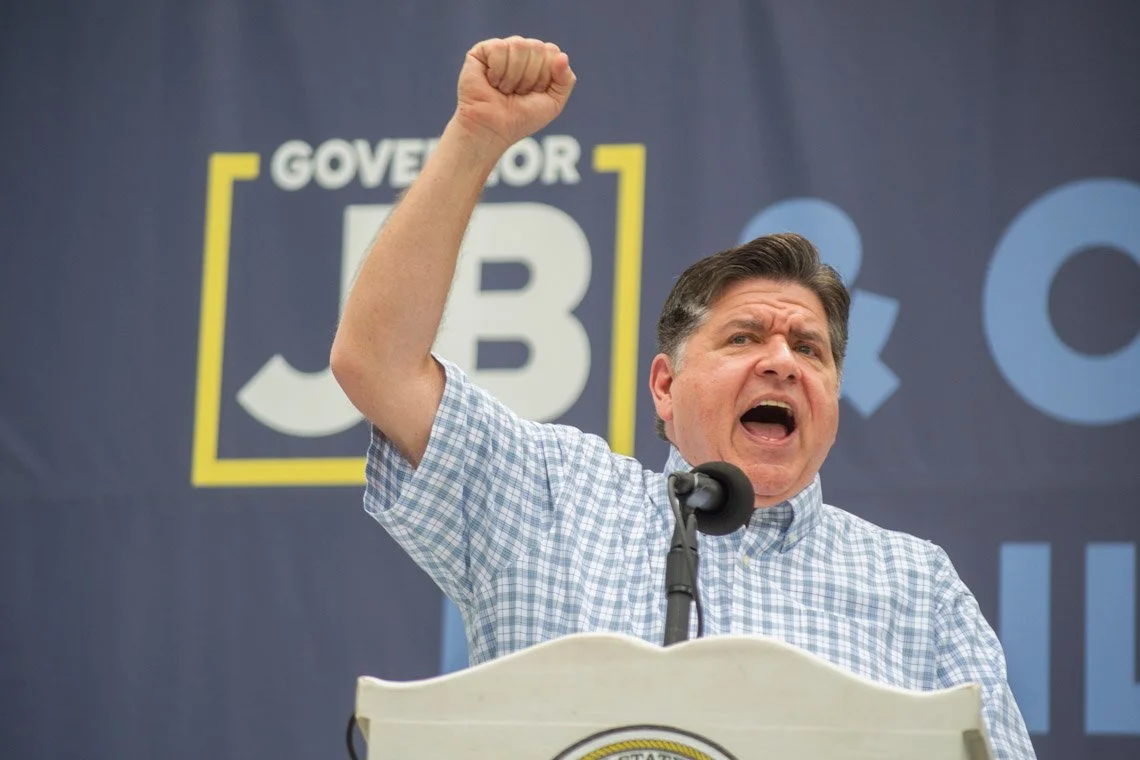
Gov. JB Pritzker fires up the crowd during Governor’s Day festivities at the Illinois State Fair on Aug. 19, 2026. (Capitol News Illinois photo by Jerry Nowicki) 

In Illinois, Warren urges Democrats to unite behind all party nominees

Massachusetts senator delivers keynote in event honoring retiring Sen. Dick Durbin

By PETER HANCOCK
Capitol News Illinois
phancock@capitolnewsillinois.com

Article Summary

  • Massachusetts Sen. Elizabeth Warren delivered the keynote address at the Illinois Democratic County Chairs’ Association annual brunch in Springfield.

  • She called on Democrats to unite behind all the party’s candidates in the November midterm elections to take control of Congress and check the power of President Donald Trump.

  • Her speech came as left-leaning and self-described socialist candidates have been scoring upset victories in Democratic primaries around the country, prompting fear among some that the party is shifting too far to the left.

This summary was written by the reporters and editors who worked on this story.

SPRINGFIELD — U.S. Sen. Elizabeth Warren urged Illinois Democrats on Wednesday to unite behind all of the party’s nominees in the upcoming midterm elections so they can win control of Congress and block Republican President Donald Trump from advancing his agenda.

And to show she was serious, she announced she is putting $500,000 into the party’s coordinated campaign funds to elect Democrats to the U.S. House and Senate, plus another $100,000 to the Democratic National Committee to strengthen the party’s internal infrastructure.

“It is time to stop the handwringing and to invest in a key part of our Democratic infrastructure,” Warren, D-Massachusetts, told an audience of more than 2,000 Democrats gathered in Springfield. “And I am asking others to join me and do the same.”

Warren was the keynote speaker at the Illinois Democratic County Chairs’ Association brunch, an annual event that coincides with Governor’s Day at the Illinois State Fair. The focus of this year’s event was to celebrate Illinois’ retiring Sen. Dick Durbin while also showcasing the party’s slate of candidates in the November election.

But her speech came at the same time internal friction has been rising within the party as a new generation of young, left-leaning and self-identified socialist candidates have been rising to prominence around the country by defeating establishment-backed candidates in contested primaries.

Rise of the left

Just a day earlier, Angie Nixon, a little-known Florida state legislator and member of the Democratic Socialists of America, scored an upset victory over the more moderate, establishment-backed candidate Alex Vindman to win that state’s U.S. Senate primary.

And earlier this month, Abdul El-Sayed, a progressive candidate, edged out the more moderate U.S. Rep. Haley Stevens to win Michigan’s Senate primary.

Warren, who is often identified with the liberal wing of the Democratic Party, but whose message is usually more populist than socialist, admitted she has often been critical of party leaders for “meddling” in competitive primaries.

“I think it's wrong for the (party) to put a thumb on the scale when Democrats are choosing their nominee,” she said. “I think it's wrong to line up with big money, to drown out grassroots candidates. Wrong, and it weakens us.”

“But I know our job now,” she continued. “Democrats must win the Senate, and I am 100% behind our Democratic nominees everywhere, and I am 100% behind getting them the resources they need to win with.”

In his speech, Gov. JB Pritzker downplayed Democratic divisions. 

“These days, it seems like the pundits and the naysayers want to stay in an endless loop of debate about the future of the Democratic Party to draw false and rigid divisions, to paint a picture of a fractured coalition,” Pritzker said. “If there's a divide in the national Democratic Party that exists, it's the one between team fight and team cave. And in Illinois, we've made our choice. We're on team fight.”

Still, the rise of self-identified socialist candidates has raised concern in some circles that the party may be shifting so far to the left that it is hurting its own chances to win in a general election, especially in a swing state like Michigan, which Trump narrowly won in 2024, or a conservative-leaning state like Florida, which Trump won by 13 percentage points.

Leading Illinois Democrats said Wednesday they remain confident of the party’s chances in November.

“I think Democrats are a big-tent party, and I think as many voices as we can get under the same umbrella is a good thing,” U.S. Sen. Tammy Duckworth said in an interview later in the day at the state fairgrounds. “We don’t want a homogenous party that is beholden to a single individual like the Republicans. I’m glad that we have diverse voices in our party so we can have many different perspectives.”

Lt. Gov. Juliana Stratton, who is running to succeed Durbin in the Senate, told reporters that she thinks Democrats still have a shot at winning control of the Senate.

“I think that it’s still in play and everybody is going to focus on these races over the next 76 days,” she said. We’re going to make sure that we are electing Democrats up and down the ticket in our own state but I’m also going to do everything I can to help Democrats win across this country.”

Honoring Durbin

Warren also took time to praise Durbin for his 30 years in the Senate, giving him credit for being an early supporter of legislation that would eventually bring her to national attention —  creation of the Consumer Financial Protection Bureau.

That agency was created in 2010 as part of the Dodd-Frank Wall Street Reform and Consumer Protection Act, a legislative response to the 2008 financial crisis. Warren was still a Harvard law professor at the time and had been a vocal advocate of forming a government agency to protect consumers from predatory lending practices.

“Dick Durbin was the original sponsor of the Consumer Financial Protection Bureau,” she said. “He fought to make that agency happen, and I will forever be grateful.”

After the bill was signed into law, then-President Barack Obama named Warren to head a steering committee to get the new agency up and running. But she was not nominated to become the agency’s first director.

In 2012, Warren was elected to the Senate from Massachusetts, defeating incumbent Republican Scott Brown. Brown had won the seat in a special election in 2010 following the death of Sen. Ted Kennedy.

Durbin received several rounds of applause and said he’d remain involved, quipping that once politics is “in the blood,” it takes “embalming fluid" to get it out.

Capitol News Illinois is a nonprofit, nonpartisan news service that distributes state government coverage to hundreds of news outlets statewide. It is funded primarily by the Illinois Press Foundation and the Robert R. McCormick Foundation.  


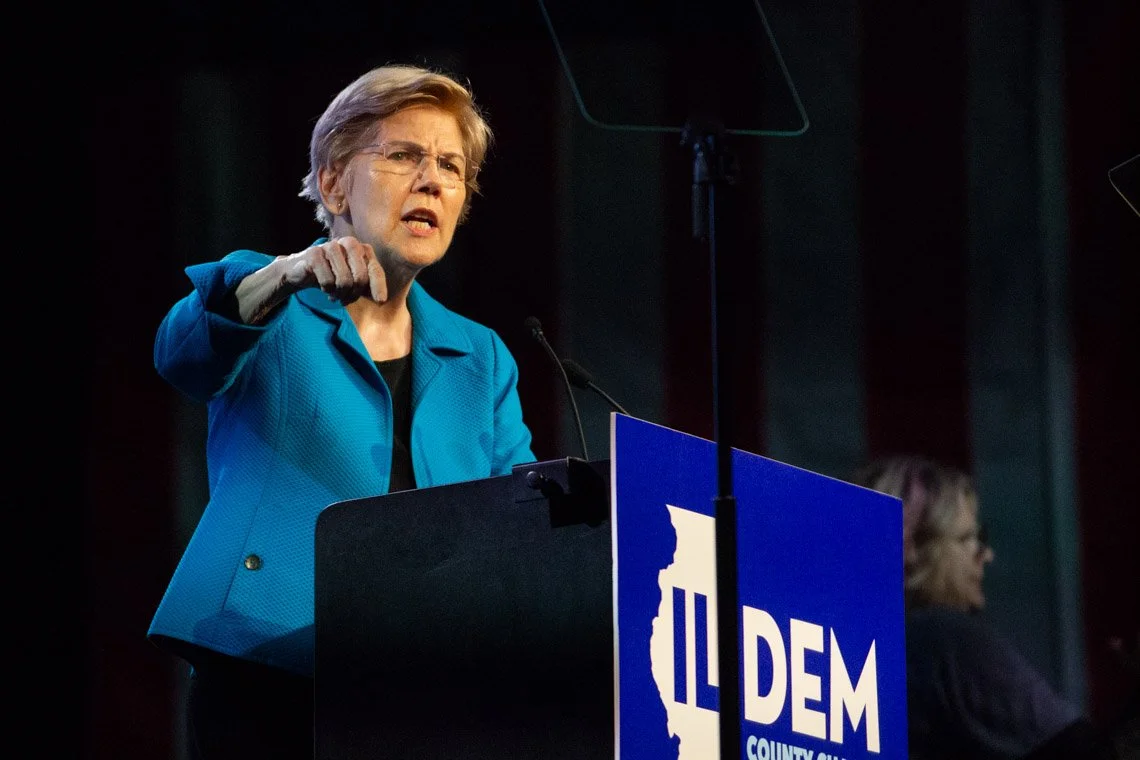
U.S. Sen. Elizabeth Warren, D-Massachusetts, gestures during her speech at the Illinois Democratic County Chairs’ Association brunch on Aug. 19, 2026, in Springfield. (Capitol News Illinois photo by Jerry Nowicki)

Amid Democratic scandals, Illinois Republicans hoping to flip legislative seats 

House and Senate Republicans trying to protect incumbents, pick up seats 

By BEN SZALINSKI
Capitol News Illinois
bszalinski@capitolnewsillinois.com

Article Summary

  • Republican legislative leaders are hoping to flip several seats this fall and protect others they currently hold. 

  • Democrats are targeting several suburban Republicans and hoping to take advantage of President Donald Trump’s unpopularity.

  • Republicans are trying to flip several districts throughout the state and capitalize on ethics issues in the Statehouse. 

  • Party leaders say Republicans need to balance campaigning on ethics problems with addressing voters’ concerns about affordability. 

This summary was written by the reporters and editors who worked on this story.

SPRINGFIELD — Illinois Republicans are hoping to buck historic midterm election trends by focusing on affordability and Democratic scandals in the Statehouse as they seek to emerge from superminority status.

President Donald Trump remains deeply unpopular in Illinois, and midterm elections have spelled bad news throughout U.S. history for the party that holds the White House. But Democratic corruption and sexual harassment scandals have dominated this summer’s headlines in Illinois politics, and state tax burdens remain higher in Illinois than in most other states. 

Those factors have GOP leaders of the General Assembly optimistic that this election represents an opportunity to gain ground. 

“There's a lot of things going on in Illinois that certainly is motivating voters, and I think the voter turnout is going to be what's instrumental in winning additional seats this year,” House Republican Leader Tony McCombie, R-Savanna, told Capitol News Illinois on Thursday at Republican Day at the State Fair in Springfield.

MCCOMBIE PHOTO

Candidate after candidate on Thursday said most of their conversations with voters come back to issues, especially cost of living and high taxes. 

Gov. JB Pritzker and Democrats would prefer to make this year’s election a referendum on Trump. At their Democrat Day events on Wednesday, they hammered Republicans for supporting the war in Iran, which has raised gas prices, and tariffs, which have more broadly increased prices. 

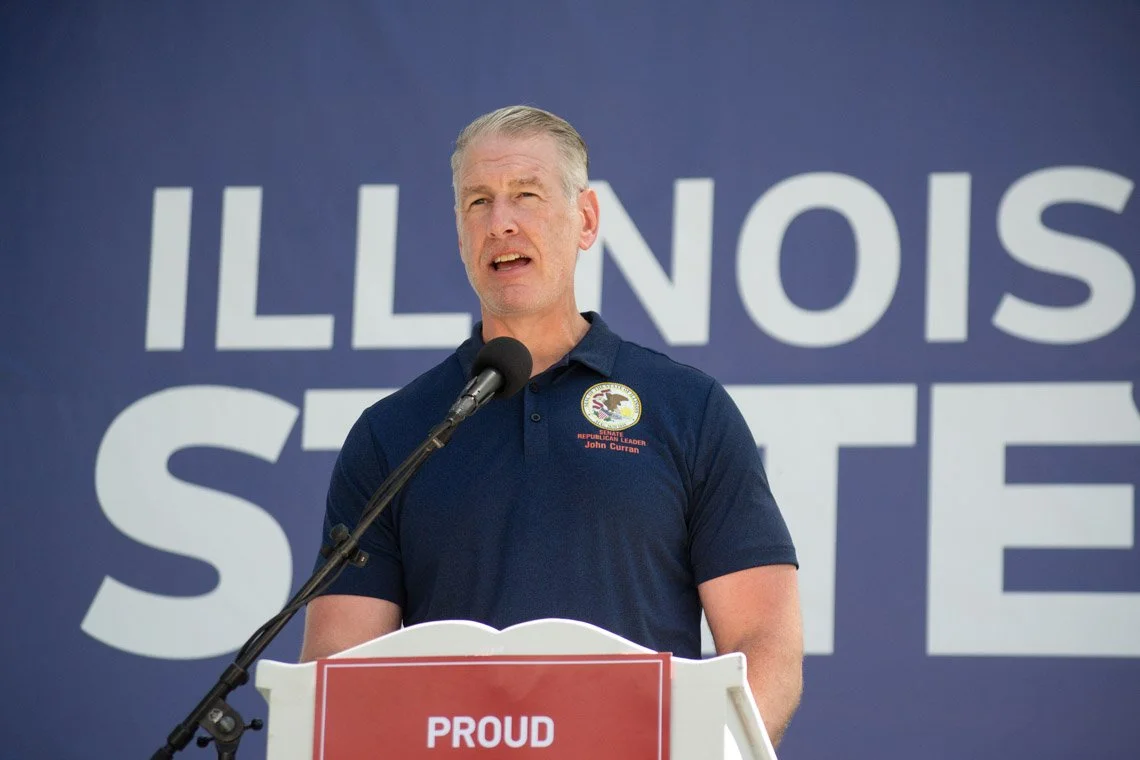
Senate Republican Leader John Curran, R-Downers Grove, told supporters at a state party meeting on Thursday morning that Republicans should make this year’s election a referendum on Democrats, taxes and spending. 

“This election is a referendum on JB Pritzker and his failed economic policies for the state of Illinois,” Curran said in an interview. “We have to talk about the Illinois story here, not what's going on nationally.” 

Targets for ouster

Republicans have been in the superminority in the House since 2018, but they’ve since held ground, preserving 40 of 118 seats. It’s been worse on the Senate side, where the party has been in the superminority since 2012 and currently holds 19 of 59 seats. 

CURRAN PHOTO

This year, several legislative races are expected to be close, including for some seats held by GOP incumbents, especially in the suburbs. 

Rep. Martin McLaughlin, R-Barrington Hills, is facing Democrat Maria Peterson for the second consecutive election, having beat her by just 47 votes in 2024. 

“Everybody's been doubting me for years and it just seems to keep working,” McLaughlin said in an interview. “So maybe it's the message, maybe it's being genuine, authentic, and direct. And I've always tried to be that. It doesn't always rub everybody the right way, but with me, you know what you're going to get.”

McLaughlin is taking help from the House Republican Organization this time after declining it two years ago. That allows him more access to party staff and money, and he said he believes McCombie has improved her caucus’ political operation.

“I want programs that are going to move the needle forward and get more butts in the seats, and I think people are moving in that direction,” McLaughlin said. “The communication success that I'm having individually is actually starting to be replicated amongst the group.”

That same northwest suburban area is also the site of a tough Senate race between incumbent Sen. Darby Hills, R-Barrington Hills, and Rep. Nabeela Syed, D-Inverness. 

Curran also has other seats his caucus currently holds that he is trying to defend, but said he’s also hoping Frank Lesko will oust Sen. Doris Turner, D-Springfield, Brad Beekman will defeat Sen. Mike Halpin, D-Rock Island, and Daniel Rhyne will send Sen. Christopher Belt, D-Swansea, packing. 

LESKO PHOTO

McCombie declined to say how many seats she’s aiming to pick up, but said the 112th District represented by Rep. Katie Stuart, D-Edwardsville, 76th District represented by Rep. Amy “Murri” Briel, D-La Salle, and 97th District represented by Rep. Jessica Dixon Heitman, D-Plainfield, are among her targets. Stuart is facing Jimmy Ford and Briel is up against Liz Bishop for a second time.

The 97th District was held by former Rep. Harry Benton until early July when he resigned after a report by the Legislative Inspector General found he engaged in a “pattern” of sexual abuse. 

Benton beat Republican Gabby Shanahan by about 4 points two years ago and she told Capitol News Illinois she thinks victory is within reach.

SHANAHAN PHOTO

“I think we have a very good chance,” said Shanahan, a grassroots engagement director for Americans for Prosperity. “Obviously always a very winnable district for Republicans, and then I think people are just hungry for change. They're hungry for trust in government. They're hungry for transparency in government, accountability in government. And I think that's what I offer.”

Ethics issues 

Republicans are using Benton’s allegations, as well as the federal indictment of Rep. Carol Ammons, D-Urbana, against Democrats.

The new chair of the Illinois Republican Party, Bob Grogan, said he’s disappointed unethical behavior continues to be an issue in the state.

GROGAN PHOTO

“I don't view it as an opportunity. I think it's disgusting that we even have to talk about it,” Grogan said. “It's a vast disappointment, and we're going to point out the differences between the two parties.”

However, he cautioned Republicans against adopting old practices where the party was a “one-trick pony” that largely focused on bashing former Speaker Mike Madigan. Even after Madigan’s indictment before the 2022 election and conviction before the 2024 election, Republicans failed to win significant races. 

Curran said voters are also not singularly focused on ethics.

“We're not hearing ethics at the door,” he said. “We're hearing cost of living at the door, but ethics is something that we want to come in with a strong plan and tackle in a veto session. It is past due, and what's going on in the House right now, it shows that we are lagging. But really, what's top of mind of voters is high taxes, cost of living —  property taxes in particular.”

McCombie said Republicans should focus on both. 

"I think it's a combination. The affordability, property taxes, is a No. 1 concern around the state,” she said.

New allegations

As the GOP kicked off fair events Thursday morning, another allegation against an incumbent Democrat surfaced. Laura Jackson, a former staffer for Rep. Briel, alleged in a video interview released by Bishop’s campaign that the representative harassed her and supplied drugs.

Jackson, who worked on Briel’s 2024 campaign and then in her district office for a time, claims Briel referred to her as her possible sexual “prize” for winning the election. She also says Briel supplied unlimited Adderall throughout the campaign and then as a state representative, gave out marijuana as a “bonus.”

“There can be no repeat with Murri Briel,” the House Republican Organization said in a statement. “These allegations demand a serious response, and (House Speaker Emanuel “Chris”) Welch should make clear immediately that Briel will not receive caucus support while they remain unresolved.”

In a statement, Briel denied the accusations and said they have been resolved. 

“The statements in the video produced by her MAGA political operatives were previously taken to the Legislative Inspector General in 2025 and were found to be without merit,” Briel said. “I am calling for the immediate release of the Legislative Inspector General’s report on this matter.”

Legislative Inspector General Mike McCuskey confirmed to Capitol News Illinois a complaint was filed more than a year ago and it was investigated. He declined to discuss the results.  

Capitol News Illinois is a nonprofit, nonpartisan news service that distributes state government coverage to hundreds of news outlets statewide. It is funded primarily by the Illinois Press Foundation and the Robert R. McCormick Foundation.  


Senate Minority Leader John Curran talks to Republicans at the Illinois State Fair on Aug. 20, 2026. (Capitol News Illinois photo by Jerry Nowicki)

With Trump barely mentioned, Illinois Republicans focus on common enemy: Pritzker

GOP officeholders, candidates lay blame for high prices, taxes on Democrats

By BRENDEN MOORE
Capitol News Illinois 
bmoore@capitolnewsillinois.com  

Article Summary  

  • President Donald Trump has been the dominant political force within the Republican Party for more than a decade, but he was barely mentioned by party leaders at Republican Day at the Illinois State Fair on Thursday. 

  • Instead, the GOP candidates were laser focused on Gov. JB Pritzker and Democrats who hold all statewide offices and supermajorities in the General Assembly.  

  • Illinois Republican Party Chairman Bob Grogan said he sees an opening to win over new voters due to Democratic policies he cast as extreme. Or, to put it another way: "It's common sense versus communism," he said.

This summary was written by the reporters and editors who worked on this story.  

SPRINGFIELD — President Donald Trump has been the dominant political force within the Republican Party for more than a decade. 

But as Illinois GOP faithful gathered Thursday in Springfield for their annual day at the Illinois State Fair, their party's national leader was barely mentioned. Instead, the GOP candidates were laser-focused on Gov. JB Pritzker and Democrats who hold all statewide offices and supermajorities in the General Assembly. 

"Everywhere we go, we hear the same thing: Illinois is too damn expensive, and it's time to change it," said Darren Bailey, the Republican gubernatorial nominee. "Property taxes, they're crushing homeowners. Electric bills are exploding. Groceries, insurance, gas, childcare — they all cost more. Everything costs more under JB Pritzker. After nearly eight years in office, the excuses are over."

It was a stark contrast to Democrats Day at the fairgrounds on Wednesday, where Pritzker  and other statewide elected officials focused their ire on Trump while barely mentioning their underdog Republican opponents. 

On Republican Day, Trump's name was conspicuously absent, with GOP leaders blaming the state's Democrats for soaring energy costs, high property taxes and other affordability concerns on voters' minds. Unlike the previous day, there was no mention of the impact of Trump's tariff regime and the war with Iran on the price of consumer goods and gasoline.

"We need to stop looking at Washington and start looking at Springfield," said Aaron Del Mar, Bailey's running mate. 

'Common sense vs. Communism'

Illinois Republicans are in their worst electoral position in a generation. They're locked out of all statewide offices, relegated to superminority status in the General Assembly and hold just three of 17 congressional seats. 

Trump registered his best electoral performance in Illinois in 2024, but the closer margin didn't come because he received substantially more votes. Instead, many Democratic voters apparently stayed home rather than casting a ballot for Kamala Harris. 

The president's unpopularity has proven an anchor to Republicans running down ballot, particularly in the Chicago suburbs. Compounding that is the collapse of the party's fundraising base, which was heavily dependent upon a handful of wealthy donors like former Gov. Bruce Rauner and venture capitalist Ken Griffin. 

The former stopped funding the Illinois GOP after a landslide election loss to Pritzker in 2018 and the latter bolted Illinois for Florida after his favored candidate in the 2022 GOP gubernatorial primary came in third place to Bailey.

Over the past decade, the party has cycled through four different chairmen, each tasked with building back a fundraising apparatus and desperately trying to encourage supporters skeptical of vote-by-mail to bank their votes. They've also had to mend intraparty feuds.

Illinois Republican Party Chairman Bob Grogan, who defeated incumbent Kathy Salvi for the statewide party post earlier this year, joked to reporters that he "probably has the second-hardest job in the world" after Trump.

"Look, it was never going to be an easy year," Grogan said of 2026. "It's Illinois. We always have an uphill fight. But I'll say this: If you actually think that the polls are the end-all, be-all, talk to President Hillary Clinton."

While Trump's shock victory in 2016 defied polling, Illinois Republicans haven't had a similar night in more than a decade. The last statewide races the party won were in 2014, when Rauner defeated incumbent Democratic Gov. Pat Quinn and Comptroller Judy Baar Topinka was reelected. They haven't won a federal race since Mark Kirk's 2010 victory over Democrat Alexi Giannoulias for U.S. Senate. 

But Grogan said he sees an opening to win over new voters due to Democratic policies he cast as extreme. Or, to put it another way: "It's common sense versus communism," he said.

"We won the Cold War, but we lost the war in the universities, where communism was kept in a petri dish just to be regrown here in some of the youth," Grogan said. 

Voter fatigue with Pritzker, who's seeking a third term, will win out over Trump's continued unpopularity in Illinois, Grogan said.

"We've had some long-term trends that we're trying to reverse," Grogan said. "Donald Trump's not on the ballot. I got asked if Speaker Welch is the next Mike Madigan. Here's the thing: As the Republican Party, we were a one-trick pony. We just ripped on Mike Madigan. Deserved, but that was our campaign strategy. You know what? The Democrats, they're a one-trick pony. All they do is rip on Donald Trump. He's not on the ballot either."

Focusing on Illinois 

Bailey openly embraced Trump when he was running for governor in 2022. He accepted the president's endorsement at a rally just outside of Quincy days before the primary election. At that rally, the farmer-turned-politician from southern Illinois promised to "roll the red carpet out for him because Illinois will be ready for President Trump."

But Pritzker smoked Bailey that fall and, two years later, Trump lost the state by an 11-percentage-point margin to Harris. In his rematch with Pritzker, Bailey is singing a different tune. He made no mention of Trump in his prepared remarks and sought to avoid politically tough subjects like abortion rights.

"I am committed to staying focused on what unites us instead of divides us," Bailey said. "We know that's affordability, that's safety, and that's education. I will not be legislating nor restricting abortion. I've made that statement before, and I will stick with that."

Bailey said Trump "has nothing to do with the problems that Illinois is having right now" while pledging to work with whoever is president. 

"They've been winning elections," Bailey said of Democrats. "I think this election cycle is going to be different because people are waking up because Illinois is too expensive, and there's only one party and one person that that gets pointed back to, and that is JB Pritzker and the Democrat leadership in Springfield."

Other Republican candidates echoed Bailey.

"Donald Trump didn't raise the budget by 40% here in the state of Illinois, and I guess my question to the people of this state would be: Is your life 40% better? And it's not," said Bryan Drew, the GOP nominee for comptroller, referring to the not-adjusted-for-inflation climb in state spending under Pritzker. 

While not openly embracing Trump, Republicans did not walk away from him. 

Don Tracy, the party's nominee for U.S. Senate, told reporters that he "would certainly welcome the endorsement of the president of the United States." He also said he would have supported former Trump personal attorney and now-Attorney General Todd Blanche's nomination. 

Rhonda Belford, the Illinois national GOP comitteewoman, told party officials that she recently had a meeting at the White House that included a private audience with Trump in the Oval Office.  

“When he found out who I was, he said, ‘Oh, you got to get rid of JB Pritzker,'" Belford recalled. "I said, ‘We're trying.’"

The $65 million elephant

But to dislodge Pritzker, Republicans will have to overcome a vast financial disadvantage. The governor, a billionaire self-funder, last week cut a $65 million check to his campaign fund, which will support his bid for a third term and help Democrats up and down the ticket. Bailey, on the other hand, has just a few hundred thousand in his account. 

Republicans running for statewide office, the General Assembly and Congress also face similar fundraising disparities, which will impede their ability to purchase advertising and support campaign operations. And candidates in non-statewide races must grapple with gerrymandered legislative and congressional maps drawn to lock in Democratic power in Springfield and send a disproportionately Democratic delegation to Washington. 

But party leaders said money and district leans aren't the only decider of races, pointing to the defense of state House and Senate seats in 2024 against better-funded Democratic challengers. 

"Democrats may have the money, they may have the map, but they don't own the voters," said House Minority Leader Tony McCombie, R-Savanna. "We may not be able to outspend them, especially with Sugar Daddy in office," an apparent reference to the deep-pocketed Pritzker, "but we can outwork them."

Del Mar said Pritzker's spending is because "he knows a fight is coming to him."

"If you think you're going to win by 30 points, you don't put $65 million in your account," Del Mar said. 

Capitol News Illinois is a nonprofit, nonpartisan news service that distributes state government coverage to hundreds of news outlets statewide. It is funded primarily by the Illinois Press Foundation and the Robert R. McCormick Foundation.


Birkla Jury Trial Pushed Back to December

The jury trial for a Wabash County man facing multiple charges stemming from an alleged domestic violence incident has been postponed until December.

34-year-old Jeremy Birkla’s case was back in Wabash County Circuit Court Thursday. Birkla appeared by Zoom from the House of Victory program, while defense attorney Melissa Doran also participated remotely. Wabash County State’s Attorney Kelli Storckman appeared for the prosecution.

Court records show the previously scheduled jury trial was vacated. The trial had most recently been set for September 14th.

A new jury trial is now scheduled for December 7th at 9 a.m. A final pretrial conference has been set for November 12th at 9 a.m., with another pretrial hearing scheduled for October 1st at 9 a.m.

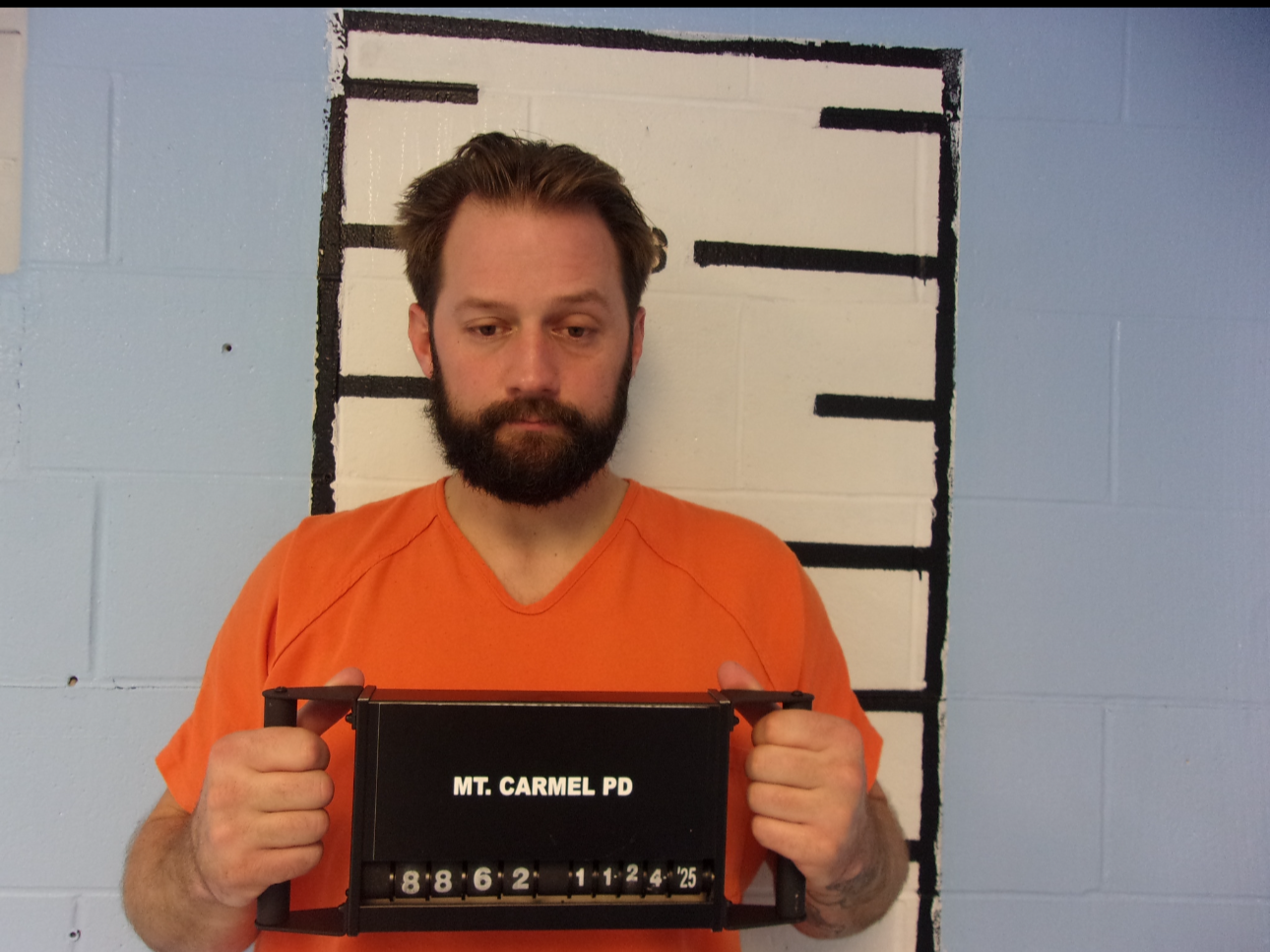
Birkla faces multiple charges, including aggravated domestic battery, unlawful restraint and interference with the reporting of domestic violence. The charges stem from alleged incidents last November.

Birkla’s case has been moving through Wabash County Circuit Court for several months, with Thursday’s hearing resulting in another delay before the case reaches a jury.

As with all criminal cases, the charges are allegations, and Birkla is presumed innocent unless proven guilty in a court of law.

Charges Dismissed Against Two Michigan Men in Wabash County

Charges have been dismissed against two Michigan men who were scheduled to stand trial next month in Wabash County Circuit Court.

53-year-old Matthew Wrosch and 51-year-old Steve Jones had faced felony and misdemeanor charges stemming from a 2024 incident in downtown Mt. Carmel.

According to court records, the State filed a motion for a nolle prosequi disposition Wednesday. Judge Denton Aud granted that motion Thursday, effectively dismissing the pending charges against both men.

Jones and Wrosch had been scheduled to go before a jury September 14th.

Both men had pleaded not guilty to a Class 4 felony charge of making a false alarm or complaint to 911, along with misdemeanor charges of filing a false report to a public safety agency and disorderly conduct.

The charges followed an altercation with Mt. Carmel Police while Jones and Wrosch were recording businesses and individuals along Market Street.

The two men operate YouTube channels with thousands of followers and describe themselves as First Amendment or constitutional auditors.

With the State's motion granted Thursday, the cases against Jones and Wrosch have been nolle prossed and the September jury trials will not take place

Judge Offers Updates On Local Road Projects

A major resurfacing project planned for Cherry Street/Route 1 North in Mt. Carmel and Wabash County has been pushed back several years.

During Friday's Ask the Mayor program on WSJD, Mayor Joe Judge said the resurfacing of Cherry Street north from 9th Street, which had been expected to begin later this year or early next year, has now been moved to around 2030.

Judge said city officials met about the project within the past two weeks and were told it had been placed in the state's 2031 budget, meaning construction would likely take place in 2030.

According to Judge, the delay comes as the state redistributes transportation funding and downstate Illinois receives less Motor Fuel Tax revenue. He said the Illinois Department of Transportation's Effingham district is also dealing with reduced funding and has been forced to reprioritize planned road projects.

Judge cautioned that the schedule could change again, noting additional funding could allow the Cherry Street project to be moved up.

Meanwhile, another planned project at the intersection of 3rd and Cherry streets has also been delayed.

Judge said city crews have struggled to obtain concrete this summer because of the large number of construction projects underway in Illinois and Indiana.

Crews are currently working on the Park Road sidewalk project. Judge said the city had planned to move next to 3rd and Cherry, but has instead shifted its attention to another intersection project expected to begin in late August or early September.

Rising Wabash River Threatens Crops Just Weeks Before Harvest

Farmers with crops in low-lying areas along the Wabash River are facing a difficult situation as rising water threatens thousands of acres just weeks before harvest.

Wabash Valley Service Company’s Mike Wilson discussed the impact of the flooding during Wednesday’s Valley Update on WSJD.

Wilson said an August rise on the Wabash River is unusual and comes at an especially difficult time because many soybean fields are approaching maturity.

Some farmers are now attempting to defoliate soybeans in river bottoms in hopes of harvesting them before floodwaters arrive. Wilson said products are being applied by both drones and ground equipment, but supplies are limited and the window for getting the crop out is extremely narrow.

One White County farmer, Wilson said, has about 400 acres of soybeans in bottom ground, but enough defoliant could only be found to treat about half of those acres.

Wilson said soybeans that go underwater before reaching maturity may never fully mature. Beans that are already mature can sometimes still be harvested after floodwaters recede, although quality can suffer from splitting and mud.

The situation is particularly frustrating because Wilson believes the local crop had been shaping up to be one of the strongest in the Midwest.

“In all my travels across the Midwest in the last two weeks, we’ve got the best-looking crop right here,” Wilson said.

But with the Wabash expected to rise close to 22 feet at Mount Carmel, Wilson said a significant amount of farmland on both sides of the river could be affected.

Additional rain chances over the next several days could also complicate efforts to harvest fields ahead of the water.

Outside the river bottoms, Wilson expects harvest activity in Wabash County to begin picking up after Labor Day. He said some corn has already been harvested in White and Gallatin counties, while early-planted soybeans are also being cut.

Overall, Wilson expects harvest south of Highway 50 to run roughly two weeks ahead of a normal schedule, while areas farther north could trail southern Illinois by another ten days to two weeks.

City Trying Again At Market Street Rehab Grant

The City of Mt. Carmel is taking another shot at securing a multimillion-dollar grant for improvements along Market Street.

At Monday afternoon's City Council meeting, commissioners unanimously approved Resolution 721 as part of the city's application for an Illinois Transportation Enhancement Program, or ITEP, grant.

City Clerk Ryan Turner said the resolution formally designates engineering firm Horner & Shifrin to prepare the grant application for the city.

If successful, the grant could be worth a couple million dollars and would fund new sidewalks and landscaping along Market Street from 3rd Street to 6th Street.

Turner said the city has included a potential 10-percent local match in the application to make the proposal more competitive at the state level. If required, that money would come from TIF funds, although Turner said there is a possibility the city would not ultimately have to provide the full match.

Mt. Carmel previously applied for the grant but was not selected.

Turner said the city is moving forward with another application in hopes of securing funding for the uptown improvements.