Advocates, accusing governor of ‘lack of engagement,’ urge passage of data center regulations by end of May

Advocates, accusing governor of ‘lack of engagement,’ urge passage of data center regulations by end of May

Members of both parties have shown a willingness to approve at least some regulations

Article Summary 

  • Advocates are calling for the General Assembly to pass the POWER Act to regulate data centers before the legislative session ends on May 31. 

  • The urgency, they say, is that data center projects continue popping up across the state, including three that were approved since the bill was introduced in February. But they’re critical of what they see as a “lack of engagement” by the governor’s office. 

  • The bill has only had subject matter hearings so far and hasn’t received any official votes, but Democrats and Republicans have indicated a willingness to regulate data centers. Stakeholders say they’re open to negotiations.

  • Illinoisans around the state have called for more transparency in the way data center projects are proposed and negotiated.

This summary was written by the reporters and editors who worked on this story.

By NIKOEL HYTREK
Capitol News Illinois
nhytrek@captiolnewsillinois.com

SPRINGFIELD — Environmental advocates continue to pressure lawmakers to require more transparency about data centers’ water and energy use as the legislative session creeps toward the finish line.

The POWER Act is the primary vehicle for regulations that address concerns about the effects data centers have on communities, but it hasn’t seen any action beyond subject matter hearings since it was introduced in February. 

With less than three weeks left before lawmakers are slated to adjourn, however, it’s unclear whether the wide-ranging bill will come together and whether Gov. JB Pritzker will throw his support behind any specific regulatory proposal. 

“We are confused and concerned by the Governor’s lack of engagement on the issue of data centers this spring legislative session,” Kady McFadden, lead lobbyist on behalf of the Illinois Clean Jobs Coalition that has been behind several recent energy reforms, said in a statement. 

Pritzker mentioned data centers in his February State of the State address, calling for PJM Interconnection, the electric grid operator that covers all or part 13 states from Illinois to the East Coast, to require data center developers to pay for and provide their own energy. 

He also proposed a two-year pause on state tax credits for new data centers to compensate for rising demand and higher prices. Illinois has provided tax incentives for data centers since Pritzker signed bipartisan legislation in 2019. According to the state’s 2024 report, at least 27 data centers had received incentives totaling $983 million in estimated lifetime tax breaks and benefits.

But the advocates behind the bill say he’s been silent since, even as a vast array of stakeholders indicate they have at least some interest in regulation. 

“The Governor’s Office continues to monitor and take note of all legislation that requires additional state resources,” a spokesperson said in an emailed statement. “As bills make their way to the second chamber, agencies and Governor’s Office staff will continue to educate members and budgeteers about the fiscal impact of bills.”

It’s not uncommon, however, for lawmakers to wait until the last minute to pass major legislation, including energy policy.

“Illinois has the opportunity to set real guardrails before even more projects move forward,” said Tyshianna Bankhead, executive director of Faith Coalition for the Common Good based in Springfield, at a House committee meeting on Tuesday. 

The urgency comes from the increased interest of data centers to develop in Illinois. A representative from Commonwealth Edison said the northern Illinois territory has almost 100 large-load projects in the queue. Since February, data center proposals have been approved in Sangamon County, Joliet and Yorkville. 

“This is not something that we can solve one community at a time,” Jen Walling, executive director of the Illinois Environmental Council, said at a Wednesday news conference. “This is a statewide issue, and it demands a statewide solution.”

Bipartisan support for regulation?

Advocates say they don’t know why the bill has stalled, because Democrats and Republicans have aired concerns about water use, energy prices and the lack of transparency around proposed developments. As with all legislation with the scope of the POWER Act, however, the devil is in the details. 

Walling pointed toward a Republican representative’s bill to regulate data centers and said she was encouraged by the conversation that happened in the Tuesday committee.

“I think that that hearing just showed a large level of support for moving forward and doing something, and how interested people are and how much all lawmakers are hearing from their constituents,” Walling said.

Rep. Jed Davis, R-Yorkville, filed House Bill 5755 on April 27, which would require municipalities to provide public notice and hearings for proposed data centers. It would also allow residents to gather signatures to trigger a referendum vote on proposed projects.

He said the bill was inspired by constituents who felt Yorkville didn’t listen to them before approving several data center projects. 

“I'm really hearing the voice of my constituents back home and how they feel silenced,” he said. "And, through this piece of legislation, I’m trying to give them fresh breath, give them a voice again, to empower them to have change locally.”

Davis told Capitol News Illinois he’s “right on the fence” as to whether he’d vote for the POWER Act, and he’s heard similar from some of his Republican colleagues. He said constituents have emailed him since “day one,” asking him to support the POWER Act.

Republicans have called for regulations on data centers, but they don’t want restrictions to interfere with data centers’ economic benefits and many dislike the requirement that new data centers get their energy from renewable sources. 

What would the POWER Act do

Despite several recent committee hearings on data centers, lawmakers this week commented on how the bill feels like it’s still in its early stages. Many members of the House Energy and Environment Committee said Tuesday they were learning details about the bill for the first time.

“Clearly, there's a lot of conversation that needs to happen around the bill,” said Rep. Carol Ammons, chair of the committee. “I'll just put on the record that my major concern and protection area will certainly be the Mahomet (Aquifer), which is sole source, and utilization of water is a huge, huge problem in the either existing data centers or those coming online.”

The POWER Act would prohibit nondisclosure agreements between governmental units and data centers and would require data center developers to create community benefits agreements in the places they’re located.

It would also require public water-use reports, environmental impact assessments, and would make data center developers build their own renewable energy generation to power the facilities.  

The bill is meant to address concerns about the millions of gallons of water data centers can use and the power strain they’ll put on an already struggling grid. 

The ComEd territory in northern Illinois, for example, has enough large-load energy projects in its queue to more than double the amount of energy demand in the territory by 2040.

Even the data center industry has indicated its open to regulation — at least nominally. 

Brad Tietz, the Midwest policy director for the Data Center Coalition, acknowledged that data centers have impacts on communities but said data center companies can be useful too, especially as technology for water and energy use evolve. 

“We've been asking throughout the session now for formal stakeholder negotiations to begin,” he said. “While we do have concerns with the POWER Act, a number of the issues are not insurmountable, and we'd love a chance to talk through this.”

Tietz said the data center industry would like to change proposals requiring data centers to provide their own renewable energy and water use reports to make them voluntary instead of mandatory — a proposition that’s unacceptable to environmental advocates.

Similarly, Joe Duffy with Climate Jobs Illinois, said his organization supports the goals of the POWER Act and is open to negotiating with other stakeholders, but it has concerns about whether the renewable generation projects required in the bill will be held to union labor standards. 

Climate Jobs Illinois also opposes a pause on the data center tax credit. 

“Without it, there's no guarantee that these projects benefit Illinois workers or Illinois communities,” Duffy said. 

McFadden said the Clean Jobs Coalition has spoken with labor interests about the bill, but they have not been able to sit down with the Data Center Coalition. 

Calls for transparency

Across Illinois, proposed data centers have drawn hundreds of Illinoisans to city council meetings and town halls demanding more information about how data centers will impact their communities. Many have called out the frequent use of nondisclosure agreements between data center companies and municipalities and limited time for public input.

In some cases, like in Naperville and Pekin, the outcry has been able to halt projects, but several communities have moved ahead despite opposition from residents.

“When it comes to data centers, communities are struggling to get basic information, let alone meaningful involvement,” Bankhead said at a House committee meeting on Tuesday. 

The Sangamon County Board approved a data center in April on a 17-10 vote after limited public comment. Bankhead said the board did not openly discuss the project.

“Information was difficult to access, and decisions seemed to move faster than the public process should, and many residents were left feeling like they were reacting to the process instead of being included,” she continued.

Joliet residents voiced similar concerns about the Joliet Technology Center, a planned 795-acre data center project that was approved in March on an 8-1 vote. 

“City officials were quiet or contemptuous, information was inconsistent and delayed, and technical analyses were either incomplete or unavailable to the public,” Noah Martinez, a member of Joliet Residents for Responsible Growth, said at a Monday news conference in Joliet. 

Capitol News Illinois is a nonprofit, nonpartisan news service that distributes state government coverage to hundreds of news outlets statewide. It is funded primarily by the Illinois Press Foundation and the Robert R. McCormick Foundation.
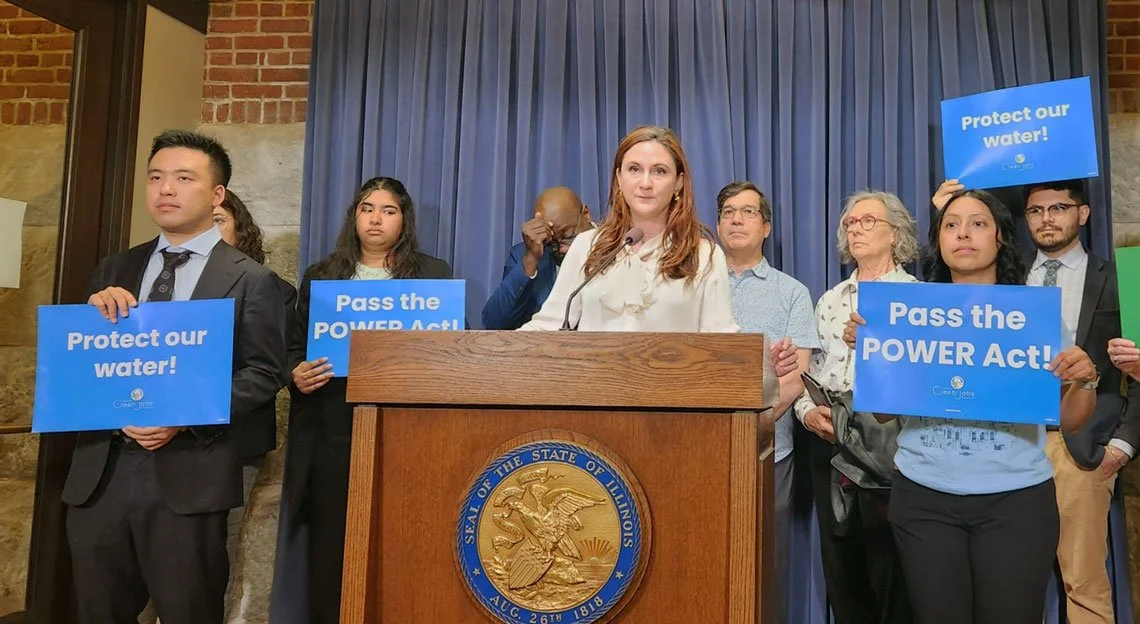

Jen Walling, the executive director of the Illinois Environmental Council, speaks about the POWER Act at a May 13, 2026, news conference. (Capitol News Illinois photo by Nikoel Hytrek)

Senate Democrats introduce bills to regulate artificial intelligence

 The eight-bill package tackles consumer protection, education, transparency

Article Summary

  • With less than a month left in the spring legislative session, Senate Democrats introduced a package of bills aimed at regulating some artificial intelligence usage.

  • The eight bills tackle consumer protections, chatbot transparency and how AI can be used in schools.

  • The senators said the lack of federal policy was part of their motivation for introducing legislation, by banding together with other states to create a standard.

This summary was written by the reporters and editors who worked on this story.

By JENNA SCHWEIKERT 
Capitol News Illinois 
jschweikert@capitolnewsillinois.com 

With just two weeks left in the spring legislative session, Illinois Senate Democrats introduced an eight-bill package aimed at regulating some uses of artificial intelligence after a lack of federal action on the issue. 

Illinois lawmakers modeled their bills that address consumer protection, developer transparency and educational usage after legislation in California and New York to create a “de facto national standard,” Sen. Bill Cunningham, D-Chicago, told Capitol News Illinois. 

In committee hearings, industry advocates voiced concerns about state-led regulations creating a “patchwork environment” that is difficult to do business in and encouraged lawmakers to wait for federal action. But no such movement has been made in Congress, and President Donald Trump signed an executive order in December discouraging states from “excessive” regulation.

“From our observation, not much is happening at all in Washington, so we felt it was necessary for us to act,” Cunningham said. “We also were motivated by the idea that two other big states have passed pretty meaningful AI regulation, California and New York, and together, we believe that our three states will cover about 40% of the AI market in the United States.”

Led by Cunningham, the senators said in a Wednesday news conference that they’re aiming to pass their bills before the chambers adjourn on May 31 — and they’re undaunted by threats from the federal government. 

Some of the bills include specific provisions about deferring to federal actions, if any come to fruition, and states are subject to federal law. But despite Trump’s threats, potentially including withholding broadband funding, Cunningham said lawmakers are dedicated to regulating AI.

“There are all sorts of threats happening right now about the federal government cracking down on states doing things that the Trump administration doesn't like,” Cunningham said. “We're going to do the right thing regardless of those threats, and that's what we're trying to do with this package.”

The bills are each aimed at specific, ongoing issues relevant to AI, and senators are looking to protect their constituents in those areas, Sen. Laura Ellman, D-Naperville, said. 

Transparency

Senate Bill 315 from Sen. Mary Edly-Allen, D-Libertyville, aims to require more transparency from large developers like OpenAI, the company that developed ChatGPT. 

“Illinois needs to create a road map for responsible innovation to prevent catastrophic risks,” Edly-Allen said, comparing the technology to the “Wild Wild West.”

“This is not about stopping innovation, but rather about balancing the great promise of AI with its potential harms,” she continued.

The bill would require large developers — those with annual gross revenues greater than $500 million — to create, follow and publish a framework detailing how the company approaches incorporating industry standards, assesses the model’s capabilities and potential for catastrophic risk, and identifies and responds to safety incidents. It would also require developers to review this framework annually and advertise any significant modifications.

The bill defines catastrophic risk as a predictable and substantial risk that, by helping a person to create or release a weapon or conduct an attack, a model will contribute to the death or serious injury of more than 50 people or more than $1 billion in damages.

Further, developers would be required to publish a transparency report before launching a new or significantly modified model and employ a third party to conduct annual audits, although it includes protections for trade secrets and national security. 

Developers would also be prohibited from making false or misleading statements about its framework or potential for catastrophic risk, from retaliating against employees for whistleblowing, and subject to civil penalties for violations.

A representative from Anthropic, the Claude model developer, testified in support of the bill, which passed unanimously out of committee on Wednesday.

Chatbots

Sen. Laura Ellman, D-Naperville, is sponsoring Senate Bill 316 to ensure that AI chatbots provide resources to struggling teenagers after rising rates of suicide and self-harm linked to chatbot use.

“AI isn't necessarily trained in crisis response, especially as it relates to mental health,” Ellman said. “Due to a lack of proper intervention, the teenager can commit self-harm, and in some cases, dies by suicide after confiding with an artificial intelligence chatbot. That is unacceptable.”

The bill would require operators of AI chatbots designed for social or emotional interaction — exempting models like customer service chatbots — to develop and maintain protocols around expressions of suicidal ideation and self-harm, including preventing the model from encouraging such behavior. When the chatbot recognizes such expressions, it would need to direct users to resources like crisis hotlines. 

The bill would also require operators to disclose to users that they are communicating with an automated system at the beginning of interactions and at least every three hours during ongoing conversations, and to prevent chatbots directed toward minors from generating sexually explicit material or encouraging sexually explicit conduct.

Senate Bill 317 from Sen. Rachel Ventura, D-Joliet, would require companies using customer service chatbots to disclose to consumers that they are speaking with an automated system.

“Automatic systems lack the empathy and human understandings that are essential,” Ventura said. “People deserve to know that they're communicating with a human or an AI system from the very beginning of interaction to increase transparency and accountability.”

The attorney general would have enforcement authority, unless a person experienced damages because of a violation, in which case they could bring a civil suit against the company.

Both bills passed unanimously out of committee on Wednesday.

Consumer protection

Sen. Steve Stadelman, D-Caledonia, is sponsoring Senate Bill 318 to prevent bots from buying and reselling event tickets.

“For too long, ticket buying has felt stacked against everyday fans who are forced to use their hard-earned money to pay exorbitant prices, in large part because so-called bots are scooping them up and reselling them for outrageous prices,” Stadelman said.

The bill would prohibit users from using bots, multiple accounts or email addresses from making mass purchases of event tickets. It would also prohibit resellers from falsely representing affiliation with an artist, team, venue or organizer. Venues and ticket issuers would also have to disclose how many tickets are withheld when other tickets are up for sale.

The bill passed unanimously out of committee on Wednesday.

Senate Bill 340 from Sen. Laura Murphy, D-Des Plaines, would require tech companies to give consumers the ability to opt out of data collection for personalized ads or for sale to third parties. It would also prohibit the sale of personal data to influence life-changing decisions like loan approvals, job screening or insurance rates.

“Illinois needs to protect our consumers' personal data from being collected by these companies,” Murphy said. 

The bill is modeled after a 2025 Minnesota law restricting the use and sale of consumers’ data. While the bill does not directly reference AI, the technology is often used to analyze consumer data.

Sen. Graciela Guzmán, D-Chicago, is sponsoring Senate Bill 343 to prohibit landlords from using AI-driven platforms to collude on rental prices.

“Housing is a human need. It should not be manipulated by algorithms built to maximize corporate profits at the expense of our communities,” Guzmán said. 

The bill would ban landlords from indirectly coordinating prices for residential rental units through third-party services. A representative from Illinois REALTORS testified against the bill, saying the organization is concerned that the bill puts liability on landlords as the end user rather than the software.

Murphy’s and Guzman’s bills passed out of committee along partisan lines on Wednesday.

Education

Senate Bill 415 from Sen. Karina Villa, D-Chicago, would restrict schools from using facial recognition software on school cameras. 

“No child should be subjected to invasive surveillance or have risk of their sensitive personal data collected and misused,” Villa said. “When it comes to protecting children's biometric information, Illinois must be steadfast in securing student privacy and preventing discrimination.”

Villa introduced the bill after students in her district were concerned about the safety of their biometric data being captured, she said. But Republicans on the committee expressed concern that the bill would limit schools’ ability to keep their students safe, although they ultimately voted to pass it out of committee.

“Public policy is balancing priorities, and I would place a greater priority on the safety of the students in school, school security, over an individual visit,” Sen. John Curran, R-Downers Grove, said. “Maybe its technology is not completely developed and precise right now, but it's going to continue to get better.”

Villa said she plans to bring an amendment to clarify how schools should handle existing contracts and data, and who — between students, teachers and visitors — the bill applies to.

Sen. Robert Martwick, D-Chicago, is sponsoring Senate Bill 416 to regulate the use of AI in the classroom. 

The bill would prohibit teachers from using AI to assign grades and would direct school boards to adopt a policy requiring the boards to approve any use of AI in relation to students or student work by the 2026-27 school year.

“Education should be an interactive collaboration with human beings as we try to develop the young minds of our young students,” Martwick said. “It should not be AI grading based off of implicit biases that are built into the systems.”

Martwick’s bill passed out of committee unanimously on Wednesday.

Moving forward

The package comes a month after a Senate subcommittee held nearly 11 hours of subject matter hearings over several days on dozens of similar, bipartisan AI regulatory bills. The package is, in part, a product of those hearings, Cunningham said.

All but two of the bills in this package passed out of committee unanimously, signaling bipartisan support for the regulations. How far that goes is yet to be seen, with some technical amendments expected before the bills are called for a vote on the floor.

“I think there are definitely things that both parties agree on, we see the potential of AI, we also see some of the potential harm, and there is a bipartisan belief in that,” Cunningham said.

The House and Senate are in alignment with their goals on AI regulation, Cunningham said, after chamber leadership met to develop a plan earlier this week.

 “I'm confident at the end of the day, we'll get bills out of both chambers that attack the problems we want to take care of,” Cunningham said.

And it’s not the be-all-end-all, Edly-Allen said: “This is not one and done. We're going to have to continue to come back and retool, but at this point, our most important job is to protect our constituency, and that's what all these pieces of legislation do.”

Capitol News Illinois is a nonprofit, nonpartisan news service that distributes state government coverage to hundreds of news outlets statewide. It is funded primarily by the Illinois Press Foundation and the Robert R. McCormick Foundation. 

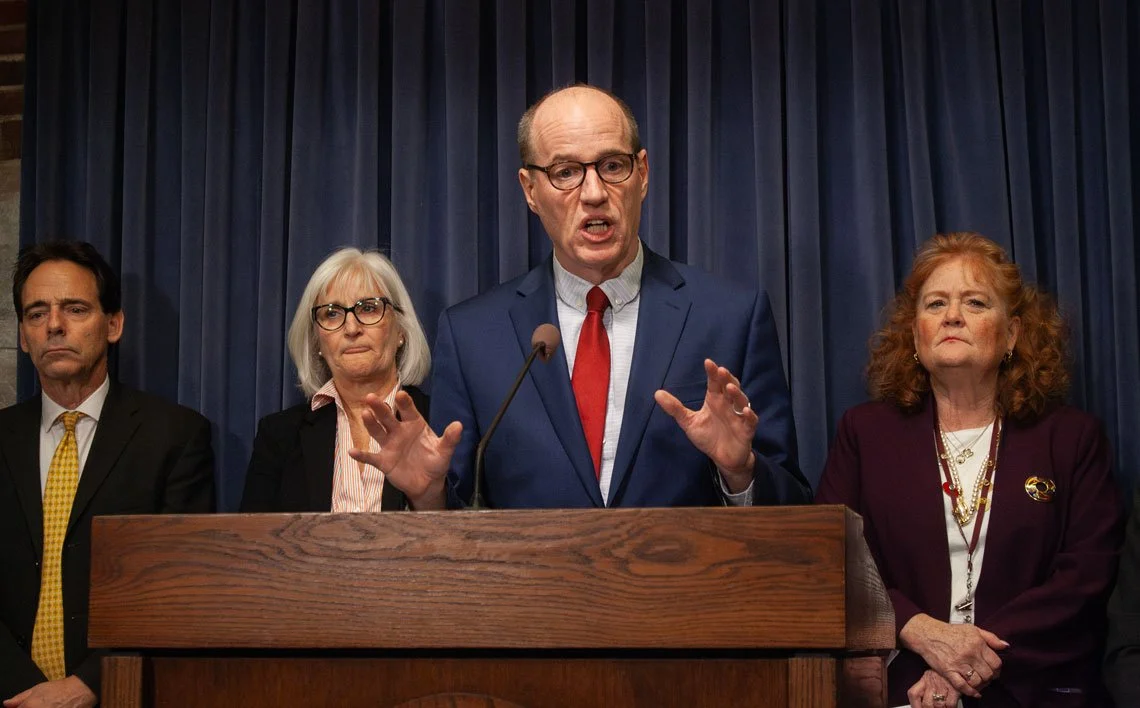
Sen. Bill Cunningham speaks at a news conference announcing the AI bill package on Wednesday, May 13, 2026. Cunningham said the package came, in part, out of a lack of federal action to regulate AI. (Capitol News Illinois photo by Jenna Schweikert)


IDOT targets young engineering talent with student loan assistance

The initiative aims to make IDOT more competitive for employment and tame a national engineer shortage 

By AIDAN KLINEMAN
Medill Illinois News Bureau
news@capitolnewsillinois.com

Article Summary

  • The Illinois Department of Transportation announced this week it will soon repay up to $60,000 in student loans for up to 50 eligible employees over four years as part of an initiative to attract recently graduated engineers in an increasingly competitive job market.

  • The Higher Education Student Loan Repayment Assistance for Engineers Pilot Program will reimburse engineers up to $15,000 annually after four years of service at the agency.

  • State-employed engineers are needed to support the Rebuild Illinois Capital Program, initially passed in the first year of the Pritzker administration in 2019.

  • Republicans are also working to assist the creation of new engineers for the state with a scholarship bill proposed by Senate Republican Leader John Curran. 

This summary was written by the reporters and editors who worked on this story.

SPRINGFIELD — The Illinois Department of Transportation announced this week it will soon repay up to $60,000 in student loans for eligible employees over four years as part of an initiative to lure recently graduated engineers in an increasingly competitive job market.

The Higher Education Student Loan Repayment Assistance for Engineers Pilot Program will reimburse 50 Illinois-educated engineers up to $15,000 annually after four years of service at the agency. IDOT hopes to incentivize young talent to remain in the state and the field, citing data from the American Council of Engineering Companies that shows a national shortfall of approximately 20,000 engineers per year due to retirements or departures from the field.

“At a time when workforce challenges continue to impact the engineering industry and public sector alike, this initiative will help attract and retain the next generation of transportation professionals needed to deliver critical infrastructure projects across Illinois,” Kevin Artl, president and CEO of ACEC Illinois, said in a statement announcing the initiative.

The student loan repayment program is the latest effort by Gov. JB Pritzker and the state to spur economic growth by retaining young talent. In February, the Illinois Retail Merchants Association launched an apprenticeship program for emerging Illinois retailers, and late last month, Pritzker announced public and private partnerships with computing giant IBM that will bring 500 apprenticeships to the company’s new innovation hub located in Chicago’s quantum park.

The program is funded by IDOT, with funds allocated as part of the Pritzker administration’s ongoing Rebuild Illinois efforts and paid out as bonuses. Rebuild Illinois has made significant investments in Illinois infrastructure projects since fiscal year 2020.

Massive infrastructure investments augment engineering needs

State-employed engineers are needed to support the Rebuild Illinois infrastructure program, passed in the first year of the Pritzker administration in 2019 and continued since then. The latest six-year plan calls for investing $50.6 billion in infrastructure, including $32.5 billion for transportation projects exclusively: the construction and maintenance of roads, bridges, public transit, freight and passenger rail, aeronautic facilities and ports.

This is not the first time IDOT has targeted young engineering talent. Last year, the agency implemented an “Intern to Hire” program meant to attract college students to civil engineering internships with the department by providing direct pathways to full-time employment.

The need to fill engineering positions at IDOT is also driven, in part, by federal legislation encouraging new projects. In 2021, President Joe Biden signed the $1.2 trillion Infrastructure Investment and Jobs Act, which allocated over $17 billion to Illinois public works projects over five years.

“We have more projects than ever at IDOT right now, thanks to the capital program and funding at the federal level,” Guy Tridgell, director of communications for IDOT, said. “And we need engineers to do that work.”

According to IDOT data, the state has invested over $24 billion in Illinois highway projects through Rebuild Illinois since the 2020 fiscal year. The state hopes young engineers will take advantage of these new jobs incentives and meet the demand for continued infrastructure investment.

Public sector recruitment for the long term

In addition to helping accomplish what Rebuild Illinois set out to do, Tridgell hopes the student loan repayment incentives will inspire young engineers to pursue long-term careers in public service.

“We’re aggressively taking a look at a variety of strategies to get young engineers, in particular, to come and work for the state,” Tridgell said. “It’s a good career — you learn a lot about the profession and you can make a real difference in your community.”

Sen. Ram Villivalam, D-Chicago, initially sponsored legislation calling for the program. He said he hoped the incentives would encourage students to pursue engineering careers with reduced financial pressure.

“We know that access to higher education is challenging,” Villivalam told Capitol News Illinois. “So making sure that young students and folks looking at different career opportunities understand that there are tools available to them to make it more affordable, make it more accessible to pursue a career in engineering.”

Republican Leader proposes scholarships amid delay

In addition to the Pritzker administration's IDOT loan repayment program, Republicans are also working to assist the creation of new engineers for the state. 

Senate Republican Leader John Curran, R-Downers Grove, is a lead sponsor of Senate Bill 3855, which would create scholarship and living stipend incentives for engineering students attending Illinois public universities at the front end of their higher education careers. Curran supports the student loan repayments in addition to his own proposal, but noted that the repayments have been delayed.

“I’m glad they’re moving forward with it. It’s well past time,” Curran told Capitol News Illinois. “We are behind on capital.”

Similar to the student repayment plan, Curran’s scholarship bill requires eligible students to commit to working for IDOT for at least three years. He argues that scholarships would unlock more opportunities for students and help assuage financial concerns that arise from college decisions sooner.

“It is a way to help not only lock them in early, but also a pathway to pay for school,” Curran said. “It’s a win-win.”

Curran’s bill was assigned to committee and is currently awaiting a hearing, with a deadline of Friday.

Aidan Klineman is an undergraduate student in journalism with Northwestern University’s Medill School of Journalism, Media and Integrated Marketing Communications, and is a fellow in its Medill Illinois News Bureau working in partnership with Capitol News Illinois.

Capitol News Illinois is a nonprofit, nonpartisan news service that distributes state government coverage to hundreds of news outlets statewide. It is funded primarily by the Illinois Press Foundation and the Robert R. McCormick Foundation.

A truck drives on Illinois roads. (Medill Illinois News Bureau photo by Jacques Abou-Rizk)

School choice option at standstill as legislators weigh benefits, political fallout

Illinois takes cautious approach on whether to opt into federal tax credit program

By MARISA GUERRA ECHEVERRIA 

Medill Illinois News Bureau 

news@capitolnewsillinois.com

CHICAGO — Diverse interest groups — from public school activists and downstate voters to state officials and school boards — have pushed Gov. JB Pritzker to finally make a decision about the Trump administration’s Education Freedom Tax Credit.

Yet, there has been mostly silence from the Governor’s Mansion as Pritzker considers opting into the controversial school choice tax credit, an initiative that has also stalled in a bipartisan state Senate Bill 3776 due to scarce conversations with colleagues, according to chief sponsor, Sen. Adriane Johnson, D-Buffalo Grove.

The tax credit, passed under the One Big Beautiful Bill Act in 2025, is a dollar-for-dollar non-refundable federal tax credit for donations of up to $1,700 a year to authorized scholarship-granting organizations. Scholarships under the tax credit do not have a cap and are decided by the donor organizations. 

The organizations then distribute scholarships to eligible families, whose income must be below 300% of their area’s median income, leaving a wide eligibility range. Families can then decide to spend their scholarships on expenses for private, public and charter schools, including private school tuition, tutoring and uniforms, according to a January 2026 fact sheet published by the U.S. departments of Education and Treasury.

Read more: Lawmakers decline to extend private school scholarship tax credit program

As a federal initiative, any taxpayer can take advantage of the tax credit — but students can only receive the scholarships if their governor or legislatures opt them in.

So far, 31 states have planned to opt into the program, most led by Republican governors, according to a tracker from Education Week

The Treasury Department and IRS have yet to promulgate federal regulations to implement the program, causing some states to pause before deciding. 

In a statement on May 8, a spokesperson for the governor’s office confirmed the governor's team is reviewing the federal tax credit.

“We will evaluate the issue through a lens focused on affordability for working families and what best supports Illinois students, families, and public schools,” the spokesperson wrote in an email to CNI. 

As the states await federal guidelines, Pritzker and state legislators in Illinois are measuring the costs, benefits and political calculus behind the decision to opt into the program. 

A ‘voucher’ in disguise?

Public school advocates have rallied against the tax credit, arguing it is a voucher program, in which the state directly funds students’ private school tuition. They argue that the tax credit will ultimately siphon funds away from public schools to pay for private education. 

Proponents of the tax credit, on the other hand, make the distinction that private funds power the scholarships, and that the initiative does not interfere with local or state tax dollars funding public education.

Paul Bruno, assistant professor of education policy, organization and leadership at the University of Illinois Urbana-Champaign, maintains that the debate is “a distinction without a difference.”

“What we call it is mostly people trying to score rhetorical points and doesn't actually make a big difference from a normal person point of view,” Bruno said. 

In addition, Cassie Creswell, executive director and president of Illinois Families for Public Schools, argues that public schools will face increased disenrollment and higher fixed costs as a result, posing a key risk for already-underfunded schools.

The sentiment is shared on the House side by Rep. Carol Ammons, D-Urbana, who said in a statement to CNI that opting into the tax credit may also “incentivize privatization over investment in public education.”

“Our responsibility is to strengthen the public systems that serve the vast majority of students across this state,” Ammons wrote. “Policies that create parallel systems of funding risk deepening inequities rather than addressing them.” 

However, Bruno points out that funding outcomes largely depend on school districts’ and local governments’ response to declining enrollment, a crisis that Illinois public schools already face. 

He said that decreased enrollment could actually incentivize greater per-student-spending, which has steadily increased since fiscal year 2020 despite declining enrollment dating back to 2018, according to the 2024-2025 Illinois Report Card.

House Republican Leader Tony McCombie, R-Savanna, who has sponsored corresponding legislation to opt into the federal tax credit in the House, maintains that regardless of funding debates, legislators must recognize that “traditional public schools cannot be the only option available to families,” especially those in underserved communities. 

While initially skeptical of the tax credit without federal guidelines, Johnson said its potential use to supplement public education for lower-income families was what tipped the scales for her. 

“So it isn't like it's enough money to then take you from another school, you know, from your school,” Johnson said. “It's just really to augment whatever the funding you get as a student and some to pay for additional services and programs if your family doesn't have the resources.”

Some education nonprofits have found themselves caught in the middle of the tax credit debate, forced to weigh the potential benefits of expanded tutoring access against the threat it may create for public schools.

Jessica Handy, executive director of Stand for Children Illinois, describes the group as an “anti-private school voucher” organization that still supports “high quality and equitable” school choice, particularly charter schools. 

However, as a part of the Illinois Early Literacy Coalition, which supports greater funding for literacy tutoring programs, Handy said Stand feels “torn” on the matter. 

“We all care really deeply about public education,” Handy said. “We all care really about equitable access and opportunity. And I think there's just a lot of variables about what this program would mean for both of those.”

Legislators remain wary

One of the central concerns behind the federal tax credit include the extent to which it will benefit public schools, and whether the institutions it benefits will be open to students of all protected groups.

In many rural areas, for example, there are no private schools that would be eligible for the tax credit. 

The argument against funding private schools arose from Illinois’ now-defunct state tax credit, Invest in Kids, which ended in 2023. According to Cresswell, a majority of private schools that benefited from the program discriminated on the basis of at least one protected status, most frequently discriminating against students with disabilities.

“It funded discrimination, it hurt education equity, and we certainly don't want to see that replicated on an even bigger scale with even less oversight, less accountability, less transparency on how these dollars are being spent,” Cresswell said. 

While some have proposed for legislators to set state-level guidelines for the federal tax credit, Cresswell said it’s "basically legally impossible” to enforce, especially if discriminatory practices are due to schools’ religious beliefs. 

To Johnson, the long-running discrimination debate reinforces the need for flexible school choice for parents among public, private and religious schools.

“(Critics) forgot that they, too, have choice. It could be a private school, but it doesn't have to be a religious-based school,” Johnson said. 

What comes next?

Support in the legislature for the federal tax credit so far has almost exclusively come from Republicans in the House, with House Bills 4098 and 4099. for Johnson and her Senate bill co-sponsor, Sen. David Koehler, D-Peoria, are the only Democratic sponsors in either chamber.

The bills remain at a legislative standstill, with the House bills stuck in the Rules Committee since October and the Senate bill languishing in Assignments since February. To Sen. Chris Balkema, R-Channahon, it simply means the Democratic leadership team is not excited by the measure, partly due to added political pressure. 

Johnson attributes some of the struggle to what she called "misinformation" about the tax credit defunding public schools, and that the next step would be to “educate” her colleagues and the public to garner support for the bill. 

Pritzker’s caution in weighing in on the federal tax credit has incurred both criticism and praise at the current stage of the political debate. 

Johnson added she supports the decision to be “prudent” in awaiting federal regulations, but argues that they can signal their support of the program to Illinoisans by advancing the bill “with caution.” 

Leslie Hiner, vice president of legal policy at EdChoice, attributes Pritzker’s hesitance to the political clout of state teachers unions in upcoming elections. She claims the decision to opt in would be a “no-brainer” if politics weren’t involved. 

Bruno, on the other hand, contends that the tensions in the decision exist beyond the elections, as he sees a large constituency in Illinois will be upset if their students can’t access scholarship money while other states will under the program. 

“Taxpayers in Illinois already pay more to the federal government than they get in benefits,” Bruno said. “You can think of a program like this as potentially doing something similar and making that even more extreme.” 

Balkema heralds the tax credit program as a rare gift from the federal government. He called on Democrats and skeptics of the Trump administration to support the legislation and to not allow “unhappiness with a personality get in the way of doing the right thing.”

“Why would we, Illinois, not take advantage of that and provide tax relief for people that are having to write these checks to property tax bills, and then also for their child's education that they could get reimbursed for?” Balkema said. 


Marisa Guerra Echeverria an undergraduate student in journalism and political science with Northwestern University’s Medill School of Journalism, Media, Integrated Marketing Communications, and a fellow in its Medill Illinois News Bureau working in partnership with Capitol News Illinois. 

Capitol News Illinois is a nonprofit, nonpartisan news service that distributes state government coverage to hundreds of news outlets statewide. It is funded primarily by the Illinois Press Foundation and the Robert R. McCormick Foundation.

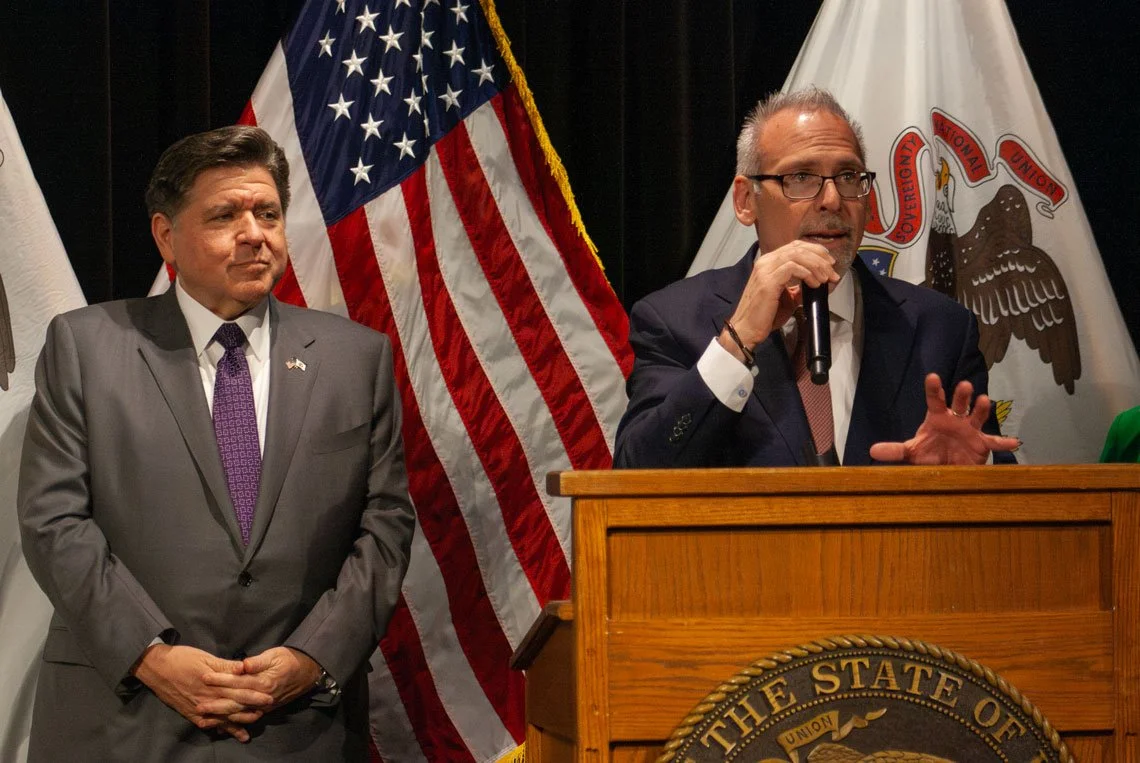
Gov. JB Pritzker and Illinois Superintendent of Education Dr. Tony Sanders speak at an event at the Governor’s Mansion in March 2026. (Capitol News Illinois photo by Jenna Schweikert)

Ex-residents of apartment building targeted in massive immigration raid seek millions in damages

Feds claimed Venezuelan gang had ‘taken over’ Chicago complex

By HANNAH MEISEL
Capitol News Illinois
hmeisel@capitolnewsillinois.com 

Article Summary 

  • Immigrant rights groups have filed federal tort claims against the U.S. Department of Homeland Security over the Sept. 30, 2025, immigration raid on an apartment complex in Chicago’s South Shore neighborhood.

  • Roughly 300 immigration agents stormed the building in a middle-of-the-night raid in the early weeks of “Operation Midway Blitz” this past fall, ultimately arresting 37 people allegedly without warrants.

  • The 18 former residents who filed claims this week are seeking $5 million each in damages for agents’ alleged actions, including marching them outside in various states of undress and restraining them with zip ties. Those zip-tied outside the building for hours included undocumented immigrants and U.S. citizens alike — allegedly including children, though DHS denies that.

  • After the raid, the building’s already-poor condition deteriorated further, leaving residents essentially homeless when a Cook County judge deemed the apartment complex uninhabitable in November.

This summary was written by the reporters and editors who worked on this story. 

CHICAGO — In a series of federal tort claims filed this week, immigrant rights groups took the first step in suing the Trump administration on behalf of 18 former residents of a Chicago apartment building that became the site of a surreal middle-of-the-night military-style immigration raid in September.

The raid, which began after midnight on Sept. 30, 2025, unfolded in dramatic fashion as immigration agents rappelled down from a Black Hawk helicopter onto the building’s roof in Chicago’s South Shore neighborhood. Some of the roughly 300 total agents who orchestrated the raid deployed flashbang grenades and broke down doors without warrants, allegedly holding residents at gunpoint or using other types of force to march them outside in their pajamas or various states of undress.

By dawn, dozens of residents — children and adults, undocumented immigrants and U.S. citizens alike — shivered in the parking lot, their wrists and, in some cases, ankles restrained with zip ties. The Department of Homeland Security denies children were “handcuffed or restrained” during the raid but acknowledged some juveniles were taken into custody “for their own safety” to ensure they “were not being trafficked, abused, or otherwise exploited.”

The former residents, which include two U.S. citizens, are seeking millions of dollars in damages for federal agents’ actions during the raid. The legal filings, made public on Wednesday, describe residents’ screams in both fear and pain — including one man who suffered multiple dog bites from a K9 agent. The filings also detailed residents’ embarrassment at being filmed by a professional camera crew despite not being fully dressed. The footage would ultimately become highly produced promotional video for DHS used on social media.

“The U.S. government has no right to inflict this level of emotional distress and property damage and then just walk away — seeking compensatory damages is a necessary step toward righting the wrong these members of our communities, including families with young children, experienced that night,” said Allena Martin, senior litigation attorney at the Chicago-based National Immigrant Justice Center.

Read more: The real story behind the midnight immigration raid on a Chicago apartment building | ‘I lost everything’: Venezuelans were rounded up in a dramatic midnight raid but never charged with a crime

The chaotic night, just a few weeks into “Operation Midway Blitz,” marked a major flashpoint in the mass deportation campaign. Top White House immigration policy advisor Stephen Miller justified the raid claiming the building was a “Tren de Aragua complex filled with TdA terrorists,” referring to the violent Venezuelan gang. 

But not one of the 37 residents arrested in the raid has been charged with a crime, despite the Trump administration’s claims that two of the arrestees were “confirmed” members of Tren de Aragua.

Instead, the 18 residents who filed claims this week — one of whom was detained outside the building a week prior to the raid — claim they and their neighbors were “targeted based on race and ethnicity.” 

In the aftermath, many of the 37 people arrested remained in immigration detention for weeks or months. A number of them have been deported or have asked for voluntary departure.

In response to a request for comment, DHS sent the same statement it’s issued for months, saying the raid “was performed in full compliance of the law,” and touting the arrests of immigrants with criminal records. Two of those arrested, including a U.S. citizen, allegedly had active warrants out for them.

In addition to the NIJC, three other major immigrant rights groups are behind the effort, including the Mexican American Legal Defense and Educational Fund, the University of Chicago Immigrants’ Rights Clinic and the Chicago-based MacArthur Justice Center.


“We should not live in a country where the federal government can use violations of the Constitution as propaganda and get away with it,” Jonathan Manes, senior counsel at MacArthur Justice Center, said. “This raid was a nightmare turned into reality. It put federal agents’ abuse of power on full display while leaving the Chicago community traumatized.”

A traumatic night

Though civilians can sue state and local law enforcement officers for alleged civil rights violations, federal law enforcement officers are exempt. Instead, those who believe they were harmed by federal agents or other employees can file complaints under the Federal Tort Claims Act, which allows for compensation for death, injury, property damage or emotional distress. 

The 18 former residents are seeking $5 million each, plus property damages.

The federal government has six months to respond or settle a claim within six months. If an agency does neither — or denies a tort claim — filers can then sue in federal court, where individual officers can be deposed and internal government records subpoenaed.

The claims name DHS and subsidiary agencies U.S. Immigration and Customs Enforcement, or ICE, U.S. Customs and Border Protection and U.S. Border Patrol. It also names the FBI and the Bureau of Alcohol, Tobacco, and Firearms, both of which fall under the U.S. Department of Justice.

The legal filings paint a picture of how agents stormed the 130-unit building shortly before 1 a.m. on Tuesday, Sept. 30. The account of one man, Johandry José Andrades Jiménez, describes how his wife woke him up after hearing helicopters outside and other noises from within the building. Within minutes, agents were outside their unit, yelling for them to “Open the door! Get out! Get out!” according to the filing.

When Andrades Jiménez did not open the door, agents allegedly hit it forcefully enough for them to breach the apartment. Four “heavily armed” agents entered and “pointed their weapons” at him.

“The agents ... ordered Mr. Andrades Jiménez to get on the floor ‘or I’ll kill you,’” the filing states.  “Agents struck Mr. Andrades Jiménez in the head with a rifle and threw him to the floor. They did this in front of his wife and children, who were crying.”

He was then zip-tied and asked whether he was a member of Tren de Aragua, which he denied. 

Still shirtless, he was eventually forced into a van with 15 other male residents who’d been arrested and taken to the ICE processing facility in Chicago's near-western suburb of Broadview. There, he was allegedly held in crowded conditions and “deprived of adequate basic necessities, including water.” 

Read more: Judge orders ICE to clean up conditions in Broadview facility that’s ‘become a prison’ | Judge calls alleged conditions at Broadview ICE facility ‘unnecessarily cruel’ after day of testimony

Over the next two months, he was transferred to several ICE facilities in multiple states and eventually deported in December, according to reporting from ProPublica, separating him from his wife and three daughters, the youngest of whom was six months old at the time of the raid.  

Other claimants’ filings, the majority of which are for members of three separate families, described children’s reactions to the raid. In one family’s account, the father feared agents would break down their door and hurt their four children, so instead he opened the door. When he did, he saw “agents pointing guns into his apartment” right at his family. The couple “huddled with their children as the children screamed and cried in terror,” according to the filing.

Agents restrained the father with zip ties and then yelled at the family in English, pushing all six of them out of their apartment in their pajamas, with the father and mother held at gunpoint, according to the filing. As they walked through the hall, “the family saw agents break down their neighbors' doors. children became increasingly distressed and started crying even harder than they already were.”

Once outside, agents lined up the family with dozens of other residents and took pictures of each person in line. When agents separated the father, their children became even more upset.

“Her children were crying and screaming, except for D.J.D.L., who was having a panic attack — he could not speak or move,” according to the mother’s claim, referring to her 9-year-old son by his initials.

Landlord coordination

In January, the Illinois Department of Human Rights opened an investigation into the building’s former landlords, who coordinated with DHS prior to the raid claiming the complex was becoming overrun by Tren de Aragua. According to February legal filings that cite two arrest records from the raid, agents attested to having received “owner/manager’s verbal and written consent.”

Arrest records also stated the raid was planned “based on intelligence that there were illegal aliens unlawfully occupying apartments.” The Department of Human Rights’ official housing discrimination charge alleges building management “unlawfully discriminated against their tenants” both by neglecting maintenance requests and then tipping off DHS.

Read more: State investigating landlord of Chicago apartments raided by immigration agents

In addition to many longtime residents, most of whom were Black U.S. citizens, the building was home to many Venezuelan migrants who arrived in Chicago in the latter half of the Biden administration. Republican governors sent thousands of migrants in busses from states like Texas to “sanctuary” cities run by Democrats, including Chicago.

Some living in the complex were squatters, and reporting by ProPublica found there had been drug dealing and prostitution in the building. In June, one Venezuelan resident allegedly executed his neighbor, another Venezuelan national, after he and two others forced their way into the victim’s apartment. 

A recently published report by a state commission charged with memorializing alleged abuses during Operation Midway Blitz cited an internal CBP report on the raid that pointed to federal law enforcement intelligence as the basis for the operation. According to the report, the feds had intelligence “indicating that TdA (Tren de Aragua) members and other suspected criminals had ‘seized control of approximately 30 vacant apartments’ in the building and that ATF had conducted several undercover operations to purchase illicit firearms in the apartment complex.”

Read more: Accountability Commission refers federal agents for investigation, possible prosecution for conduct last fall | State commission finds agent abuses were ‘greenlit by Washington’ for Operation Midway Blitz

The building, which had been deteriorating for years according to reporting by the Chicago Tribune and Block Club Chicago, was left in shambles after the raid. In November, remaining residents were forced out of the building after a Cook County judge deemed it uninhabitable and ordered the property vacated for safety reasons. 

The state Department of Human Rights’ January filing alleges building management “blamed Venezuelan tenants for their own (management's) failure to provide needed locks and security service, as well as other needed maintenance and repairs, and perpetuated stereotypes” so that all Venezuelan nationals living in the building would be associated with Tren de Aragua. 

Capitol News Illinois is a nonprofit, nonpartisan news service that distributes state government coverage to hundreds of news outlets statewide. It is funded primarily by the Illinois Press Foundation and the Robert R. McCormick Foundation.


Federal drug discount expansion proposal may cost Illinois millions, agency head says

Memo details how expanding 340B program would impact private health plans and state employee insurance

By PETER HANCOCK
Capitol News Illinois
phancock@capitolnewsillinois.com

Story Summary

  •  The 340B Drug Pricing Plan is intended to give safety-net clinics and rural hospital access to discounted drugs.

  • Pending legislation to expand those providers’ access to those discounted drugs has sparked strong lobbying campaigns for and against the proposal.

  • A memo obtained by CNI details the potential impact passage of the bill would have on group health insurance plans, including Illinois’ state employee health plan.

  • But groups representing the healthcare organizations who would benefit from HB 2371 questioned the memo and called attention to the expensive lobbying campaign aimed at killing it.

This summary was written by the reporters and editors who worked on this story.

Editor’s note: This story was updated with further comment from health care groups.

SPRINGFIELD — A proposal that would expand access to a federal program that discounts the price of prescription drugs could end up costing Illinois employers an additional $89 million a year, including more than $12 million a year for the state of Illinois itself.

That’s according to a memo, dated May 12, from the Department of Central Management Services, the state agency that administers the state employee health plan, to Rep. Travis Weaver, R-Edwards, who requested the information following a meeting of the legislative Commission on Government Forecasting and Accountability, or COGFA.

Capitol News Illinois obtained a copy of the memo through a third party. But groups representing healthcare organizations quickly disputed its findings.

The proposal, contained in a Senate amendment to House Bill 2371, is intended to give Federally Qualified Health Centers, Ryan White AIDS clinics, safety-net hospitals and other healthcare providers that serve large volumes of Medicaid patients greater access to what’s known as the 340B Drug Pricing Program.

What is the 340B program?

That’s a federal program, established in 1992, that requires drug manufacturers to provide drugs to those facilities at substantially discounted prices. Those facilities then mark the price back up when they dispense or prescribe the drugs to their patients. That spread between their acquisition cost and the price they charge becomes an indirect revenue stream that helps feed their bottom line.

The bill pending in the General Assembly, which awaits a final vote in the House, would prohibit drug companies from restricting the ability of those hospitals and clinics to acquire those discounted drugs through contract pharmacies.

That’s something many clinics and safety-net hospitals say they’ve experienced in recent years, limiting their ability to acquire drugs at the discounted prices.

The bill would also prohibit drug manufacturers from requiring 340B-qualified hospitals and clinics to report ingredient cost or pricing data, to report how they manage inventory of 340B drugs or to submit any data or information not required by state or federal law as a condition of participating in the 340B program.

The bill has generated enormous lobbying campaigns on both sides of the issue, shedding light on the complexities of how prescription drugs are priced in the United States and how a seemingly small change in one area can have far-reaching unintended consequences.

During an April 14 COGFA hearing, Shawn Gremminger, president and CEO of the National Alliance of Healthcare Purchaser Coalitions, explained how the 340B program has grown beyond what anyone expected when it was created.

“It was a program designed to be so small, they didn't bother giving it a name,” he said. “Literally, it's called 340B because it just sits at section 340B of the Public Health Service Act.”

Over the years, he said, as Medicaid programs expanded, so too did the number of hospitals that were able to qualify for the 340B drug program. And as those hospitals became eligible, Gremminger said, all of their affiliated clinics and medical practices became eligible, too.

Today, Gremminger said, the 340B program is the second-largest drug purchasing program in the country, behind Medicare Part D, and growing by an average 15% to 20% each year.

In Minnesota, he said, one hospital operated by the University of Minnesota earns more money through the 340B program than all of the state's rural hospitals, community health centers and Ryan White AIDS clinics combined.

But groups representing the healthcare organizations who would benefit from HB 2371 questioned the memo and called attention to the expensive lobbying campaign aimed at killing it.

“The memo released this week by CMS simply regurgitated Big Pharma’s testimony from the April 14th COGFA hearing,” Illinois Health and Hospital Association president and CEO AJ Wilhelmi said in a statement. “The footnotes in the memo clearly indicate that the research referenced in the memo was funded by Big Pharma. So, unsurprisingly, Big Pharma is trying to misrepresent the government’s position on the legislation.”

Groups including the Illinois Council of Health-System Pharmacists and the Illinois Pharmacists Association say Illinois’ legislation “preserves the original intent” of the 340B program, rather than expands it.

Impact on other health plans

The problem for many health insurance plans like Illinois’ State Employees Group Insurance Program, or SEGIP, is that when their members go to a 340B-qualifying hospital or clinic, those plans pay the full marked-up price for any drugs their members receive. But the plans no longer receive any manufacturer’s rebate for the drugs they purchase, thus raising the net cost of prescription drugs for patients enrolled in those health plans.

“Effectively, our rebates are crowded out by the 340B rebate,” Gremminger said.

“The 340B program was created by Congress to help low-income and uninsured patients access medicines, but it is difficult for Illinois to confirm that its patients are benefiting as intended or to understand the impact on taxpayers and employers,” Will May of the pharmaceutical trade organization PhRMA said in a statement.

Following that meeting, Weaver requested additional information from CMS, including an estimate of the fiscal impact passage of HB 2371 would have on the state employee health plan.

“Independent analysis estimates that the current 340B program costs Illinois employers approximately $224 million annually, with the proposed legislation expected to increase those costs by an additional $89 million,” CMS said in the memo. “For SEGIP specifically, lost rebates are estimated at $31 million annually, with an additional projected impact of $12.4 million under the proposed legislation.”

The memo cites an analysis published in 2024 by the health industry research and technology firm IQVIA. The health care groups, however, say that study was funded by the National Pharmaceutical Council and thus provides untrustworthy data.

“The focus of this conversation should remain on the Illinois patients and providers who depend on the 340B program, not on the financial interests of the pharmaceutical industry,” Ollie Idowu, President & CEO, Illinois Primary Health Care Association, said in a statement.

Pending legislation

As debate over HB 2371 continues, lawmakers will be asked to weigh the estimated cost to employers, including the state of Illinois itself, with the cost currently being borne by community health clinics and other providers who were originally intended to benefit from the program.

Cyrus Winnett, executive director of the Illinois Primary Health Care Association, a group that represents Federally Qualified Health Centers, said during an interview in March that under current law, drug manufacturers have been able to restrict the number of pharmacies or suppliers where clinics can acquire 340B-discounted drugs, thus limiting their ability to reap the financial benefit.

“What pharmaceutical manufacturers began doing was limiting the distribution of these drugs to a single location,” he said. “And when I say single location, I don’t mean Walgreens chain or CVS or a local independent. I mean one physical location, which for our organizations and their patients that have wide service areas, that’s extremely limiting.”

The proposed legislation originated in the Senate as an amendment to a bill that had previously passed the House. That amendment passed the Senate on May 29, 2025, by a vote of 55-0. It then went back to the House for a vote to concur in the Seate amendment, but so far the House has not taken further action.

Sen. Dave Koehler, D-Peoria, who sponsored the amendment last year, said during the April 14 COGFA hearing that the current system of pricing and delivering drugs in the healthcare marketplace is imperfect, but that lawmakers can only work with the tools they have.

“Is this the best way to cover rural hospitals or FQHCs? No, it's not,” he said. “But you know what? Congress gives us the tools that we have to use. And when we have rural hospitals in our area, or FQHCs, or poor people that are now being kicked off of Medicaid, we have to respond to our constituents.”

Capitol News Illinois is a nonprofit, nonpartisan news service that distributes state government coverage to hundreds of news outlets statewide. It is funded primarily by the Illinois Press Foundation and the Robert R. McCormick Foundation. 


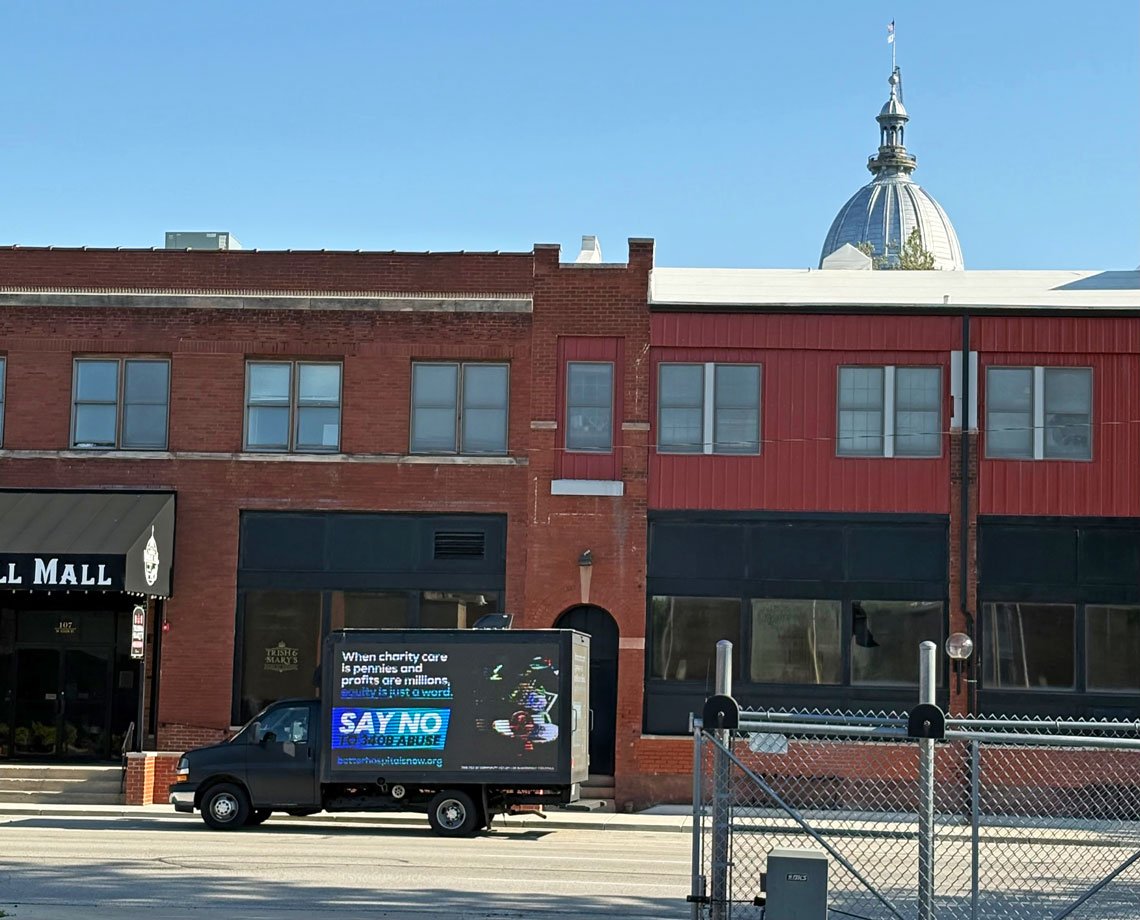
A billboard truck urges lawmakers to “say no to 340B abuse” as it makes its rounds in the neighborhood surrounding the Illinois State Capitol. (Capitol News Illinois photo by Jerry Nowicki)

Tech giants sued over ‘stealing’ voices of well-known journalists, voice actors to train AI

The 9 Class actions filed under Illinois’ strongest-in-nation biometric data privacy law

By HANNAH MEISEL
Capitol News Illinois
hmeisel@capitolnewsillinois.com 

Article Summary 

  • A group of well-known Chicago journalists, podcasters and voice actors are behind nine class-action lawsuits filed this week alleging major tech companies used their voices without their permission in order to train AI products.

  • The lawsuits represent a new area of focus for Illinois’ strongest-in-the-nation biometric data privacy law, which has spawned thousands of lawsuits in the last decade or so. The litigation has netted Illinoisans millions of dollars in settlements, mostly over the collection of employees’ fingerprints in timeclock technology.

  • Plaintiffs include locally famous broadcast journalists Carol Marin and Phil Rogers, both retired from Chicago’s NBC 5 news station, along with prolific audiobook narrators and podcasters.

This summary was written by the reporters and editors who worked on this story. 

CHICAGO — Over hundreds of pages in legal filings this week, a group of well-known Chicago-based journalists, podcasters and voice actors accused tech giants like Google, Amazon, Apple, Microsoft and others of “stealing” their voices to train Artificial intelligence.

The nine class action lawsuits, filed in Chicago’s federal court between Monday and Wednesday, represent a new frontier for Illinois’ strongest-in-the-nation biometric data privacy law. In the last decade or so, the state’s Biometric Information Privacy Act, or BIPA, has spawned thousands of lawsuits against companies alleged to have collected and stored biometric data from employees and customers without proper notice or consent.

The vast majority of that litigation — which has paid out millions of dollars to Illinoisans mostly via class-action settlements — has been over employee fingerprints collected by timeclock technology, though Facebook’s $650 million settlement in 2020 was with users over facial recognition.

Read more: Court rulings supercharge Illinois’ strongest-in-nation biometric privacy law

But as companies adopted policies to comply with BIPA and the pool of plaintiffs began to dry up, technology has rapidly evolved. Smart security cameras, safety cameras focused on workplaces, online “try-on” technology that allows users to envision, for example, what a certain pair of glasses would look like on their face, have become popular targets of BIPA litigation.

And with the breakneck speed of AI development, companies focused on building that technology could prove to be the next major focus for BIPA lawyers.

In the cases filed this week, locally famous broadcast journalists like Carol Marin and Phil Rogers, both retired from Chicago’s NBC 5 news station, along with podcast hosts and voice actors allege the companies ingested recordings of their voices in order to train their AI “foundational voice models.”

“What we are seeing is an illegal and unethical exploitation of talent on a massive scale, and one of the largest violations of biometric privacy ever committed,” Ross Kimbarovsky, an attorney with Chicago-based law firm Loevy & Loevy, said Thursday in a statement announcing the lawsuits

Kimbarovsky accused the companies of disregarding BIPA despite knowing “exactly how to build consent systems that comply with BIPA.” 

“They’ve built a billion-dollar industry on stolen voices because they thought no one would make them pay for it,” he said.

Other plaintiffs include journalist Robin Amer, audiobook narrators and voice actors Lindsay Dorcus and Victoria Nassif, and podcasters Yohance Lacour and Alison Flowers — all Illinois residents.

Tech heavyweights named

The lawsuits name Amazon, Adobe, Google and its parent company Alphabet, Apple, Microsoft and Samsung, as well as Facebook parent company Meta, text-to-speech AI company ElevenLabs, and advanced computer chip maker NVIDIA. None of the companies responded to a request for comment on the lawsuits.

BIPA defenders point out that biometric information is unique, and losing control of it can be irrevocable. If an individual’s Social Security number is stolen, for example, it may be a nuisance to get a new one but not impossible. But there’s no remedy for a stolen fingerprint, retinal, voice or face scan, they argue. Under the law, companies deploying this technology must obtain written consent before biometric information is collected.

But the lawsuits allege the companies never gave anyone a chance to give consent for their voiceprints to be ingested into their AI training models.

“None of them was told that their voice was being used to train Amazon’s commercial voice AI,” the lawsuit against Amazon said. “None of them was asked. None of them consented.”

A voiceprint “is a digital fingerprint of the human voice,” according to the complaints, which go on to characterize it as “a mathematical representation” of someone’s voice, including pitch, timbre and resonance determined by a speaker’s physiology. A voice is also defined by speech patterns “developed over a lifetime,” including accent, cadence and articulation. 

“Like a fingerprint, a voiceprint identifies the individual and cannot be changed,” the lawsuits say. “A Social Security number can be reissued. ... A person whose voiceprint has been taken cannot recover it by altering their voice — the biological and behavioral patterns that produced the voiceprint are the same ones used to speak every day.”

Voiceprint-focused lawsuits may very well become fertile ground for BIPA, especially if judges weighing the complaints filed this week agree the cases should move forward. Industry experts believe the cases could hinge on whether the voiceprints are identifiable.

In early 2023, upscale grocer Whole Foods — which was acquired by Amazon in 2017 — settled a case brought by 330 warehouse employees who alleged the company collected their voiceprints without permission and used them to verify workers' identities. The $300,000 payout was the first BIPA settlement resulting from voiceprint-focused litigation.

Capitol News Illinois is a nonprofit, nonpartisan news service that distributes state government coverage to hundreds of news outlets statewide. It is funded primarily by the Illinois Press Foundation and the Robert R. McCormick Foundation.

The Dirksen Federal Courthouse in downtown Chicago. (Capitol News Illinois photo by Jerry Nowicki)

Tell City Couple Arrested for Dealing Meth and Child Neglect

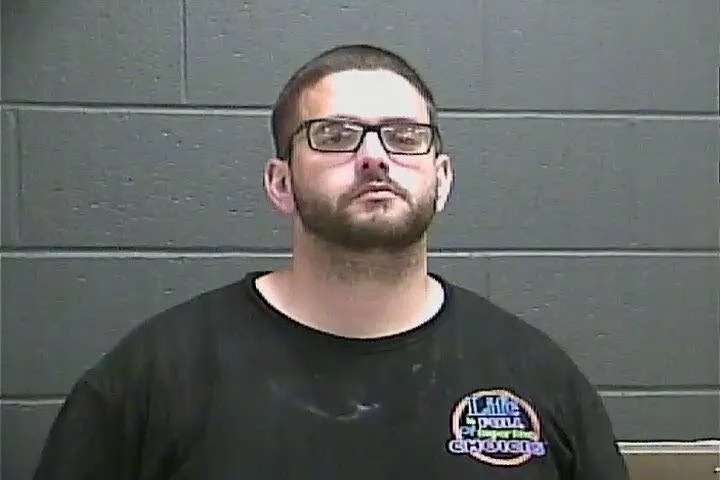
Perry County - On May 13, 2026, Master Trooper Trey Lytton of the Indiana State Police Drug Enforcement Section was contacted by the Noblesville Police Department for assistance in locating Zachary Duncan, who had a active warrant since September 2024.

On May 14, 2026, Master Trooper Lytton and Trooper Connor Giesler developed information indicating Duncan may be in the Tell City, Indiana area. Troopers subsequently observed Duncan leaving a residence in a vehicle, and contacted Lieutenant Detective Bryce Hammack of the Tell City Police Department to assist with a traffic stop.

Officers conducted the stop and identified the driver as Duncan, who was taken into custody without incidence. During the arrest, officers observed used hypodermic needles inside the vehicle, as well as a juvenile passenger seated in the backseat.

Lieutenant Trevor Vaal of the Perry County Sheriff’s Office and his K9 partner responded to the scene and conducted a free-air sniff of the vehicle. The K9 alerted to the presence of illegal narcotics.

During the investigation, troopers developed information indicating additional drug-related activity may have been occurring at the residence Duncan had exited prior to the traffic stop. Officers applied for and obtained a search warrant through the Perry County Circuit Court for the residence, which was also occupied by Haley Burton.

During the execution of the search warrant, officers located approximately 850 hypodermic needles. Many of the needles contained suspected methamphetamine, blood, and several were used with exposed needles. Officers also recovered approximately 15 grams of suspected methamphetamine, drug paraphernalia, and additional items commonly associated with the dealing of narcotics.

Officers determined Duncan and Burton were the parents of the juvenile child residing at the home. The Indiana Department of Child Services was notified.
Duncan and Burden were transported to the Perry County Jail without incident.

Arrested and Preliminary Charges:
Haley A. Burton, 29, Tell City, IN.

  • Dealing Methamphetamine (Level 2 Felony)

  • Possession of Methamphetamine (Level 4 Felony)

  • Neglect of a Dependent (Level 6 Felony)

  • Possession of a Hypodermic Syringe (Level 6 Felony)

  • Possession of a Controlled Substance (Class A Misdemeanor)

  • Possession of Paraphernalia (Class C Misdemeanor)


Zachary D. Duncan, 30, Tell City, IN.

  • Dealing Methamphetamine (Level 2 Felony)

  • Possession of Methamphetamine (Level 4 Felony)

  • Neglect of a Dependent (Level 6 Felony)

  • Possession of a Hypodermic Syringe (Level 6 Felony)

  • Possession of a Controlled Substance (Class A Misdemeanor)

  • Possession of Paraphernalia (Class C Misdemeanor)

Duncan is also being held on an active Hamilton County warrant for:

  • Possession of Methamphetamine (Level 4 Felony)

  • Causing Serious Bodily Injury While Operating a Vehicle with a Schedule I or II Controlled Substance (Level 4 Felony)

  • Possession of a Hypodermic Syringe (Level 6 Felony)

  • Operating a Vehicle with a Schedule I or II Controlled Substance or its Metabolite (Class A Misdemeanor)


This investigation was conducted by the Indiana State Police Drug Enforcement Section and was assisted by the Tell City Police Department, Perry County Sheriff’s Office, and the Indiana Department of Child Services.


Road closure planned for State Road 64 in Gibson County


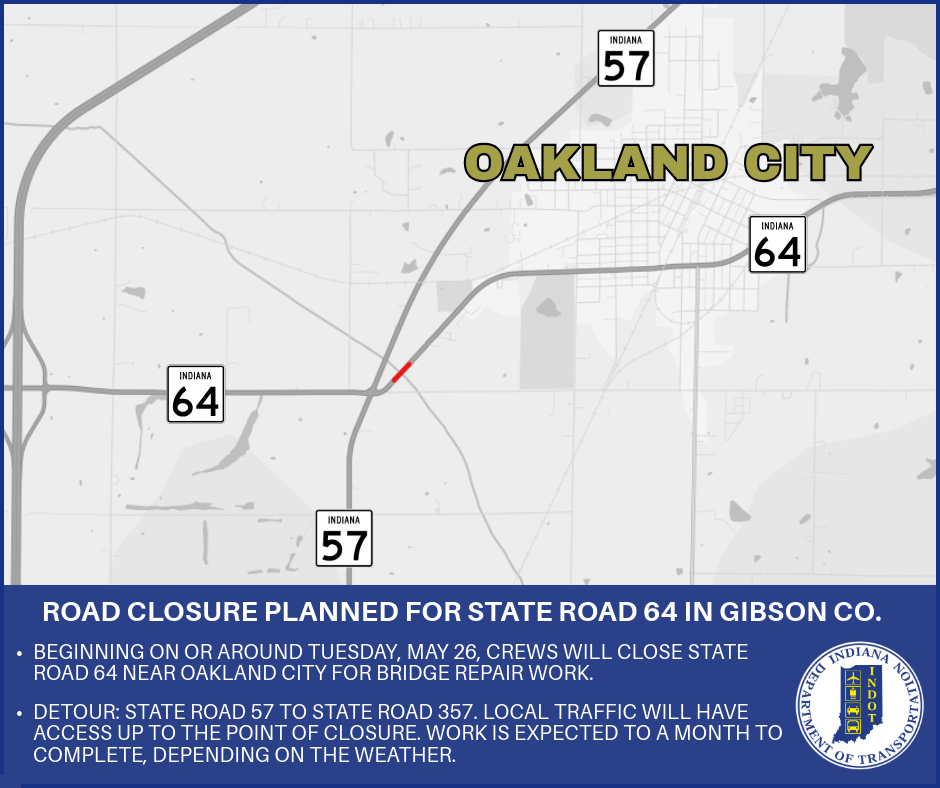
GIBSON COUNTY Ind. – The Indiana Department of Transportation announces a road closure for State Road 64 in Gibson County.

Beginning on or around Tuesday, May 26, crews will close State Road 64 near Oakland City. This closure will occur just east of the intersection of State Road 57, over East Fork Keg Creek.

This road closure will allow for bridge repair work. Work is expected to take a month to complete, depending on the weather.

The official detour for this project is State Road 57 to State Road 357. Local traffic will have access up to the point of closure. INDOT reminds drivers to slow down, use extra caution, and avoid distractions when traveling in and near work zones.

City Taking Action With Two Properties

At Monday afternoon’s Mount Carmel City Council meeting, City Clerk Ryan Turner updated council members on two city-owned properties targeted for cleanup and possible redevelopment.

Turner said the city plans to move forward with selling property at 115 North Chestnut. The city purchased the property several years ago and demolished a house there that had become an eyesore. Turner noted the vacant lot remains on the city’s books and is currently only being maintained through mowing.

Turner said he plans to prepare an ordinance for the next council meeting that would allow the property to be placed on the market.

He also reported the city recently purchased another dilapidated property at 114 North Market Street for approximately 900 dollars after it went to a tax sale. Turner said the structure, located near the ball diamond, had previously suffered fire damage and has been a concern for years.

Mayor Joe Judge noted the Market Street property backs up to the North Chestnut lot.

Turner said purchasing the property directly helped the city avoid legal fees and court proceedings, and demolition work could begin soon as the city continues efforts to clean up blighted properties.