Federal drug discount expansion proposal may cost Illinois millions, agency head says

Memo details how expanding 340B program would impact private health plans and state employee insurance

By PETER HANCOCK
Capitol News Illinois
phancock@capitolnewsillinois.com

Story Summary

  •  The 340B Drug Pricing Plan is intended to give safety-net clinics and rural hospital access to discounted drugs.

  • Pending legislation to expand those providers’ access to those discounted drugs has sparked strong lobbying campaigns for and against the proposal.

  • A memo obtained by CNI details the potential impact passage of the bill would have on group health insurance plans, including Illinois’ state employee health plan.

  • But groups representing the healthcare organizations who would benefit from HB 2371 questioned the memo and called attention to the expensive lobbying campaign aimed at killing it.

This summary was written by the reporters and editors who worked on this story.

Editor’s note: This story was updated with further comment from health care groups.

SPRINGFIELD — A proposal that would expand access to a federal program that discounts the price of prescription drugs could end up costing Illinois employers an additional $89 million a year, including more than $12 million a year for the state of Illinois itself.

That’s according to a memo, dated May 12, from the Department of Central Management Services, the state agency that administers the state employee health plan, to Rep. Travis Weaver, R-Edwards, who requested the information following a meeting of the legislative Commission on Government Forecasting and Accountability, or COGFA.

Capitol News Illinois obtained a copy of the memo through a third party. But groups representing healthcare organizations quickly disputed its findings.

The proposal, contained in a Senate amendment to House Bill 2371, is intended to give Federally Qualified Health Centers, Ryan White AIDS clinics, safety-net hospitals and other healthcare providers that serve large volumes of Medicaid patients greater access to what’s known as the 340B Drug Pricing Program.

What is the 340B program?

That’s a federal program, established in 1992, that requires drug manufacturers to provide drugs to those facilities at substantially discounted prices. Those facilities then mark the price back up when they dispense or prescribe the drugs to their patients. That spread between their acquisition cost and the price they charge becomes an indirect revenue stream that helps feed their bottom line.

The bill pending in the General Assembly, which awaits a final vote in the House, would prohibit drug companies from restricting the ability of those hospitals and clinics to acquire those discounted drugs through contract pharmacies.

That’s something many clinics and safety-net hospitals say they’ve experienced in recent years, limiting their ability to acquire drugs at the discounted prices.

The bill would also prohibit drug manufacturers from requiring 340B-qualified hospitals and clinics to report ingredient cost or pricing data, to report how they manage inventory of 340B drugs or to submit any data or information not required by state or federal law as a condition of participating in the 340B program.

The bill has generated enormous lobbying campaigns on both sides of the issue, shedding light on the complexities of how prescription drugs are priced in the United States and how a seemingly small change in one area can have far-reaching unintended consequences.

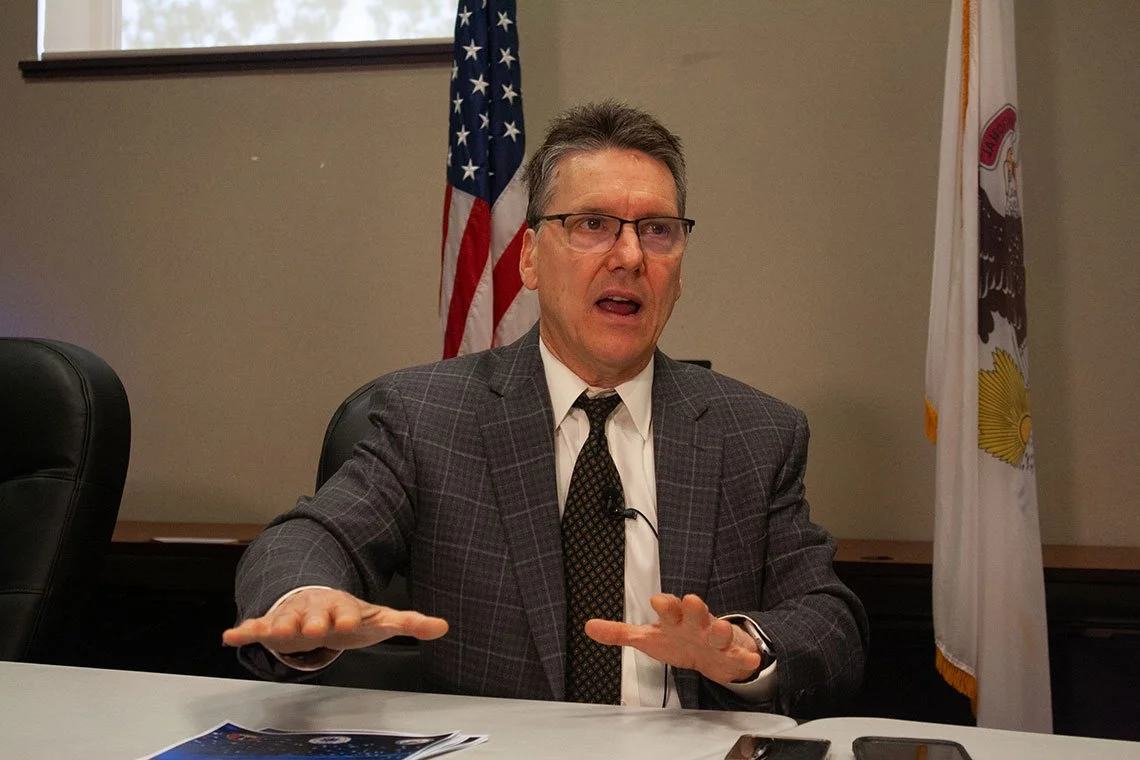
During an April 14 COGFA hearing, Shawn Gremminger, president and CEO of the National Alliance of Healthcare Purchaser Coalitions, explained how the 340B program has grown beyond what anyone expected when it was created.

“It was a program designed to be so small, they didn't bother giving it a name,” he said. “Literally, it's called 340B because it just sits at section 340B of the Public Health Service Act.”

Over the years, he said, as Medicaid programs expanded, so too did the number of hospitals that were able to qualify for the 340B drug program. And as those hospitals became eligible, Gremminger said, all of their affiliated clinics and medical practices became eligible, too.

Today, Gremminger said, the 340B program is the second-largest drug purchasing program in the country, behind Medicare Part D, and growing by an average 15% to 20% each year.

In Minnesota, he said, one hospital operated by the University of Minnesota earns more money through the 340B program than all of the state's rural hospitals, community health centers and Ryan White AIDS clinics combined.

But groups representing the healthcare organizations who would benefit from HB 2371 questioned the memo and called attention to the expensive lobbying campaign aimed at killing it.

“The memo released this week by CMS simply regurgitated Big Pharma’s testimony from the April 14th COGFA hearing,” Illinois Health and Hospital Association president and CEO AJ Wilhelmi said in a statement. “The footnotes in the memo clearly indicate that the research referenced in the memo was funded by Big Pharma. So, unsurprisingly, Big Pharma is trying to misrepresent the government’s position on the legislation.”

Groups including the Illinois Council of Health-System Pharmacists and the Illinois Pharmacists Association say Illinois’ legislation “preserves the original intent” of the 340B program, rather than expands it.

Impact on other health plans

The problem for many health insurance plans like Illinois’ State Employees Group Insurance Program, or SEGIP, is that when their members go to a 340B-qualifying hospital or clinic, those plans pay the full marked-up price for any drugs their members receive. But the plans no longer receive any manufacturer’s rebate for the drugs they purchase, thus raising the net cost of prescription drugs for patients enrolled in those health plans.

“Effectively, our rebates are crowded out by the 340B rebate,” Gremminger said.

“The 340B program was created by Congress to help low-income and uninsured patients access medicines, but it is difficult for Illinois to confirm that its patients are benefiting as intended or to understand the impact on taxpayers and employers,” Will May of the pharmaceutical trade organization PhRMA said in a statement.

Following that meeting, Weaver requested additional information from CMS, including an estimate of the fiscal impact passage of HB 2371 would have on the state employee health plan.

“Independent analysis estimates that the current 340B program costs Illinois employers approximately $224 million annually, with the proposed legislation expected to increase those costs by an additional $89 million,” CMS said in the memo. “For SEGIP specifically, lost rebates are estimated at $31 million annually, with an additional projected impact of $12.4 million under the proposed legislation.”

The memo cites an analysis published in 2024 by the health industry research and technology firm IQVIA. The health care groups, however, say that study was funded by the National Pharmaceutical Council and thus provides untrustworthy data.

“The focus of this conversation should remain on the Illinois patients and providers who depend on the 340B program, not on the financial interests of the pharmaceutical industry,” Ollie Idowu, President & CEO, Illinois Primary Health Care Association, said in a statement.

Pending legislation

As debate over HB 2371 continues, lawmakers will be asked to weigh the estimated cost to employers, including the state of Illinois itself, with the cost currently being borne by community health clinics and other providers who were originally intended to benefit from the program.

Cyrus Winnett, executive director of the Illinois Primary Health Care Association, a group that represents Federally Qualified Health Centers, said during an interview in March that under current law, drug manufacturers have been able to restrict the number of pharmacies or suppliers where clinics can acquire 340B-discounted drugs, thus limiting their ability to reap the financial benefit.

“What pharmaceutical manufacturers began doing was limiting the distribution of these drugs to a single location,” he said. “And when I say single location, I don’t mean Walgreens chain or CVS or a local independent. I mean one physical location, which for our organizations and their patients that have wide service areas, that’s extremely limiting.”

The proposed legislation originated in the Senate as an amendment to a bill that had previously passed the House. That amendment passed the Senate on May 29, 2025, by a vote of 55-0. It then went back to the House for a vote to concur in the Seate amendment, but so far the House has not taken further action.

Sen. Dave Koehler, D-Peoria, who sponsored the amendment last year, said during the April 14 COGFA hearing that the current system of pricing and delivering drugs in the healthcare marketplace is imperfect, but that lawmakers can only work with the tools they have.

“Is this the best way to cover rural hospitals or FQHCs? No, it's not,” he said. “But you know what? Congress gives us the tools that we have to use. And when we have rural hospitals in our area, or FQHCs, or poor people that are now being kicked off of Medicaid, we have to respond to our constituents.”

Capitol News Illinois is a nonprofit, nonpartisan news service that distributes state government coverage to hundreds of news outlets statewide. It is funded primarily by the Illinois Press Foundation and the Robert R. McCormick Foundation. 


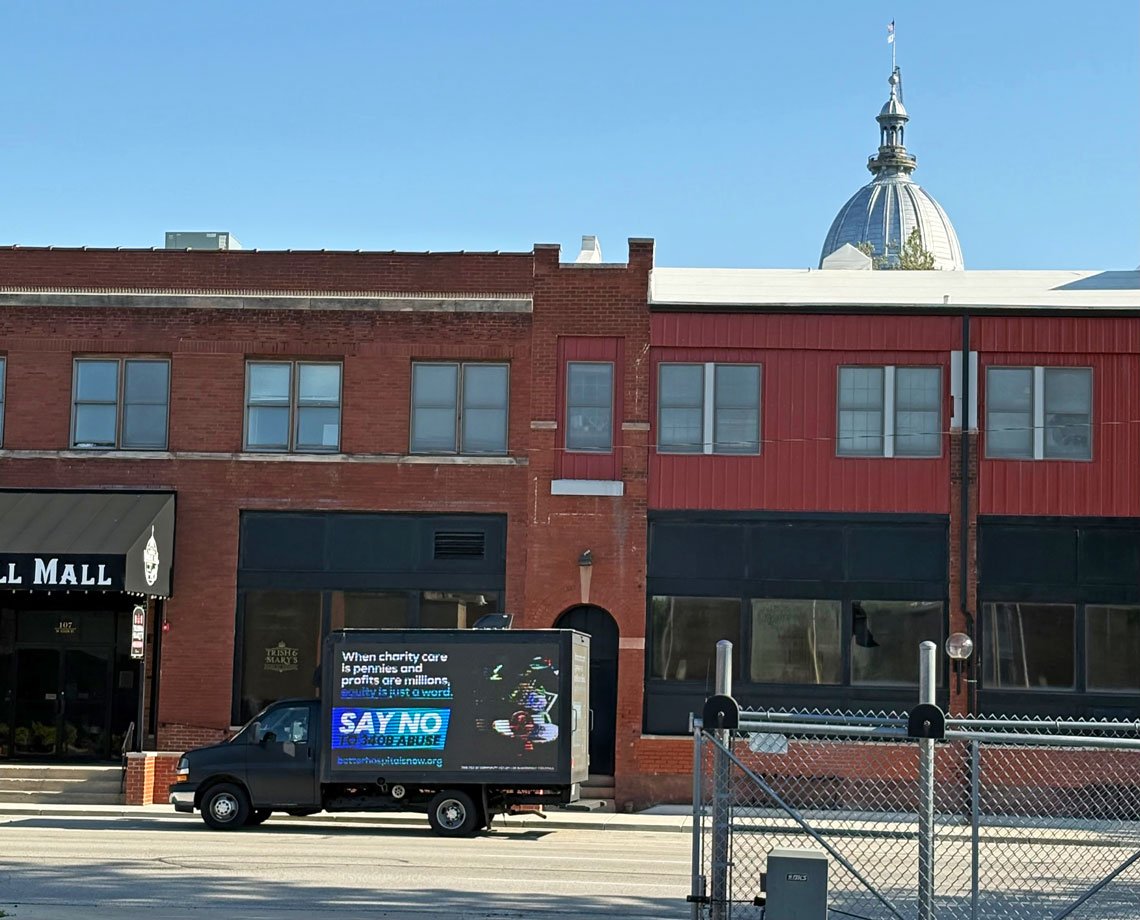
A billboard truck urges lawmakers to “say no to 340B abuse” as it makes its rounds in the neighborhood surrounding the Illinois State Capitol. (Capitol News Illinois photo by Jerry Nowicki)

Tech giants sued over ‘stealing’ voices of well-known journalists, voice actors to train AI

The 9 Class actions filed under Illinois’ strongest-in-nation biometric data privacy law

By HANNAH MEISEL
Capitol News Illinois
hmeisel@capitolnewsillinois.com 

Article Summary 

  • A group of well-known Chicago journalists, podcasters and voice actors are behind nine class-action lawsuits filed this week alleging major tech companies used their voices without their permission in order to train AI products.

  • The lawsuits represent a new area of focus for Illinois’ strongest-in-the-nation biometric data privacy law, which has spawned thousands of lawsuits in the last decade or so. The litigation has netted Illinoisans millions of dollars in settlements, mostly over the collection of employees’ fingerprints in timeclock technology.

  • Plaintiffs include locally famous broadcast journalists Carol Marin and Phil Rogers, both retired from Chicago’s NBC 5 news station, along with prolific audiobook narrators and podcasters.

This summary was written by the reporters and editors who worked on this story. 

CHICAGO — Over hundreds of pages in legal filings this week, a group of well-known Chicago-based journalists, podcasters and voice actors accused tech giants like Google, Amazon, Apple, Microsoft and others of “stealing” their voices to train Artificial intelligence.

The nine class action lawsuits, filed in Chicago’s federal court between Monday and Wednesday, represent a new frontier for Illinois’ strongest-in-the-nation biometric data privacy law. In the last decade or so, the state’s Biometric Information Privacy Act, or BIPA, has spawned thousands of lawsuits against companies alleged to have collected and stored biometric data from employees and customers without proper notice or consent.

The vast majority of that litigation — which has paid out millions of dollars to Illinoisans mostly via class-action settlements — has been over employee fingerprints collected by timeclock technology, though Facebook’s $650 million settlement in 2020 was with users over facial recognition.

Read more: Court rulings supercharge Illinois’ strongest-in-nation biometric privacy law

But as companies adopted policies to comply with BIPA and the pool of plaintiffs began to dry up, technology has rapidly evolved. Smart security cameras, safety cameras focused on workplaces, online “try-on” technology that allows users to envision, for example, what a certain pair of glasses would look like on their face, have become popular targets of BIPA litigation.

And with the breakneck speed of AI development, companies focused on building that technology could prove to be the next major focus for BIPA lawyers.

In the cases filed this week, locally famous broadcast journalists like Carol Marin and Phil Rogers, both retired from Chicago’s NBC 5 news station, along with podcast hosts and voice actors allege the companies ingested recordings of their voices in order to train their AI “foundational voice models.”

“What we are seeing is an illegal and unethical exploitation of talent on a massive scale, and one of the largest violations of biometric privacy ever committed,” Ross Kimbarovsky, an attorney with Chicago-based law firm Loevy & Loevy, said Thursday in a statement announcing the lawsuits

Kimbarovsky accused the companies of disregarding BIPA despite knowing “exactly how to build consent systems that comply with BIPA.” 

“They’ve built a billion-dollar industry on stolen voices because they thought no one would make them pay for it,” he said.

Other plaintiffs include journalist Robin Amer, audiobook narrators and voice actors Lindsay Dorcus and Victoria Nassif, and podcasters Yohance Lacour and Alison Flowers — all Illinois residents.

Tech heavyweights named

The lawsuits name Amazon, Adobe, Google and its parent company Alphabet, Apple, Microsoft and Samsung, as well as Facebook parent company Meta, text-to-speech AI company ElevenLabs, and advanced computer chip maker NVIDIA. None of the companies responded to a request for comment on the lawsuits.

BIPA defenders point out that biometric information is unique, and losing control of it can be irrevocable. If an individual’s Social Security number is stolen, for example, it may be a nuisance to get a new one but not impossible. But there’s no remedy for a stolen fingerprint, retinal, voice or face scan, they argue. Under the law, companies deploying this technology must obtain written consent before biometric information is collected.

But the lawsuits allege the companies never gave anyone a chance to give consent for their voiceprints to be ingested into their AI training models.

“None of them was told that their voice was being used to train Amazon’s commercial voice AI,” the lawsuit against Amazon said. “None of them was asked. None of them consented.”

A voiceprint “is a digital fingerprint of the human voice,” according to the complaints, which go on to characterize it as “a mathematical representation” of someone’s voice, including pitch, timbre and resonance determined by a speaker’s physiology. A voice is also defined by speech patterns “developed over a lifetime,” including accent, cadence and articulation. 

“Like a fingerprint, a voiceprint identifies the individual and cannot be changed,” the lawsuits say. “A Social Security number can be reissued. ... A person whose voiceprint has been taken cannot recover it by altering their voice — the biological and behavioral patterns that produced the voiceprint are the same ones used to speak every day.”

Voiceprint-focused lawsuits may very well become fertile ground for BIPA, especially if judges weighing the complaints filed this week agree the cases should move forward. Industry experts believe the cases could hinge on whether the voiceprints are identifiable.

In early 2023, upscale grocer Whole Foods — which was acquired by Amazon in 2017 — settled a case brought by 330 warehouse employees who alleged the company collected their voiceprints without permission and used them to verify workers' identities. The $300,000 payout was the first BIPA settlement resulting from voiceprint-focused litigation.

Capitol News Illinois is a nonprofit, nonpartisan news service that distributes state government coverage to hundreds of news outlets statewide. It is funded primarily by the Illinois Press Foundation and the Robert R. McCormick Foundation.
The Dirksen Federal Courthouse in downtown Chicago. (Capitol News Illinois photo by Jerry Nowicki)

Tell City Couple Arrested for Dealing Meth and Child Neglect

Perry County - On May 13, 2026, Master Trooper Trey Lytton of the Indiana State Police Drug Enforcement Section was contacted by the Noblesville Police Department for assistance in locating Zachary Duncan, who had a active warrant since September 2024.

On May 14, 2026, Master Trooper Lytton and Trooper Connor Giesler developed information indicating Duncan may be in the Tell City, Indiana area. Troopers subsequently observed Duncan leaving a residence in a vehicle, and contacted Lieutenant Detective Bryce Hammack of the Tell City Police Department to assist with a traffic stop.

Officers conducted the stop and identified the driver as Duncan, who was taken into custody without incidence. During the arrest, officers observed used hypodermic needles inside the vehicle, as well as a juvenile passenger seated in the backseat.

Lieutenant Trevor Vaal of the Perry County Sheriff’s Office and his K9 partner responded to the scene and conducted a free-air sniff of the vehicle. The K9 alerted to the presence of illegal narcotics.

During the investigation, troopers developed information indicating additional drug-related activity may have been occurring at the residence Duncan had exited prior to the traffic stop. Officers applied for and obtained a search warrant through the Perry County Circuit Court for the residence, which was also occupied by Haley Burton.

During the execution of the search warrant, officers located approximately 850 hypodermic needles. Many of the needles contained suspected methamphetamine, blood, and several were used with exposed needles. Officers also recovered approximately 15 grams of suspected methamphetamine, drug paraphernalia, and additional items commonly associated with the dealing of narcotics.

Officers determined Duncan and Burton were the parents of the juvenile child residing at the home. The Indiana Department of Child Services was notified.
Duncan and Burden were transported to the Perry County Jail without incident.

Arrested and Preliminary Charges:
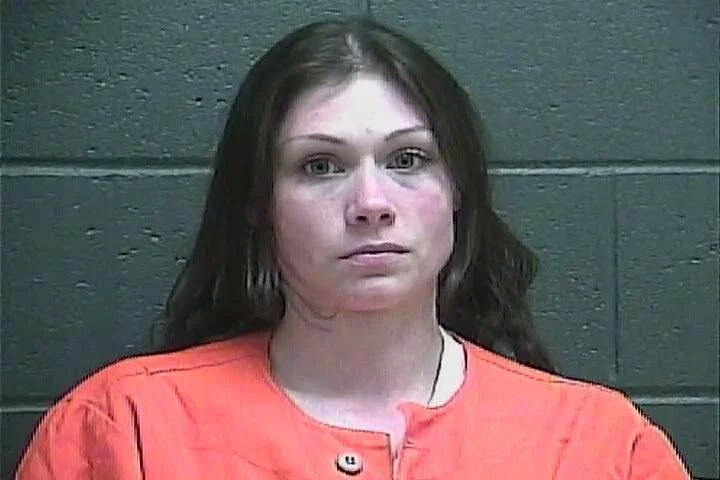
Haley A. Burton, 29, Tell City, IN.

  • Dealing Methamphetamine (Level 2 Felony)

  • Possession of Methamphetamine (Level 4 Felony)

  • Neglect of a Dependent (Level 6 Felony)

  • Possession of a Hypodermic Syringe (Level 6 Felony)

  • Possession of a Controlled Substance (Class A Misdemeanor)

  • Possession of Paraphernalia (Class C Misdemeanor)


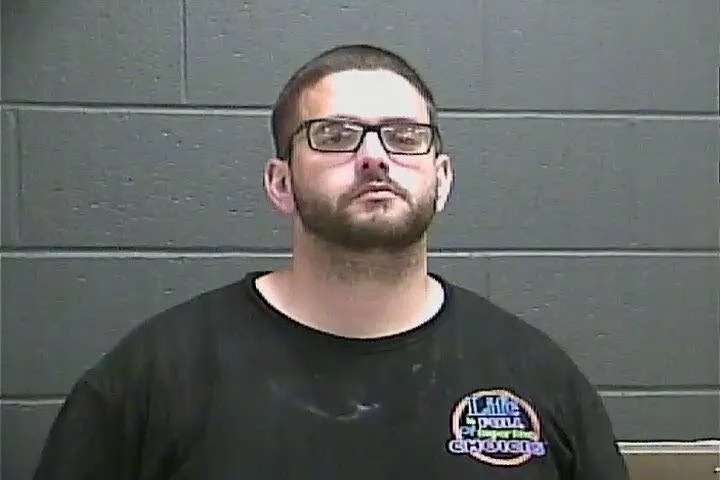
Zachary D. Duncan, 30, Tell City, IN.

  • Dealing Methamphetamine (Level 2 Felony)

  • Possession of Methamphetamine (Level 4 Felony)

  • Neglect of a Dependent (Level 6 Felony)

  • Possession of a Hypodermic Syringe (Level 6 Felony)

  • Possession of a Controlled Substance (Class A Misdemeanor)

  • Possession of Paraphernalia (Class C Misdemeanor)

Duncan is also being held on an active Hamilton County warrant for:

  • Possession of Methamphetamine (Level 4 Felony)

  • Causing Serious Bodily Injury While Operating a Vehicle with a Schedule I or II Controlled Substance (Level 4 Felony)

  • Possession of a Hypodermic Syringe (Level 6 Felony)

  • Operating a Vehicle with a Schedule I or II Controlled Substance or its Metabolite (Class A Misdemeanor)


This investigation was conducted by the Indiana State Police Drug Enforcement Section and was assisted by the Tell City Police Department, Perry County Sheriff’s Office, and the Indiana Department of Child Services.


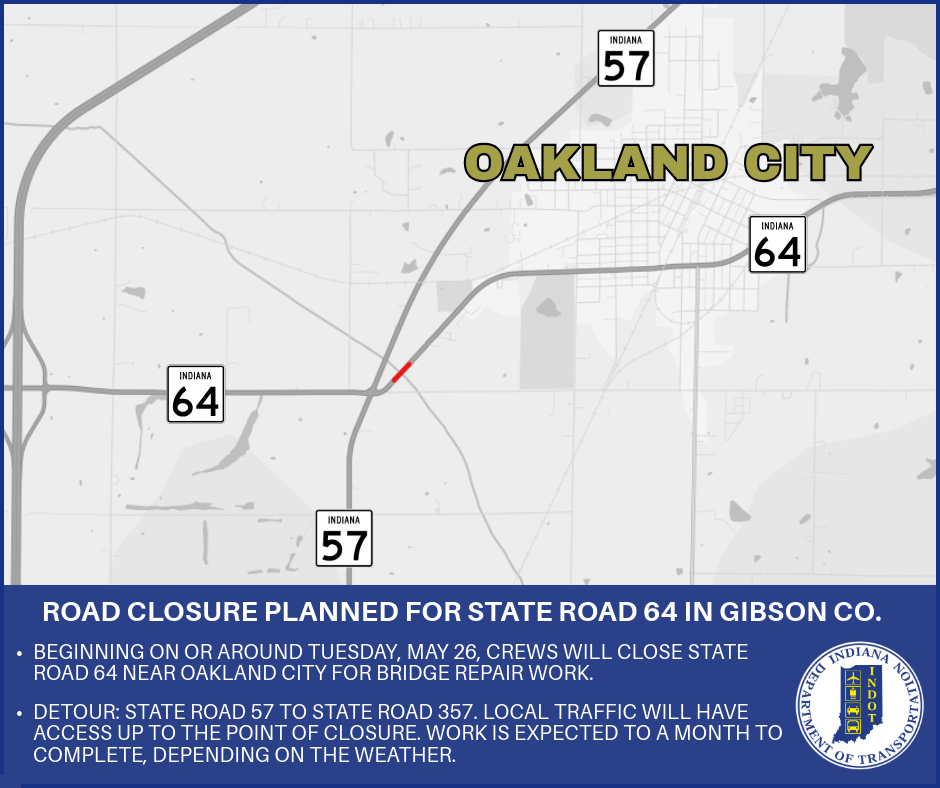
Road closure planned for State Road 64 in Gibson County


GIBSON COUNTY Ind. – The Indiana Department of Transportation announces a road closure for State Road 64 in Gibson County.

Beginning on or around Tuesday, May 26, crews will close State Road 64 near Oakland City. This closure will occur just east of the intersection of State Road 57, over East Fork Keg Creek.

This road closure will allow for bridge repair work. Work is expected to take a month to complete, depending on the weather.

The official detour for this project is State Road 57 to State Road 357. Local traffic will have access up to the point of closure. INDOT reminds drivers to slow down, use extra caution, and avoid distractions when traveling in and near work zones.

City Taking Action With Two Properties

At Monday afternoon’s Mount Carmel City Council meeting, City Clerk Ryan Turner updated council members on two city-owned properties targeted for cleanup and possible redevelopment.

Turner said the city plans to move forward with selling property at 115 North Chestnut. The city purchased the property several years ago and demolished a house there that had become an eyesore. Turner noted the vacant lot remains on the city’s books and is currently only being maintained through mowing.

Turner said he plans to prepare an ordinance for the next council meeting that would allow the property to be placed on the market.

He also reported the city recently purchased another dilapidated property at 114 North Market Street for approximately 900 dollars after it went to a tax sale. Turner said the structure, located near the ball diamond, had previously suffered fire damage and has been a concern for years.

Mayor Joe Judge noted the Market Street property backs up to the North Chestnut lot.

Turner said purchasing the property directly helped the city avoid legal fees and court proceedings, and demolition work could begin soon as the city continues efforts to clean up blighted properties.

Departure Leaves Vacancy On Health Board

A longtime member of the Wabash County Board of Health is stepping down.

Cindy Bishop announced during Wednesday’s Board of Health meeting that she will be leaving the board after more than 15 years of service. Bishop said she plans to travel more in the future and felt it would not be fair to remain on the board if she could not regularly attend meetings.

Her current term is set to expire June 30th.

No replacement was appointed Wednesday, but Health Department Administrator Judy Wissel said the search for a new board member is already underway. Interested individuals can contact the Wabash County Health Department for an application.

Any recommendation made by the Board of Health must be ratified by the Wabash County Commissioners, who in past cases have sometimes selected a different appointee.

Also during Wednesday’s meeting, two current members, Dr. Larry Jennings and Mark Brines, agreed to serve another three-year term on the board.

The board also approved its officer slate for the upcoming year beginning July 1st. Dr. Bryce Miller will serve as board president, current president Theresa Marcotte will become president-elect, and Marcia Hall will continue as board secretary.

Pool Project Begins To Show Progress

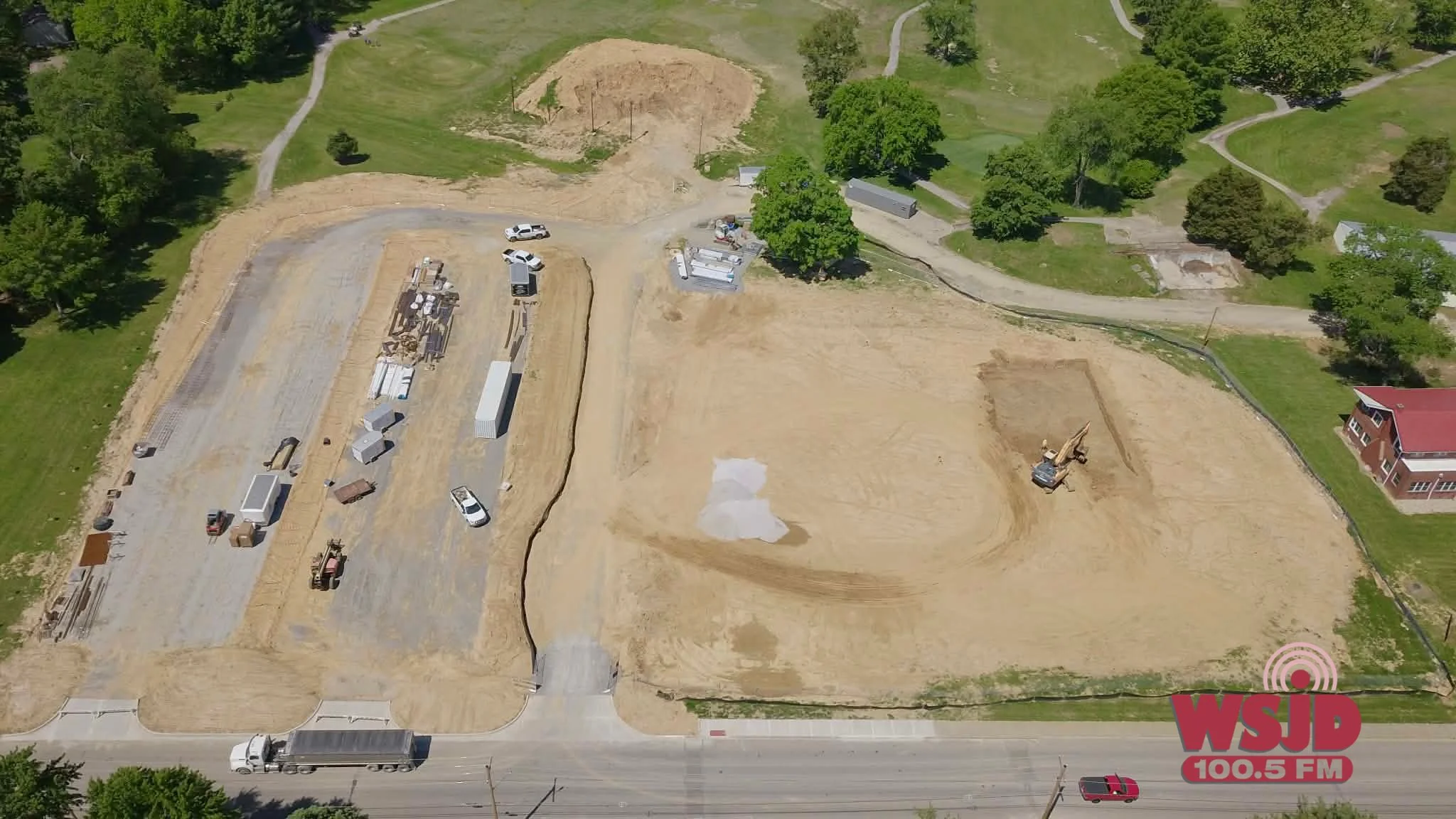
Mount Carmel’s aquatic center project continues to move forward, with visible progress now taking shape at the site.

During Friday’s “Ask the Mayor” segment on WSJD, Mayor Joe Judge said crews have poured the entrances and are currently working on drainage. He also noted that many of the key components needed for construction have already been delivered.

Judge says work on the bathhouse could begin within the next week or two.

As for the long-awaited state permitting, Judge reported the city has received partial approval, with full approval expected either Friday or early this week. He says the city has now met all Illinois Department of Public Health requirements after recent discussions helped clarify remaining issues.

Among the final concerns were items like a concession stand window and a deck drain, both of which have now been resolved.

Judge also expressed frustration with the state’s process, noting hundreds of pool projects submitted last fall are still awaiting full approval.

An additional update came during Monday afternoon’s Mount Carmel City Council meeting, where Mayor Judge announced the city has now received full approval from the state to move forward with construction.

Judge also said groundwork at the pool site has officially begun, with crews now using heavy equipment to excavate the large pool area. He noted the project is beginning to progress and expressed hope that construction activity will move rapidly in the coming weeks.

Chip & Seal Date Set For July 16th In Mt. Carmel

At Monday afternoon’s Mount Carmel City Council meeting, City Engineer Dave Dallas provided an update on upcoming street maintenance work.

Dallas told council members that a date has now been scheduled with Mt. Carmel Stabilization for the city’s oil and chip road work. Barring any changes, the work is expected to begin July 16th.

Dallas said the follow-up fog seal application is currently planned for the week after the oil and chip work is completed.

The annual maintenance program is designed to help preserve city streets and extend the life of road surfaces.

School board moves to fire Carterville coach charged with criminal sexual abuse

John Wakey can request a dismissal hearing, is suspended without pay in the interim 

Article Summary

  • The Carterville School Board has indicated it intends to fire the assistant football coach and teacher charged with nine counts of criminal sexual abuse.

  • John “Jake” Wakey is accused of sexually abusing students at Carterville High School over a period of years during the 2013-15 school years.

  • Wakey can request a dismissal hearing and in the meantime has been suspended without pay.

This summary was written by the reporters and editors who worked on this story.

By JACKSON BRANDHORST

Saluki Local Reporting Lab

jbrandhorst@dailyegyptian.com

CARTERVILLE — The Carterville School Board voted Tuesday night to begin the process of firing John “Jake” Wakey, the Carterville High School assistant football coach and teacher who is charged with nine counts of sexual abuse against students, including members of the football team.

The decision came during a special meeting five days after Wakey’s arrest.  

According to dismissal documents obtained by the Daily Egyptian, the board concluded that Wakey engaged in “unprofessional, unacceptable, and immoral conduct,” demonstrated a “consistent pattern” of inappropriate communication with students and was “not qualified to teach.”

He has 17 days after receiving the notice to request a formal dismissal hearing overseen by a hearing officer. If he does not request one, the dismissal automatically takes effect. In the interim, Wakey has been suspended without pay. Wakey had been on paid administrative leave for nearly three months, during which he continued receiving his roughly $3,300 biweekly salary.

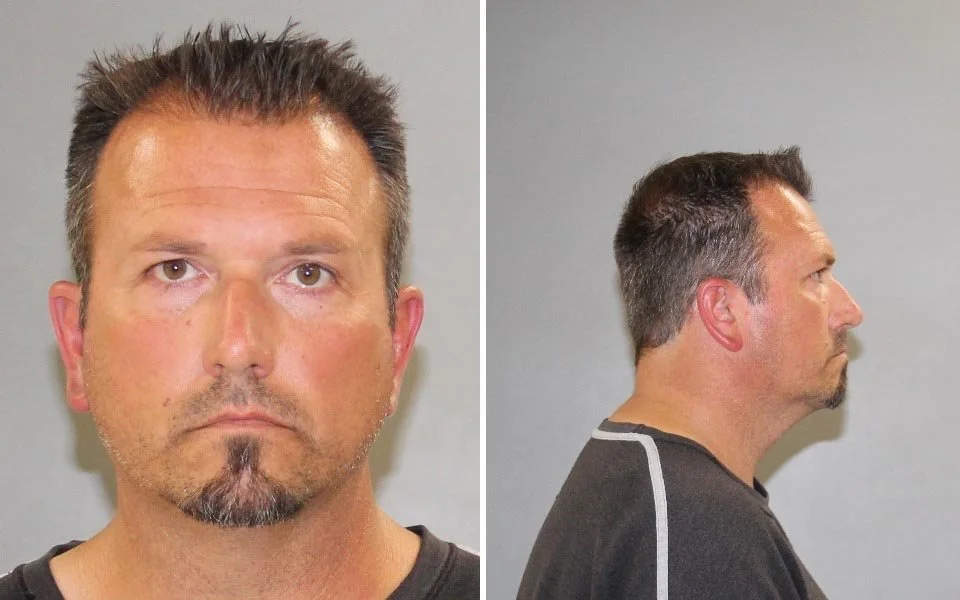
John Wakey. (Williamson County Sheriff's Office)

Wakey was arrested on Thursday, May 7, near Pontiac, Illinois. He is charged with nine Class 2 felony counts of aggravated criminal sexual abuse involving victims ages 13-17 by a person in a position of trust during the 2013, 2014 and 2015 school years. 

Williamson County Sheriff Jeff Diederich said during a May 8 news conference that four former Carterville students had provided formal statements to investigators after months in which detectives had only one verified statement from an alleged victim.

Diederich also said investigators had developed “solid and credible information” identifying nine potential victims connected to the Wakey investigation.

A day after his arrest, Wakey was transferred from the Livingston County Jail in Pontiac to the Williamson County Jail in Marion. He then spent three nights in the Williamson County Jail and was released from custody on Tuesday, May 12. During a detention hearing Tuesday, Williamson County Judge Michelle Schafer denied Williamson County State’s Attorney Ted Hampson’s petition for Wakey to remain in custody throughout the remainder of the trial.

“The defendant has no prior criminal history, and there is no history of violent or abusive behavior,” Schafer wrote in her decision. “Abuse is alleged to have occurred over 10 years ago … the relevant inquiry is whether the historical facts translate into a current danger. During this 10-year window, the defendant has had no criminal conduct, has maintained employment and has established community ties. As a result, detention is denied.”

Wakey was released on pretrial conditions including GPS electronic monitoring and residency confinement at his parents’ home in Herscher, Illinois.

Board notes ‘consistent pattern’ of wrongdoing

The notice of dismissal from the board of education repeatedly references Wakey’s “consistent pattern” of inappropriate communication with students, including text messages from 2022 and 2025, the Daily Egyptian previously reported

The board alleges that Wakey “engaged in unprofessional, unacceptable, and immoral conduct” by communicating via text message with a student in March 2022 and December 2025.

The dismissal document also acknowledges that Wakey violated a 2009 disciplinary warning. During that time, he was suspended for 10 days after the board found that he was “sending inappropriate text messages to students.” 

The board also alleges that Wakey initially denied having sent those text messages in each account, and that he also “failed to attend an investigatory conference with school administrators on April 16, 2026,” concerning the current investigation. 

During Tuesday's special meeting, the board heard comments from several parents of both former and current students concerning the conduct of the board. Parents raised various questions about mandated reporting, the validity of internal investigations and student safety. 

They also asked why administrators did not act sooner to remove Wakey from the classroom and called for accountability for district employees who may have been complicit in Wakey’s alleged crimes.

Board members did not respond to any questions or concerns raised during Tuesday night’s meeting. Previously, the district said it did not have enough credible information to take action when it first learned that allegations had been made to the FBI in November 2024. 

During the meeting, board President David Schwartz read aloud a statement detailing the notice of dismissal. The board also sent out a statement to parents of the district signed by Superintendent Sarah Barnstable notifying them of their decision after the meeting.

Currently, no other district employees have been charged in relation to the investigation. 

Wakey’s next pretrial hearing is scheduled for 8:30 a.m. June 24 at the Williamson County Courthouse. 


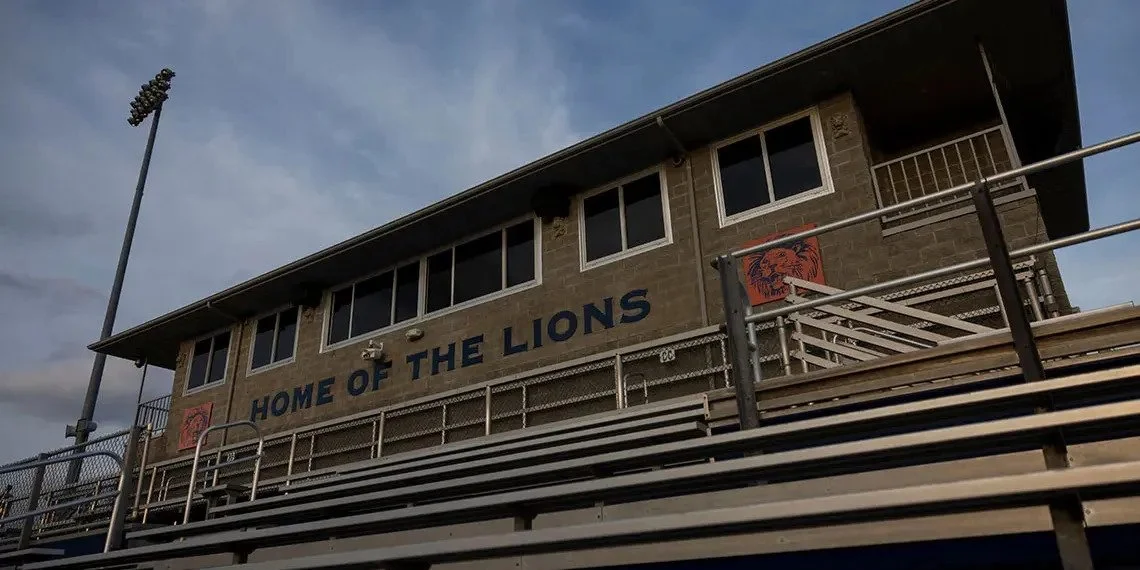
The sun sets on the press box at the Lions Field football stadium at Carterville High School. (Photo by Lylee Gibbs/Saluki Local Reporting Lab)

The Saluki Local Reporting Lab is a special project of the SIU Carbondale School of Journalism and Advertising and is designed to give students from diverse backgrounds practical reporting experience while providing news coverage to underserved communities.

Capitol News Illinois is a nonprofit, nonpartisan news service that distributes state government coverage to hundreds of news outlets statewide. It is funded primarily by the Illinois Press Foundation and the Robert R. McCormick Foundation.


How Illinois county clerks are combating election misinformation

Amid lower rates of voter faith, officials say elections are safe and secure — and they’re working to prove it to the public

Article Summary

  • Amid eroding trust in elections, Illinois county clerks are working to repair voter trust and campaign against misinformation.

  • The effort, led by a bipartisan group, seeks to address partisan claims of fraud, fear of foreign breaches, rampant misinformation and volatile security infrastructure funding. 

  • Clerks say they’ve seen the effects in voter concerns, but their efforts to raise awareness and increase voter education have been successful.

This summary was written by the reporters and editors who worked on this story.

By JENNA SCHWEIKERT
Capitol News Illinois 
jschweikert@capitolnewsillinois.com 

Trust in U.S. elections is eroding. Between skepticism about redistricting, fear about immigration agents at the polls, and unproven claims about widespread election fraud, Americans are losing confidence in the accuracy and security of their elections.

But many local election authorities say their effort to address misinformation and reassure voters is beginning to turn the tide, as they’ve seen less voter concern about election security.

Voter confidence in accurate vote counts dropped 17% across party lines in about a year, according to two nationwide polls from the Center for Transparent and Trusted Elections at the University of California San Diego. One poll was conducted just after the 2024 presidential election, the other in late 2025, in collaboration with UCSD’s Yankelovich Center for Social Science Research.

Voters had different reasons for why they are skeptical about the midterms — and those reasons broke across party lines, with more Republicans naming redistricting as a concern and Democrats more worried about the presence of immigration agents at the polls.

Although 60% of respondents indicated they did have confidence in the midterms, the survey paints a bleak picture ahead of this fall. And it was followed by headlines about the Supreme Court’s ruling weakening a key racial redistricting provision in the Voting Rights Act, the Department of Justice suing states for access to voter records and a report finding a Trump appointee encouraged the DOJ raid of election offices in Fulton County, Georgia. 

This is all on the heels of President Donald Trump’s repeated, but disproven, claims of widespread voter fraud and falsified 2020 election results. Now, he’s staffed his federal administration with officials who echoed his claims in 2020 and refuse to walk them back, doubling down in some cases. 

For one, Kash Patel, the embattled director of the Federal Bureau of Investigations, is overseeing the investigation that led to the Fulton County raid and a subpoena of Maricopa County, Arizona, records. Just last week, the administration demanded names of election officials who worked in the county during the 2020 elections. 

Much like Pam Bondi, the former director of the Justice Department, Patel would not state that Joe Biden won the 2020 election in his confirmation hearing.

The Trump administration’s efforts to establish a narrative of fraud, lies and vote stealing during Biden’s presidency are not for nothing. As the UCSD poll shows, Americans of both parties have begun to doubt if they can trust upcoming elections. It makes for a tense environment as the country rockets towards the 2026 midterms and as rumors swirl around potential 2028 presidential nominees.

But across the country, and within Illinois, election authorities of both political parties say American elections are, and will stay, fair and secure. While county clerks report having an impact on their local constituencies, the disparate nature of U.S. elections — while widely considered a strength — make communicating to a broader audience a greater challenge.

Local election authority

Authority over administering elections, by federal law, is given to the states. In Illinois, elections are administered either by the 102 county clerks or the six municipal election commissions. The Illinois State Board of Elections works with these local election authorities in an advisory capacity.

Every state has differing laws on election administration, and each Illinois county clerk conducts their elections a little differently. The needs and wishes of the voting population of Chicago and suburban Cook County, for example, are much different than those of Tazewell or Sangamon County.

That environment makes things complicated, but local authority is part of the strength of Illinois elections, according to Republican Tazewell County Clerk John Ackerman. 

Tazewell County Clerk John Ackerman speaks at an Illinois Association of County Clerks and Recorders event in East Peoria in January 2026. (Capitol News Illinois photo by Jenna Schweikert)

“(Individuals) have the ability to go in and see how their elections are being handled in their jurisdiction,” Ackerman said. “There isn't some appointed bureaucrat that is running this operation. It's an individual they have a direct impact of putting into office. That's something that gives them, should give them, more faith if they don't like the way things are being done.”

Capitol News Illinois spoke with county clerks from across the state to find out more about what they do to administer a secure election and maintain voter confidence. 

Ackerman said many sources track deteriorating trust in elections back to 2020, but he believes it really started in 2016, the same year foreign hackers breached election databases in Illinois and Arizona.

The hackers were able to steal some voters’ information that was already publicly available. But while they accessed the voter roll, they could not access any tabulators —machines that scan each ballot and count the votes — because they are not connected to outside internet and can’t be hacked.

Still, claims of election fraud dominated the 2016 campaign trail, with Trump frequently deriding a system he called “rigged.” Post-election, Green Party candidate Jill Stein launched a recount effort for the presidential race, backed by losing Democrat Hillary Clinton, as Trump’s shock election to the presidency shook voter confidence for some. 

“What we saw in 2016 at the federal level were social media campaigns that were aimed at all, not just one particular voting group,” said Matt Dietrich, public information officer at the Illinois State Board of Elections. “They were aimed at everyone, and they were basically there to sow discord among voters, to create conflict.”

Recalling an interview he gave in 2018, as election authorities were preparing for the 2020 campaign and election season, Dietrich remembered saying it’s “dangerous” to introduce the question of fraud because it’s hard to disprove.

Matt Dietrich, spokesperson for the Illinois State Board of Elections, speaks to Capitol News Illinois. (Capitol News Illinois photo by Jenna Schweikert)

“For years, we wouldn't have dreamed that that American voters would be claiming that there is widespread voter fraud on a nationwide basis,” Dietrich said. 

But Dietrich, who handles Freedom of Information Act requests for the state elections board, said he’s also seen a substantial decrease in requests for files about election protocol and security.

“I'm optimistic that they are coming around to what we had been saying all along, which was, you never doubted this before,” Dietrich said. But he warned that county clerks must remain vigilant against future misinformation campaigns.

“Completely unsubstantiated charges of fraud can’t draw the spotlight and increase the volume to such an extent that the true message has, you know, that the facts have a hard time getting out,” Dietrich said.

Combating misinformation

Prior to 2020, election authorities did not have to be as proactive about misinformation, but the 2016 and 2020 elections brought both political parties to “slinging mud and dirt,” Ackerman said.

“I can't stress enough we're not seeing this from one political party,” Ackerman said. “Both are just as guilty of committing the sin of throwing misinformation into the media circus, and that's part of the problem.”

To combat misinformation, some clerks use social media to run voter education campaigns, while others use mailing campaigns to inform voters. It all depends on the comfort level of the clerk and what makes sense for their county, Ackerman said. But the campaign against misinformation is bipartisan, across the board.

“It matters for us to be able to work together across party lines,” Champaign County Clerk Aaron Ammons, a Democrat, said. “All of my visits to other states and cities and conferences, I have found that by and large, the Democrats and Republicans are trying to do the same thing. We're trying to run a fair, free and accessible election.”

Ammons said groups like the nonpartisan Illinois Association of County Clerks and Recorders, which Ackerman is a vocal member of, are also helpful in getting messaging out.

“We've always done everything in an open, transparent way of inviting everybody to the table, because then it's passing the information forward,” Ackerman said. “There isn't a political bit to that. It's information I want spread.”

Tazewell County Clerk John Ackerman is joined by fellow members of the Illinois Association of County Clerks and Recorders at an event in East Peoria in January 2026. (Capitol News Illinois photo by Jenna Schweikert)

Officials at the Illinois State Board of Elections, Illinois State Police and Department of Homeland Security also monitor social media for misinformation campaigns and security threats and work with local officials to address those. 

“Since about 2018 we have adopted a proactive approach of when we see it, engaging it in the public, trying to remove it as quickly as possible, rather than allowing it to fester and grow,” Ackerman said.

Sangamon County Clerk Don Gray, also a Republican, has been a county clerk for nearly twelve years and is running for his fourth term, while Ackerman is running for his third.  

The key to maintaining voter trust is transparency, the clerks agreed.

“We're only as strong as the accuracy and the belief of the public that the result is clear and that it can be trusted,” Gray said. 

Maintaining faith through transparency

Franklin County Clerk Paris Dunk, a Republican, said his office approaches elections with a simple goal: making sure people trust the process and understand how it works. Dunk said that staff members spend every day updating voter rolls through address confirmations, state data checks and repeated mailings. 

Franklin County Clerk Paris Dunk talks to Capitol News Illinois. (Capitol News Illinois photo by Molly Parker)

National narratives in the wake of the 2020 election fueled skepticism in voter integrity, he said, but some of that has quieted, which he credits to transparency. He said he encourages anyone with concerns to “come in and be a part of the process” and observe everything from machine testing to vote tabulation. The use of paper ballots is one of the county’s strongest safeguards because “it’s an easy audit,” he said. 

Ammons agreed that 2020 brought an onslaught of skepticism, much of it coming from Trump: “We saw just so much more of that, and that, I think, has grown and has caused some voters to be even more hesitant or cautious than they were before.”

But letting the public witness and experience how an election is operated and what the procedural policy is goes a long way in increasing trust and confidence, Gray said.

“I think the chief responsibility of the election authority is to be that advocate of exposing how we operate, and that goes a great distance in giving people real, firm confidence,” Gray said. “I spend a lot of time analyzing that (disinformation) and refuting what's being said that's disturbing people.”

But when federal officials claim there is widespread fraud, county clerks must work with them as well as voters to maintain faith in the process.

“First we need to address the federal officials to make sure that they understand why their information is inaccurate,” Ackerman said. “Then we need to target also our public to make sure they have their questions answered.”

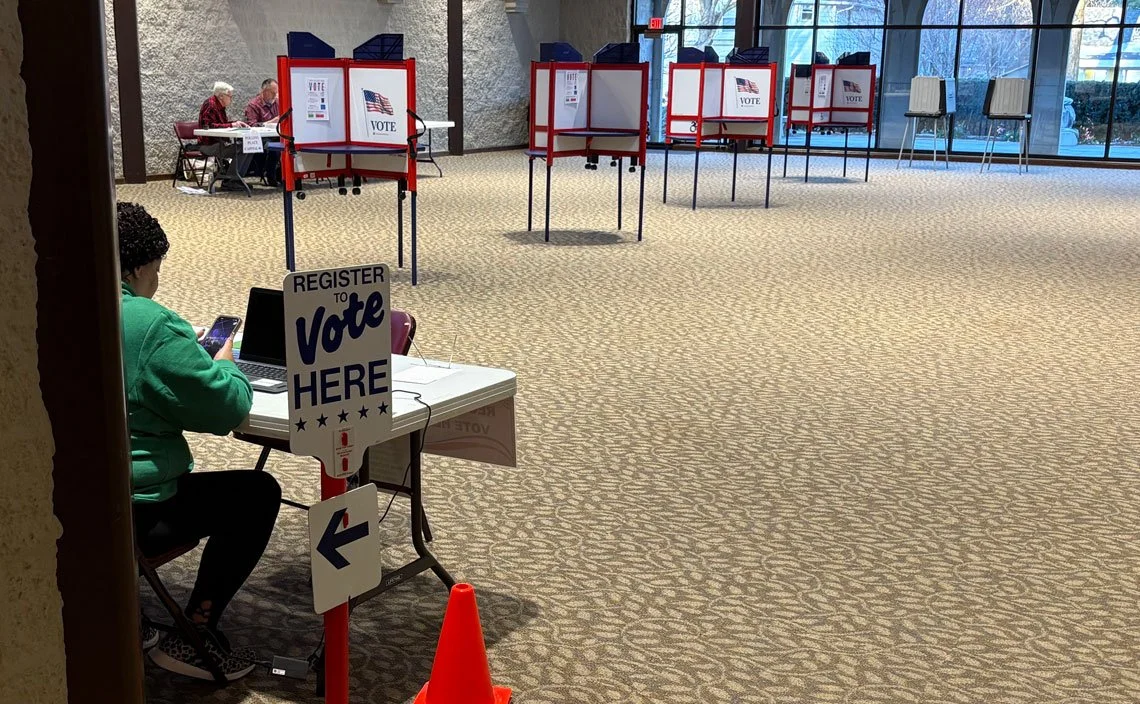
Stand-up voting booths and a registration table at a Sangamon County polling place in March 2017. (Capitol News Illinois photo by Jerry Nowicki)
Some efforts for transparency are required by law, like public equipment tests. But some clerks also go out of their way to invite the public and members of both parties to engage. It’s all about opening up the process, Ackerman said.

“We invite youth groups. We invite civic organizations. Anybody who wants to have a tour of our equipment,” Ackerman said. “We've really led the way in many innovations in being transparent, opening up our required testing of our equipment and our required public events, putting them online, live streaming them so that the public can observe them from the comfort of their home.”

Ammons said he has a hard time getting voters to show up to in-person, transparency-oriented events like the equipment tests. But he sends out a newsletter, updates the county website regularly and works with the media to get communications out. 

Ackerman also said bipartisanship plays a big role among county clerks. In January, for example, the county clerks association held a joint news conference to inform media and voters about a recent postmarking change that would affect mail-in ballots.

“I'm not talking just through a Republican audience or a Democrat audience, but to the public as a whole,” Ackerman said. “We were happy to do those joint press conferences where it's the same message going out from all of us in a unified voice. I think the public has some comfort with that.”

In 2023, county clerks also held a series of news conferences, led by Ackerman, to get ahead of election-related misinformation and claims of fraud, Dietrich said.

“The message among those local election authorities … was that, look, we are — we live in your towns. Our kids go to the same schools, you know us. If you have questions, or if you have any doubts about the security and integrity of the election system, come to us and let us explain it to you,” Dietrich said.

Some misinformation comes from confusion about jurisdictions’ different rules, Ackerman said. Voters have concerns about election-related events in Georgia or California that don’t apply in Illinois because the states have contradictory election laws. That also makes having a national conversation about election security harder, he said.

Gray said he hears a lot of security-related concerns from voters, many about noncitizen participation, foreign involvement, engagement and participation.

“The more pinnacle pieces that I hear most often, centered in and around of, how are you ensuring to make sure that only those that are qualified are actually taking part in our elections?” Gray said.

Election authorities follow strict security protocols to ensure all ballots are valid. In recent years, they have begun more voter outreach to ensure voters know and have faith in those protocols — but clerks say real fraud is rare.

Sangamon County Clerk Don Gray speaks to Capitol News Illinois in February. (Capitol News Illinois photo by Andrew Campbell)

In his 12 years of being a county clerk, Gray said he’s never really seen any fraud and that most incorrect results are from errors like improper ballot marking.

“We’re human, and elections are processed by people. Errors do happen, but that doesn't mean there's this huge systemic effort of fraud to defraud an election,” Gray said.

Firsthand experience

Gray and Ammons recommend voters serve as election judges to see the process for themselves. 

“You'll see the controls. You'll see the attention to detail of vetting accuracy, to ensuring accountability to our electoral system,” Gray said. 

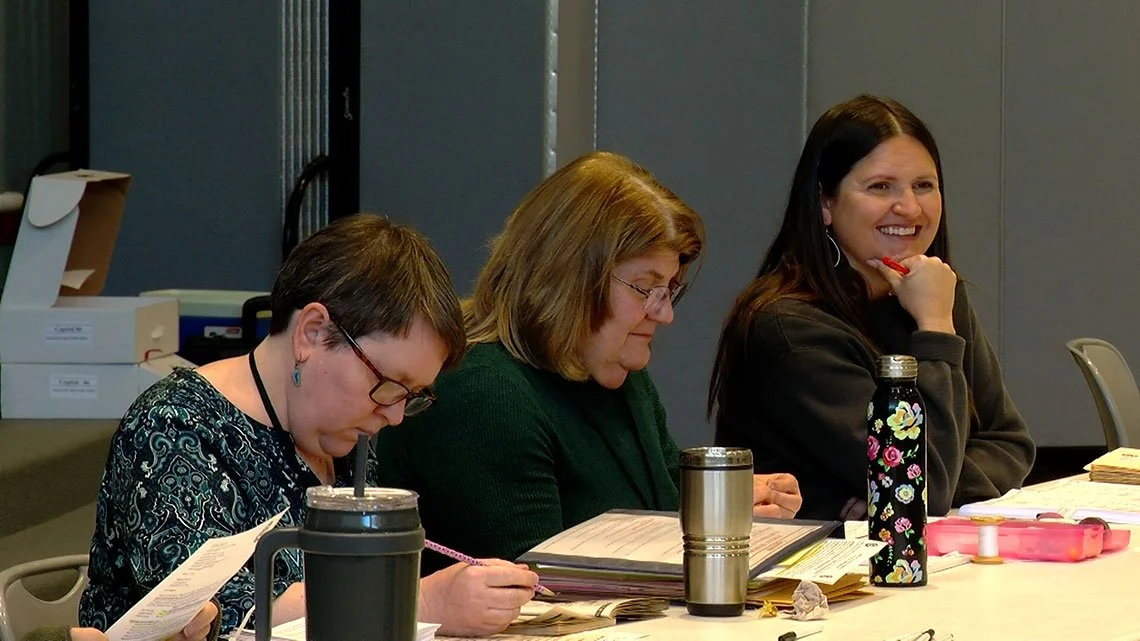
On March 17, during Illinois’s primary Election Day, Capitol News Illinois spoke to election judges at one Sangamon County polling place to find out more about what they do.

The judges we spoke to said after they served as an election judge, they felt more informed and comfortable with the process.

“Everybody, whether you're Democrat or Republican, you're getting both voices together and making sure things are done properly,” said Jennifer Crowder, a local resident. 

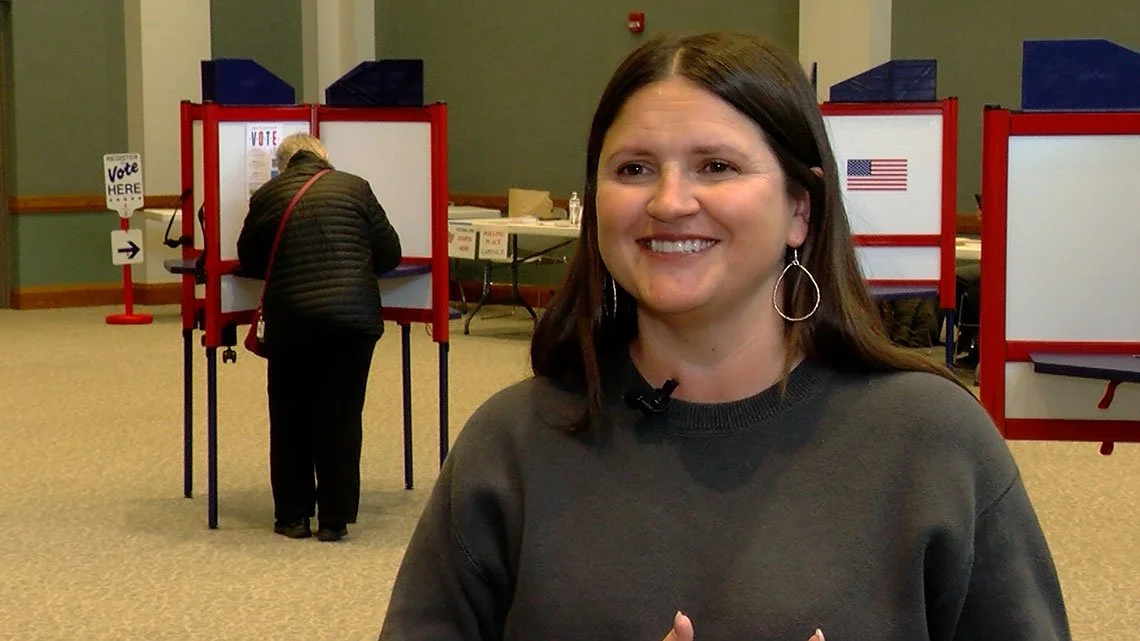
Jennifer Crowder, a Sangamon County election judge, speaks to Capitol News Illinois on the day of the March 2026 primary election. (Capitol News Illinois photo by Andrew Campbell)

For Crowder, serving as an election judge for the past five elections has also boosted her and her family’s involvement.

“I see it (voting) as a very critical part of who we are,” Crowder said.

Local high school senior Josephine Oke signed up to be an election judge through her high school, along with some of her friends. With permission from her guidance counselor and parents, she was approved for the position.

“The idea of actively participating in, like, local elections as an election judge, that really drew me in because I like being involved in my community,” Oke said. This was her first year serving as an election judge and voting in an election. 

OKE PHOTO

To be an election judge, any resident can apply through their local county clerk. First-time judges attend an in-person course to learn the responsibilities of an election judge, while those who’ve done it previously can complete the course online.

John Brim, another Sangamon County resident, said he’s served as an election judge on and off since 1980.

“Every election is a learning experience. You learn different things, because sometimes they may tweak some of the procedures, but they're for the better,” Brim said. 

On Election Day morning, election judges open the tabulators and check that they’re working. They do this by running a blank tape through the machine to ensure there are no previous votes cast and that the ballot is correct.

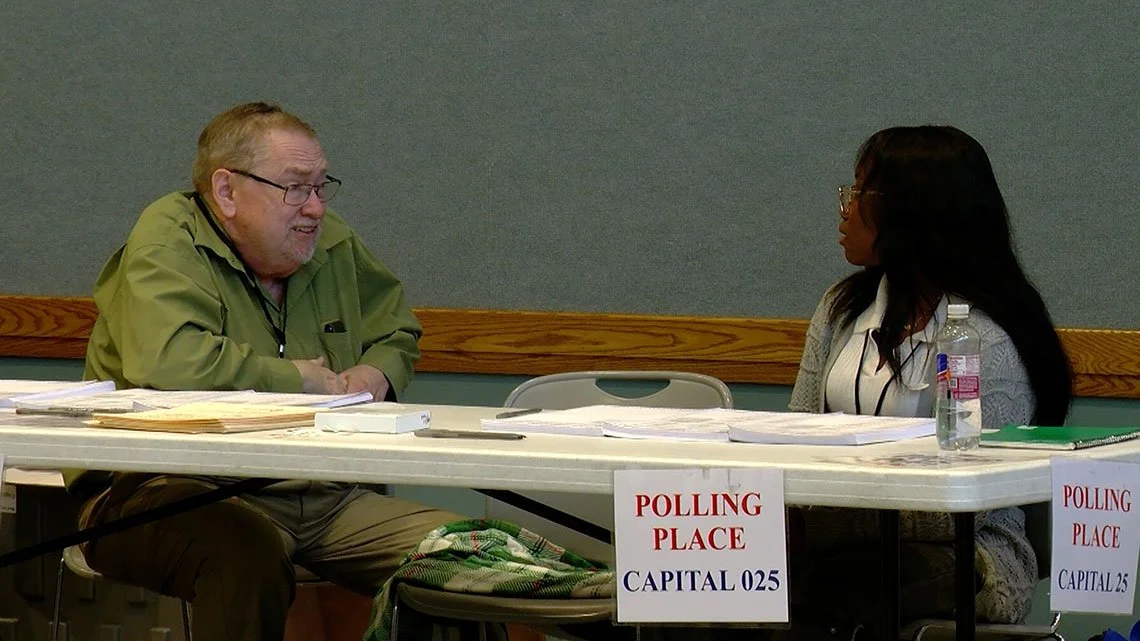
Election judges John Brim and Josephine Oke help run the 2026 primary election in Sangamon County. (Capitol News Illinois photo by Andrew Campbell)

Ballots seem simple, but one county can have hundreds of different ballots for one election, Gray said. For example, primary elections have a Democrat, a Republican and a nonpartisan ballot that includes any local or statewide ballot measures, like constitutional amendments. And within one county, there can be several municipal elections with dozens of small, local districts, so the different ballot combinations multiply quickly. 

At the end of the day, the judges run the tape again, count and sort the ballots by precinct, and turn in the number of filled-out ballots and however many are left over. The number of distributed ballots is strictly monitored to prevent voting multiple times, Dietrich said.

Oke described the different tasks election judges might do when a voter comes into their polling place.

“The first role that's more identification, like, what's your name, your address, what political party you’re affiliated with, so they can get their ballot,” Oke said. “Then the second one is verifying, you know, just checking signatures, seeing everything matches up. … And then you give them the ballot type that they need, and then they fill it out, and that’s it.”

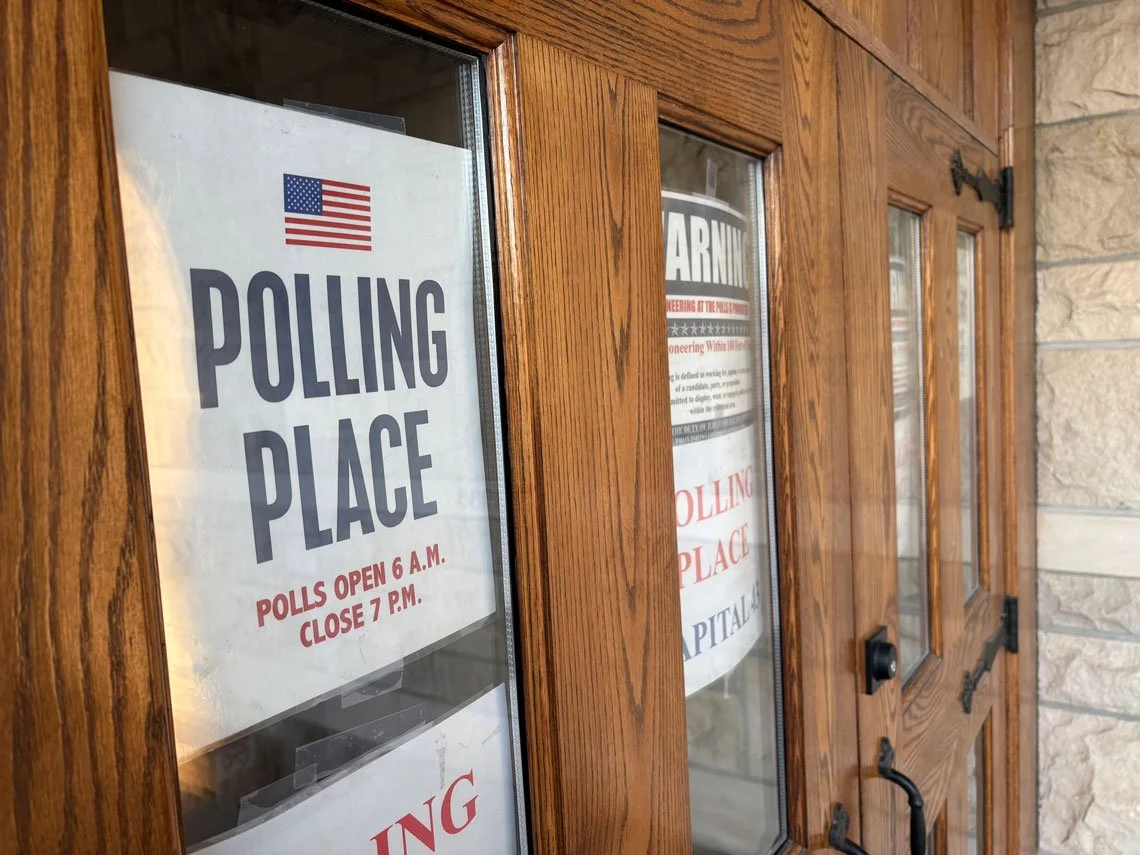
A sign shows polling place hours in Sangamon County on March 17, 2026. (Capitol News Illinois photo by Jerry Nowicki)
These judges arrived at the polling place by 5 a.m. to set up for the polls to open at 6 a.m. They remained there until after the polls closed at 7 p.m., leaving only when the tabulating machines had been counted and put away.

“You're helping the process, and you're making sure that things are done right,” Brim said. “I mean, you feel like you're accomplishing something for the country.”

Physical security

For county clerks, election administration requires physical security and cybersecurity. For the former, clerks must ensure proper maintenance and custody of voting equipment, ballots and voter rolls.

“In advance, there's a lot that we have to be focused in on, in terms of assuring that our equipment is properly maintained, that it’s properly calibrated, that ballots are properly created and devised,” Gray said. “We have to ensure that all of those work properly, that they read properly, and that the manner in which voters cast those ballots is an accurate reflection of the election.”

Clerks hold the tests before every election to show the public that the tabulators work correctly. But they also have a strict chain of custody protocol to protect from physical tampering. Every distributed ballot must be accounted for, and the machines are sealed until the ballots are removed for counting by the poll workers.

Williamson County Clerk Amanda Barnes, who has worked in the clerk’s office for nearly 30 years, said election security in Williamson County relies heavily on testing, paper ballots and public transparency. 

Barnes, a Republican who was elected county clerk in 2013, said her office begins preparing “months prior to an election,” testing voting machines, ballots and software before every election, then conducting a post-election “re-tabulation” audit using randomly selected precincts assigned by the state. 

Williamson County Clerk Amanda Barnes speaks to Capitol News Illinois. (Capitol News Illinois photo by Molly Parker)

She said one of the biggest misconceptions voters have is that voting is entirely electronic, explaining that “there is a paper trail” for every vote cast in the county because even touchscreen machines produce paper ballots that can be audited if questions arise. Barnes also pushed back on fears about hacked voting machines. 

“The program and the machines themselves are not hooked up to the internet,” she said. Rather, they are “just plugged into an outlet for electricity, so nothing is getting in that way.”

Most of the work outside of election season is just maintaining the voter registration roll. The state elections board maintains a statewide voter roll, but it’s updated daily only by the county clerks who add and remove voter registrations, Ackerman said. That was a concern he’s heard from some voters.

“I think there’s a lot of hysteria about dead people voting, illegal aliens voting,” said Dunk, who was appointed to the clerk position in December 2025 after spending six years working in the county’s election office. “I would say that’s just not something that we see, not in this county anyway. We put our voter registration through rigorous trials.” 

While Illinois does not require voter ID at the polls, Dunk said he has “definitely become more pro” voter identification over time and believes “having something” such as a voter ID card would make many residents feel more secure about elections. 

He also voiced frustration with Illinois’ permanent vote-by-mail system, saying he would “like to see permanent vote by mail completely revert back to just the by-request basis.” He said the current system results in a significant amount of returned mail because people forget to update their addresses during moves. 

At the urging of the president, whose claims of voter fraud are centered around noncitizen voting, members of Congress introduced the SAVE America Act, which would tighten voter ID guidelines and exercise more federal control over voter rolls. Its future is uncertain.

“I've always been very fundamentally comfortable on how we're operating today,” Gray said of the act. “But if it's not enough to give confidence to the public, and they demand more controls and more vetting and more transparency in the process, I'm certainly supportive of that too, because again, you're always subject to the trust and confidence of the public.”

Sangamon County election judges run the 2026 March primary election. (Capitol News Illinois photo by Andrew Campbell)

Election judges verify voter registration at polling places on Election Day by checking an individual’s signature against one they have on file. When registering to vote, individuals must show two forms of valid identification, one of which with their current address. 

Voter registration is very accessible in Illinois, Dietrich said. Most voters now register online or when they apply for or renew their driver’s license.

The SAVE America Act would require voters to show proof of citizenship when they register to vote and to show photo ID when they vote in-person or request an absentee ballot. 

Voting rights advocates say the bill could disenfranchise millions who don’t have easy access to proof of citizenship, like a passport or birth certificate. The act passed the House in February but stalled in the Senate.

Cybersecurity

County clerks also take charge of cybersecurity, working closely with local, state and federal law enforcement. Illinois is at the forefront of cybersecurity, Gray said, after the 2016 breach.

To protect tabulation machines from outside tampering, the machines have firewall protection systems, no connection to outside internet, strict chain of custody protocol and data redundancies.

“The machines run tapes and data internally to give the cumulative report. Every ballot is kept, every ballot that's been cast by a voter and how it's been marked is represented to each machine,” Gray said. “We go through audits and we show the public that how ballots are being marked as a direct reflection to how the machines are reading them.”

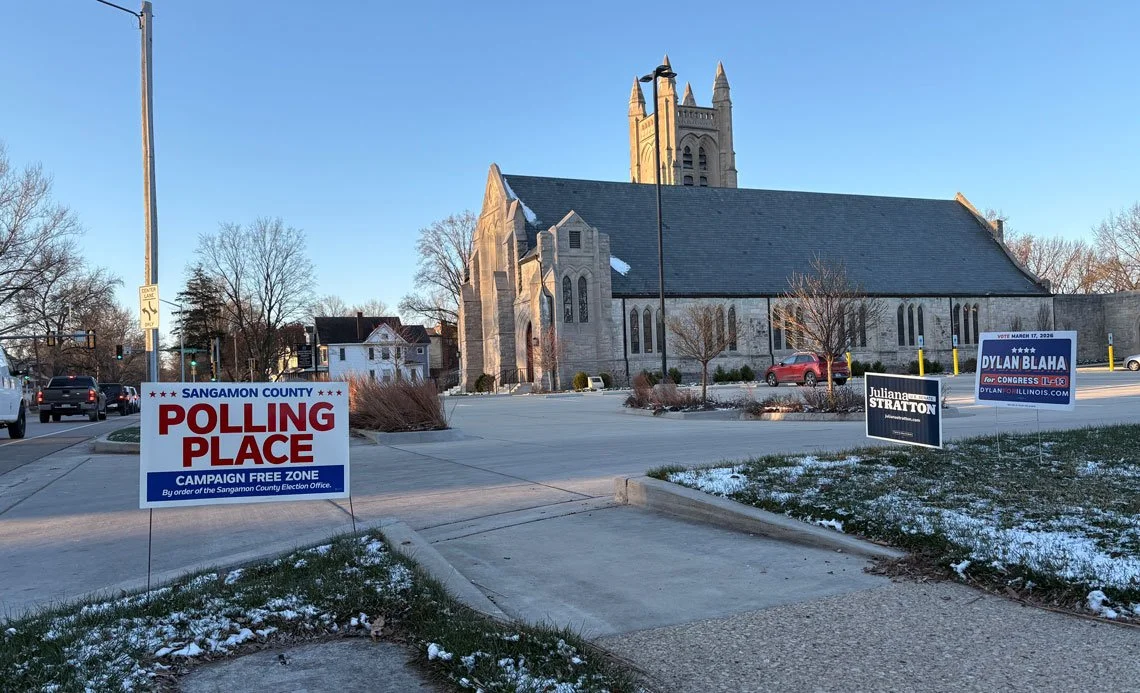
A church serves as a polling place in Sangamon County for the 2026 March primary (Capitol News Illinois photo by Jerry Nowicki)
Another one of the strengths of Illinois conducting elections locally is if a bad actor was able to identify a vulnerability in one county, they wouldn’t find the same one in every county, which makes it nearly impossible to rig the system, Ackerman said.

After the 2016 breach, Illinois used a federal grant to hire cybersecurity specialists to improve election security and started the Illinois Cyber Navigator Program to ensure every county has access to cybersecurity communication and training.

Federal grant funding for elections infrastructure is primarily awarded by the bipartisan Election Assistance Commission, but the funds themselves are controlled by Congress. Between 2019 and 2021, annual funding was on average $400 million. In 2022 and 2023 it dropped to $75 million, then $55 million in 2024 and $15 million in 2025, according to a news release from Ackerman.

In January, Capitol News Illinois spoke with Ackerman after he led a bipartisan delegation of Illinois county clerks to Washington, D.C. last fall and again in April 2026 to advocate for election infrastructure funding. 

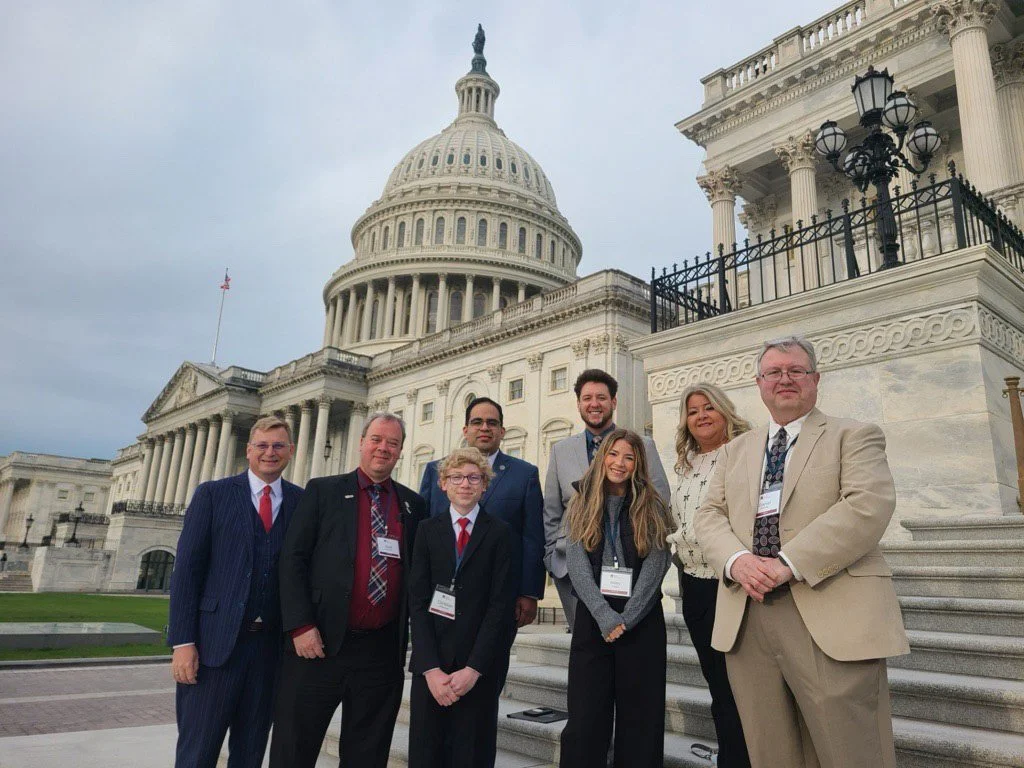
A bipartisan group of election officials from Illinois visit the U.S. Capitol. Pictured left to right are Tazewell County Clerk John Ackerman, Knox County Clerk Scott Erickson, Christian Ackerman, Lake County Clerk Anthony Vega, Alexander County Clerk Zachary Price, Miley Dolder, Putnam County Clerk Tina Dolder, and Tazewell County Chief Deputy Clerk Dan Sullivan. (Photo provided by John Ackerman)

Federal funding may vary, but the cost of administering an election stays the same, Ackerman said. When funding is so volatile, it’s difficult to plan and follow through on big purchases like equipment upgrades.

Lake County Clerk Anthony Vega, a Democrat, is also heavily involved with the clerk’s association and attended these trips to call for greater funding: “Protecting our democracy requires partnership, and our voters deserve nothing less,” he said in an April news release.

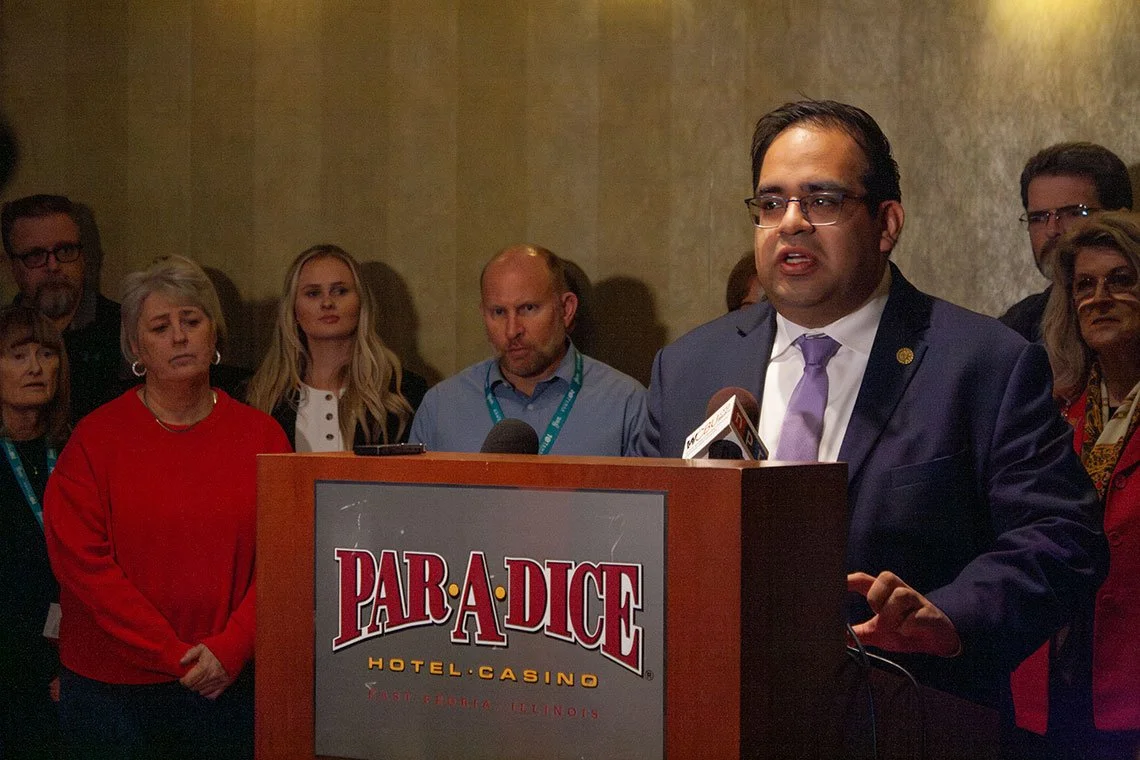
Lake County Clerk Anthony Vega speaks at an Illinois Association of County Clerks and Recorders event in East Peoria in January 2026. (Capitol News Illinois photo by Jenna Schweikert)

“We were kind of pointing out that just within the state of Illinois, the cost of an election in just a couple counties could equal that full $15 million,” Ackerman said. “How are you really funding elections nationwide when that's the total amount of a couple counties added together, let alone all the other states?”

The delegation met with bipartisan members of Congress and their staff and said the April trip was successful. 

“We all have the same struggles, the same issues, so it was a great opportunity to network, to talk, to see what best practices are being done elsewhere that we can bring back and utilize within our jurisdictions,” Ackerman said.

The Trump administration has been less direct in communication with election authorities, but every administration has different priorities, so it’s all about adapting, Ackerman said.

At the end of the day, election authorities’ goal is to assure voters that elections are secure: “I don't want voters to think that voting is something that is complicated. It's not and it never has been,” Dietrich said.

Capitol News Illinois reporter Molly Parker contributed reporting to this story.

This article was produced through the Healing Illinois: Democracy Lives Here Reporting Project with the Medill Solutions Journalism Hub at Northwestern University. Healing Illinois — an Illinois Department of Human Services initiative managed with the Field Foundation — supports storytelling and community collaborations to address racial and systemic inequities across the state.

Capitol News Illinois is a nonprofit, nonpartisan news service that distributes state government coverage to hundreds of news outlets statewide. It is funded primarily by the Illinois Press Foundation and the Robert R. McCormick Foundation.