
Illinois lawmakers punt remap amendment after SCOTUS Voting Rights Act ruling

House-approved amendment sought to rewrite redistricting guidelines

By BEN SZALINSKI
& PETER HANCOCK
Capitol News Illinois
news@capitolnewsillinois.com

Article Summary

  • Senate President Don Harmon, D-Oak Park, said the Senate will not move forward with a constitutional amendment rewriting the state’s redistricting rules after a ruling by the U.S. Supreme Court on Wednesday.

  • The nation’s high court invalidated Louisiana’s congressional district over racial gerrymandering, opening the door for other potential challenges to maps drawn on racial lines.

  • The ruling undermines a provision in the federal Voting Rights Act that has been interpreted to prohibit splitting large minority groups into multiple districts to dilute voting power. Illinois lawmakers sought to add that provision to the state constitution. 

  • The proposed amendment passed the House last week after House Speaker Emanuel “Chris” Welch said he feared the U.S. Supreme Court could eliminate racial protections. 

This summary was written by the reporters and editors who worked on this story. 

SPRINGFIELD — Illinois lawmakers are not planning to pursue a constitutional amendment on redistricting after a key U.S. Supreme Court ruling on Wednesday.

Senate President Don Harmon, D-Oak Park, told Capitol News Illinois that Senate Democrats decided not to call an amendment that passed House last week after the U.S. Supreme Court dealt a hefty blow the federal Voting Rights Act. If approved by voters, it would have rewritten the state’s redistricting rules. 

“We want to spend a little bit of time unpacking the Supreme Court decision to make sure we get it right and protect the voting rights of Illinois residents,” Harmon said. “It's much better and much more important to get this correct than to do it quickly. The worst thing that would happen is if we rushed and there were unintended consequences that undermine people's voting rights.”

But that means the matter will have to wait until at least 2028, as lawmakers faced a May 3 deadline to approve constitutional amendments for voters to consider in November.

The proposed amendment would have inserted a provision from the Voting Rights Act into the state constitution to specifically direct lawmakers to consider race in drawing district lines. 

The Voting Rights Act provision has long been interpreted as a ban on splitting large minority groups into multiple legislative districts to dilute their voting power. 

The U.S. Supreme Court, however, struck down Louisiana’s congressional map on Wednesday, ruling a district drawn to consolidate Black voters was illegally gerrymandered based on race. While the decision did not broadly eliminate the section of the Voting Rights Act, dissenting liberal Justice Elena Kagan suggested it is “all but a dead letter.” 

Racial intent

David Becker, founder and executive editor of the nonpartisan Center for Election Innovation and Research, called the decision a “radical” change in the way voting rights cases are now reviewed.

“When I woke up this morning, we had a functional Voting Rights Act,” he said during a media briefing on the case Wednesday. “And unfortunately, I can't say that anymore.”

Prior to Wednesday’s decision, he said, plaintiffs in voting rights cases only had to show that a set of maps had the effect of diluting a minority group’s voting strength, not that there was a specific intent to discriminate.

Wednesday’s decision, he said, reverses that standard and provides what he called “a clear roadmap” for how a state legislature can engage in racial gerrymandering without it being declared illegal.

“All it has to do is to be very careful about talking about intent,” he said. “Don't talk about intent at all. Couch everything in partisanship. And then it can't even be really reviewed because racial effects aren't going to be enough to establish a violation, even if those racial effects are stark.”

Illinois reaction

Illinois House Speaker Emanuel “Chris” Welch, D-Hillside, said fear that the court would strike down protections for racial groups inspired him to pursue the constitutional amendment. While the court did not go that far, the ruling that lawmakers cannot draw maps based on race affirmed many Democrats’ fears. 

Read more: House approves redistricting amendment, fearing federal Voting Rights Act will be eliminated

“The decision by the Supreme Court today on the Voting Rights Act is an abomination,” Gov. JB Pritzker told reporters in Chicago. “It is an attack on a crown jewel of our democracy.” 

Illinois’ proposed amendment would’ve established a priority list stating what factors lawmakers should consider in the redistricting process. It stated they should draw districts “to be substantially equal in population; to ensure that no citizen is denied an equal opportunity to participate in the political process and to elect representatives of his or her choice on account of race; to create, where practical, racial coalition or influence Districts; to be contiguous; and to the extent practicable, to be compact.”

Harmon said the ruling “highlights how much the court would frown upon race being a predominant factor in drawing districts.”

The Illinois Voting Rights Act, which was established in 2011, requires lawmakers to create “crossover” districts where minority groups are a large enough share of the population to potentially elect their preferred candidate and “influence” districts where a racial minority is large enough to sway the outcome of an election toward their preferred candidate. 

Political fight 

House Republicans argued last week that the amendment was in response to a lawsuit they filed last year that sought to overturn the state’s legislative maps by alleging dozens of districts failed to meet a decades-old Illinois Supreme Court precedent that defined an appropriately compact map. The Illinois Supreme Court ultimately tossed the lawsuit, ruling it was filed too late.

They said the proposed constitutional amendment would give Democrats more leeway to draw heavily gerrymandered districts that snake around communities. 

“This Supreme Court decision addresses the very gerrymandering efforts the Democrats are hoping to codify into Illinois law with this Constitutional Amendment,” the Illinois Freedom Caucus, a group of far-right Republicans, said in a statement. “(House Joint Constitutional Amendment 28) is now, very clearly, unconstitutional.” 

New congressional maps are not in General Assembly Democrats’ plans for now either. The possibility was floated last year as other states began redrawing their boundaries to increase partisan representation in Congress, but talks in Illinois faded after Indiana Republicans decided not to attempt a mid-decade remap.

“I think we have an excellent congressional map that reflects the communities of interest across the state,” Harmon said. “I'm not sure that we could, and if we could, whether we should draw a district that leans more one way or the other.” 

Capitol News Illinois is a nonprofit, nonpartisan news service that distributes state government coverage to hundreds of news outlets statewide. It is funded primarily by the Illinois Press Foundation and the Robert R. McCormick Foundation.
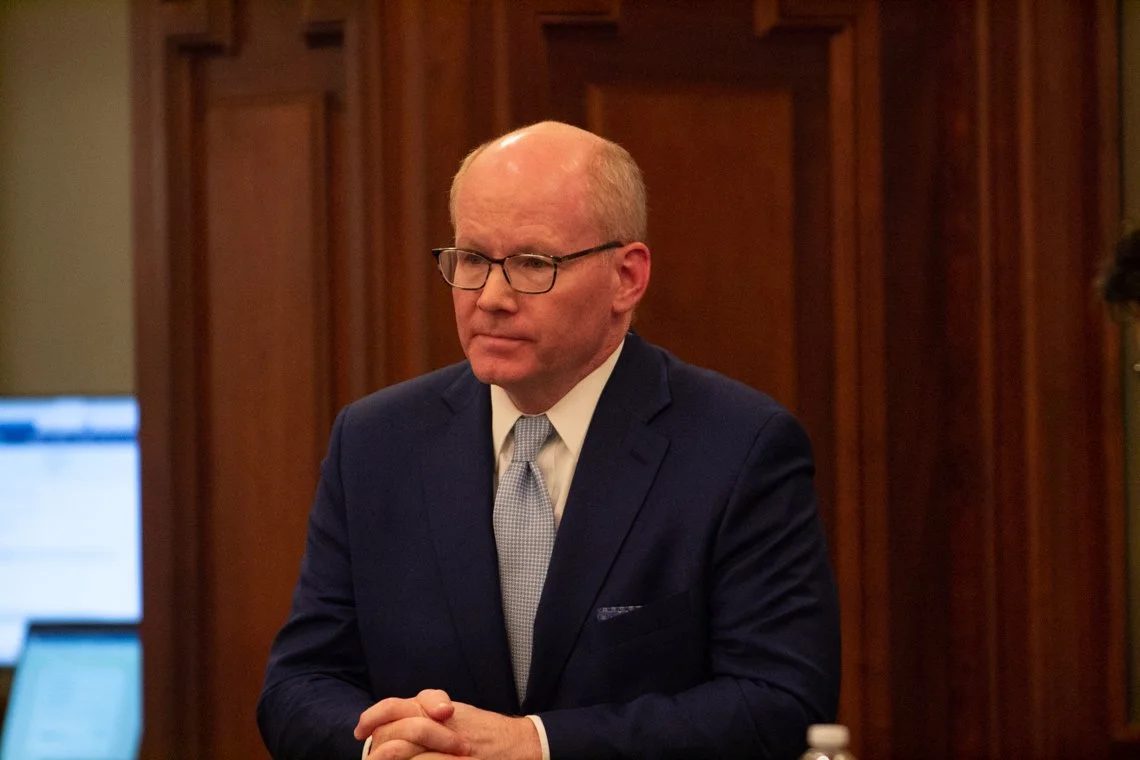

Senate President Don Harmon, D-Oak Park, said state lawmakers need more time to evaluate a U.S. Supreme Court ruling before proceeding with a constitutional amendment. (Capitol News Illinois photo by Jerry Nowicki)

ILLINOIS STATE POLICE MAKES ARREST IN 42-YEAR HOMICIDE COLD CASE AND SEEKS THE PUBLIC’S ASSISTANCE

JOPPA – An Illinois State Police (ISP) Division of Criminal Investigation (DCI) Zone 7 homicide investigation resulted in the arrest of 76-year-old George E. Bradfield of Owensboro, Kentucky after an extensive investigation that spanned over four decades.

 On March 30, 1984, the body of 26-year-old Lisa Ann Carnes was discovered in a field in rural Massac County. She died as the result of a single gunshot wound. On April 22, 2026, the Massac County State’s Attorney’s Office charged Bradfield with five counts of Murder.

 The Massac County Sheriff’s Office, the Owensboro (KY) Police Department, the FBI Behavioral Analysis Unit, and Parabon NanoLabs Inc., with funding from EWU Media LLC, assisted with the investigation.

 ISP is continuing its investigation and is seeking the public’s assistance. ​ If you have information about this incident or about Bradfield, please contact ISP.

 Tips or information about this case or Bradfield can be submitted via email directly to ISP at ISP.CRIMETIPS@illinois.gov, or by calling ISP at 618-542-1486 and 618-542-2171 ext. 1202. Individuals providing information can remain anonymous.

Ordinance Violations Can Be Costly Warns City Attorney

City Attorney Derek McCullough reminded residents about local ordinances involving e-bicycle, golf cart, and side by side permits and animals running at large at Monday’s City Council meeting.

McCullough said while the base fines for violations are relatively small, the total cost can quickly increase once state-mandated assessments and court fees are added. He noted that a citation for an unregistered e-bicycle, golf cart, or side by side can end up costing more than 200 dollars if it goes through the court system.

He added the same applies to dogs running at large, where initial fines may be minimal but total costs rise significantly with additional fees.

McCullough encouraged residents to avoid those expenses by making sure e-bikes, golf carts, and side by sides are properly permitted and dogs are kept on a leash, emphasizing that compliance can save both time and money.

State Permitting Continues To Slow Pool Work

At Monday afternoon’s Mount Carmel City Council meeting, Mayor Joe Judge provided an update on progress at the city’s new aquatic center.

Judge said crews with Landmark Aquatics were on site Monday and are beginning work, with pool tiling expected to get underway this week. He added the project is awaiting final approval from the State of Illinois before moving into full construction mode, which could happen later this week or early next week.

The mayor expressed frustration with delays at the state level, noting the approval process has taken longer than expected. Judge said while he understands staffing challenges, the timeline has slowed progress on the project.

Despite the delays, Judge said work is now moving forward on site, with hopes the project will soon receive the necessary approvals to continue full construction.

New Ambulance Agreement Approved By WGH Board

The Wabash General Hospital Board of Directors approved an updated ambulance service agreement with Wabash County at their April meeting held on Monday.

President and CEO Karissa Turner said the agreement replaces the hospital’s original contract with the county, which dates back to 1993 and had not been updated since. She said the review was prompted by the hospital’s ongoing expansion plans.

The new agreement is structured as a one-year term that automatically renews, with provisions allowing termination either by mutual agreement or by the hospital.

Turner emphasized the importance of the long-standing partnership, noting the hospital’s paramedics and EMTs work closely with emergency room staff, assist with patient transfers, and provide additional support such as IV starts. She added the service offers paramedic-level care to county residents.

Hospital officials also noted the ambulance service operates at an annual loss of around $400,000, with the county contributing just over $100,000 through tax revenue.

Following discussion, the board approved the agreement, allowing Turner to formally sign the updated contract with the county.

WGH Board Hears Update On Strategic Plan

At Monday evening’s meeting of the Wabash General Hospital Board of Directors, President and CEO Karissa Turner provided a first quarter update on the hospital’s strategic plan.

Turner highlighted several areas of progress, including community outreach efforts. She said the hospital hosted two free foot care clinics in April, serving 107 patients in Mount Carmel and 79 in Olney.

In terms of quality and patient experience, Turner reported the hospital is performing in the 85th percentile for its “provider would recommend” score.

She also noted improvements in services, including the addition of a new CT scanner and expanded availability of MRI services.

On the workforce side, Turner announced Wabash General Hospital has been named one of the Best Places to Work in Illinois for 2026, with final rankings to be released May 7th.

Financially, the hospital continues to show growth, with cash and investments increasing by 2.6 million dollars since the end of 2025. Days cash on hand has also risen to 174, moving closer to the hospital’s goal of 205.

Turner said the report reflects the first quarter of the hospital’s new strategic plan cycle.

#348 School Board Sets Special Meeting

WABASH CUSD #348

BOARD OF EDUCATION SPECIAL MEETING

Wabash CUSD #348 District Office

Wednesday May 6, 2026

5:00 p.m.

AGENDA

1. Call to order / Roll call

2. Executive Session pursuant to Section 2(c)(1) of the Open

Meetings Act: “The appointment, employment, compensation,

discipline, performance, dismissal of specific employees, or

student discipline.”

3. Employment

4. Adjourn

City Opened Senior Center As Storm Shelter

The Wabash County Senior Center was opened as a storm shelter last night as severe weather moved through the area.

During Monday afternoon’s Mount Carmel City Council meeting, Mayor Joe Judge thanked city employees who stepped in to staff the shelter, noting many worked additional hours beyond their regular shifts.

Judge said the city no longer relies on volunteers to operate the shelter, and he expressed appreciation for those willing to come in and help during severe weather events.

The mayor also addressed questions about the facility’s policy on animals. He said pets are allowed, but must be kept in kennels due to health regulations, as the senior center also operates as a restaurant and must be ready for service the following day.

Judge added the policy also considers the safety and comfort of all individuals using the shelter, noting some people may be uncomfortable around animals.

He emphasized the senior center is not a full-scale storm shelter, but rather the basement is used as a temporary safe location during severe weather situations.

‘It’s not for her’: DHS dedicated Midway Blitz in her name.  Her mother says she would have hated it 

Illinois Accountability Commission hears final two days of testimony into misconduct by federal immigration officials

By MAGGIE DOUGHERTY
Capitol News Illinois
mdougherty@capitolnewsillinois.com 

Article Summary 

  • The mother of a young woman to whom the Trump administration dedicated Operation Midway Blitz testified to the Illinois Accountability Commission on Monday, saying her daughter would not have wanted this legacy.

  • The testimony comes in the penultimate public hearing of the commission ahead of a Thursday deadline to provide findings and recommendations to Gov. JB Pritzker.

  • Since its formation last October, the commission says it has conducted 16 in-depth investigations into federal agent misconduct, based on over 60 interviews and hundreds of hours of body camera, surveillance camera and private citizen footage.

This summary was written by the reporters and editors who worked on this story. 

CHICAGO — The Trump administration dedicated Operation Midway Blitz in a press release to 20-year-old Katie Abraham, who was killed last year in a drunken driving accident in Urbana by a Guatemalan man residing in the U.S. without legal status. 

But her mother said the administration never sought her permission to use her daughter’s name in furtherance of its political agenda, an association she says her daughter would not want. 

Denise Lorence, Abraham’s mother, testified Monday during one of the final two hearings of the Illinois Accountability Commission, a body created by Gov. JB Pritzker last fall to document misconduct of federal agents amid the Chicago area immigration enforcement campaign. 

“Katie would have hated it, and she would have hated having her name continuing to be used by politicians, publicly and on social media,” Lorence told commissioners. “The Trump administration preyed on her name and used it in a vile way.”

Abraham’s father, Joe Abraham, has been supportive of President Trump’s immigration enforcement campaign, appearing beside the president as he promoted his domestic agenda in the White House last June. 

He and his current wife were featured in a video released by the Department of Homeland Security, voicing support for increased border security funding. Abraham also penned an op-ed in the Chicago Tribune, criticizing Illinois lawmakers for undermining federal immigration policy.

“If even just one life is saved because of her story, then I know my Katie would be proud that I spoke up,” Abraham wrote. “As parents, we all process grief in different ways. The best way I know to honor my daughter is to help prevent other families from living this nightmare.”

The immigration enforcement campaign conducted last fall detained roughly 3,800 people and deported nearly 2,500, the majority of whom had no criminal record, according to an analysis by the Chicago Tribune. 

It’s not how her daughter would want to be remembered, Lorence said, arguing that DHS should have consulted both parents. 

“It’s not for her,” Lorence said. “Having my daughter’s legacy associated with this violent government operation and their political agenda, instead of the light and positivity that she contributed to this world is inexcusable, and she would want nothing to do with it.”

DHS did not respond to a request for comment regarding the use of Abraham’s name in connection with Operation Midway Blitz. 

Sixteen investigations

The testimony from Abraham’s mother was featured in the second-to-last hearing to be held by the commission before it submits a final report with its recommendations to Pritzker on Thursday. 

Since the commission was formed last October, it has conducted 16 in-depth investigations in Chicago based on interviews with over 60 eyewitnesses, nearly 100 hours of federal agent body camera footage and hundreds of hours of footage from surveillance cameras, personal devices and social media.

It also conducted seven commissioner-led private group listening sessions in different neighborhoods, according to a news release.

 Read more: Accountability Commission hears testimony about excessive force by ICE agents. Felt like a ‘war zone’ | ‘A crisis for the nation’: ICE accountability commission continues to seek solutions | A city blanketed in fear: Accountability Commission hears shocking testimony about ICE

The investigations included the fatal shooting of Silverio Villegas Gonzales, a Mexican father of two fatally shot by an Immigration and Customs Enforcement agent during a September traffic stop in Franklin Park, and the shooting of Marimar Martinez, a teacher’s aide who was shot five times by a Border Patrol agent in October. 

Martinez is expected to testify tomorrow with her lawyer, as is former Illinois House Minority Leader Jim Durkin.

Capitol News Illinois is a nonprofit, nonpartisan news service that distributes state government coverage to hundreds of news outlets statewide. It is funded primarily by the Illinois Press Foundation and the Robert R. McCormick Foundation.

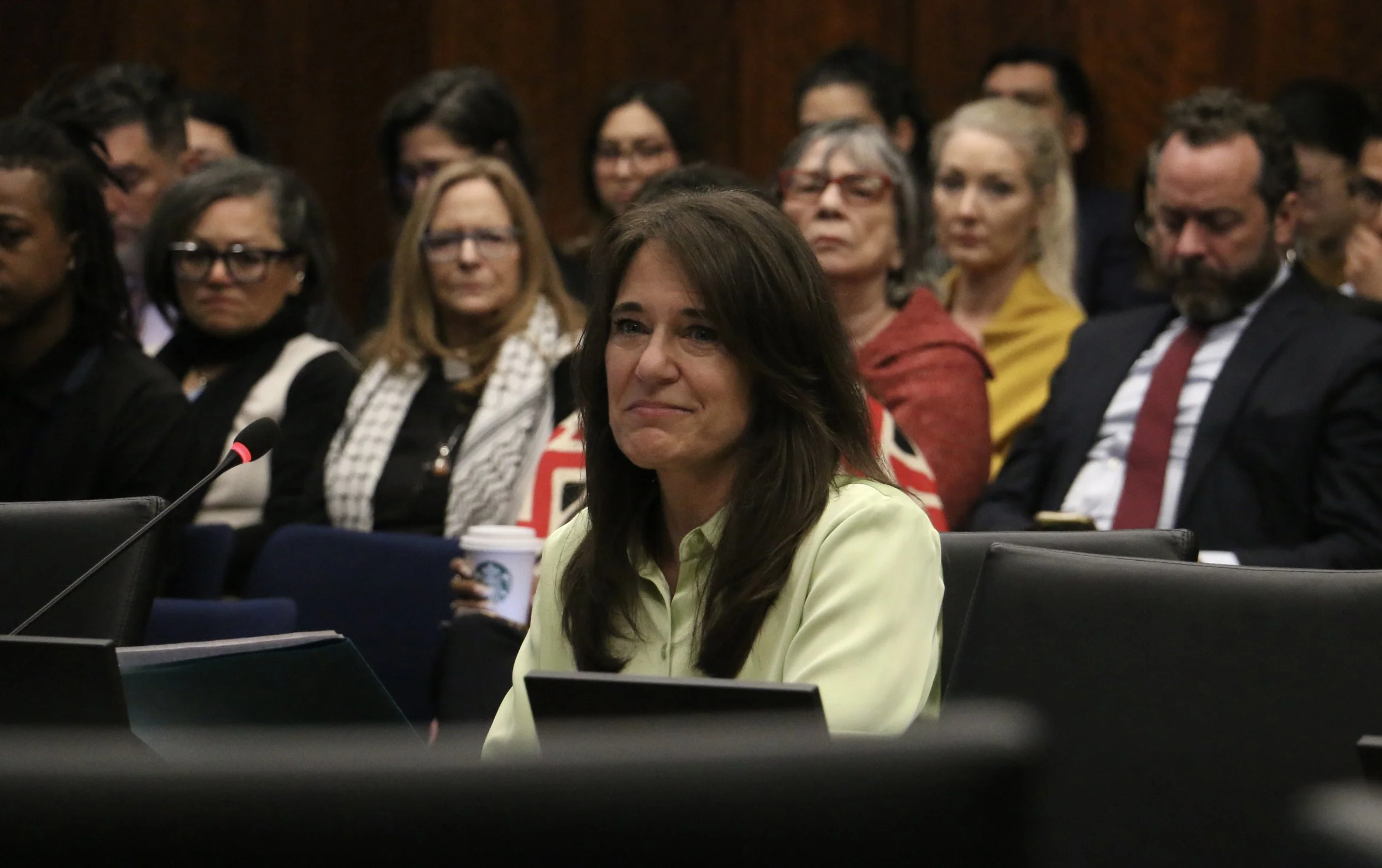
Denise Lorence, mother of Katie Abraham, says during an April 27 hearing of the Illinois Accountability Commission that her daughter should be remembered as the “empathetic and caring person she was,” not used to further the Trump administration’s political aims. (Capitol News Illinois photo by Maggie Dougherty) 

Federal agency casts further uncertainty on Illinois’ credit card ‘swipe fee’ law

Measure slated for a May appellate court hearing prior to July 1 effective date 

By JERRY NOWICKI
Capitol News Illinois
jnowicki@capitolnewsillinois.com

Article Summary 

  • The federal Office of the Comptroller of the Currency published two filings last week stating federal law prohibits states from regulating credit and debit card “swipe” fees. 

  • An Illinois law that would prohibit financial institutions from charging those fees on the tax and tip portion of credit card bills is tied up in the courts, slated for a May 13 hearing.

  • The state law is scheduled to take effect July 1, but one OCC filing would stop its implementation. 

  • It’s the latest development in a two-year legislative fight between banks and retailers that will affect hundreds of millions of dollars in revenue for each of the industries. 

This summary was written by the reporters and editors who worked on this story.

A federal agency says Illinois can’t limit credit card swipe fees for federally chartered banks, even though a federal judge earlier this year ruled that it could. 

Two interim filings posted last week by the Office of the Comptroller of the Currency, an independent subsection of the U.S. Treasury Department, represent the latest twist in a two-year legislative fight between banks and retailers.

Read the filings: Preemption of Illinois law | Restatement of National Banking Act

One of the filings specifically preempts the state’s first-of-its-kind Interchange Fee Prohibition Act, throwing the policy into further uncertainty by creating a second legal front and added pressure on state lawmakers amid an ongoing appellate court case. 

Interchange or “swipe fees” are automatically applied to debit and credit card transactions, redirecting about 1-2% or more of a transaction’s cost from the merchant to the banks, credit unions and card companies. The fees include both a set amount and a percentage of the transaction, but the credit card companies, namely Visa and Mastercard, control how they’re calculated. 

Read more: ‘Credit card chaos’? Financial institutions bet big on repeal of first-of-its-kind Illinois law

Illinois lawmakers passed the Interchange Fee Prohibition Act as part of the state budget in May 2024 to prohibit financial institutions from charging such fees on the tax and tip portion of credit and debit card transactions. 

At stake is more than $100 million annually between retailers and banks, as exempting tax and tips from interchange fees would reduce the banks’ cut of swipe fees by 10% or more. 

Banks have since warned of impending “credit card chaos.” They say the current system only asks for the total amount of a transaction, meaning consumers might have to do multiple swipes or pay cash to cover the tax and tip portion of transactions. Retailers say they’re bluffing and can implement the changes with mere software upgrades. 

Given the pending court case and a hard push from financial institutions, lawmakers are considering pushing back the state law beyond its July 1 effective date that was already delayed by a year.

Reaction to the filings

The financial institutions praised the OCC’s filings but warned they create a piecemeal legal landscape by only applying to banks that are federally chartered. Smaller state-chartered institutions would still be subject to the law.

A joint statement from the Illinois Bankers Association, Illinois Credit Union League, American Bankers Association and America's Credit Unions urged similar application to national credit unions. 

“They (the filings) reinforce the firm legal foundation of our ongoing appeal and underscore that Illinois’ misguided law is unlawful and should not be implemented,” the statement read. “The OCC’s actions should also send a strong signal to other states to follow the law and not repeat Illinois' mistake.”

Rob Karr of the Illinois Retail Merchants Association accused the Trump administration of trying “to evade the law, undermine the legal system and threaten the very consumers they purport to serve.”

IRMA was heavily involved in the Illinois law’s passage, which was a concession to retailers after the state capped a tax exemption merchants claim for serving as the state’s de facto sale tax collectors. 

 “We are confident the courts will make the final decision in this matter — not an agency operating at the behest of big banks and credit card companies,” Karr said in a statement. 

The case has been tied up in court for two years. The law was initially set to take effect in July 2025, but lawmakers pushed it back a year to allow time for implementation and to allow the court challenge to play out. 

A U.S. district judge sided with the retailers and the state in February. Judge Virgina Kendall ruled that the National Banking Act prohibits states from regulating fees charged by banks — but swipe fees are set by third parties, namely card companies. Because of that, the state has the authority to regulate, she ruled. 

But the banks quickly appealed to the 7th Circuit Court of Appeals, and arguments are slated for May 13. Some believe the matter could even come before the U.S. Supreme Court.

The latest filings

This is not the first time the Office of the Comptroller of the Currency weighed in on the issue. It did so under President Joe Biden as well in a 2024 legal filing, referring to the Illinois law as “bad policy” and “unworkable.”

Addressing that point, Kendall wrote: “That may well be true. But even the Office of the Comptroller does not meaningfully contest that the third parties set the fees.”

She also warned that national banks “could shield a vast amount of their otherwise regulatable activities from State regulation by hiding behind third-party entities like the credit card companies.” 

The OCC rebutted that line in one of the two recent filings that applied to the National Banking Act more broadly.  

The interim final rule explicitly states “national banks may charge non-interest charges or fees, even when such charges and fees are set by or in consultation with third parties.”

Doug Kantor, of the National Association of Convenience Stores, said the ruling goes far beyond interchange fees.  

“The OCC rules endorse price fixing of fees banks charge, including not just swipe fees but a wide range of consumer fees,” he said in a statement. 

The OCC issued “interim final” filings, meaning they can go into effect June 30 and bypass the standard process for proposed rules. The public can submit comments, but ultimately it would require a vote of Congress or an act of a court to repeal the final rule and order.

Capitol News Illinois is a nonprofit, nonpartisan news service that distributes state government coverage to hundreds of news outlets statewide. It is funded primarily by the Illinois Press Foundation and the Robert R. McCormick Foundation.