
The school board approved these items at Monday’s meeting…

Barbara Flynn Currie, 40-year veteran of Illinois House, trailblazer for women in Springfield, die
s
First woman majority leader remembered as ‘the original Illinois progressive’
By HANNAH MEISEL
Capitol News Illinois
hmeisel@capitolnewsillinois.com
Article Summary
Former Illinois House Majority Leader Barbara Flynn Currie, who served 40 years in the General Assembly, died Thursday at 85.
Currie was first elected to the House in 1978, at a time when women made up only a small minority of the legislature. After 18 years in Springfield, Currie was promoted to House Majority Leader, the first woman to hold the second-in-command role.
Currie retired from the General Assembly in 2019 but was then appointed to head the Illinois Pollution Control Board, a post she held until her death.
This summary was written by the reporters and editors who worked on this story.
CHICAGO — Barbara Flynn Currie, a 40-year veteran of the Illinois House and the first woman to serve as the second-in-command majority leader of the chamber, died Thursday. She was 85.
Currie, who is tied for the second-longest-serving legislator in Illinois' modern era behind imprisoned ex-Speaker Michael Madigan, retired from the Illinois House in early 2019 but remained involved in state government and politics, including serving as the head of the Illinois Pollution Control Board, a post she held until her death. She maintained relationships with colleagues who grieved her death on Friday.
State Rep. Curtis Tarver, D-Chicago, who was elected in 2018 to replace Currie after she announced she wouldn’t seek a 21st term, was emotional as he summarized her legacy as a “trailblazer” in a speech on the House floor in Springfield. He said she “raised her children first, finished her degree later, in what she described as ‘doing it on the motherhood plan.’”
“That mattered,” Tarver said. “It shaped how she saw people, how she approached policy and how she understood their real lives behind the decisions we make in this chamber.”
Currie, whose father taught at the University of Chicago, grew up in Hyde Park and graduated from its laboratory high school in 1958. But the next year, she withdrew from her university studies at the U of C and married her husband David, a recent graduate, whom she followed to Harvard Law School. In the early 1960s, the couple moved back to Chicago when David began teaching at the U of C’s law school.
While raising young children, Currie finally obtained her undergraduate degree in 1968 before working on the campaign of activist and lawyer Michael Shakman to be elected delegate to the 1969-70 constitutional convention. As she told the University of Chicago’s alumni magazine in 2019, it was Shakman who encouraged her to run for an open House seat in 1978.
When Currie arrived in Springfield as a newly minted legislator in January 1979, it was to a Capitol — and by extension, a state government — run almost exclusively by men. According to transcripts of House proceedings at the time, she was referred to as “Mrs. Currie” more than a third of the times she was called on to speak on the House floor during her first term; in modern times, representatives are almost exclusively referred to by their titles.
Women comprised roughly 13% of the legislature in those days, and as Currie told the U of C’s magazine in 2019, the few women who were in public office “generally inherited the job.”
But Tarver noted Friday that there are now 78 women in the General Assembly, which account for roughly 44% of the Illinois House and Senate, a statistic that can be directly traced back to Currie, he said. Madigan’s appointment of Currie to majority leader in 1997 was not popular, but Tarver said she’d earned it “through preparation, discipline, and most importantly, intellect.”
“She did not inherit it,” he said. “She built the path.”
House Majority Leader Robyn Gabel, D-Evanston, who is now the second woman to serve in that role, broke down in tears Friday as she asked the House for a moment of silence “to honor my friend, my mentor and my role model for over 30 years.”
Gabel expounded on Currie’s example of serving “with dignity ... humility” and her example of how “to dedicate your life to something larger than yourself.”
“Her leadership in the General Assembly helped guide the state through some of the most difficult moments,” she said. “The impeachment, actually.”
Gabel was referring to the impeachment proceedings of ex-Gov. Rod Blagojevich in early 2009, for which Currie had been appointed chair of the House committee to investigate the governor after his December 2008 arrest by FBI agents. Blagojevich wouldn’t be indicted until April 2009, but in the weeks after his arrest, the Democratic governor declined to resign.
In addition to shaking down people, including children’s hospital leaders, for campaign donations, Blagojevich was accused of attempting to sell president-elect Barack Obama’s U.S. Senate seat. Before his 2004 election to Congress, Currie worked extremely closely with Obama as her state House district comprised half of the district he represented in the Illinois Senate.
Heather Wier Vaught, an attorney in the speaker’s office at the time who worked on the impeachment effort, recalled that when Madigan formed the bipartisan committee, many in Springfield expected a quick process wherein articles of impeachment were drafted and Blagojevich swiftly removed from office.
But from the outset, Currie made clear that the committee’s work would be “a very solemn experience” and that “every i was dotted and every t was crossed,” Wier Vaught, who is now a Springfield lobbyist, said.
Wier Vaught said Currie and the committee had to invent the process “from scratch,” because the state constitution didn’t specifically lay it out and Blagojevich was the first constitutional officer impeached in Illinois.
“A lot of us on staff — we never worked harder, we never worked so many hours as we did those weeks because she was so insistent we did everything right,” she said, including giving Blagojevich a chance to defend himself. Ultimately, he declined to testify.
“She didn’t just treat it as a political exercise,” Wier Vaught said of the impeachment proceedings. “It was important to her that it not look like a clown show and that it be a legitimate process.”
Wier Vaught pointed to Currie’s same seriousness in leading the post-impeachment negotiations on campaign finance reform, along with other matters like criminal justice reform, which she said Currie championed “before it was cool.”
Another former Democratic House staffer-turned-lobbyist, Liz Brown, agreed, calling Currie “the original Illinois progressive.”
Currie was often criticized as being too close to Madigan and what many referred to as his “Democratic Machine.” But from Brown's vantage point during a near-decade on staff, she said she saw Currie “work within the system” to change it.
“If you look at all the bills that passed under Madigan that had any progressive bent, that was Barbara,” Brown said. “There wouldn’t be any progressive wins without her pushing back on Madigan.”
But Currie was also a pragmatist, Brown said, and a master negotiator with an acerbic wit.
She also recalled Currie going to bat for her personally when she wanted to leave staff to become a lobbyist in 2009. Brown said that key Madigan deputies told her flat-out no — “this isn’t the year you become a lobbyist.”
According to Brown, Currie stepped in, “physically pushed me” into the office of the senior staffer and said simply: “she’s becoming a lobbyist.”
When the message back was that Brown “wouldn’t be getting any help from the speaker’s office,” Currie retorted that “she won’t need any.”
Brown said the episode was another example of Currie working within the system to change it.
“You had to earn her respect,” she said. “But if you earned it, she had your back for life.”
Capitol News Illinois is a nonprofit, nonpartisan news service that distributes state government coverage to hundreds of news outlets statewide. It is funded primarily by the Illinois Press Foundation and the Robert R. McCormick Foundation.
Evansville man arrested for DUI
On April 17, 2026, at 3:21 p.m. Gibson County Deputy Eric Powell conducted a traffic stop on US 41 near County Road 1200 South after observing a Ford F150 failing to maintain its travel lane on multiple occasions. Upon approaching the vehicle Deputy Powell observed multiple clues that the driver 32-year-old Cole Fike of Evansville was under the influence. At that point Deputy Powell began a roadside DUI investigation. At the conclusion of the investigation Mr. Fike was taken into custody and transported to the Gibson County Detention Center where he was charged with Operating a Vehicle While Intoxicated.
Deputy Wyatt Hunt assisted in this investigation.
All criminal defendants are to be presumed innocent until and unless proven guilty beyond a reasonable doubt in a court of law.
911 call leads to arrest of duo on multiple drug charges
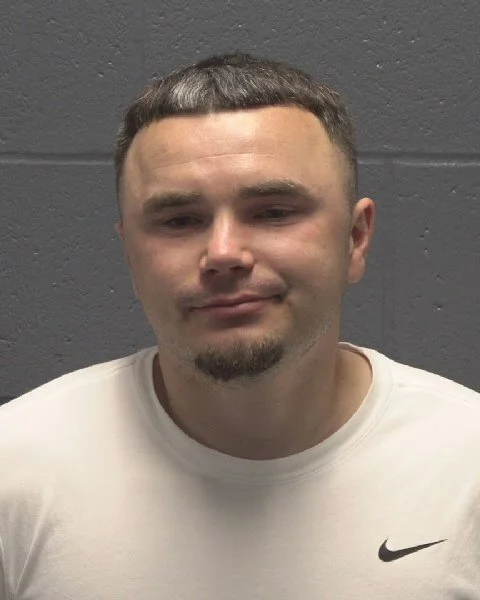
On April 19, 2026, at 3:43 p.m. Gibson County Central Dispatch received a 911 report of a disturbance in the 600 block of East Brummitt Street in Owensville. Upon arriving on scene law enforcement officers could hear the disturbance happening inside the residence while approaching the residence. Deputies finally got the residents to step outside of the residence so the parties could be separated to conduct an investigation into the disturbance. While speaking with one of the parties Deputies detected multiple clues that the person was under the influence of Methamphetamines. As the investigation progressed Deputy Eric Powell applied for a search warrant of the resident and was ultimately granted a search warrant by the courts. At that point a search of the residence was conducted where Methamphetamines, Marijuana, and Drug Paraphernalia were seized. Once the investigation was completed 33-year-old Zane Thompson and 40-year-old Tara Crowley of Owensville were taken into custody and transported to the Gibson County Detention Center.
Zane Thompson was charged with:
Possession of Methamphetamines
Possession of Marijuana
Possession of Paraphernalia
Possession of a Hypodermic Needle
Possession of a Legend or Prescription Drug
Maintaining a Common Nuisance
Tara Crowley was charged with:
Possession of Methamphetamines
Dealing in a Schedule Drug
Possession of Marijuana
Possession of Paraphernalia
Possession of a Hypodermic Needle
Maintaining a Common Nuisance
Deputy Eric Powell was assisted in his investigation by:
Sgt Loren Barchett- Gibson County Sheriff’s Office
Deputy Wes Baumgart- Gibson County Sheriff's Office
Deputy Wyatt Hunt- Gibson County Sheriff's Office
Deputy Wyatt Lashbrook- Gibson County Sheriff's Office
Officer Matt Perry- Princeton Police Department
Officer Jackie Wood- Princeton Police Department
All criminal defendants are to be presumed innocent until and unless proven guilty beyond a reasonable doubt in a court of law.


Princeton man arrested for OWI
On April 19, 2026, at 3:15 a.m. Gibson County Deputy Levi Sims conducted a traffic stop on a Gray 2025 Mazda CX3 for speeding on US 41 near State Road 168. Upon stopping the vehicle on US 41 near CR 550 South Deputy Sims detected multiple clues that the driver 50-year-old Rennan Sublemente of Princeton was under the influence. At that point Deputy Sims began a roadside DUI investigation that resulted in Mr. Sublemente being taken into custody and transported to the Gibson County Detention Center where he was charged with Operating a Vehicle While Intoxicated.
Princeton Officer David Jones assisted Deputy Sims in his investigation.
All criminal defendants are to be presumed innocent until and unless proven guilty beyond a reasonable doubt in a court of law.

Sex Offender Registry check leads to drug arrest
n April 18, 2026, at 5:46 p.m. Gibson County Deputy Wes Baumgart went to the Diplomat Motel located at 1733 S State Road 57 to conduct a Sex Offender Registry Compliance Check on 39-year-old Brian Dillard of Oakland City. Upon arriving at the hotel room Deputies detected the odor of burnt Marijuana coming from inside the residence when Mr. Dillard opened the door. At that point they began a drug investigation. During the investigation Mr. Dillard became argumentative and physically resisted law enforcement officers on scene when they attempted to stop him from leaving. After a brief struggle Mr. Dillard was taken into custody and prepared for transport to the Gibson County Detention Center. At the conclusion of the investigation Mr. Dillard was charged with Possession of Cocaine, Possession of Methamphetamines, Possession of Paraphernalia, Possession of Hypodermic Needles, and Resisting Law Enforcement.
Deputies Wyatt Hunt, Sgt. Loren Barchett, and Eric Powell assisted Deputy Baumgart in his investigation. Oakland City Police Officer Michael McGregor and Princeton Officers Matthew Perry and Jackie Wood also assisted in this investigation.
All criminal defendants are to be presumed innocent until and unless proven guilty beyond a reasonable doubt in a court of law.

Evansville woman arrested for never having received a valid operators license
On April 17, 2026, at 5:44 p.m. Gibson County Deputy Wyatt Lashbrook conducted a traffic stop on US 41 near County Road 350 South after conducting a traffic stop on a White 1995 Ford Ranger for having an expired license plate. Upon approaching the vehicle Deputy Lashbrook identified the driver as 42-year-old Dolores Correa of Evansville. During a roadside investigation Deputy Lashbrook ran Ms. Correa through the Indiana Department And Communications System and discovered that the driver was operating a vehicle without ever having received a valid license. At the conclusion of the investigation Ms. Correa was taken into custody and transported to the Gibson County Detention Center where she was charged with Operator Never Licensed and Possession of Marijuana.
Deputy Lashbrook was assisted in his investigation by Deputy Eric Powell.
All criminal defendants are to be presumed innocent until and unless proven guilty beyond a reasonable doubt in a court of law.

Despite Increase--Wabash Co. Still Has Lowest Jobless Rate In So. IL.
The Illinois Department of Employment Security has released its January unemployment figures, showing higher jobless rates across the region compared to one year ago.
In Wabash County, the unemployment rate rose to 4.1 percent in January 2026, up from 3.5 percent in January 2025. Edwards County increased to 5.6 percent, up from 4.1. Lawrence County came in at 5.6 percent, compared to 4.4 a year ago, while Richland County matched Wabash at 4.1 percent, up from 3.5. Wayne County reported a 5.2 percent unemployment rate, up from 4.2 percent last year.
Wabash and Richland Counties are tied for the lowest unemployment rates in southern Illinois. The highest rate in the region was reported in Pulaski County at 7.2 percent. Statewide, Illinois posted a 5.4 percent unemployment rate in January.
Meanwhile, the Olney–Mount Carmel area saw total nonfarm payrolls decrease by 725 jobs compared to January of 2025, with no sector posting job gains over the year.
The largest job losses were reported in manufacturing, down 200 positions. Private education and health services, as well as trade, transportation, and utilities, each declined by 150 jobs. Government employment dropped by 125 jobs, while smaller losses were seen in leisure and hospitality, professional and business services, and other services.
Construction, financial activities, information, and natural resources and mining remained unchanged over the year.
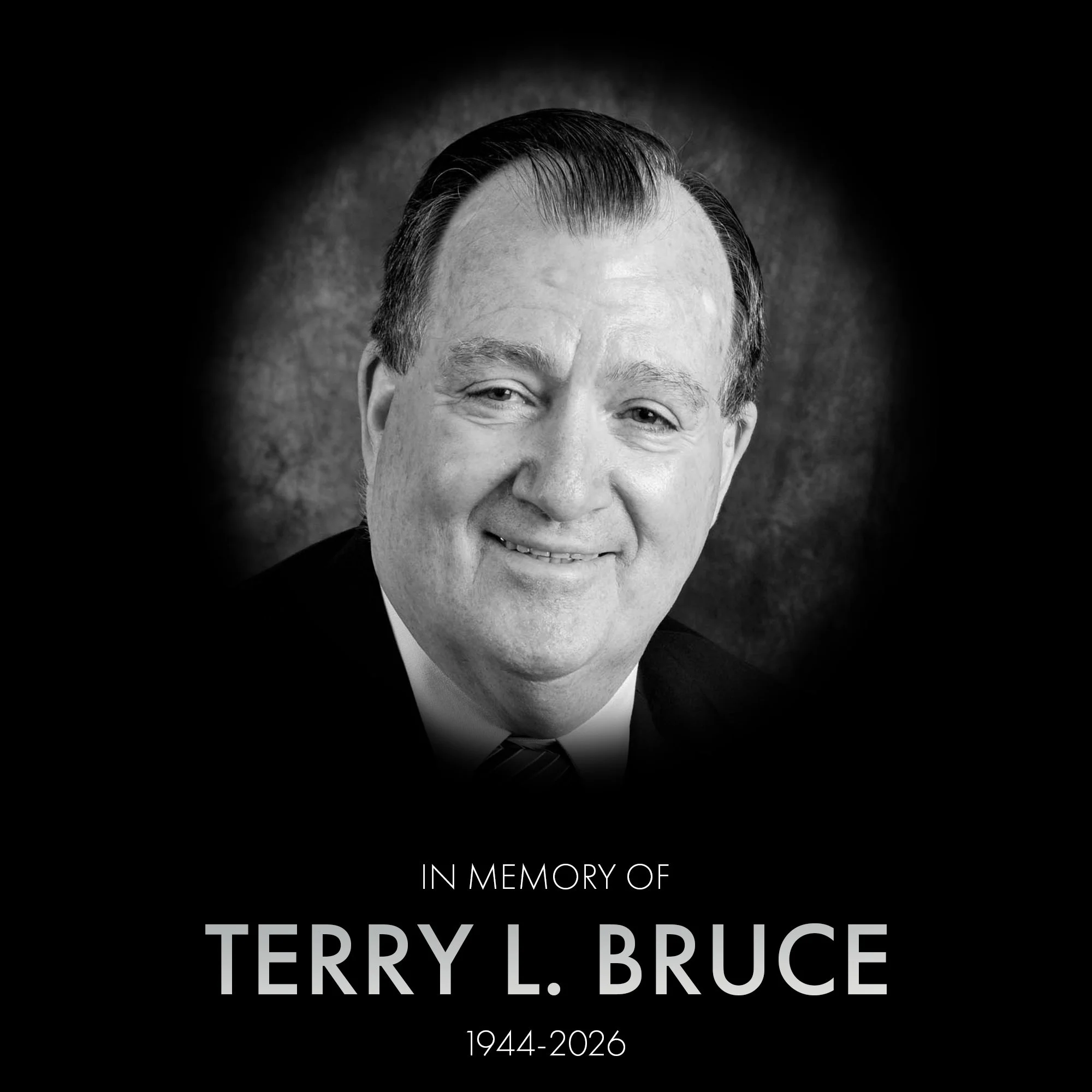
ILLINOIS EASTERN COMMUNITY COLLEGES HONORS THE LIFE AND LEGACY OF FORMER CEO TERRY L. BRUCE
Olney, Ill. – Illinois Eastern Community Colleges mourns the death of former Chief Executive Officer Terry L. Bruce, who passed away on April 17, 2026. Mr. Bruce’s decades of leadership and public service left a lasting mark on the institution, the region, and the Illinois community college system.
Bruce served as CEO of Illinois Eastern Community Colleges from 1996 until his retirement in 2019. Over those 23 years, he helped guide the district through a period of significant transformation while maintaining a strong commitment to students, employees, and the communities served by IECC.
In addition to his leadership at IECC, Bruce served on the Illinois Community College Board, including as Vice Chair. Earlier in his career served in both the Illinois Senate and the U.S. House of Representatives. Throughout his public life, he played an important role in advancing education and public service in southern Illinois.
“Mr. Bruce’s impact on IECC and on community colleges in Illinois is difficult to fully capture,” said Dr. Ryan Gower, Chancellor of Illinois Eastern Community Colleges. “His influence is woven into what we do every day. He cared deeply about access to education and about strengthening the communities of District 529, and that commitment continues to shape this institution.”
Beyond his professional accomplishments, Mr. Bruce was known for his character and the way he connected with others.
“For those who knew Mr. Bruce and worked closely with him, what stood out most was how deeply he cared about people,” Gower said. “He believed in giving second chances, and I saw him extend those opportunities time and again. He believed in helping people move forward in their lives, and that showed up in how he led this institution and how he conducted himself personally. He made a difference in the lives of many people.”
The Board of Trustees, faculty, and staff of IECC extends its deepest condolences to the Bruce family and to all who knew and worked with him.
House approves Pritzker initiative to regulate social media algorithms
Plan seeks to make children’s social media feeds less addictive
By BEN SZALINSKI
Capitol News Illinois
bszalinski@capitolnewsillinois.com
Article Summary
The Illinois House voted on bipartisan lines to pass the Children’s Social Media Safety Act.
The bill is designed to limit children’s access to social media algorithms that the courts have ruled and scientists have warned are addictive.
It would require platforms to use stricter default settings for minors, including limiting location sharing, digital currency transactions and nighttime notifications.
Gov. JB Pritzker proposed the bill and said addictive social media feeds are one of the top concerns parents ask him to address.
This summary was written by the reporters and editors who worked on this story.
SPRINGFIELD — A bill to regulate social media companies and the features they make available to minors is advancing in the Statehouse.
A bipartisan group of lawmakers in the House voted 82-27 to pass House Bill 5511, also known as the Children’s Social Media Safety Act. Gov. JB Pritzker proposed the bill, which is designed to make social media scrolling less addictive for children.
“What this bill is really designed to address is the weaponization of your data, your personal habits in a way that keeps kids glued and addicted to the screen,” bill sponsor Rep. Jennifer Gong-Gershowitz, D-Glenview, said.
The bill does not limit social media use to certain ages but does require platforms to allow users setting up an account to input their age, which would trigger certain settings on the device for users under 18 years old.
The bill mandates that information used to generate a social media feed cannot be “persistently associated with the user’s device” and based on content the user previously shared or interacted with. Users must follow the creator of the content or person who shares it to see the content in their feed. Additional content could only be provided to the user when they search for it.
The bill would also require social media platforms to have default privacy settings for minors that would stop addictive feeds, location sharing and transactions with digital currency. Platforms would also be prohibited from sending notifications to minor users between 10 p.m. and 7 a.m.
Companies that violate the law would have to pay fines.
The changes would take effect in 2028, and despite cracking down in some areas, Gong-Gershowitz said there won’t be restrictions on the content kids see.
"This bill does not include any content moderation or allow parents to monitor what children are doing online,” Gong-Gershowitz said. “It simply targets a harmful design feature like addictive algorithms that are designed to keep kids online. Children can still see the same content.”
Pritzker, some Republicans back it
Pritzker called on lawmakers during his February State of the State address to advance regulations.
“Everywhere I go, parents tell me one of their deepest concerns is the impact social media is having on their kids,” Pritzker said in his address. “It’s a challenge unique to this generation. And it is made worse by the perverse incentive that social media companies seem to have to keep kids scrolling no matter what the cost to their physical and mental health.”
Read more: Lawmakers advance Pritzker’s cell phone ban, social media regulations
Tackling children’s addictions to social media has been a bipartisan priority in Springfield in recent years and nine House Republicans joined Democrats in advancing the measure to the Senate.
“Up until this point, we haven’t had a lot of guardrails when it comes to social media use in our state,” Rep. Nicole La Ha, R-Lemont, told Capitol News Illinois. “Being a mom of school aged children, I think it’s really important that we start to have those conversations.”
La Ha said she is looking forward to using parental controls to make sure the content her kids see on their feeds is appropriate for their age.
Other Republicans said they supported the concept of the bill but would vote against it until more changes were made in the Senate.
Pritzker is also pushing lawmakers to tax social media companies based on the number of users they have in Illinois.
Capitol News Illinois is a nonprofit, nonpartisan news service that distributes state government coverage to hundreds of news outlets statewide. It is funded primarily by the Illinois Press Foundation and the Robert R. McCormick Foundation.
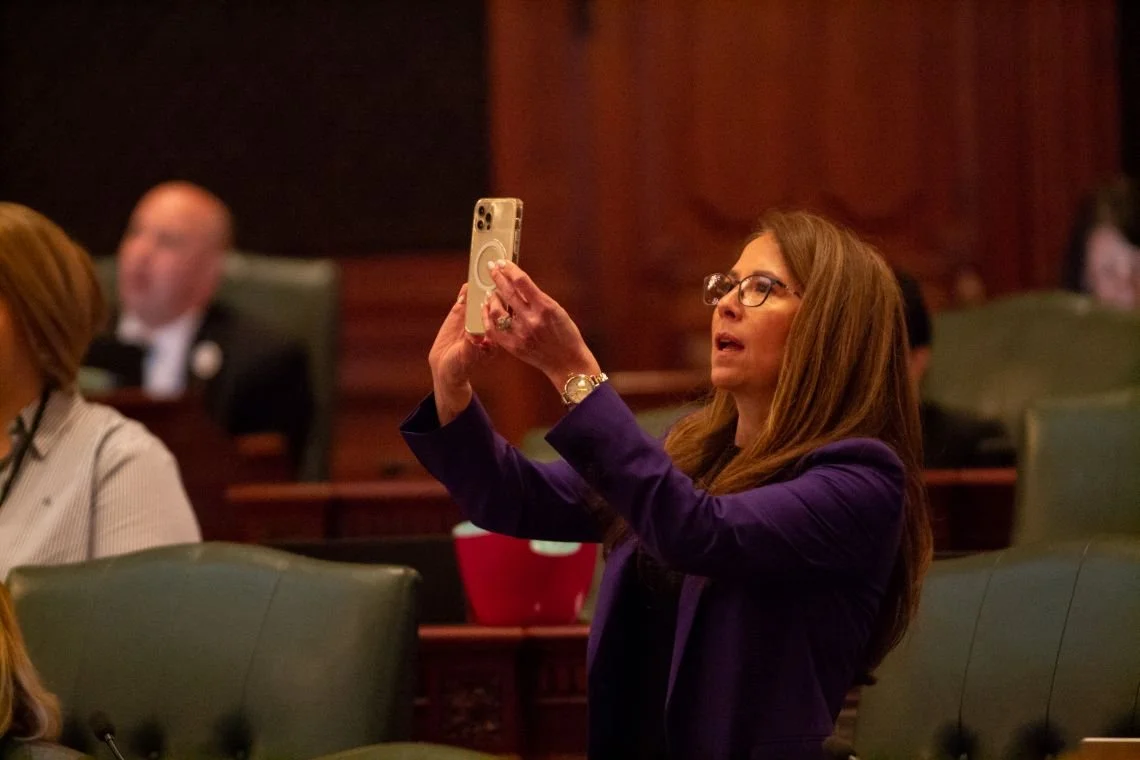
Jennifer Gong-Gershowitz, D-Glenview, takes a picture of the vote board in the Illinois House after the passage of a bill in May 2023. (Capitol News Illinois photo by Jerry Nowicki)