City Hall Workers Facing Unruly Conduct

Mount Carmel Mayor Joe Judge is asking residents to show respect when conducting business at City Hall.

During Friday’s Ask the Mayor segment on WSJD, Judge addressed recent incidents involving verbal abuse toward city employees.

Judge says multiple situations in recent weeks have involved residents yelling, using profanity, and acting disrespectfully toward staff members over utility bills.

He emphasized that City Hall employees are not responsible for unpaid balances and should not be subjected to that type of behavior.

Judge says while the city understands financial pressures are increasing, residents must take responsibility for their accounts and treat employees with common courtesy.

He also outlined the city’s billing policies, noting water bills are due monthly, with additional time often provided before service disconnection.

The mayor says the city has implemented new automated notification systems to alert residents of high usage, potential leaks, or pending shutoffs.

Judge adds those efforts are designed to help residents avoid costly issues and prevent service interruptions.

He says the city is doing everything it can to assist customers, but respect and accountability must go both ways.

City Still Looking For Mosquito Sprayer Applicator

The City of Mt. Carmel is still working to line up a mosquito sprayer as the season gets off to an early start.

During Friday’s Ask the Mayor segment on WSJD, Mayor Joe Judge said the city has been advertising for the position as mosquito activity has already picked up in mid-April.

Judge acknowledged the process may have ideally started earlier, but says efforts began in early March to find someone qualified to handle the job.

He says the city reached out to workers in other communities, but scheduling and travel made it difficult, with some only able to spray late at night—something the city wants to avoid.

Judge also noted there is a specific window when spraying is most effective.

In the meantime, the mayor says he has even begun the certification process himself as a backup plan if no one steps forward.

That certification requires passing a State of Illinois applicator’s license.

City officials say they are working to get the program in place as soon as possible as mosquito concerns continue to grow.

Commissioners Hear Report From Highway Engineer

At Monday’s meeting of the Wabash County Commissioners, County Highway Engineer Dustin Bunting reported several ongoing projects and updates within the department.

Bunting said the county’s annual oil and chip letting is scheduled for this Friday at 10:30 a.m. at his office. He also noted that a compliance review technician from IDOT District 7 is expected to visit later this month for the county’s annual review of Motor Fuel Tax and township bridge funds. Bunting said those reviews are routine and typically do not result in any issues.

In funding news, Bunting reported that IDOT has released preliminary federal funding allocations for fiscal year 2027, which are comparable to last year. The county is set to receive just over $308,000 in federal Surface Transportation Program funds, along with more than $41,000 in state matching funds and approximately $21,000 for local bridge projects.

Bunting also told commissioners he will attend mandatory bridge inspection refresher training next week in Springfield.

Meanwhile, highway department crews have remained busy with ditch work, shoulder repairs, and pipe replacements across the county.

Bunting also shared that a recent equipment incident involving a trailer transporting a mini excavator resulted in a wheel breaking loose. Fortunately, no injuries were reported, and the trailer has since been repaired.

WVC Instructors Recognized with Student Senate Awards

Wabash Valley College (WVC) is proud to recognize three instructors who were selected by students to receive this year’s Student Senate instructor awards. The honors are based on student nominations and reflect the strong connections instructors build with students inside and outside the classroom.

From the student body nominations, Student Senate selected the following instructors for this year’s awards:

· Transfer Instructor of the Year – Rich Poskin

· Career and Technical Education Instructor of the Year – Megan Bunnage

· Adjunct Instructor of the Year – Terrance McGee

“This recognition reflects an outstanding commitment to student success, excellence in teaching, and meaningful contributions to the WVC academic community,” said Dr. Cathy Rob, IECC Vice Chancellor of Academic Affairs.

Dr. Rob added that, “These instructors support IECC’s mission, values, and standards for excellence by inspiring enthusiasm for learning and student engagement in their classes.”

The award recipients are known for their dedication to helping students succeed, whether they are preparing to transfer, enter the workforce, or balance school with work and family responsibilities.

These instructors will be recognized at the WVC graduation ceremony. Wabash Valley College also extends appreciation to all instructors who serve students every day. To all the WVC instructors, thank you for your dedication to teach, motivate and inspire your students on a daily basis!

For more information about Wabash Valley College, visit www.iecc.edu/wvc.

Commissioners Approve One Request, Table Another From Market St. MTC

At Monday’s meeting of the Wabash County Commissioners,  a representative from Market Street MTC appeared to request funding support for two of their ongoing community programs.

Terry Beckerman explained that Market Street MTC, a 501(c)(3) organization focused on improving the downtown business district, is continuing its Murals and Art program. Beckerman told commissioners the group has already completed murals, with more planned this summer, along with additional art-related events. He noted the cost of projects can be significant, citing one mural at just over $5,000, and requested $500 in support to help offset expenses.

However, commissioners chose to table that request for at least two weeks after discussion revealed the county’s tourism board was not unanimous in its recommendation. Commissioners said they would seek additional clarification before taking action.

Beckerman also presented a separate request of $2,500 to support the “Music at the Park” concert series. He said the program, which began in 2020, typically features four tribute band concerts each year and draws crowds of around 400 to 450 people, with even larger attendance during homecoming weekend.

Beckerman added that Harris Insurance covers roughly half of the program’s costs, with the organization working to secure funding for the remainder. He emphasized the concerts not only provide local entertainment but also help draw visitors to the community.

Following discussion, commissioners approved the $2,500 request for the Music at the Park program using hotel-motel tax funds.

Illinois pursues abortion coverage for people with little or no insurance

The measure takes advantage of ACA abortion coverage

Article summary 

  • A new Illinois bill would establish a state grant program to pay for abortions for uninsured or underinsured people. 

  • The grant money would come from funds set aside from Affordable Care Act plans that cover abortions beyond cases of rape, incest or when the mother’s life is in danger.

  • Illinois Medicaid and private insurance plans are already required to cover abortion services. 

  • The bill is an initiative from the governor’s office and aims to use more resources to support abortion providers and ensure access to abortion care for Illinoisans in need.

This summary was written by the reporters and editors who worked on this story. 

SPRINGFIELD — Gov. JB Pritzker and Democrats have added a new abortion access measure to their agenda that would allow people with limited or no insurance to get financial assistance for abortion care in Illinois. 

House Bill 5408 would take advantage of an under-used provision of the Affordable Care Act that requires insurance plans that offer coverage for abortions in instances that go beyond rape, incest and life of the mother to collect at least $1 a month from enrollees to cover the cost of abortion claims. 

Federal law requires the insurers to segregate that money and use it only for abortion care. Illinois’ bill would allow the state to exert greater authority over the funds. 

The bill is meant to give insurers clarity about how to use the money they collect, according to Rep. Anna Moeller, D-Elgin, who sponsored the bill. She also said another reason for the bill is because the state doesn’t have a clear picture of the amount of funds being collected. 

“Similar bills have passed in California and Maryland and are under consideration in Massachusetts and Washington State to require the insurance industry to release these funds and put them into these kinds of grant programs so that people can access these services if they don't have insurance or they're underinsured,” Moeller said in an interview with Capitol News Illinois. “So I think maybe the insurance industry didn't have clarity on how to use it.”

Counting the money

In California, actual amounts collected haven’t been reported publicly, but analysts have estimated it could be more than $100 million. When Maryland’s law was expanded in 2025, insurers had collected $25 million. Under its law, the Maryland health department allocates up to $2.5 million annually.

In Illinois, Moeller said, “there’s not a lot of clarity” when it comes to fund balances. The Illinois Department of Insurance said it was unable to speculate about pending legislation and didn't provide an estimate for how much money has been collected in these accounts. 

HB 5408 would require insurance companies to report to the Department of Insurance how much money is in these separate accounts, how much has been spent, and to transfer remaining funds to the newly created state Abortion Access Fund. After that, the Illinois Department of Public Health could use the money to award grants for abortion providers to cover uninsured and underinsured individuals through a new grant program. 

Passed on partisan lines

Moeller presented the bill at the House Human Services Committee on March 25, where it passed 8-4 along partisan lines and was placed on the House calendar for a second reading.

“My colleagues, we all understand, especially on the Democratic side, how important it is to provide a place for women to access reproductive health care, especially since these rights are under assault in so many places in our country,” Moeller said.

Federal law prohibits federal money being used for abortion care unless the pregnancy is the result of rape or incest or the abortion is needed to save the life of the mother, but states have more leeway. Illinois already requires state Medicaid, ACA plans and private insurance to cover abortions. 

Moeller said this bill is just another way the state can support people who need abortions for reasons that don’t meet federal guidelines. Advocates said it also creates a new funding stream to help providers keep up with demand.

Insurers object

Opponents of the Illinois’ bill point to December 2025 guidance from the Centers for Medicare & Medicaid that changed the way funds can be managed and used — although health policy attorneys argue that guidance misinterprets the language in the statute and violates the law.

The Illinois Life & Health Insurance Council opposes the Illinois measure, Kate Morthland, its policy and advocacy director, said in a statement. 

“It mirrors the Maryland approach, which federal regulators have already warned ‘exceeds the permissible uses of the segregated funds under Section 1303 of the ACA,’ creating clear compliance concerns,” Morthland said in a statement.

She said the Illinois bill risks putting the state at odds with federal regulations and risks “legal and operational uncertainty.”

“While we remain committed to working with the sponsor, this bill, in its current form, is not workable for the industry,” she said.

Illinois a major out-of-state provider

Since the 2022 overturn of Roe v. Wade, Illinois has become a national haven for people seeking abortion care. The state has responded by passing many protections and supporting the clinics that provide these services. 

According to the governor’s office, this fund is not connected to the recently announced Prairie State Access Fund, which is a separate partnership with the Michael Reese Health Trust. The money in the Abortion Access Fund would be entirely made up of money set aside by insurance companies.

According to the latest numbers from the Guttmacher Institute, an independent abortion policy research organization, 87,210 abortions were provided by clinicians in Illinois in 2025, a slight decrease from previous years, but still far more than any other state in the Midwest. The numbers represent procedural and medication abortions that were provided in physical facilities and via telehealth. 

“We need to just stay vigilant so that it (abortion access) stays protected in Illinois. Because clearly things can change very quickly, as we saw with the overturn of Roe,” Moeller said. “Illinois, I think, has done a lot, but it's kind of up to other states to do the same.  We just have to stay vigilant.”


Capitol News Illinois is a nonprofit, nonpartisan news service that distributes state government coverage to hundreds of news outlets statewide. It is funded primarily by the Illinois Press Foundation and the Robert R. McCormick Foundation.

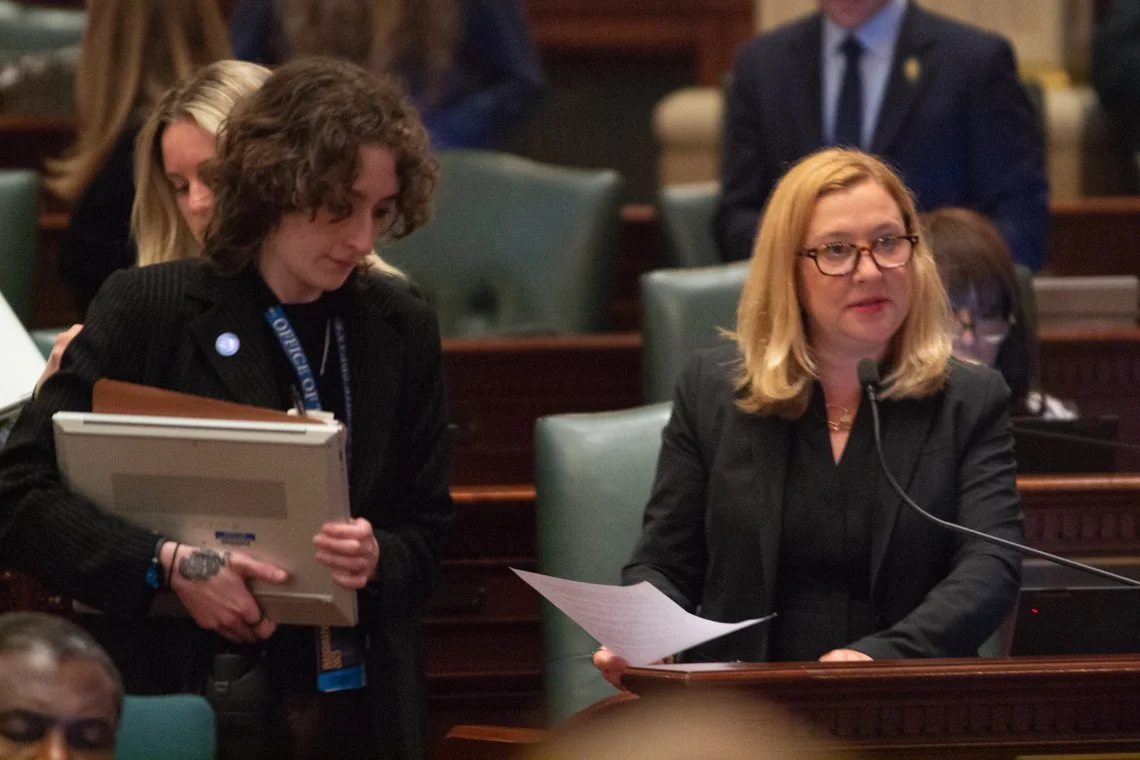
State Rep. Anna Moeller, D-Elgin, presents her Medicaid legislation on the House floor on Saturday, May 31, 2025. (Capitol News Illinois photo by Jerry Nowicki)

Waymo begins testing in Chicago as bill seeks to legalize autonomous vehicles

Labor, driving unions are raising concerns over safety, job loss 

Article Summary

  • Autonomous vehicles, known as AVs, currently are being tested on the streets of Chicago.

  • A bill in the legislature would eventually allow such driverless vehicles to operate in Illinois counties that have more than 1 million residents, plus Sangamon and three downstate jurisdictions. They could replace rideshare and taxi drivers.

  • The bill has a long road ahead before legalization can occur and currently is held up in committee.


By JACQUES ABOU-RIZK
Medill Illinois News Bureau
news@capitolnewsillinois.com

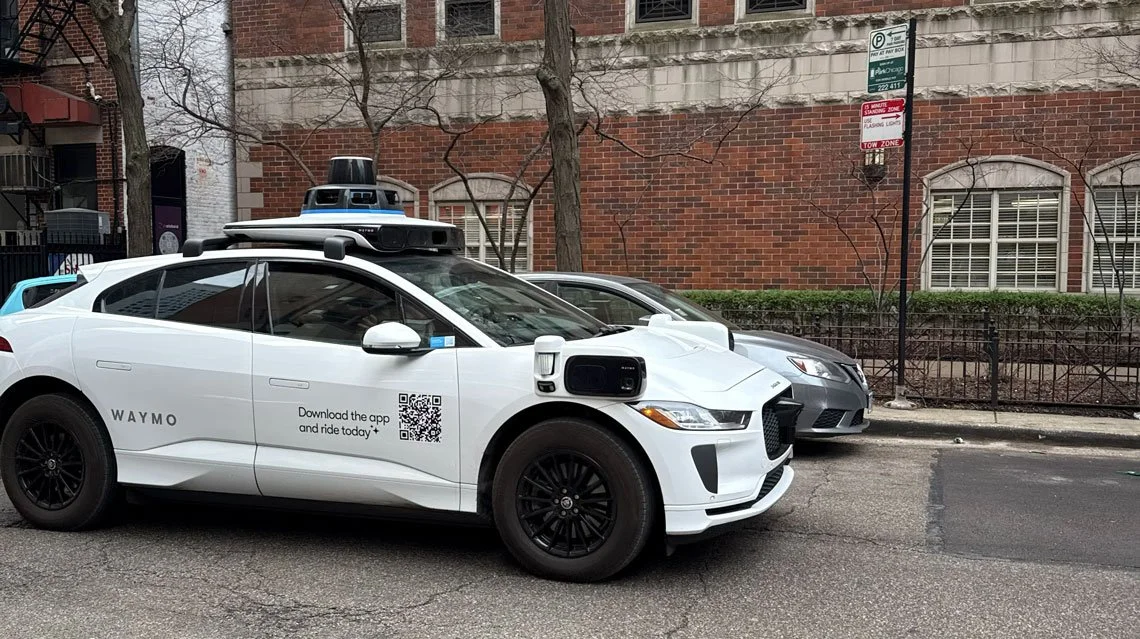
CHICAGO – In downtown Chicago, people have been spotting Google’s Waymo automated vehicles testing and mapping the Windy City’s streets. For now, the autonomous vehicles must be driven by a human, as the industry seeks the endorsement of state lawmakers.

For the last year, legislators in Springfield have been trying to work through a variety of issues raised by skeptics of the autonomous vehicles, known as AVs. Rep. Kam Buckner, D-Chicago, said AV legislation has a long road ahead to address constituent concerns over safety, insurance and job losses for rideshare and cab drivers.

In January, he introduced the Autonomous Vehicle Pilot Project Act, which would open counties in Illinois with over 1 million residents, as well as the counties of Sangamon, Madison, St. Clair, and Monroe, to automated commercial vehicles. But the bill has since been held up in the Rules Committee, an early step in the process that means it’s far from passage, especially in the current legislative session. Other bills supporting the industry also have yet to get the necessary support.

While Waymo has started testing its vehicles with safety drivers in Chicago, the company has not yet announced plans to bring the robotaxis to counties other than Cook, according to Waymo spokesperson Chris Bonelli.

Automated Vehicle legislation in Illinois

Waymo only fully operates in Arizona, California, Florida, Georgia and Texas — warm weather states where concerns about handling icy conditions are not as big an issue.

The company has faced significant questions over the safety of its vehicles and fully automated taxis. A subsidiary of Alphabet, Waymo is under multiple federal investigations for traffic violations, including illegally passing stopped school buses. Company vehicles have also made headlines for blocking emergency vehicles and hitting a child near an elementary school. 

In a statement, Bonelli said Waymo is committed to “continuous improvement,” adding, “While rare incidents will occur over the more than four million miles we drive every week, our entire fleet can learn from these events and continue to make our roads safer.” 

According to company data, Waymo vehicles are involved in 92% fewer crashes with serious injuries compared to an average human driver in the same city. 

Among some legislators and observers, it seems a matter of time before legislative compromises eventually produce a bill that will pass to allow AVs to operate without the safety drivers. 

Rep. Brad Stephens, a Republican who is also the mayor of suburban Rosemont, introduced his own AV bill last Spring. He said he sees a bright future for AVs in Illinois, but he acknowledged that it might not pass this session. 

“It’s going to be a challenging two-and-a-half months with a lot of other issues,” Stephens said.

‘Still in the negotiation phase’

P.S. Sriraj, director of the Urban Transportation Center at University of Illinois Chicago, outlined a host of challenges for AV safety in the state, but he also said he believes the vehicles eventually will become part of life here.

State officials, he said, should look for ways to implement new automations responsibly. 

The public benefit of AVs includes widening options for people who live in areas where there are few rideshare drivers or taxis. People with mental or physical disabilities around the state also could greatly benefit from AVs. 

“All of the mobility needs of a population are so diverse that these types of technological advancements could play a role,” Sriraj said. 

But, like others, he said he understands there are real concerns about safety, especially if AVs are to be allowed in smaller towns and counties. 

“If the infrastructure is not set up to support this kind of a technology, for example, if there is no lane marking visible, at least to the naked eye, on a rural road, then what will happen to the technology?” he said.

Labor lobbyist groups are at the forefront of opposition to Waymo, arguing that automation will threaten driver and laborer jobs. 

Ronnie Gonzalez, a representative of the International Association of Machinists and Aerospace Workers, said it’s vital that labor is part of the conversation before any legislation is passed. 

“In labor, throughout the industrial revolution, we’ve been watching technology replace workers year after year, and it’s only sped up in the recent decade,” Gonzalez said. “The realization is it’s going to happen, so having a seat at the table lobbying for legislation that implements the use of autonomous vehicles responsibly, that is mindful of workers, mindful of safety, is what labor is pushing for.” 

His association is part of the Illinois Drivers Alliance, a coalition of thousands of rideshare drivers across the state fighting for unionization. He said he hopes to engage in conversations with Buckner about specifics in the bill. 

“We are still in the negotiation phase,’’ Buckner said, “walking and talking through what the issues may be, what the concerns may be, and trying to find a way to arrive at a version of this bill that works for everybody.”

‘On a bigger scale than just driverless taxis’

Across labor unions, there is agreement that AVs could threaten some of the estimated 100,000 rideshare drivers. Marc Poulos, executive director of labor management operations at the International Union of Operating Engineers Local 150, said Waymo operations are just a step toward further automation of labor jobs. 

“We need to be thinking of this on a bigger scale than just driverless taxis,” he said. “Meaning it can impact whole industries like operating engineers and Teamsters and a whole bunch of others.  Every time we just move to a technological advancement, we need to take into consideration, what does that mean to the overall economy?” 

Sriraj said plans must be made to counteract any impact on the labor market: “If jobs are going to be reinvented, people will have to be retrained, and the corrective actions will always happen within society on their own,” he said.

“At least until the 1970s, elevators had an elevator operator, and then people became accustomed to just punching a button and riding in an elevator on their own,” he said. “Now there is no elevator operator job anywhere to be found. Did that mean that that section of population actually starved to death?” 

Resistance to AVs in Illinois also includes two groups with differing constituents but similar concerns about safety.

Safety, insurance concerns

Tim Cavanagh, the president of the Illinois Trial Lawyers Association, has spoken out about the need for requirements that AV operators have adequate insurance to cover any injuries or damage involving the cars. 

“The current legislation doesn’t speak to financial responsibility,” Cavanagh said. “All it talks about is that they shall have at least the minimum requirement of insurance coverage.” 

But, he said, the minimums should be far higher for AVs, and the well-financed companies behind them, than they are for individuals.  

Josh Witkowski, the president of the Illinois motorcyclist rights organization ABATE, also has voiced strong opposition to AV deployment in the state because of the risk he says they pose to motorcycles. 

He also points to icy conditions and low visibility in Illinois, as well as poorly lit roads and street markings downstate as challenges for AV technology, which relies on cameras and sensors to safely navigate roadways. 

In response to weather concerns, Bonelli said Waymo already serves in cities that receive annual snow with freezing temperatures. 

“The Waymo Driver has proven it can generalize to new cities, and we’ll continue to validate our performance for harsh winter weather conditions, such as those we’ll experience in Chicago,” Bonelli said. 

He added, “Waymo has invested in weather testing since its earliest days as Google’s Self-Driving Car Project, and we’ve regularly tested in various conditions from coast to coast, building our technology for all-season operations.”

The past two winters, Bonelli said, Waymo has tested and validated its systems in multiple winter markets, including Detroit, New York City and Buffalo. 

Read more: How Illinois’ Road Fund will help fund transit, especially in the Chicago region

Witkowski said more work needs to be done to ensure a proper rollout of AVs, with an oversight panel and publicly available data.

Jacques Abou-Rizk is a graduate student in journalism with Northwestern University’s Medill School of Journalism, Media and Integrated Marketing Communications, and is a fellow in its Medill Illinois News Bureau working in partnership with Capitol News Illinois.

Capitol News Illinois is a nonprofit, nonpartisan news service that distributes state government coverage to hundreds of news outlets statewide. It is funded primarily by the Illinois Press Foundation and the Robert R. McCormick Foundation.


Illinois farmers ease critical labor shortages through this agricultural visa program 

The H-2A visa has become a lifeline for farmers who can’t find enough domestic workers  

By GEORGIA EPIPHANIOU
Medill Illinois News Bureau
news@capitolnewsillinois.com

Article Summary

  • A lack of domestic workforce participation in agriculture pushes Illinois farmers to employ foreign workers through the temporary H-2A non-immigrant visa program. 

  • Illinois’ employment of farmers through the visa program has grown rapidly, filling 4,488 positions in 2025. 

  • These farms benefit from the arrival of foreign workers, as output, productivity and worker retention increases.

  • The administrative process is rigid, and costs associated with issuing these visas are vast, including providing housing and transportation, but the current administration has streamlined the application process and reduced wage rates. 

This summary was written by the reporters and editors who worked on this story.

CHICAGO — Jeff Flamm, farmowner at Flamm Orchards in Cobden, struggled to find enough workers to harvest his crops — and the problem kept getting worse each year.

"It got down to the point where I left a pretty significant amount of my crop in the field. One year I just couldn't get it fixed. We just did not have enough help to get the job done," he said.

To resolve this labor shortage issue, Flamm turned to foreign workers. For the past 20 years, he has been employing a majority (approximately 80) of his farmworkers from abroad, through an agricultural nonimmigrant visa, the H-2A. As farm labor shortages deepen across the country, the H-2A visa program has become a lifeline for growers who can no longer find enough domestic workers to keep their operations running.

“I came to the realization, if I'm gonna stay in business, I've got to do it,” Flamm said of using the visa program. 

The H-2A visa helps address seasonal labor shortages and allows U.S. farmowners to temporarily employ nonimmigrant foreign nationals for agricultural positions, but it can be costly. Farmowners need to meet conditions to qualify as H-2A employers, such as providing free housing, covering transportation fares and paying for the visa application fees. Additionally, employers must prove they cannot fill open positions with domestic workers.

At a time when President Donald Trump’s crackdown on undocumented immigrants has sent a chill through the immigrant community in cities and rural areas all around America, this program is an oasis of comfort and opportunity for legal immigrants and a demonstration of the vital importance of immigrant workers in Illinois and on farms across this nation. Many American farmers simply can’t make ends meet without them, and the Trump administration has even moved to streamline the visa program and make it more accessible to farmers.

Illinois ranks 18th in H-2A employment nationwide, with states like California and Florida taking the lead. Illinois’ reliance on legal immigrant farm labor has grown rapidly: About 8% of the state’s hired farmworkers are employed through H-2A visas, with Illinois’ growth rate outpacing the roughly 300% increase observed nationally since 2010, according to data from Farmdoc Daily

Illinois’ growth reflects a broader nationwide expansion of the H-2A program, with 398,258 positions certified in 2025, out of 415,496 applications, according to the Farm Bureau’s Market Intel. According to USA Facts, an overwhelming majority of applicants are from Mexico, accounting for 90% of filled positions in 2024, followed by South Africa and Jamaica. 

Is this strictly a farmworker program, or can roofers and hotels also use it?

Visa helps access labor

Raghela Scavuzzo, associate director of food systems at the Illinois Farm Bureau, said the H-2A program is a vital component of multiple sectors of agriculture in Illinois, impacting the state’s specialty crop industries and conventional agriculture. 

“It is a way to access labor that has not previously been available,” she said. 

According to the Economic Research Service of the U.S. Department of Agriculture, the number of  American farmworkers has significantly declined. According to the Western Ag Network, only 182 farming positions out of over 415,000 advertised were filled by a domestic applicant in 2025, accounting for less than 0.04%. 

Maggie Taylor, owner of Delight Flower Farm in Champaign, has also fallen victim to this trend, struggling to employ local farmers. She is now in her second year of using the visa program, having employed two women from Mexico last season. She expected two new workers to arrive by the end of March, but because of the partial shutdown of the Department of Homeland Security causing delays and slower processing, they are now expected to arrive by the end of April. 

She emphasized how these workers are professionally performing physically intense work that is otherwise deemed undesirable by Americans. “These workers are professional farmers. They are so good, such a high caliber of work and so efficient, that is amazing," Taylor said. 

“I felt like, if I didn't do the H-2A, I would want to quit farming,” Taylor said. 

Flamm has been renewing the visas of a lot of his workers every season. 

“Why do I keep doing it? Because that's the only way I can get the job done,” he said. “I can't hire. I have virtually zero local applicants for those jobs.” 

Beyond solving the labor shortage problem, Taylor sees the visa program as a mutually beneficial arrangement, sustaining her farm while providing meaningful income for workers who send their earnings back to their families abroad.  

“I see this as a win-win,” she said.

Taylor also pointed to the program's seasonal structure as an unexpected advantage. Unlike year-round employees who often leave during the winter and do not return, H-2A workers come only during the agricultural season, with their visas being valid only for up to 10 months, reducing turnover and keeping her workforce stable.

"I think the security of knowing that I'm going to have people to work on my farm and that they're going to do a good job is such peace of mind, and it really makes my farm business sustainable," Taylor said. "Hopefully the same women will want to come back year after year, and we all get to grow together and get more efficient over time."


Red tape and costs burden employers

To have H-2A visas approved, an employer needs to prove they have the resources to house the workforce. Flamm houses his workers in units he owns on his own land. Taylor however, needs to rent out spaces to accommodate her H-2A employees.

“You have to apply (for housing) 75 days before you want their contract to start,” Taylor said. “So that means that I'm basically paying for a vacant house at least 80 days,” 

Employers also need to pay visa application costs and cover air-fares and transportation for the workers to safely arrive at the site. 

“For my farm, it was around $12,000 in extra expenses beyond their wages that I would pay for,” Taylor said. 

Both farmers said filing these applications is a long bureaucratic procedure, and find it difficult navigating the Department of Labor, the Department of Homeland Security and the Department of State.

Effective Oct. 2, 2025, the DHS issued a new rule, aimed at strengthening the H-2A visa program and easing the application process. The rule states that the DOL will streamline the application review process that ensures the visa does not harm American workers. It will also speed up the U.S. Citizenship and Immigration Services’ reviewing process for visa petitions. 

The labor department also made efforts to reduce the red tape, establishing the Office of Immigration Policy in June 2025. The department aimed to create a “one-stop shop” to allow employers to apply for the visa through one single portal instead of doing so via three different agencies.

The office was intended to improve coordination among the federal departments and streamline the application and processing of employment-based visa programs, including the H-2A. However, internal emails obtained by Investigate Midwest showed that as of March 2026, the Department of Labor was unsuccessful in delivering on these goals, with officials failing to coordinate within agencies. 

When hiring workers through the H-2A program, employers are required to comply with federally mandated wage rules. 

“(The) H-2A visa has a required payment plan. All these positions have specific salary requirements,” said Scavuzzo, the Illinois Farm Bureau official. “Oftentimes, the salaries can be very high depending on those positions, which can limit how many people that they can bring over.”

The Department of Labor has set a new Interim Final Rule surrounding the Adverse Effect Wage Rate, the minimum wage for agricultural workers in the H-2A visa program.

Higher-skilled workers paid more 

Employed workers on the H-2A are divided into two categories based on their skill level, with higher-skilled workers being paid more of the adjusted wage. The minimum hourly wage for each category will be determined using data reported by the Department’s Bureau of Labor Statistics’ Occupational Employment and Wage Statistics survey for each state. 

Before the rule, the 2025 rate in Illinois for H-2A farmers was $19.57 an hour. Now, the rate is set at $15.48 for entry-level workers and $18.75 for experienced employees, according to Farm Week Now

Estimates calculated by the Economic Policy Institute show that farmworkers across the country stand to lose $4.4 to $5.4 billion annually because of the change. 

Robert Anthony Bruno, a professor and director of the Labor Education Program at the University of Illinois Urbana-Champaign, said this adjustment primarily benefits employers over workers, and that requiring farmers to pay for housing should not justify lower pay for hired farm hands. 

“It should be an additional benefit that the employers contribute along with paying them the required hour of pay,” Bruno said.

The AEWR has been adjusted to compensate for the free housing provided. Minimum wages for Illinois H-2A workers has decreased by $1.79 per hour, according to Farm Week Now

“We were like on a boat with a hole in it, and it was getting pretty close to being full. So it was a much-needed reset,” Flamm said. 

Scavuzzo said these changes can help Illinois farmers manage labor costs, which will in turn allow farms to hire more workers and sustain output in the years ahead.

“These policies which decrease the minimum wage are imperative — this way the number of farm workers employable will rise,” she said. 

Georgia Epiphaniou is a graduate student in journalism with Northwestern University’s Medill School of Journalism, Media, Integrated Marketing Communications, and a fellow in its Medill Illinois News Bureau working in partnership with Capitol News Illinois.

Capitol News Illinois is a nonprofit, nonpartisan news service that distributes state government coverage to hundreds of news outlets statewide. It is funded primarily by the Illinois Press Foundation and the Robert R. McCormick Foundation.


The sun sets over a field of corn in Douglas County. (Capitol News Illinois photo by Jerry Nowicki)

Richland County Student Among Illinois LICA Annual Scholarship Recipients

Strengthening its dedication to supporting members and their families, Illinois LICA recently established a scholarship program to help its members’ families offset rising costs associated with pursuing post-high school education. Open to high school seniors and upperclassmen pursuing ANY post-high school education (including 2 or 4 year degrees and trade schools) and ANY course of study, applicants must submit transcripts, an essay, and 3 letters of recommendation to complete the application process. For 2026, the selection committee awarded three outstanding individuals with $1,500 scholarships each:

Callista Ridgely (Parkersburg, IL) – Richland County High School - Chemical Engineering

Granddaughter of Allen & Patricia Yonaka and daughter of Austin & Suzanna Ridgely, Callista is a senior at Richland County High School where she is dual enrolled in both high school and college credit courses, maintaining a 5.0 GPA. She is engaged in a wide variety of extracurricular activities including Marching Band, Symphonic Band, Jazz Band, Honors Wind Ensemble, Scholar Bowl, FBLA, Tri-M, Student Council, FFA, Interact Club, Brain Games, and ACES. Callista serves as class treasurer, Tri-M Music Honor Society treasurer, and a council member for FBLA. She is a Big Future Rural and Small School Scholar and a recipient of the STRIPES award for respect, integrity, and self-discipline. Outside of school, Callista has committed time to volunteering with multiple organizations and service projects, from visiting nursing homes and  assisting with the Christmas Bucket Brigade to volunteering at the Parkersburg Chowder and serving food at local fundraisers like the Noble Airport Fly-In. With plans to attend Rose-Hulman Institute of Technology in pursuit of a chemical engineering degree, Callista has a strong desire to work in the energy and/or materials sector.

Jessica Dietz (Walnut, IL) – Eastern Kentucky University - Fire, Arson, and Explosion Investigation

Daughter of Paul & Kimberly Dietz, Jessica is a junior at Eastern Kentucky University, maintaining a 3.38 GPA. Being engaged with her local fire department in her teens and attending her first fire investigation by age 16, Jessica became inspired at an early age to pursue her current career path and has already gained years of hands-on experience. While making the Dean’s List and Honor Society, she has served on two local fire departments and assisted with her family’s drainage company, Dietz Drainage. Currently, she is a member of the Walnut Fire Protection District, an Emergency Medical Responder, and works at Ace Hardware, while maintaining her college coursework. After graduation, Jessica plans on working for either the Bureau of Alcohol, Tobacco, Firearms and Explosives (ATF) or Fire Tech, Inc.

Shay Layden (Hoopeston, IL) – Hoopeston Area High School – General Studies

Daughter of Eric & Angela Layden, Shay is a senior at Hoopeston Area High School, maintaining a 3.51 GPA. She is actively involved in Marching Band, FFA, National Honor Society, Drama Department, Student Council, basketball, golf, and softball. Shay serves as Vice President of her FFA Chapter and team manager for the softball team. Outside of school, she attends St. Anthony Catholic Church, where she is a member of the youth group and attends Catholic Heart Work Camp every summer. She also works part-time at a local ice cream shop. Shay’s aspiration is to become a Master Electrician with a focus on becoming an Outside Lineman.

Illinois LICA is honored to support these outstanding scholars as they work toward their future goals. Their dedication and passion exemplify the values of our association, and we look forward to seeing all they accomplish!

Callista Ridgely (Parkersburg, IL)

Princeton man arrested for OWI

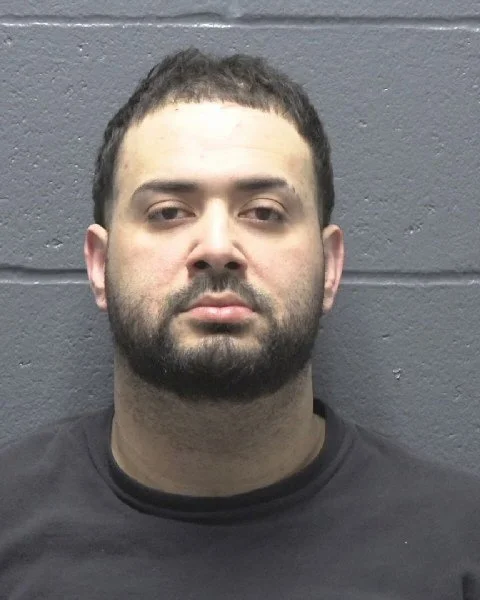
On April 8, 2026, at 1:27 a.m. Gibson County Deputy Levi Sims conducted a traffic stop on a White 2016 Toyota Highlander after observing a moving violation on US 41 and County Road 350 South.  Upon approaching the vehicle Deputy Sims observed multiple clues that the driver 33-year-old Naxel Diaz of Princeton was under the influence.  At that point Deputy Sims began a roadside DUI investigation that resulted in Mr. Diaz being taken into custody and transported to the Gibson County Detention Center.   Upon arriving at the detention center Mr. Diaz was charged with Operating a Vehicle While Intoxicated and Operator never licensed.   
 
Sgt. John Fischer and Princeton Officers Sgt. Ben Kiesel and Officer Landon Perryman assisted Deputy Sims in his investigation.
 
All criminal defendants are to be presumed innocent until and unless proven guilty beyond a reasonable doubt in a court of law.