
On April 2, 2026, at 7:13 p.m. Gibson County Central Dispatch received a report of a vehicle in a ditch in the 600 block of East 250 South. Deputy Bart Wagner and Princeton Officer David Jones arrived on scene and discovered a Silver 2005 Cadillac Deville on its side with the driver outside of the vehicle. Upon speaking with the driver, 22-year-old Keaton Winkler of Princeton officers observed obvious clues that the driver was under the influence. At that point they began a roadside DUI investigation that resulted in Mr. Winkler being taken into custody and transported to the Gibson County Detention Center. Upon arriving at the detention center Mr. Winkler was charged with Operating a Vehicle While Intoxicated.
Arresting Officer Bart Wagner was assisted in his investigation by Princeton Officer David Jones and Deputies Wyatt Lashbrook and Wyatt Hunt.
All criminal defendants are to be presumed innocent until and unless proven guilty beyond a reasonable doubt in a court of law.

ISP ANNOUNCES RESULTS OFALCOHOL COUNTERMEASURE ENFORCEMENTSURVEILLANCE DETAILS
MOUNT CARMEL – Illinois State Police (ISP) Zone 8 Commander Holly Finney announces the results of Alcohol Countermeasure Enforcement (ACE) surveillance at various establishments in Wabash County on April 1, 2026. The detail was conducted to determine which businesses may be selling alcoholic beverages to minors (persons under 21 years of age). The ultimate goals are to enforce underage drinking laws and save lives by preventing impaired driving crashes and fatalities.
A total of 18 locations were surveilled. Five establishments were involved in the sale of an alcoholic beverage to a minor.
Business Name / Employee
West Berwick Management INC: Neve Knapp
CVS Pharmacy #6887: Amber Thompkins
Tenpins LLC: Lawrence Byrns
Eagles: Brandy Keele
El Cactus Cuisine: Emely Gonzalez
The employees were cited for Unlawful Delivery of Alcoholic Liquor to a Minor, a Class A misdemeanor. The public is reminded that all defendants are presumed innocent unless proven guilty in a court of law. ISP commends establishments and their employees that do not sell alcohol to minors. This project is funded through the Illinois Department of Transportation.
Mayor Urges Safety as Recreational Vehicle Use Increases This Spring
Mount Carmel city leaders are reminding residents about safety and registration requirements for recreational vehicles as spring activity picks up.
At Monday’s City Council meeting, Mayor Joe Judge shared an update from Police Chief Erin Peach, who was unable to attend.
Judge says officers are seeing an increase in e-bikes, golf carts, and side-by-sides operating with outdated registration stickers. He says all units must display a valid 2026 sticker, and those without one could result in a traffic stop and citation.
Residents needing to register a vehicle are asked to call the Mt. Carmel Police Department’s non-emergency line at 262-4114 to schedule an appointment.
Judge also stressed that registrations do not transfer between owners. Even if a vehicle was previously registered, new owners must complete the process again to meet insurance requirements.
City officials are also urging parents to talk with their children about safety, especially when it comes to scooters.
Judge says there have been recent complaints about kids riding scooters in the roadway, creating dangerous situations for both riders and drivers.
In addition, officials reminded residents that golf carts may only be operated by licensed drivers, typically age 16 or older. Violations could result in losing the privilege to drive them on city streets.
City leaders say enforcement efforts will be increasing as warmer weather brings more outdoor activity.
Final Reminders Issued For Spring Cleanup Week
Mount Carmel residents are being reminded how this week’s large item trash pickup is working.
During Monday afternoon’s City Council meeting, Garbage Commissioner Susan Zimmerman said pickup is not continuous throughout the week, but instead follows each neighborhood’s regular garbage day.
Zimmerman says crews will only make one pass through each area. If items are not picked up after they’ve gone by, residents are responsible for removing them.
She also outlined several items that will not be accepted, including batteries, electronics, landscape waste, construction materials, oil, paint, tires, and unwrapped mattresses or box springs.
City officials stress that mattresses and box springs must be wrapped to be eligible for pickup.
Zimmerman added that large amounts of wood or lumber are also considered construction material and will not be collected.
Residents can dispose of unaccepted items at the city dump by purchasing a dump ticket at City Hall or, after hours, at the police department.
City leaders say understanding the guidelines will help ensure a smoother cleanup process across the community.
Plans Coming Together For America 250 Celebration in Mt. Carmel
Mount Carmel Mayor Joe Judge says early plans are underway for a major community celebration as part of America’s 250th anniversary.
Speaking at Monday afternoon’s City Council meeting, Judge said a planning group met last week with strong participation from several local organizations.
The mayor says the group is working toward a week-long celebration centered around the Fourth of July.
Judge says the idea is to host a full seven days of events to mark the America 250 milestone, with organizers already sharing a number of ideas.
A second planning meeting is scheduled for April 15th, and more details are expected to be announced soon.
Judge says the goal is to bring the community together for a memorable celebration next summer.
In Illinois, a short-term guardianship can help youths during ICE deportations
Some parents are turning to the state program to protect their children during a crisis
By OLIVIA ARDITO
Medill Illinois News Bureau
news@capitolnewsillinois.com
Article Summary:
Short-term guardianship is a process that allows another adult to become the legal guardian of a child for up to one year.
This process can be a protective measure and only implemented in extreme situations, such as the parent having a medical emergency or being arrested.
Amid immigration raids in Illinois, the process can help protect children should their parents be detained or deported.
This summary was written by the reporters and editors who worked on this story.
CHICAGO — Operation Midway Blitz brought hundreds of federal immigration agents to the Chicago area last fall and led to more than 4,500 arrests. What happens to the children in these situations?
One option for parents is to complete a short-term guardianship form for their children to protect them should the parents be detained, deported or disappear.
What is a short-term guardianship?
Short-term guardianship refers to an adult other than the parent or legal guardian taking temporary custody of a child for up to one year. Created in the late 1980s, the standardization of this process became law under the Illinois Probate Act after extensive lobbying by AIDs activists worried about their children if they were to pass away.
“It gives families peace of mind in case there’s something that goes wrong,” Illinois attorney Scott K. Summers said.
Summers describes the process as preparing a backup or emergency guardian. It is one legal pathway to protect children in case something happens to their parent, whether that be a military deployment, a medical emergency, arrest or deportation.
Rebekah Rashidfarokhi, the director of guardianship and immigration programs for children at Chicago Volunteer Legal Services, said the form can be easily revoked as well if needed.
Read more: Even amid partial DHS shutdown, Illinois remains on edge over ICE coming back
“The parent filling out this form gets to designate someone, and if they change their mind, they can just revoke the form and write a new one. So they’re not really relinquishing any rights by filling out a short-term guardianship,” Rashidfarokhi said.
Since the start of raids across Illinois by the U.S. Immigration and Customs Enforcement and U.S. Customs and Border Protection, Rashidfarokhi reported that her group has seen a significant increase in the number of short-term guardianship forms filed. They have also been hosting frequent educational classes on what these forms are and how they work.
How does one become a short-term guardian?
To become a temporary guardian of a minor, the parent or permanent guardian of the child must fill out this form in the presence of two witnesses over 18. This process does not need to be completed in a court of law or in front of a judge. Additionally, the form allows for the short-term guardianship to apply only under specific circumstances, such as if the parent were to be deported or arrested.
“More advanced guardianships or longer-term guardianships do require going to court, filing papers, getting a judicial appointment as a guardian,” attorney Summers said. “This gives parents autonomy and convenience.”
Summers suggests that families who are curious about this process but have concerns over the legal details should speak with a trusted attorney to get more information and advice.
Rashidfarokhi said a significant advantage of choosing short-term guardianship over alternative processes is the ease of doing so. Going through the courts can take months, cost money and require all members of the new guardian’s household to be fingerprinted.
“Parents really have a lot of discretion and control over the situation, unlike in a court process. So, the court process is kind of the opposite of all of those things,” Rashidfarokhi said.
Here’s what a short-term guardianship is not
Short-term guardianship is governed by state, not federal, law. Because of this, the new short-term guardian only has custodial privileges on the state level, and only for a year. For example, a short-term guardian could not get a child’s passport.
Rashidfarokhi also notes that the short-term guardianship is not a good idea for parents to use in cases where one parent is unaware or against assigning their child a short-term guardian.
“This somewhat flimsy piece of paper is not going to hold up in court against the parental rights of the other parent,” she said. “It’s really important to note that this is meant to be something that either both parents file or that at least the other parent is notified of, because it can actually be revoked by either parent.”
Additionally, in situations of domestic abuse, short-term guardianship is not the best option. Rashidfarokhi suggests a full custody order or an order of protection would better serve that circumstance.
“I don’t recommend using it for really long-term situations. Like, it’s meant to be kind of a Band-Aid, which is why it only lasts for a year,” Rashidfarokhi said.
How do short-term guardianships relate to ICE?
The guardianship process allows parents to list a “triggering event,” where if a specific incident happens, that begins the short-term guardianship process. Parents at risk of deportation could make their detainment their triggering event and then their chosen guardian would be able to legally take over decisions for the children.
“That’s why I’m an advocate for these short-term guardianships — it gives parents and children a lot of flexibility in terms of getting their needs met without having to go through a whole lot of effort,” Summers said.
Summers added that if a parent were to be detained or deported and this document is not pre-emptively filled out, the Illinois Department of Children and Family Services might take over as the child’s caretaker. When asked how many children DCFS have taken care of due to immigration raids, DCFS responded that this has not happened in Illinois yet.
Read more: Metro East attorney helps immigrant families prepare for crackdown
In the situation where a parent was already deported, they could fill out this form in their home country to help their child who is still in Illinois, according to the law.
Parents looking for more information or support can reach out to organizations like Chicago Volunteer Legal Services or the Illinois Guardianship and Advocacy Commission.
“I always feel like ‘better safe than sorry,’” Rashidfarokhi said. “The form is easy to fill out. You don’t have to have a lawyer to help you fill it out. It’s free, and the parents are not giving up any rights. So I always recommend that everybody have one of these in place.”
Olivia Ardito is a graduate student in journalism with Northwestern University’s Medill School of Journalism, Media and Integrated Marketing Communications, and is a fellow in its Medill Illinois News Bureau working in partnership with Capitol News Illinois.
Capitol News Illinois is a nonprofit, nonpartisan news service that distributes state government coverage to hundreds of news outlets statewide. It is funded primarily by the Illinois Press Foundation and the Robert R. McCormick Foundation.
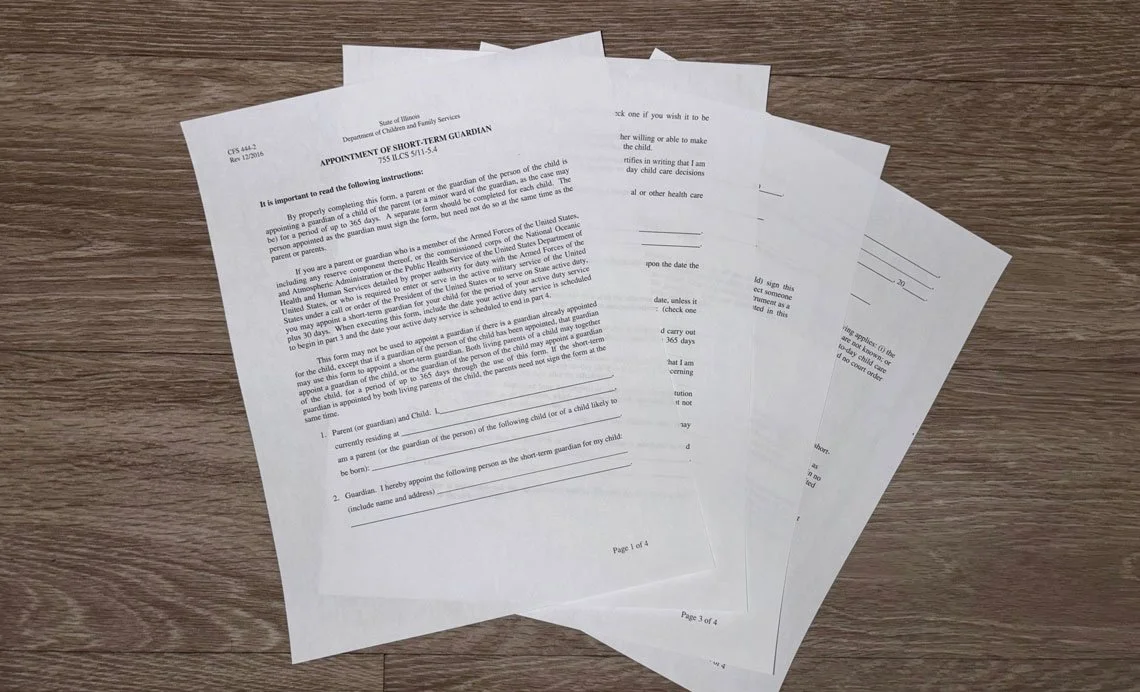
Form CFS 44-2, also known as the short-term guardianship form, allows parents in Illinois to appoint temporary custody for their children during a crisis. (Medill Illinois News Bureau photo by Olivia Ardito)
ILLINOIS STATE POLICE ANNOUNCES THE COMPLETION OF STATEWIDE NEXT GENERATION 911 SERVICE UPGRADES
SPRINGFIELD – The Illinois State Police (ISP) is announcing all 169 Public Safety Answering Points (PSAPs) throughout Illinois, commonly called 911 call centers, have successfully transitioned to Next Generation 911 (NG911). NG911 upgrades the traditional 911 service from voice-centric networks to secure, IP-based infrastructure designed to support today’s communications.
“This milestone reflects years of coordinated work by the ISP Division of Statewide 911, PSAPs, Emergency Telephone System Boards (ETSBs), local and regional stakeholders, and public and private partners,” said ISP Director Brendan F. Kelly. “Illinois has moved into the 21st century for 911 communication offering more efficient emergency services.”
Transitions to NG911 began with the first PSAP switching from the old to the new system in Grundy County on June 21, 2022, and concluded with the final PSAP cutover to AT&T Statewide ESInet in Northbrook on March 4, 2026.
“This accomplishment belongs first and foremost to the PSAPs and their ETSBs who did the day-to-day work to prepare, test, train, and transition, while continuing to answer 911 calls every hour of every day,” said Illinois Statewide 911 Administrator Alicia Atkinson. “It also reflects strong public-private partnership and coordination among local, regional, and statewide teams, including the ISP Division of Statewide 911, which supported readiness, testing, and implementation. While this is a major milestone worth celebrating, the work continues as we build on this foundation to strengthen service reliability and NG911 capabilities statewide.”
The upgrades were completed using various regional providers, including Comtech ESInet, INdigital ESInet, Motorola ESInet, AT&T Statewide ESInet.
"We’re dedicated to providing Illinois with reliable, modern emergency communications service,” said AT&T Illinois President Eileen Mitchell. “We’re honored to support the state's public safety professionals and the communities they protect."
The upgrade to NG911 means people in Illinois will have more efficient and reliable 911 emergency services. In a legacy 911 system, a wireless call to 911 could be routed to emergency services based on the location of a cell tower as opposed to the location of the caller. That could mean the call would have to be transferred to emergency services that were closer to the caller, causing a delay in response time. NG911 improves this by supporting geospatial call routing based on the caller's actual location. NG911 also provides redundant capabilities for reliable service. For example, if multiple PSAPs were unable to operate in southern Illinois due to damaging storms and tornadoes, emergency calls in that area could be rerouted automatically and handled by PSAPs in other parts of the state.
Additionally, NG911 supports the continued expansion and reliability of Text-to-911, helping ensure equitable access to emergency services for individuals who cannot place a voice call. The upgraded system allows for more flexibility as 911 services evolve, including the potential to eventually allow for photo and video sharing between residents and PSAPs during emergency situations.
WEMA Director Highlights Tech Improvements at City Council Meeting
he Wabash County Emergency Management Agency is continuing to modernize its operations.
At the most recent Mount Carmel City Council meeting, WEMA Director Mark Seaton updated officials on recent technology upgrades and thanked the city for its support.
Seaton said after taking over the role last summer, one of his priorities was improving outdated equipment. He worked with city leaders, including Mayor Joe Judge and City Clerk Ryan Turner, to secure a new laptop for the agency.
Seaton told the council the laptop has now been received and is already in use. It has been set up in the county’s Emergency Operations Center, complete with a docking station, allowing staff to use it both in the office and in the field during emergencies.
He said the portable setup will be especially valuable during storms or other incidents when crews need to operate outside of the EOC.
Seaton also expressed appreciation to the council for helping move the agency forward, saying the upgrades are a big step from what he described as outdated equipment.
City leaders thanked Seaton for the update and for his work in improving emergency preparedness in the community.
Mt. Carmel City Council Agenda
Meeting is at 4pm At City Hall.

Illinois House committee advances bill banning immigration detention centers near homes, schools
The bill comes months after Broadview facility became focal point of Midway Blitz
By BRENDEN MOORE
Capitol News Illinois
bmoore@capitolnewsillinois.com
Article Summary
An Illinois House committee advanced a bill that would prohibit the federal government from operating an immigration detention center within 1,500 feet of any home, school, daycare center, park, forest preserve, cemetery or place of worship.
It comes months after an Immigration and Customs Enforcement facility in suburban Broadview became a central point of conflict during Operation Midway Blitz last year.
The state is extremely limited in its ability to restrict the federal government from operating within its borders. And it is unclear whether the proposal, if passed and signed into law, would pass constitutional muster.
This summary was written by the reporters and editors who worked on this story.
SPRINGFIELD — An Illinois House committee on Wednesday advanced a bill that would prohibit the federal government from owning, leasing or operating an immigration detention center within 1,500 feet of any home, school, day care center, park, forest preserve, cemetery or place of worship.
The legislation, sponsored by House Speaker Emanuel “Chris” Welch, D-Hillside, moved to the House floor on an 8-3 vote, with all Democrats in favor and all Republicans opposed.
“This is not an abstract policy debate for me,” Welch told the committee. “This is personal and it is deeply local.”
Welch’s district includes Broadview, the west suburban village of about 8,000 that became a central point of conflict during Operation Midway Blitz last year.
Welch acknowledged, however, that the legislation is not retroactive, meaning it would apply to future facilities, but not the existing facility in Broadview or others currently owned or leased by the federal government.
The state is also extremely limited, however, in its ability to restrict the federal government from operating within its borders. And it is unclear whether the proposal, if passed and signed into law, would pass constitutional muster. Generally, the federal government is exempt from local zoning restrictions.
The Trump Administration sued the state late last year a seeking to nullify a new state law that allows Illinois residents to sue federal immigration agents who arrest them in or near courthouses or if they believe their constitutional rights were violated. That case is ongoing.
Broadview facility
Immigration and Customs Enforcement used a facility the agency owns and operates in the community to detain undocumented immigrants swept up in the aggressive immigration enforcement campaign that targeted the Chicago region.
Many detainees described inhumane conditions inside the facility, which had previously been used to quickly process and send them to their next destination. But, by the end of last year, a federal judge said it had “really become a prison,” with some detained there for as long as three weeks during the height of Midway Blitz.
Outside the facility, masked federal agents and protestors clashed repeatedly and often violently. The situation quickly overwhelmed the local police department, and Illinois State Police troopers and Cook County Sheriff’s deputies were called in to maintain order.
Read more: Judge orders ICE to clean up conditions in Broadview facility that’s ‘become a prison’ | Charges dismissed for 2 of ‘Broadview 6’ ICE facility protesters
“This bill says something very simple and very reasonable: Detention facilities do not belong in the middle of our neighborhoods,” Welch said.
“It doesn't just affect the people inside that building,” Welch said. “It affects every child walking to school, every senior looking out their window, and every family trying to live in peace. This bill is about public safety. It is about human dignity, and it is about drawing a clear line and saying that Illinois communities should not be forced to serve as staging grounds for fear and intimidation.”
Broadview Mayor Katrina Thompson told the committee that some residents live as close as 600 feet from the facility. And she estimated that the village has lost more than $700,000 in direct and indirect impact associated with the facility, including a strain on public safety resources and economic disruption. She said the bill “recognizes that communities deserve a buffer, especially in areas where families live, learn, worship and gather.”
Illinois already bans privately-owned immigration detention centers. And under the Illinois Way Forward Act, local governments are prohibited from entering contracts with ICE to detain immigrants for the agency in county jails.
Capitol News Illinois is a nonprofit, nonpartisan news service that distributes state government coverage to hundreds of news outlets statewide. It is funded primarily by the Illinois Press Foundation and the Robert R. McCormick Foundation.
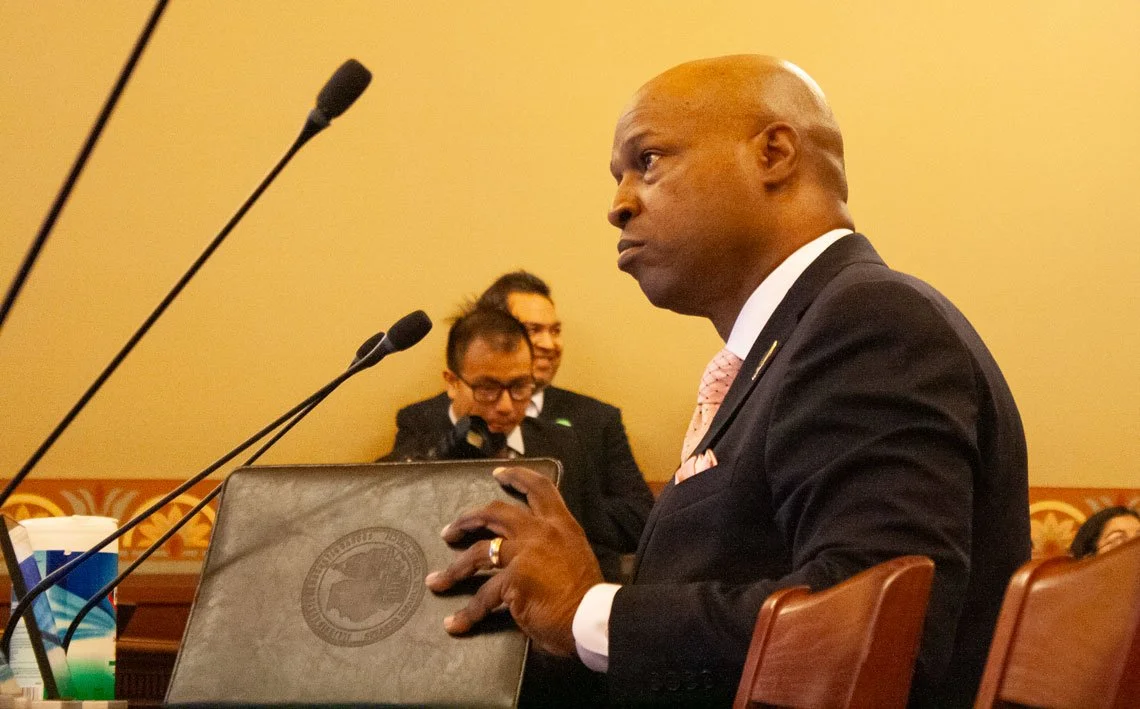
House Speaker Emanuel “Chris” Welch presents his bill to limit where federal immigration centers can be placed in Illinois to a House committee on Wednesday, March 25, 2026. (Capitol News Illinois photo by Jenna Schweikert)