
Pritzker to present 8th budget as Illinois faces federal funding uncertainty

Democrats seeking new taxes while Republicans call for limiting spending 

By BEN SZALINSKI
Capitol News Illinois
bszalinski@capitolnewsillinois.com

Article Summary

  • Gov. JB Pritzker will present his eighth budget on Wednesday and outline a plan to deal with limited revenue growth and significant uncertainty over the future of federal funding for the state. 

  • Several policies from the federal government raise costs for the state or diminish how much money Illinois will receive, causing forecasters to project growing deficits in the coming years. 

  • A recent economic forecast expects the state’s economy to struggle under the weight of tariffs and cuts to social services. 

  • Progressive lawmakers want the governor to raise taxes on corporations and billionaires while Republicans are hoping to keep spending flat in fiscal year 2027.

This summary was written by the reporters and editors who worked on this story. 

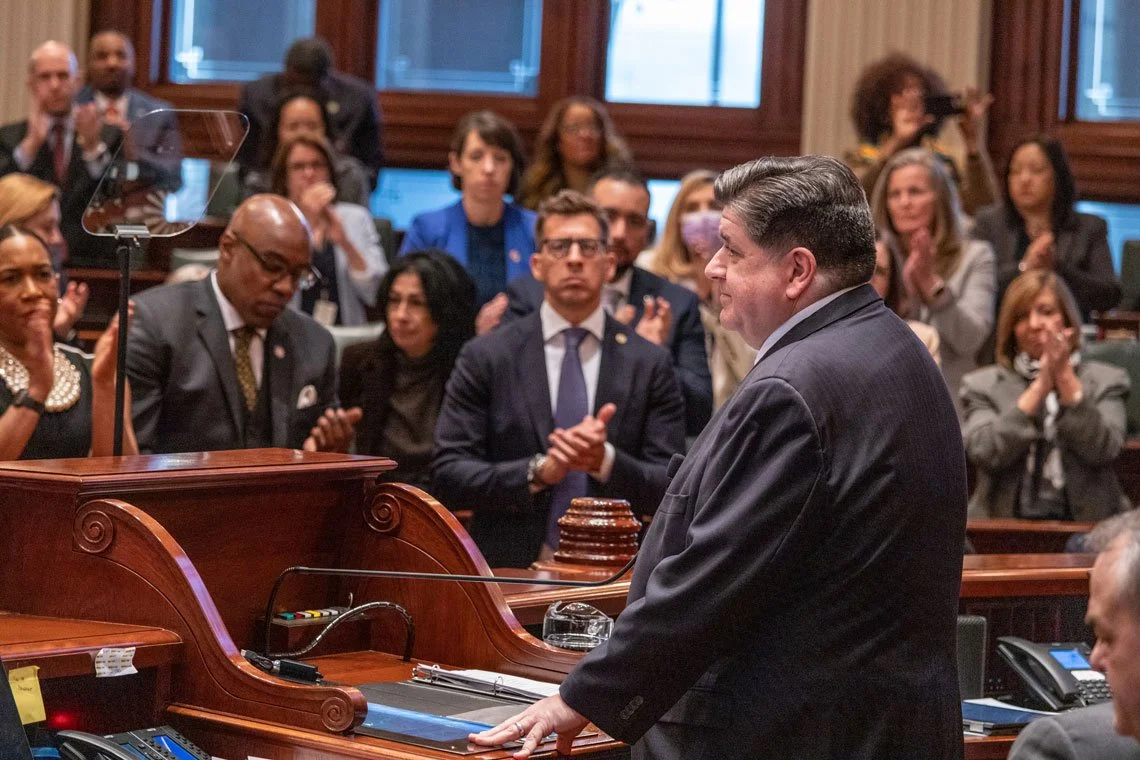
SPRINGFIELD — Gov. JB Pritzker will stand in front of the General Assembly on Wednesday in a familiar position: confronting tremendous uncertainty over the state’s financial future.

Pritzker will present his eighth budget as he seeks reelection to a rare third term and becomes a growing national presence as a possible 2028 presidential candidate and one of President Donald Trump’s loudest critics.

The Trump administration has put Illinois and other states whose leaders disagree with his vision in the crosshairs, targeting them for massive cuts to federal funding. In the last two months alone, that has included a $1 billion child care funding cut that’s temporarily been blocked by the courts and $100 million in threatened health care funding cuts. 

At the same time, the economy has been shaken by Trump’s tariff policies and Congress passed a sweeping domestic policy bill, known as the One Big Beautiful Bill Act, that will alter the fiscal landscape for states across the country. That measure cuts eligibility for Medicaid and the Supplemental Nutrition Assistance Program, increases administrative costs and reduces what the state can collect in provider taxes

The ever-changing federal funding landscape presents lawmakers and Pritzker with a murky picture of the future — one that can change as fast as the president can send a social media post or a judge can issue a restraining order. 

But the state constitution requires lawmakers to pass a balanced budget, and Pritzker will outline his plan for one on Wednesday.  His annual budget address sets up months of negotiations — mostly between supermajority Democrats. They’ll try to balance their desires to fund programs while revenues — both from the feds and the state’s base sources — are projected to flatten at best. 

Rep. Kam Buckner, a top House Democrat budget negotiator from Chicago, said one of the goals of this year’s budget will be to play “defense.”

“It’s hard when the biggest variable in the budget is not something that you can control,” he said, referring to federal funding. “And with this president, the volatility isn’t a possibility; it’s a given.”

Pritzker and his team have already started setting expectations for a conservative budget, telling agency leaders in memos and signaling to legislators that it will be difficult for the state to fulfill funding requests this year. 

Federal impacts

The Governor’s Office of Management and Budget estimated in October that lawmakers will have to close a $2.2 billion deficit for fiscal year 2027, which begins July 1. Much of that deficit is driven by the state’s own spending exceeding projected revenue. But GOMB projected changes at the federal level are making the problem more challenging and will further exacerbate deficits in the coming years. 

In the short-term, Pritzker’s budget office estimates income tax revenue for the state will be lower because of federal tax code changes and some administrative costs for food assistance programs will be required this year. 

Most of the impacts of Trump’s big bill won’t be felt until FY28. But that doesn’t mean it won’t factor into this year’s process. 

“You can't ignore what is coming down the road, and so we should expect and work towards a proactive plan for next year’s gap starting now, not after May, because the gap is being driven by forces that won’t wait for the spring,” Buckner said.

Read more: Pritzker’s new budget report could set tone for conservative 2027 spending plan | Judge blocks Trump’s $10B child care funding freeze that targeted blue states, including Illinois

Dwindling federal funding is already starting to appear in the state’s balance sheets. The Commission on Government Forecasting and Accountability’s January report shows revenue was 3% lower in January compared to the same month in 2025, largely because of decreased federal funding. 

Federal funding to Illinois has declined for three consecutive months, though the commission cautioned there could be a variety of reasons for that, such as the timing of payments. In any case, federal funding was 35% lower this January than last and is now down 8% for the year. Overall revenue for the year is still up 3.5%.

Economic conditions

It’s not just federal funding that presents a challenge for lawmakers — the overall health of the economy does as well. A forecast by Moody’s Analytics released last week set an ominous tone: “Illinois’ economy is in a precarious spot,” and a weak economy ultimately makes it difficult for revenue to naturally grow.

“Potential budget shortfalls in Illinois and the city of Chicago mean lawmakers may need to consider a mix of revenue enhancements and spending adjustments, measures that could ultimately stifle consumer spending,” the report said.

The forecast predicts employment will not grow or decline, and the economy will grow at a slower rate than other states because of outmigration, a shrinking tax base, and a massive long-term pension liability. Additionally, tariffs are hurting the state’s manufacturers, and rural areas are suffering from both tariffs and higher farming costs.

“Illinois has a lot at stake, given its reliance on manufacturing and logistics and its above-average exposure to foreign trade,” the report said. 

Moody’s said the results of Trump’s big bill will be mixed by region, but the overall impact of the policy will be negative because it weakened social services. 

More broadly, Moody’s notes an artificial intelligence bubble in the stock market could burst and trigger a recession. 

Health care costs to balloon 

Lawmakers could also consider taking proactive steps to absorb new health care costs and cuts set to take effect in the coming years. 

Under a provision in Trump's big bill — one that applies only to states like Illinois that expanded Medicaid eligibility under the Affordable Care Act — a 6% cap on the tax Illinois can charge health care providers will gradually be cut starting in FY28 until it reaches 3.5% in FY32.

Read more: Illinois Medicaid program faces looming funding crisis due to federal changes

When the lower cap is combined with a decline in federal aid for Medicaid, the state could lose $1.7 billion annually by FY31, according to the governor’s budget office. 

The impending limits on Medicaid provider taxes will pose a significant challenge for lawmakers who will either have to find some other way to pay the state’s share of the cost or adjust the program to fit within the new fiscal constraints.

Since the federal changes do not take effect for another year, it is possible lawmakers will not feel pressure to take immediate action in the upcoming legislative session.

Current-year changes

The October GOMB report also revealed the state was on track to run a small deficit in the current fiscal year ending June 30, largely because the state’s income tax code was tied to the federal level and Congress made changes that will ultimately lower tax revenue flowing into Illinois.

In response, lawmakers decoupled the state’s tax code from the federal government in certain areas, which GOMB expects to reduce the deficit by $243 million. The state still faces a $587 million deficit because of the federal tax changes. 

Pritzker has also asked several state agencies to reserve nearly $500 million in spending because of uncertainty over how revenue will shake out as federal funding remains in flux. The reserves largely focus on cost savings, such as forgoing hiring in certain agencies for the remainder of the fiscal year, reducing available grants and saving money on health insurance costs. 

In the last two budgets, Pritzker and lawmakers have also relied on targeted tax increases. Though the FY26 budget ultimately amounted to a $2 billion spending increase, most discretionary spending outside core areas increased by less than 1%. Pritzker also warned lawmakers last year that if they want to increase spending for a certain program, they must come up with a corresponding cut. Pritzker has also opposed broad tax increases, such as statewide sales and income tax hikes. 

Senate Republican Leader John Curran, R-Downers Grove, said at a news conference earlier this month that he expects limited spending to continue in this year’s proposal. 

“You saw the rollback on the health care for working-age population for undocumented immigrants last year,” Curran said. 

The Health Benefits for Immigrant Adults program was launched in 2021 and covered qualifying individuals aged 42-64 but was ended in this fiscal year’s budget because it far outstripped initial estimates.

“That was something that the governor, in his budget address, readily admitted that it was a mistake to go down that road, and the state could not afford that,” Curran said. “So I think that process already started last year. I expect that to continue this year in this budget.”

What lawmakers want

A group of progressive Democrats want to raise taxes substantially to fill gaps in the budget. The $4 billion tax package calls for taxing the appreciation of billionaires’ assets, a 10% tax on digital ads, increasing taxes on corporations' offshore earnings, and closing loopholes in the corporate tax code. 

Lawmakers said at a news conference earlier this month that the taxes are necessary because businesses and wealthy Americans have benefited from tax policies in Washington. 

“If we don’t fight back with taxing the ultra-wealthy, we’re going to continue to chop services in order to balance budgets,” Sen. Karina Villa, D-West Chicago, said. 

Speaking to CNI, Buckner said any new revenue must be reliable for the state beyond one year and fair to taxpayers so they “are not the default state ATM.” 

“We got to create some certainty in this chaos and that means that we have to build a budget that can take a hit without passing the pain straight to families, hospitals, schools and local governments,” Buckner said.

Rep. Amy Elik, R-Godfrey, who leads budgeting for House Republicans, framed concerns about federal funding differently. 

“In my opinion, it is always volatile because you are relying on another level of government with programs that they may begin or end,” Elik told Capitol News Illinois. 

Elik said Republicans are worried Democrats will go to the taxpayers’ well for more money.

“They’re not even ashamed or embarrassed anymore to say we need to raise taxes,” Elik said. “And so when they’ve got so many people on board with that theory and concept, I’m very, very concerned.”

Republicans in the House have largely been shut out of budget negotiations for several years and Elik said she doesn’t expect this year will be different, adding Republicans won’t agree to vote for a budget before it is completed. 

The House Democratic Women’s Caucus said in a statement they are hoping to see the governor boost funding for social services that have been cut at the federal level and are “open to potential revenue options that do not negatively or disparately impact the vulnerable populations we represent.”


Capitol News Illinois is a nonprofit, nonpartisan news service that distributes state government coverage to hundreds of news outlets statewide. It is funded primarily by the Illinois Press Foundation and the Robert R. McCormick Foundation.
Penny shortage causes headaches for retailers in the Land of Lincoln

For many Illinoisans, it’s a sentimental ending to see “Honest Abe’s” coin disappear

BY ERIKA TULFO

Medill Illinois News Bureau

news@capitolnewsillinois.com

Article Summary

  • Illinois citizens and retailers are grappling with the slow disappearance of the penny in the Land of Lincoln.

  • The lack of fixed guidance at the state and federal levels on how to address the scarcity of new pennies has left some businesses at a loss.

  • Many retailers have resorted to rounding their prices up or down when selling or making change, but that is imprecise.

This summary was written by the reporters and editors who worked on this story.

SPRINGFIELD — At the Abraham Lincoln Presidential Library and Museum in Springfield, visitors can shop for sweatshirts, pillows, jewelry and chocolates using coins bearing the face of perhaps the most-famous Illinoisian, Abraham Lincoln.

But even here, pennies are growing scarce at the cash register. 

The museum gift shop, like the rest of the country, is grappling with a penny shortage after the United States Mint halted production of the coin in November, citing the rising cost of producing them.

The lack of fixed guidance from the state and federal governments about how to cope with the shortage of new pennies has left some business owners scrambling to come up with ways to address it. 

Many retailers are just rounding up or down to the nearest 0- or 5-cent mark in their prices to make change. They will accept the one-cent coins, but can’t always pay them out.

“The retailer faces frustration on behalf of the consumer,” said Rob Karr, president of the Illinois Retail Merchants Association. “Most retailers are rounding in the consumer's favor, which doesn't make the consumer mad, but it also takes profits out of the retailer and puts them at the narrowest end of the net profit margin. So every penny matters there. I think the absence of clear guidance at the moment is difficult.”

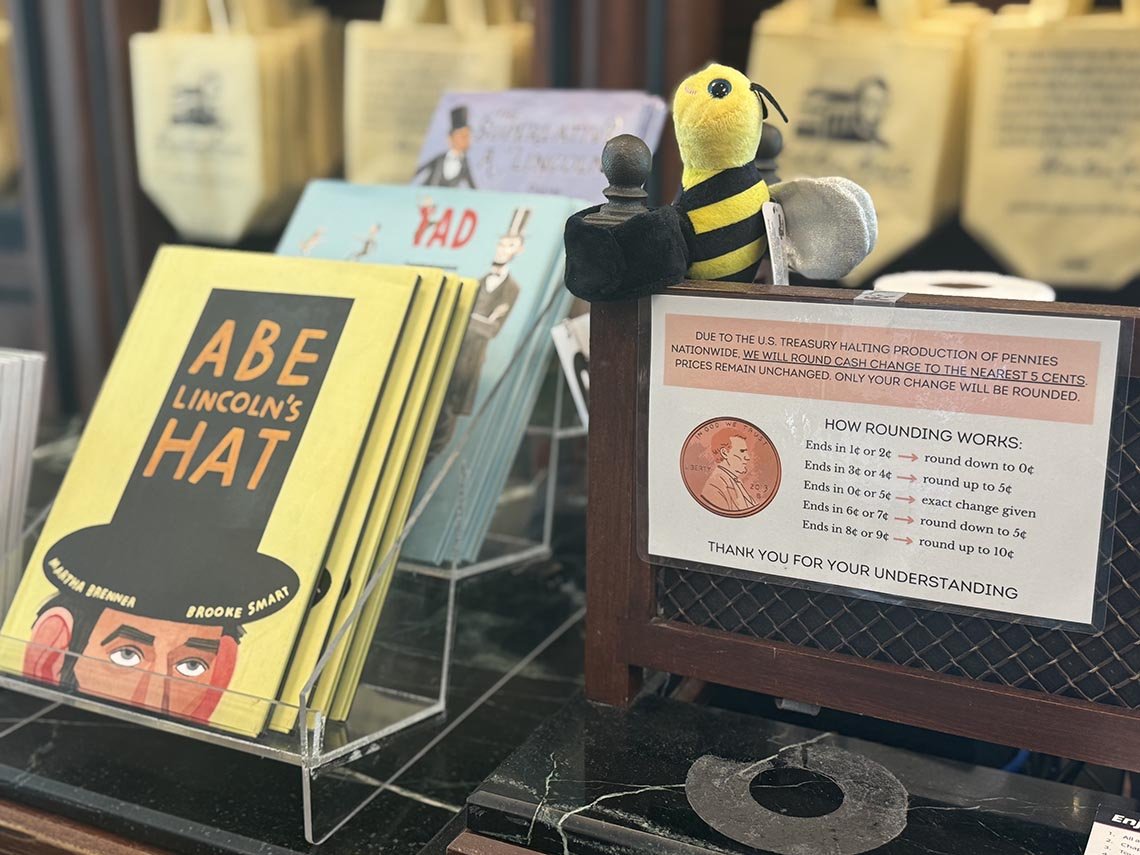
Some businesses, like the Lincoln Museum gift shop, display a guide on how its rounding system works. The museum, for example, rounds amounts ending in 1 or 2 cents down to 0. It rounds amounts ending in 3 or 4 cents up to 5 cents, and amounts ending in 6 or 7 cents down to 5 cents. However, other business owners say this kind of multi-tiered rounding system can be inconvenient and confusing for customers.

For many Illinoisans, there is a sad, end-of-an-era feeling watching the slow disappearance of the one-cent coin, which was one of the first coins made by the U.S. Mint after its establishment in 1792. President Lincoln’s profile has been on the “heads” side since 1909, and that change made him the first president featured on U.S. coins in honor of his 100th birthday.

Mary Disseler has been working as a volunteer at the Lincoln Museum for over 20 years since its founding in 2005. As a die-hard fan of Lincoln, she sees the decision to stop penny production as a sad but sensible decision. 

“It kind of breaks my heart. I think it’s a nice tribute to Mr. Lincoln, but I understand that it’s costing four cents to make a penny, so there’s a part of us that has to be practical, too,” she said. 

Keith Wetherell, executive director of the Illinois Beverage Association, which represents a handful of small, cash-reliant or cash-exclusive businesses, has practical concerns, too. He worries that the inconvenience posed by complicated rules around rounding could affect customers’ sentiments.

“The one thing that we would really lobby against was any type of bouncing around from city to city where you have all these different rules and stuff; we want to just minimize the confusion,” he said. “We just like to make everything as good and as easy as possible for the customer. Small businesses are struggling as it is. We don't want any operational challenges. When (customers) have challenges, they take it out on us by not buying them as much.”

Julie Johnson, who owns Daisy Jane’s, a boutique in downtown Springfield, said she rounded up cash change to the benefit of the customer when necessary, but would rather use pennies to give them exact amounts. 

“My jar is pretty low on coins. I’m gonna have to figure out what (the state) wants us to do with pennies,” she said. “There has to be a plan for that. When you calculate tax on something, it’s almost always going to have pennies as part of the equation.”

How will lawmakers respond?

Illinois lawmakers say the penny shortage is not an issue at the top of the agenda because of factors like the popularity of cashless payment methods and the fact that there are still billions of pennies in circulation.

Sen. Dave Syverson, R-Cherry Valley, wrote a note on his website in November applauding the U.S. Treasury’s decision to halt production, saying it was “more of an inconvenience than a useful part of the economy.” He said no steps were currently being taken to address the shortage at the state level and that he would await guidance from the federal level.

“It'll be something that they'll obviously start working on addressing more and more as the pennies become less in circulation,” he told Capitol News Illinois. “It doesn't look like people have to worry about it at all for 2026. I'm guessing that the soonest there'd be any guidance would be '27, when they would maybe set some rules about requiring businesses to accept whatever rounding decision that gets made.” 

But Karr, head of the retail merchants association, said he wasn’t satisfied with Springfield playing the waiting game and leaving the decision up to the U.S. Treasury.

“While the federal government makes currency decisions, the states make sales tax decisions. So it's a shared responsibility,” he said. “While there's clarity that the federal government needs to provide, there's also clarity that the state needs to provide. That clarity, it helps in terms of lawsuits as well, because there are lawyers out there who can sue if they don't think you've done something correctly. And without that guidance, it leaves the retailers certainly exposed.”

Gordon Davis, founder of the Springfield tea store Whimsy Tea, said he hasn’t had issues with the penny shortage yet, but that it was “looming.” He said that while 72% of his customers opted to pay with cards, more than one-quarter still chose to pay with cash.

Instead of rounding prices, Davis made prices tax-inclusive in his store’s point of sale system, which he says saves him the trouble of facing legal complications with rounding.

“Rounding, as I understand, can run you afoul of federal law because you have to treat all currencies, all payment methods the same. If you’re rounding for cash but not rounding for card, you’re breaking the law,” he said. 

Still, experts say that beyond minor adjustment costs on the retailers’ end, the penny shortage won’t pose a major issue in terms of price increases simply because its value is low. 

“Inflation-wise, it's not creating a problem,” said Shihan Xie, an assistant professor of monetary economics at the University of Illinois Urbana-Champaign. “The value of the penny has diminished. It's at a point where the value is so small that it’s not going to affect daily life much, or that it becomes crazy.”

But for some citizens of the Land of Lincoln, the penny shortage is an issue that has more to do with sentiment. Lincoln Museum volunteer Disseler she understands the economics no longer support the beloved one-cent piece. 

“We’ll still have the $5 bill,” she said. “Even though they’re phasing (the penny) out, we’ll keep his memory alive forever.”

Erika Tulfo is a graduate student in journalism with Northwestern University’s Medill School of Journalism, Media and Integrated Marketing Communications, and is a fellow in its Medill Illinois News Bureau working in partnership with Capitol News Illinois. 

Capitol News Illinois is a nonprofit, nonpartisan news service that distributes state government coverage to hundreds of news outlets statewide. It is funded primarily by the Illinois Press Foundation and the Robert R. McCormick Foundation.


ICE agents detain five men on their way to work at a Du Quoin sawmill 

This marks one of the first reported mass ICE enforcement actions this far south in Illinois

By JACKSON BRANDHORST & LYLEE GIBBS
Saluki Local Reporting Lab 

Capitol News Illinois

Article Summary

  • The men worked at a sawmill in Du Quoin and ICE detained them during a traffic stop on Jan. 29 on their way to work. Du Quoin’s mayor said he had no advance knowledge of the enforcement activity.

  • All of the workers had been employed at Alstat Wood Products through a labor subcontracting firm, and the owner of the sawmill said he had been informed the workers’ visa statuses were valid. 

  • ICE did not respond to multiple emails from Capitol News Illinois seeking comment, and reporters were unable to independently verify the existence of warrants for the men.

This summary was written by the reporters and editors who worked on this story.

DU QUOIN — U.S. Immigration and Customs Enforcement agents arrested five men on their way to work in late January in Du Quoin, marking one of the first reported mass ICE enforcement actions this far south in Illinois under President Donald Trump’s immigration crackdown.

ICE agents in an unmarked vehicle were conducting surveillance in Perry County on the morning of Thursday, Jan. 29, when they pulled over their truck and detained them, according to the owner of Alstat Wood Products, a sawmill in Du Quoin where the men had been working.

Those arrested were 53-year-old Carlos Sanchez-Luna of Mexico; 37-year-old Guadalupe Hernandez Lopez of Mexico; 27-year-old Ramiro Lopez Alvarez of Mexico; 28-year-old David Ernesto Rodriguez-Mejia of El Salvador, and 42-year-old Gilberto Gomez Perez of Mexico. They were booked that same day and sent to the Ste. Genevieve County Detention Center in Ste. Genevieve, Missouri, officials at the jail confirmed. 

Rodriguez-Mejia was transferred and is currently being held in the Greene County Jail in Springfield, Missouri. Gomez Perez was transferred to Greene County on Feb. 3 and was later extradited from the facility by ICE on Feb. 6, according to staff at Greene County Jail. ICE did not return multiple calls and emails seeking information on his whereabouts. 

The Perry County Weekly-Press, which first reported on Feb. 11 the names of those detained, cited an ICE spokesperson as saying that a sixth man — 38-year-old Yecfren Alexander Alvarez, of Honduras — had also been arrested. However, reporters from the Daily Egyptian at Southern Illinois University Carbondale and Capitol News Illinois could not independently verify his detention, location or status. 

ICE did not respond to multiple requests for confirmation or to comment on the arrests.

Daniel Alstat, owner of Alstat Wood Products, said the detainment of the workers took him by surprise. 

“I did not dream of this, really, to be honest with you — until I got the phone call saying that they’d been picked up,” he said. 

Alstat Wood Products is a family-owned sawmill and logging company located just off of Illinois 127 in rural Perry County, Illinois. The company has been in operation since 1988 and is one of the few remaining sawmills in southern Illinois. 

Alstat said he has struggled at times to fill certain labor-intensive positions with local workers, particularly during parts of the year when demand is highest. Depending on the season, the company employs about 25 to 30 people, many of them family members.

The visa and immigration status of the five individuals detained in Du Quoin is unclear. Alstat said he was told that the five employees he subcontracted had six-month work visas. 

Looking for additional laborers to begin work in 2026, other sawmill owners pointed Alstat to a contracting company called Midwest Lumber Solutions Inc.

Through this company, Alstat said he hired five men on six-month contracts at the beginning of the new year in what he called an “experimental” approach to finding employees. 

“When I signed the contract for the five employees, basically it states that they'll (Midwest Lumber) be responsible for them,” Alstat said.  “When I ran it through my people and got it approved, it was all good. So, we just kind of went from there.”

Diego Rest, of Kissimmee, Florida, the owner of Midwest Lumber Solutions Inc., which operates out of Missouri and Florida, confirmed that the employees had been hired by his firm and contracted to work at Alstat. He said he’d been aware they were detained by ICE but declined further comment. 

Rest is also the owner of Midwest Outsourcing Inc., located in Cape Girardeau, Missouri.

According to Alstat, Rest’s contracting company was responsible for providing housing and transportation for the men. They had been living in a trailer on North Howard Street in Du Quoin since November, according to neighbors, who were familiar with them and knew that they worked at Alstat.

Quiet neighbors

Multiple neighbors said they recalled more than one instance of police activity at the trailer during the months the men lived there. Several described what they believed was an incident weeks earlier in which individuals were placed in handcuffs and taken into custody. However, reporters were unable to determine which agency was involved, what prompted the response or independently verify the account.

Perry County State’s Attorney Matt Foster said his office had no reports involving the men or the address in question. A review of Judici, the online court records system used by most southern Illinois counties, did not show any pending charges for the men in Perry, Jackson or Union counties.

One neighbor, Tristan Gossman, said he didn’t hear much from the men, though had been familiar with where they lived. 

“Good neighbors are quiet neighbors,” Gossman said “They must have come and gone at different hours. I didn't know there was more than a couple people living there. I had not a single problem with them.”

Other neighbors said they occasionally heard loud music at night, and said it appeared multiple people were living in the home. 

Du Quoin is home to about 5,600 residents — 2.44% of which are Hispanic, according to Data USA, and is best known for the Du Quoin State Fair and Street Machine Nationals, which brings thousands of visitors to town during the summer.

Under the TRUST Act, Illinois state law prohibits local and state police officers and other officials from cooperating with ICE, with some limited exceptions.

Du Quoin Mayor Josh Downs said he did not learn about the ICE activity until after the men had been detained. 

“Du Quoin police were not notified beforehand or asked to participate in any way with any ICE activities in Du Quoin,” Downs said. “They were notified afterward by a resident who noticed unmarked vehicles in town.” 

The report from the Weekly-Press cites ICE Public Affairs Officer Nina Pruenda saying that ICE, along with federal partners, conducted a vehicle stop during a targeted enforcement operation and encountered six men — all which Pruenda told the Weekly-Press have warrants out for their arrest. 

Alstat said it was his understanding that the men were pulled over by ICE as part of a broader surveillance effort by the agency in the region, and that the workers were not necessarily the target of it. 

“From the details I’m gathering, they were pulled over on an actual highway,” Alstat said. “They got in their vehicle and started coming to work and drove through an area where they (ICE) were looking for people in another spot and when they happened to drive by with some Hispanic looking people they (ICE) went, ‘Oh look at that, let’s question these people.’”

Temporary labor

Intensified ICE action over the past year in places like Chicago, Minneapolis, Los Angeles and others, has produced a plethora of legal battles concerning the conduct and procedures involving arrests and detentions made by ICE agents, such as Perdomo vs. Noem.

Perdomo, represented by the ACLU, alleges that recent ICE activity violates the Fourth Amendment because ICE agents are racially profiling and conducting stops on individuals without reasonable suspicion. The ongoing case has made its way to the Supreme Court, where it saw a contentious concurring opinion from Justice Brett Kavanaugh.

“He (Kavanaugh) suggested that if ICE knows people are working in jobs typically held by immigrants, or at workplaces where immigrants often work, if they’re speaking Spanish or doing other things typically associated with undocumented individuals, that might give law enforcement reasonable suspicion to stop and question them,” said Cindy Buys, a professor in the Southern Illinois University Simmons Law School, who specializes in immigration law. 

Buys said that H-2A visas are used for agricultural workers, and that many southern Illinois farmers use them to add employees for seasonal labor. 

“It sounds like they had some kind of temporary visa, meaning they were lawfully present and had employment authorization,” Buys said. “However, depending on the nature of their criminal records, that could invalidate their ability to remain and work lawfully. For those without criminal records, if they were here on valid temporary visas, there shouldn’t be a reason to arrest and detain them.”

A wide range of criminal behavior puts an individual at risk of losing immigration status, including most misdemeanors. 

Buys said that obtaining immigration visas can be time-consuming, and that some companies specialize in handling that process. 

“Companies with expertise in the visa process may act as the employer of record and subcontract workers to local businesses,” Buys said. “There’s nothing inherently improper about that arrangement.”

Alstat said he entered into the contract for workers in good faith, and that the situation has been unsettling to him.

“If I’d have known this was going to go down this way, I maybe would have chosen a different path to approach this,” Alstat said. “But still, I needed the labor. It was a chance I was willing to take. At the same time, I don’t know that there’s really been anything that’s gone wrong with anybody, because I still haven’t understood why they were taken if they had that paperwork. So I don’t know yet.”

This story was produced for Capitol News Illinois through the Saluki Local Reporting Lab, supported by grant funding from the SIU Foundation and the Illinois Press Foundation. Jackson Brandhorst and Lylee Gibbs are students at Southern Illinois University, and senior members of the Daily Egyptian, SIU’s student newspaper. Brandhorst can be reached at jbrandhorst@dailyegyptian.com and Gibbs at lgibbs@dailyegyptian.com

Capitol News Illinois is a nonprofit, nonpartisan news service that distributes state government coverage to hundreds of news outlets statewide. It is funded primarily by the Illinois Press Foundation and the Robert R. McCormick Foundation. 


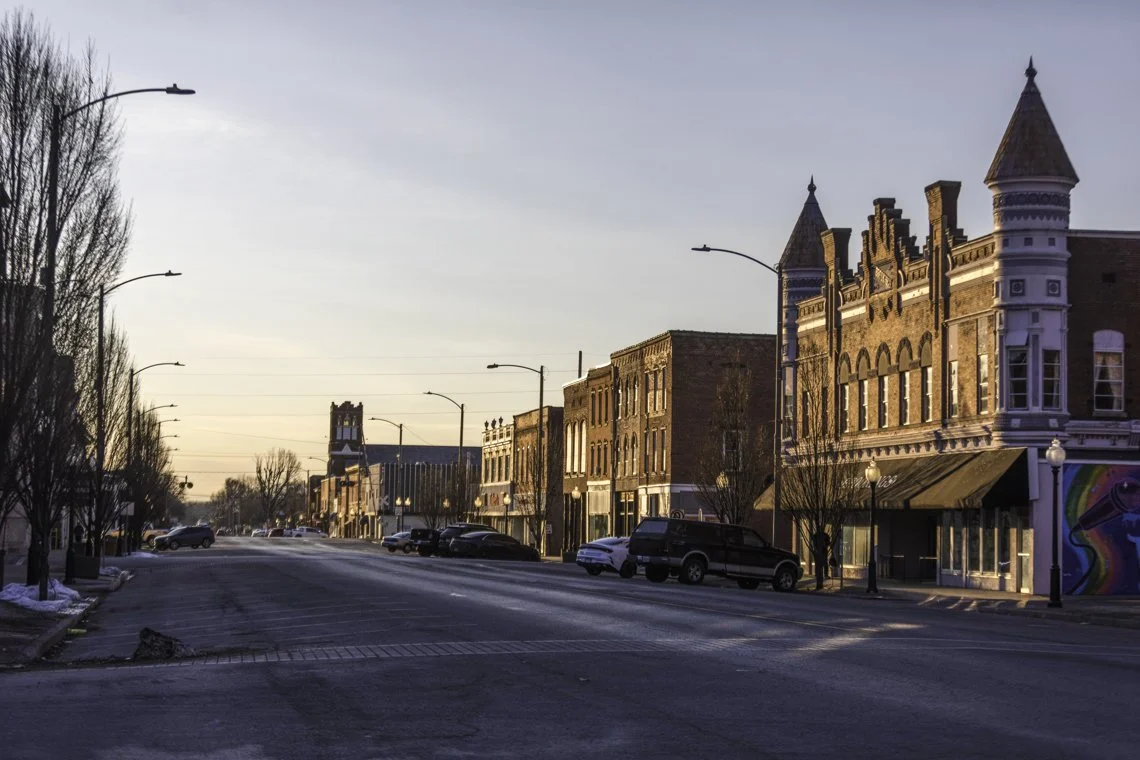
The sun sets on Du Quoin’s Main Street on Thursday evening. (Saluki Local Reporting Lab Photo by Lylee Gibbs)

Hazleton woman arrested for DUI

On February 12, 2026, at 5:36 p.m. Gibson County Central Dispatch received a 911 report of an accident with injuries on State Road 56 at the Shiloh Church Road intersection north of Princeton.  Deputies with the Gibson County Sheriff’s Office as well as Union Fire and units with the Gibson County Ambulance Service were dispatched to the scene.  Upon arriving Deputy Wyatt Hunt observed that two vehicles had collided and while speaking to the participants he observed multiple clues that one of the drivers may be under the influence of alcohol.  At that point he began a roadside DUI investigation.  At the conclusion of the investigation, he placed 53-year-old Billie Golden of Hazleton into custody and transported her to the Gibson County Detention Center.  Upon arriving at the detention center Ms. Golden was charged with Operating a Vehicle While Intoxicated.
 
Deputy Hunt was assisted in his investigation by Deputies Wes Baumgart and Eric Powell. 
 
All criminal defendants are to be presumed innocent until and unless proven guilty beyond a reasonable doubt in a court of law.
 

Wabash County Sheriff's Correctional Officer Receives Lifesaving Award

The Illinois Sheriff’s Association commended a Wabash County Sheriff’s  correctional officer this week for her quick response in saving the life of a detainee.

According to the department, on May 21st, 2025, Correctional Officer Francine Clowers was in her office when she heard inmates yelling for help. She immediately went into the jail to investigate and discovered a detainee hanging from the bars inside his cell.

Authorities say the detainee had tied his thermal clothing together to form a noose and attached it to the bars in his night cell. When Clowers attempted to unlock the cell, she found the door would not open because the detainee had also tied his socks around the bottom of the door to prevent entry. Clowers quickly directed another correctional officer to retrieve scissors. After cutting away the socks and gaining access to the cell, she cut the detainee down. Officials say he was purple in color, not breathing, but still conscious. Officers lowered him to his bunk and immediately called for EMS. The detainee was transported to Wabash General Hospital for treatment. The ISA says the detainee’s life was saved due to Officer Clowers’ swift actions and training in responding to individuals in crisis and  commended her for a job well done.

Clowers was recognized this week during the Illinois Sheriffs' Association 2026 Sheriffs Winter Training Conference, Awards Banquet, and Installation of Officers in Springfield. 2025 Lifesaving Awards went out to 6 Illinois County Sheriff's Offices and 11 Deputies and Correctional Officers.

The ISA produced a video recognizing all of the honorees. The portion featuring Francine Clowers is below.

Video Credit: Illinois Sheriff’s Association Facebook page. https://www.facebook.com/Illinoissheriffsassociation

Final Totals Released For 2025 Operation Share Campaign

Wabash County Operation Share has released its final totals for the 2025 campaign, and organizers say the results show a strong increase in community support.

Wabash County Ministerial Association President, Reverend Kevin McGinnis, reported that the final donation for Operation Share was received this week, officially closing out the 2025 campaign. McGinnis said contributions and volunteer efforts increased over last year, allowing Operation Share to help more local families during the holidays.

In 2025, Operation Share assisted 250 families at Thanksgiving, up from 200 families in 2024. At Christmas, the program helped 300 families, compared to 250 the previous year. While fewer children received toys in 2025, with 385 kids served compared to 424 in 2024, overall outreach expanded significantly.

Financial support also saw a notable boost. The annual bell-ringing campaign raised just under 6,000 dollars in 2025, totaling 5,977 dollars and 71 cents, compared to just under 5,000 dollars the year before. Donations from the mailing campaign and other contributions climbed to more than 15,000 dollars in 2025, up from nearly 13,000 dollars in 2024.

Altogether, total donations for Operation Share reached more than 21,000 dollars in 2025, an increase of over 3,000 dollars from 2024.

Reverend McGinnis expressed gratitude to the many volunteers, donors, and churches who made the campaign possible, saying the generosity of Wabash County residents continues to make a meaningful difference for neighbors in need.

WGH Board Votes To Join Orthopedic Registries

The Wabash General Hospital Board of Directors has approved a request to participate in national orthopedic clinical registries operated by the American Academy of Orthopedic Surgeons.

During the board meeting, Chief Operating Officer Tamara Gould presented the proposal to enroll the hospital in three AAOS registries: the American Joint Replacement Registry, the Shoulder and Elbow Registry, and the American Spine Registry.

Gould told the board the total cost for participation in all three registries will be $20,000 for the first year, followed by $17,000 annually in subsequent years. The agreement is based on the calendar year, renews automatically, and can be terminated with notice by December 1 of any renewal year.

According to Gould, participation in the registries will support quality improvement, benchmarking, compliance, and performance transparency for orthopedic services. The data collected will provide risk-adjusted outcomes to help drive clinical excellence, support physician engagement, and align the hospital with national standards.

Gould also noted the registry reporting helps meet Joint Commission requirements, including Advanced Total Hip and Knee Replacement certification, and could strengthen payer confidence by demonstrating quality outcomes. That, in turn, may open access to additional markets and attract patients seeking joint, spine, and orthopedic procedures.

Board members voted unanimously to approve entering into the Master Registry Participation Agreement with the AAOS.

North Dakota man arrested for DUI

On February 8, 2026, at 12:38 a.m. Gibson County Deputy Levi Sims conducted a traffic stop on a Red 2016 Nissan Sedan for traveling 85 mph in a 60-mph zone on US 41 north of Patoka.  Upon approaching the vehicle Deputy Sims detected multiple clues that the driver 36-year-old Demarcus Jackson of Bismark, North Dakota was impaired.  At that point Deputy Sims began a roadside DUI investigation.  Once the investigation was completed Deputy Sims placed Mr. Jackson into custody and transported him to the Gibson County Detention Center where he was charged with Operating a Vehicle While Intoxicated and Operating a Vehicle Without Ever Having Received a Valid License. 
 
Sgt. John Fischer of the Gibson County Sheriff’s Office and Princeton Officers Logan Lashbrook and Jackie Wood assisted in this investigation.
 
All criminal defendants are to be presumed innocent until and unless proven guilty beyond a reasonable doubt in a court of law.

Mount Carmel man arrested for DUI

On February 6, 2026, at 11 p.m. Gibson County Deputy Eric Powell conducted a traffic stop on a Blue Ford F150 after observing the vehicle disregard the traffic signal on US 41 and State Road 68.  Upon approaching the vehicle Deputy Powell detected the odor of an alcoholic beverage coming from inside the vehicle.  At that point he began a roadside DUI investigation that resulted in the driver, 29-year-old Colton Dixon of Mount Carmel being taken into custody and transported to the Gibson County Detention Center.  Upon arriving at the detention center Mr. Dixon was charged with Operating a Motor Vehicle While Intoxicated. 
 
Deputy Powell was assisted in his investigation by Deputy Michael Bates and Haubstadt Officer Jason Marceaux. 
 
All criminal defendants are to be presumed innocent until and unless proven guilty beyond a reasonable doubt in a court of law.

Robinson man arrested for Possession of Marijuana

On February 6, 2026, at 2:54 p.m. Gibson County Deputy Wyatt Hunt conducted a traffic stop on a Silver 2014 BMW passenger for traveling 81 mph in a 60 mph zone on US 41 near County Road 775 North.  Upon approaching the vehicle Deputy Hunt detected the odor of raw Marijuana coming from inside the vehicle.  At that point Deputy Hunt began a roadside drug investigation where he seized 120 grams of raw Marijuana from the driver 22-year-old Alex Orr of Robinson, Illinois.  Mr. Orr was taken into custody and transported to the Gibson County Detention Center where he was charged with Possession of Marijuana with a Prior Conviction. 
 
All criminal defendants are to be presumed innocent until and unless proven guilty beyond a reasonable doubt in a court of law.