City Council Reviews Winter Storm Response Efforts

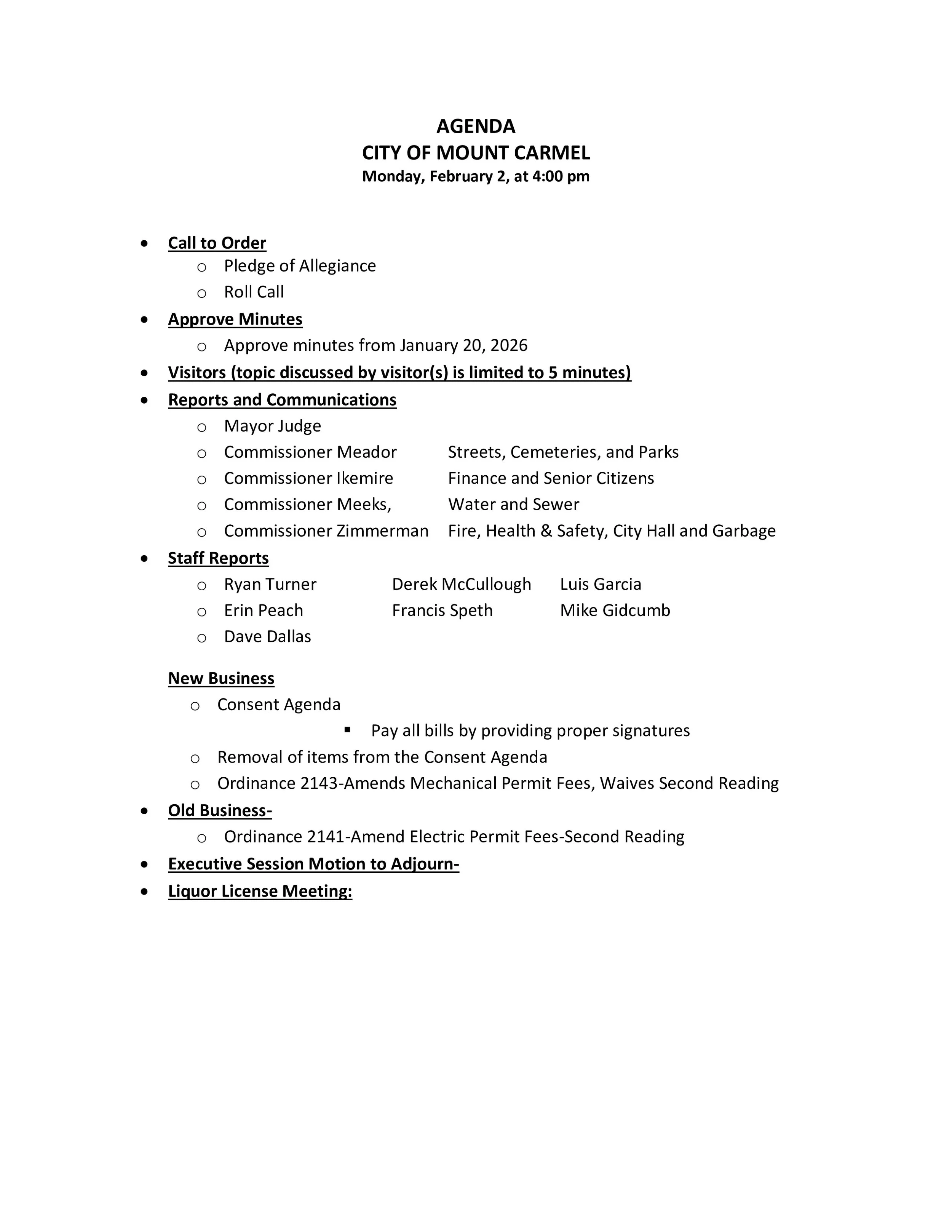
Monday afternoon’s meeting of the Mt. Carmel City Council marked the first gathering since the massive winter storm that hit the area over the weekend of January 24th.

Mayor Joe Judge opened the meeting by thanking the city’s public works crews for their long hours and dedication as they worked through what he called one of the most challenging snow events the city has faced in years. Judge said crews made steady progress clearing roads and emphasized how much it helped when residents kept vehicles off the streets during the storm.

Judge also thanked city staff who braved the cold and snow to keep City Hall open, noting that trash pickup delays are an unfortunate reality after a storm of that magnitude. He told residents that collection will resume as soon as conditions allow.

Streets Commissioner Tyson Meador echoed the mayor’s comments, saying crews prepared for, plowed, and salted throughout the storm. Meador also expressed appreciation to Public Utility crews who provided equipment and trucks to help haul snow, calling their assistance a big help.

Fire Commissioner Susan Zimmerman reported that the Mt. Carmel Fire Department has been extremely busy since the storm. She said firefighters responded to 32 calls over the past week, primarily assisting ambulance crews through auto-aid responses.

City Engineer Dave Dallas, who has worked with the city for decades, said the recent storm rivals some of the biggest snowfalls he remembers from the late 1970s. Dallas praised city crews for what he described as a remarkable job handling the historic snowfall.

Mayor Judge closed the discussion by again commending city employees and residents for working together to get Mt. Carmel back to normal.

Illinois Extension’s local Hunters Feeding Illinois program provides over 2,600 pounds of venison to area food pantries

ALBION, Ill. – Illinois Extension serving Edwards, Lawrence, Richland, Wabash, and Wayne counties marked the end of the 2025-2026 deer hunting season with the success of the local Hunters Feeding Illinois program. Over 2,600 pounds of venison were donated to food pantries this fall and winter to support food access within local communities.

 Hunters Feeding Illinois provides food pantries with ground venison from hunters who’ve donated their legally harvested deer. Illinois Extension facilitates this program in partnership with participating meat processors and with the support of donors, program partners, and deer hunters.

 “This program is really all about making connections,” said SNAP-Ed Educator Alizah Harper, who spearheaded the program. “Hunters want to give back, local donors are willing to cover processing costs, and food pantries need quality protein. When these efforts come together, it helps meet local needs and ensures families in our communities have additional access to nutritious food.”

 This year’s partnering processors, Charlie’s Deer Processing and Smokehouse in Bridgeport and Legacy Meats in Sumner, processed a total of 83 deer donations during the deer hunting seasons. The capacity to accept 83 deer donations was made possible by monetary donations, which covered the processing cost of each deer.

 In total, 2,698 pounds of ground venison, which is an estimated 10,792 servings, were delivered to five food pantries within the Feeding Illinois food bank network in Lawrence, Richland, and Wabash counties. Extension also provided resources such as cookbooks, educational handouts, hot pads, and meat mashers to help food pantry patrons incorporate venison into their meals.

 “Hunters Feeding Illinois is a powerful example of how Illinois Extension brings communities together to meet real needs,” said County Extension Director Tara Buerster. “Through the generosity of local hunters, community partners, and donors, alongside our partnering processors, we were able to turn a successful hunting season into nutritious food for families who need it most across our area.”

 To learn more about Hunters Feeding Illinois, visit go.illinois.edu/HuntersFeedingIllinois. For questions about the local program, contact the Edwards County Extension Office by calling 618-445-2934.

ILLINOIS STATE POLICE ARRESTS BRIDGEPORT MAN FOR FIRST DEGREE MURDER ​ ​ ​

BRIDGEPORT – Illinois State Police (ISP) Division of Criminal Investigation Zone 8 Special Agents arrested 28-year-old Elijah W.D. Hooker of Bridgeport, IL after his wife was fatally shot in their residence.

 ​On January 29, 2026, the Bridgeport Police Department requested ISP’s assistance with a death investigation in the 700 block of Washington Street. Officers found the deceased victim, 37-year-old Omni Hooker, in the residence suffering from a fatal gunshot wound. Elijah Hooker was taken into custody on scene.

 ​On February 2, 2026, after a thorough investigation, ISP Special Agents presented the case to the Lawrence County State’s Attorney’s Office and the charge of First Degree Murder (Class M Felony) was filed. Elijah Hooker remains in custody at the Lawrence County Jail. There is no further information.

Wabash Valley College Foundation Scholarship Applications Now Available

Wabash Valley College (WVC) Foundation scholarship applications are now available on the WVC website. Students may apply by visiting www.iecc.edu/wvc/scholarships and navigating to the Current High School Students tab. From there, applicants will find a complete list of available Foundation scholarships.

A single application is used for all Foundation scholarships. Students are encouraged to review the scholarship list carefully to ensure the opportunities they wish to apply for are included within the application.

Application Requirements

Applicants must submit the following materials:

· A written essay

· One character reference

· An official high school transcript

· An official IECC transcript, if applicable

Official IECC transcripts are provided at no cost and may be obtained by visiting the Student Services Office in Main Hall and informing staff that the transcript is for WVC scholarship application use. Some scholarships may also include additional eligibility criteria.

The deadline for all scholarship applications is March 15. Because this date falls on a Sunday, applications will be accepted until 4:30 p.m. on Monday, March 16.

To be considered, applications must be complete and submitted to the Financial Aid Office by the stated deadline.

If you have any questions, please contact the Financial Aid Office at 618-262-8641.

County Aerial Property Maps Going Online

Wabash County Supervisor of Assessments Connie Larry recently updated the County Board on exemptions and a plan to modernize access to county property maps.

Larry told board members that senior exemptions and other renewal exemption forms were mailed out earlier this week, and residents should begin receiving them in the coming days.

Larry also discussed efforts to place the county’s aerial property maps online. She said the county currently does not offer public online access to updated aerials, which has caused confusion for residents who rely on outdated or inaccurate maps from third-party websites. Larry explained that changes such as property splits, combinations, ownership updates, and acreage adjustments are often not reflected on those outside sources, leading to complaints directed at her office.

Under the proposal, the aerial maps would be hosted and managed by BHA, allowing the public to view current aerial imagery, property lines, ownership, acreage, and basic legal descriptions online. Larry said this would benefit realtors, appraisers, government agencies, and the general public, while also reducing foot traffic and phone calls to her office.

The plan includes a one-time setup cost of 5,295 dollars, to be paid from GIS funds, along with a monthly maintenance fee of 150 dollars, which Larry said is already included in her department’s budget.

Following discussion, the County Board unanimously approved a motion allowing Larry to sign the contract and move forward with placing the county’s aerial maps online.

Group challenges Illinois’ restrictions on using ‘Democrat,’ ‘Republican’ in org names

The law requires nonprofits to get party’s permission to use names

Article Summary

  • The Foundation for Individual Rights and Expression filed a lawsuit on Tuesday to overturn a 40-year-old Illinois law that bans organizations from using a political party’s name without permission.

  • The lawsuit, filed on behalf of Democrats for an Informed Approach to Gender, calls the law unconstitutional based on “content-based speech restriction.”

  • The organization has applied three times to operate as a nonprofit in Illinois but was denied each time.

This summary was written by the reporters and editors who worked on this story.

By JENNA SCHWEIKERT 
Capitol News Illinois 
jschweikert@capitolnewsillinois.com

A first amendment advocacy group is suing Illinois’ secretary of state over a 40-year-old law that prohibits nonprofits from having the word “Democrat” or “Republican” in their name without the party’s approval. 

The lawsuit, filed on behalf of Democrats for an Informed Approach to Gender, seeks to overturn an Illinois law that dates back to the 1980s, arguing that it violates the organization’s First Amendment rights.

The nonprofit Foundation for Individual Rights and Expression, or FIRE, filed the lawsuit Tuesday against Illinois Secretary of State Alexi Giannoulias in the U.S. District Court for the Northern District of Illinois.

Democrats for an Informed Approach to Gender, or DIAG, is a national nonprofit organization formed by current and former Democrats who separate with the national party on the issue of transgender identity. 

But the secretary of state’s office denied the group’s application to operate as a nonprofit in Illinois because it had not obtained permission from the Democratic Party of Illinois to use the word “Democrats” in its organization name.

“We haven't gotten a request from this group,” a spokesperson for the Democratic Party of Illinois said in a statement. “But frankly, whether we did or not, the fact that they're proudly anti-transgender does not align with the Democratic Party of Illinois's values. We believe in progress and inclusivity. It does not appear that this group does.”

Calling the national party stance on gender identity contrary to “core liberal values,” DIAG says its mission is to end “ideology-driven medicine” and guide “our fellow liberals back to reality and reason.”

“The Illinois Democratic Party doesn’t get to decide whether we can call ourselves ‘Democrats,’” Jenny Poyer Ackerman, DIAG’s board secretary, said in a statement. “DIAG was founded on our belief in open inquiry, challenging ideological conformity, and above all, the freedom to speak out. Backing down would go against everything we believe in.”

The 1986 nonprofit naming provision

Giannoulias’ office denied the request based on a provision from the state’s 1986 law governing the incorporation of nonprofits that bans them from using the names of established political parties without consent from the state committee.

The law also gives that committee power to revoke consent at any time.

“We just don't think we should have to ask permission of the Illinois Democratic, you know, central party, to make a judgment on what we can call ourselves,” Ackerman said in an interview. “We are lifelong Democrats and also, no other state is responding in any way like this. So for me, the conversation kind of stops there.”

Of the 37 states in which DIAG operates, Illinois is the only one which has blocked the organization’s registration, according to the lawsuit. The organization said it has applied to Giannoulias’ office three times and been denied each time.

The suit calls the provision “constitutionally problematic” based on its “speaker-based” and “content-based speech restriction.”

“The Democratic and Republican parties don’t have a monopoly on the concepts of what is democratic or republican,” Daniel Zahn, an attorney for FIRE, said in a statement. “When the government tries to give them that monopoly, it’s absurd and unconstitutional.”

FIRE also filed a preliminary motion asking the court to allow DIAG to engage in activities like fundraising and supporter meetings while the case proceeds. 

“The blue states in particular are states where we feel we really need to be heard, because there are just so many people who feel the same frustrations we do with the elected Democrats who just won't listen to us,” Ackerman said. “We want to be a resource for elected Democrats and Democrats who are running for office because we really want them to succeed.”

Giannoulias did not immediately respond to request for comment. 

Capitol News Illinois is a nonprofit, nonpartisan news service that distributes state government coverage to hundreds of news outlets statewide. It is funded primarily by the Illinois Press Foundation and the Robert R. McCormick Foundation. 

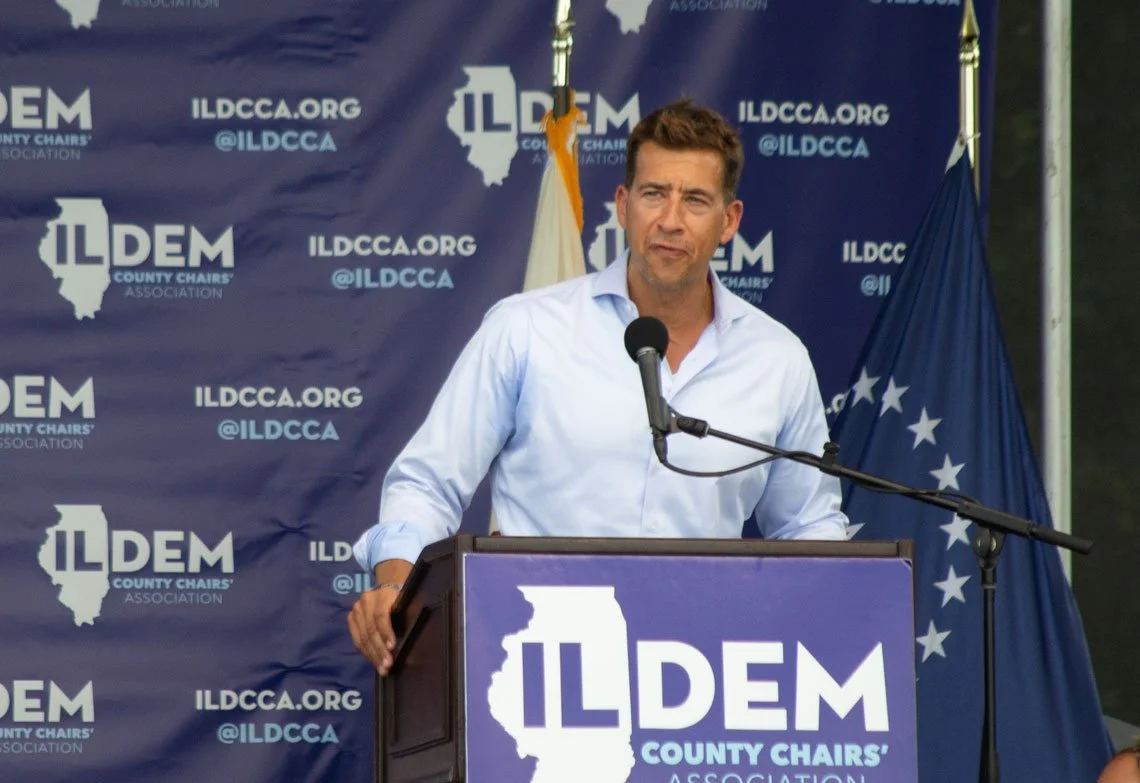
Alexi Giannoulias, now the Illinois secretary of state, speaks at a Democratic Party event in 2021. He’s being sued over a 40-year-old law governing which companies can use the word “Democrat” or “Republican” in their name. (Capitol News Illinois photo by Jerry Nowicki)

Student loan borrowers in Illinois could face federal, state ‘tax bomb’ in 2026

Tax policy changes mean some student loan forgiveness dollars are now taxable 

BY SAM FREEMAN
Medill Illinois News Bureau
news@capitolnewsillinois.com 

Article Summary 

  • Certain types of student loan forgiveness face federal and state taxes after a law that protected borrowers expired Dec. 31. Now, these loan breaks are considered taxable income at the federal and state levels. 

  • A new settlement agreement could terminate the Saving on Valuable Education plan, requiring borrowers to switch to other plans to qualify for loan forgiveness. 

  • Student loan forgiveness that was halted by the lawsuit is expected to resume in February, but programs including income-contingent repayment and pay-as-you-go plans will be phased out entirely by July 2028. 

This summary was written by the reporters and editors who worked on this story. 

SPRINGFIELD — For the first time in five years, certain forms of student loan forgiveness will be taxable following a change in federal tax policy this year.

This comes after a provision of the American Rescue Plan Act expired Dec. 31. That measure, signed into law in 2021 by former President Joe Biden, temporarily excluded student loan debt from federal income taxes.

And those tax implications could extend to Illinois state taxes as well unless lawmakers act. 

President Donald Trump’s “One Big Beautiful Bill Act,” enacted last summer, did not make the student loan tax forgiveness provision permanent. As a result, student loans that are canceled or partially forgiven in 2026 and beyond will see taxes owed on those forgiven amounts, advocates said. These taxes could amount to as much as $10,000, depending on the borrower’s income. 

This includes income-driven repayment plan-related forgiveness; some closed school discharges — where 100% of a student loan obligation is wiped out if a school closes — and private settlements. Meanwhile, some forms of loan forgiveness remain tax-free, such as public service loan forgiveness, teacher loan forgiveness, and death and disability discharge programs. 

According to a report from Protect Borrowers, a nonprofit organization dedicated to eliminating the burden of student debt, two-thirds of people who receive loan cancellation under income-driven repayment plans earn less than $50,000 a year and have less than $1,000 in savings. 

“A tax bomb on people with that amount of assets and that amount of income, it could be really financially devastating,” said Jennifer Zhang, a researcher for Protect Borrowers.

A group of congressional Democrats, including U.S. Sen. Tammy Duckworth, sent a letter to Treasury Secretary and Acting IRS Commissioner Scott Bessent on Nov. 9  calling the tax reinstatement a “financial disaster for working-class Americans.”

Illinois will also tax loan forgiveness

In addition to federal taxes, some borrowers will also face a similar tax hike at the state level. Illinois is one of 20 states whose tax codes automatically conform to the federal change. This means that unless Illinois legislators decouple the conforming provision before taxes are due next year, student loan forgiveness amounts will also be taxed by the state. 

“I would certainly be supportive of (decoupling),” Sen. Mike Halpin, D-Rock Island, said, although it’s currently not an issue that has reached the Illinois state legislature.

Borrowers identified for forgiveness embed 

Lawmakers passed a bill in their fall veto session to decouple the state and federal tax code as it pertained to certain corporate taxes to head off a budget shortfall for the upcoming year. But it did not address student borrowing. 

Other challenges facing student loan forgiveness are also expected to take effect this year: 

Student loan forgiveness under Biden’s Saving on Valuable Education, or SAVE, plan has been blocked for more than a year after some Republican-led states mounted legal challenges, claiming the program is illegal. As a result, 7 million borrowers have been stuck in forbearance, which does not count toward loan forgiveness under income-driven repayment plans or the public service loan forgiveness provision. 

The SAVE plan is an income-driven repayment plan for federal student loans created to lower monthly payments, limit interest from ballooning payments, and accelerate loan forgiveness. 

If a proposed settlement agreement between the U.S. Department of Education and the state of Missouri is approved, the SAVE plan will end entirely. That would require borrowers to switch to another plan, like an income-based repayment plan, to qualify for loan forgiveness. This change shouldn’t result in any loss of loan forgiveness credit. 

Income-based repayment  currently is the only student loan repayment plan that remains preserved by the One Big Beautiful Bill. Trump’s bill removed the partial financial hardship requirement from the income-based repayment, which makes it easier for borrowers with higher incomes to enroll. 

Income-based repayment is a federal student loan plan that caps monthly payments at a percentage of the borrower’s discretionary income. It is intended to benefit borrowers who have a high debt relative to their income. 

Search feature embed

The SAVE lawsuit also suspended student loan forgiveness under the Income-Contingent Repayment, or ICR, plan and Pay As You Earn, or PAYE, plan. The Department of Education agreed to resume processing student loans that had reached their 25-year or 20-year eligibility thresholds, after a lawsuit challenge.

Although loan forgiveness under ICR and PAYE is expected to resume in February, these plans will be phased out under Trump’s bill by July 2028. As with SAVE, borrowers enrolled in ICR and PAYE will need to switch to an income-based repayment plan or a new Repayment Assistance Plan, or RAP, that is supposed to launch later this year. 

RAP includes lower payments for some borrowers, an interest subsidy that will prevent loans from ballooning over time, and a 30-year repayment term before a borrower can qualify for student loan forgiveness. This repayment term is longer than current IDR options. 

“When people have that much of a continual financial strain, they don't build up their savings. They might not ever buy a home. They might not ever have kids,” Zhang said. “They might not ever achieve these different kinds of financial milestones.” 

RAP also will require higher monthly payments for the lowest-income borrowers.

Finally, borrowers with federal Parent PLUS loans, who are typically limited to the ICR plan, also could face changes to their repayment options.

“Individuals with questions about their loans should call our Student Loan Helpline, 1-800-455-2456, which can direct struggling student borrowers to free resources about repayment options and information on avoiding default,” Illinois Attorney General Kwame Raoul said in a statement.

Borrowers can also use the Federal Student Aid website’s loan simulator to calculate monthly payments, evaluate repayment plan eligibility and choose the repayment plan that best suits their needs.


Sam Freeman is a graduate student in journalism with Northwestern University’s Medill School of Journalism, Media, Integrated Marketing Communications, and a fellow in its Medill Illinois News Bureau working in partnership with Capitol News Illinois. 

Capitol News Illinois is a nonprofit, nonpartisan news service that distributes state government coverage to hundreds of news outlets statewide. It is funded primarily by the Illinois Press Foundation and the Robert R. McCormick Foundation.


 ‘A crisis for the nation’: ICE accountability commission continues to seek solutions

Commissioners set to review actions of key Trump officials, at Pritzker’s request

By MAGGIE DOUGHERTY
Capitol News Illinois
mdougherty@capitolnewsillinois.com 

Article Summary 

  • The Illinois Accountability Commission held its second public meeting, hearing testimony from legal experts, law enforcement professionals and historians. 

  • Commissioners released their initial report, based on testimony, lawsuits, social media posts and news reporting reviewed since October.

  • They also took up a new mandate to review key Trump officials, at the governor’s request.

This summary was written by the reporters and editors who worked on this story. 

CHICAGO — A state commission dedicated to documenting misconduct by federal immigration agents and making policy recommendations issued its initial report  Friday, while also adopting a new direction to look at high-ranking White House officials.

The Illinois Accountability Commission, created through executive order by Gov. JB Pritzker in October, has spent recent months reviewing actions of federal agents stationed in the Chicagoland area during President Donald Trump’s “Operation Midway Blitz” immigration enforcement campaign, including public testimony provided at its first open hearing in mid-December.

Ahead of the commission’s second public hearing Friday, Pritzker asked the commission to expand its review to include major Trump officials, including the now-ousted Customs and Border Patrol “commander at large” Gregory Bovino, White House “border czar” Tom Homan, Secretary of Homeland Security Kristi Noem, and Stephen Miller, Trump’s deputy chief of staff for policy.

“For too long, Gregory Bovino and his rogue federal agents have terrorized communities in Illinois and across the country, violated our people’s constitutional rights, and unleashed violence at every turn,” Pritzker said. “Bovino packing his bags cannot detract from our mission (of) accountability.”

In addition to eight named officials, Pritzker’s request applied to additional “deputies, subordinates and officials across the Trump hierarchy who may have played a role in the federal deployments.”

The commission agreed to take up that mandate, with Commission Chair and former U.S. District Court Judge Rubén Castillo signaling that the commission may recommend disciplinary action or prosecution related to the shootings of Silverio Villegas González, a father of two killed by ICE agents in Franklin Park in September and of teaching assistant Marimar Martinez, shot five times by a Border Patrol agent in October. 

“Just imagine if agents who shot Mr. Villegas González back on Sept. 12 had been publicly disciplined. Imagine a world where that had happened, maybe, just maybe, the Minnesota shootings would not have occurred and two people would be alive who are now dead,” Castillo said, referencing the fatal shootings of Renee Good and Alex Pretti in Minneapolis.

The commission’s report also states that it “is seeking to make referrals for criminal or civil prosecution for misconduct by federal immigration agents.”

Erosion of legitimacy

The three-hour hearing in downtown Chicago featured testimony from professors, legal scholars, historians, journalists and law enforcement professionals.

University of Chicago Professor of Political Science Robert Pape focused on the public’s perception of Operation Midway Blitz and the ongoing immigration enforcement campaign in Minnesota. 

The Trump administration’s denial of visible facts, like the claim that Alex Pretti was holding a gun in his hand and approached agents with the intent to “massacre them,” undermines the government’s legitimacy, Pape said.

“Democracies don’t fail when laws are enforced,” Pape said. “They fail when enforcement loses legitimacy and people stop believing restraint will protect them. That is why Minneapolis is a crisis for the nation.” 

But that crisis, he said, did not start in Minnesota. Pape pointed to DHS’s characterization of Martinez, the Chicago woman shot in October, as a “domestic terrorist.” The administration ultimately dropped its charges against Martinez after it was revealed that the agent who shot her had bragged over text about the shooting. 

Martinez’ lawyer has recently sought to have video footage from her case released, as he said it contradicts the administration’s claim that she had prevented the agents from passing by. The evidence from her case remains under a protective order that prevents its release, which her legal team says has allowed DHS to control the narrative without evidence.

If people do not trust the government to tell them the truth and to use its force to protect them, they will resist, Pape argued. Immigration enforcement officers’ reliance on face masks and coverings also deteriorates that legitimacy, he said. 

“The mask, of course, is building a perception that the state doesn’t want to be truthful about its use of force,” Pape said. 

That contributed to a perception by over half of Chicago residents that Operation Midway Blitz was about exerting political control, rather than a legitimate immigration enforcement campaign, according to a study conducted by the University of Chicago.

Historical, new abuses

Garrett Graff, an author, journalist and historian who has documented the evolution of ICE and CBP for over two decades, outlined a long history of abuses and misconduct inside the organizations.

Nearly 5,000 Border Patrol agents have been arrested since 2005, some of them multiple times a year, said Graff, a former editor at Politico.

“The population of CBP agents and officers who have been arrested would make it roughly the nation’s fourth largest police department, equal in size to the entire Philadelphia police,” Graff told the commission. “It appears that the crime rate of CBP agents and officers was higher per capita (for much of the 2010s) than the crime rate of undocumented immigrants in the United States.”

That has gotten worse and will continue, Graff said, with the ballooning of funding for ICE under the so-called One, Big, Beautiful Bill Act passed by Congress last year. The bill gave ICE $75 billion to spend over four years, in addition to its annual budget of $10 billion. 

For years, the ICE budget was expected to support around 400,000 deportations annually, or 3,000 a day. But in April 2025, the administration set a new goal: to deport one million people per year. That new quota has required the administration to hire a lot of people quickly.

The once required five-month training for agents has been shortened to six-weeks, according to Graff. ICE recruits have been hired without background checks or meeting the department’s own standards, according to NBC News. 

“In any other foreign country, if a U.S. reporter was writing about these raids and the occupation of Chicago or Minneapolis, we wouldn't hesitate to call ICE or CBP a paramilitary force loyal to the regime or a masked right-wing militia,” Graff said. “As an even larger cohort of even less-qualified and less-trained ICE and CBP officers begins to hit the streets, this is almost all certainly going to get worse.”

Recommendations

The commission is tasked with issuing recommendations to the governor and the public.

Those who spoke Friday offered a number of recommendations for accountability, including that immigration agents are not masked and have clearly displayed identification, and that the geographic jurisdiction for CBP be limited to areas closer to the border, and that disciplinary action be referred local law enforcement, which would be exempt from presidential pardon.  

The commission will consider these and other recommendations as it works toward issuing a final report on April 30.

Earlier this month, the commission opened a contact form for people who witnessed or experienced misconduct by federal immigration enforcement agents to submit information for review. Commissioners encouraged the public to reach out with recommendations or other information for its consideration.

For his part, Graff called on Congressional leaders to act to reverse the major influx of spending that is set to begin for ICE over the next four years.

“This doesn’t change unless we demand change,” Graff said. “The way that the funding for ICE has been allocated, it can spend that money straight through to 2029. Congress is going to have to act to turn that funding and hiring spigot off. Otherwise, this continues on autopilot for the next four years. The damage that we are doing to our country will be long lasting.”

Capitol News Illinois is a nonprofit, nonpartisan news service that distributes state government coverage to hundreds of news outlets statewide. It is funded primarily by the Illinois Press Foundation and the Robert R. McCormick Foundation.

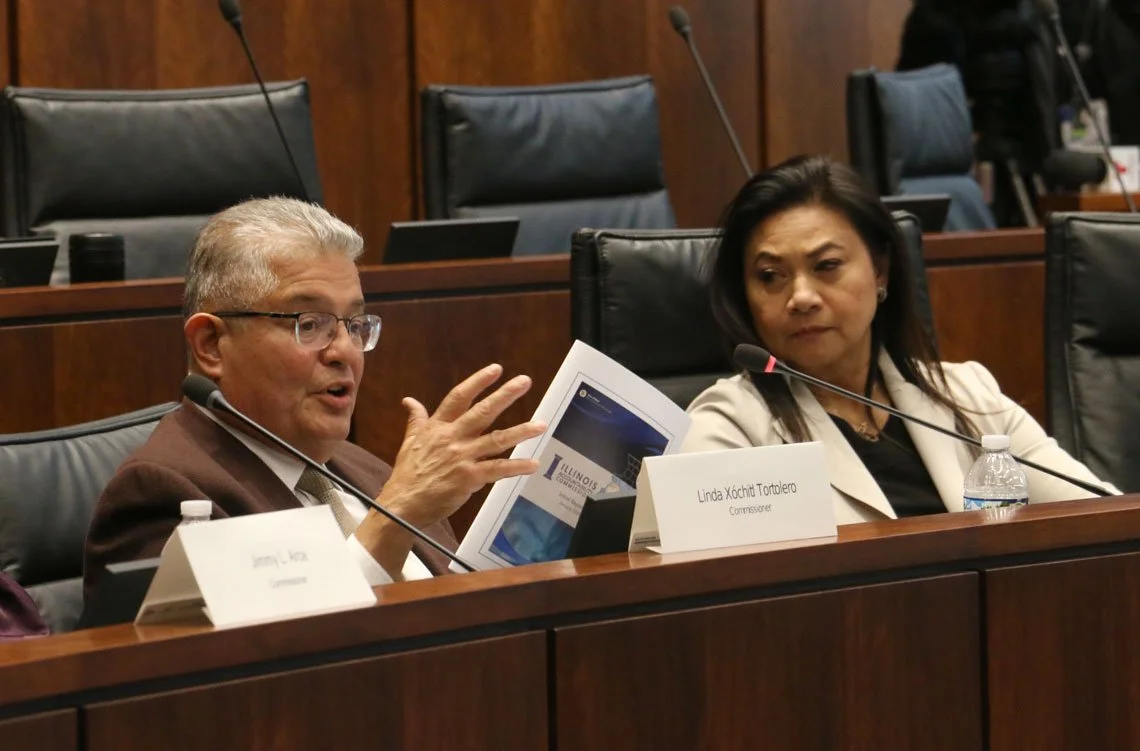
Illinois Accountability Commission Chair Judge Rubén Castillo holds up a copy of the commission’s initial report at its second public hearing in Chicago on Jan. 30, 2026. (Capitol News Illinois photo by Maggie Dougherty)

Jobless Rates Bump Up In December

New employment numbers show a rise in unemployment across southeastern Illinois in December.

According to the latest data, the Olney–Mt. Carmel region saw total nonfarm payrolls decline by about 400 jobs in December 2025, compared to December 2024.

The only sector posting job gains was Private Education and Health Services, which added 50 positions. Year-over-year, payroll totals remained unchanged in Information and Professional and Business Services.

Several industries experienced job losses, including Trade, Transportation and Utilities, down 100 jobs; Financial Activities, down 75; and Leisure and Hospitality, Manufacturing, and Natural Resources and Mining, each down 50 jobs. Additional losses were reported in Other Services, Construction, and Government.

County unemployment rates also increased over the year. Wabash County’s unemployment rate rose from 3.1 percent in December 2024 to 4.5 percent in December 2025. Edwards County saw a similar increase, climbing from 3.4 percent to 4.8 percent during the same period.

State labor officials note that seasonal factors and broader economic trends can influence year-end employment figures.