New SNAP work requirements go into effect Feb. 1, threatening recipient eligibility  

The requirements change which recipients must work or volunteer and how often

Article Summary

  • H.R. 1, or the One Big Beautiful Bill Act, signed into law last July, changes the work requirements for the federal food assistance program known as SNAP.

  • Starting Feb. 1, adults aged 18 to 64 without dependents under age 14 must work, participate in employment and training programs or volunteer at least 80 hours each month to receive benefits.

  • Officials from the Illinois Department of Human Services say over 300,000 Illinoisians who receive SNAP benefits could be affected.

This summary was written by the reporters and editors who worked on this story.

By JENNA SCHWEIKERT 
Capitol News Illinois 
jschweikert@capitolnewsillinois.com 

New work requirements for the Supplemental Nutrition Assistance Program go into effect Feb. 1, threatening benefits for hundreds of thousands of Illinoisians. 

Adults aged 18 to 64 without dependents under age 14 will be required to work, participate in SNAP Employment and Training programs or volunteer for at least 80 hours per month to receive benefits. Previously, only adults aged 18 to 54 without dependents under age 18 had to meet those requirements.

H.R. 1, known as the “One Big Beautiful Bill Act,” set these new SNAP requirements and made changes to many other federal programs when it was signed into law in July 2025. 

Up to 340,000 Illinoisians are at risk of losing their benefits with the new requirements, according to the Illinois Department of Human Services. Adults who do not meet the requirements can only receive SNAP benefits for up to three months in a three-year period.

As of September 2025, nearly two million Illinois residents were using SNAP benefits, according to the U.S. Department of Agriculture.

Two major changes to SNAP

Most SNAP recipients must meet general work requirements by applying for and accepting available work, participating in SNAP Employment and Training and not voluntarily quitting or reducing work hours below 30 a week without good reason.

Some recipients are automatically exempt from this requirement based on factors like age, while others must submit exemption forms if they meet other criteria like homelessness or certain health conditions.

A smaller group of SNAP recipients known as ABAWDs, or able-bodied adults without dependents, must meet further requirements if they are not exempt.

H.R. 1 made two major changes by modifying the definition of ABAWDS and implementing more work requirements for the newly defined population, ending Illinois’ long-term work requirement waiver for existing ABAWDs, according to IDHS.   

“Trump’s budget bill is designed to deliberately prevent Americans and Illinoisans from receiving assistance through the SNAP program by implementing new requirements that burden states and individuals who rely on this 100 percent federally funded benefits resource,” Summer Griffith, a spokesperson for IDHS said in a statement. 

SNAP recipients must also continue to update their income and household information to ensure they are receiving the correct benefits and meeting the applicable requirements.

“The Illinois Department of Human Services is communicating with SNAP participants regarding upcoming changes to SNAP and continues to provide support as people navigate new processes and changes imposed by the Trump Administration,” Griffiths said.

Capitol News Illinois is a nonprofit, nonpartisan news service that distributes state government coverage to hundreds of news outlets statewide. It is funded primarily by the Illinois Press Foundation and the Robert R. McCormick Foundation. 


Illinois sees its worst flu season in recent years as vaccine skepticism grows

The IDPH classified the state as having “very high” levels of flu, the most since 2009-10

By OLIVIA ARDITO

Medill Illinois News Bureau

news@capitolnewsillinois.com

Article Summary

  • Illinois is experiencing a severe flu season with outbreak zones popping up across the state. 

  • Peak flu season comes in February as January fatalities increase at a rapid rate to at least 100.

  • One cause for the high rate of cases, experts believe, is people distrusting vaccines and avoiding the flu vaccine altogether due to political pressure.

  • Illinois lawmakers recently passed a bill revising standards for residents, defying new lower federal vaccine recommendations.

CHICAGO — Flu cases are increasing rapidly in Illinois as the state sees its worst flu season in more than 15 years.

At least 100 people have died from the flu this season in Illinois, with 77 of those deaths occurring this month alone, according to the Illinois Department of Public Health. Children and the elderly have been the most-affected age groups. So far, there have been three pediatric fatalities in Illinois this flu season, IDPH reports. 

IDPH reported this month that flu activity in the state has climbed to “very high,” the most severe of five categories of respiratory illness, as defined by the U.S.Centers for Disease Control and Prevention. The 2009-10 season was the last time the state reached such high numbers of cases.

The public health department reported that for the week of Jan. 11-17, on average, 3% of all emergency department visits and 2.1% of hospital admissions were for the flu. The IDPH does not report a total number of cases. Additionally, 16.9% of flu tests, or 2,963 tests, done in a lab were positive for the flu. There were also 414 ICU admissions across the state for the flu.  

The height of flu season is typically from early to mid-February.  According to the IDPH, flu outbreaks are specifically growing in West Chicago, Bellwood, Rockford, Metro East, Peoria and Champaign. Additionally, the CDC reports that at least 230,000 people have been hospitalized for the flu nationwide, and the numbers continue to rise.

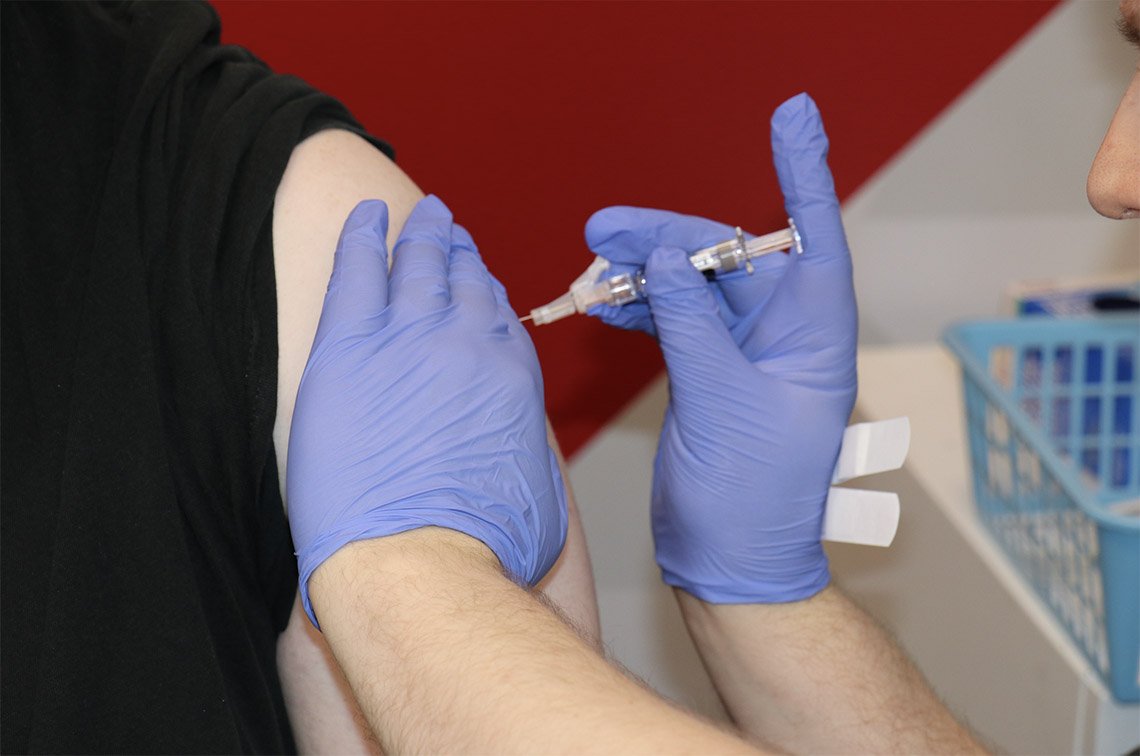
Dr. Taylor Heald-Sargent, an associate professor at Northwestern University who specializes in the cold and flu, vaccines, and pediatric illnesses, said one reason Illinois is having such a severe flu season is because fewer people are getting vaccinated against the flu. 

“We've definitely seen just overall vaccination rates decreasing for years,” Heald-Sargent said. “We just keep trying to remind people that vaccines are safe and effective, and they’ve been well-studied. And if you look back over the past century and a half, some of the biggest gains in modern medicine have been because of vaccines.” 

Two significant reasons people distrust the flu vaccine are that they may experience flu symptoms after receiving it, and sometimes people still get the flu after receiving the shot, according to Heald-Sargent. Another explanation for these feelings of distrust could be that people often forget that the goal of the flu vaccine is to prevent hospitalization, not to build complete and total immunity from the disease.  

Vaccines have become a political target instead of being solely a medical issue. Political conversations about vaccines became popularized by a study published by Andrew Wakefield in 1998 that connected the MMR vaccine to autism in children. This study has been proven to be false and has since been retracted from publication. Recently, vaccines have reentered the political zeitgeist due to U.S. Secretary of Health and Human Services Robert F. Kennedy Jr.’s policies.

A significant portion of Kennedy’s agenda has involved a large-scale overhaul and change to vaccine schedules and standards. Kennedy considers himself a long-time vaccine skeptic and hopes to restore public trust in vaccines through his changes. The most notable change so far has been the overhaul of the recommended vaccine schedule for children. Previously, federal standards recommended 18 vaccines for children, including the COVID-19 vaccine. The new standard cuts the recommended number of vaccines to 11. 

However, Illinois state legislators recently responded to these changes by passing House Bill 767 in early December. The bill allows Illinois to issue state-specific standards. State Sen. Dave Koehler, D-Peoria, a sponsor of the bill, said the changes look very similar to the standards Illinois had before Kennedy took office and initiated his new protocol. 

“Robert F. Kennedy Jr. has made a mockery of all that DHS should stand for,” Koehler said. “When the federal government fails, we as a state have to fill in the gaps and make sure that people have the right kind of information. We show that government actually cares and wants to provide them scientifically sound information.” 

Koehler advised Illinoisans not to turn to the internet or to the federal government, but to listen to one’s own trusted doctor for medical advice. 

“(House Bill 767) was the governor and the legislature’s attempt to say, ‘Look, we need to have the professionals, the doctors, the people who actually understand this stuff provide the public with information that is sound and that people want,’” Koehler said. 

To handle such rapidly spreading diseases like the flu, physicians like Heald-Sargent suggest taking as many precautions as possible: Avoid large crowds, stay home when sick, wash your hands well, and talk to your doctor if you get a virus. 

“Once you get a virus, while there are antiviral medications … they’re not as great as boosting up your immune system ahead of time through giving your immune system practice, and that is what a vaccine is — your immune system getting some training on how to respond,” Heald-Sargent said. 

Olivia Ardito is a graduate student in journalism with Northwestern University’s Medill School of Journalism, Media and Integrated Marketing Communications, and is a fellow in its Medill Illinois News Bureau working in partnership with Capitol News Illinois.  

Capitol News Illinois is a nonprofit, nonpartisan news service that distributes state government coverage to hundreds of news outlets statewide. It is funded primarily by the Illinois Press Foundation and the Robert R. McCormick Foundation.


Commissioners Hear Update On County's 911 System

Wabash County 911 Director Kyle Smith has updated the County Board on an issue involving the county’s phone system and power outages.

Smith explained that when the police department upgraded its phone system, it made financial sense to tie into the county’s existing system at the courthouse. However, he noted a major concern — the courthouse is not connected to a generator. During power outages lasting more than an hour, the phone system relies on backup batteries, and staff have had to run an extension cord from the jail to the courthouse basement to keep the system operating.

Smith told board members that situation is not ideal, especially for emergency communications. He asked for permission to explore moving the phone system to the police department, which is supported by a generator, and to gather cost estimates for the change.

According to Smith, Midwest Communications estimated their portion of the work at around one thousand dollars, while Clearwave indicated there may be no cost involved. He added that relocating the system would benefit the county by providing more reliable backup power and eliminating the need for temporary fixes during outages.

The County Board approved a motion allowing Smith to continue exploring the project and obtaining quotes. No funding request was made at this time.

WGH Board Moves Forward With $75 Million Expansion Project

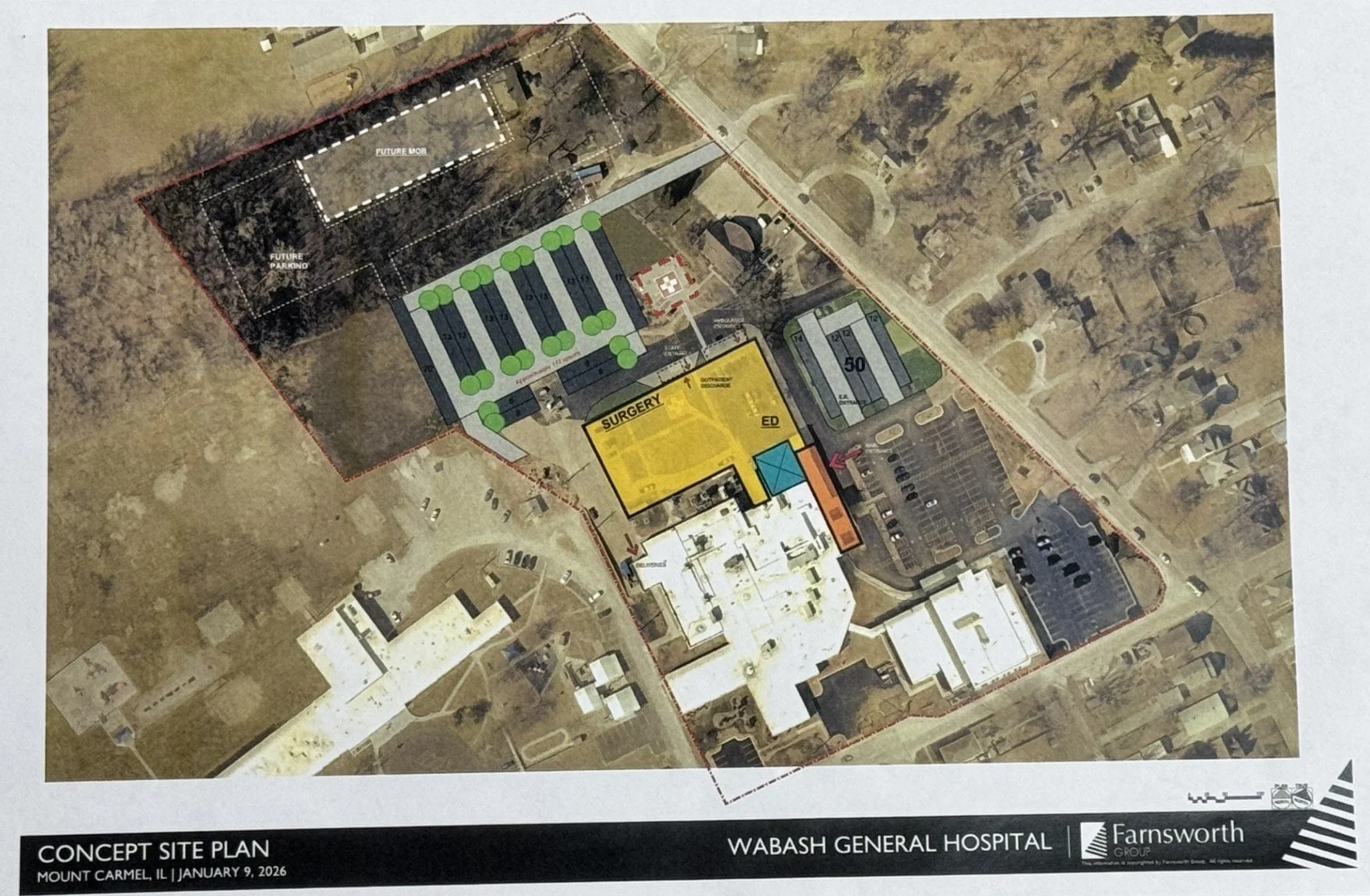
As Wabash General Hospital starts to celebrate serving the community for 75 years this year, the Wabash General Hospital Board of Directors has approved moving forward with planning for a major campus expansion.  During a special meeting Monday, the board voted to advance a proposed $75 million building plan, marking the largest construction project in the hospital’s history.  This planning approval does not authorize construction.  A project of this complexity has several design and permitting steps, including a Certificate of Need permit from the Illinois Health Facilities Services and Review Board, before it can officially proceed. 

Hospital President and CEO Karissa Turner noted the timing is especially meaningful, as 2025 marks Wabash General Hospital’s 75th anniversary.  Turner said planning for campus improvements began several years ago, dating back to 2018 and 2019, when hospital leadership identified growing needs in several departments. She pointed out that parts of the facility — including the medical-surgical unit and emergency department — have not seen major renovations in decades, despite continued growth.

The hospital now employs more than 650 people, and Turner said the project represents an investment in both staff and the community’s future.

Vice President of Project Management and Infrastructure Nate Stevenson, who has led the project for the past year, outlined a phased construction approach designed to limit disruptions to patient care.  Stevenson explained that early concepts approached $100 million, but revisions and phased planning reduced the recommended project cost to approximately $75 million, with construction expected to take several years.

Hospital officials emphasized that detailed floor plans are still being developed and that the current designs reflect a high-level framework rather than final layouts.

Until the project is further along in design and permitting, including the Certificate of Need permit, no formal timeline will be set.  The next phase of design is expected to take 12 months.  Routine progress updates will be presented to the Hospital Board of Directors.  Construction would be staged to keep hospital services operating throughout the project.  Planning for this investment into our community reflects Wabash General Hospital’s long-standing commitment to providing high-quality care close to home. 

Girl Scout Cabin For Sale

The Mt. Carmel City Council has approved moving forward with a request for proposals to sell the former Girl Scout cabin located at First and Walnut Streets.

City Clerk Ryan Turner discussed the issue during last week’s City Council meeting, explaining that the city has been exploring options for the excess property and has received interest from a group looking to purchase the building. Turner said the city worked with a firm from the Metro East area to develop a formal Request for Proposal, or RFP, in compliance with state law.

Under the proposal process, the property will be offered without a set sale price, allowing interested parties to submit packets outlining their proposed purchase price and intended use for the building. Turner said the council will review each proposal and has the option to accept or reject any or all submissions.

Turner noted that any proposed use must meet specific criteria, including retail or commercial use, encouraging pedestrian activity and community engagement, being family-friendly and publicly accessible, and fitting the scale and character of the surrounding area. Private clubs or organizations would not qualify under the guidelines. The property being sold does not include the bluff adjacent to the cabin.

The council agreed to allow 45 days for interested parties to submit proposals, giving potential buyers time to inspect the property and prepare detailed plans. The motion to issue the request for proposals was approved by a roll call vote.

Once proposals are received, the City Council will review them and consider next steps at a future meeting.

WSJD File Photo

Duck hunters rescued after boat freezes in river

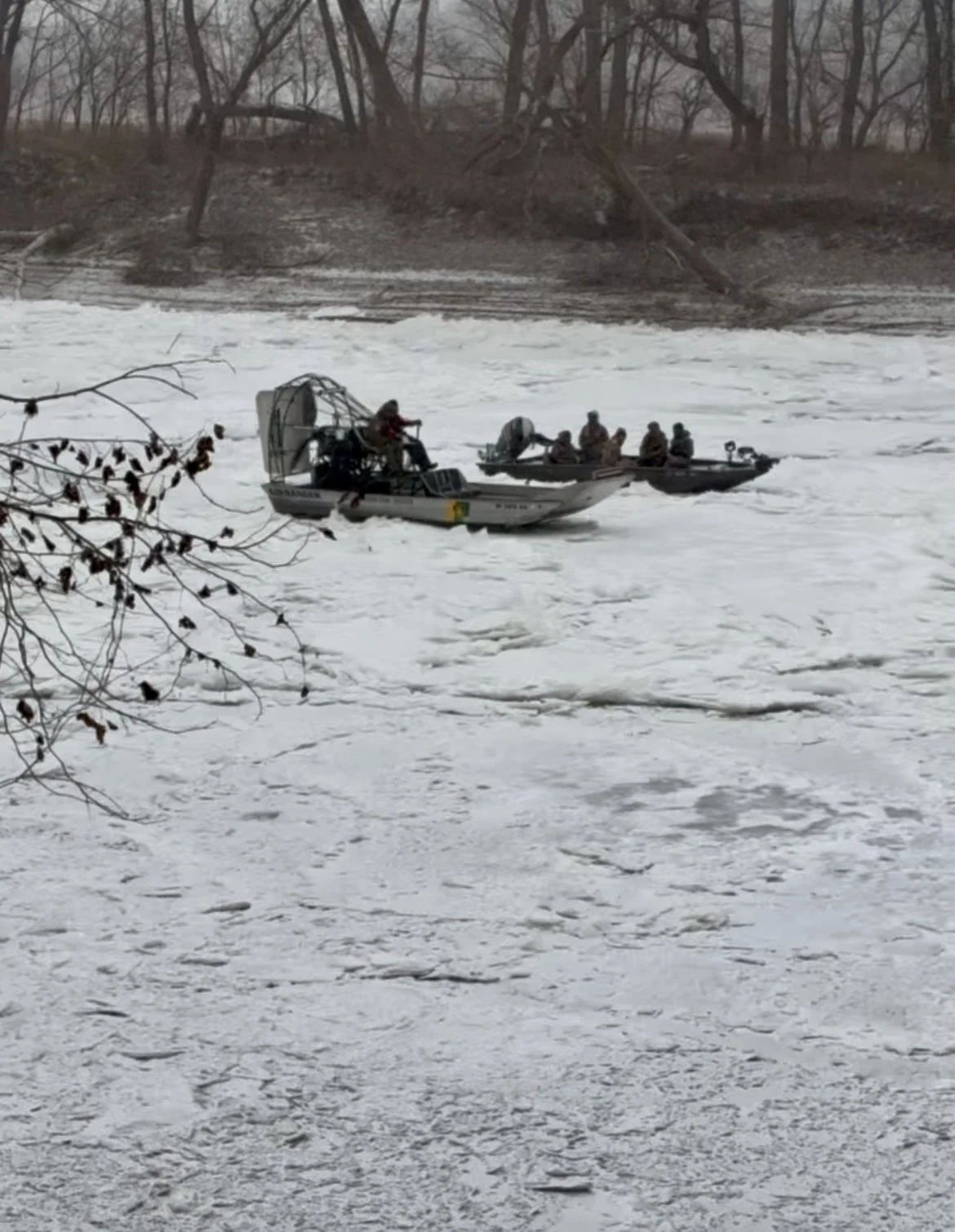
Indiana Conservation Officers responded to a call for help on the White River on Saturday and rescued five hunters after their boat froze into the White River near Haysville.

At 11:37 a.m., officers responded to the call for help just east of the Haysville bridge.

Under weather conditions of 12 degrees and snow, with that area of the river nearly frozen from bank to bank, officers deployed an airboat, reached the hunters, and brought them safely to shore.

Other responding agencies included the Dubois County Sheriff’s Department, Dubois County Emergency Medical Services, Haysville Fire Department, and Luce Township Fire Department (Spencer County). 

MCPU Issues Update On Rising Natural Gas Prices

As Mt. Carmel continues to dig out from the winter storm, residents are being warned to prepare for higher heating bills.

In a Monday Facebook post, Mt. Carmel Public Utility Company says the massive national impact of the storm has driven natural gas prices higher across the country. As a result, customers who heat with natural gas should expect above-average heating bills for the end of January and into February.

MCPU is encouraging customers to conserve energy when possible, to help reduce the impact of rising natural gas costs.

Utility officials say customers who are struggling to keep up with higher heating bills are urged to contact Mt. Carmel Public Utility as soon as possible. Assistance and payment options may be available by calling 618-262-5151 or the toll-free number 1-877-262-7036.

Additional help may also be available through the Low-Income Home Energy Assistance Program, known as LIHEAP. Wabash County residents can contact Wabash Area Development Incorporated at 618-262-4151, while Lawrence County residents should contact Embarras River Basin Agency at 618-943-2938.

Officials say reaching out early can help residents stay warm and avoid service interruptions as extreme cold continues across the region.


Princeton man arrested for driving on suspended license

On January 24, 2025, at 10:46 p.m. Gibson County Deputy Levi Sims conducted a traffic stop on a Silver 2006 Mitsubishi hatchback in the 300 block of South Main Street in Princeton.  Upon approaching the vehicle Deputy Sims confirmed the identity of the driver as 44-year-old Christopher McGillem of Princeton, who he knew was suspended on a prior driving while suspended conviction.  After a brief investigation Mr. McGillem was taken into custody and transported to the Gibson County Detention Center where he was charged with Driving While Suspended Prior. 
 
Deputy Michael Bates and Princeton Sgt. Ben Kiesel assisted in this investigation.
 
All criminal defendants are to be presumed innocent until and unless proven guilty beyond a reasonable doubt in a court of law.

Elwood, Indiana teen arrested for OWI

On January 25, 2026, at 3:36 a.m. Gibson County Deputies were dealing with a stranded motorist in the construction on US 41 near County Road 100 West.  While deputies were attending the motorist who had the only lane of travel blocked Sgt. John Fischer was at the beginning of the construction area, stopping traffic.  While Sgt. Fischer was stopping traffic, a White 2025 Ram truck passed Sgt. Fischer’s fully marked vehicle that was actively displaying its red and blue emergency lights.  As the vehicle made its way to the stranded vehicle Deputy Michael Bates stopped the vehicle for disregarding an emergency vehicle.  Upon approaching the vehicle Deputy Bates detected obvious signs of impairment coming from the driver 18-year-old Gabriel Rogers of Elwood, Indiana.  At that point Deputy Bates began a roadside OWI investigation which ultimately lead to Mr. Rogers being taken into custody and transported to the Gibson County Detention Center.  Upon arriving at the detention center Mr. Rogers was charged with Operating a Vehicle While Intoxicated-Endangerment, Possession of a Schedule II Substance, and Minor Possession of an Alcoholic Beverage. 
 
Arresting Officer Michael Bates was assisted in his investigation by Deputies Levi Sims and John Fischer. 
 
All criminal defendants are to be presumed innocent until and unless proven guilty beyond a reasonable doubt in a court of law.