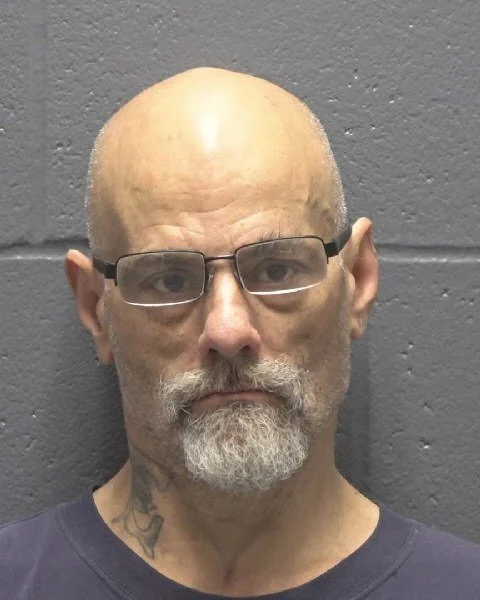
On December 31, 2025, at 1:33 p.m. Gibson County law enforcement officers went to 788 South 1150 East to serve a failure to appear warrant on 53-year-old Dennis McCloskey. Upon arriving at the residence, they spoke with 58-year-old William Pope about the outstanding warrant for Mr. McCloskey. While speaking with Mr. Pope he gave false information to Deputy Eric Powell to hinder the warrant service. After a brief investigation Mr. McCloskey was taken into custody without incident. Mr. Pope was also taken into custody, and both were transported to the Gibson County Detention Center. Upon arriving Mr. McCloskey was booked in on his outstanding warrant and Mr. Pope was charged with False Informing.
Deputy Powell was assisted in this warrant service by Deputy Quinten Might as well as Oakland City Police Officers Ty Schmittler and John Pace.
All criminal defendants are to be presumed innocent until and unless proven guilty beyond a reasonable doubt in a court of law.

Ring in the New Year on safe, sober note if you are getting behind the wheel
SPRINGFIELD – The Illinois Department of Transportation, Illinois State Police and law enforcement agencies throughout the state are joining forces to increase patrols focused on impaired drivers, seat belt violations, distracted driving and speeding as 2025 comes to a close. Whether you’re traveling a short or long distance the goal is for everyone to arrive to their destination and kick off 2026 safely.
“Don’t ever drive if you’ve been drinking alcohol, using cannabis or any other drugs. Getting behind the wheel if you’re impaired can ruin your life and others,” said Stephane B. Seck-Birhame, IDOT’s bureau chief of Safety Programs and Engineering. “Make the smart decision and designate a sober driver.”
According to IDOT provisional data, through Dec. 18 of this year, 1,123 people have lost their lives in fatal crashes in Illinois, 10 fewer than during the same period in 2024.
“Almost all fatal crashes are preventable,” said ISP Division of Patrol Col. Chris Owen. “End 2025 and begin 2026 on a safe note. Always wear your seatbelt, don't speed and don't drive impaired or distracted.”
Some important tips to avoid a tragedy or an arrest:
If it’s your turn to be the designated driver, take that role seriously – your friends and family are relying on you.
Use your community’s sober ride program if available, call a cab, use your favorite ride-sharing app or transit.
See a friend or family member who is about to drive impaired by alcohol, cannabis or drugs? Take the keys and plan to get them home safely.
The increased enforcement is made possible through federal funds administered by IDOT and supported by ISP and local law enforcement. The effort coincides with IDOT’s “It’s Not a Game” radio, digital and TV campaign, which reminds the public of the consequences of impaired driving as well as distracted driving, work zone safety, pedestrian safety, motorcycle awareness and occupant safety. Visit itsnotagameillinois.com for more information.
Coroner Identifies Victim in Fatal Train-Pedestrian Incident
Wabash County Coroner Shaun Keepes has identified the individual killed in a train-pedestrian incident at the railroad crossing near 3rd Street and Poplar Street as Nicholas Ted Esten Lamar, age 35, of Mount Carmel.
The incident occurred on December 27 at approximately 2:46 p.m.
The Wabash County Coroner’s Office was assisted at the scene by the Mount Carmel Police Department, Wabash Emergency Management Agency, Mount Carmel Fire Department, and the Illinois State Police.
The incident remains under investigation. No further information will be released at this time.
35 Year Old Dead After Being Hit By Train
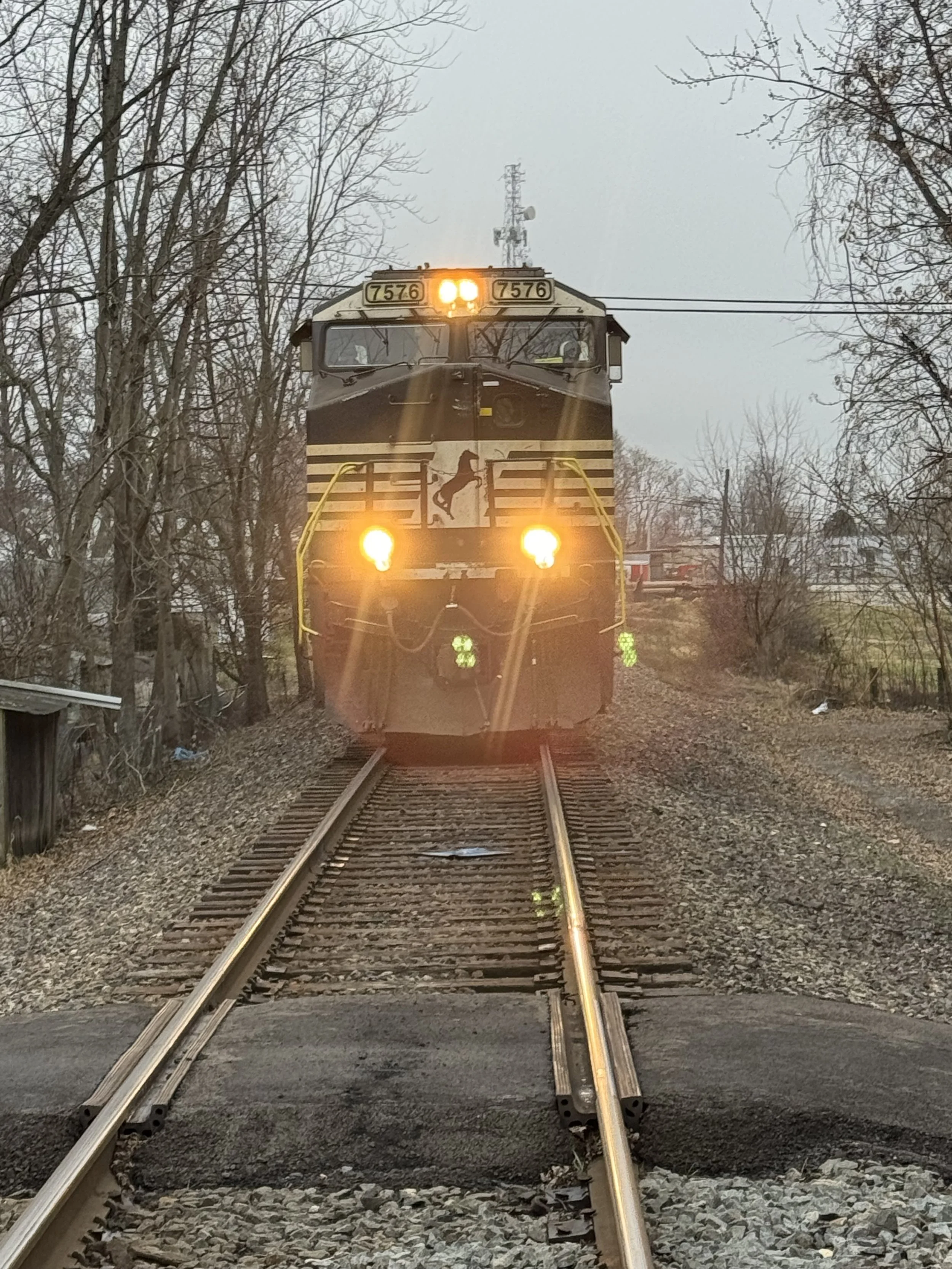
On 12/27/25, at approximately 2:46 p.m, Mt. Carmel Police responded to a pedestrian versus train accident at the 3rd and Poplar Street railroad crossing. Officers, along with responders from the Mt. Carmel Fire Department and the Wabash General Ambulance Service arrived on scene to find a white male subject deceased from the impact. According to witnesses, the male subject was walking south on the tracks when the incident occurred, just south of this crossing. The Wabash County Coroner’s Office was contacted and began a death investigation along with MCPD. The male was later identified as a 35 year old individual, whose identity will be released pending notification to his family. The Wabash County Coroner’s Office will release further information on Sunday. MCPD was also assisted by the Wabash Emergency Management Agency and the Illinois State Police. No further information will be released at this time.
District #348 December Personnel Matters
The Wabash Unit School District 348 Board of Education took action on several personnel items during its regular December monthly meeting.
The board accepted a number of resignations, including Heather Borowiak, technology teacher at Mount Carmel Junior High School, effective November 25th.
At Mount Carmel High School, resignations were approved for Eden Wankel, assistant girls’ track coach; Trevor Kennard, assistant boys’ track coach; and Anthony Peach, assistant baseball coach — all effective November 20th.
The board also accepted the resignation of Jamie Tolliver, part-time cook at Mount Carmel Grade School, effective November 19th, and Heidy Wankel, individual assistant at MCGS, effective December 19th.
In other personnel matters, the board approved the retirement of Chris Pitzer, nurse and secretary at Mount Carmel Junior High School, effective at the end of the 2025–2026 school year.
Two certified hires were also approved. Allyson Bunting was hired as a special education teacher at Mount Carmel Grade School, and Leslie Bell as a special education life skills teacher at Mount Carmel Elementary School, both beginning January 5th.
In non-certified action, the board approved Hollie Stuessell as the district’s new head cook, beginning January 5th.
#348 School Board Approves Audit
The Wabash Unit School District 348 Board of Education has approved its annual financial audit. During this month’s meeting, Michelle Smith with Kemper CPA presented the district’s audit report to board members. Smith explained the district received an unmodified audit opinion, meaning the financial statements are accurate and properly presented under the regulatory basis of accounting, a change from prior years when reports were prepared using generally accepted accounting principles.
Smith noted the district’s overall assets decreased by about 54-thousand dollars, largely due to a decline in cash balances, while property and equipment values remained relatively steady. Liabilities were also down, primarily because there were no major construction projects outstanding at the end of the fiscal year.
On the revenue side, Smith reported district revenue was down approximately 2.5 million dollars, largely due to the expiration of federal COVID-related grants, including ESSER funds. Expenses increased by about 845-thousand dollars, driven mainly by higher costs for salaries, insurance, supplies, and repairs.
The audit also included an 8.3 million dollar restatement of the district’s beginning net position, largely related to changes in pension reporting requirements.
Smith told the board the audit produced no findings, marking another year without any significant issues. A minor internal control recommendation was included regarding documentation of journal entry reviews, but no material weaknesses were identified.
Following the presentation, the board voted to approve the audit.
New laws: Illinois expands job-protected leave for parents with newborns in NICU
Laws also address AI in hiring, workplace transparency, organ donation leave, more
By BRENDEN MOORE
Capitol News Illinois
bmoore@capitolnewsillinois.com
Article Summary
People who work for employers of between 16 and 50 people will get up to 10 days of unpaid leave if they have a newborn in neonatal intensive care. Larger employers have to offer up to 20 days.
Another measure prohibits use of AI in employment decisions such as recruitment, hiring and promotion if that use results in discrimination due to race, religion, sex and age.
Paid time off will be extended for those participating in a military funeral honors detail. And part-time workers will get paid leave to serve as organ donors.
This summary was written by the reporters and editors who worked on this story.
Illinois workers with a newborn in a neonatal intensive care unit will soon have additional access to job-protected, unpaid leave.
Gov. JB Pritzker signed House Bill 2978, dubbed the Family Neonatal Intensive Care Leave Act, earlier this year and it takes effect Jan. 1. It requires employers of between 16 and 50 workers to provide up to 10 days of unpaid leave to employees who have a child in the NICU. Larger employers must provide up to 20 days.
The law applies to both part- and full-time workers. It covers a broader swath of workers than the federal Family and Medical Leave Act — the law requiring public agencies, K-12 schools and private companies with at least 50 employees to provide up to 12 weeks of unpaid leave per year. Workers eligible for FMLA must exhaust that leave first before utilizing NICU leave.
Employers covered under the law must maintain their employee’s health insurance benefits and guarantee their reinstatement upon the conclusion of leave. Employers can’t force workers to exhaust their paid leave instead of unpaid NICU leave, though employees can take it if they choose.
Violations may result in fines of up to $5,000.
Here are some other new labor laws that take effect in 2026.
AI in employment decisions
An amendment to the Illinois Human Rights Act, House Bill 3773, prohibits use of AI in employment decisions such as recruitment, hiring and promotion if that use results in discrimination due to race, religion, sex and age.
The law, which goes into effect Jan. 1, will require employers to disclose use of AI in employment decisions. The measure, however, could potentially run afoul of a recent order that limits how states can regulate AI.
Documenting domestic violence
House Bill 1278 prevents employers from disciplining employees for using work devices to document domestic violence, sexual violence, gender violence or other forms of violence against them or a family member. Employers also have to grant employees access to such documentation and communications stored on the devices.
The law was inspired by a New York woman who used her work device to document domestic abuse committed by her husband. She was disciplined by her employer and later murdered by her husband.
Workplace transparency
House Bill 3638 amends the Illinois Workplace Transparency Act to broaden the definition of “unlawful employment practice” to include any act prohibited by the Illinois Human Rights Act, the federal Civil Rights Act and any other state or federal law covering employment issues.
Employment contracts can also no longer include terms that limit an employee’s ability to engage in “concerted activity” like collective bargaining. And it prohibits contract stipulations that shorten the statute of limitations for employee claims, apply the law of another state to claims or require claims be resolved outside Illinois.
Paid leave for organ donors
House Bill 1616 extends paid leave requirements for organ donors to part-time employees.
Under the law, workers can use up to 10 days leave per year to serve as an organ donor. Part-time workers’ pay for these days will be their average daily pay rate over the previous two months.
Military honors
Under Senate Bill 220, employers with more than 50 workers must offer up to eight hours of paid leave per month — capped at 40 hours per calendar year — for employees to participate in a military funeral honors detail. It is in addition to regular paid time off.
Unemployment benefits
House Bill 3200 allows for someone who voluntarily leaves their job for mental health reasons to be eligible for unemployment benefits. It is a three-year pilot program that sunsets Dec. 24, 2028.
Maggie Dougherty contributed to this report.
Capitol News Illinois is a nonprofit, nonpartisan news service that distributes state government coverage to hundreds of news outlets statewide. It is funded primarily by the Illinois Press Foundation and the Robert R. McCormick Foundation.

The Illinois State Capitol is pictured in Springfield. (Capitol News Illinois photo by Jerry Nowicki)
Mayor Seeks Volunteers For Local America 250 Committee
At Monday’s Mount Carmel City Council meeting, Mayor Joe Judge announced plans to begin organizing the city’s America 250 celebration.
On July 4th, 2026, the nation will mark the 250th anniversary of the signing of the Declaration of Independence. Mayor Judge said the milestone offers a chance to reflect on America’s past, honor the contributions of all Americans, and look ahead to the future being created for the next generation and beyond.
To prepare for the celebration, the mayor says the city will form an America 250 Celebration Board. Judge is accepting applications from community members interested in serving on the board.
He says the city is looking for four to six people to help develop ideas and work with local organizations to plan events centered around the July 4th timeframe in 2026.
More information on how to apply is expected to be released soon.

City Council Expands TIF VII
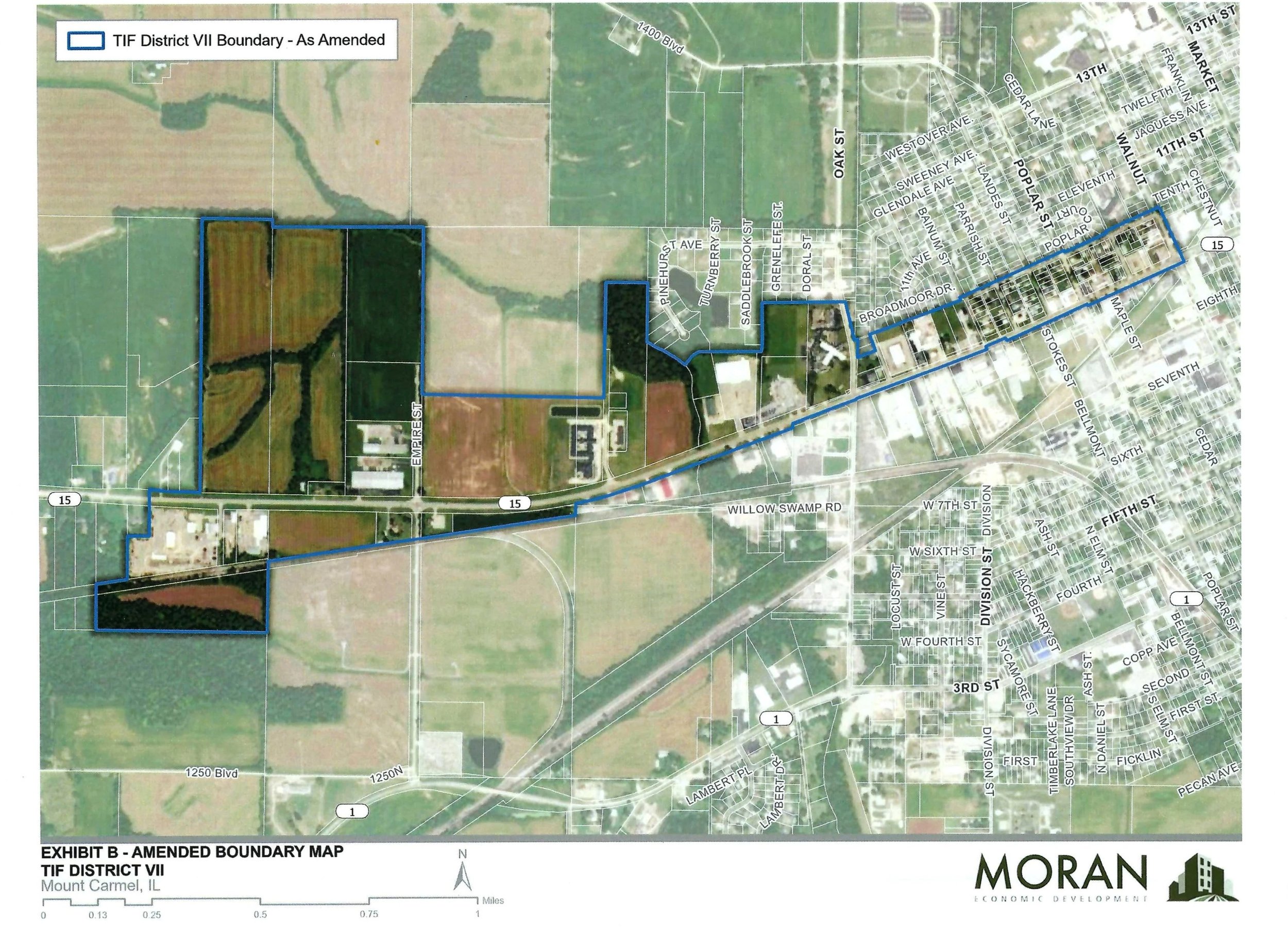
The Mount Carmel City Council has approved a series of ordinances moving forward with the city’s Tax Increment Financing District 7, commonly referred to as TIF VII.
At Monday meeting, City Clerk Ryan Turner explained the ordinances finalize months of discussion involving an expansion of the city’s corporate limits and the TIF district. Council first approved an ordinance annexing approximately 41 acres of land west of Mount Carmel into the city limits. The council waived a second reading, citing that a public hearing had already been held on the matter.
Following the annexation, council members approved additional ordinances amending and expanding TIF District VII to include the newly annexed property. The measures also added additional parcels to the existing TIF and adopted an amended redevelopment plan for Area VII, as required by the state.
All ordinances were approved unanimously by roll call vote, with second readings waived for each item.
City officials say the final approvals will now be filed with the state, allowing the city to move forward with development projects and funding opportunities within the expanded TIF VII area.
New laws: Illinois’ grocery tax to end, aquifer protections begin
Bills regulating reservation apps, single-use plastics to take effect Jan. 1
By BEN SZALINSKI
& BRENDEN MOORE
Capitol News Illinois
news@capitolnewsillinois.com
Article Summary
Nearly 300 Illinois laws will take effect on Jan. 1, 2026.
Illinois’ 1% statewide grocery tax will be eliminated, but more than half the state’s cities and towns have passed an ordinance establishing their own grocery tax.
Small single-use plastic toiletry bottles will be phased out in hotels, police will be able to remove squatters from a person’s residence even without a court order and carbon sequestration will be banned in the footprint of a sole-source aquifer, among other laws taking effect.
This summary was written by the reporters and editors who worked on this story.
Illinois’ statewide 1% grocery tax will go away on Jan. 1, though many people will continue to pay it at the local level.
Data compiled by the Illinois Municipal League shows that 656 municipalities — a little more than half of the state’s municipalities — have passed an ordinance establishing their own grocery tax. Those communities are home to 7.2 million people, or 56.5% of the state’s population. Three counties — Washington, Wabash and Moultrie — have also approved countywide grocery taxes.
Read more: More than half of Illinois communities have enacted a local grocery tax
Gov. JB Pritzker signed a bill in 2024 eliminating the 1% statewide grocery tax, which he touted as a measure to ease residents’ tax burden. But because the revenue from the state grocery tax went to municipal governments, rather than state coffers, the measure allowed local governments to levy their own 1% tax via ordinance, rather than a referendum to voters.
Here are some other laws that will take effect in the new year:
Hotel soaps phased out
The phase-out of small, single-use plastic bottles in Illinois hotel rooms continues.
Senate Bill 2960, passed and signed into law in 2024, bars hotels from providing toiletries such as shampoo, conditioner and bath soap in less than six-ounce plastic containers unless specifically requested by the hotel guest.
The ban took effect in hotels with 50 or more rooms on July 1 and takes effect for all hotels starting in 2026. Hotels in violation will receive a written warning for the first offense and be subject to fines of up to $1,500 for each subsequent violation.
The legislation is intended to spur the state’s hospitality industry to reduce its plastic footprint by shifting to either refillable toiletry containers or larger plastic bottles.
Similar laws have been enacted in states like California, New York and Washington.
Squatter removal
Senate Bill 1563 will make it easier for authorities to remove squatters who are illegally staying at someone else’s residence.
The law clarifies that a court-ordered eviction is not required for police to remove squatters from a person’s home, and police can enforce criminal trespassing charges against a squatter.
Read more: Following state rep’s encounter, Pritzker signs ‘squatter bill’ into law
Pritzker signed the bill in July after squatters moved into a home next door to Rep. Marcus Evans in Chicago. According to ABC-7, Chicago Police told homeowners they couldn’t remove the squatters from the home and the homeowners would have to go through the eviction process in Cook County court, which can take months.
Drinking water protections
Senate Bill 1723 bans carbon sequestration — the process of capturing and storing carbon by injecting it underground — within an area that "overlies, underlies, or passes through" a U.S. Environmental Protection Agency-designated sole-source aquifer.
The new law applies to the footprint of the Mahomet Aquifer, which is the main source of drinking water for more than 500,000 people across a 15-county area in central Illinois.
It comes as Illinois, especially downstate, is targeted for carbon sequestration projects due to the state’s favorable geology and the availability of federal tax credits.
Studies, including those conducted by researchers at the University of Illinois, have found minimal risk to water sources from sequestration activity.
But the legislation was a priority for central Illinois community activists, environmental advocates and a bipartisan cadre of local lawmakers with zero risk tolerance due to the lack of a clear alternative water source if the aquifer were tainted.
Safer gear for firefighters
Illinois will take first steps towards requiring safer gear for firefighters.
Under House Bill 2409, manufacturers of firefighter turnout gear starting in 2026 must provide written notice if their products contain PFAS, also known as “forever chemicals.”
Numerous scientific studies have linked exposure to PFAS to an increased risk of developing various forms of cancer.
Manufacturers will be banned from selling turnout gear and personal protective equipment containing PFAS altogether starting on Jan. 1, 2027.
Lift-assist fees
House Bill 2336 allows municipalities or fire districts to charge assisted living facilities or nursing homes for calls to fire departments requesting help lifting a resident when it is not an emergency.
The bill was an initiative of the Illinois Municipal League, which argued the calls to fire departments for the nonemergency service are a burden on local governments and shift liabilities for injuries that happen during the process to fire departments rather than the facility.
Stadium funding
Senate Bill 2772 adds women’s professional sports to the types of facilities the Illinois Sports Facilities Authority can oversee. Current law only allows the ISFA to oversee sports facilities for baseball, football and auto racing.
The bill is not designed to move any team’s stadium proposals forward, though the Chicago Stars women’s soccer team has previously been reported to be interested in building a new stadium with help from state funding.
The bill was the only one related to sports stadium funding that advanced in Springfield in 2025. The Chicago Bears committed earlier this year to building a stadium in Arlington Heights but are still waiting for approval from the village and struggling to find support in Springfield for funding.
Public official privacy
House Bill 576 allows state lawmakers, constitutional officers and state’s attorneys, among others, to request that their personal information be redacted on public websites.
Public officials would be able to use their campaign funds to pay for personal security services and security upgrades to their home, including security systems, cameras, walls, fences and other physical improvements.
Rewilding
House Bill 2726 allows the Illinois Department of Natural Resources to implement rewilding as a conservation strategy for the state.
This could entail the restoration of land to its natural state and the reintroduction of native species, especially apex predators and keystone species like bison and beavers.
Illinois is believed to be the first state to codify the strategy into law.
Reservation app regulations
State lawmakers voted this year to crackdown on third-party restaurant reservation apps.
House Bill 2456 prohibits third-party reservation services from selling reservations without a restaurant’s permission. Restaurants are still allowed to partner with the services.
Paid time off to pump breast milk
Senate Bill 212 mandates employers to compensate mothers who take breaks at work to pump breast milk for up to a year after their child is born. The bill prohibits employers from requiring employees to use paid leave time for pumping.
Naloxone in libraries
House Bill 1910 requires that libraries maintain a supply of opioid overdose medication, like naloxone. This drug is often administered through a nasal spray like Narcan. The law also requires that at least one staff member be trained to identify overdoses and administer the drug.
Police training on sexual assault
Senate Bill 1195, also known as Anna’s Law, requires police officers in training to participate in trauma-informed programs, procedures and practices that are designed to reduce trauma for victims. The bill is named after Anna Williams, a suburban resident who brought the initiative to lawmakers following her own experience with a sexual assault investigation. The bill takes effect in January.
Predatory towing
Senate Bill 2040 gives the Illinois Commerce Commission new powers to punish predatory towing companies which sometimes tow cars under false pretenses only to charge drivers afterwards. The ICC-backed law allows the agency to revoke towing licenses, impound tow trucks and more.
Jerry Nowicki contributed to this story.
Capitol News Illinois is a nonprofit, nonpartisan news service that distributes state government coverage to hundreds of news outlets statewide. It is funded primarily by the Illinois Press Foundation and the Robert R. McCormick Foundation.
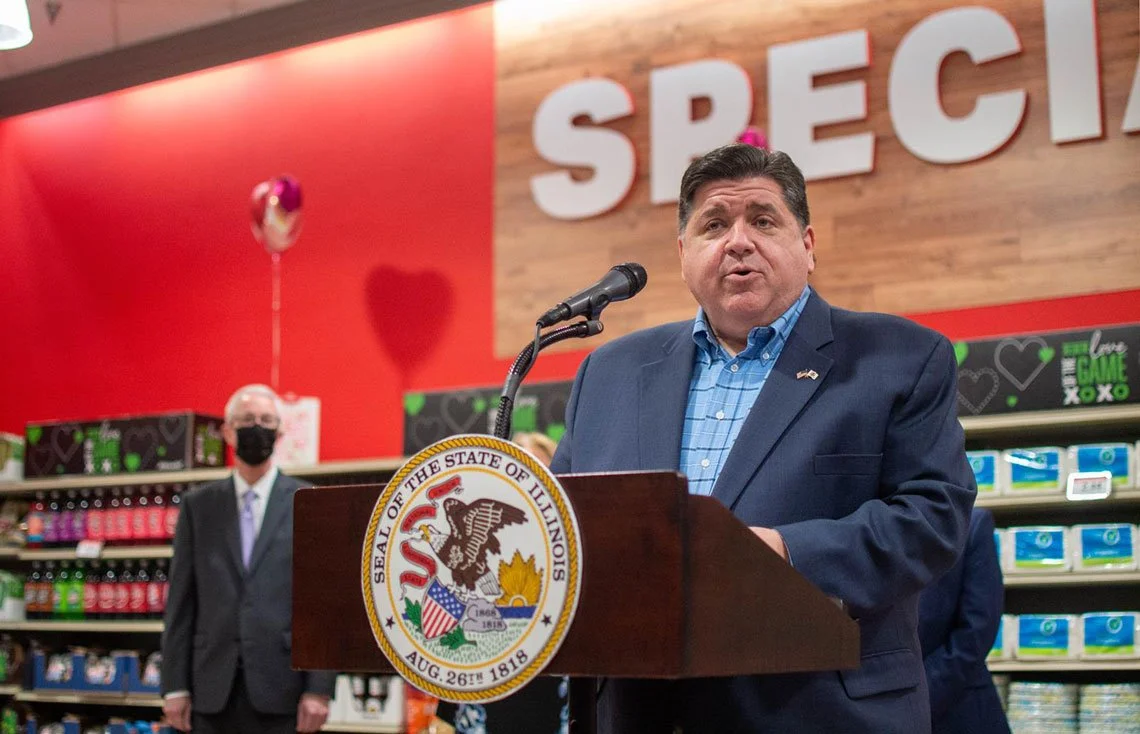
Gov. JB Pritzker speaks at a Springfield grocery store in 2022 in favor of temporarily eliminating the state’s grocery tax. Four years later, the tax will end permanently, at least statewide. (Capitol News Illinois file photo by Jerry Nowicki)