Today is the last day for candidates to run in next year’s election in Illinois. In Wabash County, county clerk Janet Will is the only candidate with a petition yet to file. But, Will told WSJD that she will file her nominating petition today. The long time county clerk will face a challenge next year from Republic Sean Morgan who filed his papers last week. The other contested race will be for the county commissioner seat currently held by Scott West. Filing last week were Mary Sweppy, Missy Judge, David S. Brown, and Jayden Pettyjohn. Treasurer Angela Broster and Sheriff J. Derek Morgan have both filed for re-election and will be unopposed next year barring a last minute filing from another candidate. Petitions can still be picked up and then filed in the county clerk’s office. The primary election is March 17th and the general election is next November 3rd.
Illinois lawmakers approve ban on civil immigration arrests in state courthouses
After weeks of criticizing federal immigration raids, state lawmakers took legislative action
By BRENDEN MOORE
Capitol News Illinois
bmoore@capitolnewsillinois.com
Article Summary
State lawmakers worked behind the scenes for weeks to craft a package to respond to the federal immigration campaign known as “Operation Midway Blitz.”
Civil immigration arrests would be barred inside state courthouses and within a 1,000-foot buffer zone outside of the buildings.
The legislation, among other provisions, would also allow Illinois residents to sue immigration agents who violate their constitutional right to due process and protection against unreasonable searches and seizures.
This summary was written by the reporters and editors who worked on this story.
SPRINGFIELD — After weeks of verbally condemning the aggressive federal immigration crackdown in the Chicago region, Illinois lawmakers approved legislation banning civil immigration arrests in and around state courthouses early Friday morning.
House Bill 1312, among other provisions, would also allow Illinois residents to sue immigration agents who violate their constitutional right to due process and protection against unreasonable searches and seizures.
It heads to Democratic Gov. JB Pritzker’s desk after clearing the Illinois Senate 40-18 and the Illinois House 75-32 in the waning hours of their annual fall veto session.
“We are standing here because our communities have been living in fear — fear of being separated from their children, fear of being taken from their homes, fear of simply existing,” said state Sen. Celina Villaneuva, D-Chicago. “This bill is about giving people a sense of safety, a sense of humanity, and the assurance that their government sees them and will stand up for them.”
State lawmakers worked behind the scenes for weeks to craft a package to respond to the federal immigration campaign known as “Operation Midway Blitz.”
The Department of Homeland Security claims the operation has resulted in the arrest of more than 1,500 immigrants who were living in Chicago and its suburbs without legal permission over the past seven weeks.
But it has also resulted in violence, with federal agents and protestors repeatedly clashing outside of an Immigration and Customs Enforcement processing facility in suburban Broadview. And, increasingly, masked federal agents have used tear gas and other chemical agents to disperse protests that arise during operations in Chicago neighborhoods.
Many Chicago area lawmakers have had a front-row seat for these actions. State Rep. Hoan Huynh, D-Chicago, said a Border Patrol agent pointed a gun at him last week while he warned residents of Chicago’s Albany Park neighborhood of immigration enforcement activity nearby. A Vietnamese refugee who said his family was on a kill list, Huynh said the tactics the agents use remind him of the authoritarian regime he escaped decades ago.
“We cannot continue to allow gun-toting mercenaries, often without agency badges, to roam our communities and abduct our neighbors,” Huynh said. “Enough is enough. ICE conduct is unacceptable and un-American. If you love the Constitution of the United States, if you love America as much as you say you do, and if you believe in due process, then I urge you to vote yes on this bill.”
House Speaker Emanuel “Chris” Welch, D-Hillside, who sponsored the bill in the House, put the action into historic context, asking his colleagues if they would have supported amendments abolishing slavery or granting women the right to vote if given the opportunity.
“This is our moment,” Welch said. “And history will judge our actions in this moment, just as is did our predecessors. History will remember those who are silent in moments like these.”
Under the bill, civil immigration arrests would be barred inside state courthouses and within a 1,000-foot buffer zone outside of the buildings. Though there had long been a de facto understanding that such were off-limits for immigration enforcement, they have increasingly been the site of apprehensions over the past year. Those who violate the act would face statutory damages of $10,000.
Suing law enforcement agents
The bill also allows Illinois residents to sue immigration agents for violating their constitutional rights. They would be able to collect punitive damages, which can be increased if the agents are wearing a mask, concealing their identity, failing to wear a body camera or using a vehicle with a non-Illinois or obscured license plate.
State Rep. Patrick Windhorst, R-Metropolis, warned that it would have unintended consequences on state and local law enforcement. Law enforcement groups like the Illinois Association of Chiefs of Police and the Illinois Sheriff’s Association cited similar concerns.
“This bill goes too far,” Windhorst said. “It is too broad and there will be grave consequences to our state if it is adopted.”
Proponents suggested this would not impact state and local law enforcement since they are banned from participating in civil immigration enforcement under the state’s TRUST Act.
Senate President Don Harmon, D-Oak Park, characterized it as “an imperfect bill.”
And he acknowledged that lawmakers were “playing with a stacked deck” versus a federal government with the “upper hand” due to the supremacy clause of the U.S. Constitution. And there will be legal pushback.
“This law will be challenged — we know that it will,” Harmon said. “But it doesn't mean it's not the right thing to do.”
All Republicans opposed the measure, accusing supermajority Democrats of overreaching to the point where the legislation will not withstand a legal challenge. They also expressed concerns about the legislation impeding enforcement of the country’s immigration laws.
“We have to stop demonizing people for enforcing the current law,” said state Sen. Neil Anderson, R- Andalusia. “If don’t like the law, change it. But that’s the law.”
Other provisions of the legislation require public colleges and universities, hospitals and child care facilities to set up policies for dealing with immigration enforcement. It would also mostly prohibit them from disclosing the immigration status of students, patients, parents and children. Day care providers and public universities would be required to notify parents and campus communities of immigration enforcement activity.
Capitol News Illinois is a nonprofit, nonpartisan news service that distributes state government coverage to hundreds of news outlets statewide. It is funded primarily by the Illinois Press Foundation and the Robert R. McCormick Foundation.
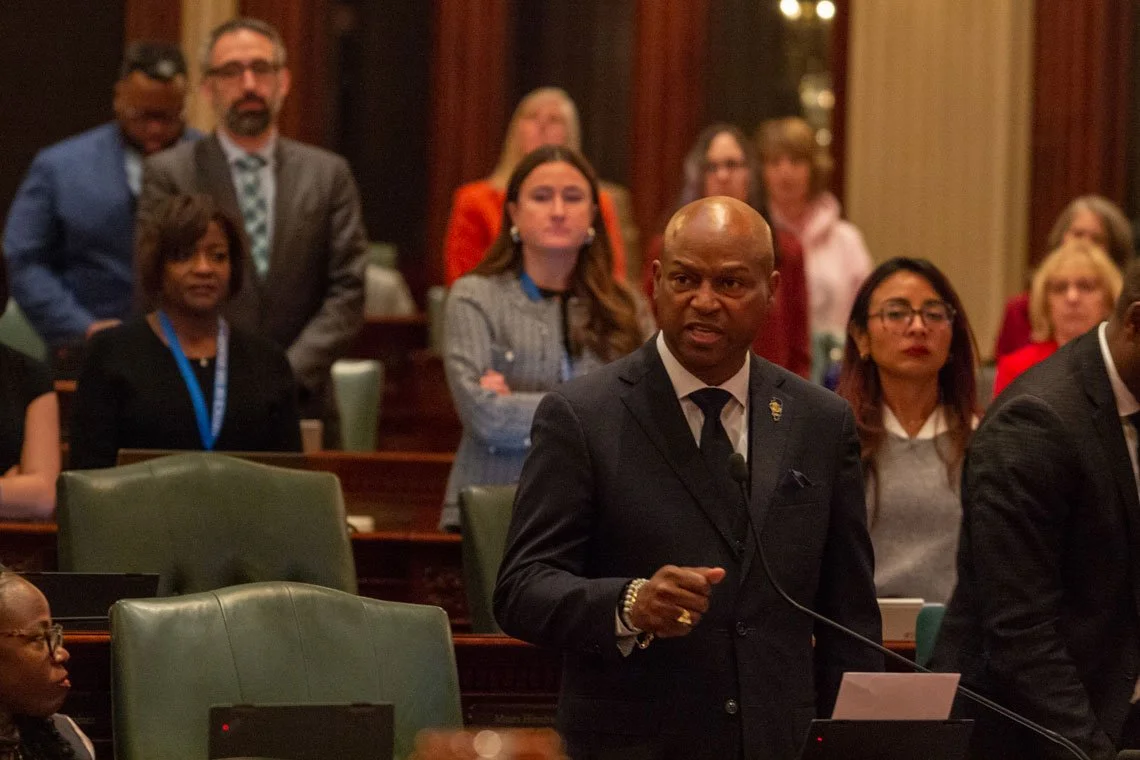
(LEAD) WELCH: House Speaker Emanuel “Chris” Welch presents his bill that aims to limit where federal officials can enforce civil immigration law in Illinois during the early hours of Friday, Oct. 31. (Capitol News Illinois photo by Jerry Nowicki)
Lawmakers approve $1.5B transit funding package without statewide tax increases
Funding for downstate transit agencies decreases from previous plan
By BEN SZALINSKI
Capitol News Illinois
bszalinski@capitolnewsillinois.com
Article Summary
A new transit funding bill passed Thursday night raises $1.5 billion for public transportation agencies, mostly in the Chicago area.
The proposal calls for diverting sales tax revenue from motor fuel purchases to public transportation operational expenses and allocating interest from the Road Fund to public transportation.
It does not include several controversial new statewide taxes or increases that were introduced in previous versions.
Chicago-area residents would pay more through a sales tax increase and higher tolls.
Downstate transit agencies are set to receive $129 million – below the $200 million they hoped for.
This summary was written by the reporters and editors who worked on this story.
SPRINGFIELD – State lawmakers approved new funding for public transportation agencies without large statewide tax increases previously proposed.
Instead, the measure would be fueled by revenue sources that currently feed the state’s Road Fund and an increased sales tax targeted to the Chicago area.
The bill frustrated some lawmakers outside the Chicago area because of provisions that reroute money from the broader funding source of infrastructure projects.
The House voted 72-33 to pass Senate bill 2111 around 2:15 a.m. on Friday with only Democrats supporting the plan.
“That system has been running on borrowed time,” bill sponsor Rep. Eva-Dina Delgado, D-Chicago, said. “Fragmented governance, uneven investment and post-COVID ridership losses have left transit struggling with unreliable service, delayed trains, canceled routs and a looming fiscal cliff that’s threatening to derail it all without action.”
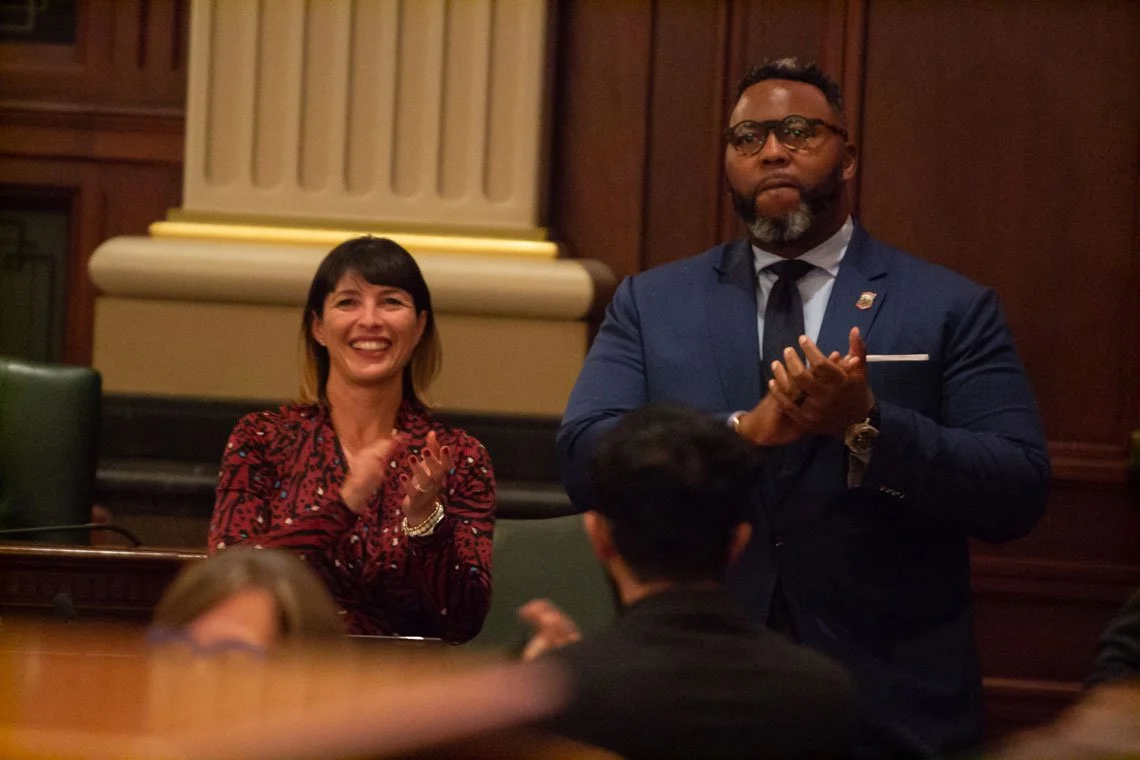
Reps. Eva-Dina Delgado and Kam Buckner celebrate after a transit funding measure they shepherded through the House received final passage. (Capitol News Illinois photo by Jerry Nowicki)
The Regional Transportation Authority, Chicago Transit Agency, Metra commuter rail and Pace Suburban Bus collectively face a $230 million funding shortfall in 2026 as pandemic relief money runs out. The funding deficit is projected to grow to $834 million in 2027 and $937 million in 2028. Without action in Springfield to plug that gap, the transit agencies have said they could be forced to cut services by 40%.
Republicans pleaded with the Democratic sponsors to pull the bill given the funding shortfall for the Chicago Transit Authority wouldn’t hit until the middle of 2026. But after more than a year of negotiations, Democratic leaders were ready to put the issue to rest.
The Senate followed with a 36-21 vote in favor of the bill around 4 a.m., concluding more than a year of negotiations.
“We are changing our public transit system for the first time in five decades to be safe, to be reliable, to be accessible, to be integrated; making sure that we got the performance and we got the funding that's needed to make a system of the next level,” Sen. Ram Villivalam, D-Chicago, said.
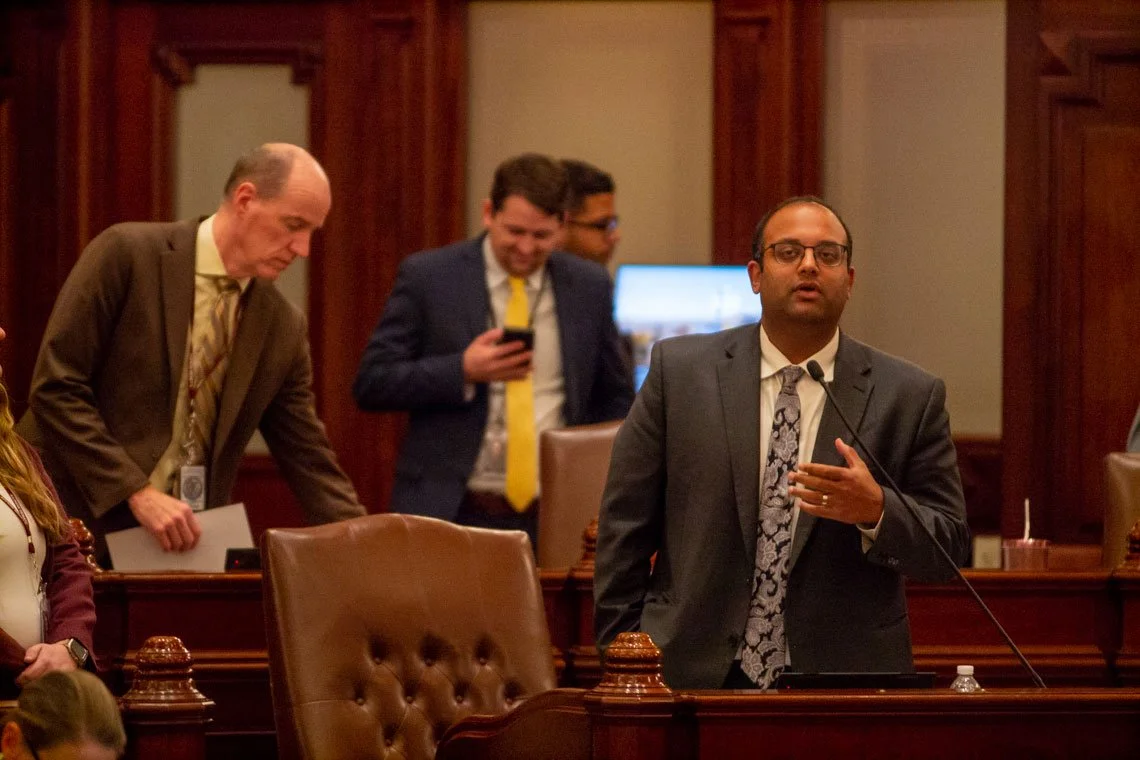
Democratic state Sen. Ram Villivalam speaks in favor of his bill to direct $1.5 billion to public transit funding in Illinois. (Capitol News Illinois photo by Jerry Nowicki)
The plan goes to the governor’s desk without any of the controversial statewide taxes on package deliveries, streaming or event tickets that were part of previous bills. The House two days earlier had introduced a measure that taxed entertainment and billionaires’ investments — ideas Gov. JB Pritzker quickly shot down.
Read more: House transit bill ‘not going forward,’ Pritzker says as he opposes new revenue forms
The bill got back on track on Thursday following a day of negotiations between stakeholders, lawmakers and the governor’s office.
How it’s funded
The bulk of the funding, $860 million, would come through redirecting sales tax revenue charged on motor fuel purchases to public transportation operations. Another estimated $200 million would come from interest growing in the Road Fund — a state fund that is typically used for road construction projects but can also be used for transportation-related purposes under the state constitution.
The plan calls for raising the existing Regional Transportation Authority sales tax by 0.25 percentage points, to 1% in Lake, McHenry, Kane, DuPage and Will counties and 1.25% in Cook County. That tax hike will generate $478 million.
Drivers of passenger vehicles on northern Illinois’ toll roads will also have to pay 45 cents more per toll as part of a plan to create a new capital program for tollway projects. It will also increase by inflation each year. That will raise up to $1 billion annually, Marc Poulos, executive director of Local 150, told the House Executive Committee Thursday evening.
A coalition of labor unions that had generally opposed using Road Fund money for public transportation supported the latest bill.
“It is, you know, just vitally important that we keep 15,000 people in transit working,” Illinois AFL-CIO President Tim Drea, who led the labor coalition, told Capitol News Illinois. “Overall, it was a good bill that that we needed.”
The bill also calls for 25% of the systems’ revenue to come from fares. Historically, half of the funding was generated by the riders, but that requirement became unsustainable after the pandemic.
“The 50% fair box recovery ratio is way out of whack if you compare to other agencies, similarly situated agencies across the country,” Delgado said.
The bill and its associated tax and toll increases would not take effect until June 1.
Republicans feel slighted
Funding for downstate public transportation agencies, which face their own funding challenges as a sales tax-based formula becomes less lucrative, are set to receive $129 million annually – below the $200 million they had hoped for.
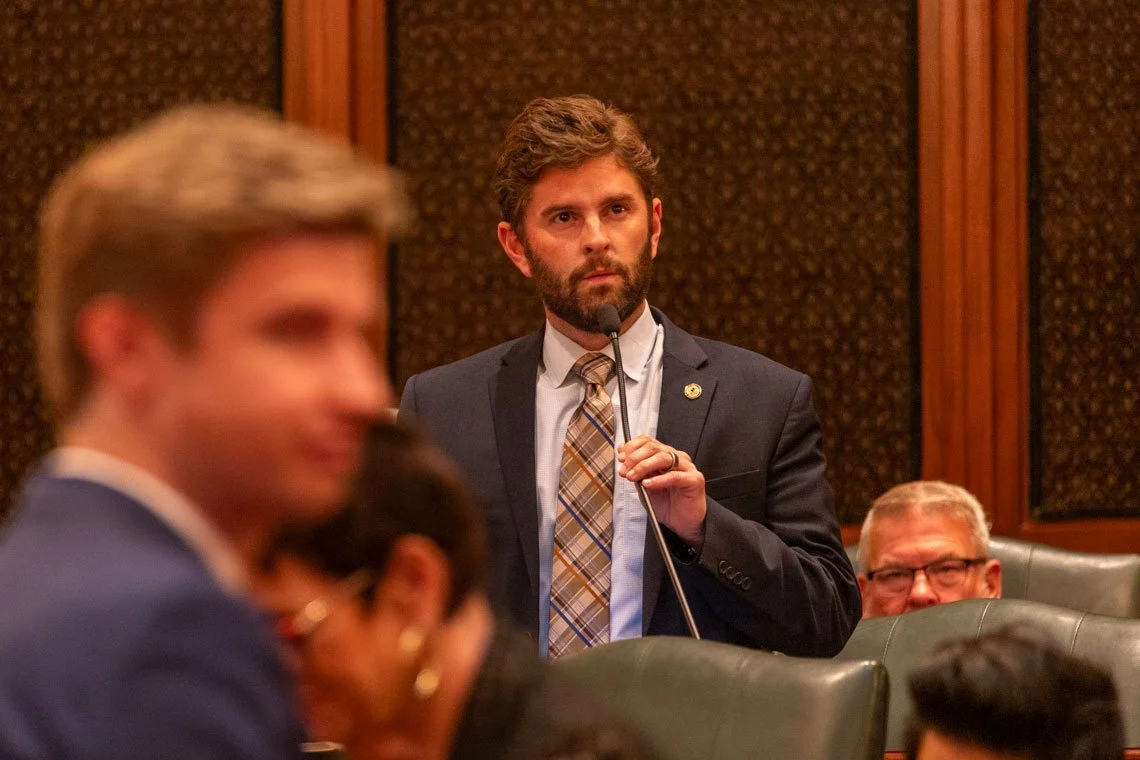
Rep. Ryan Spain, R-Peoria, speaks during debate over a bill reforming public transit in northeastern Chicago in the early house of Oct. 31. (Capitol News Illinois photo by Andrew Adams)
The move to direct most of the funding to the Chicago area left Republicans frustrated.
“I'm actually not thrilled that we are continuing on this transit bill, although I am happy that my constituents aren't going to be stuck with ridiculous taxes,” Rep. Regan Deering, R-Decatur, said. “But I just can't continue to vote for a piece of legislation that's screws them anyway.”
Downstate lawmakers also worried the bill tapping into Road Fund money removed a critical funding source for road construction projects.
“This transit funding bill creates a perverse incentive ... to not diminish the balance of the Road Fund, not get projects out of the door ... but continue to build up big balances in the Road Fund,” Rep. Ryan Spain, R-Peoria, said.
Sen. Don DeWitte, R-St. Charles, the Senate Republican’s transit leader, spoke in support of using interest from the road fund to pay for public transportation.
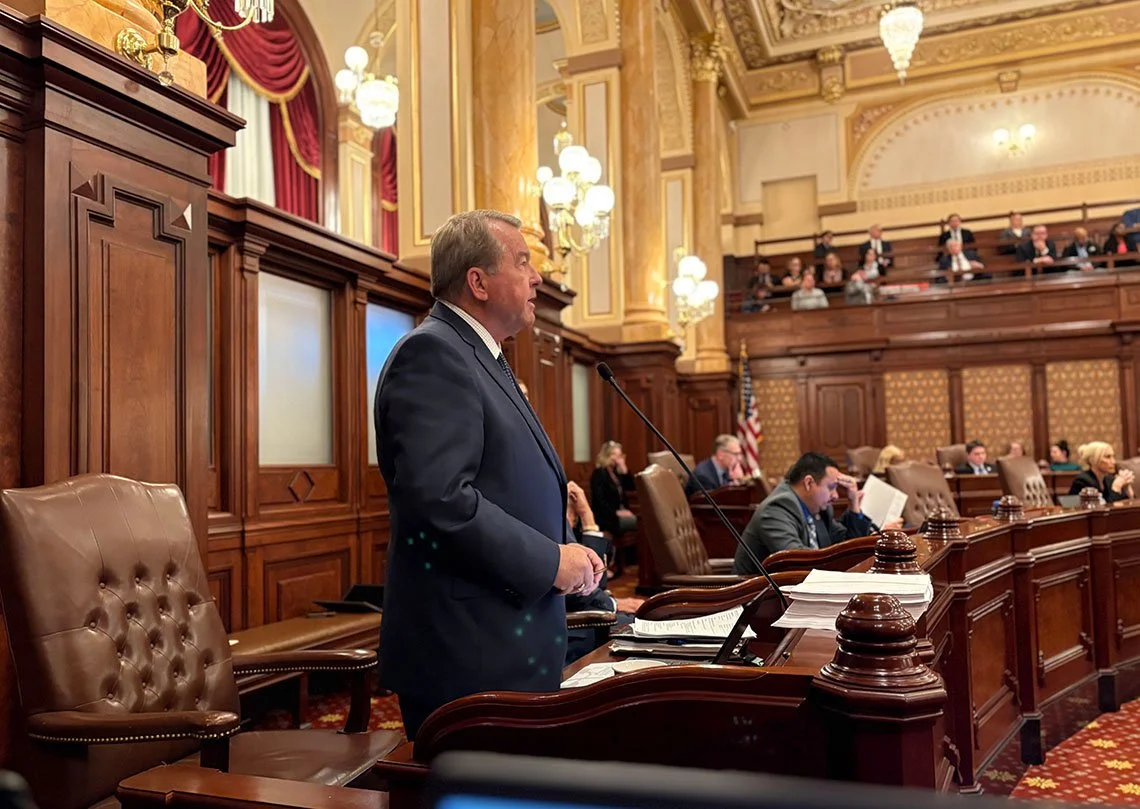
Republican Sen. Don DeWitte questions Democrats on a transit funding bill just before 4 a.m. on Friday, Oct. 31. (Capitol News Illinois photo by Jerry Nowicki)
New transit board part of reforms
The reforms in the proposal are similar to what the Senate passed in May.
The bill would create the Northern Illinois Transit Authority, which would be a stronger version of the RTA and would have the ability to establish a universal fare system and coordinate scheduling between the three service agencies.
The board would be comprised of 20 members: five appointed by the mayor of Chicago, five by the Cook County Board president, five by the governor and five collectively by Lake, McHenry, DuPage, Kane and Will counties. That makeup has drawn criticism from some suburban leaders who fear it will limit their ability to affect public transportation decisions.
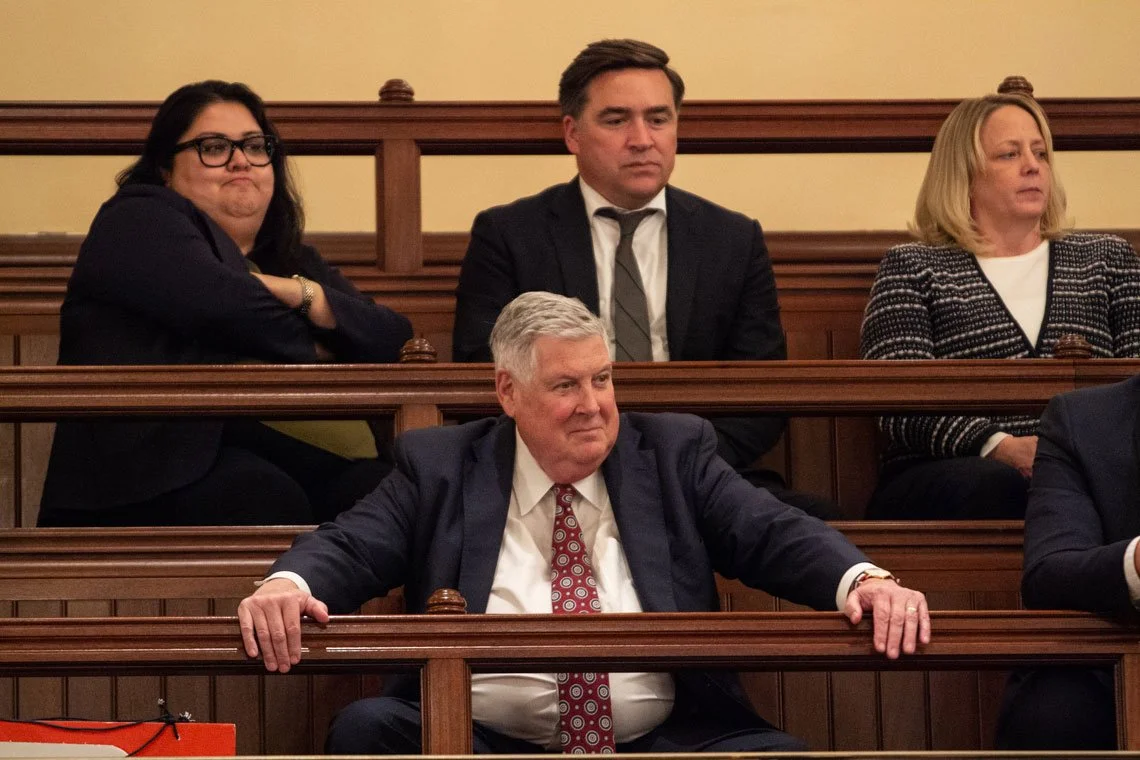
Regional Transportation Authority Chair Kirk Dillard watched floor debate of a transit funding bill in the early hours of Friday, Oct. 31. (Capitol News Illinois photo by Jerry Nowicki)
It would also create a law enforcement task force that will target hot spots for public safety issues on the transit systems. Other roles will be tasked with deescalating conflicts or seeking to address homelessness and mental illness – issues that can sometimes escalate into public safety issues.
The bill also blocks transit agencies from transferring operating dollars to capital expenses — a controversial move Metra recently proposed in its 2026 budget that raised red flags for several state lawmakers and RTA leaders.
Capitol News Illinois is a nonprofit, nonpartisan news service that distributes state government coverage to hundreds of news outlets statewide. It is funded primarily by the Illinois Press Foundation and the Robert R. McCormick Foundation.
ILLINOIS EASTERN COMMUNITY COLLEGES NAMED AMONG ASPEN INSTITUTE’S TOP 200 U.S. COMMUNITY COLLEGES
Illinois Eastern Community Colleges (IECC) - encompassing Frontier Community College, Lincoln Trail College, Olney Central College, and Wabash Valley College — has been named among the Top 200 U.S. Community Colleges by the Aspen Institute College Excellence Program.
The recognition places IECC among the top 20 percent of nearly 1,000 community colleges eligible to compete for the $1 million Aspen Prize for Community College Excellence — the nation’s signature recognition of achievement and performance in two-year higher education. The Aspen Prize honors colleges that excel in student outcomes such as retention, completion, transfer, and workforce success, while advancing equity and continuous improvement.
“Being recognized by the Aspen Institute is an affirmation of what we already know to be true about Illinois Eastern Community Colleges — that our students receive one of the best community college educations in the nation,” said Chancellor Dr. Ryan Gower.
Across the country, community colleges face unprecedented pressures, including uncertainty in state funding, shifting demographics, and growing skepticism about the value of higher education. According to the American Association of Community Colleges, national enrollment in two-year institutions has fallen nearly 40% since 2010, and persistence rates remain below 60%. IECC’s inclusion in the Aspen Top 200 underscores its leadership in navigating those trends through a systemwide focus on innovation, student success, and workforce alignment. “This recognition reflects the outstanding achievements of our faculty and staff who put students first,” said Dr. Cathy Robb, Vice Chancellor of Academic Affairs. “Our success is not only about what we’ve accomplished, but also our willingness to evolve — to embrace new technologies, flexible teaching strategies, and learning experiences that meet the needs of today’s students.”
As higher education adapts to a changing environment, including an increasingly mobile, digital, and cost-conscious generation of learners, IECC continues to expand student access while preserving accessibility and quality. From guided pathways and transfer articulation to dual credit pipelines and fully online programs, IECC is modernizing the student experience without sacrificing affordability. “Across the country, higher education costs continue to rise, limiting access for many families,” said Chris Simpson, Vice Chancellor of Business Operations. “IECC offers a different story. Students can receive an excellent education and graduate without being burdened by excessive debt.”
IECC’s recognition also reflects its commitment to supporting the whole student. Research consistently shows that co-curricular involvement, meaningful student support services, and a sense of belonging significantly elevate retention, completion, and transfer rates at community colleges. IECC’s investments in holistic learning environments — the arts, recreation, student life to student-support services — help students find their footing and their future. “When we connect academic learning with personal growth, students not only stay enrolled — they thrive,” said Dr. Matt Fowler, Vice Chancellor of Student Affairs.
With deep roots across southeastern Illinois, IECC’s mission is different from four-year colleges and universities. Community colleges play a vital role in strengthening local economies through workforce partnerships, apprenticeships, and career programs. “We partner with employers to build programs that provide practical, hands-on experience — preparing students for high-demand, rewarding careers that keep our communities strong,” said Dr. Sharmila Kakac, Vice Chancellor of Business and Industry. And the success of IECC students after graduation is one of the more important metrics measured by the Aspen Institute.
The Aspen recognition is an important validation that IECC’s student-centered approach — from affordability and access to completion and career outcomes — is among the best in the country. “For prospective students, parents, guidance counselors, and community partners, this recognition is proof that an IECC education is trusted, high-quality, and focused on results,” said Tona Ambrose, Vice Chancellor of Institutional Outreach. Enrollment for the Spring 2026 term is now open and students who are interested in attending one of the four IECC campuses can find the application online at www.iecc.edu/apply.
The 200 eligible colleges will now enter a rigorous review process that culminates in the announcement of the Aspen Prize winner in spring 2027. Colleges will be evaluated on student outcomes, equity, and institutional practices that drive exceptional performance. “This recognition belongs to our people,” said Gary Carter, Chair of the IECC Board of Trustees. “Our faculty, staff, and administrators are united by one mission — to ensure every student in southeastern Illinois has access to an exceptional education that changes lives and strengthens communities.
About Illinois Eastern Community Colleges:
Illinois Eastern Community Colleges is a college with four campuses located in the southeastern region of Illinois. Committed to providing accessible, high-quality education, IECC offers a wide range of academic and career-focused programs to serve the diverse needs of its students and communities. For more information, please visit www.iecc.edu.
About the Aspen Institute College Excellence Program:
The Aspen Institute College Excellence Program aims to strengthen higher education leadership and practice to improve student outcomes—with the ultimate goal of advancing economic mobility and developing talent for the good of each individual and society as a whole.
The Aspen Institute is a global nonprofit organization whose purpose is to ignite human potential to build understanding and create new possibilities for a better world. Founded in 1949, the Institute drives change through dialogue, leadership, and action to help solve society’s greatest challenges. It is headquartered in Washington, D.C. and has a campus in Aspen, Colorado, as well as an international network of partners. For more information, visit www.aspeninstitute.org.
Niemerg - Accident that took the life of Coles County board member and his wife is inexcusable
U.S. Immigration and Customs Enforcement has issued an immigration detainer on 34-year-old Edwin Pacheco-Meza, the man accused of causing a fatal crash in Clark County last week that claimed the lives of Coles County Board member Michael Clayton and his wife, Gail.
An Illinois State Police spokesperson said Pacheco-Meza was driving a conversion van on West Lincoln Street in Westfield when he crossed the center line and hit a vehicle carrying the Clayton's head-on. Meza and the 18-year-old passenger in his vehicle were not hurt. What ISP did not disclose was that the driver and the passenger in the van were illegal migrants.
Pacheco-Meza from Honduras is facing charges of reckless homicide and aggravated DUI. He was denied pre-trial release in a hearing on Monday. He's expected back in court on Nov. 17. According to an ICE spokesperson, his passenger, Juan Morales Martinez, from Guatemala is being processed to face immigration proceedings.
At a Capitol press conference in Springfield Tuesday afternoon, State Representative Adam Niemerg (R-Dieterich) said the accident that happened in district is inexcusable.
According to the ISP, the investigation is ongoing.
House passes energy bill amid debate over costs to consumers
Proponents say energy storage, efficiency programs will save money, critics wary of claims
By ANDREW ADAMS
Capitol News Illinois
aadams@capitolnewsillinois.com
Article Summary
House lawmakers passed a sweeping energy reform bill along party lines Wednesday evening.
The bill would create new incentives for energy storage, allow construction of new nuclear power plants and give regulators expanded authority over the state's electric grid.
It now heads to the Senate, where it is expected to be discussed Thursday.
This summary was written by the reporters and editors who worked on this story.
SPRINGFIELD — Illinoisans could see a new line item on their electric bills under a bill passed Wednesday night by the Illinois House.
Under the proposal, contained in an amendment to Senate Bill 25, ratepayers will subsidize energy storage projects like large battery installations.
Environmental groups and the renewable energy industry often tout batteries as a way to make solar and wind power facilities more effective by storing energy for when the sun isn’t shining or wind isn’t blowing.
The bill, which passed the House 70-37, has been in the works for more than a year. Much of the back-and-forth between lawmakers, business groups, environmentalists and organized labor centered on the balance between reliability and consumer costs.
The bill now goes to the Senate for consideration.
What the energy bill does
Lawmakers in the Senate and House held hearings throughout the day Wednesday, with affordability being among the top concerns. State officials — including the highest-ranking staffer at the state’s utility regulator — urged new policies to avoid an unstable grid.
“With the spike from data centers, with new manufacturing, we’re seeing rapid increases in demand. If we don’t meet the moment, we’re looking at blackouts,” Illinois Commerce Commission executive director Jonathan Feipel said during the Senate’s hearing on the bill.
Energy storage is the centerpiece of the bill, which would create incentive structures similar to current programs for renewable energy. This would create a new charge for ratepayers to offset costs for energy storage projects.
Some critics of the bill characterized that provision as harmful to consumers.
“If you vote for this bill, it is a guaranteed rate increase to ratepayers,” Rep. C.D. Davidsmeyer, R-Murrayville, said. “There may possibly be some savings down the line.”
But proponents said that, in the long run, battery storage would save consumers money and increase grid reliability.
The Illinois Power Agency, which manages Illinois’ electricity market and oversees renewable energy procurement in the state, conducted an analysis of the bill. The agency found that while the programs in the proposal will increase customer bills slightly, those increases will be entirely offset by 2029.
The bill would also direct utilities to create “virtual power plants” that coordinate rooftop solar, home-based batteries, electric vehicles and other small, distributed energy generation.
The bill would also place new requirements on utilities for energy efficiency programs in an effort to reduce the overall demand — and price — of electricity. The bill requires utilities to offer “time-of-use” rate plans where consumers are charged more at certain times of day and less at others based on market price and grid strain.
Customers will see decreases in their bills due to the energy efficiency programs “after about six months,” bill sponsor Rep. Jay Hoffman, D-Swansea, said in an interview. He said other cost reductions would come over the next several years, and that increases from the battery storage subsidy wouldn’t arrive until 2030.
Environmentalists and renewable advocates praised the bill for its cost-related provisions.
“This is really exciting for Illinois, and it’s something that’s going to address affordability as well,” Jen Walling, head of the Illinois Environmental Council said Wednesday. “For so long, we have thought of renewable energy as being more expensive and increasing consumer bills, but all of these steps and tools combined together are going to decrease bills.”
Meanwhile, business associations held that the immediate increased costs could hurt industrial businesses and keep new businesses from coming to the state.
“Illinois manufacturers already pay some of the highest electricity rates in the Midwest. Increasing the costs of energy will put our manufacturers at a competitive disadvantage compared to neighboring states and make it far more difficult to attract new investment to the Land of Lincoln,” Mark Denzler, president and CEO of the Illinois Manufacturers’ Association, said in a Monday statement.
New power for agencies
Lawmakers in Springfield had a particularly spirited debate over a portion of the bill that would create a new “integrated resource plan” process.
But critics, including several Republicans, warned this provision would cede oversight power to a state agency.
“Once we give it away, we will never, ever get it back,” Rep. Ryan Spain, R-Peoria, said during floor debate.
Hoffman defended the provision. He said lawmakers made a “mistake” three decades ago when they deregulated the state’s electricity market and stripped the ICC of its long-term planning authority.
“They’re the experts; we’re not,” Hoffman said.
Others worried the bill preempts local governments and counties from preventing certain kinds of renewable energy projects from being built. It also limits counties’ ability to control the site selection, or siting, of some renewable projects.
While some Republicans criticized this as a usurpation of local control, bill proponents said it would simplify the process for renewable development while protecting counties’ right to appeal to the ICC.
“The attempt is to have uniform standards across the state for this kind of siting approval, but in addition, I’ve heard from counties that have concerns — some of my counties — we were very deliberate about having a kind of appeal process,” Hoffman said. “And that would be before the ICC.”
New nuclear plants
One facet of the bill that received broad, bipartisan support would lift a state-level ban on constructing new nuclear power plants.
The measure follows a move several years ago to lift the nuclear moratorium for small modular nuclear reactors, a type of next-generation design. But this allows for new large-scale nuclear plants.
Nuclear reactors have become central to debates around electricity demand from data centers. Meta, Facebook’s parent company, entered an agreement over the summer to pay for an existing nuclear reactor in Clinton, Illinois to stay open. Google has entered into agreements to revive shuttered reactors in other states.
But this provision also charges new fees for existing nuclear plant operators, which could be as high as $3.9 million fee per reactor. Most nuclear plants in Illinois have multiple reactors.
Capitol News Illinois is a nonprofit, nonpartisan news service that distributes state government coverage to hundreds of news outlets statewide. It is funded primarily by the Illinois Press Foundation and the Robert R. McCormick Foundation.
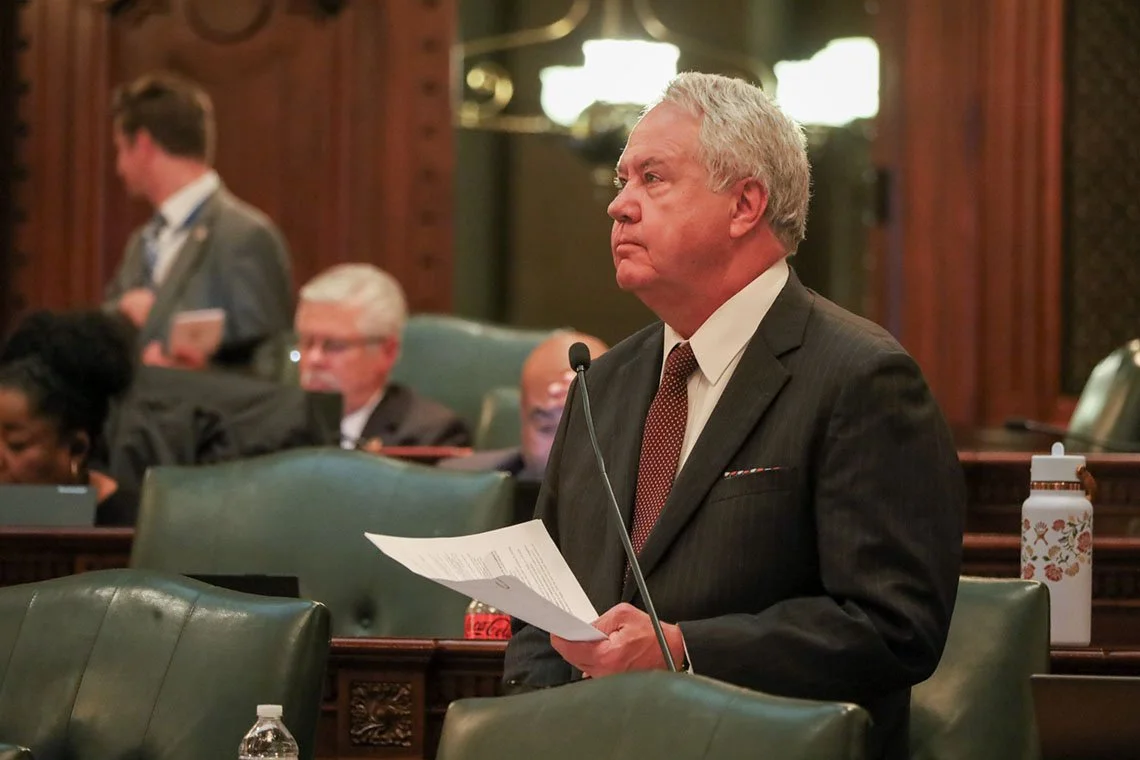
Rep. Jay Hoffman, D-Swansea, speaks about his energy legislation during House floor debate on Oct. 29, 2025. (Capitol News Illinois photo by Andrew Adams)
Illinois school report card continues to show wide achievement gaps
First report under new scoring system shows higher proficiency rates, uneven performance
By PETER HANCOCK
Capitol News Illinois
phancock@capitolnewsillinois.com
Story summary:
The 2025 school report card is the first one based on a new grading system that uses lower cut scores for proficiency in English language arts and math. State officials say the old system unfairly classified high-performing students as not proficient.
States have been required to produce annual report cards since the 2002-2003 school year under a federal law formerly known as the No Child Left Behind Act. That law aimed to hold school systems accountable for bringing all students up to proficiency and closing persistent achievement gaps.
This year’s report card shows there are still wide gaps between racial and ethnic groups in some area. In high school graduation rates the gaps are narrowing as the rates have increased among all groups.
This summary was written by the reporters and editors who worked on this story.
SPRINGFIELD — The first school report card issued under Illinois’ new, revised scoring system shows higher student proficiency rates in English language arts and math, but continuing disparities between racial, ethnic and economic subgroups.
The 2025 report card shows more than half of all students (52.4%) scored proficient or better on English language arts exams, but only 38% met grade-level proficiency standards for math.
Those numbers are based on standardized tests that students from third grade through high school took in the spring 2025 semester. They reflect a new scoring system the Illinois State Board of Education approved in August that established new benchmarks for proficiency.
“Illinois' previous benchmarks for English language arts proficiency were the most restrictive in the country, resulting in the mislabeling of high achieving college ready students as being not proficient,” State Superintendent of Education Tony Sanders said during a media briefing on the report card.
“This meant that the students who were succeeding in school passing advanced placement and dual credit courses, taking leadership roles within their schools, enrolling in college and still being labeled as not proficient on our state assessment.”
The change in scoring systems was expected to result in more students being classified as proficient in reading and math, but fewer in science. And that is what happened.
In 2024, only 39% of students who were tested scored proficient or better in English language arts and only 28% did so in math. On the science assessment, which is given to fifth and eighth grade students, the proficiency rate dropped from 53.1% in 2024 to 44.6% in 2025.
But Sanders said the 2025 scores cannot really be compared with previous years because the year-over-year changes are mostly the result of the new scoring system, not a change in how well students performed. However, he also said there were other indications that student performance did improve in 2025.
“They would have increased if we had kept the same cut scores,” he said. “However, we changed the cut scores, so we can't tell you what they would have been. But we know they would have improved.”
Performance gaps
All states have issued annual report cards since the 2002-2003 school year when they were mandated by the federal law known as the No Child Left Behind Act. They were intended as a tool to hold districts and individual schools accountable for bringing all students up to a level of proficiency in reading and math, and for improving their high school graduation rates.
That also meant closing the persistent achievement gaps between racial, ethnic and economic subgroups of students.
But the law also gave states flexibility to establish their own standards for proficiency and to develop their own tests to measure student performance.
In Illinois, most students in grades 3-8 take the Illinois Assessment of Readiness for English language arts and Math. Students in fifth and eighth grade also take the Illinois Science Assessment.
At the high school level, ninth and 10th grade students take the PreACT Secure exam. High school juniors and some high school seniors take the ACT with Writing, which includes tests in English, math, reading, science and writing.
In Illinois, the 2025 report card shows there are still wide gaps in proficiency rates between white, Black and Hispanic students in both English language arts and math.
Among fourth graders, for example, 55.4% of white students scored proficient or better in math, compared to 28.8% of Hispanic students and 17.4% of Black students.
Among eighth graders, two-thirds of white students (66.6%) scored proficient compared to just over one-third (36.7%) for Black students and 45.4% for Hispanic students.
The 2025 report card also includes data for the first time for a newly categorized ethnic group — “Middle Eastern or North African,” abbreviated MENA in the data files.
Among MENA students, the 2025 report card showed a 53.9% proficiency rate in fourth-grade English language arts and a 42.3% proficiency rate for eighth-grade math.
Graduation rates
One area where Illinois has made progress in closing achievement gaps is high school graduation rates.
In 2025, the statewide four-year graduation rate reached a 15-year high of 89%. That was up 3.4 percentage points from a decade earlier. But the rate was also up across all demographic groups, and the gap between those groups narrowed significantly.
In 2015, the four-year graduation rate among white students was 90.2%. That was 14.7 points higher than the Black graduation rate, and 9.5 points higher than the rate for Hispanic students.
In 2025, the graduation rate for white students inched up to 92.4%, but it also rose among other groups. As a result, the gap between white and Black students narrowed to just 9.5 percentage points, and the gap between white students and Hispanic students narrowed to just 6 points.
Sanders gave credit for much of that improvement to the Evidence-Based Funding formula, which lawmakers passed in 2017. That law called for adding at least $300 million per year in new funding each year to the state’s K-12 education budget.
Since then, Sanders said, Illinois has added more than $3 billion in EBF funding to the budget, with the bulk of that money targeted toward the least-funded school and earmarked for things specifically designed to improve student outcomes.
“Districts have used these resources to expand interventions like summer school,” he said. “They've added mentoring, credit recovery courses, transition programs for English and math, and they broadened access to career and technical education, advanced placement, international baccalaureate and dual credit. These opportunities keep students engaged and on track for success.”
Other findings
The report card also contains data on several other measures of the state’s education system.
The number of full-time equivalent teachers working in Illinois reached a new high of 137,899, an increase of 687 from the previous year. The teaching workforce also became slightly more racially diverse, with 21.1% of them classified as nonwhite, compared to 20.4% last year. But total student enrollment decreased slightly to just under 1.85 million.
Chronic absenteeism declined for the third consecutive year in 2025 but still remained high at 25.4%. Students are classified as chronically absent if they miss 10% or more of the days in a school year, regardless of whether the absence is excused or not. The rate shot up during the COVID-19 pandemic, reaching a peak of 29.8% in 2022.
Capitol News Illinois is a nonprofit, nonpartisan news service that distributes state government coverage to hundreds of news outlets statewide. It is funded primarily by the Illinois Press Foundation and the Robert R. McCormick Foundation.

ILLINOIS STATE POLICE SQUAD CAR STRUCK ON I-57
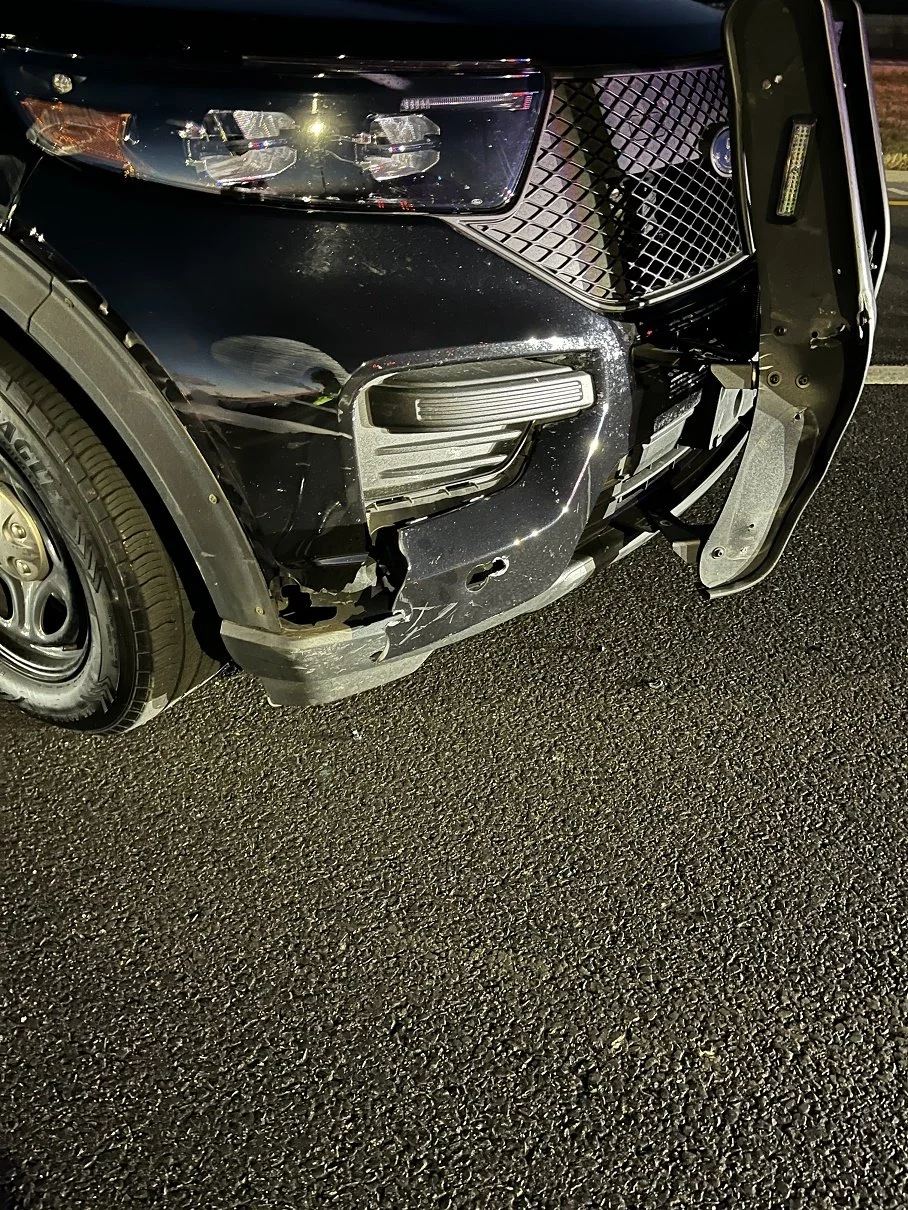
ARCOLA – An Illinois State Police (ISP) squad car was hit this morning on I-57 in Douglas County as the Trooper was conducting traffic control for a previous crash.
On October 30, 2025, at approximately 5:50 a.m., an ISP Trooper was parked across the northbound lanes of I-57 conducting traffic control for a previous crash involving a commercial motor vehicle. The Trooper had activated the emergency lights in the squad car, directing traffic to exit at milepost 203 onto IL 133. A Chevrolet Trailblazer failed to move over, failed to exit, and struck the front passenger side of the Trooper’s squad car. The Trooper was outside of the squad car at the time of the crash and reported no injuries. The driver of the Chevrolet, 68-year-old Donald E. Morecraft of Robinson, IL, was charged with Failure to Reduce Speed to Avoid an Accident and a Scott’s Law/Move Over Law violation.
In 2025, ISP has now suffered 12 Move Over Law-related crashes. In 2024, ISP suffered 27 Move Over Law-related crashes with 12 Troopers injured and one death. In 2023, ISP had 21 Move Over Law-related crashes with seven Troopers injured. ISP reminds the public the Move Over Law, also known as “Scott’s Law” in Illinois, requires all drivers to move over when approaching an emergency vehicle or any vehicle with its emergency or hazard lights activated.
A person who violates the Move Over Law faces a fine of no less than $250 and no more than $10,000 for a first offense. If the violation results in injury to another person, the violator’s driver’s license will be suspended for a mandatory period of anywhere between six months and two years. Additional information about ISP related crashes can be found at the following link: https://isp.maps.arcgis.com/apps/dashboards/340d57cd956c453da2de25af804c268d.
SOS Pushes Back; Not Backing Down From Plan To Close Mt. Carmel DMV
The Illinois Secretary of State's office responded Wednesday to erroneous claims made by elected officials regarding the upcoming closing of the Mt. Carmel DMV, at 219 W. Second Street.
The office made the decision to close the facility based on data and facts, which showed that keeping it open was not an efficient use of taxpayer dollars based on the low volume of transactions.
The DMV only processes a total of 15 driver’s license transactions a day, making it among the lowest in terms of transactions out of the state’s 122 DMVs.
Furthermore, four other DMVs are located within 20 miles of the Mount Carmel facility, one of the highest concentrated areas in the state in terms of the number of DMVs.
In addition, customers and staff regularly complained about the condition of the facility, which the landlord failed to address when negotiating terms for a new lease.
The Secretary of State’s office reached out to legislators informing them that it was having difficulty reaching an agreement with the landlord and asked for suggestions of alternative locations but none were provided.
The office eventually performed detailed surveys of alternative locations proposed by Mt. Carmel officials over the last year, but none of the properties came close to meeting the requirements from a service and property management perspective, making them poor uses of taxpayer money.
The DMV will close on Friday, November 14. Residents who utilize the Mount Carmel DMV can obtain services at nearby facilities, including Lawrenceville, Fairfield, Carmi and Olney.
The office will retain all the Mount Carmel facility’s five employees and redeploy them to nearby locations.
Officials Press Case To Keep Driver's License Facility Open
Mount Carmel city officials are demanding answers from the Illinois Secretary of State’s Office over the sudden closure of the local driver services facility.
Mayor Joe Judge announced that a press conference will be held Wednesday, alongside State Representative David Severin and State Senator Terri Bryant, to address what they call a lack of transparency about the closure.
“There will be a press conference with State Representative David Severin and State Senator Terri Bryant and myself to address the Secretary of State’s closing and the lack of transparency on the real reason why the Mount Carmel location is closing.”
The mayor said numerous calls from local and state officials to the Secretary of State’s office in Springfield and Chicago have gone unanswered.
“As of right now, the only details they’ve provided have been very slim and limited and not been fully transparent on why.”
Residents will be able to join the meeting online, with a link expected to be shared through local media. The mayor says he hopes the Secretary of State himself will attend to answer questions directly from Mount Carmel residents.
The local SOS office is set to close November 14th.