
On 4/12/25, Mt. Carmel Police arrested Charles C. Brown, age 45, of Mt. Carmel on a Wabash County Warrant for Failure to Appear. The arresting officer located Brown at a residence in the 1900 block of N Cherry Street, where he was taken into custody. Brown was transported to the Wabash County Jail, where he was issued the warrant and held pending a pre-trial release determination by the court.
Out Of State Warrant Sends Mt. Carmel Man To Jail
On 3/27/25, Mt. Carmel Police arrested Randal S. Harms, age 57, of Mt. Carmel on a Vanderburgh County, Indiana warrant for Failure to Appear. The arresting officer located Harms in the 200 block of W 3rd Street, where he was taken into custody. Harms was transported to the Wabash County Jail, issued the warrant, and held pending extradition back to Vanderburgh County.
Grayville Woman Picked Up On FTA Warrant
On 3/22/25, Mt. Carmel Police arrested Patricia A. Bailey, age 53, of Grayville on an Edwards County Failure to Appear Warrant. Police made contact with Bailey in the area of 9th & Oak Street when Bailey and her male friend called looking for transportation assistance to Grayville. Police learned of the warrant and took her into custody. Bailey was transported to the Wabash County Jail, where she was issued the warrant and later transported to the custody of the Edwards County Sheriff’s Office.
Mt. Carmel Teen Faces Multiple Charges
On 3/11/25, Mt. Carmel Police arrested Wyatt B. Pritchett, age 18, of Mt. Carmel for Burglary, Theft from a Building, Criminal Damage to Property, and Contributing to the Delinquency of a Minor following an investigation into damage inside a building in the 300 block of N Market Street. While on scene, it was also discovered that several items had been stolen from the location and that a vehicle and at least two other buildings had been vandalized with spray paint in the same area. Evidence found at the scene led officers to Pritchett and two juveniles. Further investigation resulted in Pritchett’s arrest on the above charges and two juveniles being charged with Criminal Damage to Property. Pritchett was processed and later released on a Notice to Appear. The two juveniles were arrested and released to their parents.
Bone Gap Man Arrested On DUI Charge
On 3/16/25, Mt. Carmel Police arrested Melvin B. Delong, age 21, of Bone Gap for Driving Under the Influence of Alcohol following a report of a Dodge van being stuck on the railroad tracks near Market Street and Railroad Street. Upon arrival, the officer found that Delong had failed to turn when approaching Railroad Street, causing him to drive onto the railroad tracks and get stuck. In speaking to Delong, the officer detected the odor of an alcoholic beverage coming from him, leading to a roadside sobriety check. Delong demonstrated multiple clues to indicate impairment, resulting in his arrest. Delong was transported to the Wabash County Jail, where he was charged, processed, and later released on a Notice to Appear.
Mt. Carmel Woman Arrested For DUI-Drugs
On 3/14/25, Mt. Carmel Police arrested Jennifer D. Paschal, age 33, of Mt. Carmel for Driving Under the Influence of Drugs following a traffic stop for a violation of the Illinois Vehicle Code on College Drive. In speaking with Paschal, the officer detected a strong odor of burnt cannabis coming from the vehicle. Paschal acknowledged ingesting cannabis before the stop. Paschal agreed to and submitted to a roadside sobriety check, where she exhibited multiple clues to indicate impairment. Paschal was placed under arrest and transported to the Wabash County Jail, where she was charged with DUI and Disobeying a Traffic Control Device. After jail processing, Paschal was released on a Notice to Appear.
Judge: Stay. Off. The. Levee.
The Wabash River at Mt. Carmel is expected to finally fall back below flood stage on Sunday, but local authorities are still reminding residents to stay away from floodwaters. At Monday’s City Council meeting, Mayor Joe Judge said a new problem has arisen…
The admonishment comes after a driver drove onto the levee during a snowy day this past January.
Council Approves College Drive Resurfacing
Mt. Carmel motorists will have to contend with a second major road project this year. The city council on Monday approved spending $485,000 to resurface College Drive from 13th Street to Park Road. City engineer Dave Dallas told commissioners that the project will be mostly paid for with Rebuild Illinois funds that have been accumulated over last couple of years. He said the monies have to be spent in the next few months, so work on College Drive will begin soon. The project involves milling the old asphalt and replacing it with new asphalt.
Public works director Mike Gidcumb also told the council that Mt. Carmel Stabilization Group and HSI have been awarded the bids for the summer road maintenance. Stabilization will do the chip and seal work in late June and the fog sealing after the 4th of July holiday. The bids came in at $148,000, about $17,000 below original estimates.
Work has already started on Mt. Carmel’s biggest 2025 road project, the resurfacing of 9th Street.
Mink farming industry toes the line as Illinois lawmakers consider regulations
One side says it aims to shut the industry down, the other maintains it’s about public safety
By JADE AUBREY
Capitol News Illinois
jaubrey@capitolnewsillinois.com
SPRINGFIELD — For over 65 years, Bernice and Frank Monteleone have been raising minks on their farm in Elgin. The couple bought their first mink in 1959 — a red female who was pregnant at the time. She quickly produced seven babies, or kits.
“Before then, I had never seen a mink before in my life,” Bernice Monteleone said.
The couple traded those kits for minks from a neighboring farmer and began to breed them. That one female mink led the family to raise around 30,000 minks at the height of their production. In turn, the farm financially supported all the couple’s children and their families throughout the 1970s and 1980s.
“It has been a really wonderful way of life,” she said. “We’ve raised six kids here and a bunch of grandkids, and they learned good work habits and things like that from it, too. We really enjoyed that kind of life.”
Although the industry has self-imposed guidelines farmers adhere to in order to sell their pelts legally, mink farming is not regulated at the federal level or in Illinois.
But a bill in play in Springfield could change that. House Bill 2627, sponsored by Rep. Joyce Mason, D-Gurnee, would regulate the mink industry at the state level, creating mink farm licensing and requirements. But proponents and opponents have two vastly different opinions on what the bill really aims to do.
“This is not a ‘save the minks’ bill,” Mason said in a House Public Health Committee hearing earlier this session. “It is not one of those bills. It is a bill that is very much about public health. It does not intend to close mink farms or provide any undue burden to them.”
Mason testified during the hearing alongside Chris Green, executive director of the Animal Legal Defense Fund, and Marc Ayers, Illinois director of the Humane Society of the United States, who all warned of the potential public health risks mink farms pose.
But Bernice Monteleone and Challis Hobbs, executive director of Fur Commission USA, disagree. They say the bill’s main goal is to ban the mink industry, and that the requirements outlined in the bill are impossible for farmers to adhere to.
“I don’t know if it’s ignorance, or if, in my opinion, it is them trying to push us out of business,” Hobbs said in an interview. “Because these same proponents tried to pass a bill last year to ban us, so that’s what it looks like.”
What the bill would do
Hobbs and Monteleone’s opinion, the bill is yet another attempt to shut the industry down.
“There’s not much doubt in my mind that they’re just trying to get rid of it,” Hobbs said, referring to the mink farming industry. “When I read these things and how they’ve written this bill, obviously, it’s not someone who’s been in agriculture or they just want to put us out of business.”
But Mason maintains the bill’s intention is to protect public health.
“This isn’t even about mink welfare, it’s about health,” Mason said in an interview. “My goal is not to shut them down at all. It's just to make sure that they're not breeding viruses.”
HB2627 is supported by the Animal Legal Defense Fund, the Humane Society of the United States, and the Animal Welfare Institute. It is opposed by such groups as the Fur Commission USA, the Illinois Farm Bureau, and the Illinois Trappers Association.
The bill passed a House committee in March but was never called for a vote in the full House before an April 11 deadline. However, if passed into law, HB2627 would create a mink farming license, requiring farmers to disclose their location, the number of staff they employ, and the number of minks they house.
“To our knowledge, only four fur farms exist in this state, just four,” bill proponent Marc Ayers, Illinois director of the Humane Society of the United States, said in committee.
However, Monteleone said she’s not sure there are even that many fur farms in the state.
“I'm not even aware of four, to be honest with you,” Monteleone said. “We used to communicate quite a bit before, but the industry has gotten much smaller.”
Hobbs said the transparency of farm locations poses a safety risk to farmers. They say the locations of mink farms are kept relatively secret on purpose – to protect both mink farmers and their animals from anti-fur activists, who often break into farms and set caged minks free. Hobbs said minks usually die within 24-48 hours of their release and that activists have released over 50,000 commercially raised minks in the past few years.
“Our concern is, if they do this and those extremist activists get their hands on that information and attack them, it’ll be terrible,” Hobbs said. “It's going to hurt the farmers. It's going hurt the animals and hurt the environment.”
The bill also requires farmers to pay an annual license fee of $1,000, which would be used for two annual inspections of mink farms, among other things. It also sets several requirements that farmers must meet if their minks show signs of infection.
One of those requirements would be that farmers test enough of their minks weekly for COVID, bird flu or any other “potentially harmful virus.” Farmers would also have to test all their staff for viruses as well.
Those testing requirements, Hobbs said, would put a large financial burden on small mink farmers. According to him, the industry voluntarily participated in a national USDA program where they tested minks and farm employees for viruses. Between the costs of labor and sample collection from that program, they estimated the testing would cost farmers over $160,000 per year.
If any of the minks or workers on a farm test positive, the bill would require farmers to quarantine all their workers and separate their minks from one another by six feet. Hobbs said this separation would be “impossible” to achieve on any commercial farm – as commercially raised minks live in rows of small wire cages, placed side by side.
“They want you to separate the mink six feet apart. You can't. There's no livestock where you can do that,” Hobbs said. “I promise you, if this bill was proposed for any other industry, you’d have every powerful lobbyist group there in two seconds, because the regulations on this are crazy.”
Another provision would mandate that farmers euthanize their minks “if euthanasia of the mink is necessary for disease containment.” Currently, poultry farmers who have to euthanize their birds due to bird flu are eligible for reimbursements through the USDA’s indemnity program. In an interview, Mason said she expects the Illinois Department of Agriculture would also reimburse mink farmers who have to euthanize their minks.
Green, of the Animal Legal Defense Fund, pointed out that the federal law regulating animal farming exempts minks from the classification of “farm animals,” which are under authority of the USDA.
Green served as the executive director of Harvard Law School’s Animal Law & Policy Program until 2023. He was the main author of a 170-page report that assessed the rates and risks of animals spreading diseases to humans in the United States, including among minks raised on farms.
“Because fur-bearing animals are not considered livestock, producers are not eligible for indemnity payments from the USDA if their animals are culled because of a disease outbreak,” the Harvard report read. “As a result, producers have little incentive to report disease outbreaks for fear of financial losses.”
Hobbs said the industry has been in talks with the federal Department of Agriculture about potentially developing an indemnity program for mink farmers, but “it didn't look like there was too much appetite for it.”
Another concern Monteleone and Hobbs share is that licensing would be overseen by the Illinois Department of Public Health. They say the Illinois Department of Agriculture would be better suited to oversee the issue.
Minks and infectious diseases
Minks are part of the mustelid family of animals, which includes other carnivorous mammals like badgers, wolverines, otters, weasels and ferrets. The New York Times Magazine reported these animals have respiratory systems that are like humans – so similar that scientists often use them as subjects in experiments designed to study respiratory diseases like coronaviruses.
In the committee hearing, Mason said that fact is extremely relevant now, especially with bird flu infection rates on the rise.
“In the case of mink, we know that they also had COVID before it was transmitted to humans,” she said. “They are now experiencing avian flu, and they are very likely to become vectors of future diseases, which could lead to pandemics.”
So far, the CDC has only confirmed one case of an American mink with bird flu, but the history of minks contracting and spreading COVID is what worries Mason.
During the pandemic, humans infected many different types of animals with the virus, including captive minks living on mink farms. But the CDC says that only four types of animals gave the virus back to humans – and minks were one of those animals.
Although the CDC maintains that the current public health risk for humans is low, the concern is that interaction between the seasonal flu virus and the bird flu virus might create a new strain that could start human-to-human transmissions. This would likely increase the risk of another pandemic, officials said.
Read more: Illinois health officials taking bird flu precautions despite assessing no ‘active risk’ to humans
“The real concern is that as these diseases move through these populations and jump from species to species to species again, especially with minks’ respiratory system being so similar to ours,” Green said. “If one of those deadly mutated versions gets to mink, then it's highly likely that it's going spread to humans.”
Since minks are naturally independent and free-roaming animals, Green said being kept in a cage is very stressful for them. And because higher rates of stress have been proven to lower immune responses, he said that leaves the animals more susceptible to disease.
But John Easley, a Wisconsin-based veterinarian who specializes in minks, disagrees. He said minks have been bred to thrive in and adapt to commercial farm settings since the 1940s.
“In most cases, I don't feel that the animals are under stress, undue stress, compared to any other animal that's raised in a commercial setting,” he said in an interview.
Hobbs, the Fur Commission executive director, said Green and Mason are making a bigger deal about the risk of the bird flu spreading in minks than necessary.
“You can go to the CDC and USDA websites and it will literally say that mink farms did not play a significant role in spreading COVID-19,” Hobbs said. “The bottom line is that the health authorities are saying that we are low risk. Maybe the proponents are saying that we're not, but that's kind of where we differ.”
He said Fur Commission USA is currently working with United States Department of Agriculture to develop a bird flu vaccine for minks, just as it worked with the department to develop a COVID vaccine for minks during the pandemic – which Easley said approximately 92% of the U.S. commercial herd received.
Minks, Denmark and COVID
Since U.S. mink farms aren’t regulated, there is no state or national database that discloses where farms are or how many minks they house. When an outbreak of coronavirus occurred in mink farms in Wisconsin, the state government was unaware how many farms were in the state and had no direct way to reach them. The Wisconsin State Veterinarian had to contact Fur Commission USA to get in touch with the state’s mink farmers.
According to the Harvard study, 18 fur farms across four U.S. states experienced an outbreak during the pandemic. One mink farm in Michigan experienced an outbreak that resulted in a small number of workers testing positive for a strain of the virus the CDC said, “contained unique mink-related mutations.”
The New York Times Magazine reported that in Denmark, more minks were infected with COVID than humans during the pandemic. The virus mutated in the minks, resulting in a new strain that infected workers on the farms, which prompted the Danish prime minister to order a mass slaughter of the country’s roughly 17,000 commercially farmed minks.
A CDC webpage about minks and COVID states there is no evidence that minks played a “significant role” in the spread of the virus to humans, but that “there is a possibility” the minks spread the virus to workers. It also notes mink-to-human COVID-19 transmission was reported in Europe and data suggests it might have also happened in the U.S.
But the virus wasn’t confined to minks on mink farms. Minks regularly escape farms or are released by anti-fur activists. Those escaped minks then infect wild minks and other animals they encounter, allowing the diseases to spread and mutate among other wild animals.
In August 2020, the CDC identified coronavirus outbreaks on mink farms in Wisconsin, Utah, Michigan, and Oregon. That month, the CDC launched a wildlife investigation near two Utah mink farms that had experienced outbreaks. The report says officials captured and tested 102 mammals – including 78 rodents, 11 presumed escaped minks, two presumed wild minks, five raccoons, and six skunks.
Although no wild animals tested positive for the coronavirus, all 11 escaped minks tested positive and the potential of escaped minks spreading the disease to the wildlife population was labelled by the CDC as “concerning.”
How mink farms currently operate
Mason said the main goal of her bill is to create state-level regulations for the mink farming industry to ensure farmers take precautions to contain potential viral outbreaks.
Although she acknowledged the industry has self-made regulations, she said her concern is that there’s no way to enforce those regulations.
Monteleone and Hobbs disagree.
Hobbs explained that a professional certification organization – who certifies audit systems for all types of animal farms, including audits for mink farms – certified the Fur Commission’s industry standards and audit tool, which spans 130 pages. The Fur Commission then took the standards from that tool and created the Humane Care Certification Program, which they use to certify mink farms.
Since the regulations aren’t mandated at a state or federal level, the Fur Commission’s program is voluntary for mink farmers. But Hobbs explained that farmers have virtually no other options than to go through the organization if they want to sell any pelts they raise, as American mink farmers can only sell their pelts through two international auction houses that will only buy pelts from farmers who are certified.
“As of today, just over 96% of the mink pelts produced in the U.S. comes from these certified farms,” Hobbs said.
Fur Commission USA essentially serves as a middleman between the auction houses and mink farmers: communicating the industry standards to farmers, setting up contact between third-party auditors and farmers, and administering the certifications to farms that meet all the regulations and requirements.
Monteleone echoed Hobbs’ statements, saying any pelts farmers want to sell through the auction houses must have approval from Fur Commission USA before the houses will buy them.
Capitol News Illinois is a nonprofit, nonpartisan news service that distributes state government coverage to hundreds of news outlets statewide. It is funded primarily by the Illinois Press Foundation and the Robert R. McCormick Foundation.

A wild American mink. (Photo provided by IDNR)
Legislature kills bill that would have expanded resentencing for youth offenders
Illinois expanded release options for certain youth offenders in 2023
By BEN SZALINSKI
Capitol News Illinois
bszalinski@capitolnewsillinois.com
SPRINGFIELD — The Illinois House shot down legislation Thursday that would have allowed some people incarcerated for crimes they committed when they were under 21 to become eligible for release.
In a rare rebuke of a Democrat-sponsored bill, a bipartisan coalition of lawmakers voted against House Bill 3332, causing the bill to fail on a 49-51 vote. Bills require 60 votes to pass the House, and numerous Democrats voted against the bill or skipped the vote. The bill was declared “lost,” meaning it cannot be recalled later.
The bill would have allowed people sentenced for crimes they committed when they were under 21 to be eligible for a parole hearing after serving 10 years in prison. Those sentenced for murder would be eligible for parole after serving 20 years, while those sentenced for murdering a victim who was under 18 years would be eligible for parole after serving 30 years.
"This bill would create a pathway for people sentenced as children and young adults to show that they have been rehabilitated and potentially return home and give back to their communities,” bill sponsor Rep. Theresa Mah, D-Chicago, told the House.
Mah declined to comment Friday on the bill’s failure.
Read more: Illinois banned life sentences for young offenders—but not for those already behind bars
Gov. JB Pritzker signed a law in 2023 that makes anyone sentenced to life in prison while they were under 21 eligible for release after serving 40 years behind bars — but only for people sentenced after June 1, 2019. Mah’s bill aimed to make that law retroactive and provide an opportunity for parole for all people incarcerated for crimes they committed before they were 21.
Illinois previously became one of the first states to abolish parole for crimes committed after 1978. Anyone sentenced for crimes committed between 1979 and early 2019 is not eligible for parole, but state law provides other mechanisms that allow people to have their sentence reduced, such as for good behavior in prison.
Mah’s bill immediately drew heavy criticism from Republicans who objected to creating a path to freedom for people convicted of violent crimes. Rep. Patrick Windhorst, R-Metropolis, argued that people serving decades-long sentences for convictions before they turned 21 are likely in prison for murder or major sex crimes.
"With respect to victims, we need to give them finality in the criminal justice system,” Windhorst said. “They should not be having to come back to court to relive the loss they suffered either being a victim of crime or the family of a victim of a murder. There needs to be finality, and we should not be reducing sentences for murderers and those guilty of criminal sexual account.”
Rep. John Cabello, R-Machesney Park, who works for the Winnebago County Sheriff’s Office, recalled serious crimes he investigated in his law enforcement career.
"Murder is brutal. It is final for one person; it’s a lifetime for their family,” Cabello said. “We can’t allow this yet.”
Mah attempted to ease concerns of her Republican colleagues, stating that the bill would merely create an opportunity for someone to receive a parole hearing and would not guarantee anyone will be given a hearing or released from prison.
"It’s not an automatic resentencing or a release,” Mah said. “All these cases come up for review by a judge. The victim’s families are also included in that process.”
Progressive Democrats voiced support for the bill even as many others in their party voted against it or skipped the vote.
"These are people who have spent decades working to be better in the most unimaginable and heinous situations you could dream of, locked behind bars still committed to reforming themselves,” said. Rep. Will Guzzardi, D-Chicago.
Mah argued that studies show youth offenders have lower rates of recidivism, and the legislation would give people in prison a reason to rehabilitate themselves.
"This is essentially a way to create fairness in our system that provides incentive for rehabilitation,” Mah said.
Similar legislation has also failed to gain traction in Springfield. A bipartisan bill in the Senate in 2023 stalled after passing committee.
Capitol News Illinois is a nonprofit, nonpartisan news service that distributes state government coverage to hundreds of news outlets statewide. It is funded primarily by the Illinois Press Foundation and the Robert R. McCormick Foundation.
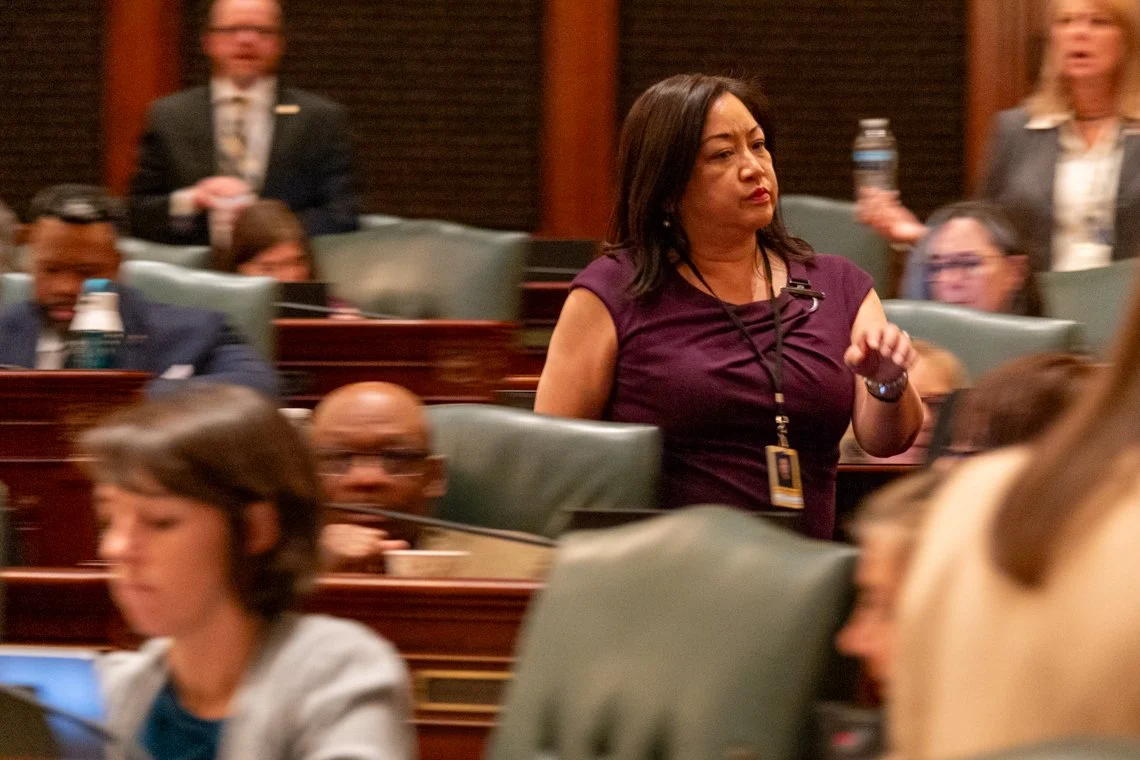
Rep. Theresa Mah, D-Chicago, rushes across the House floor shortly after her bill failed — a rare embarrassment for a lawmaker in the legislature’s supermajority. (Capitol News Illinois photo by Andrew Adams)