Raoul says ‘I do not want to go to Washington,’ rules out bid for U.S. Senate

Illinois attorney general says he can do more by staying in his current job

By PETER HANCOCK
Capitol News Illinois
phancock@capitolnewsillinois.com

While many Illinois Democrats wait anxiously to hear whether U.S. Sen. Dick Durbin will run for reelection in 2026 or step down after five terms in the Senate, at least one incumbent officeholder appears to be ruling himself out as a potential successor.

Illinois Attorney General Kwame Raoul said Tuesday he is not interested in running for that job, or any other elected position in the foreseeable future.

“I do not want to go to Washington. I want to stay here,” Raoul told a luncheon audience at the City Club of Chicago. “And this is no knock on Sen. Durbin or Sen. (Tammy) Duckworth. I truly believe what I do on a day-to-day basis (as attorney general) has more impact than what I could do as U.S. senator.”

Durbin, who turned 80 in November, currently serves as the Democratic whip in the Senate, the second-highest ranking position in the caucus, behind Democratic Leader Chuck Schumer, of New York. But he is widely expected to announce in the coming weeks whether he will run for another term, and there has been rampant speculation in political circles about who might succeed him.

Raoul, 60, has become the target of much of that speculation in recent months by joining numerous multistate lawsuits that seek to block many of President Donald Trump’s executive orders and other policy initiatives.

Those include Trump’s efforts to halt the recognition of birthright citizenship that is recognized under the 14th amendment; to freeze the distribution of federal funds previously appropriated by Congress; to dismantle the U.S. Department of Education, and to terminate the employment of tens of thousands of federal employees.

But Raoul, who served 15 years in the Illinois Senate before being elected attorney general in 2018, said emphatically Tuesday he does not want to be considered for Durbin’s seat, insisting he can do more to counteract the Trump administration from the attorney general’s office than from anywhere else.

“I know that the attorney general's office, and it's in every state, produces more than a single U.S. senator can for its constituency,” he said. “So why would I leave doing something more important to doing something — I’m not saying unimportant — but less impactful?”

Durbin himself has come under criticism from fellow Democrats, including Gov. JB Pritzker, for voting last month in favor of a Republican-backed spending plan that averted a partial government shutdown but also provides for implementing massive spending cuts over the next 10 years.

Pritzker called that vote “a huge mistake,” but Durbin defended it by telling reporters at a March 18 event in Taylorville, “I have never voted for a shutdown and I didn’t last week.”

In his comments Tuesday, Raoul said the budget vote caused a rift within Democratic circles nationally, but he said he would not second-guess Durbin or any of the other Democrats who voted to let the spending package go through.

“I don't know how I would have voted on the continuing resolution,” he said. “But I'm not going to drag anybody over the coals without a very healthy, well-informed debate about everything that they were facing in that moment.”

Capitol News Illinois is a nonprofit, nonpartisan news service that distributes state government coverage to hundreds of news outlets statewide. It is funded primarily by the Illinois Press Foundation and the Robert R. McCormick Foundation. 

Attorney General Kwame Raoul, left, answers questions from City Club of Chicago CEO Dan Gibbon during a luncheon appearance Tuesday, April 1, 2025. (Credit: City Club of Chicago)

Former Wayne City police chief pleads guilty to corruption charges

EAST ST. LOUIS, Ill. – A former Wayne City police chief appeared in federal court Monday and admitted to selling forfeited items confiscated by the department for his personal benefit.

Anson Fenton, 46, of Belle Rive, pleaded guilty to one count of misapplication of property from federally funded programs and one count of interstate transportation of stolen property.

“The U.S. Attorney’s Office strongly supports our police, but we must take decisive action when things like this happen,” said U.S. Attorney Steven D. Weinhoeft. “By taking unauthorized possession of forfeited property for his personal benefit, the defendant used his position of trust as police chief to deceive the community he was sworn to protect.”

Asset forfeiture is a legal process to confiscate the means or proceeds of a crime and can apply to money, vehicles, real estate and more. Wayne City stores forfeited items at the Wayne City Police Department until city officials pass an ordinance to authorize the sale of the property.

As police chief, Fenton was responsible for safeguarding, documenting and preserving property within the care, custody and control of the Wayne City Police Department.

"No one is above the law, especially those charged with upholding the law, and the Illinois State Police will continue to work with our partners in law enforcement at all levels to protect the public's trust," said ISP Director Brendan F. Kelly.

According to court documents, Fenton sold two motorcycles, a 2017 Harley-Davidson and a 2000 Harley-Davidson, valued at more than $5,000 and kept the proceeds without authorization from the Wayne City Board of Trustees.

He also traded one 2022 Suzuki Hayabusa motorcycle for a 1991 Ford Mustang for his personal benefit. He admitted to driving the Suzuki over state lines to complete the sale from Wayne City to Alexandria, Virginia.

For the charges, Fenton could face up to 10 years’ imprisonment and fines up to $250,000 per count. His sentencing hearing is scheduled for 10:30 a.m. on July 30 at the federal courthouse in East St. Louis.

Wayne City is a village in Wayne County in the Southern District of Illinois.

The Illinois State Police is leading the investigation. Assistant U.S. Attorney Kathleen Howard is prosecuting the case.

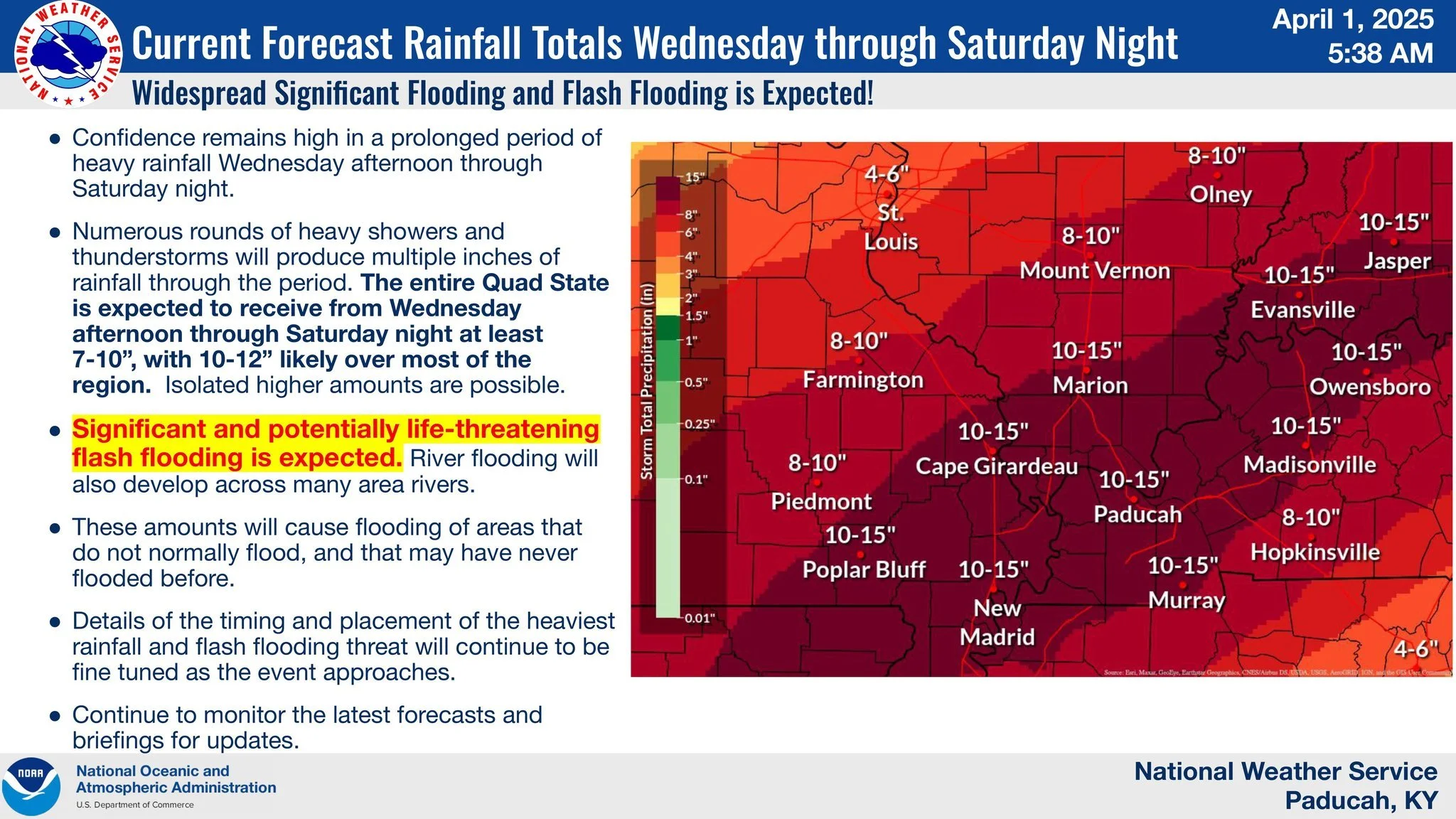
Mayor Urges Prep Ahead Of Possible Historic Rains

From Mt. Carmel Mayor Joe Judge:

The City of Mt. Carmel Public Works Department will be doing everything we can to keep storm drains clear and make sure all of the critical culverts are clear. With that being said….

We urge all citizens to take precautions ahead of this extreme rainfall. Please clean your gutters, check sump pumps, and clear out drains and culverts around your home to be sure they’re clear before the water starts backing up. Older homes with block basements are very prone to flood and we suggest that you elevate valuables that are stored there.

If you have to get out in the weather do not drive into flood water and if you see City Crews and they are stopped clearing street drains please give them room.

If you have a floor drain in your basement, today would be a great day to check your backflow prevention valve, also known as “check valve”. Unfortunately there are times that storm water infrastructure just cannot keep up with the amount of rainfall in a period of time and this will cause backups. A backflow preventer can stop those backups from happening.

Please keep watching for updates on WSJD and other social media for more information.

Traffic stop leads to arrest of duo on drug charges

On March 31, 2025, at 3:34 p.m. Gibson County Deputy Eric Powell conducted a traffic stop on US 41 near County Road 800 South after observing a Gray in color Ford Edge failing to maintain its lane of travel.  Upon approaching the vehicle Deputy Powell identified the driver as 40 year old Carla Embry of Harrisburg, Illinois.  While speaking with Ms. Embry Deputy Powell detected multiple clues that drug activity was or had recently taken place in the vehicle.  At that point Deputy Powell asked for Sgt. Loren Barchett and his K9 partner Duke to come to the scene to assist in a roadside drug investigation.  At the conclusion of the investigation Ms. Embry as well as 46 year old Paul Abshear of Henderson, Kentucky were taken into custody and transported to the Gibson County Jail. 
 
Upon arriving at the jail 40 year old Carla Embry was charged with Possession of Methamphetamines, Possession of Paraphernalia, and Operating a Vehicle While Intoxicated.  46 year old Paul Abshear was charged with Possession of Methamphetamines and Possession of Paraphernalia. 
 
Assisting Deputy Powell in his investigation were Deputies Wes Baumgart, Sgt. Loren Barchett, and his K9 partner Duke. 
 
All criminal defendants are to be presumed innocent until, and unless proven guilty beyond a reasonable doubt in a court of law.

Delays In Monday's Big Trash Pick Up

There’s been a hiccup in the Spring big trash pickup in Mt. Carmel. At yesterday’s City Council meeting, garbage commissioner Susan Zimmerman said some areas in Mt. Carmel may see their trash picked up later than usual this week…

And, if you forgot to set your big items out, Zimmerman said you’re out of luck if the truck has already been past your house…

The electronics recycling day in Mt. Carmel is coming up on Saturday, May 3rd.

City Council Adopts 1% Sales Tax

With no discussion, the Mt. Carmel City Council has unanimously passed a 1% sales tax to help pay for the new city pool. The 1% sales tax will replace the property tax increase that city voters overwhelmingly approved last November. At yesterday’s City Council meeting, Mayor Joe Judge said there are some items that won’t be covered by the additional 1%....

Yesterday’s meeting was moved up to noon so that the ordinance could be passed and mailed before the March 31st deadline. The new sales tax will go into effect July 1st. Judge said the sales tax is similar to the one voters approved several years ago for District #348.

Drone & K-9 Help Apprehend Suspect

On 3.31.25 at 12:18 a.m. Wabash County 911 received a complaint from 12041 Highway 1, who stated that his step-son was intoxicated and being belligerent. Caller further stated the step-son, Lewis Wade Linder, 36, was armed. It was then reported that Linder had discharged a .45 handgun inside the residence.  Next the caller stated that Linder had gone out to is vehicle, a white Audi. It was then reported that the caller had heard another "shot" outside. 

When the deputy arrived a .45 caliber handgun was located in the Audi, and the deputy observed a person running from the garage into the backyard of the residence. The MCPD K9 unit arrived to assist and began to track the Linder. K9 Eleven tracked some 800 yards circling back into the thick wooded area behind the residence. The Wabash County Drone was deployed and helped pin point Linder's position which allowed the K9 unit and Sheriff's Office to take Linder into custody without incident. 

Lewis Wade Linder was transported o the Wabash County Jail and  issued a statement of charge for Reckless Discharge of a Firearm (class 4), Aggravated Assault -discharging a firearm (Class A), Resisting Arrest (class A), and Possession of Firearm no FOID - FOID revoked (class 4) and issued a court date of 04/14/25 at 09:00. Linder is currently held at the Wabash County Jail pending detention determination.

The use of the Wabash County Drone and the assistance of MCPD K9 Eleven and Officer Nelson were a direct result to a swift and safe resolution to this incident. We cannot thank our community partners enough for their willingness to support our work.  

Mt. Carmel Woman Arrested For DUI

On 3/31/25 at approximately 4:30 a.m. Wabash County 911 received a call about a vehicle that was parked in the southbound lane of the roadway in the area of 18421 Friendsville Ave.

While en route, the deputy was notified by dispatch that additional callers advised that the vehicle had drifted into the ditch and the driver was asleep in the driver's seat.

 Upon making contact with the driver, 20-year-old Alexis K. Lewis, of Mt. Carmel , a roadside investigation was conducted. That investigation resulted in Lewis being taken into custody for driving under the influence and illegal consumption by a minor. Lewis was taken to the Wabash County jail and charged with the above offenses. Lewis was processed and later released. 

Illinois governor moves to slash cover crop funds despite rising demand

Farmers and environmental advocates warn conservation efforts could stall without it. 

By JENNIFER BAMBERG

Investigate Midwest

jennifer.bamberg@investigatemidwest.org

SPRINGFIELD — When Steve Stierwalt studied agriculture at the University of Illinois in the 1970s, soil health wasn’t commonly taught or discussed. Faculty often told their young farming students to put all their faith in commercial fertilizers. 

But over his 40 years as a corn and soybean farmer in Champaign County, Stierwalt said soil erosion, which can cause fertilizer and manure runoff to end up in nearby rivers and streams, has become an increasingly serious problem. 

“When we plowed, we plowed pretty much everything,” except for a row near the fence line, Stierwalt said. “The grass near the fence row kept getting taller, it seemed to me. I came to understand that it wasn’t the fence row getting taller, it was the soil in the fields that was getting shorter.”

In the early 2010s, Stierwalt started experimenting with cover crops, which can help hold soil in place and reduce runoff pollution.

“This valuable resource that we take for granted, we were letting it get away,” Stierwalt said. “We have some of the best soil in the world here, and we have to protect it.” 

Six years ago, Illinois became the second state in the nation to offer subsidies to farmers for planting cover crops in the fall, an effort to reverse its status as one of the worst states for agriculture runoff. Demand for the Fall Cover for Spring Savings program — which offers a $5 per acre discount on the following year’s crop insurance premiums — has outpaced state funding every year since. 

However, despite the program’s popularity and calls from environmentalists and farmers for its funding to increase, Gov. JB Pritzker has proposed a 31% funding cut.

Pritzker, a Democrat, recently proposed an overall $2 billion increase to next year’s state budget. But he also recommended cuts to several programs, including reducing the cover crop insurance credit budget from $960,000 to $660,000. 

Pritzker’s office did not comment but the governor referenced program cuts in a recent address.

“I have made difficult decisions — including to programs I have championed, which is hard for me,” Pritzker said during his State of the State and budget address in February. 

Two state lawmakers introduced bills this legislative session to increase the program’s annual funding to $6.1 million. They say it’s crucial to support the practice, which will benefit communities in Illinois and beyond.

The bills did not clear a recent committee deadline. However, lawmakers can still negotiate funding for the program as they continue to work to pass a budget by the end of May.

Illinois is one of the leading states for farm fertilizer runoff and one of the top contributors to the Gulf of Mexico’s dead zone, a barren area of around 4,500 square miles of coastal waters deadly to fish, shrimp and other marine life. It costs the region’s fishing and tourism industry millions annually.  

Runoff from Illinois farms has only worsened, according to a 2023 state study. From 2017-21, average nitrate-nitrogen loads increased by 4.8%, and total phosphorus loads increased by 35%, compared to the 1980-1996 baseline. 

Nutrient levels were highest between 2016 and 2020 before declining slightly. The improvement was attributed to regulatory permits on wastewater treatment plants, which also pollute waterways. 

However, nitrate levels remain well above the state’s reduction goals. 


Less than 6% of Illinois farmland uses cover crops

The soil in Illinois is famously fertile and much of the land is flat. The soil isn’t highly erodible like soil on a slope or a hill might be. But when fields are left bare after harvest, the soil can easily blow away in the wind or wash away in storms, depositing fertilizers and chemicals into waterways. 

Cover crops, which include winter wheat, crimson clover, cereal rye, oats or radish, are planted after harvest and before winter. The crops can reduce soil erosion, break up compacted soil, provide a habitat for beneficial insects and wildlife, and prevent latent fertilizer from leaching into rivers and streams. 

Since the Fall Cover for Spring Savings program began in 2019, the Illinois Department of Agriculture has received more applications than the program can fund. 

This year, the program sold out in two hours.

Under current funding levels, only 200,000 acres are available, which advocates say is too small.

“At the rate conservation is being invested in right now for agriculture, it would take 200 years to hit the goals under the Nutrient Reduction Strategy. And that’s assuming … there would be new adopters,” said Eliot Clay, executive director of the statewide Association of Soil and Water Conservation District. 

The Nutrient Loss Reduction Strategy (NLRS) is a statewide, multi-agency effort to reduce the amount of nutrients in Illinois waterways and the Gulf of Mexico. The policy working group’s latest report, produced in 2023, found that to meet just half of its goals of reducing runoff, nearly all of Illinois’ corn and soybean farmers would need to adopt cover crops. 

“It doesn’t mean the state won’t meet the goal,” a spokesperson for the NLRS team at University of Illinois Extension said in an emailed statement to Investigate Midwest. “There is quite a bit of variability of riverine nutrient loads at watershed scales for nitrogen and phosphorus.” 

However, the spokesperson added that more research, data acquisition, and planning are needed at watershed scales. 

Out of the state’s 26.3 million acres of farmland, an estimated 3% to 6% grew cover crops in 2022, according to USDA data.

Kristopher Reynolds, Midwest director for American Farmland Trust and a fifth-generation farmer in Nokomis, said Illinois needs to see cover crop adoption of at least 15% and more state and federal incentives are needed. 

The Gulf Hypoxia Task Force, a federally funded program through the U.S. Environmental Protection Agency, has provided additional funding to supplement the cover crop program. However, the Trump administration’s freeze of some federal grants might put those funds at risk. 

Earlier this year, the Illinois Department of Agriculture was awarded a $25 million grant from the EPA to support conservation practices for the next three years. 

“We don’t know the status (of the grant),” said Jerry Costello II, director of the Illinois Department of Agriculture, while speaking to the House Appropriations Committee on March 12. “Last that we’ve heard, things looked good. But that’s been a while.”

“We’ve got two and a half months left in this process in Illinois, right?” added Costello, citing the time the state has to finalize its 2026 budget, which begins in July 2025. “Two and a half months plus or minus. So surely we’ll have some guidance … we certainly hope so.”

Because of the sheer scale of the agriculture industry, government regulations requiring conservation practices can be difficult to carry out, said Clay, the executive director of the Soil and Water Conservation District. 

Farmland covers 75% of the entire state of Illinois, and even if all farmers employed precision sensors to track runoff points, it would cost billions, Clay said. 

There would also need to be an army of workers to track and enforce regulations. 

However, “industry self-regulating usually doesn’t work, and it hasn’t worked in ag, because that’s basically what they’ve been doing for the most part,” Clay said. What’s needed, he added, is more public-private partnerships. 

Stierwalt, the farmer in Champaign County, helped develop STAR, or Saving Tomorrow’s Agricultural Resources, which gives farmers a five-star score based on their conservation practices.

The state adopted the framework in 2023 to support the state’s nutrient loss reduction goals. 

Stierwalt said the goal is to get companies to purchase agricultural commodities based on the rating system.

If the public and industries that rely on agricultural goods for ethanol or food products want sustainably raised crops, then the farmers will grow them, he said. 

Cover crop barriers include both cost and culture

Cover crops have long-term benefits but can be expensive and require extra work. Crop yields may even decrease during the first few years. 

Cover crops cost roughly $35 to $40 an acre, and farmers don’t make a direct profit from it. The crops are planted in the fall and aren’t harvested. Instead, as the plants die and decompose, they provide nutrients back into the soil for the new commodity crop. Some farmers terminate the crops with chemical herbicides.

But the $5 an acre from the Fall Cover for Spring Savings program acts as an incentive for doing the right thing, which will pay off later, said Ed Dubrick, a small pasture poultry farmer in Cissna Park who also farms vegetables with his wife. 

“It’s an investment because you know you’re doing right by the environment,” Dubrick said. “You know you’re doing right by your land, and long term, you’re going to build your soil health, and that will impact your bottom line.” 

There are also cultural barriers to planting cover crops. Row crop farmers often pride themselves on tidy, neat rows, and cover cropping and no-till can leave fields looking messy. 

Walter Lynn, a retired certified public accountant and farmer in Springfield, said farmers sometimes only cover crop fields that are out of sight from their neighbors or the road because they’re afraid they’ll be judged. 

At a recent soil health conference in Omaha, Lynn said he met a farmer who believes he can’t openly discuss his practices with his equipment dealer, saying, “There’s a vulnerability that ag doesn’t deal well with.” But at the conference, Lynn said the farmer found a welcoming atmosphere: “It’s so good to come to this space at this meeting … I feel like I’m a member of the cover crop witness protection.”


This article first appeared on Investigate Midwest and is republished here under a Creative Commons license.

Investigate Midwest is an independent, nonprofit newsroom. Its mission is to serve the public interest by exposing dangerous and costly practices of influential agricultural corporations and institutions through in-depth and data-driven investigative journalism. Visit online at www.investigatemidwest.org 


Soybeans planted in cereal rye cover crop. Planting cover crops can reduce soil erosion, break up compacted soil, provide a habitat for beneficial insects and wildlife, and prevent latent fertilizer from leaching into rivers and streams. (Photo by Jennifer Jones, Illinois Extension)