Eliminating immigrant spending, boosting education funding top Senate Republican budget priorities

Gov. JB Pritzker set to give budget address Wednesday

By BRIDGETTE FOX
Capitol News Illinois  
bfox@capitolnewsillinois.com 

SPRINGFIELD – A day ahead of Gov. JB Pritzker’s annual budget address Wednesday, Senate Republicans said they want budget negotiations to include cuts to noncitizen spending while bringing in “transparent accounting.”

The Governor’s Office of Management and Budget predicts the state would face a $3.2 billion deficit in fiscal year 2026 if no changes were made to revenue or spending. Federal pandemic aid is no longer flowing, and tax revenue projections are static. 

The new fiscal year will begin July 1.

Senate Republicans want the Pritzker administration to provide more details about how the state has spent money on programs for asylum seekers and undocumented residents. They argue the state has made it difficult to see exactly where resources have been spent.

“We're unable to do that because of all the workarounds by this administration through executive orders and the state of emergency declarations that are constantly issued,” Senate Minority Leader John Curran, R-Downers Grove, said Tuesday at a Capitol news conference.

Curran was referencing Pritzker’s 30 separate, but altogether similarly worded, emergency declarations made since September 2022 in response to the asylum seekers transported from Texas and southern states to cities around Northern Illinois.

The declarations allow Pritzker to allocate funding for emergency services to cities like Chicago and its suburbs to support asylum seekers. The governor’s most recent declaration related to asylum seekers was filed Jan. 31. 

Sen. Sue Rezin, R-Morris, claimed the declarations were a way for Pritzker to “move money in the shadows,” as lawmakers aren’t sure how much money has been allocated from the budget for disaster declarations. 

However, the comptroller’s office has a database showing specific state expenditures on payments processed by the comptroller’s office for asylum seekers beginning in November 2023. Data shows the state has spent $158.7 million on asylum seekers since then. 

Senate Republicans said they don’t want taxes raised to fix the shortfall; instead, they want the emergency declarations to stop.

“We're calling on Gov. Pritzker to not increase taxes on Illinois families and businesses and present a transparent plan of how he intends to address the budget hole,” Rezin said.

Pritzker said in January that increasing taxes to raise revenue would be a “last resort.”

Curran also criticized the Illinois State Board of Education for not releasing $50 million from this year’s budget to fund after school programs.

ISBE said it was waiting on direction about how to release that $50 million, and Democratic lawmakers said they were frustrated by ISBE. In early February, Rep. Will Guzzardi, D-Chicago, said lawmakers would explore giving ISBE more guidance to ensure the money is released.

Capitol News Illinois is a nonprofit, nonpartisan news service that distributes state government coverage to hundreds of news outlets statewide. It is funded primarily by the Illinois Press Foundation and the Robert R. McCormick Foundation.  


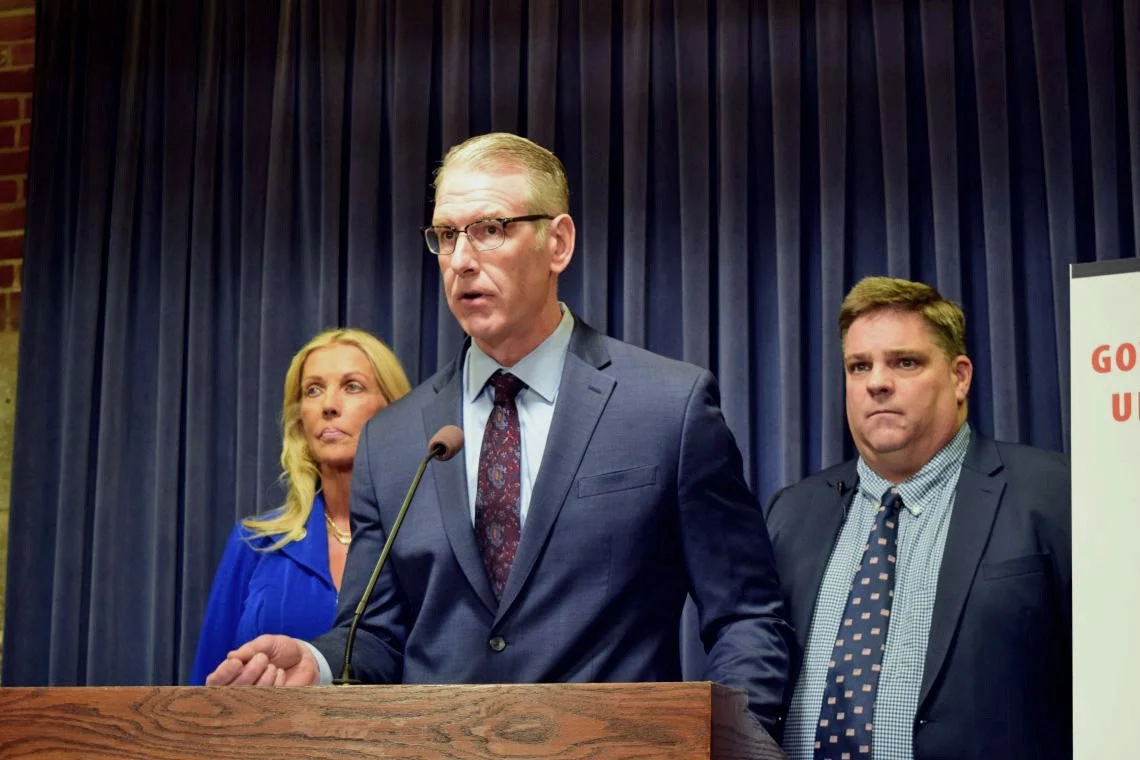
Senate Republican Leader John Curran, R-Downers Grove, center, speaks at a Statehouse news conference Tuesday, Feb. 18, 2025, about Gov. JB Pritzker’s upcoming budget address. Joining him were Sen. Sue Rezin, R-Morris, left, and Sen. Chapin Rose, R-Mahomet, right. (Capitol News Illinois photo by Jade Aubrey)

Committee advances bill to ban vehicle searches based on smell of cannabis

Legislation comes after state Supreme Court ruled burnt, raw cannabis odors are governed by different laws 

By BEN SZALINSKI
Capitol News Illinois
bszalinski@capitolnewsillinois.com 

An Illinois Senate committee advanced a bill on Tuesday that would strictly limit police’s ability to search a vehicle after smelling cannabis. 

The Senate Criminal Law Committee voted 7-3 to advance Senate Bill 42, which would eliminate the requirement that cannabis be transported in vehicles in an odor-proof container. It would also prohibit police from searching a vehicle based only on the odor of burnt or raw cannabis if the occupants are at least 21 years old. 

The bill comes after the Illinois Supreme Court issued a pair of rulings last year. The court ruled in September that the smell of burnt cannabis did not give police probable cause to search a vehicle, but three months later ruled the smell of raw cannabis was probable cause for a search. 

“This sets up a contradictory situation for law enforcement,” bill sponsor Sen. Rachel Ventura, D-Joliet, told the committee. 

Illinois law requires drivers to store cannabis in a “sealed, odor-proof, child-resistant cannabis container” when in a car, and it must be “reasonably inaccessible while the vehicle is moving.” When the smell of raw cannabis is detected, that indicates the statute is being violated, the court ruled in December. 

Read more: Smell of raw cannabis allows police to search a vehicle, Illinois Supreme Court rules

“The odor of raw cannabis strongly suggests that the cannabis is not being possessed within the parameters of Illinois law,” Justice P. Scott Neville wrote in the court’s majority opinion in December. “And, unlike the odor of burnt cannabis, the odor of raw cannabis coming from a vehicle reliably points to when, where, and how the cannabis is possessed — namely, currently, in the vehicle, and not in an odor-proof container.”

Read more: High court: Smell of burnt cannabis is not cause for warrantless vehicle search

Justice Mary Kay O’Brien wrote a dissenting opinion in the December ruling.

“It makes no sense to treat raw cannabis as more probative when the odor of burnt cannabis may suggest recent use, whereas the odor of raw cannabis does not suggest consumption,” O’Brien wrote. “If the crime suggested by the odor of burnt cannabis is not sufficient for probable cause, then certainly the crime suggested by the odor of raw cannabis cannot be either.”

The American Civil Liberties Union of Illinois supports Ventura’s bill.

“Drivers and passengers are legally able to possess cannabis in our state,” Alexandra Block, director of the Criminal Legal System and Policing Project for the ACLU of Illinois, said in a statement. “This confusion over the odor of cannabis should not be a trigger for officers to continue to harass and delay motorists with intrusive searches.”

But law enforcement warned the bill jeopardizes public safety by making it harder for police to catch drug traffickers and drivers impaired by cannabis. 

Illinois Sheriffs’ Association Executive Director Jim Kaitschuk provided the committee an odorless container with raw cannabis to demonstrate people can transport cannabis in compliance with the law. 

“Through our training and experience, we can make this distinction” between burnt and raw cannabis, Kaitschuk said. 


Capitol News Illinois is a nonprofit, nonpartisan news service that distributes state government coverage to hundreds of news outlets statewide. It is funded primarily by the Illinois Press Foundation and the Robert R. McCormick Foundation.

State official: renewable investments ‘best thing’ to lower energy costs

House committee with history of supporting environmentalist proposals gets new chair 

By ANDREW ADAMS
& LEONARDO PINI
Capitol News Illinois
news@capitolnewsillinois.com

SPRINGFIELD — With an increasing number of officials warning Illinois might struggle to meet its renewable energy goals, regulators and lawmakers met Tuesday to discuss how the state should regulate its energy industry. 

The state is facing a potential decrease in electricity generation at the same time demand is increasing, partially because of data centers’ high demand for energy. Lawmakers are likely to discuss several proposals to address these issues this spring, including new energy efficiency programs in downstate Illinois and incentives for energy storage technology. 

Read more: Worried about grid reliability, state officials seek to boost renewables, energy storage

On Tuesday, Illinois Commerce Commission Executive Director Jonathan Feipel lent credence to some concerns around energy generation. The ICC regulates electric and natural gas utilities and is one of the major entities enforcing the state’s renewable energy goals. 

“If we all sat and did nothing, we would have a significant problem when we get to 2030,” Feipel told lawmakers. 

But Feipel, who said he was “bullish” on the issue, noted that the state will be able to meet its clean energy targets if it quickly develops additional sources of renewable energy, expands energy efficiency programs and rolls out new ways of pricing electricity. 

“We have to think really thoughtfully around how we bring all those tools to bear,” Feipel said. 

This lines up with the goals that Rep. Carol Ammons — the Urbana Democrat who took over as chair of the House Energy and Environment Committee earlier this year — said she has for the body. 

In an interview after Tuesday’s committee hearing, Ammons said she hopes the committee will build on the state’s current energy and climate laws: the 2021 Climate and Equitable Jobs Act and the 2016 Future Energy Jobs Act. 

Those laws laid out timelines for transitioning the state to only relying on clean energy and shutting down the state’s fossil fuel power plants. Under current law, all electricity in the state will come from renewable sources and nuclear power by 2050. CEJA and FEJA also laid out funding mechanisms for renewable energy, including state-funded incentive programs and charges on consumer utility bills to cover costs for new renewable developments. 

Read more: Pritzker touts climate investments despite renewables lagging state goals

“Balancing the things that are working with CEJA and tweaking where they are not,” Ammons said of her goals. “Or where FEJA may have not covered something, we’ll look to try to tweak that.” 

Ammons also noted that she hopes the committee puts a renewed emphasis on diverse workforce development “to help us get to a clean energy economy.” 

AMMONS 

But the focus on renewable energy development raised concerns for some Republicans on the committee. Rep. Dave Severin, R-Benton — the ranking Republican on the committee — emphasized his position at the beginning of the group’s first meeting of the year. 

“I like coal,” Severin said, speaking at the beginning of the committee’s first meeting this year.

Committee member Rep. Brad Halbrook, R-Shelbyville, said in an interview Tuesday evening that CEJA opponents had warned of rising prices when the law passed nearly four years ago.

Read more: Massive energy bill becomes law, investing billions between renewable, nuclear sectors

“Republicans talked about what would happen if CEJA was enacted — that energy costs would go up, we would have less reliable sources of energy, it would drive jobs out of the state and it would provide that less clean energy would be imported into the state,” he said. “All those things have happened.”

The price of electricity in northern Illinois spiked to the highest point in the last decade over the summer of 2024, according to data from the Bureau of Labor Statistics. Prices have also generally risen in Illinois and many parts of the country since being relatively low in 2020 and 2021.  

“The best thing that we can possibly do is to make sure we’re making investments in generation in Illinois because that will ultimately put downward pressure on prices,” Illinois Power Agency director Brian Granahan told lawmakers. 


Proposals on the table 

Lawmakers are likely to consider several policies during this legislative session — which ends in May — to address some of the issues facing Illinois’ energy sector. 

In January, during a “lame duck” session before the inauguration of current lawmakers, the General Assembly passed a bill that requires a study of energy storage. Proponents of that technology say it could be a way to ensure that electricity from wind and solar plants deliver power at times of high demand.

Feipel said battery storage was “infamously” left out of CEJA, but that it is likely going to be addressed soon. 

“You’ll see proposals on battery storage coming through the General Assembly — probably this session,” Feipel said.

Lawmakers are also likely to take up “energy efficiency” legislation to put the same requirements on Ameren — the electric utility that serves most of downstate Illinois — as are on Commonwealth Edison, the utility serving northern Illinois. 

“In lame duck, we were very close on an agreement on energy efficiency — putting Ameren on parity with ComEd,” Illinois Environmental Council executive director Jen Walling told Capitol News Illinois last week. 

A proposal like that is likely to be considered at some point this spring, something that Feipel indicated could benefit consumers. He said that, as a general rule, “every dollar you spend on energy efficiency programs actually saves customers two to three dollars.” 

“It’s a perfect place to look to expand,” Feipel later added. 

FEIPEL 

Data centers 

One of the major issues facing Illinois is growing electricity demand from data centers — large facilities that run computers for artificial intelligence companies, stock exchanges and other high-tech enterprises. Those demands, according to Feipel, “came out of nowhere” and that it was a “critically important” issue.

“This is a real challenge that I think we’re facing,” Feipel said. “And I don’t think it’s insurmountable.”

Consumer advocates worry that data centers could force higher energy prices for residential customers. 

A new report, released last month and conducted by a coalition of environmental and consumer groups, examined the connection between the data centers and consumer costs and the transition toward renewable energies in the United States. 

“We believe there is great promise in AI generally, but it is important to distinguish between that and the specific generative AI platforms and their insatiable computing needs,” said Abe Scarr, the Energy and Utilities Program Director at PIRG and a coauthor of that report, in an interview with Capitol News Illinois. “We have seen the DeepSeek technology from China, which can do the same things with much less computing power.” 

According to data from the Electric Power Research Institute quoted in the report, in 2023, Illinois was among the top 15 states for estimated percentage of data center electricity use. It accounted for about 5.5% of the total electricity consumed in the state — a number researchers believe is destined to grow due to new data centers opening in Illinois. 

Another issue addressed in the report is the subsidization of data centers, which, according to the report, “benefit some of the most profitable companies in the world while creating major costs and electrical grid strain for communities.” 

Tax breaks for data centers have ballooned under Gov. JB Pritzker. The state approved $468 million worth of tax credits to data centers between mid-2019, when the state’s data center tax credit first took effect, and mid-2023. The annual cost for data center tax incentives was $370 million by 2024, according to the report. 

“We should think twice about promoting those developments here,” said Scarr. “Tax credits should end right away. We should slow down instead of incentivizing further.”


Leonardo Pini is a graduate student in journalism with Northwestern University’s Medill School of Journalism, Media, Integrated Marketing Communications, and a Fellow in its Medill Illinois News Bureau working in partnership with Capitol News Illinois.

Capitol News Illinois is a nonprofit, nonpartisan news service that distributes state government coverage to hundreds of news outlets statewide. It is funded primarily by the Illinois Press Foundation and the Robert R. McCormick Foundation.



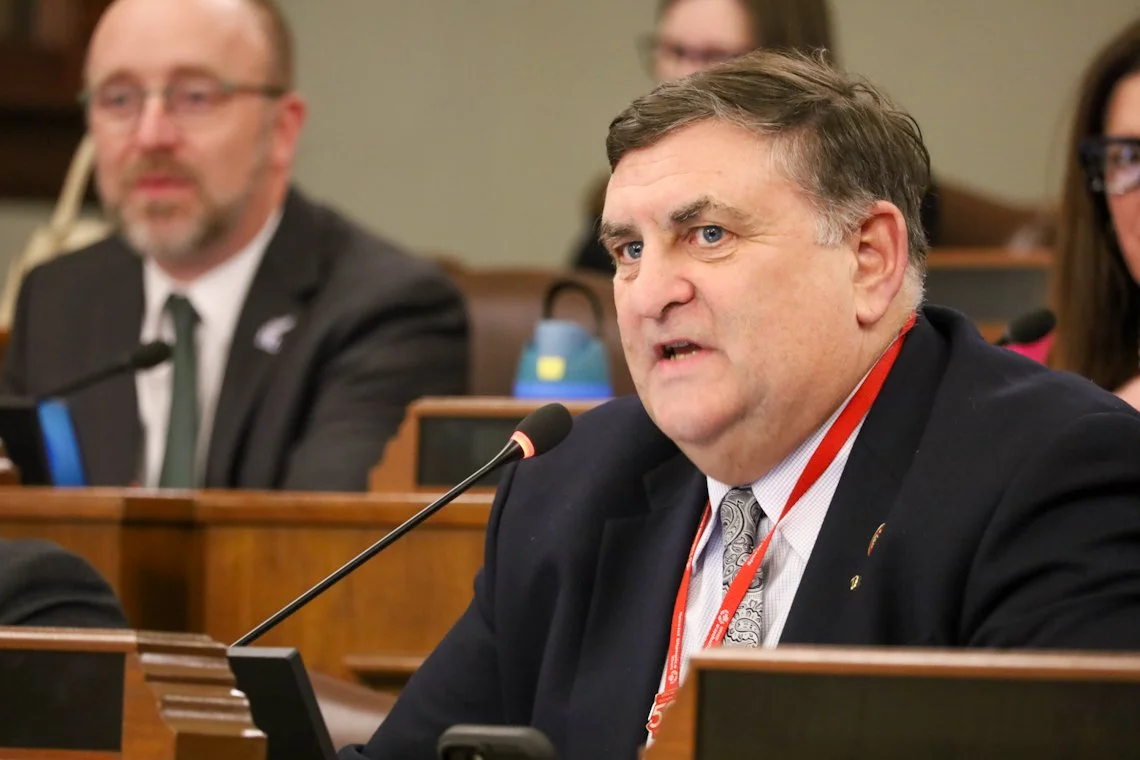
Rep. Dave Severin, R-Benton, speaks during a House Energy and Environment Committee hearing. (Capitol News Illinois photo by Andrew Adams)

Pritzker to call for expansion of 4-year degree offerings at some community colleges

Select institutions could offer bachelor’s degrees in high-need career fields

By PETER HANCOCK
Capitol News Illinois
phancock@capitolnewsillinois.com

SPRINGFIELD – Gov. JB Pritzker plans to offer a proposal in his budget address Wednesday that would allow some community colleges to offer four-year baccalaureate degrees.

The goal, according to the governor’s office, would be to make four-year degrees more accessible to working adults, particularly those who don’t live near a public university.

That would be a big change for Illinois community colleges, which typically offer two-year associate’s degrees and other kinds of training certificates. But Martin Torres, Pritzker’s first assistant deputy governor for education, said it’s a concept already in use in many other states.

“There are 24 states across the country that have this type of policy in place, including Indiana, Missouri and Michigan just in the Midwest,” he said in an interview with Capitol News Illinois. “There are almost 200 community colleges across the country who are doing this today. And so the concept is certainly not new. It's something that's been advocated for here by our own community colleges. And we really felt like it was time to do everything we can to reduce barriers across the state in earning a B.A. in high-need areas.”

Torres said the governor’s office will push for legislation this year to authorize community colleges to offer four-year programs specifically tailored to meet the employment needs of their communities in high-demand employment areas. Examples of those might include health care, early childhood education or advanced manufacturing, he said.

The legislation would allow community colleges to offer programs in subject areas where they have identified unmet workforce needs in their region. The proposed programs would also need to be approved by both the Illinois Board of Higher Education and the Illinois Community College Board.

Schools would also have to demonstrate how their proposed programs would reach students who are underserved by other higher education programs in the state.

The governor’s proposal would also cap the tuition rates community colleges could charge for a baccalaureate program. Schools would not be allowed to charge more than 150% of their regular tuition for the third and fourth years of a four-year program.

By comparison, according to the governor’s office, Illinois public universities currently charge tuition and fees that are nearly three times higher than those of community colleges while private, not-for-profit universities charge rates that are more than six times higher.

There are currently 15 public universities in Illinois, including three medical schools. Only two of those – the Southern Illinois University campuses in Carbondale and Edwardsville – are located south of Interstate 70.

Community colleges, by contrast, are spread throughout the state more evenly. Illinois is divided into 39 community college districts, each governed by a board of trustees that has its own taxing authority. 

Torres said one of the main goals of the governor’s proposal is to make four-year degrees more accessible to a segment of the population that doesn’t fit the standard profile of an undergraduate college student.

“What we've observed of the student profile across the country where this is done is that those students tend to be older, they tend to be more diverse, and they tend to have personal logistics and circumstances that just don't allow for them to up and move to wherever a four-year public university may be,” he said.

It was not immediately known prior to the governor’s address, however, whether state universities will support the idea of allowing community colleges to offer degree programs that might duplicate, or even compete with, established programs at the universities.

“I don't want to speak on behalf of the public universities on the subject,” Torres said. “What I would say is, when we look at the experience of other states throughout the country – Florida was a real early adopter of the community college baccalaureate – there’s no evidence in the enrollment patterns there or anywhere else across the country that would suggest that this is going to have a negative impact on public university enrollment.”

Torres said the legislation being proposed does not include funding for the additional cost of launching new degree programs. He said the bill proposes to give community colleges permission to offer four-year degrees, but it would be up to those schools to decide for themselves how to pay for any additional costs associated with the programs.

He also said the governor’s proposal to expand community college degree offerings is unrelated to any other higher education plan being considered in the General Assembly this year, including proposals in the House and Senate to overhaul the state’s funding system for public universities. Those plans would replace the current system with one similar to the Evidence-Based Funding model used for PreK-12 education.


Capitol News Illinois is a nonprofit, nonpartisan news service that distributes state government coverage to hundreds of news outlets statewide. It is funded primarily by the Illinois Press Foundation and the Robert R. McCormick Foundation. 

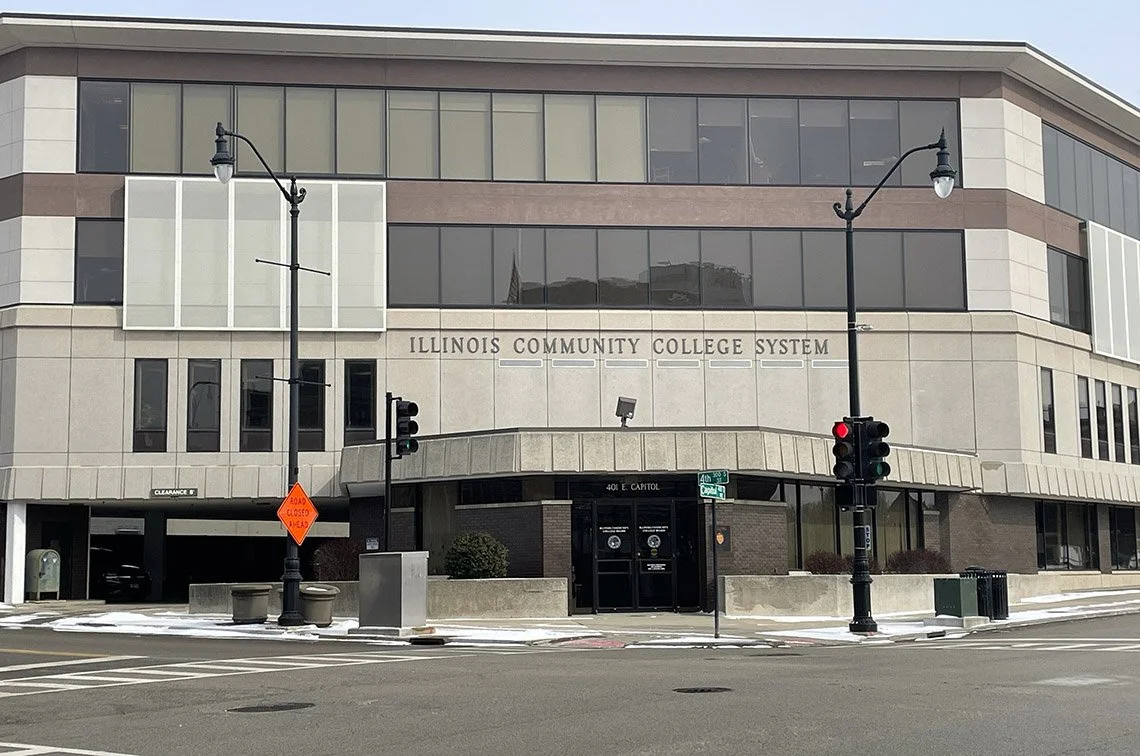
The Illinois Community College System headquarters is pictured in downtown Springfield. (Capitol News Illinois photo by Andrew Campbell)

City Using TIF Funds To Assist Eagles Club

The Mt. Carmel Eagles will be the recipient of a one time grant of $14,800 from the city’s TIF fund. Eagles representatives Mick Mollenhauer and Chris Cunningham told commissioners upgrades to the Eagles HVAC, walk-in cooler, and parking lot will total $74,000. Mayor Joe Judge expressed appreciation for the work the Eagles club does in the community as he proposed the grant which amounts to 20% of the total project. City Clerk Ryan Turner said a resolution will be drafted for the council to formally approved at their next meeting.

Save The Dates: City Council Okays Events

The Mt. Carmel City Council has approved two big community events for later this year. The first one is the 5th annual Riverview Ramble sponsored by Mt. Carmel Public Utility. President David James said this year’s race will be Saturday, 25th and around 100 runners from throughout the area are expected to be on hand. The second big event was the Christmas Uptown festival set this year for Friday evening, December 5th on Market Street. In addition to approving the date, the council appropriated $2,500 to aid in the event, the same amount as the last couple of years.

City Takes Back Mowing Of Cemeteries

Complaints regarding contractors that mow city cemeteries has caused the Mt. Carmel City Council to get back into the cemetery mowing business. At Friday’s City Council meeting, city clerk Ryan Turner said City Hall had received a multitude of complaints from residents about the less than acceptable job mowing crews had been doing, of which the city was paying more than $26,000 a year. To remedy the situation, the city is purchasing two 60 inch Toro mowers for $32,300 which will be paid for out of the saving from eliminating the contractor and $7,000 sitting in a never used cemetery fund. Turner said he expects the appearance of the cemeteries to improve….

Motorad Project Subject Of Special City Council Meeting

The Mt. Carmel City Council will meet in special session this afternoon to hear details of a project at Motorad. The meeting begins at 4pm as Motorad is working with the city and Greater Wabash Regional Planning Commission to obtain a grant that would improve the entrance to Motorad’s shipping facility in the former Shopko building on West 9th Street.

Princeton man arrested on OWI charge

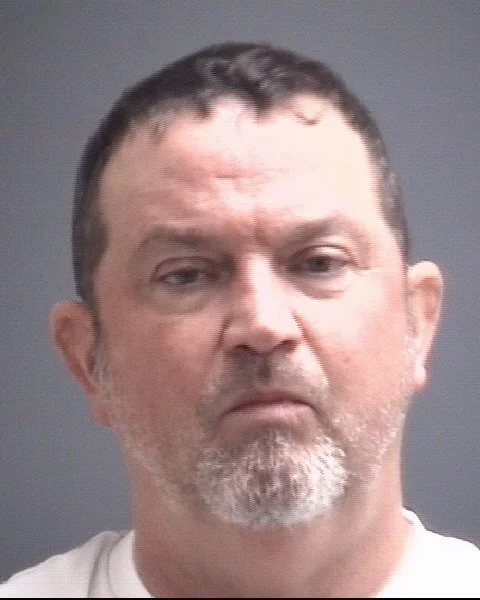
On February 16, 2025, at 2:53 a.m. Gibson County Central Dispatch received a report of an accident on Old US 41 just south of Patoka.  Upon arriving Deputy Michael Bates found a White 2018 Lexus passenger car unoccupied and in a ditch.  At that point Deputy Bates began an investigation into the accident that led him to the home of 55 year old Stephen Hack of Princeton.  While speaking with Mr. Hack Deputy Bates detected clues that Mr. Hack was under the influence of alcohol.  At that point he began a DUI investigation that led to Mr. Hack being placed into custody and transported to the Gibson County Jail.  Upon arriving at the jail Mr. Hack was charged with Operating a Vehicle While Intoxicated and resisting law enforcement. 
 
Assisting Deputy Bates in his investigation was Sgt. John Fischer and Princeton Officers Logan Lashbrook and Nick Rainey.
 
All criminal defendants are to be presumed innocent until, and unless proven guilty beyond a reasonable doubt in a court of law.