
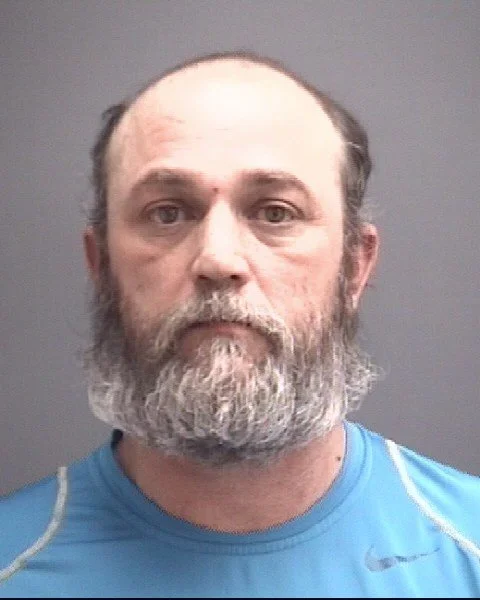
There’s been another continuation in the court case of former Wabash County Sheriff’s Deputy Chase Cheadle. Yesterday, Cheadle was in court for a preliminary hearing but special prosecutor Brian Towne and defense attorney Jonathan Turpin said they had been working on a possible settlement to the case and requested continuance. Cheadle is now due back in court on February 27th for a preliminary hearing. It’s the third straight month, dating back to November 14th that Cheadle’s preliminary hearing has been delayed. Cheadle, who was the sheriff’s department’s canine handler, faces four charges of official misconduct, 1 count of Theft, 1 count of Cruelty to animals, and 2 counts of Animal owner duties. Five of the eight charges are felonies. Cheadle found Kiki unresponsive last July and was arrested following an investigation. He resigned from the sheriff’s department on August 8th.
Naked Man Tased By Authorities Following Thursday Morning Incident
From Wabash County Sheriff Derek Morgan: On 01.23.25 Wabash County 911 received a call of a disturbance at 229 N. Main St. Bellmont. While the deputy was enroute the male aggressor fled the scene in a blue passenger car north on E 400 Rd. The deputy was able to locate the vehicle which was now east bound on Highway 15 driving erratically and at a high rate of speed. Once the deputy topped the hill, he observed a blue passenger car that had crashed just east of the intersection of Highway 15 and E 700 Rd. (Maud Rd.) on the south side of the highway.
As the deputy approached the crashed vehicle the male was actively kicking out the back window of the passenger car. Once he was out of the vehicle, the deputy made contact with the male, who was distraught, confrontational, and out of control, while smoking a cigarette. The deputy tried to speak with the man and he began taking his clothes off, and asked the deputy what branch he was with and threw his cigarette at the deputy. Officer from the Mt. Carmel Police Department arrived for assistance. The male would not comply with directions form law enforcement and began marching naked in the snow. A taser was deployed for the safety of everyone and he was taken into protective custody with no further incidents.
The male continued to talk about Jesus, Donald Trump and nuclear war while threatening to take the police officers' guns and shoot them. The male was transported to Wabash General Hospital for a mental health evaluation.
Morgan Wins Allendale Spelling Bee
Allendale School held its annual Spelling Bee on Thursday, January 23rd. Participating in the Spelling Bee were the following students: Abi Hipsher, Haylee Bergman, Sophia Breen, Grasyn Morgan, Abe Medler, Bennett Morris, Braxton Culp, and Jaxon Moore. Bennett Morris, a 5th grader, finished second in the 10th round. Grasyn Morgan, a 7th grader, is the Spelling Bee Champion. Bennett received a $25 cash prize from Allendale School Student Council and Grasyn received a $50 LifeSaver CD from The Allendale First National Bank and a free year subscription to Britannica Online for Kids.
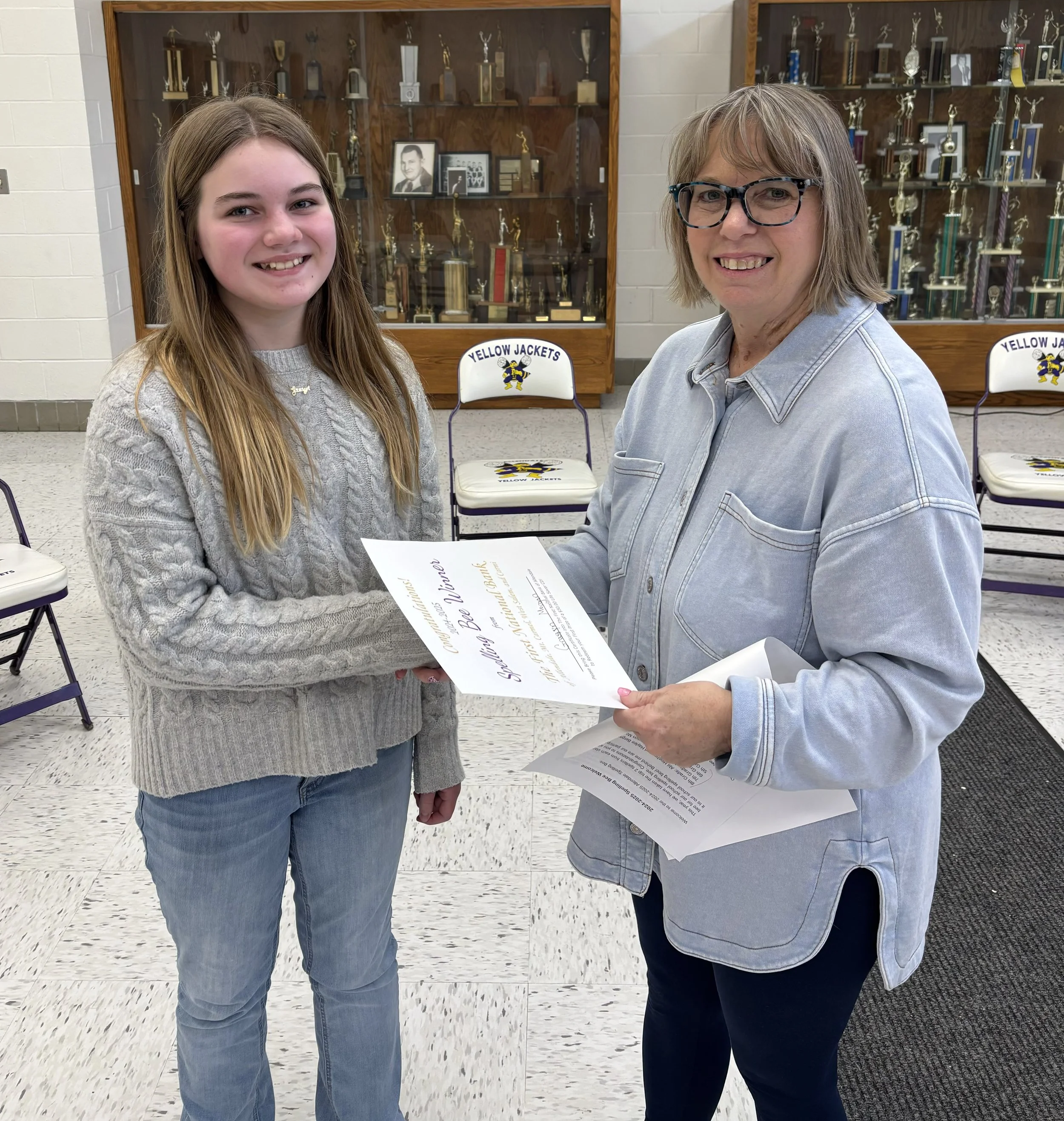
Spelling Bee Sponsor, Mrs. Dena Tarpley and 1st Place Finisher, Grasyn Morgan.
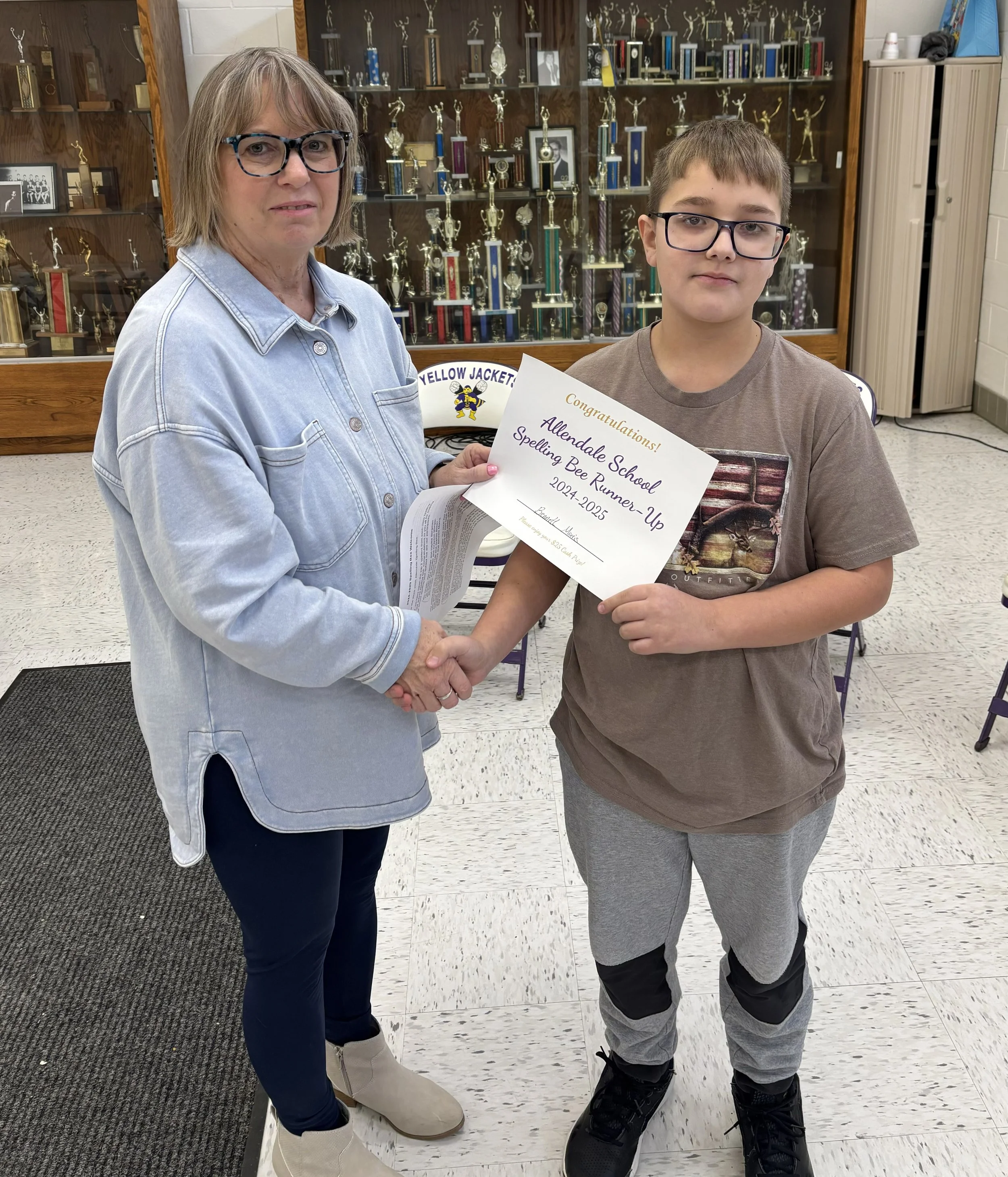
Spelling Bee Sponsor, Mrs. Dena Tarpley and 2nd Place Finisher, Bennett Morris.
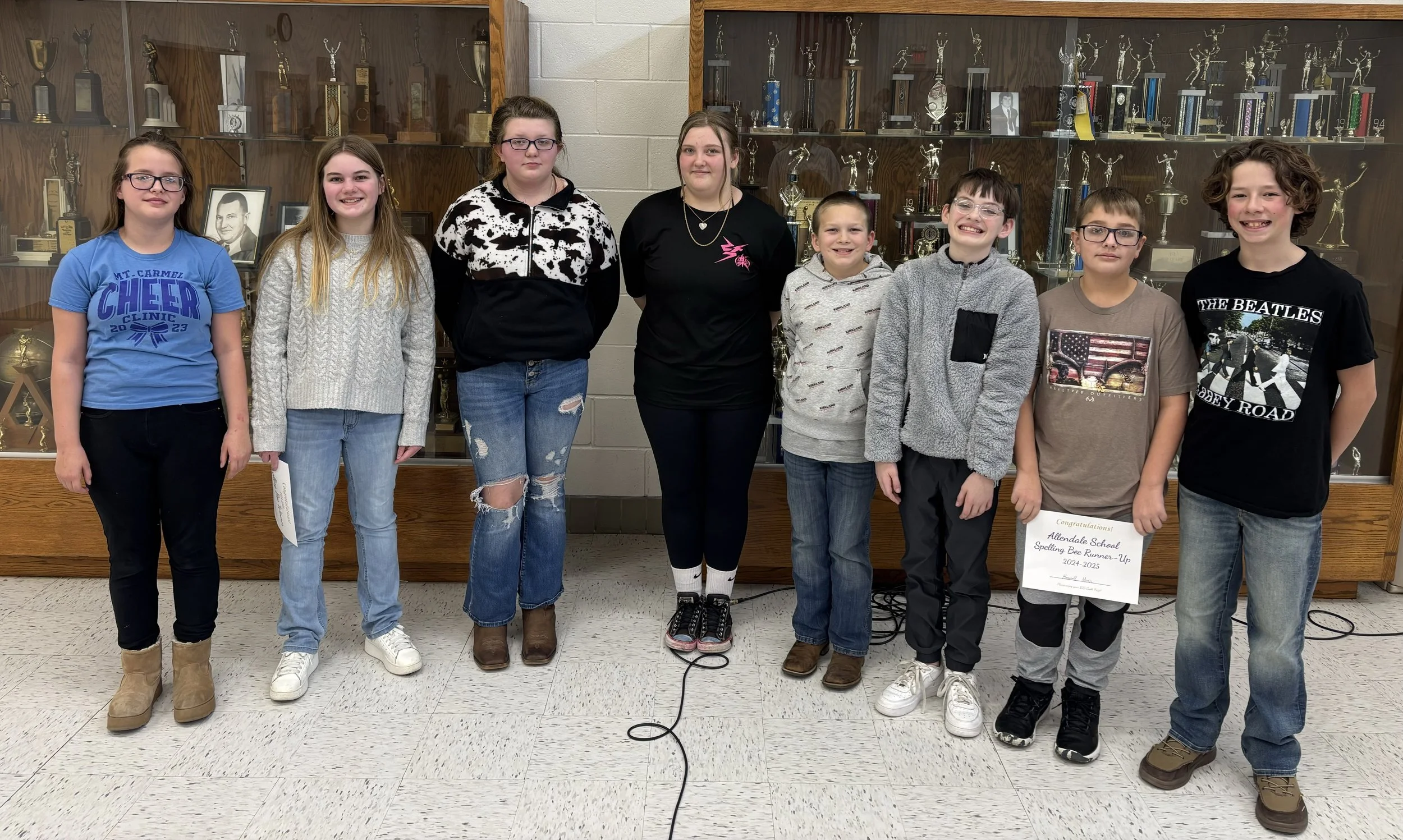
Spelling Bee Elite 8: Sophia Breen, Grasyn Morgan, Abi Hipsher, Haylee Bergman, Jaxon Moore, Braxton Culp, Bennett Morris, and Abe Medler.
Winter Weather Keeping City Crews Busy
At Tuesday’s City Council meeting, Mt. Carmel Mayor Joe Judge again praised city workers for their hard work in the wake of two major winter storms and extremely cold temperatures…
Judge said the key to the city’s stellar response was planning and preparation within the city and other local entities….
Judge said while they hope it won’t be needed, the city has ordered another 100 tons of road salt.
Florissant Man Sentenced to 26 Months in Check Washing Scheme
EAST ST. LOUIS, Ill. – A Florissant, Missouri, man was sentenced to federal prison after he participated in a scheme to deposit counterfeit checks at an Illinois bank.
Quentin T. Gandy, Jr., 22, pleaded guilty in October to one count of bank fraud and one count of aggravated identity theft.
“When criminals steal checks from the mail, commit fraud by washing the check and print fake copies, real people are victimized,” said U.S. Attorney Rachelle Aud Crowe. “I appreciate the efforts by the U.S. Postal Inspection Service to disband this organized effort to defraud banks.”
According to court documents, Gandy obtained checks from uncharged conspirators who stole authentic checks from the mail. Using the authentic checks, the conspirators created counterfeit checks using the account name, number and routing information.
Gandy knew the checks were counterfeit with forged signatures and admitted to trying to deposit $48,200 into his bank account in O’Fallon, Illinois.
“The U.S. Postal Inspection Service is dedicated to defending the nation’s mail system from criminal activity, preserving the integrity of the U.S. Mail, and protecting United States Postal Service employees. The U.S. Postal Inspection Service values our law enforcement partners for supporting our mission to protect the integrity of the U.S. Mail,” said Ruth M. Mendonça, Inspector in Charge of the Chicago Division of the U.S. Postal Inspection Service, which includes the St. Louis Field Office.
The U.S. Postal Inspection Service led the investigation, and Assistant U.S. Attorney Kathleen Howard prosecuted the case.
GUNS STOLEN FROM FIREARMS DEALERS DROPS FOLLOWING ILLINOIS STATE POLICE INSPECTIONS
SPRINGFIELD – Since the Illinois State Police (ISP) began conducting inspections of Federal Firearms License (FFL) dealers, the number of guns stolen from dealers has decreased. In 2024, the number of firearms stolen from FFL dealers in Illinois dropped almost 80% compared to 2023, and 92% compared to 2022.
“Five years ago, I signed a bipartisan law to combat illegal gun trafficking—and the data ISP released today demonstrates that state oversight works,” said Governor JB Pritzker. “Too many Illinoisans know the pain of gun violence and the added security measures enforced by ISP are ensuring that guns don’t fall into the wrong hands.”
“Stemming the flow of stolen guns used in crime is one way we are fighting gun violence,” said ISP Director Brendan F. Kelly. “Inspections, which ensure firearm dealers have security measures in place, reduces the number of guns stolen often later used to commit violence, and this effort appears to be producing good results.”
To help address the problem of illegal firearms, the General Assembly passed the Firearm Dealer License Certification Act (430 ILCS 68), which went into effect January 18, 2019. Under the Act, each certified FFL dealer was required to have a video security system by January 2, 2021. To help ensure dealers complied, ISP began conducting site visits in 2021, and inspections in 2022. Since the implementation of the Act, but specifically since ISP inspections began looking at security measures, the number of firearms stolen from dealers has dropped.
Today’s announcement arrives a week after ISP released the 2024 interstate shooting data showcasing a 31% decrease in shootings, compared to 2023. ISP’s continued dedication of resources and enforcement actions are effectively reducing the illegal possession of firearms and potentially related gun violence, keeping roads and communities safer statewide.
1 ATF data - https://www.atf.gov/resource-center/data-statistics. Burglary, Larceny, Robbery
2 Preliminary data not finalized.
Owensville man charged for OWI
On January 22, 2025, at 10:31 p.m. Gibson County Deputy Eric Powell conducted a traffic stop on a 2014 Dodge Avenger in the Walmart parking lot after observing an equipment violation on West Broadway in Princeton. Upon approaching the vehicle Deputy Powell detected the odor of burnt Marijuana coming from inside the vehicle and began a roadside OWI investigation. During the investigation standard field sobriety tests were administered. At the time of those tests which were conducted outside the vehicle officers detected the odor of alcohol coming from the driver 44 year old Joshua Maggard of Owensville. At the conclusion of the investigation Mr. Maggard was transported to the Gibson County Jail where he was charged with Operating a Vehicle While Intoxicated.
Deputy Powell was assisted in his investigation by Deputies Michael Bates and Bart Wagner. Also assisting in this investigation was Princeton Officer Nick Rainey.
All criminal defendants are to be presumed innocent until, and unless proven guilty beyond a reasonable doubt in a court of law.
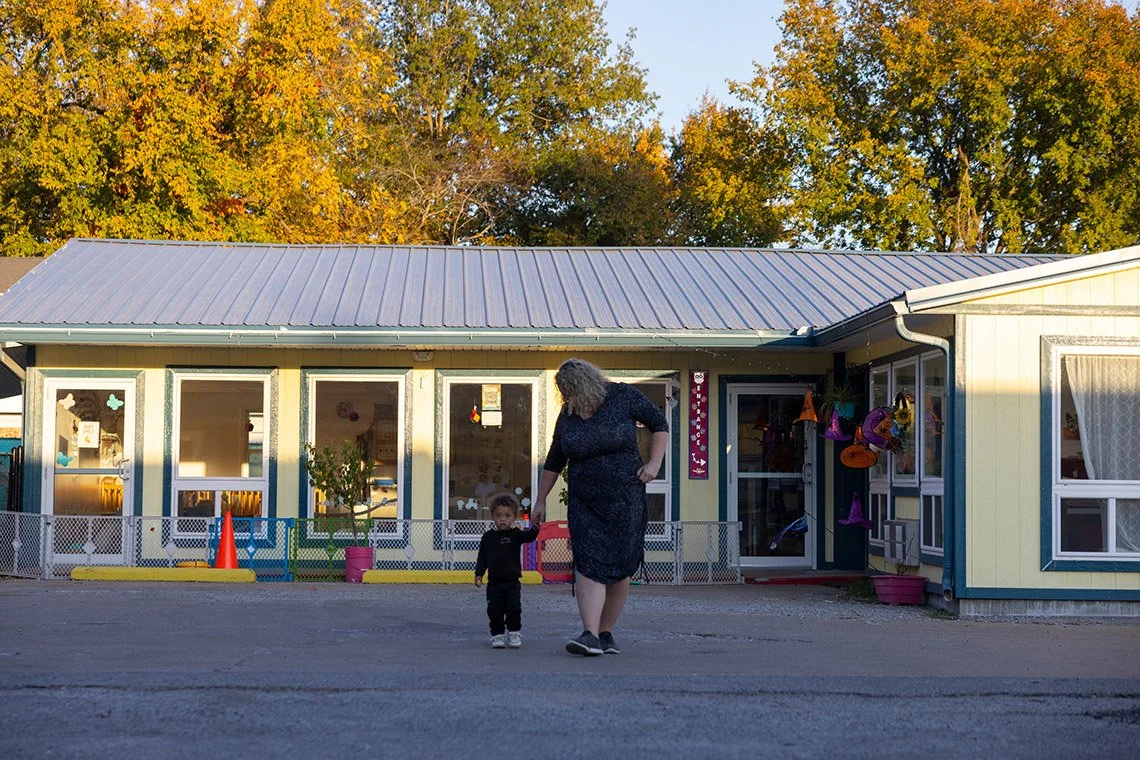
Five big obstacles to opening child care facilities in rural Illinois
Though the state faces a critical child care shortage, the government has not made it easy to open new facilities. These are the biggest roadblocks for providers.
By MOLLY PARKER
Capitol News Illinois
mparker@capitolnewsillinois.com
This article was produced for ProPublica’s Local Reporting Network in partnership with Capitol News Illinois.
Sixty percent of rural Americans live in child care deserts — regions with too few licensed slots for children. In rural Illinois, that number rises to nearly 70%.
Over the past decade, Illinois has experienced a 33% decline in licensed child care providers, losing nearly 4,300 facilities and about 38,000 licensed slots for children. This loss, driven by years of budget cuts, has outpaced the shrinking child population and hit rural areas the hardest. In 2019, during his first year in office, Gov. JB Pritzker acknowledged that rural providers were closing at an “alarming rate” and vowed to make Illinois the “best state in the nation for families raising young children.”
While the state has increased payments to providers in recent years, it hasn’t been enough to reverse the damage caused by years of budget cuts. The COVID-19 pandemic further destabilized the already fragile system. Despite additional state and federal funding, Illinois has lost about 1,300 providers since Pritzker took office.
But opening new facilities is hard, and the government itself makes things harder. Here are five reasons it’s difficult to open and operate new child care centers in Illinois:
1. Politics delayed federal relief
Experts say that launching a child care center can cost upwards of $1 million, even in rural areas, where people tend to assume that it’s cheaper to start a small business. It’s true that properties may be less expensive than in urban areas, but they are often harder to find in regions with little new construction and many old buildings requiring costly repairs.
The largest source of child care funding in America comes from the federal Child Care and Development Block Grant funds administered by the U.S. Department of Health and Human Services. But most of it goes to offset child care payments for low-income parents; only a few exceptions allow spending federal funds on the buildings themselves.
Federal efforts to ease these startup costs for rural regions include a proposed expansion of loans and grants through the Department of Agriculture, but this measure remains tied up in Congress as part of the long-delayed new farm bill.
2. State efforts to help didn’t go very far
Rebuild Illinois is a $45 billion, multiyear capital improvement plan that was passed in 2019, the state’s first such plan in nearly a decade. Through it, the state allocated $100 million for early childhood facilities. But in the first round of funding, only eight programs out of 238 applicants received a combined $55 million in January 2023, with most grants awarded in Chicago and suburban areas. No providers in the southern half of the state received funding. A second $45 million round is planned, but no timeline has been announced.
3. Licensing delays and staffing shortages
The Illinois Department of Children and Family Services, which oversees child care licensing, is grappling with a staffing crisis. The agency has a 20% vacancy rate for licensing staff and 45% for supervisors, who must review and approve all applications for child care providers.
Navigating Illinois’ complex licensing rules can be hard, and providers say they can’t always get the information they need in a timely manner. Some say their applications have been caught in limbo for months or weeks without explanation. According to DCFS’ own report to the General Assembly, the agency misses its 90-day deadline to approve applications about a third of the time — and in regions with severe staffing shortages, that rate can rise above 50%. Although licensing will soon transfer to the newly created Department of Early Childhood, most changes won’t begin until mid-2026, and what impact they will have on providers is not yet clear.
While DCFS acknowledges the staffing shortages, the agency also attributes delays to provider paperwork errors and holdups from other agencies, like the state fire marshal or local officials.
4. Outdated and contradictory regulations
Illinois’ child care regulations, though intended to protect children, include outdated and contradictory rules that frustrate providers. For instance, one regulation requires blankets in every crib, even though the state prohibits blanket use for sleeping infants to reduce the risk of sudden infant death syndrome, or SIDS. Another rule requires that providers carry coins on walks to use a payphone in emergencies — a relic from a pre-cellphone era.
Providers say that inconsistencies in the rules further complicate an already difficult process for opening and operating child care centers. A DCFS spokesperson told Capitol News Illinois that the agency is working to update some regulations.
5. Low reimbursement rates for providers
The federal Child Care and Development Block Grant is the largest source of child care funding in the U.S. It is administered by states and helps eligible low-income families offset the high cost of child care. The money is paid directly to providers, and the federal government mandates that states reimburse providers at least 50% of market rates and recommends a higher benchmark of 75%. However, Illinois falls short of both targets. As of April 2023, the state reimbursed less than 45% of market rates for child care centers, one of the largest gaps nationwide. This underfunding violated federal equal access provisions, though state officials said that recent subsidy increases have brought Illinois into compliance in most categories.
Rural providers face additional hurdles beyond inadequate reimbursement rates. High startup costs and lower population density make it harder to fill classrooms quickly, prolonging financial strain. Even providers offering unsubsidized care struggle to set fees that reflect the true cost of operations, as many families who barely earn too much to receive a subsidy cannot afford to pay higher rates.
This persistent funding gap leaves providers, particularly those in rural areas, in a difficult financial position.
Pritzker signs bill to phase out subminimum wage for disabled workers
Organizations must implement changes by 2030
By BEN SZALINSKI
bszalinski@capitolnewsillinois.com
Capitol News Illinois
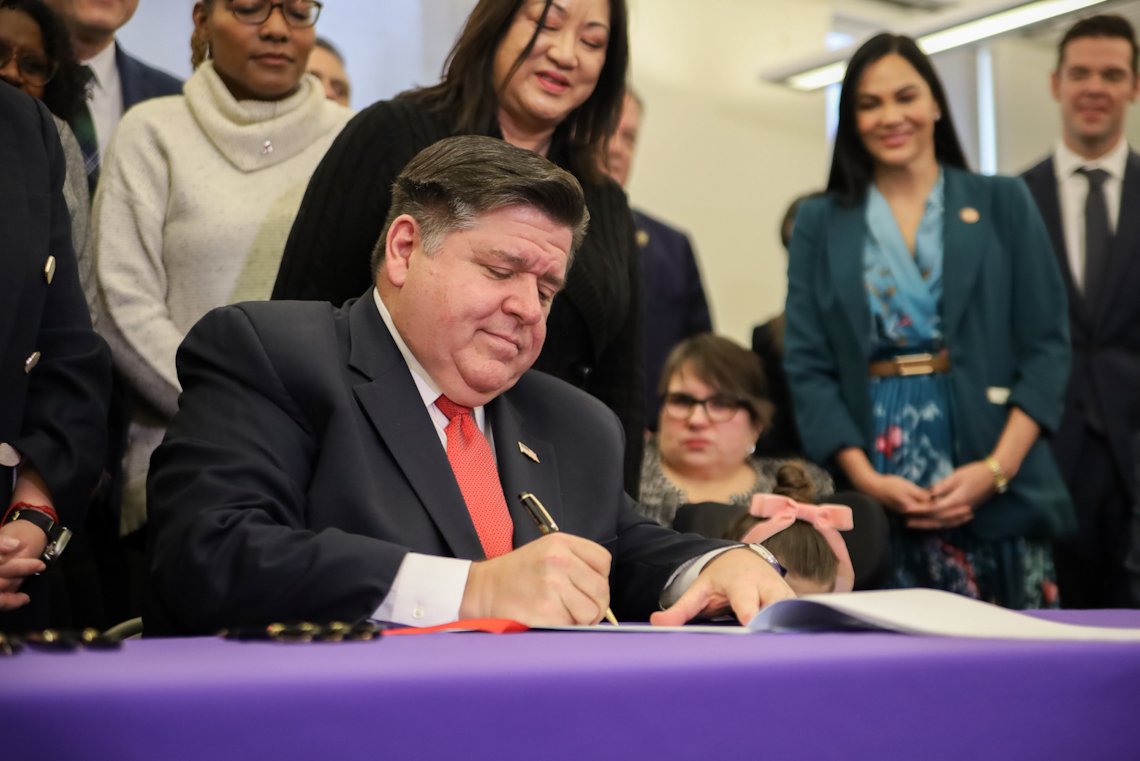
CHICAGO — Gov. JB Pritzker on Tuesday signed a long-awaited bill to stop Illinois organizations from paying less than the minimum wage to workers with disabilities.
The bill applies to businesses and other facilities that hold what is known as a 14(c) certificate, named after the section of the Fair Labor Standards Act of 1938 permitting lower wages for disabled people. Organizations receiving the exemption are allowed to pay a “commensurate wage” based on the worker’s individual productivity in proportion to the wage and productivity of workers who do not have disabilities but are performing the same or a similar task.
“Illinois is closing an era of an outdated two-tier wage system that lets disabled workers make less money for their hard work,” Pritzker said at a signing ceremony in Chicago.
The governor signed House Bill 793, which, beginning in 2030, will prohibit businesses and other residential facilities in Illinois from claiming an exemption allowing them to pay workers with disabilities less than minimum wage. Illinois is the 19th state to eliminate the subminimum wage for workers with disabilities. Organizations must phase in the full minimum wage by the end of 2029.
The bill received bipartisan support in the General Assembly in 2024 following lengthy negotiations that began more than five years ago. It creates a transition grant program designed to provide financial support for organizations to continue employing people with disabilities while paying them at least the state minimum wage. It also establishes a task force to oversee the transition.
Money for the transition program would come from the Illinois Department of Human Services’ line item for transforming the state’s developmental and intellectual disability system. That line item includes $20 million for various programs for the current fiscal year, but lawmakers and advocates had previously discussed using $2 million to fund the transition grant program.
Illinois has 59 programs currently receiving a federal exemption. Those programs employ about 2,500 people, according to the U.S. Department of Labor.
Pritzker called on the new Trump administration to end 14(c) exemptions nationwide — a process that began under former President Joe Biden’s administration.
“People with disabilities dream big,” said Erin Compton, a person with disabilities who advocated for the law. “Let's prove that people with disabilities are not broken people in a normal world, but normal people in an inclusive world.”
Opposition in Springfield came from some of the state’s largest operators of “sheltered work” programs, which employ people with disabilities to perform work for less than minimum wage and often do work that is outsourced from other businesses.
Those organizations, and people with family members participating in them, argued the bill will force those programs to end at places that can’t afford to pay minimum wage for potentially low-productivity work.
Sen. Jil Tracy, R-Quincy, voted against the bill and told a Senate committee in November her brother has a disability and is paid less than minimum wage to shred paper for a business.
“How in the world are they going to be able to pay minimum wage is my question? What happens if that shredding paper employment goes away?” she said.
Read more: Bill to phase out subminimum wage for disabled workers clears General Assembly
Lawmakers and stakeholders agreed to create a task force and five-year phase in period to work out issues that arise from the transition with the goal of keeping people who benefit from the programs employed.
“My excitement today is not just because we are making history here in Illinois, but also because of all the hard work advocacy and activism that it took to get here,” bill sponsor Rep. Theresa Mah, D-Chicago, said Tuesday. “To say that this was a challenging bill to pass would be an understatement. There was a lot of opposition.”
Capitol News Illinois is a nonprofit, nonpartisan news service that distributes state government coverage to hundreds of news outlets statewide. It is funded primarily by the Illinois Press Foundation and the Robert R. McCormick Foundation.
Potential immigration raids spark fear, protests on Inauguration Day
Illinois among states to file early challenge to one of Trump’s executive orders
By ASHLEY N. SORIANO,
ISMAEL M. BELKOURA,
& BEN SZALINSKI
Medill Illinois News Bureau
& Capitol News Illinois
news@capitolnewsillinois.com
CHICAGO – Immigrant communities around Illinois braced Tuesday for threatened mass deportations. But the Little Village neighborhood in Chicago, facing subzero temperatures, saw little foot traffic and no anticipated raids as of Tuesday afternoon on the second day of the Trump Administration.
Trump has vowed to carry out the “largest mass deportation in history.” He wasted no time on Inauguration Day before signing multiple immigration-related executive orders, including ones reinstating the “Remain in Mexico” policy and pausing refugee admissions.
Several states quickly moved to block Trump’s executive order seeking to end birthright citizenship, which grants citizenship to all people born in the U.S., even in cases where the parents are not citizens.
“The President has no authority to amend the Constitution or supersede the Citizenship Clause’s grant of citizenship to individuals born in the United States,” argued a lawsuit filed by Illinois Attorney General Kwame Raoul and attorneys general in Oregon, Arizona and Washington state.
Eighteen other states had earlier announced a similar lawsuit.
But raids previously alluded to by the Trump administration hadn’t occurred as of Tuesday afternoon.
A Wall Street Journal report said around 100 to 200 ICE officers would be sent to the city to execute the operation. Following leaks about raids targeting Chicago, and after initially telling Fox News the raids would begin as early as Tuesday, “border czar” Tom Homan later said he was reconsidering the operation’s details due to officer safety concerns.
At an event hosted by local Republican groups in December, Homan, former ICE acting director, named Chicago “ground zero” for the Trump Administration’s mass deportation plan.
Gov. JB Pritzker said at an unrelated news conference Tuesday he spent part of Monday in some of Chicago’s Hispanic neighborhoods. He described businesses that were “relatively empty because people were afraid to show up” with the threat of action by ICE looming. But he said he hadn’t heard anything from the Trump administration.
“They've not communicated with us, so we don't know when exactly those enforcement actions might take place. We have heard that they are targeting as many as 2,000 people, initially in the city of Chicago alone,” Pritzker said.
The governor has reiterated in recent months he supports immigration authorities deporting people living in the U.S. without legal permission who have been convicted of violent crimes, but he said he is worried law-abiding undocumented Illinois residents will get caught up in deportations as well.
Advocacy organizations have been mobilizing resources to inform immigrants of their rights and try to protect undocumented people from the crackdown targeting Chicago and other sanctuary cities.
Mayor Brandon Johnson did not return requests for comment but posted to X Sunday that Chicago “will continue to fight for the justice and safety of all who call this place home.” At the start of the year, Johnson also reaffirmed Chicago’s Welcoming City Ordinance, which does not allow city employees and agencies to help civil immigration enforcement.
An ICE spokesperson told Capitol News Illinois Saturday that questions about post-inauguration activities would need to be directed to the incoming administration.
Hundreds march in Inauguration Day protest
In freezing temperatures, hundreds of protesters and more than 80 organizations gathered at Federal Plaza in downtown Chicago around the same time as the new president’s swearing-in ceremony in Washington, D.C., on Monday.
Chants of “No hate, no fear, immigrants are welcome here” echoed blocks away, as the group marched through Chicago’s Loop and ended the rally across the river from Trump Tower.
Nadiah Alyafai, an organizer for the U.S. Palestinian Community Network, was one of the first speakers and said the organizations were not “blind to the reality” that the incoming administration would target members of marginalized communities.
“We have seen how Trump weaponized fear and bigotry and how he perpetrated harmful stereotypes that fuel violence, discrimination and hate, and we know that these policies will continue, starting today,” Alyafai said to the crowd.
Martín Unzueta, the executive director and founder of Chicago Community and Workers Rights, urged people who are concerned or confused about their immigration status to reach out to their alderpersons and local organizations.
“We are part of this country,” Unzueta said in a speech spoken in Spanish. “No one is going to run us out. Here is where we’ll defend ourselves.”
Unzueta also reminded protesters that Chicago remains a sanctuary city. Last week, the Chicago City Council temporarily blocked a proposal that would have allowed the Chicago Police Department to help ICE officers in some deportation cases.
The Chicago Police Department confirmed to Capitol News Illinois Tuesday it would not assist federal immigration authorities with civil enforcement. CPD also does not document immigration status.
“To be clear, the Chicago Police Department will not assist or intervene in civil immigration enforcement in accordance with the City of Chicago Municipal Code,” a CPD spokesperson said in an emailed statement. “As always, we will continue to enforce the law if a crime occurs, regardless of the citizenship status of those involved.”
Texas Republican Gov. Greg Abbott began busing migrants to Chicago in 2022 as part of what critics, including Illinois’ Democratic Gov. JB Pritzker, called a political stunt. Since August 2022, nearly 52,000 people seeking asylum arrived by bus and plane through Dec. 18, 2024, according to city data. The governors of Arizona and Florida also bused migrants to various cities, including New York City and Washington, D.C.
Chicago has been a sanctuary city for immigrants since 1985 and reaffirmed the protections during the first Trump administration.
A lone counterprotester stood across the street during Monday’s demonstration, swinging an American flag back and forth chanting “America first!” He declined to give his name.
Advocacy organizations warn undocumented clients
Since late last year, advocacy organizations have been warning and preparing their undocumented clients by hosting “Know Your Rights” sessions, including roleplay workshops on what to do if a loved one is detained.
La Villita Community, an organization in the majority Hispanic Little Village neighborhood, provided instructions on social media ahead of reported ICE activity.
Other groups like the Illinois Coalition for Immigrant and Refugee Rights serve Illinois communities beyond Chicago.
Dulce Ortiz, the ICIRR board president, came to the U.S. from Mexico without documentation when she was 10 years old. The now 43-year-old is a U.S. citizen, and she’s providing resources to people who are in the same shoes as she was as a child.
"I had to make some decisions when I was young, (and) I hope young women will never have to make those decisions in order to become a U.S. citizen,” Ortiz said.
ICIRR, which primarily serves Lake County and parts of McHenry County, defines its mission as to empower and integrate immigrants into their communities.
The organization recommends preparation ahead of possible confrontations with ICE officers, including renewing any visas or permits five months ahead of their expiration. Ortiz, the ICIRR board president, suggests a three-step process: don’t open your door, remain silent and ask for a lawyer.
“We don't want to create even more fear in our community, but at the end of the day, the fear is already there,” Ortiz said. “And I rather argue to be ready and prepared and alert and aware than us, you know, trying to protect their feelings and do nothing.”
Ortiz and other ICIRR advocates have been meeting with state legislators, ensuring staff and volunteers are keeping an eye out for any ICE presence and hosting mental health workshops.
Another group, Immigrant Solidarity DuPage, provides services to immigrants in the Chicagoland area, organizer Cristobal Cavazos said.
Cavazos attended the Federal Plaza protest alongside a dozen members of the organization, saying that although there is fear, it’s important to translate that fear to action.
“We want to show Trump that we are many and we are more united than ever,” Cavazos said in an interview conducted in Spanish. “He’s not going to make us feel like strangers in our own home.”
Ashley N. Soriano and Ismael M. Belkoura are graduate students in journalism with Northwestern University’s Medill School of Journalism, Media, Integrated Marketing Communications, and Fellows in its Medill Illinois News Bureau working in partnership with Capitol News Illinois.
Capitol News Illinois is a nonprofit, nonpartisan news service that distributes state government coverage to hundreds of news outlets statewide. It is funded primarily by the Illinois Press Foundation and the Robert R. McCormick Foundation.