On November 3, 2020, at 4:25 a.m. Gibson County Central Dispatch received a 911 report of a man covered in blood knocking on doors in the Somerville area. Deputies Bryce Jutzi and Garrett Tuley were dispatched to the area to locate the man. Upon locating the individual Deputy Jutzi spoke with the victim and began a battery investigation. While speaking with the victim a Gibson County Medic administered medical aid to the victim. Once a statement was secured from the victim Deputy Jutzi with the assistance of Deputy Garrett Tuley and Oakland City Police Chief Tim Gaines went to a residence near the intersection of County Road 540 South and State Road 57. Upon speaking with the other parties Deputy Jutzi placed 28-year-old Matthew Weber of Oakland City and 38-year-old Adam Staat of Princeton into custody. At the conclusion of his investigation Deputy Jutzi transported Mr. Weber and Mr. Staat to the Gibson County Jail.
Upon arriving at the Gibson County Jail Matthew Weber was charged Battery with Bodily Injury. He remains in custody on a $650 bond. Adam Staat was charged with Aggravated Battery and he remains in custody without bond.
All Criminal defendants are to be presumed innocent until, and unless proven guilty beyond a reasonable doubt in a court of law.


Nearly 3,000 Have Already Voted In Wabash County
If early voting and vote by mail are any indication, turnout in Wabash County for Tuesday’s election will easily surpass turnout four years ago.
The last presidential election saw 5,526 voters or 64% go to the polls in 2016. But, Wabash County Clerk Janet Will said between 2,500 and 3,000 voters have already either cast an early vote and voted by mail. The percentage of voters going to the polls Tuesday should be higher than four years as Will said there are fewer registered voters now than in 2016.
If you’re voting Tuesday, go to your normal voting location unless you need to change your address or register to vote..then you need to go to the county clerk’s office at the courthouse. Mid-afternoon today, early voters were lined up outside the courthouse waiting to get in.
Will noted that COVID-19 mitigations will prevent the public from coming to the courthouse tomorrow night for the election returns as has been done in the past. The only people allowed in the courthouse Tuesday night will be election workers and media. We’ll have you covered though with all of the returns Tuesday night first on WSJD-FM 100.5 and then on wsjd.fm and our Facebook page starting after the polls close at 7pm.
By the way, Election Day is now a state holiday in Illinois so that means the courthouse will be closed, along with local schools, Wabash Valley College, and state government offices.
All 11 Illinois Regions To Be Under Heightened Mitigations Starting Wednesday
Press Release From Governor’s Office:
CHICAGO – Governor Pritzker and the Illinois Department of Public Health (IDPH) are announcing COVID-19 resurgence mitigations will be implemented in Region 2—North-Central Illinois—beginning at 12:01 a.m. on Wednesday, November 4, 2020. The region has seen a 7-day rolling average test positivity rate of 8 percent or above for three consecutive days, which exceeds the thresholds set for establishing mitigation measures under the state’s Restore Illinois Resurgence Plan. Region 2 includes Rock Island, Henry, Bureau, Putnam, Kendall, Grundy, Mercer, Knox, Henderson, Warren, McDonough, Fulton, Stark, Marshall, Peoria, Tazwell, McLean, Woodford, Livingston, and Lasalle counties.
The administration continues to work aggressively to support small businesses impacted by the ongoing pandemic, distributing more than $55.7 million in emergency grants and assistance to Region 2 alone. Moving forward, businesses in Region 2, as well as other regions currently under additional mitigations, are receiving priority consideration for the current round of the historic Business Interruption Grants (BIG) program. To date, through BIG, a total of $95 million has been directed statewide to regions currently under mitigations or where mitigations will soon take effect. These programs are guided by an equity framework and seek to address the hardest hit communities with emergency relief dollars.
“Region 2 has now sustained an average positivity rate of 8 percent or higher for three consecutive days, meaning that now every region in Illinois will soon be operating under resurgence mitigations,” said Governor JB Pritzker. “I know that the vast majority of people in this state want to keep themselves safe, their families and children safe, their parents and neighbors and friends. I have always maintained enormous faith in the people of Illinois to do what’s right for each other. As cases, hospitalizations and deaths are rising across our state, across the Midwest and across the nation, we have to act responsibly and collectively to protect the people we love.”
“The mitigation measures soon to be implemented across the entire state of Illinois have been established to protect your health and the health of those around you,” said IDPH Director Dr. Ngozi Ezike. “These mitigation measures are not meant as a punishment, but as a way to help all of us co-exist with COVID-19 more safely.”
Mitigation measures taking effect November 4 in Region 2 include:
Bars
No indoor service
All outside bar service closes at 11:00 p.m.
All bar patrons should be seated at tables outside
No ordering, seating, or congregating at bar (bar stools should be removed)
Tables should be 6 feet apart
No standing or congregating indoors or outdoors while waiting for a table or exiting
No dancing or standing indoors
Reservations required for each party
No seating of multiple parties at one table
Restaurants
No indoor dining or bar service
All outdoor dining closes at 11:00 p.m.
Outside dining tables should be 6 feet apart
No standing or congregating indoors or outdoors while waiting for a table or exiting
Reservations required for each party
No seating of multiple parties at one table
Meetings, Social Events, Gatherings
Limit to lesser of 25 guests or 25 percent of overall room capacity
No party buses
Gaming and Casinos close at 11:00 p.m., are limited to 25 percent capacity, and follow mitigations for bars and restaurants, if applicable
These mitigations do not apply to schools or polling places.
From the onset of the pandemic, support for small businesses has been one of the central features of the Pritzker administration’s COVID-19 response. Since March, the administration has launched a menu of small business and community relief programs – with over $500 million in grants and programs launched by the Illinois Department for Economic Opportunity (DCEO), including emergency hospitality grants, a downstate small business stabilization program, Fast Track Capital, and more. For more information on programs available for businesses and communities, please visit DCEO’s website.
DCEO is also actively processing reimbursements for local governments impacted by COVID-19 via the state’s Local CURES program. Thus far, nearly $12.5 million has been awarded to governments in Region 2 to help cover the costs of the emergency response, with eligible costs including PPE and other public health expenses. All eligible governments in Region 2 can submit their certification to the department and begin submitting reimbursement requests. For more information on programs available for businesses and communities, please visit DCEO’s website.
The positivity rate in Region 2 has fluctuated in recent months, with the region currently seeing an 9.3% positivity rate as of today. While the rate was 7.7% in early September, it dropped to 5% by early October and increased again to 7.2% in late October. Region 2 has also experienced a slight uptick in hospitalizations in October after leveling off the two months prior.
In the coming days, IDPH will continue to track the positivity rate in Region 2 to determine if mitigations can be relaxed, if additional mitigations are required, or if current mitigations should remain in place. If the positivity rate averages less than or equal to 6.5% for three consecutive days, then the regions will return to Phase 4 mitigations under the Restore Illinois Plan. If the positivity rate averages between 6.5% and 8%, the new mitigations will remain in place and unchanged. If the positivity rate averages greater than or equal to 8% after 14 days, more stringent mitigations may be applied to further reduce spread of the virus.
With the final addition of Region 2, now all 11 regions have triggered one of the state’s failsafe state-action metric. By tomorrow, Regions 3, 4, 5, 6, 7, 8, and 9 will all operate under Tier 1 mitigation measures, given that these regions continue to report a 7-day rolling positivity rate above 8%. Regions 10 and 11 are operating under Tier 1 mitigations after triggering additional mitigations based on sustained increases in both positivity and hospitalization rates. Region 1 continues to operate under Tier 2 mitigation measures after seeing a rise in positivity even under the Tier 1 mitigation framework, with the highest rolling positivity average in the state.
As part of the administration’s robust response to the pandemic, the state continues to strengthen its nation-leading testing operation, given that testing remains a critical step to reduce further spread of the virus. Residents across Region 2 have been taking advantage of the readily available testing, with an increase of 35% over the past three weeks. For a more targeted approach, the state continues to provide mobile testing allowing testing to be directed toward communities most impacted by COVID-19. In Region 2, this coming week mobile testing will be deployed in Canton on Monday, Lewistown on Tuesday, Princeton on Wednesday, Macomb on Thursday, Aledo on Friday and at the Streator City Park on Saturday and Sunday. To find the nearest testing center, please visit DPH.Illinois.Gov/Testing.
IDPH will continue to work closely with local health departments in Region 2 to provide education to the public and offer information to businesses and organizations on keeping residents safe. The significance of face coverings, social distancing, and hand washing have been consistently emphasized by the administration throughout the pandemic.
A full list of mitigation measures pertaining to some businesses and industries may be found on the DCEO website at www.dceocovid19resources.com/restore-illinois.
Over Two-Pounds of Meth found after Chase on I-64
Posey County – This afternoon at approximately 3:15, Sergeant Werkmeister was patrolling I-64 near the 12 mile-marker when he observed a 2020 Dodge Durango traveling eastbound at a high rate of speed. The Dodge Durango was clocked by radar at 98 mph. Sergeant Werkmeister activated his emergency lights and siren and attempted to stop the vehicle, but the driver failed to stop and continued east. The driver of the Dodge stopped quickly at the 19.5 mile-marker and threw out a bag before continuing east on I-64 reaching speeds over 100 mph. The driver continued south on I-69 before exiting west onto Boonville New Harmony Road and then onto several different county roads before driving north on US 41 to I-64 west. The vehicle struck stop-sticks at the 4 mile-marker that were deployed by a deputy with the Posey County Sheriff’s Office, but the vehicle was able to enter Illinois and continued west. The pursuit was terminated. Illinois State Police and local Illinois police were contacted regarding the pursuit, but the vehicle was not located.
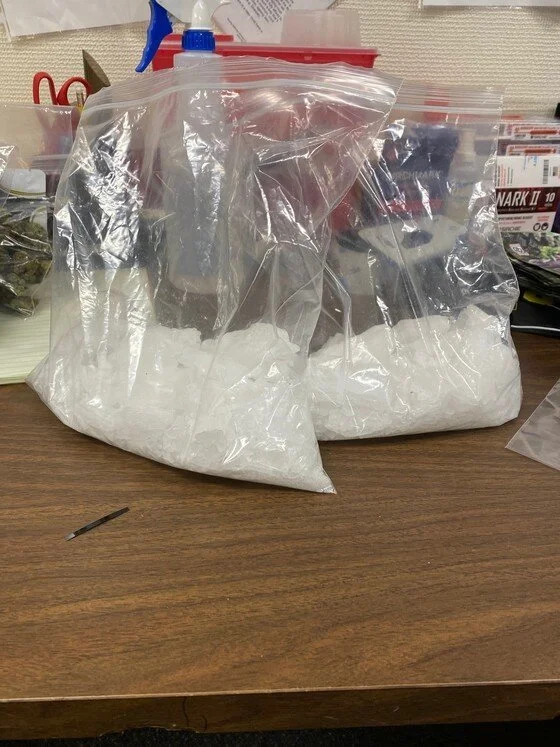
A deputy with the Posey County Sheriff’s Office later found the bag that was thrown from the vehicle near the 19.5 mile-marker. Officers located over two pounds of marijuana and over two pounds of methamphetamine inside the bag. The methamphetamine has a street value of approximately $90,000.
This is an on-going investigation. Anyone with information regarding the possible identity of the driver or about this incident is encouraged to contact the Indiana State Police at 1-812-867-2079. Anyone with information can remain anonymous.
Investigating Officer: Sergeant Russ Werkmeister, Indiana State Police
Assisting Agencies: Posey County Sheriff’s
State Police Investigate Fatal Vehicle vs. Pedestrian Crash on US 41
Pedestrian Identified – Updated Information
The pedestrian involved in the fatal crash on US 41 near Hess Road has been identified as Kenneth W. McGiffen, 68, of Vincennes, IN.
Knox County – Saturday night, October 31, at approximately 9:18, Indiana State Police responded to a vehicle vs. pedestrian crash on US 41 south of Hess Road involving a Knox County Sheriff’s Deputy.
The investigation revealed the sheriff’s deputy was responding to a crash with unknown injuries in the area of US 41 and Cottonwood Lane. The deputy was south of Vincennes and traveling north on US 41. The sheriff’s deputy had his emergency lights activated. As the deputy approached the area of Hess Road, a male wearing dark clothing walked from the median into the deputy’s lane of travel. The sheriff’s deputy braked but couldn’t avoid striking the pedestrian. The pedestrian was pronounced dead at the scene by the Knox County Coroner. The pedestrian is a 68-year-old male from Vincennes. His identity will be released after his family has been notified.
Further investigation revealed the 68-year-old male had been traveling on US 41 and for unknown reasons drove off the roadway near Cottonwood Lane and struck a tree and fence. The driver left the scene of the crash and was attempting to cross US 41 when he was struck. The original crash was approximately ¼ mile away from the crash involving the male pedestrian and the sheriff’s deputy.
The investigation is continuing.
Investigating Officer: Trooper Nick Hatfield, Indiana State Police
Assisting Officer: Sergeant Kylen Compton, Indiana State Police
Assisting Agencies: Knox County Coroner’s Office and Knox County Sheriff’s Office
COVID-19 Resurgence Mitigations to Take Effect in Region 6 on Monday
Governor Pritzker and the Illinois Department of Public Health (IDPH) are announcing COVID-19 resurgence mitigations will be implemented in Region 6—East-Central Illinois—beginning at 12:01 a.m. on Monday, November 2, 2020. The region has seen a 7-day rolling average test positivity rate of 8 percent or above for three consecutive days, which exceeds the thresholds set for establishing mitigation measures under the state’s Restore Illinois Resurgence Plan. Region 6 includes Iroquois, Ford, Dewitt, Piatt, Champaign, Vermillion, Macon, Moultrie, Douglas, Edgar, Shelby, Coles, Cumberland, Clark, Fayette, Effingham, Jasper, Crawford, Clay, Richland, and Lawrence counties.
The administration continues to provide relief for small businesses impacted by the ongoing pandemic, distributing more than $32 million in emergency grants and assistance to Region 6 alone. Moving forward, businesses in Region 6, as well as other regions currently under additional mitigations, will receive priority consideration for the current round of the historic Business Interruption Grants (BIG) program. To date, through BIG, more than $42 million has been directed to regions currently under mitigations or where mitigations will soon take effect. These programs are guided by an equity framework and seek to address the hardest hit communities with emergency relief dollars.
“As of this morning, Region 6 has now sustained an average positivity rate of 8 percent or higher for three days, today hitting 8.6 percent – meaning that, starting Monday, they will join the majority of the state in operating under resurgence mitigations,” said Governor JB Pritzker. “With community transmission rates on the rise all around our state, it’s more important than ever to take caution, mask up, avoid gatherings and ensure your family gets through this as safe as can be. Let’s remember that the quickest way we get kids back into schools and businesses open and workers employed is to bring down infections, positivity rates, and hospitalizations in our communities – and that means mask up, wash up, back up, and sleeve up to get your flu shot.”
“We are on the precipice of the entire state entering into mitigation,” said IDPH Director Dr. Ngozi Ezike. “These last few regions have seen rapid increases in test positivity, one right after another, because of increasing disease spread throughout our communities. We need all people to adhere to both the community mitigation measures and well as personal and family measures so we can swiftly turn our entire state around.”
Mitigation measures taking effect November 2 in Region 6 include:
Bars
No indoor service
All outside bar service closes at 11:00 p.m.
All bar patrons should be seated at tables outside
No ordering, seating, or congregating at bar (bar stools should be removed)
Tables should be 6 feet apart
No standing or congregating indoors or outdoors while waiting for a table or exiting
No dancing or standing indoors
Reservations required for each party
No seating of multiple parties at one table
Restaurants
No indoor dining or bar service
All outdoor dining closes at 11:00 p.m.
Outside dining tables should be 6 feet apart
No standing or congregating indoors or outdoors while waiting for a table or exiting
Reservations required for each party
No seating of multiple parties at one table
Meetings, Social Events, Gatherings
Limit to lesser of 25 guests or 25 percent of overall room capacity
No party buses
Gaming and Casinos close at 11:00 p.m., are limited to 25 percent capacity, and follow mitigations for bars and restaurants, if applicable
These mitigations do not apply to schools or polling places.
From the onset of the pandemic, support for small businesses has been one of the central features of the Pritzker administration’s COVID-19 response. Since March, the administration has launched a menu of small business and community relief programs – with over $500 million in grants and programs launched by the Illinois Department for Economic Opportunity (DCEO), including emergency hospitality grants, a downstate small business stabilization program, Fast Track Capital, and more. For more information on programs available for businesses and communities, please visit DCEO’s website.
DCEO is also actively processing reimbursements for local governments impacted by COVID-19 via the state’s Local CURES program. Thus far, nearly $5 million has been awarded to governments in Region 6 to help cover the costs of the emergency response, with eligible costs including PPE and other public health expenses. All eligible governments in Region 6 can submit their certification to the department and begin submitting reimbursement requests. For more information on programs available for businesses and communities, please visit DCEO’s website.
Region 6 is currently seeing an 8.6% positivity rate, an increase from 5.2% in mid-September, a summer peak of 6.2% over Labor Day weekend, and a low of 1.1% in late-June. While nearly every region is seeing sustained increases in both positivity and hospitalization rates, today the COVID-related hospital admissions in Region 6 have tripled since mid-September now averaging 18 admissions per day.
In the coming days, IDPH will continue to track the positivity rate in Region 6 to determine if mitigations can be relaxed, if additional mitigations are required, or if current mitigations should remain in place. If the positivity rate averages less than or equal to 6.5% for three consecutive days, then the regions will return to Phase 4 mitigations under the Restore Illinois Plan. If the positivity rate averages between 6.5% and 8%, the new mitigations will remain in place and unchanged. If the positivity rate averages greater than or equal to 8% after 14 days, more stringent mitigations may be applied to further reduce spread of the virus.
Every region is being closely monitored since as of today, including Region 6, a total of ten of the state’s 11 regions have triggered one of the state’s failsafe state-action metric. Regions 3, 4, 5, 7, 8, and 9 will all operate under Tier 1 mitigation measures by the end of this weekend, given that these regions continue to report a 7-day rolling positivity rate above 8%. Regions 10 and 11 are now operating under Tier 1 mitigations after triggering additional mitigations based on sustained increases in both positivity and hospitalization rates. Region 1 is currently operating under Tier 2 mitigation measures after continuing to see a rise in positivity even under the Tier 1 mitigation framework, with the highest rolling positivity average in the state.
As part of the administration’s robust response to the pandemic, the state continues to strengthen its nation-leading testing operation. Today, Illinois reported a record high of 95,111 tests in a single day. The administration is building upon this groundbreaking progress, given that testing remains a critical step to reduce further spread of the virus. For a more targeted approach, the state provides mobile testing allowing testing to be directed toward communities most impacted by COVID-19. In Region 6, mobile testing has been deployed in Richland County today, in Effingham on Sunday, and in Macon at the Decatur Civic Center from today through Sunday. Next week, Region 6 will have a testing site from November 2 through November 8 at the Danville Area Community College. To find the nearest testing center, please visit DPH.Illinois.Gov/Testing.
IDPH will continue to work closely with local health departments in Region 6 to provide education to the public and offer information to businesses and organizations on keeping residents safe. The significance of face coverings, social distancing, and hand washing have been consistently emphasized by the administration throughout the pandemic.
A full list of mitigation measures pertaining to some businesses and industries may be found on the DCEO website at www.dceocovid19resources.com/restore-illinois.
Halloween Weekend Gets Underway This Evening In Mt. Carmel
Halloween weekend in Mt. Carmel gets underway this evening with the trick or treat trail through the city park. Mayor Joe Judge said the trunk or treat is from 5 to 7 as visitors will park at the 4-H Center and walk over to the Shelter House where the treats will be distributed….
The city park will be closed to traffic this evening during the trunk or treat. Traditional trick or treating is set for tomorrow from 4:30 to 8:30. Judge reminded residents not wanting to participate to leave their porch lights off Saturday evening. He also said everyone needs to be mindful of the state department of public health’s Halloween guidelines.
This Halloween, don’t be haunted by a DUI
The Illinois Department of Transportation, the Illinois State Police and local law enforcement agencies today reminded motorists that driving impaired is a scary decision that causes needless fatalities. The message is simple this Halloween: “Drive Sober or Get Pulled Over” and “Drive High. Get a DUI.” “
If you think Halloween is scary, remember: a DUI will haunt you for years,” said Cynthia Watters, bureau chief of Safety Programs and Engineering. “If you will be partaking in alcohol or other impairing substances, plan ahead for a sober ride home before the party starts.”
Illinois motor vehicle crash fatality rates are higher than they were at this time last year. As of Oct. 23, 864 people lost their lives in vehicle crashes in Illinois this year, according to IDOT provisional data, 48 higher compared to the same timeframe last year.
To save lives and keep these numbers in check, law enforcement will be stepping up efforts to get impaired drivers off the road. The enforcement period will extend Halloween weekend through the early-morning hours of Monday, Nov. 2.
“On Halloween, only ghosts are supposed to have ‘boos’– not drivers. Designate a sober driver,” said ISP Director Brendan F. Kelly.
If you are celebrating, practice appropriate social distancing, keep gatherings to a minimum and never substitute a Halloween mask for a face covering intended to stop the spread of COVID-19. For more guidelines from the Illinois Department of Public Health, visit dph.illinois.gov/covid19.
The Halloween enforcement effort and “Drive Sober or Get Pulled Over” and “Drive High. Get a DUI” campaigns are financed with federal highway safety funds administered by IDOT.
State Fire Marshal Reminds Illinoisans to “Change Your Clock, Test and Inspect Your Smoke Alarms”
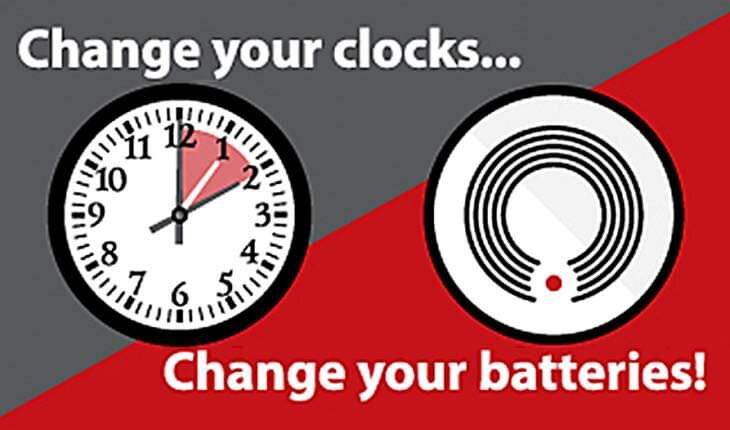
The Office of the State Fire Marshal (OSFM) reminds Illinoisans to test, check expirations dates and replace the batteries in their smoke alarms as daylight saving time ends this weekend and they turn their clocks back. In 2019, there were 91 residential fire deaths in Illinois, with most of those deaths occurring in homes without working smoke alarms.
“We recommend testing smoke alarms once a month, but the time change serves as a built-in reminder to test, inspect and replace nonoperational or expired smoke alarms, along with replacing batteries in smoke alarms. While you are changing the clocks in your homes, hit the test button on smoke alarms. Time is everything when it comes to escaping a home fire, and a working smoke alarm will increase your chances of escaping if a fire was to break out,” said Illinois State Fire Marshal Matt Perez.
The National Fire Protection Association (NFPA) reports between 2012-2016, almost three out of every five home fire deaths in the U.S. resulted from fires in homes with no smoke alarms or non-working smoke alarms. In fires in which the smoke alarms were present but did not operate, more than two of every five of the smoke alarms had missing or disconnected batteries. Dead batteries accounted for 25% of smoke alarm failures. In Illinois, 79% of smoke alarms being replaced aren’t working. By replacing alarms that have missing batteries or ones that are either expired or broken with new ten-year sealed detectors, this will help to reduce residential fire deaths across the state.
A 2017 Illinois law required ten-year sealed smoke alarms be installed in all homes built before 1988 or that do not have hardwired smoke detectors by January 1, 2023.
“The “Be Alarmed!” program is designed to help residents in Illinois comply with the new law, but it’s really aimed at creating fire-safe communities,” says Fire Marshal Perez. “Modern construction uses more synthetic material which means home burn faster and hotter. These fires emit toxic gases, burn hotter and faster, decreasing the time people have to escape. This makes the importance of having working smoke alarms in the home!”
"Be Alarmed!" is a fire safety education and smoke alarm installation program administered cooperatively between the Illinois Fire Safety Alliance (IFSA) and the Office of the Illinois State Fire Marshal (OSFM). This program provides ten-year, concealed battery smoke alarms to Illinois residents through their local fire departments and can aid with obtaining and installing these required alarms. Smoke alarms are required on every floor of the house and within 15 feet of every bedroom.
For more information on the “Be Alarmed!” program visit https://www.ifsa.org/programs/alarms.
WGH Board Approves Contract With Alliant
The Wabash General Hospital Board of Directors has approved a one year contract with Alliant Management Services of Louisville. But unlike previous Wabash General contracts with Alliant, the new agreement changes the parameters of the services from a management contract to a consulting agreement. The current contract with Alliant expires at the end of this week, and WGH President/CEO Karissa Turner said the one year deal will allow hospital officials to better gauge what scope of services they’ll require from Alliant. The board approved the new contract at their monthly meeting Monday afternoon.
Also at that meeting, the board approved spending just under $117,000 to buy five new defibrillators for the hospital and ambulance services. The new units will replace defibs that are 14 years old. The board also greenlighted spending up to $80,000 for surgical equipment to aid new ENT’s Dr. Mark Royer and Dr. Allison Royer who begin seeing patients next week. The instrument sets will allow the Royer’s to begin surgical procedures November 9th.