CONCEALED CARRY RECERTIFICATION COURSE TO BE OFFERED AT WVC OCTOBER 10

If you are interested in recertifying your Illinois Concealed Carry Permit, now is your opportunity to enroll in the IECC Concealed Carry Recertification course that provides the 3 hours of required training. This course is for any Illinois Concealed Carry permit holder that needs to take the recertification training.

Seven years ago, in the fall of 2013, Illinois Eastern Community Colleges started offering the Concealed Carry Program. The first students through the program must now take this recertification course to be recertified.

Training includes: Updates to the Law; Changes to the FOID Act and Unlawful Use of Weapons; Review of Handgun Fundamentals; Dry and Live Fire Drills.

Pre-registration is required. MUST have your Illinois Concealed Carry Permit to take the Recertification Class. The class will be offered from 8:00 – 11:00 a.m. on Saturday, October 10, at the Advanced Technology Building on West Third Street. Jay Carter is the instructor. To get registered, contact the Student Services Office: Wabash Valley College, Mt. Carmel, 866-982-4322. If you have questions concerning the program, contact the Concealed Carry Coordinator, D Ray Etzkorn, at 618-262-6346, and leave a message.

District #348 Moving To In Person Learning 4 Days A Week

Starting next week, Wabash District #348 will begin bringing all students back to a 4 day week. Near the conclusion of tonight’s school board meeting, District #348 Superintendent Dr. Chuck Bleyer made the announcement….

The district has been operating under a blended week with students split into two groups alternating between in-person learning and remote learning.

Statement from Wabash County Clerk Janet Will on Vote by Mail Letter sent by Secretary of State’s Office to Voters

Over the past few days, many Wabash County voters have received a letter from Secretary of State Jesse White’s office alerting them that they have not applied for a Vote by Mail ballot, and they should contact my office to complete their application.

These letters have been sent to voters throughout Illinois from the Secretary of State’s office.

The letters were part of the mandate of SB 1863, the election bill passed by the state legislature in May as a response to the COVID-19 pandemic. It requires election authorities, such as the Wabash County Clerk, to send a mail ballot application to every voter who has voted in any of the past three elections.

The law also stipulates that the Secretary of State shall send, by September 15, 2020, a notice to any voter in Illinois who received an application for a mail ballot but according to State Board of Elections records has not yet applied for a mail ballot.

However, the notices do not accurately reflect the current status of Vote by Mail applications my office has received from Wabash County voters.

Many voters who have applied for mail ballots, as well as voters who have no interest in voting by mail, have received these letters.

I assure those who have applied for mail ballots that my office has been processing your applications, and Vote by Mail ballots will be sent to Wabash County voters who have requested them beginning September 24th and should start arriving in homes the following week. And to those voters who do not want to vote by mail, I assure you that this is not part of any effort to pressure anyone into voting by mail.

In-person Early Voting and Election Day polling places will be available as always to any voters who prefer to utilize those options.

Wabash County Returns To COVID-19 Warning Level

SPRINGFIELD – The Illinois Department of Public Health (IDPH) today reported 24 counties in Illinois are considered to be at a warning level for novel coronavirus disease (COVID-19).  A county enters a warning level when two or more COVID-19 risk indicators that measure the amount of COVID-19 increase.

Twenty-four counties are currently reported at a warning level – Bond, Bureau, Cass, Clinton, Coles, Crawford, Cumberland, DeWitt, Edwards, Effingham, Greene, Jasper, Jo Daviess, Lawrence, Madison, Marion, Rock Island, St. Clair, Shelby, Washington, Wayne, Williamson, Wabash, and Union.

Although the reasons for counties reaching a warning level varies, some of the common factors for an increase in cases and outbreaks are associated with university and college parties as well as college sports teams, large gatherings and events, bars and clubs, weddings and funerals, long-term care facilities, correctional centers, manufacturing plants, schools, and cases among the community at large.  General transmission of the virus in the community is also increasing.

Public health officials are observing people not social distancing, gathering in large groups, and not using face coverings.  Some communities lack access to convenient testing before people become symptomatic.  In some counties, local law enforcement and states’ attorneys are not enforcing important mitigation measures like social distancing and the wearing of face coverings.  Additionally, some people refuse to participate in contact tracing and are not providing information on close contacts or answering the phone.

Several counties are taking swift action and implementing mitigation measures to help slow spread of the virus, including increasing testing opportunities, stressing the importance of testing to providers, hiring additional contact tracers, working with schools, meeting with local leaders, and educating businesses and large venues about the importance of mitigation measures.

IDPH uses numerous indicators when determining if a county is experiencing stable COVID-19 activity, or if there are warning signs of increased COVID-19 risk in the county.  A county is considered at the warning level when at least two of the following metrics triggers a warning.

  • New cases per 100,000 people.  If there are more than 50 new cases per 100,000 people in the county, this triggers a warning.

  • Number of deaths.  This metric indicates a warning when the weekly number of deaths increases more than 20% for two consecutive weeks.

  • Weekly test positivity.  This metric indicates a warning when the 7-day test positivity rate rises above 8%.

  • ICU availability.  If there are fewer than 20% of intensive care units available in the region, this triggers a warning.

  • Weekly emergency department visits.   This metric indicates a warning when the weekly percent of COVID-19-like-illness emergency department visits increase by more than 20% for two consecutive weeks.

  • Weekly hospital admissions.  A warning is triggered when the weekly number of hospital admissions for COVID-19-like-illness increases by more than 20% for two consecutive weeks.

  • Tests performed.  This metric is used to provide context and indicate if more testing is needed in the county.

  • Clusters. This metric looks at the percent of COVID-19 cases associated with clusters or outbreaks and is used to understand large increase in cases.

These metrics are intended to be used for local level awareness to help local leaders, businesses, local health departments, and the public make informed decisions about personal and family gatherings, as well as what activities they choose to do.  The metrics are updated weekly, from the Sunday-Saturday of the prior week.   

A map and information of each county’s status can be found on the IDPH website at https://www.dph.illinois.gov/countymetrics

Opinions Mixed On End Of Year Consumer Spending

Experts expect consumer spending to play a big role in how Illinois' economy recovers from the COVID-19 pandemic, but predicting how far consumers will open their wallets during the remainder of the year isn't as easy.

A survey by Chicago-based PowerReviews found spending, including for the holidays, could actually increase this year. Almost three-quarters of consumers said their overall holiday spending will either stay the same or increase this year, and 64% said they will spend more online than last year.

“Price will impact purchase decisions more than any other factor,” said Carol Krakowski, director of insights at PowerReviews. “Our survey shows around nine in ten consumers said it would have an influence.”

Director of Marketing Andrew Smith believes the pandemic and the government imposed shutdown of businesses did not allow people to spend their money as usual.

“There isn’t much to spend money on now,” he said. “If you are thinking about going to a restaurant or are you going to do a leisure activity, they are not really available.”

Some consumers will continue to go shopping at stores, about 30% said they were not concerned about visiting stores during the pandemic. In Illinois, the percentage was higher (74%).

Not everyone shares that optimism. Analyst Jill Gonzalez from the personal finance website WalletHub said spending will likely fall from last year.

“This year I think everyone should be expecting a different type of holiday and not only families and individuals, but businesses as well,” she said. “I think we are already expecting about a 40% drop.”

The July expiration of the additional pandemic federal unemployment benefits of $600 a week could be affecting spending in the third quarter. A paper from the National Bureau of Economic Research examined how cuts will affect 18 Illinois counties. Jobless workers in Illinois saw their average weekly benefit plunge from $812 to $257, according to the NBER paper. It said without the additional $600 benefit under the CARES Act, local consumer spending is expected to drop by an estimated 44%

BBB: Beware Of COVID-19 Scams

Social media users should be on alert for COVID-19 scams.

That’s the word from the Better Business Bureau, which is warning of Facebook and
Instagram accounts with fake promises of relief money.

“The Better Business Bureau has seen an increase in what we call ‘lookalike’ emails or
Instagram messages,” said Steve Bernas, president and CEO of the BBB of Chicago and
Northern Illinois. “You think it's your friend when actually it's not.”

Bernas says these offers can be very tough to sniff out, as the scammer will steal photos
and personal information to make it appear that a trusted source on Facebook or
Instagram is giving you the information.

“Basically the message looks like it's coming from a friend or a community member or
other person you know,” Bernas said. “It’s basically telling you that you have a grant for
COVID-19 relief and your friend may claim to have already applied and received
thousands of dollars already, so this is a no-brainer for you.”

The agency reports the message might follow a friend request from someone you already
are friends with on the platform.

According to the BBB, scammers often will ask for money upfront to process the
COVID grants, which should be a big warning sign.

“We say the ‘tip-off to the rip off’ is that you don't need to spend money to get money
from the government,” Bernas said. “Nobody has secret inside information. If
somebody's [telling] you there's this great COVID relief money, or they know how to
find it faster or can get you more … the Better Business Bureau suggests you do not click
on those links.”

While phone scams still are prevalent, the BBB is reporting more and more activity
happening online.

“The scammer always goes where the money's at, and they're seeing that there are a lot of
consumers on their social media sites and therefore they want to go where the people are
at and try to take advantage of it,” Bernas said.

If you think you’re being scammed, Bernas says you should report the suspicious
accounts and messages to Facebook and Instagram. He also encourages a report to be
filed on the agency’s website.

“The only way to put scams out of business is not to give me your business,” Bernas said.
“The Better Business Bureau suggests before you buy or hire or use somebody’s services
or click on an email to check with the Better Business Bureau first. Also, check our scam tracker to prevent this from happening to you or falling victim to these types of scams.”

Information is available at BBB.org.

Man Arrested After Showing Deputy His Pot Patch

On Sept. 15th, 2020 at 2:15 a.m. the Wabash County Sheriff's Office received a 911 call reference people being inside someones home. The deputy responded to the residence on E 840 Rd. and spoke to the homeowner. The homeowner described what had been taking place the last couple of months as harassment and people trying to spy on him. The homeowner believed it to be Federal or local authorities quite possibly the CIA but didn't rule out local radio stations either. The male believed "they" have been spying on him with the use of drones. 

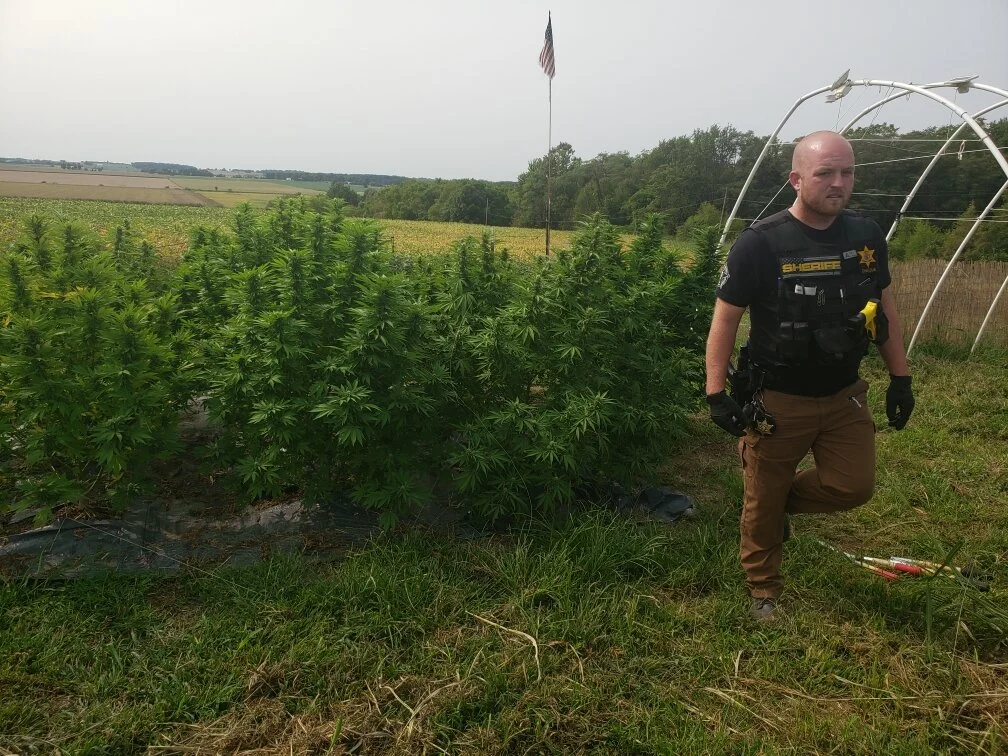
As the conversation continued between the resident and the deputy the resident advised he had a hobby grow in the back yard and someone had stolen two cannabis plants from him. he deputy asked to see the hobby grow and the gentleman showed him to the area. The area of the hobby grow was secured with electric fence with additional fencing strewn through the grow itself. 

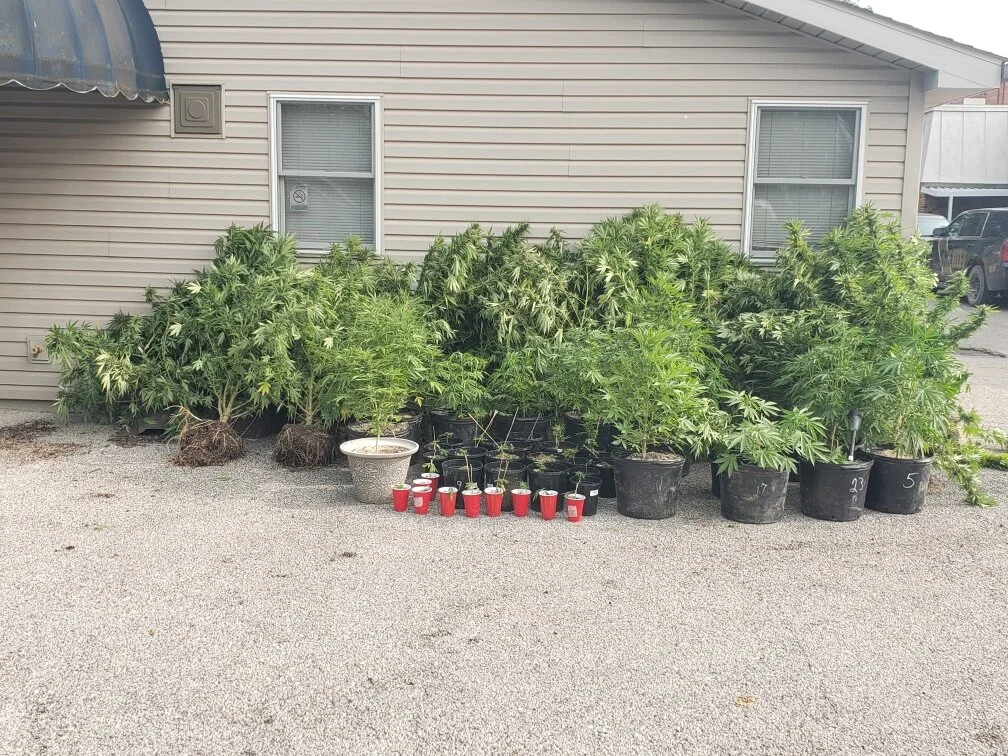
At 2:44 p.m. the Sheriff's Office executed a search warrant at the location on E 840 Rd. in rural Wabash County. Following the service of the warrant a total of 65 cannabis plants in various stages were seized. 38 year old Jordan L. Sayge of Mt. Carmel was taken into custody without incident. Sayge was taken to the Wabash County Jail where he was charged with Possession of more than 50 but less than 200 Cannabis Sativa Plants. Possession of more than 50 plants in Illinois is a Class 2 Felony offense. 

Sayge's bond was set on 09.16.20 in Wabash County Court at $20,000/$2,000 cash but was reduced the same day to $3000/$300 cash. Sayge posted bond and was released. 

Sayge,Jordan L 091520.jpg
Resized_20200915_150430.jpeg
Resized_20200915_155624.jpeg

District #348 Receives $21,248 DOJ Grant

WASHINGTON – Congressman John Shimkus (R, Illinois-15) is congratulating two local school districts for securing grants to improve school safety from the Department of Justice’s Office of Community Oriented Policing Services (COPS Office) School Violence Prevention Program.  Johnson County’s Vienna High School District is receiving $375,000, and Wabash CUSD #348 has $21,248 headed its way.

The School Violence Prevention Program provides up to 75% funding for safety measures in and around primary and secondary schools and school grounds.

"These are competitive grants, and 502 applications were received,” Shimkus noted.  “The submissions from Vienna and Wabash were two of only 160 that were approved.  It is quite an achievement, and I salute those who worked on them."

Applicants were required to submit a project description and a budget narrative.  The description addressed current school safety and planning efforts, the funding request and its integration, an implementation plan and its management, plus a sustainability plan.  The budget narrative detailed how the requested items would be used in implementing the proposed project.

In a related move, the COPS Office School Safety Working Group, which includes representatives from eight national law enforcement organizations, has published Ten Essential Actions to Improve School Safety, which can be accessed by anyone online

2018 Skeletal Remains Officially Identified As Marcus W. Adams

Nearly two years after human remains were found in a field north of Mt. Carmel, the identity of the victim has been released. Today, the Wabash County Coroner’s Office issued a statement identifying the remains as 29 year old Marcus W. Adams of Mount Carmel. Previously, Coroner Shaun Keepes said an  autopsy conducted on the skeletal remains did not reveal a definitive cause of death.  Further examinations were planned by a Forensic Anthropologist and a Forensic Odontologist to help determine the cause of death.

Master Sergeant Gwendolyn Basinger of ISP’s Department of Criminal Investigations based in Carmi told us late last year that the investigation is being handled by her office and she was “unable to comment on an active and open investigation”. If you have any information regarding the case, you’re asked to contact the State Police.

The body was found near Asbury Chapel just north of the city limits

IECC Trustees Approve $30.2 Million Budget

            The Board of Trustees of Illinois Eastern Community College District No. 529 adopted an operating fund budget of $30,215,713 for fiscal year July 1, 2020 to June 30, 2021, at the regular meeting Tuesday, September 15th at Wabash Valley College.  The budget was adopted following a public hearing. The budget includes $26,462,914 in the Education Fund and $3,752,799 in the Operations and Maintenance Fund.  These are the two principal operating funds of the IECC district. 

            The 2020 IECC Fact Book containing basic information about the community college district was adopted.  The book gathers information from various sources into one central document regarding students, enrollment history, degrees and certificates granted, financial aid received and distributed, and the district’s annual budgets and operation.

            A hearing on the of intent to issue Funding Bonds in the amount not to exceed $2,500,000 was held.

            In a continual effort to best serve the students of the IECC District, the Board of Trustees is addressing and adjusting issues to safely respond to the COVID19 Pandemic.  The Board accepted the IECC Return to Play document which provides specific guidelines in response to the COVID19 Pandemic for the District’s athletic programs for Fall 2020 and Spring 2021.  The Board approved a Memorandum of Agreement with the District’s Faculty Bargaining Unit for Academic Year 2020-2021 for adjustments in office hours to more safely accommodate students.  

            Employee health and dental insurance rates were approved for the 2021 calendar year.

Trustees approved a Health Savings Account contribution of $1,000 for each eligible employee who is enrolled in the District’s Qualified High Deductible Health Plan for calendar year 2021.  

Revisions were approved to bring the withdrawal policy and the grading section in the IECC Catalog into agreement with previously Board approved adjustments. 

 Approval was given for a lease between IECC and MRM3 LLC for the Wabash Valley College Cafeteria. 

            Trustees approved a bid for projects to be completed at the LTC Performing Arts Building.   The Bid Committee approved the amount of $853,800 for L.J. Swingler & Sons, Inc. of Teutopolis, Illinois. 

Affiliation Agreements were approved with area health care facilities for the IECC Nursing Program and for FCC’s Emergency Response Training Program.

            The Board approved the employment of Diana Dietrich as Bookkeeper at the District Office, effective September 28, 2020.    

              A resignation was accepted from Jennifer Stroughmatt as Retention Coordinator at Wabash Valley College, effective September 13, 2020. 

              Two retirements were accepted from Julie Higginbotham, Assistant Dean of Student Services at Lincoln Trail College, effective January 1, 2021 and from Jeanette (Jan) Wiles, Assistant Dean of Student Services at Frontier Community College, effective January 1, 2021.

Next regular meeting of the Board of Trustees will be Tuesday, October 20, at 7:00 p.m. at  Frontier Community College, Fairfield, Illinois.