Traffic stop leads to arrest of Evansville woman on DUI and drug charges

On August 26, 2020, at 10:08 p.m. a Gray Chrysler vehicle was pulled over on US 41 near County Road 1025 South after Gibson County Deputy Bryce Jutzi observed the vehicle make several unsafe lane movements. Upon approaching the vehicle Deputy Jutzi detected the odor of burnt Marijuana coming from inside the vehicle and summoned Deputy U.B. Smith to the scene to begin a roadside investigation. While speaking with the driver 50-year-old Tina Brinson of Evansville he believed she may be intoxicated. At that point Deputy Smith began a DUI investigation. At the conclusion of the roadside investigation Ms. Brinson was taken into custody and transported to the Gibson County Jail. Upon arriving Ms. Brinson was charged with Operating a Vehicle While Intoxicated, Possession of Marijuana, and Possession of Paraphernalia. She has since posted a $550 bond.

All Criminal defendants are to be presumed innocent until, and unless proven guilty beyond a reasonable doubt in a court of law.

user32637-1598709137-media1.jpg

Elberfeld man arrested for driving on a suspended license

On August 26, 2020, at 4:13 p.m. Gibson County Deputy Garrett Tuley conducted a traffic stop on a Grey 2006 Pontiac G6 at the Huck’s Convenience Store located on SR 168 and US 41. Upon approaching the vehicle he identified he driver as 55-year-old Dondi Wagner of Elberfeld. During a roadside investigation Deputy Tuley ran Mr. Wagner through the Indiana Bureau of Motor Vehicles and discovered that Mr. Wagner’s operator’s license was suspended on a prior Driving While Suspended charge. At that point Deputy Tuley placed Mr. Wagner into custody and transported him to the Gibson County Jail. Upon arriving at the Jail Mr. Wagner was charged with Driving While Suspended/Prior. He has since posted a $650 bond.

All Criminal defendants are to be presumed innocent until, and unless proven guilty beyond a reasonable doubt in a court of law.

Obit Pic1.jpg

Uptick In Illinois Jobless Claims

After weeks of declines, initial unemployment claims increased by nearly 3,000 filers, going against national trends. 

Earlier this week, Gov. J.B. Pritzker said the administration was working on setting up additional benefits for unemployment, but he didn’t say when that would be completed.

“It takes a lot of set up on an internal basis for us to move forward with that so that’s what we’ve been doing,” Pritzker said at an event announcing more COVID-19 business restrictions in Will County Tuesday.

Multiple messages were not returned seeking information from the Pritzker administration about how much unemployment has been paid, to how many people, and how much the state has borrowed so far this calendar year to cover the costs.

State Rep. Stephanie Kifowit, D-Oswego, said lawmakers will get answers, just not through in a public hearing.

“I don’t think it would be conducive to have public hearings when we’re having bicameral, bipartisan working groups and commissions meeting at this point in time to try and get to the bottom of the situation,” Kifowit said.

The increase comes as some regions of the state have struggled to keep COVID-19 positivity rates below the governor's thresholds. Regions that surpass those levels face additional restrictions, such as business capacity limits. Last week, Pritzker put new restrictions in place for the Metro East region. He ordered the restaurants and bars in Will and Kankakee Counties close for indoor service this week.

Around 25,000 new unemployment claims were filed in Illinois last week. That’s 3,000 more than were filed the week before. It comes after weekly declines of new filings from Illinois’ peak during the first stretch of Pritzker’s stay-at-home order. For the week ending April 4, the U.S. Department of Labor reported 200,940 people in Illinois filed for unemployment benefits.
Lawmakers from both parties say problems with unemployment benefits are among the top calls they get from constituents.

Earlier this month state Sen. Chapin Rose, R-Mahomet, demanded the governor open up IDES offices to work through the backlog. The unemployment offices have been closed since March.

“Put the Plexiglas screens up, put a tent up and do it outside, I don’t care,” Rose said. “It’s time to help these people.”

Last week he got nine other state Senators to sign on to a letter to that effect.
Kifowit opposed that idea.

“I think that right now if the job can be done without the offices being open, I think that’s the best avenue,” Kifowit said. “Next week we’re going to hear from IDES and that question is going to be presented and discussed.”

Instead of calling for a public hearing of the committee she controls, Kifowit expects to discuss the issues during a closed working group of lawmakers and administration officials in the Restore Illinois Collaborative Commission.

The Illinois Department of Employment Security reported Thursday for the month of July in all metro areas unemployment rates increased and jobs decreased.

“As the state continues to monitor the safety of economic reopening, IDES is committed to continuing to help those who need services,” IDES Acting Director Kristin Richards said. “With the support of the Pritzker administration, the Department is prepared to support working families who continue to be affected by this pandemic.”

IDES reported nearly 500,000 fewer jobs in Illinois in July from the year before.

Effingham And Coles Counties Battle Spike In COVID-19 Cases

Health officials in rural parts of Illinois are sounding the alarm as COVID-19 infections increase.

Numerous counties have been put on a warning list by the Department of Public Health, including many in smaller nonmetropolitan areas. 

Illinois Department of Public Health Director Dr. Ngozi Ezike said last week that while the positivity rate for the nation as a whole declined over the past 4 weeks, it had increased in Illinois for that period. 

“We are going in the wrong direction,” Ezike said.

One county that is seeing a spike in cases is Effingham County. Deena Mosbarger, the public information officer for the health department, said the positivity rate there is up more than 8 percent.

“We have been having a significant number of positive cases over the last several weeks mainly due to large groups that are gathering without adhering to the precautions,” she said.

Mosbarger said she has noticed more people wearing masks as a result.

As of Thursday, hospitals in Effingham County had the capacity to handle additional patients. A spokesman for HSHS St. Anthony’s Memorial Hospital in Effingham said officials were monitoring the situation.

“We are continuously evaluating how to best align our staff and supply resources with the evolving patient demand," Dr. Ryan Jennings, chief medical officer of HSHS St. Anthony’s Memorial Hospital in Effingham, said in a statement. "Since this pandemic began, we have been assessing the situation at all of our sites in the local community to ensure we can meet patient needs across our collective service areas, and we are closely coordinating with public health officials. Our COVID-19 positive patients make up only a small percentage of our overall ICU capacity.”

Another county that has reported a spike in cases is Coles County. With a population of about 53,000, the county has had more than 800 COVID-19 cases and its recent rate of new cases outpaced Cook County by a margin of three-to-one.

Susan Jenkins, a co-chair of the citizen action group Cole’s Progressives, said local residents were not taking the virus seriously.

“People are not abiding by IDPH guidelines,” she said. “The county and the city do not feel the need to enforce those guidelines.”

Other rural counties that have reported an increase in COVID-19 cases include Jefferson, Cass, Clay and Henderson, Greene, Union, Moultrie and White counties.

30 Illinois Counties at Warning Level for Coronavirus Disease

SPRINGFIELD – The Illinois Department of Public Health (IDPH) today reported 30 counties in Illinois are considered to be at a warning level for novel coronavirus disease (COVID-19).  A county enters a warning level when two or more COVID-19 risk indicators that measure the amount of COVID-19 increase.

Thirty counties are currently reported at a warning level – Bureau, Carroll, Cass, Clinton, Cook,  Cumberland, Effingham, Fayette, Greene, Grundy, Henderson, Henry, Jasper, Jersey, Jo Daviess, Johnson, Madison, Monroe, Morgan, Perry, Pike, Randolph, Sangamon, Shelby, St. Clair, Union, Warren, White, Will, and Williamson.

Although the reasons for counties reaching a warning level varies, some of the common factors for an increase in cases and outbreaks are associated with weddings, large gatherings, long-term care facilities and other congregate settings, travel to neighboring states, bars, and spread among members of the same household who are not isolating at home.  Cases connected to schools are beginning to be reported.  General transmission of the virus in the community is also increasing.

Public health officials are observing people not social distancing, gathering in large groups, and not using face coverings.  In some counties, local law enforcement and states’ attorneys are not enforcing important mitigation measures like social distancing and the wearing of face coverings.

Several counties are taking swift action and implementing mitigation measures to help slow spread of the virus, including increasing testing opportunities, working with schools, meeting with local leaders, and educating businesses and large venues about the importance of mitigation measures.

IDPH uses numerous indicators when determining if a county is experiencing stable COVID-19 activity, or if there are warning signs of increased COVID-19 risk in the county.  A county is considered at the warning level when at least two of the following metrics triggers a warning.

  • New cases per 100,000 people.  If there are more than 50 new cases per 100,000 people in the county, this triggers a warning.

  • Number of deaths.  This metric indicates a warning when the weekly number of deaths increases more than 20% for two consecutive weeks.

  • Weekly test positivity.  This metric indicates a warning when the 7-day test positivity rate rises above 8%.

  • ICU availability.  If there are fewer than 20% of intensive care units available in the region, this triggers a warning.

  • Weekly emergency department visits.   This metric indicates a warning when the weekly percent of COVID-19-like-illness emergency department visits increase by more than 20% for two consecutive weeks.

  • Weekly hospital admissions.  A warning is triggered when the weekly number of hospital admissions for COVID-19-like-illness increases by more than 20% for two consecutive weeks.

  • Tests perform.  This metric is used to provide context and indicate if more testing is needed in the county.

  • Clusters. This metric looks at the percent of COVID-19 cases associated with clusters or outbreaks and is used to understand large increase in cases.

These metrics are intended to be used for local level awareness to help local leaders, businesses, local health departments, and the public make informed decisions about personal and family gatherings, as well as what activities they choose to do.  The metrics are updated weekly, from the Sunday-Saturday of the prior week.   

A map and information of each county’s status can be found on the IDPH website at https://www.dph.illinois.gov/countymetrics

WGH Chief Of Staff: Spike In Local COVID-19 Cases Expected To Continue

August has seen positive COVID-19 cases more than triple in Wabash County. When the month began, there were 30 positive cases. Now the number has spiked to 102. Wabash General Hospital chief of staff Dr. Levi McDaniel told the WGH board of directors Monday that he doesn’t expect the local cases to tail off any time soon… 

While many people may be alarmed at the spike in Wabash County cases, McDaniel did offer some reassurance… 

McDaniel said some may feel it’s a death sentence if they’re hospitalized with COVID-19, but that’s not the case as he has had patients hospitalized who fully recovered. 

City Council Expresses No Interest In Shrub Ordinance

The City of Mt. Carmel has an ordinance regulating tall grass at residences and businesses. Should the city add an ordinance regulating the way shrubbery looks too? The issue was brought up at Monday’s City Council meeting by City Clerk Rudy Witsman who said he was contacted by a resident in the North Park subdivision outlining a series of concerns and complaints. One of those issues is the appearance of shrubbery and landscaping of residences. Commissioners were unanimous in their opposition to the idea led by Mayor Joe Judge….


Another of the issues was installing more 20 mile an hour speed limit signs on North and South Drives and seeking the neighborhood streets to be asphalted. Witsman said while the city can’t afford to undertake the asphalting project, North Park residents could decide to add a special assessment to property taxes that would go into repaving the streets. Witsman said more information is being gathered on how a special assessment might work and how much money would be needed to repave the streets.

Mt. Carmel Man Arrested After Allegedly Strangling Girlfriend

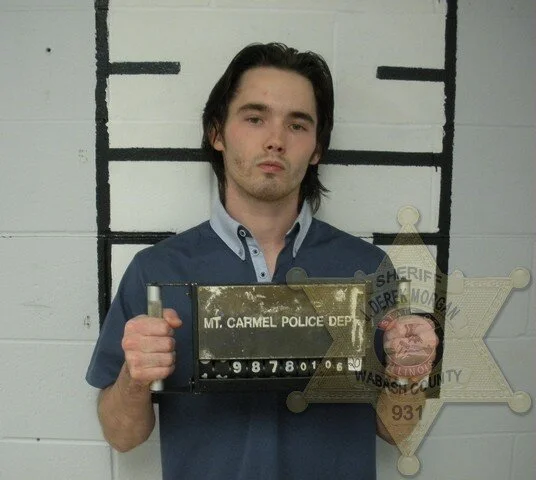
On 8/25/2020, Mt. Carmel Police arrested Anakin T. Schieve, age 21, of Mt. Carmel, for Aggravated Domestic Battery following a domestic dispute at a residence on Lambert Drive. Once officers investigated the complaint, they found evidence to indicate Schieve had battered and strangled his girlfriend during the dispute. Schieve was placed under arrest at this time and transported to the Wabash County Jail. Schieve was issued the above charge as well as a Wabash County Warrant for Failure to Appear. Schieve was held pending a bond setting by a judge.

PHOTO: Wabash County Sheriff’s Department

PHOTO: Wabash County Sheriff’s Department