Owensville Man Charged After Car Flips Onto Golf Course Fairway

On Tuesday afternoon at approximately 5:43 pm, Mt. Carmel Police and Fire responded to a vehicle accident in the 2600 block of College Drive.  Police arrived on the scene and located a 1998 Dodge Neon, on its roof, and in the fairway of the West Berwick Golf Course.  The vehicle had left the roadway and went through a utility pole, causing a power outage.   

Police identified the driver as Michael E. Arbeiter, age 23, of Owensville, Indiana.  Arbeiter informed the investigating officer the vehicle “jumped” as it crossed Dee Hill.  Arbeiter and his passenger reported minor injuries and were treated by WGH EMS. 

Police located an open bottle of alcohol in the vehicle.  Police conducted field sobriety on the driver but determined that speed and not impairment was likely the cause of the crash.  Arbeiter received a citation for illegal transportation of alcohol and was released. 

Pritzker Announces Restore Illinois: A Public Health Approach To Safely Reopen State

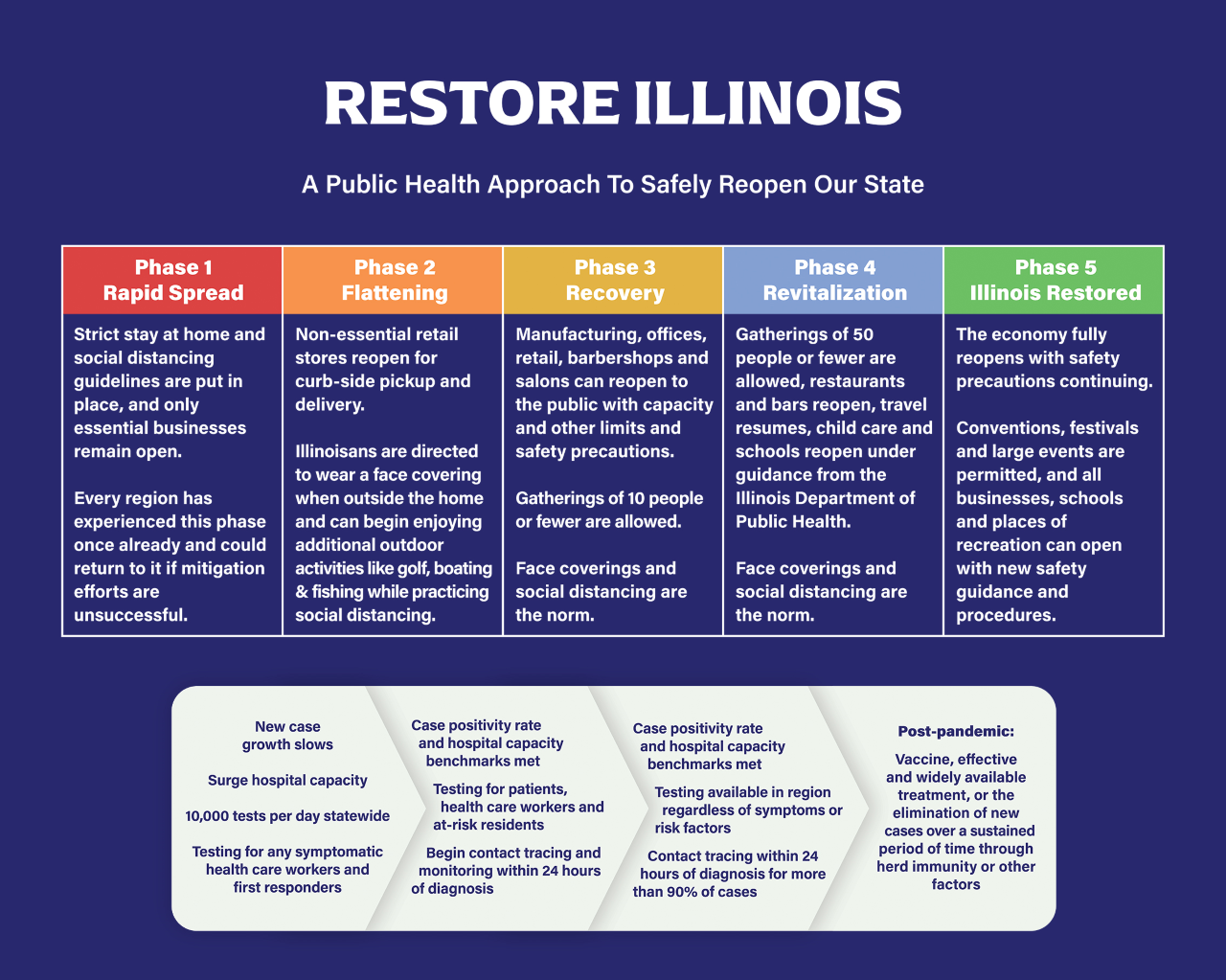
Chicago – Building on data, science, and guidance from public health experts and after consulting with stakeholders across the state, Governor JB Pritzker announced Restore Illinois, a five-phase plan focused on saving lives, livelihood, and safely reopening Illinois.

“"We have to figure out how to live with COVID-19 until it can be vanquished – and to do so in a way that best supports our residents’ health and our healthcare systems, and saves the most lives," said Governor JB Pritzker. "Restore Illinois is a public health plan to safely reintroduce the parts of our lives that have been put on hold in our fight against COVID-19. This is also a data-driven plan that operates on a region-by-region basis, a recognition that reality on the ground looks different in different areas of our state."

The five-phase plan is guided by public health metrics designed to provide a framework for reopening businesses, education, and recreational activities in each phase. This initial plan can and will be updated as research and science develop and as the potential for effective treatments or vaccines is realized.

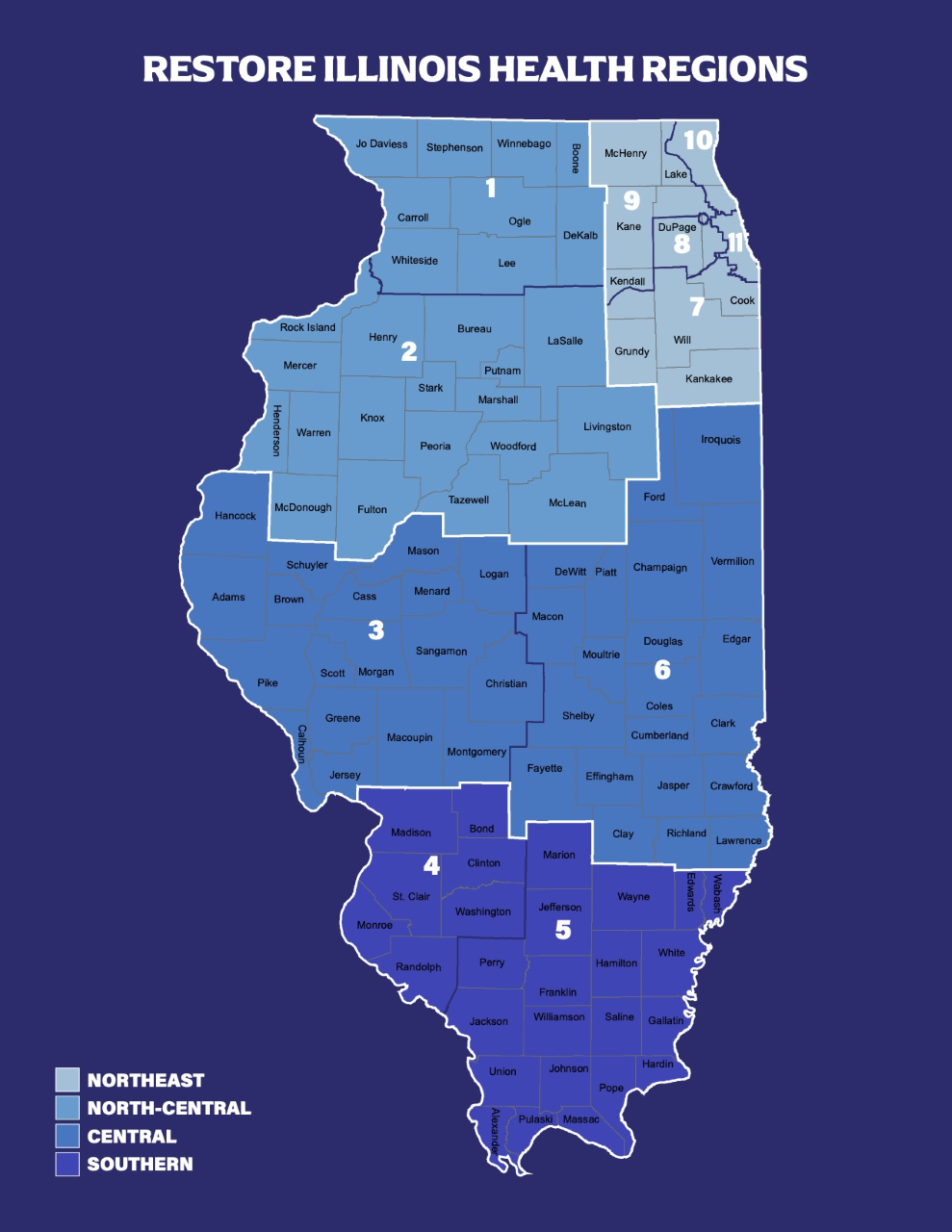
The five-phase plan is based on regional healthcare availability and recognizes the distinct impact COVID-19 has had on different regions of our state as well as regional variations in hospital capacity. The Illinois Department of Public Health (IDPH) has 11 Emergency Medical Services Regions that have traditionally guided its statewide public health work. For the purposes of Restore Illinois, from those 11, four health regions are established, each with the ability to independently move through a phased approach: Northeast Illinois; North-Central Illinois; Central Illinois; and Southern Illinois.

1.png

The five phases of reopening for each health region are as follows:

Phase 1 – Rapid Spread: The rate of infection among those tested and the number of patients admitted to the hospital is high or rapidly increasing. Strict stay at home and social distancing guidelines are put in place and only essential businesses remain open. Every region has experienced this phase once already and could return to it if mitigation efforts are unsuccessful.

Phase 2 – Flattening: The rate of infection among those tested and the number of patients admitted to the hospital beds and ICU beds increases at an ever slower rate, moving toward a flat and even a downward trajectory. Non-essential retail stores reopen for curb-side pickup and delivery. Illinoisans are directed to wear a face covering when outside the home, and can begin enjoying additional outdoor activities like golf, boating and fishing while practicing social distancing. To varying degrees, every region is experiencing flattening as of early May.

Phase 3 – Recovery: The rate of infection among those tested, the number of patients admitted to the hospital, and the number of patients needing ICU beds is stable or declining. Manufacturing, offices, retail, barbershops and salons can reopen to the public with capacity and other limits and safety precautions. All gatherings limited to 10 or fewer people are allowed. Face coverings and social distancing are the norm.

Phase 4 – Revitalization: The rate of infection among those tested and the number of patients admitted to the hospital continues to decline. All gatherings of up to 50 people are allowed, restaurants and bars reopen, travel resumes, child care and schools reopen under guidance from the IDPH. Face coverings and social distancing are the norm.

Phase 5 – Illinois Restored: With a vaccine or highly effective treatment widely available or the elimination of any new cases over a sustained period, the economy fully reopens with safety precautions continuing. Conventions, festivals and large events are permitted, and all businesses, schools, and places of recreation can open with new safety guidance and procedures in place reflecting the lessons learned during the COVID-19 pandemic.

Until COVID-19 is defeated, Restore Illinois recognizes that as health metrics tell us it is safe to move forward, health metrics may also tell us to return to a prior phase. With a vaccine or treatment not yet available, IDPH will be closely monitoring key metrics to immediately identify new growth in cases and hospitalizations to determine whether a return to a prior phase is needed.

As millions of Illinoisans continue working together by staying at home and following experts’ recommendations, the result has been a lower infection rate, lower hospitalizations, and lower number of fatalities than without these measures. As the state’s curve begins to flatten, the risk of spread remains, and modeling and data point to a rapid surge in new cases if all mitigation measures are immediately lifted. The governor and his administration continue to urge all Illinois residents to follow the state’s stay at home order and to follow the guidance issued by the state and public health experts.

2.png

IL Public Health Officials Announce 2,122 New Cases of Coronavirus

SPRINGFIELD – The Illinois Department of Public Health (IDPH) today announced 2,122 new cases of coronavirus disease (COVID-19) in Illinois, including 176 additional deaths.

  • Bureau County: 1 male 90s

  • Clinton County: 2 female 80s

  • Cook County: 1 female 30s, 1 female 40s, 4 males 40s, 3 females 50s, 6 males 50s, 8 females 60s, 20 males 60s, 5 females 70s, 17 males 70s, 18 females 80s, 15 males 80s, 11 females 90s, 8 males 90s

  • DuPage County: 2 males 50s, 2 males 60s, 2 males 70s, 2 females 80s, 1 male 80s, 4 females 90s

  • Kane County: 1 male 40s, 2 males 50s, 1 female 60s, 1 male 60s, 1 female 70s, 1 female 90s, 1 male 90s

  • Kankakee County: 1 female 90s

  • Kendall County: 3 females 80s

  • Lake County: 1 male 40s, 1 male 90s

  • Macoupin County: 1 female 40s

  • Madison County: 1 female 80s

  • McDonough County: 1 female 90s

  • McHenry County: 2 females 90s

  • Randolph County: 1 male 60s

  • Rock Island County: 1 female 50s, 1 male 60s, 1 male 90s

  • Sangamon County: 1 female 70s, 1 female 80s, 1 female 90s

  • St. Clair County: 1 male 60s, 2 males 70s, 2 females 80s, 1 male 80s

  • Union County: 1 male 80s

  • Will County: 2 females 70s, 3 females 80s, 5 females 90s

Currently, IDPH is reporting a total of 65,962 cases, including 2,838 deaths, in 97 counties in Illinois. The age of cases ranges from younger than one to older than 100 years. Within the past 24 hours, laboratories have processed 13,139 specimens for a total of 346,286.

*All data are provisional and will change. In order to rapidly report COVID-19 information to the public, data are being reported in real-time. Information is constantly being entered into an electronic system and the number of cases and deaths can change as additional information is gathered.  For health questions about COVID-19, call the hotline at 1-800-889-3931 or email dph.sick@illinois.gov.

City To Submit Regional Reopening Paperwork

Mt. Carmel Mayor Joe Judge is still hopeful that Illinois Governor JB Pritzker will relax his statewide stay at home order and allow some regions of the state to reopen before it expires May 30th. Judge said he participated in a conference call Sunday night in which Chicago Mayor Lori Lightfoot expressed her belief that regionalized reopening will in fact occur. He said state officials have requested Mt. Carmel and other southern Illinois communities form a reopening task force…

At his press briefing last Friday, Pritzker said he was open to the idea of regional reopening in areas that have seen low numbers of COVID-19 cases, such as Wabash, where only 1 positive case has been reported. 

State Lawmakers Split On Federal Bailout Or Reopening Illinois As Best Path For Budget

Some state lawmakers are hoping for a federal bailout to help balance the state's budget while others want to reopen the economy to limit losses.

State Rep. Kelly Cassidy, D-Chicago, said Friday she expects significant revenue shortfalls based on initial projections.

“People aren’t shopping, people aren’t working, those sources of state revenue are drying up,” she said.

Cassidy said some projections put the budget deficit at more than $7 billion. She said budgeteers will look at two scenarios: One with a graduated income tax up for voters to decide this november and a spending plan without a graduated income tax.

The state’s comptroller recently reported Illinois’ unfunded liabilities reached $197 billion for the fiscal year that ended last summer. With the cash crunch from the pandemic, state Sen. Heather Steans, D-Chicago, said the outlook is bleak.

“And we just came out of the [former Gov. Bruce] Rauner years where we had budget impasses and huge problems,” Steans said. “This well surpasses the challenges we had during that period.”

It’s unclear if Congress will provide states with additional funding unrelated to COVID-19 costs. Illinois Senate Democrats requested more than $40 billion to help cover things such as state and local pensions.

Gov. J.B. Pritzker said he supports seeking more federal funds to plug state and local government budget shortfalls.

“And it looks like there is real support on the Republican side [of Congress] and near unanimous support on the Democratic side for support for the states, and I would say near unanimous support by governors for support for states,” Pritzker said.

State Rep. Dan Caulkins, R-Decatur, said he can’t imagine taxpayers in other states would want to “bail out the crooks and the criminals and the misspending.”

“First of all it’s an insult to the people that have already fled Illinois to make them think that they have to come back here with their tax money and pay for the problems that they fled from,” he said.

Caulkins said the answer is to reopen and grow the state’s economy.

State Rep. Blain Wilhour, R-Beecher City, said there is an easy solution to the state’s revenue problems: Open the state’s economy back up.

“We weren’t in a good situation before, we’re in a terrible situation now and the governor needs to realize that,” Wilhour said.

Pritzker has said he wants to open the economy up, but says he’s relying on scientific advice from health experts to open up safely.

Governor Discouraging Illinois Residents From Going To Neighboring States

As neighboring states begin to loosen restrictions for businesses while Illinois remains under a modified stay-at-home order, Gov. J.B. Pritzker said he can't stop them, although he said he would discourage the practice to limit the spread of COVID-19.

Indiana, Iowa and Missouri have all begun to open up their economies, while only a couple cities and counties in Illinois are considering doing the same.

During his daily briefing on Monday, Pritzker said there isn’t much he can do about Illinoisans going over the border to spend their money.

“I think to the extent that people are not social distancing and accessing services in which Indiana may have decided that they want to open those things up, understand there are risks associated with that and I would discourage people from doing it,” the governor said.

Police across the state are fielding more calls regarding large gatherings. Chicago police reported more 1,000 dispersal calls over the weekend. The governor was asked if citations should be handed out in such cases.

“That is not something I prefer, but as I said, if people are constantly defiant, I do believe local law enforcement needs to step in,” Pritzker said.

The Illinois Department of Public Health reported 2,341 new cases of COVID-19 and 46 additional deaths, the lowest single-day death total since April 19. 

$1 A Month Child Care For Essential Workers In Illinois

Parents with essential jobs can get subsidized daycare for $1 a month – if they can find a center with an opening. 

Effective April 1, all essential workers in health care, human services, government services and infrastructure qualify for Illinois' Child Care Assistance Program. 

During April and May, essential workers who fill out the paperwork and qualify will pay $1 a month for daycare. 

Eligible workers include hospital staff, grocery store clerks, food producers, police and firefighters.

“They are heroically going out to do their jobs, which are vital for public safety," Gov. J.B. Pritzker said in a statement. “Our essential workforce deserves to know their kids are safe and cared for in a small and affordable group setting.”

Julie Reich is the director at the Calvary Church daycare in Springfield. Her center is one of four Springfield-based daycare centers that are open – operating under special emergency waivers. 

“There isn’t enough daycare. There really isn’t,” Reich said. 

Calvary has a waiting list for openings, she said. 

Special operating regulations mean that Calvary had to reduce the number of children that can enroll. Even though Calvary has fewer participants, Reich has had to add more staff. She is rotating workers throughout the week to make sure that they can rest up and stay healthy. 

Reich said she remains upbeat and energetic – even at the end of a long day.

“If you aren’t perky in this job, you shouldn’t be doing it,” she joked. 

Reich said she is aware of the risks while remaining open during the pandemic. The parents of her charges come in contact with the virus at their jobs. 

Parents and children who come to the door have their temperatures taken with forehead thermometers before they can come inside. No more than 10 children are allowed in a room. The children along with two or three staff members stay together in their assigned room all day, to reduce health risks.  

Cleanliness is always important in a daycare, but coronavirus has upped Calvary's cleaning routine, Reich said. Staff members go through a lot of bleach. They wipe down all the walls every night after the children go home. 

Calvary is a “church first” daycare, Reich said. “We have some amazing families. They are just really grateful to know that their children are safe.”

Details and applications for assistance are available on the Department of Human Services website DHS.illinois.gov/helpishere and coronavirus.illinois.gov.